Plastic Shredding and Moulding
Akshay Talekar1, Nikhil Kachare2, Shubham Tathod3, Shailesh Sharma4, Prof. R. S. Thombare5
1, 2, 3, 4
Student ,5Professor, Department Of Mechanical Engineering, Dr. D. Y. Patil School Of Engineering & Technology, lohegaon , Pune, India-412105
Abstract: The use of plastic is increased now days in many industries like automobile, packaging, medical, etc. The reason behind this is that the plastic made things are quiet easier to manufacture, handle and reliable to use. This project is about developing cost effective shredding and moulding of plastics machine. This project ensures that all shredded plastics waste is recycled. The project is compact and very easy to handle. The focus is maintained on reducing pollution due to plastics. So in this paper we are presenting different type of recycling the plastic by pneumatic method.
Keywords: Injection moulding, plastic moulding, Shredding machine, pneumatic injection cylinder.
I. INTRODUCTION
Today most used material is considered as plastic. Plastics are in five categories i.e. Polyethylene terephthalate (PET), High density polyethylene (HDPE), Polyvinylchloride (PVC), Polypropylene (PP) and Low density polyethylene (LDPE).Today the wastes are generally of about plastic materials. These plastics wastes create lot of problems as they are non degradable. So this machine is developed to treat the plastic wastes. The plastic waste needs to be produced into a desired shape which is why we need a mechanical crusher. This crusher will crush the plastic into smaller pieces or in the form of pellets. The plastic waste is being crushed for easy disposal.
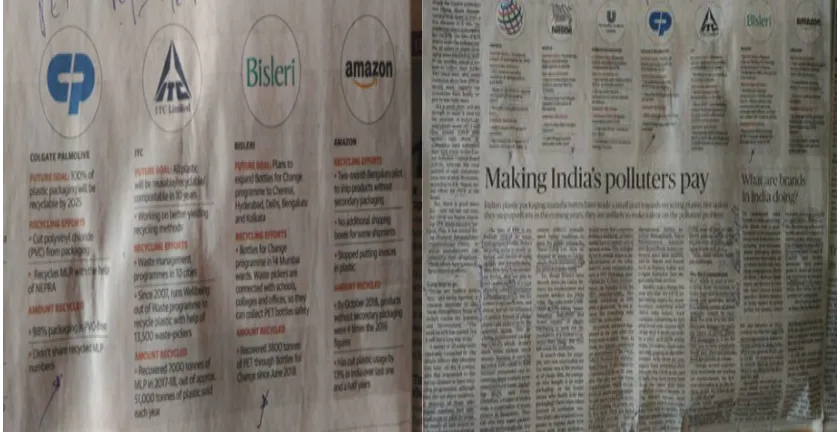
[image:1.612.96.516.487.703.2]Recycling is most important parameter in this project. This parameter turns whole plastics waste into set of new products for future use. Today use of plastics is been banned in India due to high amount of plastic waste pollution. The plastics waste if burnt releases the toxic gases like phosgene, carbon monoxide, chlorine, sulphur dioxide, nitrogen oxide, etc. burying and over stressed of waste in the environment can be reduced by investing in polythene bag recycling plants. So this project will reduce environmental pollution. Plastic Injection Molding is an assembling system for making parts from thermoplastic and thermo set materials. Rather than the expulsion (which makes nonstop parts of steady cross area), infusion shaping makes discrete parts (with perplexing and variable cross areas). Liquid plastic is infused at high pressure into a shape, which is the reverse of the coveted shape. The mold is produced using metal, typically either steel or aluminum. The government of India have already initiated their actions against the plastic pollution occurring day by day as shown in below figure. Even the plastic less than 50 microns is been banned today in India.
II. PROBLEMSTATEMENT
Nowadays the plastic bottles, plastic pipes, injections, etc. are normally used a lot. After use of these plastics they are disposed of and they take a lot of space and as it increases pollution .Hence this have to be recycled taking in consideration and environmental concerns. Plastics crushed can be melted and can be used to produce different kind of product but it is an extremely laborious work. Hence we need a simple machine which will reduce the human efforts. So it is required to design and develop plastic shredder and molding machine.
A. Objectives
1) To cut the plastic waste and recycle them.
2) To reduce plastic pollution by recycling them.
3) To reduce the toxic gases which are produced by burning plastics.
III.RESEARCHMETHOLOGY
The data was collected from both primary and secondary sources. The primary source of data is respondents concerned and collected by using a predefined questionnaire. The secondary sources include books, articles, periodicals, newspapers, various reports, websites etc.
Data Sources
A. The study is based on both primary and secondary data. Secondary Data: Secondary data is collected from the company records publications of Journals,
B. Newspapers and Websites.
For this project, many alternative concepts have been generated. The various generated concepts were then individually evaluated to find the most appropriate concept for the product. The concepts that gave the most advantages were considered as the best concept and a waits further evaluation. The product sketch for the chosen concept was further drafted.
Design concept generation is usually expressed in the form of sketches or rough 3-D model sand often accompanied by a brief textual description for the overall design concepts.
1) Literature review
2) Identification of the problem
3) Finding solution of the problem
4) Data collection
5) Design of product
6) Market survey for required components
7) Purchase of required components system
8) Manufacturing and assembly
9) Testing and experimentation
10) Evolution of result of the project.
IV.WORKING
Fig. : Block diagram of plastic shredding and moulding
V. COMPONENTSDESCRIPTION
A. HOPPER
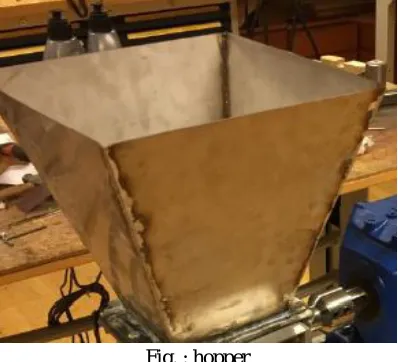
[image:3.612.213.412.282.463.2]A hopper is a large, pyramidal shaped container used in industrial processes to hold particulate matter that has been collected from expelled air. Hoppers are usually installed in groups to allow for a greater collection quantity. Most hoppers are made of steel. The hopper used was of 1mm sheet metal and welded together as shown in figure.
Fig. : hopper
B. Shaft
A drive shaft is a mechanical component for transmitting torque and rotation, usually used to connect other components of a drive train that cannot be connected directly because of distance or the need to allow for relative movement between them. As torque carriers, drive shafts are subject to torsion and shear stress, equivalent to the difference between the input torque and the load. They must therefore be strong enough to bear the stress, whilst avoiding too much additional weight as that would in turn increase their inertia.
[image:3.612.235.490.584.719.2]C. Shredder Blades
[image:4.612.214.433.118.279.2]The design of cutter blade will influence the size of cuts required. Generally, there are three types of materials used to produce the cutting tool such as High carbon steel, stainless steel and mild Steel. We used mild steel material for the blades.
Fig. : shredder blades
D. Bearings
[image:4.612.252.373.450.549.2]A bearing is a machine element that constrains relative motion to only the desired motion, and reduces friction between moving parts. The design of the bearing may, for example, provide for free linear movement of the moving part or for free rotation around a fixed axis; or, it may prevent a motion by controlling the vectors of normal forces that bear on the moving parts. Most bearings facilitate the desired motion by minimizing friction. Bearings are classified broadly according to the type of operation, the motions allowed, or to the directions of the loads (forces) applied to the parts. Rotary bearings hold rotating components such as shafts or axles within mechanical systems, and transfer axial and radial loads from the source of the load to the structure supporting it. The simplest form of bearing, the plain bearing, consists of a shaft rotating in a hole. Lubrication is often used to reduce friction. In the ball bearing and roller bearing, to prevent sliding friction, rolling elements such as rollers or balls with a circular cross-section are located between the races or journals of the bearing assembly. A wide variety of bearing designs exists to allow the demands of the application to be correctly met for maximum efficiency, reliability, durability and performance.
Fig. bearing
E. Pneumatic Double Acting Cylinder
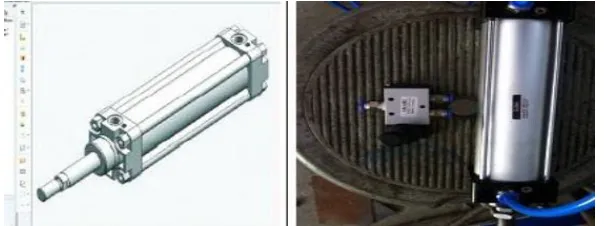
There are many types of injection cylinders that supply necessary power to inject resins according to the characteristics of resins and product types at appropriate speed and pressure. This model employs the double cylinder type. Injection cylinder is composed of cylinder body, piston, and piston load.
[image:4.612.156.458.603.716.2]F. Heater
The barrel is surounded by the heater for melting the plastic inside barrel. The plastic resins are moulded at high temperature & the heater with heat capacity can be heated to about 150-200˚C is used, and a band heater is usually used.
Fig. : heater
G. Nozzle
A nozzle is a device designed to control the direction or characteristics of a fluid flow (especially to increase velocity) as it exits (or enters) an enclosed chamber or pipe. A nozzle is often a pipe or tube of varying cross sectional area, and it can be used to direct or modify the flow of a fluid (liquid or gas). Nozzles are frequently used to control the rate of flow, speed, direction, mass, shape, and/or the pressure of the stream that emerges from them. In a nozzle, the velocity of fluid increases at the expense of its pressure energy.
VI.FUTURESCOPE
A. This project can be modified using automation methods.
B. This project can be modified for new production purpose.
C. Profitable for new plastic product production input given is plastic waste.
VII. ADVANTAGES
A. High production rate
B. Can process a wide range of materials
C. Relatively low labour
D. Less or no finishing of parts required
E. Scrap material can be recycled and reused
F. Low operation cost
G. Smooth surfaces Full automation is possible with injection moulding
H. More uniform melting
I. No degradation problem of plastics.
VIII. APPLICATION
A. Aerospace components
B. Automotive components
C. Computer and electronics
D. Engineering prototypes
E. Household equipment's
F. Instrumentation
G. Marketing samples
H. Medical and dental products
IX.CONCLUSIONS
The motive of project of reducing plastics waste and converting it into new usable products was fulfilled. Huge amount of plastics were recycled using this machine. There were no toxic gases due to no burning of plastic.
X. ACKNOWLEDGMENT
We wish to express gratitude and profound thanks to Prof. R. S. Thombare for their valuable guidance and encouraging co-operation throughout the project work without which we could never have completed it. We are thankful for their critical and constructive comments and also for their valuable guidance from time to time.
We are also thankful to all professors and everyone who helped us in completing this project.
REFERENCES
[1] Poonam G Shukla & Gaurav P Shukla, “Design and fabrication of pneumatically operated plastic injection moulding machine.” IJEIT-January 2013
[2] Mulla Irfan Faiyyaj, Mete Rushabh Pradip, Bhosale Jaydeep Dhanaji, Dange Prasad Chandrashekhar, Jadhav Suraj Shivaji, “Design and Development of
Plastic Shredding Machine ” International Journal of Engineering Technology Science and Research (2017), ISSN 2394 – 3386 Volume 4, Issue 10
[3] Olalekan Hammed, Sulaimon Abdulkareem, Ogunniyi Oluwadare, Adio Teslim “ Development of a Polythene Chipping Machine for Recycling Purposes”,
International Journal of Scientific & Engineering Research, , 2015 , ISSN 2229-5518 Volume 6, Issue 7
[4] Akinfiresoye Waleola Ayo, OJ Olukunle and DJ Adelabu “Development of a Waste Plastic Shredding Machine” International Journal of Waste Resources
(2017), DOI: 10.4172/2252-5211.1000281
[5] Rajkumar Joshi and Sirajuddin Ahmed, “Status and challenges of municipal solid waste management in India: A review” Joshi & Ahmed, Cogent
Environmental Science (2016), 2: 1139434
[6] Dr. Pawan Sikka, “Plastic waste management in India”, Department of Science & Technology, Government of India