[73 J
THE FUNCTION OF HAEMOGLOBIN IN CHIRONOMUS
PLUMOSUS UNDER NATURAL CONDITIONS
BY BARBARA M. WALSHE
From Bedford College, University of London
(Received 23 August 1949)
(With Six Text-figures)
INTRODUCTION
Haemoglobin is found in all vertebrate animals; in blood it serves as a transporter and in muscles as a temporary store of oxygen. But in the invertebrates its significance cannot be so clearly defined.
Haemoglobin is spasmodically distributed among the invertebrate phyla. Where it occurs it is situated in various tissues; it is found in blood and other body fluids either in solution or in corpuscles, it is present in muscle, in glands or in nervous tissue. Owing to these different sites and because of variability in physico-chemical properties of the pigment attempts to generalize on its functions (cf. Lindroth, Kriiger) are unsatisfactory. It is evident that haemoglobin must play different roles in different animals. It may act: (a) as it does in mammals as an oxygen absorber and transporter at all environmental oxygen pressures; (b) as an absorber and transporter only at low oxygen pressures; (c) as a store of oxygen; (d) both as a transporter and a store, or, finally, (e) it may have no function.
In order to determine the function of haemoglobin in an invertebrate it is necessary to investigate not only the physico-chemical properties of the pigment and the oxygen consumption of the animal both in normal circumstances and deprived of a functional haemoglobin by means of carbon monoxide, but also the ecological conditions of the animal's normal life. Very few data regarding the latter are available for any haemoglobin-bearing species, yet it is only from such knowledge of their ecology and behaviour under natural conditions that the true significance of the pigment, as distinct from its chemical potentialities under artificial laboratory conditions, can be assessed. This paper is a laboratory study of the behaviour of the larvae of Chironomuspkmosus L. under as natural conditions as possible, with a view to correlating their responses to environmental respiratory conditions with the known properties of their haemoglobin.
74 BARBARA M. WALSHE
could not be of significance during long periods of oxygen lack. From studies on the metabolism of larvae under various conditions, Harnisch (1936) and Ewer (1942) concluded that in normal animals the haemoglobin is used in oxygen transport at low external oxygen pressures such as the larvae must frequently encounter in nature. Its high oxygen affinity (Leitch, 1916; Fox, 1945) also indicates such a function. Harnisch (1936) worked with C. thummi larvae which were repaying an oxygen debt after anaerobiosis, and concluded that when the level of their metabolism increased during this process the haemoglobin became functional at all oxygen pressures; he considered that the main significance of the pigment lay in increasing the recovery rate. In similar experiments, however, on C. plumosus larvae recovering from anaerobiosis, I failed to confirm the functional use of haemoglobin in well-aerated water (Walshe, 19476), perhaps because the amount of oxygen debt repaid by my larvae was much smaller than that found by Harnisch. The experiments did, however, indicate that in the initial stages of recovery the larvae show a great amount of activity, during which the haemoglobin was used in oxygen transport.
Lindroth (1942) studied Chironomus larvae under more natural conditions by getting them to build U-tubes in mud between two glass plates. He observed that their respiratory ventilation of the tube was intermittent, and he reverted to the opinion that the haemoglobin functions as an oxygen store, by providing the animal with oxygen during the short pauses between ventilatory activity. His work was, however, very preliminary in nature, and his theory of haemoglobin as an oxygen store is unsubstantiated by any experimental evidence. The work described below is an extension of that begun by Lindroth, and consists of studies of the behaviour of larvae under various respiratory conditions, together with spectroscopic examinations of the haemoglobin in relation to the animals' behaviour, and the behaviour of larvae whose haemoglobin was made functionless by treatment with carbon monoxide.
METHODS
The larvae of C. plumosus live in U-shaped tubes in soft mud at the bottom of lakes and ponds. In the laboratory, larvae put into an aquarium containing several centimetres of sieved mud immediately burrow into it and they establish their tubes within a few hours. Such tubes vary somewhat in proportions; those of final instar larvae usually extend to a depth of 3-6 cm. in the mud and have an internal diameter of 2-3 mm. Their walls are consolidated by salivary secretion, the larva applying this by means of its mouthparts and hooked anterior proleg. The larval tubes once established within an aquarium seem to be permanent, and the larva pupates within its tube. Under normal conditions larvae never completely leave their tubes, although they occasionally project from them to gather food from the surface of the mud; they always hold on to the mouth of the tubes with the posterior prolegs and withdraw hastily when disturbed.
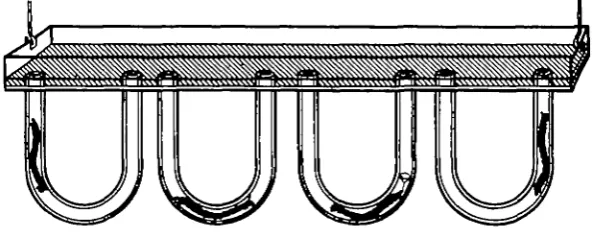
never entirely in view, and the larvae often hid in the obscured part. An attempt was made to persuade the larvae to build between two apposed glass plates, with mud in the interstitial space, as done by Lindroth (1942), but this also was unsuccessful, as under these circumstances the larvae only built very atypical structures. Finally the larvae were housed in artificial tubes. These were U-shaped, of glass tubing with an internal diameter of 2-5 mm. and external dimensions simulating those of natural tubes, fixed on small rectangular celluloid trays (Fig. 1). Each tray carried from two to five such tubes according to the size of the aquarium in which it was suspended. Into each tube a freshly collected final instar larva was introduced with a pipette. The tray was filled to the depth of about 5 mm. with sieved mud and lowered into an aquarium containing aerated lake water. This was then left for 24 hr., during which time the larvae lined the inner surface of their glass tubes with salivary secretion and particles of mud. Larvae so established showed no tendency to leave their tubes and thus could be observed over long periods of time. By means of outflow and inflow glass tubes resting on the tray the water in the aquarium could be
[image:3.451.78.377.281.398.2]'I'SSSSSSSXSSSSSfSS^
Fig. 1. Apparatus for observing the behaviour of Chironomus plumonu larvae. Description in text.
changed without disturbing the larvae; the conditions above the tubes could there-fore be controlled while at the same time the larvae were under as natural conditions as possible.
The behaviour of larvae was followed at a series of different oxygen and carbon dioxide pressures. Prior to observation the larvae were kept under constant lighting and respiratory conditions for 24 hr. They were then observed over a period of approximately 36 hr. Continuous observations of their behaviour for periods of either 30 or 60 min. were made at 3-hourly intervals. Undulations of the body were recorded on a kymograph by means of a tapping key, and other details of behaviour were noted. The oxygen content and pH of the water were frequently determined and the water changed when necessary. Oxygen determinations were made by the micro-Winkler technique (Fox & Wingfield, 1938) and the pH was estimated colorimetrically. The aquaria were kept at room temperature, which varied from
15 to 19° C.
76 BARBARA M. WALSHE
the larvae were first left for 3 hr. in their tubes in aerated water containing dissolved carbon monoxide at a relative pressure one-sixth that of the oxygen in solution in the water. In this way the haemoglobin became converted into carboxyhaemoglobin, subsequent dissociation of which was prevented by maintaining a low (approx. 0-1-0-5 ml./l.) concentration of carbon monoxide in the aquarium water. The light intensity at which all the experiments were conducted was found to be insufficient to cause any dissociation of the carboxy-compound.
The state of oxygenation of the haemoglobin of individual larvae was studied by means of a hand spectroscope, the larvae being temporarily illuminated by a strong beam of light. The increased illumination necessary for the spectroscopic examination did not alter the behaviour of the larvae.
GENERAL BEHAVIOUR (i) Normal larvae
The normal position of a larva within its tube is one in which the body is flexed so that the prolegs and the sensory setae on segment 12 are in contact with the tube walls. In this resting position the animal spends a large part of its life. Periodically, however, a series of rhythmic dorso-ventral undulations pass backwards along the body, driving water posteriorly. By renewing the water in the tube this irrigation* maintains the supply of dissolved oxygen to the larva, the animal regulating the time spent irrigating according to the oxygen and carbon dioxide pressures in the water; this intermittent irrigation of the tube may therefore be regarded as respiratory behaviour. From time to time, however, whatever their previous behaviour and irrespective of the external conditions, the larvae pass into a motionless phase which may last several hours. The immobility is complete; the larvae in a short time deplete the water in the tube of all oxygen and thus become subjected to anaerobic conditions. Such a motionless period can be artificially terminated by disturbing the larvae through vibration or sudden increase in light intensity, on which they irrigate their tubes. This sensitivity to disturbance is, however, only found after the animal has been motionless for some time.
The principal method of feeding in C. plumosus larvae is the filtering of planktonic organisms and particles from a stream of water passing through the tube. This filter-feeding mechanism has already been described in detail (Walshe, 1947a). Briefly, it consists in the larva spinning a cone of salivary secretion across the lumen of the tube, the apex of the cone sometimes being connected with the mouth by a thread; the larva then irrigates the burrow, the incoming water being drawn through the plankton net. The animal finally eats the net with its entrapped particles, and immediately spins another net. The entire performance takes less than 2 min., of which half is spent in irrigating the tube and hah0 in eating and spinning the net, but it may be repeated many times, and the feeding sometimes continues for
a number of hours. The whole forms a very stereotyped behaviour pattern which is easily recognized.
Although this is the commonest feeding mechanism, it is not the only one. On rare occasions I have seen larvae feeding from the surface mud. When doing this they extend the body out of the tube entrance, retaining contact with it by means of their posterior prolegs, and scrape the surface mud, at the same time spreading a net of salivary secretion over the surface, to which particles become attached and which is then dragged down into the seclusion of the tube for consumption. Occasionally larvae will also scrape the inner walls of their tubes with their mouthparts and anterior proleg, suggesting that they may also feed on the mud in which they live. Finally, a very small part of the life of the larva is occupied by the consolidation of the walls with salivary secretion and by moving about and turning within the tube.
On the whole, however, the behaviour of a larva within its tube can be divided into three phases: filter feeding, immobility and intermittent irrigation. There seems to be no regular sequence in these various types of behaviour either under constant conditions or with diurnal light fluctuations, neither is the duration of any one phase constant under any set of conditions. Despite having larvae with identical histories for observation the behaviour of individual animals remains variable.
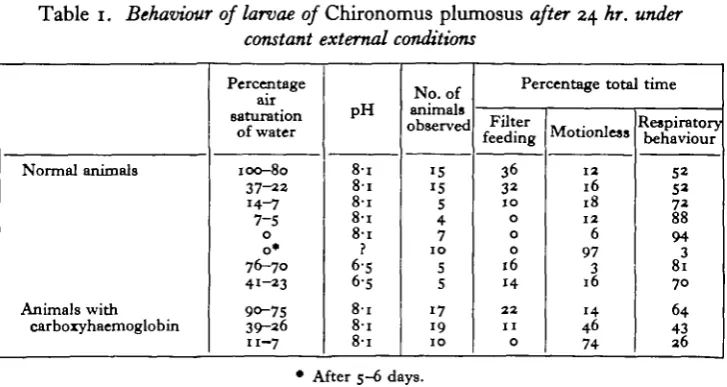
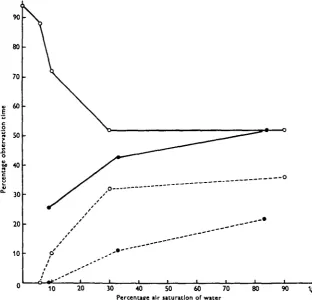
[image:5.451.46.410.392.585.2]The general behaviour of larvae, however, was obviously influenced by the conditions of the water in which the larvae were kept. In well-aerated water they spend about 50 % of their time showing respiratory behaviour, i.e. irrigating their tubes intermittently, the rest of the time being concerned with filter-feeding or remaining motionless (Table 1 and Fig. 2). Declining oxygen concentrations in the
Table 1. Behaviour of larvae of Chironomus plumosus after 24 hr. under constant external conditions
Normal animals Animals with carboxyhaemoglobin Percentage air saturation of water 100-80 37-22 14-7 7-S 0 o * 76-70 41-23 90-75 39-26 11-7 pH 8 1 8 1 8-i 8-i 8-i ? 6-5 6-s 8 1 8 1 8-i No. of animals observed IS 15 S 4 7 1 0 S s 17 19 1 0 Percentage tota Filter feeding 36 32 JO 0 0 0 16 14 2 2 1 1 0 Motionless 1 2 16 18 1 2 6 97 3 16 14 46 74 time Respiratory behaviour 52 52 72 88 9 4 3 81 7 0 64 4 3 2 6
• After 5-6 days.
78 B A R B A R A M . W A L S H E
an increase in respiratory irrigation. A high carbon dioxide concentration (pH 6-5) has a similar effect. No filter-feeding was ever observed below 10% air saturation (0-7 ml. oxygen per litre at 180 C ) ; this is the most energetic process in the life of the larvae and it appears to be essentially an aerobic one. In completely oxygen-free water the behaviour of larvae was no longer constant over the observation period; at first, when the larvae had only been in anaerobic conditions for about 24 hr., the animals irrigated intermittently for most of the time. As the anaerobiosis continued, however, the amount of respiratory behaviour declined, the animals passing into
10 20 JO 40 50 60 70
Percentage air saturation of water
[image:6.451.64.377.190.490.2]80 90
Fig. a. Behaviour of Chtronomut plumosus larvae at different oxygen concentrations, with and without functional haemoglobin. Data from Table i. O, normal animals; • , animals with carboxy-haemoglobin. Unbroken line, respiratory behaviour; broken line, filter feeding.
a state of complete immobility. They were not, however, narcotized by the oxygen lack, for slight disturbance would cause them to irrigate for a few seconds before once again settling into a motionless state.
(ii) Larvae with carboxyhaemoglobin
Larvae without functional haemoglobin showed certain interesting differences in their responses to declining oxygen pressures (Table 1 and Fig. 2). In well-aerated water their behaviour is not strikingly different from that of normal larvae; they do, however, filter-feed rather less, and the filter-feeding pattern in several individuals was irregular and atypical, in that larvae would tend to spin odd salivary cones and then not carry out the irrigation part of the cycle. Reduction in the oxygen content of the water caused a rapid decline in the amount of filter-feeding which was not observed below 26% air saturation. Irrigation behaviour also decreased and the larvae consequently spent a large part of their time motionless; at 7 % air saturation, for instance, the carbon monoxide-treated larvae were motionless for 74% of their time, while normal larvae showed a high degree of respiratory activity. The larvae with carboxyhaemoglobin, in fact, behaved as normal larvae do in anaerobic conditions.
The main effects of lack of functional haemoglobin are thus to prevent the larvae from filter-feeding and to reduce their level of activity, both these effects being greatest at low oxygen pressures. The inability to filter-feed at oxygen concentrations below 26% air saturation without haemoglobin indicates a new and interesting aspect of the function of the blood pigment; at low oxygen concentration it picks up and transports the necessary amount of oxygen for the high degree of secretory and muscular activity involved in filter-feeding. This must be of direct survival value since, although the larvae can feed by the less energetic process of eating from the walls of their tubes, larvae forced to do this by being kept in mud in plankton-free aquaria grow and metamorphose slower than those which have a plankton supply (Lang, 1931). Furthermore, the fact that at very low oxygen concentrations the carbon monoxide-treated larvae become immobile shows the value of haemoglobin to the normal animal in maintaining an internal oxygen pressure high enough to allow of respiratory activity and to ward off the immobilizing consequences of anaerobiosis.
RESPIRATORY BEHAVIOUR (i) Normal larvae
So far, the general effects on the larvae of changing environmental conditions have been described. If one now considers only the respiratory behaviour, it can be seen that regulation of the lengths of irrigation periods and pauses occurs when the oxygen or carbon dioxide pressure of the water is changed.
8o
BARBARA M. WALSHETable 2. Analysis of irrigation behaviour of Chironomus plumosus larvae
during the respiratory phase
Average percentage air saturation
%jl w m c r
Percentage time irrigating during respiratory phase
Average length in min. of each irrigation period
Average length in min. of each pause greater than 3 min. Percentage of pauses less than
3 min. in duration
9°
2-5
1-5
11
57 37
9 4
3-9
13
55
p H 8 - i
25
i r 8
4-9
13
52
1 0
59-1
> 18
1 0
67 5
8 8 0
> 3 0
0
1 0 0
p H
approi. 8 1
0
1 7 6
8
8
81
p H
65
1 6 7
2 7
6
61
6-5
3 i
3 1 3
> 14
8
93
100r
100
«lr utuntlon of water
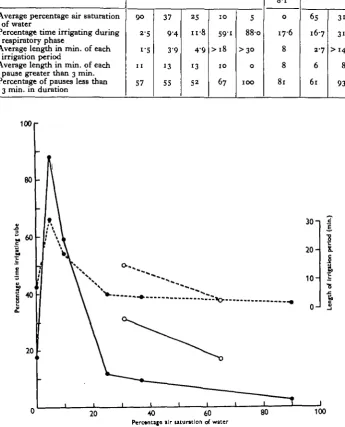
phase has therefore been analysed by estimating the average lengths of the pauses and irrigation periods* under different conditions (Table 2 and Fig. 3). The kymo-graph records of the undulatory activity show that the intermittent irrigation tends to be very irregular. It became necessary therefore, in calculating the averages, to define the limits of a pause and of an irrigation period, for on the whole the irrigating periods did not consist of one well-defined period of continuous undulation, but rather of several bouts of activity separated by short pauses varying from a few seconds to one or two minutes in duration (Fig. 4). It was obvious that a truer picture of the animal's behaviour could be obtained by considering the grouped bouts of activity as all part of one larger period of irrigation, than by regarding each one separately. The lengths of the irrigation periods in Table 2 are the averages of such grouped periods of undulation, a period being considered as ended only when the larva remained still for three or more minutes. Thus at 10% air saturation few, and at 5 % none, of the pauses are longer than 3 min.; consequently an upper limit to the lengths of the irrigation periods cannot be fixed. A true pause was considered as any still period greater than 3 min. and less than 30 min. in duration. If the larva remained motionless for more than 30 min. it was recorded as 'motionless' and not showing respiratory behaviour. This method of analysis is obviously arbitrary and artificial, since the lengths of pauses between irrigation periods cover the entire range from a few seconds to several hours, but some such treatment was necessary to present the behaviour numerically, especially as the durations of the long motionless pauses were largely unknown.
In well-aerated water a larva only spends 2-5% of its time irrigating the tube (Fig. 4a). Decline in the oxygen content alone (i.e. unaccompanied by an increased carbon dioxide pressure) has no effect on irrigation behaviour until it drops to between 50 and 45% air saturation; a preliminary series of experiments at 100, 8o, 65, 60 and 45 % saturation showed this to be the case. At 37 and 25 % air saturation (Fig. 46, c) the irrigation periods become progressively longer, although the pauses are still of the same duration. At the low oxygen concentration of 10% air saturation (Fig. ^d) the amount of irrigation is greatly increased and the pauses are now also reduced in length. At 5% air saturation (Fig. ^e), i.e. when only traces of oxygen are present, none of the rest periods is longer than 3 min.; the larva irrigates practically the whole time. This represents the extreme of respiratory regulation, for if during the recording of the behaviour the oxygen content sank to about 3 % air saturation there was a noticeable decrease in irrigation and the larvae behaved as if in completely anaerobic conditions. In the latter (Fig. 4/) they show short outbursts of undulation which gradually decrease in frequency until they finally assume the immobility characteristic of prolonged anaerobiosis.
Although in this series of experiments the only variable condition was the oxygen
• The amount of oxygen available to a larva depends on the volume of water passing through its tube: the irrigation volume (a function of both the amplitude and duration of the undulatory activity) would therefore be a more satisfactory datum than the length of the irrigation period. For any individual animal, however, the amplitude and rate of beat remained constant under various conditions. Thus the length of the irrigation period alone gives an adequate representation of the irrigation of the tube.
82 BARBARA M. WALSHE
content of the water, one cannot assume that the respiratory responses of the larva indicate a direct sensitivity to declining oxygen pressures. When the animal pauses between irrigation periods, simultaneously with the decrease in oxygen pressure there is a drop in pH owing to the production of carbon dioxide and other acid metabolic products. In fact, the changes in irrigation behaviour described above would indicate a sensitivity to pH changes rather than to oxygen deficiency itself, for
_L J
b L
f • • I I I I M I I • • I
I L
J LJ_
I II I10 30
Fig. 4. Diagram based on kymograph records of irrigation behaviour of seven larvae of Chironomut
plumosus under different respiratory conditions. Each line represents the behaviour of one
individual over a period of approximately 30 min. Vertical lines or blocks indicate periods of irrigation of the tube, horizontal lines pauses when animal was resting, a-f at pH 8'i and the' following air saturations of the water: a, 90%; b, 37 %; c, 25 %; d, 10 %; e, 5 % ; / , 0 % . g and h at pH 6-5 and the following air saturations: g, 65 %; h, 31 %.
Thus a decreased pH within the animal's body probably initiates irrigation, and a return to the normal ends it.
The behaviour of larvae at a high carbon dioxide pressure (Fig. 4^) supports this interpretation. The carbon dioxide causes a lengthening of the irrigation period, as elimination of excess carbon dioxide by diffusion is slower, and a shortening of the pause as the threshold accumulation of acid within the body is reached sooner. At all oxygen concentrations, part of the animal's metabolism during a pause is anaerobic (see later). This implies the production not only of carbon dioxide but also of fatty acids, which, since there is no evidence for their continual accumulation as a large oxygen debt, must be eliminated during the subsequent irrigation period. Each irrigation period is, in fact, evidence of the elimination of a small oxygen debt. At 37 and 25% air saturation, although the pauses are as long as in more fully aerated water, the length of the irrigation periods is increased. This may well be due to a reduced rate of removal of the oxygen debt by oxidation of the anaerobic metabolites, at the lower oxygen pressures.
That the irrigation behaviour is, in fact, controlled by a factor such as changing pH and not by any internal nervous rhythm was shown by keeping larvae at a constant high oxygen pressure and pH. This was done by drawing well-aerated water through their tubes about every 20 min. with a fine pipette. Under these conditions the larvae assumed a state of apnoea and showed no spontaneous respiratory movements. Such larvae after an hour or two's treatment in this way no longer increased their amount of irrigation when placed in water containing little oxygen: the characteristic increased respiratory activity only became apparent after several hours. Conversely, animals previously kept at a fairly low oxygen concentration (e.g. 25 % air saturation) immediately responded to a further decrease in oxygen. These data indicate that an animal showing respiratory behaviour has a certain basal accumulation of metabolic products within the body. Prolonged subjection to high oxygen concentrations removes this and causes a delay in respiratory responses. In other words, the animal has normally a permanent slight oxygen debt, above which additional accumulation of metabolites initiates irrigation. Elimination of these must become increasingly difficult at progressively lower oxygen concentrations until, finally, with poor incoming oxygen supplies the animal must be fighting a losing battle against anaerobic products. The decreased rate of irrigation and final immobility below 3 % air saturation may be the result of their excessive accumulation.
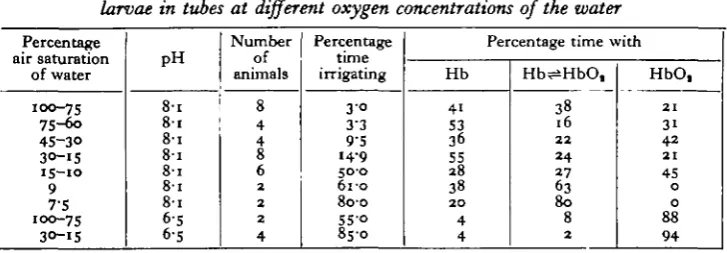
Direct data as to how much anaerobiosis larvae endure at different oxygen con-centrations, and what part the haemoglobin may play in reducing this were obtained by studying the haemoglobin in the living larvae with a spectroscope. With practice it was possible to detect various degrees of oxygenation of the haemoglobin and correlate these with the activity of the larva. Fig. 5 shows how gradual deoxy-genation of the pigment occurs between bouts of irrigation when the animal remains still, and rapid reoxygenation takes place as the larva renews its water supply by irrigation, or occasionally by moving up to one of the ends of the tube. During the time when a larva remains still within its tube it has four possible sources of oxygen supply: (a) dissolved in physical solution in its blood, (b) contained in the
84 BARBARA M. WALSHE
globin, (c) obtained from the surrounding tube water by physical diffusion into the blood, and (d) absorbed from the tube water by the haemoglobin. Owing to its high oxygen affinity the blood pigment will only come into play after ready supplies of oxygen in physical solution have been exhausted and the tissue oxygen pressure has become sufficiently low to cause dissociation of the oxyhaemoglobin. The respiratory pigment will then be functional in two ways: by yielding its stored oxygen and by transporting the remaining small amounts of oxgyen from tube water to the tissues. As seen by the spectroscope, the time when the haemoglobin is thus functioning must be when the oxyhaemoglobin bands are progressively fading. Table 3 summarizes the spectroscopic observations. The blood pigment appears to be functioning most (i.e. is fluctuating between oxygenated and deoxygenated states for the greatest proportion of time) at the very lowest oxygen concentrations in the water (7*5-9% air saturation). At 9% air saturation of the water (o-6 ml. oxygen per 1. at 180 C.) the haemoglobin remains partly oxygenated and at 7 5 % (°'S mi-oxygen per 1. at 180 C.) practically deoxygenated as long as the larva irrigates. Even though the oxygen demand of the tissues during this irrigation must be high, the pigment remains in a partly oxygenated state; this implies that as quickly as the animals' metabolism removes oxygen, it is picked up by the haemoglobin, which is thus functional in oxygen transport. At higher oxygen pressures the haemoglobin is functional over shorter periods of time.
[image:12.451.45.409.393.519.2]The data on the amount of time during which the larvae have deoxygenated haemoglobin are of special interest (Table 3); these show that a considerable pro-portion of their time is spent under anaerobic conditions even when oxygen is
Table 3. The changes in oxygenation of the haemoglobin of Chironomus plumosus
larvae in tubes at different oxygen concentrations of the water
Percentage nil* ooti 1 fofri/^n mi. o o i u i u u vil
of water 100-75 75-6o 4S-3O 30-15 iS-io 9 7-S 100-75 30-15 PH 8 1 8-6 5 6 5 Number of animals 8 4 4 8 6 2 2 2 4 Percentage time irrigating 3 0 3 3 9-5 14-9
5 0 0 6 1 0 8 0 0
SS-o 8 5 0
Percentage time with
Hb 41 S3 36 55 28 38 2 0 4 4 Hb^HbO, 38 16 2 2 2 4 27 63 8 0 8 2 HbO, 2 1 31 4 2 2 1 45 0 0 88 9 4
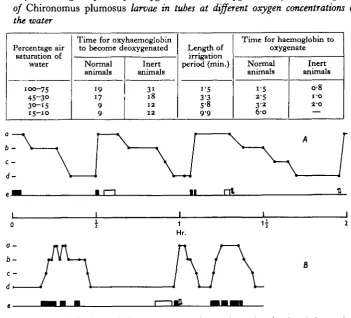
The data so far discussed give no indication as to whether the storage or the transport function of the haemoglobin has the greater significance in the life of the larvae. The actual time in minutes for the larvae to deoxygenate their haemoglobin at different oxygen pressures is relevant in this connexion. In well-aerated water the haemoglobin is only completely depleted of oxygen after about 19 min., whereas at 15-30% air saturation of the water it becomes deoxygenated after 9 min. (Table 4, Fig. 5). Below 15% air saturation down to the oxygen concentration at which the
Table 4. The lengths of time for oxygenation and deoxygenation of the haemoglobin
of Chironomus plumosus larvae in tubes at different oxygen concentrations of the water
Percentage air saturation of
water
100-75 45-3O 30-15 15—10
Time for oxyhaemoglobin to become deoxygenated
Normal animals
19 17 9 9
Inert animals
3i 18 12 12
Length of irrigation period (min.)
i-5 3-3
5-8 9.9
Time for haemoglobin to oxygenate
Normal animals
i'5 2-5 3-2 6 0
Inert animals
o-8
i-o 2-0
a - b-c —
d
[image:13.451.50.402.189.507.2]1 Hr.
Fig. 5. The state of the haemoglobin of Chironomus plumosus larvae in tubes in relation to their behaviour. Parts of the records of two individual larvae: A in air-saturated water, B in 25 % air saturated water, a-d are four recorded states of the haemoglobin: a, fully oxygenated, when absorption bands of oryhaemoglobin at maximum intensity; b, partly oxygenated, when bands fading but still clearly double; c, almost deoxygenated when single absorption band of haemo-globin definite but with traces of double band of oxyhaemohaemo-globin; d, deoxygenated when no trace of oxyhaemoglobin bands remained. Behaviour scale (e): straight line represents animal motionless within tube; solid blocks represent periods of irrigation; white blocks represent movement within tube; arrows indicate that animal moved to one of the ends of the tube.
86
BARBARA M. WALSHErepresent the storage value of the haemoglobin to the normal animal. Thus at higher oxygen concentrations the extra time taken for deoxygenation shows that during the 17-19 min. the haemoglobin is also acting in the transport of oxygen from the tube water. These data were obtained from normal larvae which, in their respiratory regulation, become increasingly active as the oxygen concentration falls. If one now irrigates the tubes artificially with aerated water so as to produce a state of apnoea (see p. 83) before observation, the deoxygenation time is lengthened at all oxygen pressures; the metabolism is lower during the inactivity of the larva and the basal storage value becomes 12 min. (Table 4). This agrees exactly with the value arrived at by Leitch (1916), whose calculations were based on the metabolism of larvae free in water and therefore less active than irrigating animals; the storage value to an active larva under more natural conditions would seem to be about 9 min.
The reverse process of oxygenation of the haemoglobin during irrigation takes progressively longer as the oxygen falls (Table 4). In part this is due to decreasing rates of diffusion of oxygen through the cuticle, but not entirely so, since the haemoglobin of inert larvae artificially irrigated becomes oxygenated quicker than actively irrigating ones at the same oxygen pressure; the increased metabolism of the active animals draws on the oxygen supply of the reappearing oxyhaemoglobin and so lengthens the process of reoxygenation. Correspondingly the actual irrigation periods are longer.
These data indicate that the haemoglobin of the larvae showing respiratory behaviour may enable the animals not only to be more aerobic during their pauses but also to return to a high degree of aerobic activity more quickly when they are irrigating their tubes. To what extent the Tiaemoglobin functioning in this way has actual significance in the life of the larva may be judged by a further analysis of the respiratory behaviour of larvae deprived of their haemoglobin by carbon monoxide.
(ii) Larvae with carboxyhaemoglobin
[image:14.451.42.412.433.599.2]Returning to the experiments on larvae with carboxyhaemoglobin, Table 5 gives an analysis of their irrigation behaviour. The figures in brackets are the corresponding
Table 5. Analysis of the irrigation of Chironomus plumosus larvae with carboxy-haemoglobin, during respiratory behaviour
(pH 8-1. Figures in brackets are corresponding values for normal larvae) Average percentage air saturation of water
Percentage total time respiratory behaviour Percentage time irrigating during
respira-tory behaviour
Average length in min. of each irrigation period
Average length in min. of each pause greater than 3 min. and less than 10 min. Percentage of pauses < 3 min. in duration No. of animals observed
9 0
64 (52) 5-6(2-5) 25 d-5)
8-5 (11)
7i (57)
15
30
43 (52) n - 6 (n-8)
22 (4-9)
9-i (13)
57 (52)
13
1 0
26 (72) 35-3 ( 5 9 0
8-5(>i8)
7-6 (10)
72 (67)
4
what one would expect if the haemoglobin were functioning as suggested above. Examination of the individual records, however, show that these values are due to data from seven animals which were unusually active throughout the observation periods; their activity taking the form of scraping movements frequently inter-spersed with very short periods of irrigation. This behaviour was thought to be a feeding reaction; that it should be commoner in larvae with carboxyhaemoglobin may be related to their reduced amount of filter-feeding. The behaviour of the remaining eight animals was not noticeably different from normal, except for an increased tendency to move about within their tubes. This restlessness serves to mix the tube water and thus in normal animals to prolong the time during which they have oxyhaemoglobin. The lack of a functional haemoglobin may in this way be the cause of a slightly increased activity in the larvae, but in aerated water the effect is not a very obvious one.
In 30% air-saturated water also, the only outstanding difference in behaviour between animals with and without functional haemoglobin is the great total reduction in filter feeding in the latter. As regards respiratory behaviour alone there is no striking difference in irrigation between the two; the variability in behaviour makes the validity of the differences given in Table 5 doubtful.
At 10% air saturation only four out of the ten animals showed any respiratory behaviour, the rest remaining motionless throughout the observation periods. The behaviour of these four was of interest; two maintained a high rate of irrigation (78-88% of the time) such as is typical of normal animals at 5% air saturation, while the other two irrigated little and at frequent intervals their behaviour recalling that of normal animals after 24 hr. of completely anaerobic conditions. Finally, in their immobility, the six motionless individuals were reacting as do normal larvae under prolonged anaerobic conditions. Thus at 10% saturation all the larvae behaved as if the external oxygen pressure were lower than it actually was. At this oxygen pressure therefore the haemoglobin has a functional value in enabling larvae to maintain a high irrigation rate and so, thanks to its transporting properties to utilize the small amounts of available oxygen. Thus while carbon monoxide treatment has no very clearly denned effect on the respiratory behaviour of larvae in aerated water, at low oxygen pressures it causes the larvae to behave as if less oxygen were present than is actually the case.
RECOVERY FROM ANAEROBIOSIS (i) Normal larvae
88
BARBARA M. WALSHEgradually sinks to normal. The speed of recovery depends on the oxygen concentra-tion of the incoming aerated water; thus in a series of experiments in which larvae were kept for 4 days under anaerobic conditions and then transferred to various oxygen concentrations, the amount of irrigation returned to that typical of the particular oxygen concentration in less than 1 hr. in 75-100%, air saturation, 2 hr. in 4 5 % , 2J-3 hr. in 10-28%, and 3 hr. in 7-22%. As the irrigation rate declines the activity of the larvae changes to filter-feeding until finally all individuals are feeding (Fig. 6). Below 7% air saturation larvae show no recovery; their irrigation rate remains high for several hours and there is no decline in rate associated with the adoption of filter-feeding. If left at this very low oxygen concentration they gradually resume anaerobic immobility.
100
80
60
•4
C
I 40
f "
o — 0
u
t 100 v
I 80
?
60
40
20 0
O "
2 3 4 Hourc >fter Introduction of oxygen
Fig. 6. Recovery of Chirononws plumotus larvae from a 96 hr. period of anaerobiosis: A in 67—100 % air-saturated water; B in 10 rising to 28% air-saturated water. O, normal larvae; 9 , larvae with carboxyhaemoglobin. Unbroken line, irrigation of tube; broken line, filter feeding.
(ii) Larvae with carboxyhaemoglobin
a considerable disadvantage when recovering from oxygen lack, especially if such recovery were taking place in water of low oxygen content.
The conclusions are in agreement with deductions based on a comparison of the metabolisms of larvae with and without haemoglobin when recovering from oxygen lack (Walshe, 19476). In these experiments the animals were out of their tubes and free in slowly running water; nevertheless, they showed a high rate of undulation immediately after an anaerobic period, to maintain which aerobically the haemoglobin was functional in oxygen transport. After this initial outburst of activity the small oxygen debt (evident from an increased metabolism) was eliminated after an hour in fully aerated water, the same interval of time which larvae in their tubes need to return to normal behaviour. Carbon monoxide-treated larvae were also found to be able to repay an oxygen debt in aerated water, but the metabolism did not return to normal until about 2 hr. after the admission of oxygen: the larvae with carboxyhaemo-globin had actually a higher metabolism during recovery than normal animals, thus appearing to pay back a greater debt. The explanation of this was not clear at the time, but subsequently observation of the behaviour of carbon monoxide-treated larvae in their tubes suggested that it may well have been due to an undetected increased amount of irrigation activity during the lengthened recovery period. Thus, although larvae are capable of recovering from oxygen-lack in aerated water without the help of haemoglobin, the recovery time is considerably lessened by the possession of the blood pigment. Furthermore, the observation of the behaviour of larvae in tubes shows that lower oxygen concentrations recovery without the help of haemo-globin becomes increasingly difficult and finally impossible.
C. plumosus larvae are characteristic of bottom muds of highly productive stagnant waters in which oxygen depletion is a common phenomenon and completely anaerobic conditions not unusual. Re-aeration of the natural waters after periods of oxygen lack is bound to be slow, therefore the ability to reassume normal aerobic metabolism quickly and in spite of a low oxygen concentration must be of great significance in the life of the larvae.
Thus in post-anaerobic recovery prolonged vigorous irrigation of the tube occurs, and cessation of this and the adoption of filter-feeding marks the completion of recovery. Recovery is slower the less oxygen there is available, and larvae with carboxyhaemoglobin show a very prolonged recovery period, or at low oxygen pressures are unable to recover. Thus a functional haemoglobin is of significance in the resumption of normal metabolism after oxygen lack.
DISCUSSION
90 BARBARA M. WALSHE
previous pause. It remains now to assess the role of the animal's respiratory pigment during such behaviour.
The most recently advocated theory of the function of the haemoglobin of Chironomus, namely that it serves essentially as an oxygen store during short pauses (Lindroth, 1942, 1943), is based on Lindroth's observation of a regular periodicity in the respiratory movements of C. pktmosus larvae; at 18-190 C. the animals irrigating for 5-10 min. and pausing for about 4 min. in well-aerated water. He supposed that during the pauses the oxyhaemoglobin maintained aerobic conditions and allowed the larvae to show other activities such as feeding. Lindroth's animals must have been much more active and regular in behaviour than mine, for he records no irregularities or long rest periods and inferred that the metabolism was essentially aerobic. In my animals, however, anaerobiosis was a normal phenomenon even with fully aerated water above the mud, for many of the pauses were of such a length that the storage value of the haemoglobin was inadequate to maintain aerobic conditions. Nevertheless, spectroscopic examination showed that the pigment does hold a 9 min. store of oxygen and this must reduce the degree of anaerobiosis to be endured by the resting animal. Were this of paramount importance in the animal's life, however, one would have expected the respiratory behaviour of animals without a functional haemoglobin to have been considerably different from normal, the removal of the oxygen store shortening the lengths of the pause. But such was not the case. With aerated water above the mud, larvae with carboxyhaemoglobin, although rather more irregular in their respiratory behaviour, showed no striking curtailment in the lengths of the pauses, and were if anything unusually active in lining their tubes and moving about during the intervals between irrigation periods. Larvae can therefore be active during pauses without the help of extra stored oxygen, and although the haemoglobin on account of its physico-chemical properties cannot help but be a short oxygen store during periods of inaccessibility of oxygen, its main significance in Chironomus does not appear to lie in this.
When the animals are lying free in water, the haemoglobin functions as an oxygen transporter at low oxygen concentrations (Ewer, 1942). In their natural tubes the oxygen pressure falls whenever the animals remain still: the conditions under which the haemoglobin can act as a transporter will therefore be present whenever the larvae pause. That the haemoglobin does in this way pick up oxygen from the tube water when the animals pause can be seen from the spectroscopic observations of the blood pigment inside the larvae in glass tubes. At oxygen concentrations above 30 % air saturation the haemoglobin takes about 19 min. to lose all traces of oxygenation. Were it only giving up a store, deoxygenation would occur more rapidly (i.e. after 9 min. in an intermittently active animal). For some minutes therefore it is con-cerned with picking up oxygen from the tube water, and this together with its storage value postpones anaerobiosis. But the amount of oxygen in the tube water is small and the transporting ability of the haemoglobin during a pause is therefore limited.
to be of far greater significance. Thus at the lowest oxygen concentrations at which the haemoglobin is to any degree oxygenated the larvae irrigate most of their time, and throughout their irrigation the haemoglobin must be giving up oxygen to the tissues. Its functional significance under these conditions can remain in no doubt since carbon monoxide-treated larvae under similar circumstances behave as if in complete oxygen lack. At progressively higher oxygen concentrations the haemoglobin gradually becomes fully oxygenated during irrigation, but the increased length of time which this takes in an active animal as compared with an immobile one shows that during the irrigation activity the haemoglobin is acting in oxygen transport. This must be on account of the muscular activity of irrigation. The haemoglobin's transporting ability will make possible not only a more aerobic muscular activity but also a more rapid recovery from any preceding oxygen lack.
The irrigation behaviour of larvae after a prolonged period of anaerobiosis is essentially similar to that after a short pause in that it is concerned with recovery from oxygen lack, but owing to the greater length of anaerobiosis involved, it is more violent and prolonged in nature. During such recovery the possession of haemoglobin considerably lessens the recovery time. In this case the haemoglobin seems to be functional even in fully aerated water, for with carboxyhaemoglobin the recovery of larvae is considerably slower.* At lower oxygen concentrations the retarding effect of lack of haemoglobin is even more marked, and below 15% air saturation recovery is no longer possible. Without haemoglobin one would suppose that the larvae could not live for any prolonged length of time at oxygen concentrations below this value, since inability to maintain or return to aerobic metabolism would prevent any feeding or in fact any activity. Harnisch (1936), from studying the metabolism of larvae recovering from oxygen lack, also arrived at the conclusion that the main significance of the haemoglobin lay in hastening recovery by acting as an oxygen transporter.
The significance of haemoglobin in keeping the animals aerobic, and therefore active at low oxygen concentrations, was also evident from the behaviour of my carbon monoxide-treated larvae at constant low oxygen pressures: at all oxygen concentrations lower than almost fully air-saturated water the proportion of motion-less individuals was higher than normal, while at 10% air saturation the animals behaved as if anaerobic.
Finally, a further noticeable effect of carbon monoxide was in reducing the amount of filter-feeding. Normal larvae can only use this method when oxygen is present and the inability of larvae with carboxyhaemoglobin to filter-feed at low oxygen concentrations must be due to their low internal oxygen pressure without the functional blood pigment. A second possible interpretation of this effect of carbon monoxide is that the gas might have a direct inhibitory effect on some step in the secretory activity of the salivary gland cells, as it is known to have on cytochrome oxidase, and it would thus be by eliminating the net-spinning part of the cycle that
92 BARBARA M. WALSHE
filter-feeding is made impossible. Arguments against this are that the carbon monoxide pressure of the water during experiments was very low, and since it was kept at one-sixth of the oxygen present in the water, was lowest in the conditions under which inhibition of feeding was most marked, and secondly, that during the rather common atypical filter-feeding of carbon monoxide-treated larvae nets were spun in the usual manner but the larvae failed to perform the irrigation part of the cycle. It would seem then that oxygen is needed rather for the rapid undulatory activity during feeding than for the salivary secretion.
In its general mode of life Chironomus shares certain features with other tubicolous, haemoglobin-bearing invertebrates. Most like it in habits is the marine littoral echiuroid, Urechis caupo, for not only does this animal irrigate its burrow for respiratory purposes but also filter-feeds by means of a mucous cone attached to the head and filled by its irrigation activity (Fisher & MacGinitie, 1928). Like Cfrironomus, too, its intermittent irrigation tends to be irregular, with pauses varying from about 20 min. to more than an hour in length (Hall, 1931). In Urechis, however, the relatively greater total quantity of haemoglobin provides an oxygen store lasting approximately 70 min., so that such rests do not entail anaerobiosis. At low tide there is evidence that the haemoglobin not only functions as an oxygen store but also acts as an oxygen transporter during the greater part of the time that the burrows are exposed (Redfield & Florkin, 1931). Thus the possession of haemo-globin, by both storing oxygen and transporting it at low pressures, enables Urechis to lead an aerobic life when aerated sea water is not available. Much the same may be said about the haemoglobin of Arenicola; the pauses between the animals' irrigation activity may last up to an hour (Van Dam, 1938), and it experiences low oxygen pressures during low tide. Hence in the past the storage value of its haemo-globin has been most emphasized (Barcroft & Barcroft, 1924; Lindroth, 1943). Borden (1931), however, considers it also of significance in oxygen transport at low pressures, and the animal's habit of trapping air bubbles over the gills when unable to circulate its tube water (Wells, 1945) might also indicate a transport function.
The behaviour of Nereis virens more closely resembles that of Chironomus in that the pauses between respiratory irrigation periods are longer than the oxygen storage time of the haemoglobin (Lindroth, 1938). Thus the animal normally experiences some anaerobiosis. Lindroth concludes that irrigation is controlled by the pro-duction of some metabolic substance, and that it not only serves to renew the oxygen supply but also makes possible repayment of the oxygen debt incurred during the previous pause, as I believe to be the case in Chironomus. The significance of the haemoglobin he thinks to lie in the pigment storing a small amount of oxygen and thereby reducing the duration of anaerobiosis during pauses. His reasons for rejecting a transporting function, however, suffer from being based largely on theoretical considerations unsupported by experimental evidence such as estimation of the metabolism of animals with carboxyhaemoglobin would afford.
the animal has the power to cut itself off suddenly and completely from its external oxygen supply, in which case its transporting ability would be eliminated. The reduction of circulation in the retia respiratoria in Nereis during a pause (Lindroth, 1938) may accomplish this (although the rhythm does not slow much during the first 10 min. of the still period and could well therefore be transporting during that time), but the trapping of air bubbles by the animal at low tide indicates some continued connexion with external oxygen during this time, and the possibility of the haemoglobin functioning in oxygen transport. And Nereis is the only haemo-globin-containing animal in which such a reduction of circulation during immobility has been reported, although the chlorocruorin-containing Sabella is known to stop its circulation when the crown is withdrawn into the tube (Fox, 1933). In Chiro-nomus the heart continues to beat at a slower rate than during activity, but sufficiently to maintain a circulation. Thus in general, unless there is experimental evidence to the contrary, invertebrate haemoglobins must be considered as oxygen transporters as well as stores.
The experiments described above indicate that for Chironomus at any rate the transporting ability of haemoglobin has greater significance in the animal's life than its storage value, for as an oxygen transporter the haemoglobin can, and does, function for as long as the animal is irrigating at low oxygen pressures, and thus makes possible activity under these circumstances, while at higher oxygen pressures it provides a quick oxygen supply for post-anaerobic recovery processes and for the high muscular activity of respiratory irrigation and filter-feeding. As a store it reduces the amount of anaerobiosis to be undergone during short periods of in-activity and so lengthens the time during which the larva can remain still within its tube for a given accumulation of anaerobic metabolic by-products.
94 BARBARA M. WALSHE
significant that after the long periods of oxygen lack to which my larvae were sub-jected, all the normal animals adopted filter-feeding once oxygen was again available to them. In this the haemoglobin would appear to be of paramount significance in allowing for quick recovery and optimal feeding, even at low oxygen concentrations.
SUMMARY
1. The behaviour of final-instar larvae of Chironomus plumosus housed in U-shaped glass tubes was observed at various concentrations of dissolved oxygen and carbon dioxide.
2. Respiratory behaviour, consisting of intermittent irrigation of the tube, alternates with periods of filter-feeding or complete immobility. In well-aerated water about 50% of the time is occupied by respiratory behaviour, 35% by filter-feeding and the remainder by periods of rest. As the oxygen concentration in the water drops, progressively less time is occupied by filter-feeding and immobility and more by respiratory irrigation. Below 10% air saturation of the water larvae no longer feed. When placed in completely anaerobic conditions larvae at first irrigate intermittently but subsequently relapse into immobility.
3. During respiratory behaviour the amount of irrigation and the length of pauses between periods of irrigation change at different oxygen and carbon dioxide contents of the water in such a way as to suggest that the respiratory irrigation is controlled by internal pH changes in the larvae.
4. A spectroscopic examination of the haemoglobin in living larvae showed that the blood pigment holds an approximately 9-min. store of oxygen for the resting animal. In addition to this it acts in the transport of oxygen from the tube water to the larval tissues when the larva pauses between periods of irrigation. It thus decreases the amount of anaerobiosis to be endured during short periods of in-activity. Nevertheless, larvae without a functional haemoglobin (i.e. with car-boxyhaemoglobin) still continue to pause during their respiratory behaviour, and the pauses are not strikingly curtailed in length.
5. At very low oxygen concentrations (7-5-o/o% air saturation), when the larva irrigates the tube almost unceasingly, the haemoglobin remains in a state of partial oxygenation, during which time it is functioning continuously in oxygen transport. At these oxygen concentrations larvae with carboxyhaemoglobin do not show respiratory activity but assume the immobility characteristic of anaerobic conditions. 6. Larvae with carboxyhaemoglobin tend to be less active than normal animals, except in well-aerated water, the decreased activity being largely due to a reduction in the amount of filter-feeding. Such larvae have not been observed to filter-feed at oxygen concentrations below 26% air saturation, whereas the limiting concentration for normal larvae is 10%.
retarded rate of recovery from anaerobic conditions, and cannot recover in water less than 15% air saturated.
8. The main significance of haemoglobin in the life of a full-grown Chironomus larva would thus seem to be threefold: (a) haemoglobin enables the larva to maintain the active process of filter-feeding when relatively little oxygen is present; (b) it acts in oxygen transport at very low oxygen concentrations, thereby enabling continued respiratory irrigation; and (c) it greatly increases the rate of recovery from periods of oxygen lack, making such recovery possible even under adverse respiratory conditions.
REFERENCES
BARCROFT, J. & BARCROFT, H. (1924). The blood pigment of Aremcola. Proc. Roy. Soc. B, 96, 28. BORDEN, M. A. (1931). A study of the respiration and of the function of haemoglobin in Planorbis
corneus and Aremcola marina. J. Mar. Biol. Ats. UJC. 17, 709.
VAN DAM, L. (1938). On the ultilization of oxygen and regulation of breathing in some aquatic animals. Thesis. Groningen.
EWBR, R. F. (1942). On the function of haemoglobin in Chironomus. J. Exp. Biol. 18, 197. FISHER, W. K. & MACGINITIE, G. E. (1928). The natural history of an echiuroid worm. Arm. Mag.
Nat. Hist. 10th Ser. 1, 204.
Fox, H. M. (1933). The blood circulation of animals possessing chlorocruorin. Proc. Roy. Soc. B, n a ,
479-Fox, H. M. (1945). The oxygen affinities of certain invertebrate haemoglobins. J. Exp. Biol. 31, 161. Fox, H. M. & WINGFIELD, C. A. (1938). A portable apparatus for the determination of oxygen
dissolved in a small volume of water. J. Exp. Biol. 15, 437.
HALL, V. E. (1931). The muscular activity and oxygen consumption of Urecfw caupo. Biol. Bull.
Woods Hole, 61, 400.
HARNISCH, O. (1936). PrimSre und secondSre Oxybiose der Larve von Chironomus thummi.
Z. vergl. Physiol. 23, 391.
HARNISCH, O. (1938). Studien zum anaeroben und Erholungsstofiwechsel der Larve von Chironomus
thummi. Z. vergl. Physiol. 36, 200.
HARNISCH, O. (1939). Studien zum anaeroben und Erholungsstoffwechsel der Larve von Chironomus
thummi. II. SaurSbildung und ' Notoxybiose'. Z. vergl. Physiol. 37, 275.
KROGER, F. (1942). t)ber Verbreitung und Bedeutung des Hemoglobins bei wirbellosen Tieren.
Biol. gen. 15, 456.
LANG, K. (1931). Faunistisch-dkologische Untersuchungen in einigen seichten oligotrophen bzw. dystrophen Seen in SUdschweden. Acta Univ. kind. N.F. 27. Nr. 18, 1.
LANKESTER, E. R. (1867). Preliminary notice of some observations with the spectroscope on animal substances. J. Anat. Physiol. 2, 114.
LEITCH, I. (1916). The function of haemoglobin in invertebrates with special reference to Planorbis
and Chironomus larvae. J. Physiol. 50, 370.
LINDROTH, A. (1938). Studien uber die respiratorischen Mechanismen von Nereis wens Sars. Zool.
Bidr. Uppsala. 17, 365.
LINDROTH, A. (1942). Periodische Ventilation bei der Larve von Chironomus plumosus. Zool. Ams.
138, 244.
LINDROTH, A. (1943). Die biologische Bedentung des ' Hamoglobins' (Erythrocruorins) der Wirbellosen. Ergebn. Biol. 19, 324.
MIALL, L. C. & HAMMOND, A. R. (1900). The Structure and Life History of the Harlequin Fly.
Oxford.
PAUSE, J. (1919). Beitrfige zur Biologie und Physiologie der Larve von Chironomus gregarius. Zool.
Zbl. 36, 339.
POSSOMPES, B. (1937). Elimination de l'hemoglobine chez le Chironome. Trav. Stat. biol. Roscqff, 15.
177-REDFIELD, A. C. & FLORKIN, M. (193 I). The respiratory function of the blood of Urechis caupo.
Biol. Bull. Woods Hole, 61, 185.
THIENEMANN, A. (1923). Die beiden Chironomus arten der Tiefenfauna der norddeutschen Seen.
Verh. int. Ver. Lintnol. kicl. Stuttgart. 1, 108.
WALSHE, B. M. (1947a). Feeding mechanisms of Chironomus larvae. Nature, Lond., 160, 474. WALSHE, B. M. (19476). On the function of haemoglobin in Chironomus after oxygen lack. j . Exp.
Biol. 34, 329.