Seedling Transplanter
Abhilash. R. Muragi1,Mahesh Sajjan2 1, 2
Mechanical Department, B.L.D.E.A’s V.P. Dr. P.G. halakatti collage of engg.&tech.
Abstract: Developing countries contribute 72% of the total vegetable production in the world. The transplanting operation is one of the most labor intensive in vegetable production. India is the second largest producer of vegetable in the world (ranks next to China only). India share 12 percent of world production of vegetable with a productivity of about 15 tons/ha which is quite low as compared to many countries. It is largely done by hand in India and most developing countries and incurs large investments in labor, time, and cost.
The basic requirements for small scale cropping machines are, they should be suitable for small farms, simple in design and technology and versatile for use in different farm operations. Many operations in agriculture are now being performed by machines. This reduces the labor requirements which have been the principal motivating force in mechanization. Our farmers cannot afford to buy large costly machine. Vegetable planting machine is a device which helps in planting of vegetable plants in a desired position hence assisting the farmers in saving time and money. The basic objective of planting operation is to plant the vegetable plants in rows at desired depth and plant to plant spacing cover the plants with soil and provide proper compaction over the plant
Keywords: Plantation, Transplantation, Quick return mechanism, Transplantation machine ,Effective cultivation
I. INTRODUCTION
A. History
Ferminger (1953) reported that in India, for small-scale vegetable gardening, holes of 60 cm diameter and 30 cm deep are manually dug in the field at desired spacing’s. The soil is mixed with farmyard manure, bone meal, and wood ashes. The hole is then filled to a depth of 15–20 cm and packed. A seedling is placed in the middle of the hole and topsoil is filled around the seedling, compacted, firmed, and soaked with water. A shelter is built to shade the seedling under dry weather conditions. This method does not require any field preparation. A shovel or spade is the only implement used. In medium and large fields in India, a well-pulverized seed bed is prepared and raised beds, 90–120 cm wide and 30 cm high, are built manually or with tractor-drawn implements.
Tsuga (2000) reported that in Japan before the mechanization of transplanting operation, the time required for manual seeding and transplanting of vegetables accounted for about 40% of the total time required for cultivation of the crop.
Kimetal (2001) observed that in Korea, manual transplanting of Chinese cabbage (B. campestris L. var. Pekinensis) required 184 man-hours·ha−1 . Manual transplanting on a large commercial scale is labor intensive, expensive, and often does not result in
uniform distribution of plants compared with mechanical transplanters (Orzolek, 1996). To overcome these factors, mechanical transplanters were developed for planting various vegetable seedlings.
B. Present Scenario
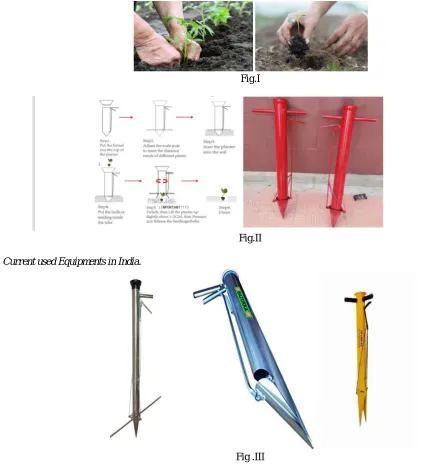
transplanting of vegetables seeding, necessary. Mechanization of transplanting means the reduction demand for labor in cultivating operation in which the minimum damage to seedling and the maximum efficiency of cultivating is being provided. However, this requirement happens when the labor income is less than the revenue provided by machines replacement. Today there are many instruments which are designed and built for automate cultivating of vegetables seedlings, But in spite of large estates which are being cultivated by vegetables in India, especially tomato, but there hasn’t been a widespread and consistent practice in this area, And imported equipment are being used very rare and limited. This need increases by rising cultivating of crops that can be cultivated in transplanted form, and in contrast, it should design and build new equipment and devices for mechanization of this kind of cultures.
Fig.I
Fig.II
C. Current used Equipments in India.
Fig .III
Vegetable transplanters perform the following functions in the field :
1) Open the furrow to a desired depth,
2) Meter the seedlings to obtain the correct spacing in rows, 3) Place the seedlings vertically in a furrow or hole,
4) Cover the seedlings with a sufficient amount of soil, and
[image:2.612.56.495.182.657.2]II. LITERATURE REVIEW
Chow, et al., (1980) have designed a semi-automatic lettuce transplanter. The speed of transplanting machine was 1,000 seedlings per hour in in the farm and the error in planting at 30 cm, was 3%.
Kazmeinkhah, et al, (2007) has designed a semi automatic transplanter machine, in order to cultivate sugar beet seedling .this machine was able to cultivate seedling with the row distance of 65 cm, seedlingdistance of 50.3 cm and 13cm depth. Standard deviation in comparison to the desired position was 4.5% along the cultivation row line and 3.6% perpendicular to the cultivation row line.
Haffar(2009) has designed a trans planter in the United Arab Emirates that the mechanism of transferring seedlingwas in a waistband type and was set for transplanting seeds into pots and postprandial bare.
Ladeindeet al., (2010) in Nigeria, designed a single row transplanter for planting cassava scion that is similar to sugarcane scion. This machine operated with the average forward speed of 4.39 miles per hour, field capacity of 0.39 ha and field efficiency of 60%. Prasanna, et al., (2012) have suggested a mechanism for feeding vegetables seedling in an automatic transplanter. Laboratory assessment of the system showed that this mechanism can be fed at the rate of 33 to 50 seedlings per minutes. In the real farm conditions, the proposed mechanism had the output of 98 to 99% with the forward speed 0.9km.h-1 .
Javidan, et al., (2012) have designed a semi-automatic tomato transplanter. Planting with this device had a significant different in terms of accuracy, speed and cost compared to manual and traditional way with the possibility of 5% and it is preferred to the manual method.
Nandede, et al., (2013) has done the evaluations of a multi-stage automatic transplanter of vegetables cultivation for tomato cultivation in potted grown.
This assessment had done based on a three-row transplanter which is able to plant the seedlings with the space of 45 and 60 cm, and the average forward speed of 2 mil.h-1, respectively.
The Percentage of inability to seed cultivation, percentage of slant transplanting, distance of cultivation on the rows, cultivation depth and extent of seedling damage was 4 to 5%, 8% to 9%, 45 ±1 cm, 7±1.5 cm and 3 to 4%. Field capacity of machine was 0.114ha.h-1 and field efficiency was measured 30.6%. In this study the overall performance of the system were ideal.
III. TRANSPLANTING & DIRECT SEEDING
1) Transplanting versus Direct Seeding: Advantages and Appropriateness of Each Technique
A. Transplanting and Direct Seeding Defined
1) “Transplanting” refers to the act of transferring seedlings from containers in the greenhouse (cell trays, flats, pots, etc.) into the garden or field
2) “Direct seeding” or “direct sowing” refers to planting seeds in the field to germinate in place
3) Note that there are no hard and fast rules about which crops are transplanted vs. directly sown; there are advantages and disadvantages to each method, and a number of factors will play into the decision regarding which approach to use. These include scale of planting, labor availability, length of season, types of seeders available, weed management capacity, and greenhouse and land availability. In some cases, transplanting a difficult-to-transplant crop can pay off if the market offers a premium for early harvest.
B. Transplanted Crops
1) Advantages of starting crops in greenhouse
a) Greater climate control: Temperature, humidity, water
b) Soil mix can be tailored to specific crop, as per fertility and drainage capabilities c) Offers protection from predators and elements: Wind, rain, birds, snails, etc. d) Greater season extension (can start crops earlier indoors)
C. Direct-Sown Or Seeded Crops
1) Advantages of direct seeding
a) Scale of Production: Many crops are direct sown on a large scale to avoid costs associated with greenhouse production and transplanting
b) Certain crops grow well at high density and/or are more easily harvested at high density, and are therefore better suited to direct sowing (e.g. cilantro, baby spinach)
c) Root Nature Of Direct-Sown Crops: Often tap-rooted crops (e.g. beets, carrots, spinach, parsnips) are direct sown so as not to disrupt the taproot by transplanting
[image:4.612.56.553.70.594.2]d) Exceptions: Most crops, including tap-rooted crops, may be transplanted if sown and transplanted in clusters
Fig. IV seedling tray
IV. MATERIALS.
Table I
Part Material Quantity
Body MS (Hollow) 1
Shaft (driver) MS 1 (dia 38mm , length 1.65m)
Driver Gear Harden Steel 1 (125 teeth)
Driven Gear Harden Steel 1 (20 teeth)
Cam MS 1
Pipe Stain Steel 1 (length 0.8m)
Connecting Plate MS 1
Attachment frame Hollow MS
Wheel Tyre 2 (dia 53.34mm)
Plumber block with bearing - 2
Shaft ( driven) Harden MS 1 ( length 0.33m)
Bolts & Nuts, Washer Carbon Steel 26
Master bearing - 2
V. METHODOLOGY
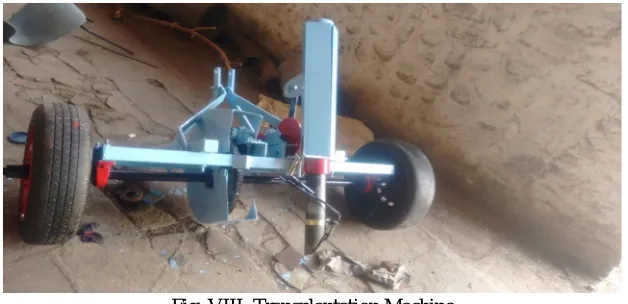
The vegetable transplanter essentially consists of a body, cam, gears, seedling box or tray holder, furrow opener, planting unit, soil covering device, soil compacting device, and a drive to the planting unit. The automatic transplanter has seats for laborers who feed seedlings to the planting unit. Accessories include trash-cutting devices, a ground wheel, water tank, micronutrient or pesticide holding tank, and pipes. In our project we have used very simple gear technology so that every common man can understand the process and repair it on their own capabilities.
A. Gear Technology
TABLE II Gear Specification
SPECIFICATION DRIVER GEAR DRIVEN PINION
No. of teeth 125 21
Outer diameter in mm 340 57
Inner diameter in mm 310 52
Module 2.72 2.7142
Fig. V: Gear assembly
B. Quick Return Mechanism
[image:5.612.171.446.436.543.2]A quick return mechanism is an apparatus that converts circular motion (rotating motion following a circular path) into reciprocating motion (repetitive back-and-forth linear motion) in presses and shaping machines, which are utilized to shape stocks of metal into flat surfaces, throughout mechanical engineering. This mechanism is responsible for up and down of the seedling transplanter device. We have whitworth quick return mechanism.
Fig.VI: Quick return mechanism
[image:5.612.238.373.582.722.2]In our cam we have two holes depending on depth of injection required, i.e. from center of shaft 75 mm and 85 mm.
VI. CALCULATION
Circumference of tire 167.4 cm i.e. for every one full rotation of the tire vehicle moves by 167.4 cm.
As it is said before that driver is mounted on same shaft which are coupled to the tire and so when tire rotates our driver gear also rotates and it attached to the shaft by hole tap and key.
A. Distance Between Seedlings Driver gear is having 125 teeth Driven pinion is having 21 teeth Gear ratio= 125/21 = 5.95
So for every full rotation of the driver gear we will be having 5.95 times rotation of the driven pinion.
One full rotation of the driver gear means one full rotation of shaft as well as tire. As circumference of the tire is 167.5 cm
As cam and driven pinion are mounted on same shaft, as pinion rotates 5.95 times for every one rotation of gear cam also rotates 5.95 times and cam is connected to the seedling transplanter device with help of connect rod so transplanter also punches 5.95 times for every one rotation of gear.
Distance between each seedling is given by the ratio of circumference of tire and gear ratio used. Distance between seedling= 167.4/5.95
= 28.13 cm B. Depth Of Punch
[image:6.612.150.464.339.491.2]If connect rod is mounted on 75 mm for cam center then depth of punch is 15mm. If connect rod is mounted on 85 mm for cam center then depth of punch is 25 mm
Fig. VIII: Transplantation Machine
VII. RESULTS AND DISCUSSIONS
A. According to practical operation the following result are obtained:
B. The operating speed of the tractor should be between 5 to 6 kmph.
C. The connecting rod is connected at 75mm the depth of punch is 15mm, and when the connecting rod is connected at 85mm the
depth of punch is 25mm.
D. The distance between the 2 seedlings as observed is 30cm or1 feet. The distance between seedling can be varied by changing
gear ratios (by changing the number of teeth of pinion). As the machine is designed for planting the tomato and egg plant , so the distance between adjacent seedling should be 30cm.
E. The speed of the transplanting machine is around 1,200 to 1,500 seedlings per hour.(depends on operator) F.
VIII. FUTURE SCOPE
A. This machine could be modified for multi-crop transplanting .
B. This can be used for planting more the 2 seedlings at a time at particular distance .
C. Engine can be installed for power transmission.
D. Gear box can be used for easy working.
IX. CONCLUSIONS
A. Tray -plants survive well after being transplanted.
B. Planting the vegetable seedlings in rows at desired depth and plant to plant spacing cover the plants with soil and provide proper compaction over the plant.
C. Time consumed for planting is less compared to manual planting .
D. Relative cheaper then transplanting manually.
E. Labor required for planting is less.
F. Average yield is high , as seedling are first grown in nursery which are maintain in better climatic conditions . G. Plants are usually healthier and have strong , deeper systems.
H. Plant density is higher .
I. Time consumed is less for planting.
REFERENCE
[1] Chow, J. B, J. Wang., j. k. and Myers, A. L. 1980. Hand-fed lettuce seedling blocktransplanter, Transactions of the ASABE. 23 (5): 1117-1120 [1]
[2] Haffar, I. 1995. Design and field evaluation of a Low cost Crop transplanter with multiple seedlings feed. Agricultural Mechanization in Asia –Africa and Latin America , 26 (3) : 29-32
[3] Javidan, M. and Mohammad zamani, D. 2012. Design, Construction and Evaluation of a Semi-automatic Tomato Transplanter .M.Sc thesis. Islamic Azad University. Takestan Branch.
[4] Kazmeinkhah, K. 2007.Determination of Energetic and Ergonomic Parameters of a Semi-automatic Sugar-beet StecklingTransplanter. J. Agric. Sci. Technol. Vol. 9: 191-198.
[5] Ladeinde, M. A., S. Verma., S. R. and Baksher, V. 1995. Performance of semi-automatic tractor - mounted cassava planter. Agricultural Mechanization in Asia –Africa and Latin America , 26 (1) : 27-30
[6] Nandede, B.M., Kumar Ranjeet, Padhee D.2013. Evaluation of multistage automatic vegetable transplanter (MAVT) for pot seedlings of tomato. BIOINFOLET - A Quarterly Journal of Life Sciences. Volume : 10, Issue : 1b