2108
©IJRASET: All Rights are ReservedTransmogrified Imputation Algorithm for
Clustering Data in Missing Data Imputation
A. Linda Sherin1, Dr. S.Niraimathi2
1
Ph.D. Research Scholar Full Time, 2Associate Professor , Dept. of Computer Science, NGM College, Tamilnadu, India
Abstract: This research article proposes to implement transmogrification process in the Imputation procedures to overcome the challenges in missing values. Appropriate data pre-processing methods and clustering mechanisms in data mining plays significant role to ensure good quality of data. The data pre-processing tasks include identification of outliers, smoothening noisy data and overcoming inconsistent data. Issues related to data incompleteness, still remains a challenge to many researchers. The transmogrified method uses mathematical approach and cluster based Imputation Algorithm for missing data imputation. The IBM Log data set and Sonar data set were used to demonstrate the performance of the proposed method. The proposed algorithm is evaluated by extensive experiments and comparison with KNNI - Imputation with K-Nearest Neighbor, MSC- Imputation with Mean-shift Clustering, AHC- Agglomerative Hierarchical clustering, EM-GMM- Expectation – Maximization Clustering using Gaussian Mixture Models and Naïve Bayesian Model. The results showed that the proposed algorithm has better performance than the existing imputation algorithms in terms of classification accuracy.
Keywords: KNNI - Imputation with K-Nearest Neighbor, MSC- Imputation with Mean-shift Clustering, AHC- Agglomerative Hierarchical clustering, EM-GMM- Expectation – Maximization Clustering using Gaussian Mixture Models and Naïve Bayesian Model
I. INTRODUCTION
Missing values has long been an unavoidable problem that occurs to almost data-driven solutions. There are various causes such as incomplete data collection, data entry errors, incompetent data acquisition from experiments, and unfinished responses to a questionnaire [1]. This raises a significant problem towards data analysis, especially to those learning Models that are compatible only with a complete data set. Over the past decades, Provision of innovative research aiming to fill in missing vales is continuously developed [2]. A rich collection of data pre-processing techniques has been made available, including zero imputation, average imputation, minimum imputation, maximum imputation, expectation maximization, linear regression imputation and k-nearest neighbours. Unlike the conventional approach that excludes any record with missing values, the aforementioned statistical and machine learning methods attempt to predict those with the values close to the original data. In this research the following supervised and unsupervised learning algorithms are compared with the proposed algorithm.
II. LITERATURE REVIEW
2109
©IJRASET: All Rights are ReservedLiu, Lei Lei et al. applied the supervised machine learning techniques called Naïve Bayesian Classifier. In the data mining context, machine learning technique is generally classified as supervised and unsupervised learning technique both belong to machine learning technique. Supervised classification focus on the prediction based on known properties and the classification of unsupervised focus on commonly used classification algorithm known as Naïve Bayesian imputation techniques.
Mean Imputation is the process of replacing the missing data from the available data where the instance with missing attribute belongs. Median Imputation is calculated by grouping up of data and finding average for the data. Median can be calculated by finding difference between upper and lower class boundaries of median class. Standard Deviation calculate the scatter data concerning the mean value. It can be convenient in estimating the set of fact which can possess the identical aim but a different domain. Estimate standard deviation based on sample and entire population data. Another way of learning technique is classified as supervised learning that focus on the prediction based on known properties.
Naïve Bayes technique is one of the most useful machine learning techniques based on computing probabilities. It analyses relationship between each independent variable and the dependent variable to derive a conditional probability for each relationship. A prediction is made by combining the effects of the independent variables on the dependent variable which is the outcome that is predicted. It requires only one pass through the training set to generate a classification model, which makes it very efficient. The Naïve Bayesian generates data model which consists of set of conditional probabilities, and works only with discrete data.
III. METHODOLOGY
In this article Transmogrification of Imputation Algorithm for Clustering of Data is dealt with novel for missing data imputation, the transmogrified method uses mathematical approach and Index segmentation based Imputation Algorithm for missing data imputation. The databases were used to demonstrate the performance of the proposed method. The proposed algorithm is evaluated by extensive experiments and comparison with KNNI - Imputation with K-Nearest Neighbor, MSC- Imputation with Mean-shift Clustering, AHC- Agglomerative Hierarchical clustering, EM-GMM- Expectation – Maximization Clustering using Gaussian Mixture Models and Naïve Bayesian Model. An imputation strategy Transmogrified approach is described to compute the proximity measure in the feature missing space between the missing data to identify the nearest neighbor missing data from where the values are to be imputed.
2110
©IJRASET: All Rights are ReservedIV. EVALUATION AND RESULTS
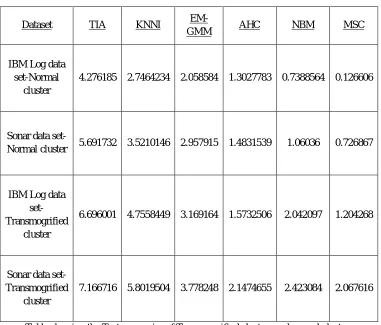
In this section we present the experimental evaluation for a Transmogrified Imputation Algorithm (TIA) for clustering data in Missing Data Imputation using IBM Log data set and Sonar data set. The table below reveals the test accuracies of Transmogrified clusters obtained through TIA and normal clusters. The Transmogrified Imputation Algorithm TIA is compared with other algorithms with KNNI - Imputation with K-Nearest Neighbor, MSC- Imputation with Mean-shift Clustering, AHC- Agglomerative Hierarchical clustering, EM-GMM- Expectation – Maximization Clustering using Gaussian Mixture Models and Naïve Bayesian Model.
Datasets Used For the Experiment
Dataset TIA KNNI
EM-GMM AHC NBM MSC
IBM Log data set-Normal
cluster
4.276185 2.7464234 2.058584 1.3027783 0.7388564 0.126606
Sonar data
set-Normal cluster 5.691732 3.5210146 2.957915 1.4831539 1.06036 0.726867
IBM Log data set-Transmogrified
cluster
6.696001 4.7558449 3.169164 1.5732506 2.042097 1.204268
Sonar data set-Transmogrified
cluster
[image:3.612.117.498.269.594.2]7.166716 5.8019504 3.778248 2.1474655 2.423084 2.067616
Table showing the Test accuracies of Transmogrified clusters and normal clusters
The chart below clearly depicts that Transmogrified Imputation Algorithm (TIA) for clustering data in missing data imputation using IBM Log data set and Sonar data set yields more test accuracies when compared to KNNI - Imputation with K-Nearest Neighbor, MSC- Imputation with Mean-shift Clustering, AHC- Agglomerative Hierarchical clustering, EM-GMM- Expectation – Maximization Clustering using Gaussian Mixture Models and Naïve Bayesian Model.
Datasets Records Attributes
IBM Log data set 56865 182
2111
©IJRASET: All Rights are ReservedTest Accuracies of Transmogrified Clusters and Normal Clusters using IBM Log data set and Sonar Data set
V. CONCLUSION
In this article, Transmogrified Imputation Algorithm for Clustering of Data in Missing Data (TIA) is described. It is an Improved novel Clustering Algorithm where Transmogrification of Data based Imputation Algorithm of missing values is discussed, that aims to improve in terms of accuracy. The test accuracies of TIA were compared with KNNI - Imputation with K-Nearest Neighbor, MSC- Imputation with Mean-shift Clustering, AHC- Agglomerative Hierarchical clustering, EM-GMM- Expectation – Maximization Clustering using Gaussian Mixture Models and Naïve Bayesian Model using two different data sets IBM Log file data set and Sonar data set. We conclude that the use of our Transmogrified Imputation Algorithm for Clustering of Data in Missing Data improved the accuracies of the predictions on real world missing data value problems.
REFERENCES
[1] Alexander J Stimpson and Mary L. Cummings (2016), “Assessing Intervention Timing in Computer-Based Education Using Machine Learning Algorithms”, IEEE Access, Volume 2.
[2] AlirezaFarhangfar, Lukasz A.Kurgan (2007), “A Novel Framework For Imputation Of Missing Values In Databases”, IEEE Transactions On Systems Man And Cybernetics Part A: Systems And Humans, Vol. 37.
[3] Anton Akusok (2016), “Extreme Learning Machines: Novel Extensions and Application to Big Data”, springer.
[4] Archana Purwar, Sandeep Kumar Singh (2015), “Hybrid Prediction Model with Missing Value Imputation for Medical Data”, Expert Systems with Applications, Doi: Http://Dx.Doi.Org/10.1016/J.Eswa.2015.02.050.
[5] Biao Qin, Yuni Xia, Fang Li (2010), “A Bayesian Classifier for Uncertain Data”, Proceedings of the ACM Symposium on Applied Computing, Pages 1010-1014, March 22 – 26.
[6] Bing Zhu, Changzheng He, PanosLiatsis (2012), “A Robust Missing Value Imputation Method for Noisy Data”, Published Online: 28 July 2010 Springer Science Business Media, Llc, ApplIntell 36 Pg no: 61–74 Doi 10.1007/S10489-010-0244-1.
0 1 2 3 4 5 6 7 8
A
C
C
U
R
A
C
Y
Test accuracies of Transmogrified clusters and normal clusters
IBM Log data set-Transmogrified cluster
Sonar data set-Transmogrified cluster
IBM Log data set-Normal cluster
2112
©IJRASET: All Rights are Reserved[7] Fabio Lobato, Claudomiro Sales, Igor Araujo, Vincent Tadaiesky, Lilian Dias, Leonardo Ramos, Adamo Santana (2015), “Multi-Objective Genetic Algorithm for Missing Data Imputation”, Pg no: S0167-8655(15) 00288-Doi: 10.1016/J.Patrec.2015.08.023 Reference: PATREC 6335, Received Date: 10 February 2015,
[8] G.Madhu, T.V.Rajinikanth (2012), “A Novel Index Measure Imputation Algorithm For Missing Data Values: A Machine Learning Approach”, Computational Intelligence & Computing Research (ICCIC), IEEE International Conference, Doi: 10.1109/Iccic.2012.6510198.
[9] Kuen-Fang, Jea, Chao-Wei Li, Chih-Wei Hsu, Ru-Ping Lin (2010), “A Load -Controllable Mining System for Frequent-Pattern Discovery in Dynamic Data Streams”, Machine Learning and Cybernetics (ICMLC), International Conference On (Volume: 5), ISBN No. 978-1- 4244-6526-2.
[10] Liqiang Pan, Jianzhong Li (2010), “K-Nearest Neighbor Based Missing Data Estimation Algorithm In Wireless Sensor Networks”, Wireless Sensor Network, Vol- 2, Pg.no 115-122 Doi:10.4236/Wsn.2010.22016.
[11] Matthew Eric Otey, Chao Wang, Srinivasan Parthasarathy, Adriano Veloso, Wagner Meira Jr (2003)”, Mining Frequent Itemsets In Distributed and Dynamic Databases,” IEEE Int'l Conf. On Data Mining.
[12] Mehran Amiria, Richard Jensen (2016), “Missing Data Imputation Using Fuzzy-Rough Methods”, Article in Neuro computing 205, Doi: 10.1016/J.Neucom.2016.04.015.
[13] Nan Jiang (2007), “Selective Integration of Linguistic Knowledge in Adult Second Language Learning”, Selective Integration of Linguistic Knowledge. [14] P. Vasudevan (2014), “Iterative Dichotomiser-3 Algorithm in Data Mining Applied to Diabetes Database” Journal of Computer Science Vol-10 (7) Pg.no:
1151-1155, ISSN: 1549-3636 © Science Publications Doi:10.3844/Jcssp.2014.1151.1155 (Http://Www.Thescipub.Com/Jcs.Toc).
[15] P.Saravanan, P.Sailakshmi (2015), “Missing Value Imputation Using Fuzzy Possibilistic C Means Optimized With Support Vector Regression And Genetic Algorithm”, Journal Of Theoretical And Applied Information Technology. Vol.72.
[16] Priyadharsini.C, Dr. Antony SelvadossThanamani (2014), “Prediction of Missing Values in Blood Cancer & Occurrence of Cancer Using Improved Id3 Algorithm” International Journal Of Innovative Research In Computer And Communication Engineering (An Iso 3297, Certified Organization) Vol. 2, Issue 8.
[17] Vincent, S.Tseng, Chun-Jung Chu, Tyne Liang (2006), “Efficient Mining Of Temporal High Utility Itemsets From Data Streams”, Copyright ACM 1-59593-440-5/06/0008.