Abstract— In this paper a new way to taking into account human error in the process of nuclear power plants maintenance optimization is presented. It explains the use of the term hotspots. Those points become relevant in a risk point of view when they are under scheduled maintenance. This paper shows how these hotspots are significant and requires a special consideration for their discovery and management.
Index Terms—human error, maintenance, management, nuclear.
I. INTRODUCTION
The maintenance optimization is not a straight line or an area cleared, but on the contrary a meandering and darkened path. Several methods were proposed [1-11] with partial focus or more integrated approached [12-14] but an issue is incorporated with more and more emphasis each year, the human error. In general the human error could be classified in Error of Omission (EOO) and Error of Commission (EOC) [15]. The first implies the loss of one or more steps in a procedure. The last is when a different procedure was made. The difference may be one or more steps. The main issue in both of them is that the human is unconscious of the error. The personnel believe that the procedure is complete (in EOO) or better than the original procedure (in EOC).
The human error occurring in maintenance tasks is a focus for several works and studies some with a special interest for this paper [16-21], because they represent the background necessary for this development.
In nuclear area, the regulation in many countries around the world includes the development of a Probabilistic Safety Assessment (PSA) [22] for the construction and operation license. This study includes models for the external events, components and systems failures, accident sequences and human error. In this work will see like a PSA support a maintenance optimization but need add some requires evaluating the importance the human error during maintenance.
Manuscript received March 23, 2011; revised April 16, 2011. This work was supported in part by the CONICET (Consejo Nacional de Investigaciones Científicas y Técnicas) and SeCTyP (Secretaría de Ciencia, Tecnolgía y Posgrado) of the Universidad Nacional de Cuyo, Argentina.
J.E. Núñez Mc Leod is with CONICET and Engineering Faculty of the Universidad Nacional de Cuyo, Mendoza, CO KFA5502, Argentina (phone: +54 261 4135000 ext. 2135; fax: +54 261 4380120; email: [email protected]).
S.S. Rivera is with Engineering Faculty of the Universidad Nacional de Cuyo, Mendoza, CO KFA5502, Argentina (phone: +54 261 4135000 ext. 2135; fax: +54 261 4380120; email: [email protected]).
II. MODEL HUMAN ERROR WITH THERP
THERP [23] uses conventional reliability technology with adaptations to the uncertainties and interdependencies of human performance. The basics steps to follow are:
1) Define the system failures of interest.
2) List and analyze the related human operations (task analysis).
3) Estimate the error probabilities.
4) Estimate the effects of human errors on the system failure events.
The previous steps are used during design stage for assessment and for obtain the construction license. If possible to add a step to remark changes and then recalculate the error probabilities during design or redesign tasks.
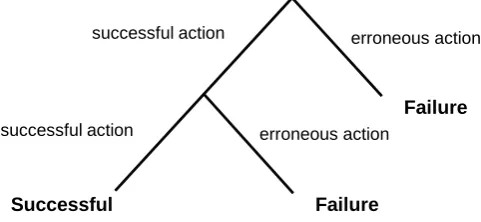
[image:1.595.307.548.425.536.2]THERP is not a model in the usual way, is a Boolean representation of the human behavior. The basic tool of THERP is called Human Event Tree. The Fig. 1 shows an example.
Fig. 1. Example of Human Event Tree
The right branches represent the erroneous actions and the left branches the successful action. All probabilities, except those in the first branching, are conditional probabilities.
In the failure branch a successful intervention of a supervisor can drive to a recovery action and the successful path is taken again. That is recovery actions are represented as dash lines.
III. HUMAN ERROR MANAGEMENT
Human Error Management in the facilities is a complex set of organizational, qualification and control aspects [19]. In a simple way several decisions must be taken by the managers. 1) Is need it the administrative control on written procedures
use?
2) Is need it the supervisor for a specific task?
3) Is need it to use a written procedure to follow a task? 4) Is need it a special qualification for a task?
Failure
Successful Failure
erroneous action successful action
successful action erroneous action
Jorge E. Núñez Mc Leod and Selva S. Rivera
But these questions are like a linear approach to on a non-linear problem. When we think that the maintenance tasks will be done by a mechanics task force, electricians task force and electronics task force, independently each other, all over the same equipment, with timing or not, the real picture rise.
An example is when we take into account only one equipment with tasks over instrumentation, mechanical parts and electrical parts like a pump. This is the more simplified scenery, due to all activities are done in a moment. The checkoff includes all the equipment, is simple and complete. The different task forces will work with complete offline equipment.
But now, the maintenance scheduled could be optimized and then the scheduled for each maintenance task forces change deeply (e.g. the mechanics task forces will begin later when the other task will be accomplished). In this scenery the checkoff list for optimal performance will be different. The new checkoff list will be created from the original chekoff cutting the excess. This action create a human scenery with a high probability of error, if this involve a critical system, we notice this how a “human error hotspot”.
Human error hotspots (HEH) will be that sceneries that results in:
1) A reactor trip or shut down necessity before regularly planned outages,
2) A reduction in power or efficiency, 3) Exceeding a technical specification limit, 4) An increased personnel safety hazard, 5) A significant damage,
6) A violation of environmental release limits,
7) A radiation release to the public, 8) A fire.
IV. MODELING
The traditional point of view about the maintenance effectiveness is focused on the actions on an item. Understanding maintenance effectiveness like a degree to which the operating conditions of an item are restored after a maintenance action was performed. Follow that idea Pham and Wang [25] proposed consider:
a. Perfect repair of perfect maintenance: a maintenance action which restores the system operating condition to as good as new.
b. Minimal repair or minimal maintenance: a maintenance action which restores the system to the failure rate it had when it failed.
c. Imperfect repair or imperfect maintenance: a maintenance action does not make a system like as good as new, but younger.
d. Worse repair or maintenance: a maintenance action which makes the system failure rate or actual age increases but the system does not break down.
[image:2.595.65.552.441.769.2]a. Repair the wrong part
b. Only partially repair the faulty part
c. Repair (partially or completely) the faultry part but damage adjacent parts
d. Incorrectly assess the condition of the unit inspected e. Perform the maintenance action not when called for but at
his convenience.
f. Hidden faults and failures which are not detected during maintenance
g. Human errors such as wrong adjustments and further damage done during maintenance
h. Replacement with faulty parts
In the previous approaches is hidden the relations between different maintenance teams (i.e. electronical, mechanical and electrical) on the same equipment, subsystem or system. We need to raise it on the horizon to lead with them. This paper works on this issue.
In another hand like conclude Van Horenbeek et al [28] from the literature study performed by them, all maintenance optimization input parameters to develop maintenance optimization model are well studied, except for the maintenance criteria used. The number of maintenance criteria or objectives used in literature for optimization is limited. Moreover, no attention is paid to which criteria are important in specific business cases.
The maintenance objectives for Dekker [2] can be summarized in ensuring system function (availability, efficiency and product quality), ensuring system life (asset management), ensuring safety and ensuring human well-being.
And the optimization of maintenance activities several times does not include a formal resolution model. In those cases the situation is worse, because new decisions are taken over changed models without a deep analysis.
We need found the critical points that need additional analysis or supervision when changes are done in the standard procedures.
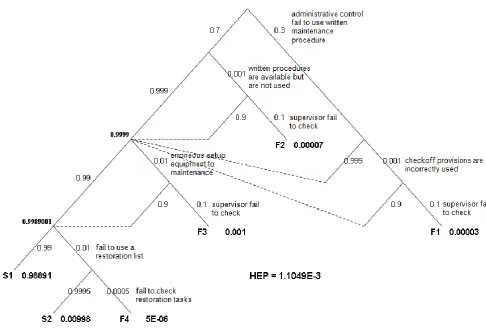
A typical maintenance task may be modeling like in Fig. 2. This model shows the probability of each branch beside them. The probability of each branch identified like S (successful) or F (Fail). Each branch has their probability and the total human error probability (HEP) for each model is shown too.
Table I resumes the used data. The data were selected from [15].
The model represents an alternative of an actual schedule for organize and control the work of technician.
The change in some of the elements, without the respective studies, drives directly to a HEH. So, a change in the administrative control due to results from the maintenance optimization, require a new evaluation for accomplish with risk-informed decisions philosophy. Others changes in maintenance written procedures, checkoff list, setup equipment procedures, restoration list, require a new evaluation too. This evaluation may be meaningfully for the senior task forces manager support by experience.
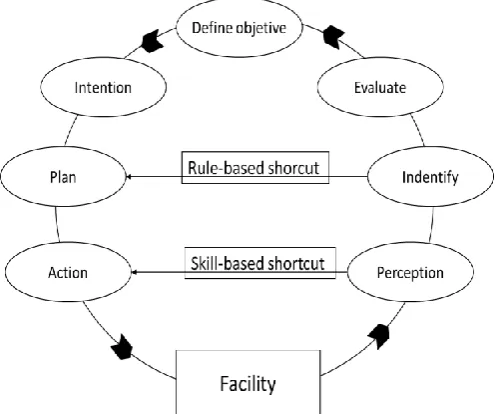
[image:3.595.300.550.109.265.2]This is usually in this case and matched exactly to simplified Rasmussen model [24] for experienced worker shown in Fig. 3.
Table I. Human error probabilities
Description Probability
Erroneous setup equipment to maintenance 0.01 Fail to restore (previous condition) 0.5
Supervisor fail to check 0.1
Fail to check restoration tasks 0.2 Written procedures are available but are no
used
0.001 Fail to use a restoration list 0.01 Administrative control fail to use written
maintenance procedure
0.3 Checkoff provisions are incorrectly used 0.001
When a young or inexperienced worker is faced with a possible change in the procedures, he follow the way around de circle, stopping when he need it. He identifies the scenery, then evaluates it, then defines an objective, then he has an intention to solve the situation, then he generates a plan and finally executes an action.
When a well former worker is faced with the same situation, he supports his decisions on well-known rules. His answers are faster than an inexperienced worker, but the identification step is more relevant than in the previous case, because does not exist an evaluation step. If the identification step was wrong the plan will be inexorably wrong. We lost a reflexive step.
When a senior worker is faced with the same case, he act based on his skills, developing during several years in the facility. His perception is the most relevant step.
Fig. 3. Simplified reasoning model
[image:3.595.305.553.483.690.2]Fig. 4. Model for technician works alone.
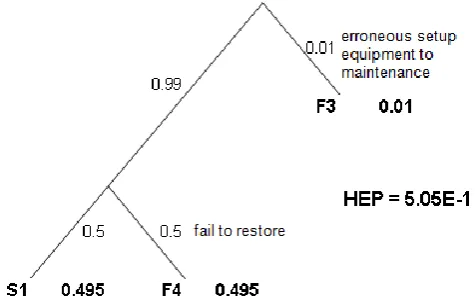
The model shows the Human Error Probability raise from 1.1x10⁻³ to 5x10⁻¹ but hidden the HEH. The HEH was inception when the procedures that include a supervisor are changed, it was erased the supervisor but not changed the procedures.
The technician learned the procedures with a check and control supervisor, but now is his responsibility. However the procedures were thought with supervision, the training was designed with supervision, due to this the situation require an analysis according to the criticality of the equipment, subsystem or system involved in this maintenance.
The main risk is associated in this case not to the technician work but the supervisor work (e.g. the supervisor include checks about the context of the equipment).
V. DISCUSSION
Accident in the nuclear area such as Three Mile Island in 1979 [29], Chernobyl in 1986 [30, 31] or in chemical area such as Seveso in 1976 [32] and Bhopal in 1984 [33] are examples that include HEH.
In all the cases the scenery was changed due to a manager decision and the procedures were followed without a deep analysis. Wrong actions were done. In all cases when the accident began more HEH became relevant due to additional manager, supervisor and technical decisions.
In other cases the situations were due to external events like earthquake or electrical blackout. It is expected that the HEH guide the situation for the worse way. This no imply that the end will be bad but would have been better.
VI. CONCLUSIONS
The identification of the Human Error Hotspots like a concept to analyses results is a step forward in the analysis of designs, procedures and maintenance models applied in the Nuclear Power Plants.
Fukushima Daiichi Nuclear Power Station Accident with 4 Nuclear Reactor involved shows from Tokio Electric Power Company (TEPCO) [34] and the Nuclear and Industrial Safety Agency (NISA) [35] Press Releases that the Human Error Hotspots were relevant in the mitigation of the accident.
VII. FURTHER WORKS
The inception of a new concept like Human Error Hotpots, require deep work to formalize it, apply it and extend it. The next works search for a systematic way to approach the HEH analysis and how to avoid it or generate a way to apply changes on a fly with safety and reliability.
REFERENCES
[1] Dekker, R. (1995). "On the use of operations research models for maintenance decision making". Microelectronics and Reliability, 35(9-10), pp. 1321-1331.
[2] Dekker, R. (1996). "Applications of maintenance optimization models: a review and analysis". Reliability engineering & system safety, 51(3), pp. 229-240.
[3] Pierskalla, W.P., Voelker, J.A. (1976). A survey of maintenance models: The control and surveillance of deteriorating systems. Naval Research Logistics Quarterly, 23, pp. 353-388.
[4] Scarf, P. (1997). "On the application of mathematical models in maintenance". European Journal of Operational Research, 99(3), pp. 493506.
[5] Wang, H. (2002). "A survey of maintenance policies of deteriorating systems". European Journal of Operational Research, 139(3), pp. 469-489.
[6] R. Luus, “Optimization of System Reliability by a New Nonlinear Integer Programming Procedure,” IEEE Transactions on Reliability, 1975, 24(1): p. 14-16.
[7] A.K.Dhingra, “Optimal Apportionment of Reliability & Redundancy in Series Systems Under Multiple Objectives,” IEEE Transactions on Reliability, 1992, 41(4): p. 576-582.
[8] Z.Xu, W. Kuo, and H.-H. Lin, “Optimization limits in improving system reliability,” IEEE Transactions on Reliability, 1990. 39(1): p. 51-60.
[9] R.Dekker, “Applications of maintenance optimization models: a review and analysis,” Reliability Engineering and System Safety, 1996(51): p. 229-240.
[10] M. Harunuzzaman and T. Aldemir, “Optimization of standby safety system maintenance schedules in nuclear power plants,” Nuclear Technology, 1996, 113: p. 354-367.
[11] C.M.F. Lapa, C.M.N.A. Pereira, and A.C.d.A. Mol, “Maximization of a nuclear system availability through maintenance scheduling optimization using a genetic algorithm,” Nuclear Engineering and Design, 2000, 196: p. 219-231.
[12] M.Cantoni, M. Marseguerra, and E. Zio, “Genetic algorithms and Monte Carlo simulation for optimal plant design,” Reliability Engineering and System Safety, 2000(68): p. 29-38.
[13] J.E. Núñez Mc Leod, S.S. Rivera & J.H. Barón, “Optimizing Designs based on Risk Approach,” Proceedings of the World Congress on Engineering 2007, 2, pp 1044-1049.
[14] International Atomic Energy Agency, Application of Reliability Centred Maintenance to Optimize Operation and Maintenance in Nuclear Power Plants, IAEA-TECDOC-1590, Vienna:IAEA, 2007. [15] A. Swain and H. Guttman, Handbook on Human Reliability Analysis
with Emphasis on nuclear Power Plant Applications. UREG/CR-1278, ed. N.R. Commission. 1983, Washington, USA.
[16] Nuclear Regulatory Commission, PRA Procedures Guide: A guide to the performance of probabilistic risk assessments for nuclear power
plants review. NUREG/CR 2300, Washington: NRC, 1983
[17] P. Kafka, “Probabilistic safety assessment: quantitative process to balance design, manufacturing and operation for safety of plant structures and systems,” Nuclear Engineering and Design, 1996, 165: p. 333-350.
[18] S.S. Rivera & J.E. Núñez Mc Leod, “Human errors in biofuels plant accidents,” Proceedings of the World Congress on Engineering 2008, pp 1214-1219.
[19] S.S. Rivera & J.E. Núñez Mc Leod, “Human error of commission modeled with Theory of Games,” Proceedings of the World Congress
on Engineering 2007, 2, pp 1117-1122.
[21] S.S. Rivera & J.E. Núñez Mc Leod, “Human error management optimization in CAREM NPP, International” Association of Engineering; ISBN 978-988-17012-5-1, London, UK, 2009. [22] R.R. Fullwood, Probabilistic Safety Assessment in the Chemical and
Nuclear Industries, 2000, Boston, USA: Butterworth-Heinemann.
[23] Swain, A.D., “THERP”, SC-R-64-1338, Sandia National Laboratories, Albuquerque, NM, 1964.
[24] Rasmussen, J., “Strategies for State Identification and Diagnosis in Supervisory Control Tasks, and Design of Computer-Based Support Systems”, Advances in Man- Machine Systems Research, Vol.1, Denmark, pp. 139-193, 1984
[25] Pham, H., Wang, H. “Imperfect maintenance”, European Journal of
Operational Research, 94(3), pp. 425-438.
[26] Brown, M. and Proschan, F. “Imperfect repair”, Journal of Applied
Probability, 20, pp. 851-859, 1983.
[27] Nakagawa, T. and Yasui, K., “Optimum policies for a system with imperfect maintenance”, IEEE Transactions on Reliability, R-36/5, 631-633.
[28] Van Horenbeek, A., Pintelon, L. and Muchiri, P., “Maintenance Optimization Models and Criteria”, Proceedings of the 1st
International Congress on eMaintenance, pp. 5-13, Lulea, Sweden,
2010.
[29] Kemeny, j. et al, Report of The President´s Commision on The Accident
at Three Mile Island, 1979, Washington DC, USA.
[30] Mochizuki, H., “Analysis of the Chernobyl accident from 1:19:00 to the first power excursion”, Nuclear Engineering and Design, 237 (2007), pp. 300-307.
[31] NEA Committee on Radiation Protection and Public Health, “Chernobyl Ten Years”, OECD Nuclear Energy Agency, 1995. [32] Wilson, D., “Lessons from Seveso”, Chemitry in Britain,pp. 499-504,
1980
[33] Kalelkar, A., “Investigation of Large-Magnitude Incidents: Bhopal as a case study”, Chemical Engineers Conference On Preventing Major
Chemical Accidents, London, 1988.
[34] TECPO (March 22, 2011), url:www.tepco.co.jp/en/index-e.html, March 22, 2011.