Quality Evaluation of Malted Barnyard Millet
Flour and Development of Value Added Rusk
Neelam Chaturvedi1, Divya Rawat2
1, 2
Department of Food Science and Nutrition, Banasthali University, Dist Tonk, Rajasthan-304022, India
Abstract: Millets have been neglected despite their nutritive value and therapeutic use. Barnyard (Echinochala frumentacea) is one of the underutilized minor millet which has high-quality nutraceutical potential. Its expediency has made it an essential food source mainly in arid and semi-arid region. Processing particularly malting results in biochemical modification improve nutritional quality and reduce anti -nutrients content. The investigation attempts have been made to assess the proximate composition (moisture, ash, protein, fiber, fat, carbohydrate, vitamin-C, calcium and iron); functional properties (water absorption capacity, oil absorption capacity, bulk density, swelling capacity) of malted and unmalted barnyard flour and sensory appraisal of malted barnyard flour based rusk by 5-point composite and 9-point hedonic scale. The results showed that malted barnyard flour had significant difference for…………. whereas protein (11.82±0.19g/100g) and carbohydrate (66.35±0.26
g/100g) were insignificant at p≤0.05. The functional properties exhibited that water absorption capacity (69.1±0.15), oil
absorption capacity (209.4±0.11) and swelling capacity (3.53±0.23) were significant whereas bulk density (0.78±0.03) showed
insignificant difference at p≤0.05 level when compared to unmalted barnyard flour. Variant I-Rusk (80:20;wheat flour: malted
barnyard flour) had insignificant(p≤0.05) mean sensory scores in terms of color, appearance, texture, crispiness, taste and
overall acceptability when compared to control Rusk(100%wheat flour). Therefore, the improvement in term of nutrients, functional properties and sensory quality that would be a vital key to expand the spectrum of malted barnyard millet flour in bakery products and their significant contribution to national food security and potential health benefits.
Keywords: Barnyard millet, malting, proximate composition, functional properties, sensory evaluation
I. INTRODUCTION
In a world of growing prosperity and agricultural abundance, about 800 million people still suffer from hunger and malnutrition. Eliminating hunger and malnutrition is one of the most elementary challenges faced by humanity [1]. Despite recent achievement in economic progress inIndia, it has failed to secure a better nutritional status of children in the country. India presents a typical scenario of South-Asia, fitting to the adage of ‘Asian Enigma’where progress in childhood malnutrition seems to have sunken into an apparent under nutrition trap, lagging far behind the other Asian countries characterized by similar levels of economic development [2].
Millet is one of the oldest foods known to humans and possibly the first cereal grain used for domestic purposes [3]. Millets have been in use since time immemorial and an array of traditional healthy foods are prepared across rural India. Apart from health benefits, millets are also good source of energy, protein, vitamins and minerals. The nutritional significance of minor millets lies in their richness in micronutrieints like calcium, iron, phosphorus, vitamins and sulphur containing amino acids. For these superior properties of minor millets, they have been recently designated as “Nutritious Millets” [4].
Barnyard millet is the fastest growing of all millet and it is grown in India, Japan, China as a substitute for rice. In India, barnyard millet is extensively grown in the central part where it is known as sawa, shama, samu, shamula, kudiraivali, sanwa, etc. [5].
Its cultivation is mainly confined to tribal belts of Orissa, Maharashtra, Madhya Pradesh, Tamil Nadu, Bihar, Punjab, Gujrat and Uttrakhand [6]. It is a fair source of protein with high digestible value and it is an excellent source of dietary fiber with good amount of soluble and insoluble fractions [7].
II. EXPERIMENTAL DETAILS A. Collection of Barnyard Millet
Barnyard millet was collected from local market of Dehradun and further research work was carried out in the Department of Food Science and Nutrition, Banasthali Vidyapith, Rajasthan.
B. Barnyard Millet Flour Production
2kg of barnyard millet sample wastaken and soaked for 24h followed by 72h of germination. Vegetative growth portion were removed by gentle brushing (manually).De–vegetated seeds were weighed and grounded for functional and nutritional analysis.
C. Functional Properties of Flour
Malted and unmalted flour samples were analyzed for functional properties in triplicate.Water and oil absorption capacity was determined by the method of [9], Bulk density and swelling capacity according to the method described by [10], with some modifications.
D. Proximate Composition of Flour
Determination of moisture (Oven-Drying Method), ash (Dry Ashing Method),protein (Kjeldahl Method), fat (Soxhlet Method), fiber (Acid Alkali Method) and carbohydrate (Difference Method; Carbohydrate content (g/100g) = 100 – (Moisture Content + Ash Content + Fat Content + iber Content + Protein Content) according to the procedures [11].
Minerals such as Calciumand iron contents were determined by using Atomic Absorption Spectrophotometer (AAS) and Vitamin-C content was analysed by the method [12].
E. Product Development
Three variations of rusk were developed with incorporation of barnyard millet along with standard. Each variation comprised of wheatflour and barnyard millet flour in different ratios as 80:20 (wheat flour:malted barnyard flour) (variation-I), 70:30(wheat flour:malted barnyard flour) (variation-II) and 60:40(wheat flour:malted barnyard flour) (variation-III).
All the three types of rusk were evaluated organoleptically. Basic ingredients were weighed accurately.
1) Water and yeastwere mixed and transferred to the kneader containing, wheat flour, malted millet flour, sugar, shortening and salt.
2) After homogeneousmixing, the dough was placed in a proofer for 15 minutes to activate theyeast.
3) After the said time, it was again transferred to the mixer and oil was added and mixing was continued until dough became to some extentelastic.
4) The dough was divided into dough balls (50 g), transferred topans and received proofing time of 15 minutes.
5) Afterwards, loaves werebaked in a baking oven for 10-12 minutes at 218ºC.
6) Loaves were cooleddown and cut into two pieces and again baked until the required colorwas obtained.
F. Sensory Evaluation
The value added barnyard millet rusk were evaluated for organoleptic quality attributes by ranking the responses using a 5 point ranking test method [13] by a panel of 25 semi-trained judges from Department of Food Science and Nutrition, Banasthali Vidyapith, Rajasthan.
G. Statistical Analysis
III. RESULTS AND DISCUSSION
Table 1. Proximate Composition of Unmalted and Malted Barnyard Millet Flour
Proximate parameters
Barnyard Millet flour
Unmalted Malted
Moisture (g/100g) 9.78±0.14 10.51±0.15*
Protein (g/100g) 10.62±0.18 11.12±0.19ns
Fat (g/100g) 3.00±0.02 2.36±0.05*
Fiber (g/100g) 6.73±0.15 7.26±0.07*
Ash (g/100g) 2.05±0.04 2.42±0.09*
Carbohydrate (g/100g) 67.37±0.41 66.35±0.26ns
Vitamin C (mg/100g) 0.02±0.03 1.82±0.11*
Iron (mg/100g) 5.42±0.56 9.09±0.07*
Calcium (mg/100g) 313.49±0.05 319.23±0.14*
The values are expressed as mean of triplicates ± standard deviation (SD). asuperscript in each row show significant difference between values (p≤ 0.05)
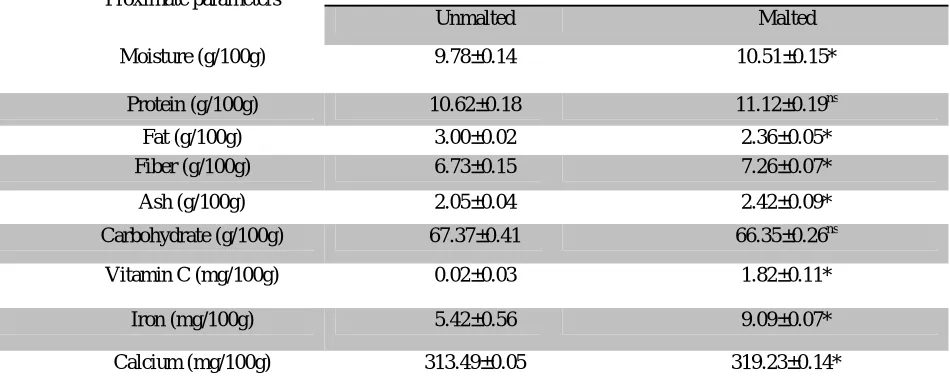
The proximate composition of malted and unmalted barnyard millet flour is depicted in table 1. Malting of grains may result in some biochemical modifications and produce malt with improved nutritional quality through induced hydrolytic activity that can be used in various recipes [14]. The moisture content of unmalted and malted barnyard millet flour was 9.78 and 10.50 g/100g respectively. Similar data was observed by [15] who reported 12.0 % moisture in malted and 11.2 % in unmalted foxtail millet.The protein content showed 10.62±0.18 g/100g and 11.12±0.19 g/100g for unmalted and malted barnyard flour which indicate insignificant increase at p≤0.05 level. The change in protein digestibility after malting can be attributed to the reduction of antinutrients such as phytic acid, tannins, and polyphenols, which are known to interact with proteins to form complexes [16]. The fat content of malted barnyard flour contained less fat content of 2.36±0.05g/100g as compared to unmalted flour (3.00±0.02g/100g).
The decrease in the fat content can be attributed to loss of low molecular weight nitrogenous compounds during soaking and rinsing of the millet grains and hydrolysis of lipid and oxidation of fatty acids during malting [17].
The fiber content of the unmalted and malted barnyard millet flour was 6.73±0.15 and 7.26±0.07g/100g respectively. The gradual increase observed in malted barnyard millet may be due to the synthesis of structural carbohydrates such as cellulose and hemicellulose [18].
The ash content of umalted and malted barnyard flour was found to be 2.05±0.04g/100gand 2.42±0.09 g/100g respectively. This result was in agreement with [19], reported that the total ash content of the raw and malted barnyard millet flour were 2 and 2.5 g/100g.The carbohydrate content of malted barnyard flour (67.37±0.41g/100g) was comparatively lesser than the unmalted flour (66.35±0.26 g/100g) which was found to be insignificant at p≤0.05 level.
The decrease in the carbohydrate during the process of germination is due to the use of carbohydrate for metabolism by the sprouts [20]. This result was in agreement with [21], reported that germinated samples of mungbean seed showed a significant decrease in the total carbohydrate.
The significant increase was observed in vitamin-C, iron and calcium content of malted barnyard flour 1.82±0.11mg/100g, 9.09±0.07mg/100g and
Table 2. Functional Properties of Unmalted and Malted Barnyard Millet Flour Functional parameters UnmaltedBarnyard millet Malted Barnyard millet
Water absorption capacity (%) 88.4±0.02 69.1±0.15*
Oil absorption capacity (%) 126±0.05 209.4±0.11*
Bulk density(g/cm3) 0.85±0.02 0.78±0.03ns
Swelling capacity (%) 7.51±0.25 3.53±0.23*
The values are mean ±SD of three independent determinations.*denotes significant difference (p ≤ 0.05)
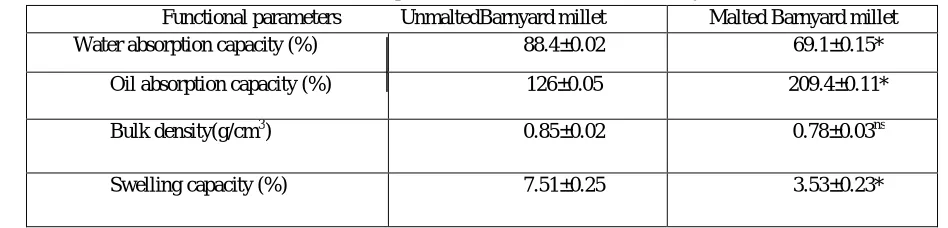
Water absorption capacity contributes to dough formation and stability [25]. The present data projected for water absorption capacity revealed that there was significantly decreased in malted barnyard millet flour (69.1±0.15) when compared to unmalted flour (88.4±0.02) at p≤0.05 level. Water absorption capacity observed in this study appears to be advantageous in formulation and development of bakery products due to its high protein and fibre content [26]. The swelling power is defined as the capability of the flour to absorb water and expand at a given temperature and time [27]. It varies with particle size, variety and the processing technique. The swelling capacity of malted barnyard millet flour was found to be significantly lower (3.53±0.23) value as compared to unmalted barnyard millet flour. The swelling behavior below 16 g/g is considered as high restricted behavior which indicates its stability against shearing action when subjected to heat [28]. In the present study, the flour samples showed restricted swelling behavior which indicates its resistant power towards heating. Swelling capacity of the sample determines the ability of the sample to absorb a particular amount of water and retain same within the period under study. From this result, the process of malting led to the reduction of both water absorption and swelling capacities [29].
[image:4.612.98.520.540.667.2]The high oil absorption capacity makes the flour suitable for facilitating enhancement in flavor and mouth feel when used in food preparation [30]. Malted barnyard millet flour recorded significant increased value (209.4±0.11) when compared to unmalted flour (126±0.05) at p≤0.05 level. Variation in oil absorption may be due to the variation in protein concentration, degree of interaction with water and oil [31]. The oil absorption capacity of barnyard millet flour (146.67) was higher due to more fiber and protein content, than wheat flour (118.1) [32]. Bulk density indicates that the volume of samples during packaging will not decrease excessively during storage and distribution [33]. Bulk density of malted barnyard flour was found to be 0.78±0.03 whereas unmalted flour showed 0.85±0.02value which was insignificant decrease at p≤0.05 level. The decreased bulk density of the germinated millet flour indicates low porosity or air spacing in the flour [19]. Similar data was obtained by [34] who found that the bulk density of jackfruit seed flour was 0.80 g/cm3. According to [35] found that bulk density ranged from 0.78-0.87 g/cm3 in millet based health drink.
Table 3. Hedonic Scores Obtained by the Acceptance Test Regarding the Attributes of Rusk Prepared from Malted Barnyard Millet and Wheat Flour
Variations Color Appearance Texture Taste Crispiness
Control (100)
4.8±0.44 4.9±0.41 5.0±0.41 5.0±0.48 5.0±0.43
Variant-I (80:20)
4.8±0.41 4.8±0.45 4.8±0.42 4.7±0.45 4.7±0.41
Variant-II (70:30)
4.7±0.42 4.7±0.51 4.6±0.48* 4.5±0.41* 4.6±0.41*
VariantIII(60:40) 4.6±0.52 4.5±0.50 4.5±0.45* 4.2±0.42* 4.2±0.45*
Values are means of triplicate determination ± SD. * denotes significant difference (p ≤ 0.05)
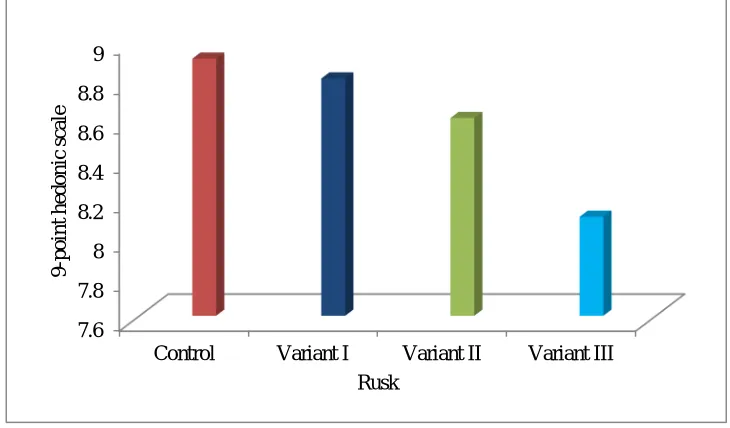
highest panelists rating in color (4.8±0.41) appearance (4.8±0.45), texture (4.8±0.42), taste (4.7±0.45), crispiness (4.7±0.41) and overall acceptability (8.8±0.42) as compared to other variantsand found insignificant at p˂0.05 level whereas variant III (70% wheat and 30% malted barnyard flour) showed significant difference at p˂0.05 when compared to control rusk. Similar data was stated that the bread incorporated with 20% minor millet was highly acceptable by panel when compared to other treatments [37].
Fig. 1 Overall acceptability of malted barnyard millet rusk
IV. CONCLUSION
The study concluded that the malted barnyard is a potential millet among the various millets with superior nutrient content and used as a functional ingredient in the formulated bakery productsbecause of its ability to improve the nutritional quality without ignoringthe palatability and various innovative products may be developed to suit the consumer needs and also to achieve nutrition security.
REFERENCES
[1] B. Lomborg, Global crises, global solutions. Cambridge University Press, United Kingdom, pp. 710, 2004.
[2] B. Kanjilal, P.G. Mazumdar, M. Mukherjee, and M.H. Rahman, “Nutritional status of children in India: household socio-economic condition as the contextual
determinant,” International Journal for Equity in Health., vol. 9, pp. 1-13, Dec. 2010.
[3] S. Admassu, M. Teamir, and D. Alemu, “Chemical Composition of local and improved finger millet [Eleusine Corocana (L.) Gaetrtin] varieties grown in Ethiopia,”Ethiopian Journal of Health Sciences., vol. 19, pp. 1-8, 2009.
[4] J.B. Mohankumar, and I.R. Vaishnavi, “Nutrient and antioxidant analysis of raw and processed minor millets,” Elixir Food Science., vol. 52, pp. 11279-11282,
2012.
[5] U.C. Lohani, and J.P. Pandey, “Effect of moisture content on physical properties of barnyard millet,” Pantnagar Journal of Research., vol. 6, pp. 148-154, 2008.
[6] U.C. Lohani, J.P. Pandey, and N.C. Shahi, “Effect of degree of polishing on milling characteristics and proximate compositions of barnyard millet (Echinochloa
frumentacea)”, Food Bioprocessing and Technology.,vol. 5, pp. 1113-1119, 2012.
[7] ohani UC, Pandey JP, Shahi NC. 2012. Effect of degree of polishing on
[8] milling characteristics and proximate compositions of barnyard millet
[9] (Echinochloa frumentacea). Food Bioprocess Technol 5:1113–9.
[10] ohani UC, Pandey JP, Shahi NC. 2012. Effect of degree of polishing on
[11] milling characteristics and proximate compositions of barnyard millet
[12] (Echinochloa frumentacea). Food Bioprocess Technol 5:1113–9.
[13] ohani UC, Pandey JP, Shahi NC. 2012. Effect of degree of polishing on
[14] milling characteristics and proximate compositions of barnyard millet
[15] (Echinochloa frumentacea). Food Bioprocess Technol 5:1113–9.
[16] ohani UC, Pandey JP, Shahi NC. 2012. Effect of degree of polishing on
[17] milling characteristics and proximate compositions of barnyard millet
[18] (Echinochloa frumentacea). Food Bioprocess Technol 5:1113–9.
[19] Lohani UC, Pandey JP, Shahi NC. 2012. Effect of degree of polishing on
[20] milling characteristics and proximate compositions of barnyard millet (Echinochloa frumentacea). Food Bioprocess Technol 5:1113–9
7.6 7.8 8 8.2 8.4 8.6 8.8 9
Control Variant I Variant II Variant III
9
-po
in
t
h
edo
n
ic
s
ca
le
[21] B. Veena, B.V. Chimmad, R.K. Naik, and G. Shantakumar, “Physicochemical and nutritional studies in barnyard millet,” Karnataka Journal of Agricultural Science., vol. 18, pp. 101–105, 2005
[22] A.S. Saleh, Q. Zhang, J. Chen, and Q. Shen, “Millet grains: nutritional quality, processing, and potential health benefits,” Comprehensive Reviews in Food Science and Food Safety., vol. 12, pp. 101-105, 2013
[23] F.W. Sosulski, M.O. Garatt, and A.E. Slinkard, “Functional properties of ten legume flours”, International Journal of Food Science and Technology., vol. 9, pp.
66–69, 1976.
[24] J.C. Okkaka, and N.N. Potter, “Functional and storage properties of cowpea powder‐wheat flour blends in breadmaking”, Journal of Food Science., vol. 42, pp.
828-833, 1977
[25] AOAC, Official methods of analysis, 17th ed., Maryland: Association of Official Agricultural Chemists, 2012.
[26] S. Ranganna, Handbook of analysis and quality control for fruit and vegetable products, 5th ed., Tata McGraw-Hill Publications, New Delhi, 719-724, 2001.
[27] M.A. Amerine, R.M. Pangborn, and E.B. Roessler, Principles of sensory evaluation of food , Academic Press, New York/London, 1965
[28] A. Sehgal, and A. Kawatra, “In vitro protein and starch digestibility of pearl millet (Pennisetum gluacum L.) as affected by processing techniques”, Food/Nahrung., vol.45, pp. 25-27, 2001
[29] G. Laxmi, N. Chaturvedi, and S. Richa, “The impact of malting on nutritional composition of foxtail millet, wheat and chickpea”, Journal of Nutrition and Food
Sciences., vol. 5, pp. 1-3, 2015
[30] A.B. Hassan, I.A. Ahmed, N.M. Osman, M.M. Eltayeb, G.A. Osman, and E.E. Babiker, “Effect of processing treatments followed by fermentation on protein
content and digestibility of pearl millet (Pennisetum typhoideum) cultivars”, Pakistan Journal of Nutrition., vol. 5, pp. 86-89, 2006
[31] M. Choudhury, P. Das, and B. Baroova, “Nutritional evaluation of popped and malted indigenous millet of Assam”, Journal of Food Science and Technology.
Vol. 48, pp. 706-711, 2011
[32] S. Banusha, and S. Vasantharuba, “Preparation of wheat-malted flour blend biscuit and evaluation of its quality characteristics”, American-Eurasian Journal of
Agriculture and Environmental Sciences., vol. 14, pp. 459- 463, 2014.
[33] P. Nazni, and S.R. Devi, “Effect of processing on the characteristics changes in barnyard and foxtail millet”, Journal of Food Processing Technology., vol. 7,
pp. 1-8, 2016
[34] O. Akinjayeju, and O.C. Francis, “Effects of sprouting on the proximate composition of bambara nut flours”, in Proc. of the annual conference/general meeting
of NIFST, 2007, pp. 22-25.
[35] A.E. Mubarak, “Nutritional composition and antinutritional factors of mung bean seeds (Phaseolus aureus) as affected by some home traditional processes”,
Food chemistry., vol. 89, pp. 489-495, 2005
[36] K. Platel, S.W. Eipeson, and R. Srinivasan, “Bioaccessible mineral content of malted finger millet (Eleusine coracana), wheat (Triticum aestivum), and barley
(Hordeum vulgare)”, Journal of Agriculture and Food Chemistry, vol. 58, pp. 8100–8103, 2010
[37] A.A. Nour, M.A. Ibrahim, E.E. Abdelrahman, E.F. Osman, and K.E. Khadir, “Effect of processing methods on nutritionalvalue of sorghum (Sorghum bicolor
L. Moench) cultivar”, American Journal of Food Science and Health., vol. 1, pp. 104-108, 2015
[38] S. Tizazu, K. Urga, A. Belay, C. Abuye, and N. Retta, “Effect of germination on mineral bioavailability of sorghum-based complementary foods”, African Journal of Food, Agriculture, Nutrition and Development., vol. 11, pp. 5083-5095, 2011.
[39] enriched with cowpea (Vigna unguiculata L. walp) flour”, Nigerian Food Journal., vol. 31, pp. 6-12, 2013
[40] H. Mepba, L. Eboh, and S.U. Nwaojigwa, 2007 “Chemical composition, functional and baking properties of wheat-plantain composite flours”, African Journal
Food, Agriculture, Nutrition and Development., vol. 7, pp. 1-22, 2007
[41] E.A. Shimelis, M. Meaza, and S.K. Rakshit, “Physico-chemical properties, pasting behavior and functional characteristics of flours and starches from improved
bean (Phaseolus vulgaris L.) varieties grown in East Africa”, Agricultural Engineering International., vol. 2, pp. 4-9, 2006
[42] R. Ugare, “Health benefits, storage quality and value addition of barnayrd millet (Echinochloa frumentacaea Link),” Doctoral dissertation, UAS, Dharwad
[43] E.T. Okonjibola, “Synthesis of high quality complementary food from locally available crops”, Global Journal of Food Science and Technology., vol. 5, pp.
251-257, 2017.
[44] I.O. Balogun, and O.P. Olatidoye, “Functional properties of dehulled and undehulled velvet beans flour (Mucuna utilis)”,Biological conservation., vol. 2, pp.
2-6, 2010.
[45] M.S. Butt, and R. Batool, “Nutritional and functional properties of some promising legumes protein isolates”, Pakistan Journal of Nutrition., vol. 9, pp.
373-379, 2010.
[46] R. Shrestha, and S. Srivastava, “Functional Properties of Finger Millet and Barnyard Millet Flours and Flour Blends”,International Journal of Science and Research., vol. 6, pp 775-780, 2017.
[47] G.O. Ogunlakin, M.O. Oke, G.O. Babarinde, and D.G. Olatunbosun, “Effect of drying methods on proximate composition and physicochemical properties of
cocoyam flour”, American Journal of Food Technology., vol. 7, pp. 245-250, 2012.
[48] F.C. Ocloo, D. Bansa, R. Boatin, T. Adom, and W.S. Agbemavor, “Physico-chemical, functional and pasting characteristics of flour produced from Jackfruits
(Artocarpus heterophyllus) seeds”, Agriculture and Biology Journal of North America., vol. 1, pp. 903-908, 2010.
[49] P.K. Nishad, S. Maitra, and N. Jangre, “Physiochemical, functional and sensory properties of developed health drink from minor millets”, International Journal