©IJRASET: All Rights are Reserved
123
Design and Implementation of Low-Cost, 3-D
Printed, Humanoid Robotic Arm
Antony John E
Mechatronics Department, Anna University
Abstract: In today’s world, with the development of advanced actuators and other precise dynamic motors, the field of robotics has seen a major boom in its growth, with applications ranging from in the International Space Station to common household homes. However, bionic, humanoid robots, that mimic human features, are still under development due to their high costs and design hindrances, which when perfected could open wide a whole new field of robotics and their applications. This paper aims to describe the design and process for the development of a low cost robotic humanoid arm, using an additive manufacturing process, commonly known as 3-D printing. The implementation of control software using high efficiency motors and micro-controller technology is also discussed. The result is a dexterous humanoid hand capable of mimicking common human-like gestures with speed, and accuracy.
Keywords:3-D Printing, Anthropomorphic robot arm, Manipulators, Humanoid robots, Dextrous Arm.
I. INTRODUCTION
Over the past few decades, robot arms have evolved from the simple gripper system to become an intricate interlink of machine parts that are capable of performing complex tasks such as, object classification with the help of machine vision, product assembly in production lines, and much more.
A majority of the robotic arms produced for commercial use in the industry are limited to 6 degrees of freedom. A German manufacturer of industrial robots, provides solutions for factory automation by developing robotic arms that can handle higher payloads, are highly precise and can be used for direct human collaboration, all while possessing 6 DOF [1]. However, these robotic arms are restricted to perform only a certain degree of actions due to design hindrances and lack of anthropomorphic nature. The human hand is a complex interlink of muscles, nerves, veins, and many other components, which allow us to perform a variety of complex actions ranging from picking up a ball, to playing a piano.
The human arm is capable of achieving 7 DOF, with the human hand having 27 degrees of freedom: 4 in each finger, 3 for extension and flexion and one for abduction and adduction; the thumb is more complicated and has 5 DOF, leaving 6 DOF for the rotation and translation of the wrist [2].
Implementing such a design in robot arms, allowing them to mimic human gestures would open a wide range of applications, causing a major advancement in the field of prosthetics, surgery, fire services, and much more. Humanoid arms have been in existence since the 18th century under the synonym automata.
One of the world’s first humanoid robot - Eric, invented by W. H. Richards, consisted of a series of electromagnets, and one motor powered by a 12-volt source, that allowed restricted motion of the arms and head [3]. Recent developments of humanoid arms include that of a human sized astronaut robot. Each arm has 14 degrees of freedom in total, and consists of a forearm, a 2-DOF wrist, and a 12-DOF hand with five fingers.
©IJRASET: All Rights are Reserved
124
II. DESIGNOFHUMANOIDARMA. Design of Hand and Fingers
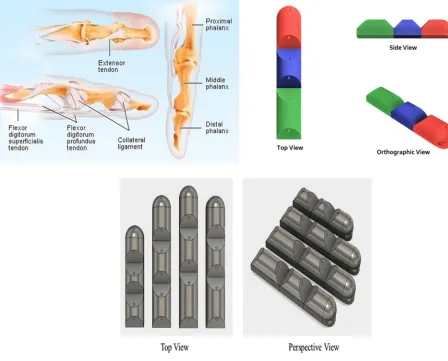
[image:2.612.63.511.213.574.2]The mechanism of the fingers of the robot arm can be achieved by the use of wires and cables, thus replicating the muscle-tendon contraption of the human hand. This also possess several advantages including decrease in self-weight, allowing for better flexibility, and prevention of backlash errors [6]. The human finger comprises of three nodes – Distal Phalanx, Intermediate Phalanx and Proximal Phalanx. Each of these Phalanxes are connected to each other by Extensor and Flexor tendons, thereby allowing the finger to contract and expand periodically. Simulating this anatomy, each finger consists of three parts that are linked to each other by elastic bands. A wire is run through the openings at the tip of the 3 nodes, allowing the fingers to move freely as programmed. Each node of the robot finger consists of a loft at 45-degree angle at both ends (excluding the tip of the Distal Phalanx), which allows the finger to contract and curl into a hook like position. Figure 1 compares a human finger to the 3-D model of a robot finger.
Fig. 1 Comparison between the anatomies of human fingers with robot fingers.
©IJRASET: All Rights are Reserved
125
Fig. 2 A Prototype of Robot’s Right Arm with Fingers.
B. Construction of Forearm
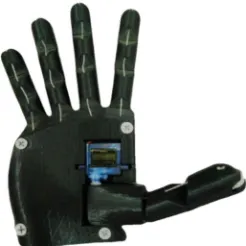
[image:3.612.239.362.85.208.2]Based on the design of the forearm, we can classify the robot hand in to two types. One is external actuation hand, while the other is internal actuation hand. In the former, all the actuators are mounted in the forearm of the robot hand, while in the latter all the electronic sensors and actuators are integrated in the fingers and palm of the hand. Internal actuators often tend to increase the cost of the hand, and tend to be bulky [8]. In this model, we tend to achieve an economical robot hand by opting for an external actuation design. The advantage of external actuation design is that is allows for easier maintenance while reducing the cost of manufacture and assembly. The forearm consists of 2 halves that can be fastened together by means of screws. These screws acts as temporary joints and can be adjusted in case of failure of the motors housed in it. Initially a 3-D scan of the human arm to be replicated is obtained and imported as a raw file into a 3D modelling workspace. Then file is then cleaned of any noise and unwanted geometry, and is modelled as per the required dimensions. Compartments are provided in the forearm for affixing the motors and other electronic components. Another motor, attached to the upper end of the forearm, replaces the elbow and provides rotational and flexion/extension movements of the forearm.
Fig. 3 Forearm Enclosure of Robot Arm
III.CONTROLUNITSYSTEM
The control unit system is responsible for initiating the movement in the robot hand as per the user specifications. In order to achieve a complete range of motion with minimal backlash and errors, high quality motor drives that are capable of supporting the supplied load weight must be employed. Depending upon the functions of the various parts of the hand, a variety of motor drives are used to achieve maximum efficiency while driving that part. A programmed controller is used to initiate a closed loop system, to provide smooth transition of the robot arm gestures, at minimum cost. The various types of motor drives affixed in the robot hand, and the micro-controllers used to actuate the system are listed in Table 1 below:
TABLE I. Component for the Development of Arm
S. No Components Quantity
1 SG90 Micro Servo 1
2 MG995 Standard Servo 5
3 HV2060MG Digital Servo 4
[image:3.612.156.451.397.507.2]©IJRASET: All Rights are Reserved
126
A. Arduino MEGA Microcontroller
The Arduino MEGA is a microcontroller board based on the ATmega2560. It has 54 digital input/output pins (of which 15 can be used as PWM outputs), 16 analog inputs and 4 UARTs (hardware serial ports). It has as flash memory of 256KB, and its lightweight and compact design makes it suitable for implementation in the robot hand [9]. Since it has a large number of I/O ports, it is perfect for interfacing the various motor drives contained in the forearm of the robot. The servo motors can be interfaced directly with the Arduino without the need of a motor directly, and can be easily triggered by sending the required pulses. The Arduino MEGA can be programmed using the Arduino IDE, to control the motors and perform the required gestures.
B. Motor Drives
1) SG90 Servo Motor: The SG90 servo motor is used for controlling the flexion/extension of the thumb, and is housed in the palm of the robot hand. It is a small, fast motor that weighs 9 grams and has a torque capacity of 2.5kg/cm. This motor is capable of rotating only 180 degrees (90 degrees in each direction), and hence is a good tool for actuating the thumb. The pulse width modulation signal produced to drive the motor should have a frequency of 50Hz that is the PWM period should be 20ms.
2) MG995 Servo Motor: MG995 Metal Gear Servo Motor is a high-speed, high torque servo motor that is capable of rotating approximately 120 degrees (60 in each direction). The MG995 has a stall torque of 8.5 kg.cm at 4.5V and 10 kg.cm at 6V. Because of its compact size and high competence, it is the perfect device for contracting/expanding the fingers. Each of the 5 fingers are connected to the 5 MG995 servo motors affixed in the forearm of the robot hand.
3) HV2060MG Servo Motor: The HV2060MG digital servo motor has high torque as well as high load carrying capacity. It is used to perform the functions of the elbow, and is capable of driving the entire forearm, which houses 5 MG995 servo motors. It has an operating voltage of 5v to 7.4V and has a maximum torque of 62 kg.cm. The HV2060MG is responsible for performing abduction/adduction motions of the forearm, and hence initiates 2 degrees of freedom in the robotic hand. The pulses to the servo are sent from the Arduino MEGA microcontroller, and depending upon the duration of the pulses, the servo motor can be made to rotate a certain degree in between 0 degrees to 180 degrees.
IV.PRELIMINARYRESULTS
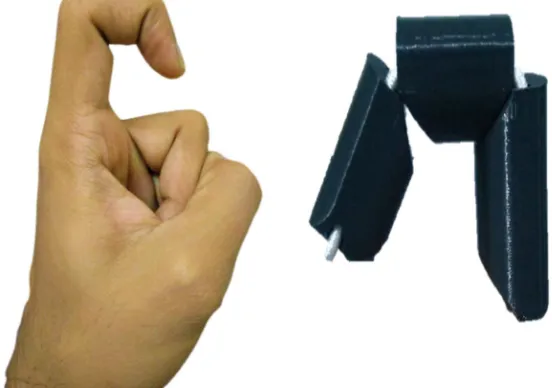
[image:4.612.145.421.509.703.2]The entire robot hand was assembled, and the program to mimic the gestures of a human hand was uploaded into the Arduino. The testing process of the prototype was carried out in a controlled environment, in order to account for any unforeseen errors that may develop in the system. Because of the use to elastic materials for the interphalangeal joints, each finger is highly flexible and durable. The motors were actuated in real time via commands from the computer, and the robotic hand was made to perform a variety of gestures to identify the extent of the anthropomorphic nature it possesses. Fig. 4 shows the robot finger mimicking a hook gesture. This gesture allows us to test the extent up to which the finger is capable of flexion/extension. It may be observed from the figure that the robot finger is capable of emulating the human finger in a fairly accurate manner.
©IJRASET: All Rights are Reserved
127
V. CONCLUSIONANDFUTUREWORKHence, a low cost, 3-D printed, anthropomorphic robot hand was designed and developed using precise actuators and dynamic motors. It consists of 4 fingers that are linked together by elastic members to provide flexion and abduction movements. The thumb is separately attached to the palm, and is controlled by a dedicated mini servo motor. Each of the fingers are controlled by 5 servo motors, which are housed in the forearm of the robot. The motors are driven by providing pre-programmed pulses from the Arduino MEGA micro-controller. The entire construction of the robot hand would take approximately 18 hours, and would come under 6000 Indian Rupees. This concept provided an alternate and cheaper approach to the development of prosthetics for patients, and can also be used for industrial applications to perform actions as required.
In the future, the payload capacity of the robot hand may be improved to handle higher loads, while further decreasing the response time delay. Improving the DOF is also a major development for applications in the Space industry. The system can be further developed for direct human collaboration by incorporating wireless technologies for easier, custom control of the robot hand. Incorporating Artificial Intelligence and Computer Vision technologies in the device, will improve the decision making capabilities of the robot in an industry environment, thereby providing maximum output with minimal errors.
REFERENCES
[1] Kuka Robotics. [Online]. Available: https://www.kuka.com/en-in/products/robotics-systems/industrial-robots [2] A.M.R. Agur and M. J. Lee. Grant's Atlas of Anatomy. Lippincott Williams and Wilkins, 10th Edition, 1999. [3] AH Reffell & Eric Robot (1928). [Online]. Available: http://www.reffell.org.uk/people/ericrobot.php
[4] R O Ambrose, Aldridge H, Askew R S, Burridge R R, Bluethmann W, Diftler M, Lovchik C, Magruder, D, Rehnmark F. Robonaut: NASA’s space human-oid. IEEE Intelligent Systems, 2000, 15, 57–63.
[5] M. A. Doshi, S. J. Parekh, M. Bhowmick, Wireless Robotic Hand Using Flex Sensors International Journal of Scientific & Engineering Research, Volume 6, Issue 3, March-2015 1471 ISSN 2229-5518
[6] Zhe Xu, Vikash Kumar and Emanuel Todorov, A Low-cost and Modular, 20-DOF Anthropomorphic Robotic Hand: Design, Actuation and Modeling 2013 13th IEEE-RAS International Conference on Humanoid Robots (Humanoids), October 15 - 17, 2013. Atlanta, GA
[7] “Finger Anatomy Picture Image on MedicineNet.com.” [Online]. Available:
http://www.medicinenet.com/imagecollection/finger_anatomy_picture/picture.htm.
[8] H. Liu, K. Wu, P. Meusel, N. Seitz, G. Hirzinger, M.H. Jin, Y.W. Liu, S.W.Fan, T. Lan, Z.P.Chen, Multisensory Five-Finger Dexterous Hand: The DLR/HIT Hand II, 2008 IEEE/RSJ International Conference on Intelligent Robots and Systems Acropolis Convention Center Nice, France, Sept, 22-26, 2008