824
©IJRASET: All Rights are Reserved
Managing the Risks Faced by Indian Road
Construction Projects
Narayan Singh Kasana1, Dr. M.K Trivedi2
1
PG student, 2Professor, Civil Engineering Department, Madhav Institute of Technology and Science, Gwalior, (M.P.) India
Abstract: Road construction projects undergo many risks during construction process, so it is required to manage these risks before starting any road construction.
This research presents a complete framework for managing risks in road construction projects using Failure mode & Effect Analysis (FMEA) system.
In this research risk management is done through undergoing five major steps: 1. Identification of risk factors 2. Assessment of risk factors in terms of its occurrence, consequences and detectability through questionnaire survey. 3. Ranking of risk factors based on Risk Priority Number (RPN, function of occurrence, consequence and detectability of risk 4. Risk Allocation 5.Treating the risks by designing risk response strategies.
Keywords: Highway Construction Projects, Risk Analysis, Failure Mode & Effect Analysis (FMEA), RPN.
I. INTRODUCTION
Road construction projects undergo many risks during construction process, so it is required to analyze these risks before starting any road construction.
Road construction requires large amount investment, but in road construction several risks may come into play as threat which increase the cost, time and decrease the quality of road construction. So, it is required to analyze the risks in road construction to take suitable response against risks before starting of road construction. To complete any project successfully it is necessary manage the risks associated to respective project.
In Failure Mode & Effect Analysis Risks are prioritized on the basis of Risk Priority Number (RPN). Risk has mainly three components, Occurrence (O), Consequence (C) and Detectability (D). RPN is function of O, C & D i.e.
RPN = O×C×D Risk Occurrence (RO) refers to probability of occurrence of risk event.
Risk Consequence (RC) refers to impact of occurred risk on objectives of project.
Risk Detectability (RD) refers to likelihood of discovering and correcting a risk event prior to harm occurrence.
In past researches risks in highway construction projects are analyzed by using risk score which depends upon only the occurrence and consequence of risk event, but it is also required to consider the current control on risk event and there is no doubt that Failure Mode & Effect Analysis is one of the most useful technique which analyze the risks beyond occurrence and consequence by considering detectability of risk.
II. OBJECTIVE OF RESEARCH
Objectives of this research are given below-
A. To identify the risk factors in highway construction projects.
B. To assess the Occurrence, Consequences and detectability of Risk factors through questionnaire survey to Calculate RPN of
each risk factor.
C. To prioritize the risk factors on the basis of their RPN values.
825
©IJRASET: All Rights are Reserved
III. PROPOSED METHODOLOGY
1) Step 1: Identification of risk factors
Total 48 risk factors were identified through literature review and discussion with road construction experts. A questionnaire form is prepared in following format-
Table: 1 Questionnaire Form
Risk No. Risk Factor RO RC RD Risk
Allocation
Risk Response R1 Lack of experience of consultant, contractors
R2 Lower Contractor Productivity
R3 Insufficient availability of time to complete project
R4 Change in construction scope
R5 Change of owner of project
R6 Rework due to errors
R7 Incomplete or complexity in project team R8 Non-reliability in construction work quality
R9 Design Errors and Omissions
R10 Uncertainty in horizontal and vertical alignment
R11 Uncertainty in access requirement
R12 Issues related to obtaining railway and government permit
R13 Change in rules, regulations and policies of government
R14 Expropriations Risk
R15 Encroachment Risk
R16 Obsolete technology
R17 Delay in approval of submittals R18 Insufficient availability of lands
R19 Uncertainty in Land acquisition cost and schedule
R20 Natural Obstructions i.e. hill, river, trees etc. R21 Lack of availability of utilities
R22 Uncertainty in price of utilities
R23 Unskilled members in organization
R24 Labour dispute and strike
R25 Conflict between project related parties
R26 Labour productivity issues
R27 Poor communication and coordination between project team
R28 Bankruptcy risk
R29 Lack of resources
R30 Fluctuation in prices of material and equipments
R31 Quality issues of materials and equipments
R32 Unanticipated damage during construction
R33 Failure, damage, fire or theft of material and equipment
R34 Safety issues i.e. labour injuries
R35 Poor soil conditions
R36 Chance of rise in G.W.T
R37 Unforeseen climate conditions on site location R38 Poor drainage facilities on site location
R39 Existing traffic
R40 Force Majeure
R41 Heritage Issues
R42 Mineral mining issues
R43 Insufficient availability of fund/money
R44 Conflict in contract document
R45 Delay in payment
826
©IJRASET: All Rights are Reserved 2) Step 2: Crisp Rating
Crisp Rating used in questionnaire: Table: 2
Linguistic term Crisp Rating
Very High(VH) 5
High(H) 4
Medium(M) 3
Low(L) 2
Very Low(VL) 1
Note: During Questionnaire survey, experts were also asked to whom risk should be allocated and which type of response is required against risk.
3) Step 3: Questionnaire Survey
Risk assessment is done through Questionnaire survey. Total 24 questionnaire forms in above format (Table:1) were filled by road construction experts. Respondent profile is given in Table:3
Respondent Profile: Table: 3
Respondent Average Experience Average cost of completion of project Average time of completion of
project
8 Contractors 8 years 147 Cr. 15 Months
8 Clients 9 years 133 Cr. 12 Months
8 Consultants 7 years 102 Cr. 18 Months
24 Overall 8 years 127.33 Cr. 15 Months
After performing questionnaire survey, responses from questionnaire were unified using Relative Importance Index Method which is given by,
RII = ∑
×
Where ∑W = Sum of responses i.e. sum of crisp rating of factor given by respondents, A = Maximum value of crisp rating which
is 5, N = No. of respondents
As per RII concept ROI, RCI & RDI of each risk factor is calculated using following formulas,
Risk Occurrence Index (ROI) = ∑
×
Risk Consequence Index (RCI) = ∑
×
Risk Detectability Index (RDI) = ∑
×
4) Step 4: RPN Calculation
Risk Priority Number (RPN) is calculated by using following formula
RPN= ROI×RCI×RDI×10 ……eq.1
5) Step 5: Ranking of Risk Factors
827
©IJRASET: All Rights are Reserved
6) Step 6: Risk Response Plan and Risk Response Strategies
During Questionnaire survey Experts were also asked to whom risk should be allocated. From Questionnaire it was concluded that risk should be allocated to either Client or Consultant or Contractor.
There are four risk response strategies which are commonly accepted-
a) Risk Avoidance refers to reducing the probability of occurrence of risk to zero by some changes in actual workplan.
b) Risk Mitigation refers to reducing the consequences or impact of risk on objectives of project.
c) Risk Transfer refers to shifting the responsibility of bearing the risk’s consequences to third party e.g. insurance policies.
d) Risk Acceptance refers to dealing with risk’s consequences directly through planning the time and cost contingencies to
response the risk.
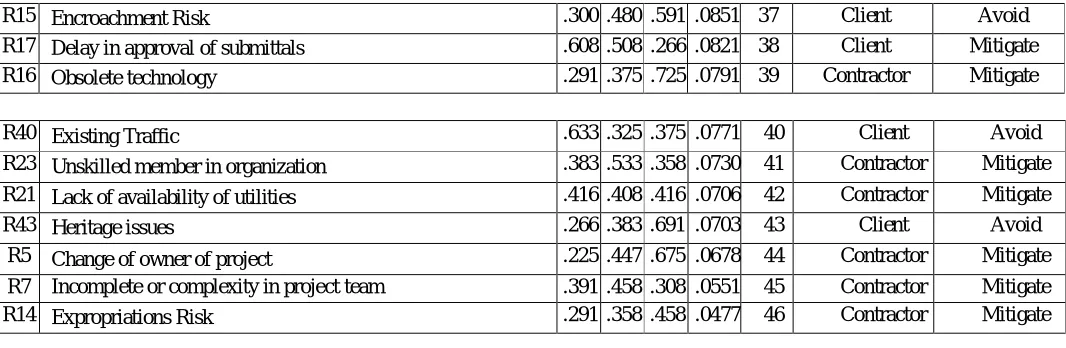
Risk Occurrence Index (ROI), Risk Consequence Index (RCI) and Risk Detectability Index (RDI), Risk Priority Number (RPN), Rank, Risk Allocation Plan and Risk Response Strategy of each risk factor are given in FMEA Table: 4, which can be considered as concluded part of Research.
Table: 4– FMEA Table
Risk No. Failure Mode ROI RCI RDI RPN Rank Risk Allocation Risk Response
R18 Insufficient Availability of Lands .883 .660 .675 4.416 1 Client Avoid
R38 Unforeseen Climate Condition on Site Location .641 .760 .900 4.384 2 Contractor Accept
R19 Uncertainty in Land acquisition cost and schedule .875 .616 .750 4.042 3 Client Avoid
R29 Lack of Resources .750 .675 .741 3.751 4 Contractor Mitigate
R45 Insufficient availability of Funds/Money .550 .641 .916 3.229 5 Client Avoid
R12 Issue related to obtaining railway and government permit .808 .675 .566 3.086 6 Client Avoid
R47 Delay in payment .633 .625 .775 3.066 7 Client Accept
R36 Poor Soil Conditions .708 .525 .591 2.196 8 Client Avoid
R41 Force Majeure .558 .625 .600 2.092 9 Contractor Accept
R4 Change in construction scope .536 .600 .650 2.090 10 Client Mitigate
R20 Natural Obstructions i.e. hill, river, trees etc. .458 .588 .741 1.995 11 Client Avoid
R33 Unanticipated damage during construction .600 .416 .750 1.872 12 Contractor Mitigate
R35 Safety issues i.e. labour injuries .491 .550 .658 1.776 13 Contractor Mitigate
R6 Rework due to errors .525 .483 .683 1.731 14 Contractor Mitigate
R34 Failure, Damage, fire or theft of material and equipment .550 .608 .466 1.558 15 Contractor Avoid
R24 Labour Dispute and Strike .408 .591 .633 1.526 16 Contractor Mitigate
R11 Uncertainty in access requirement .466 .575 .566 1.516 17 Client Avoid
R39 Poor drainage facilities on site location .500 .408 .741 1.511 18 Contractor Mitigate
R30 Fluctuation in prices of material and equipment .333 .608 .741 1.5 19 Contractor Mitigate
R37 Chance of rise in Ground Water Table .425 .625 .550 1.460 20 Contractor Mitigate
R46 Conflict in contract document .466 .500 .625 1.456 21 Contractor Mitigate
R2 Lower Contractor productivity .466 .516 .558 1.341 22 Contractor Mitigate
R26 Labour productivity issue .483 .550 .491 1.304 23 Contractor Mitigate
R48 Adverse Weather Conditions .483 .391 .600 1.133 24 Contractor Accept
R32 Quality issue of materials and equipments .400 .650 .433 1.125 25 Consultant Avoid
R25 Conflict between project related parties .450 .400 .616 1.108 26 Contractor Mitigate
R10 Uncertainty in horizontal and vertical alignment .516 .425 .500 1.96 27 Client Avoid
R44 Mineral Mining issues .300 .491 .741 1.91 28 Contractor Mitigate
R22 Uncertainty in price of utilities .408 .430 .591 1.36 29 Contractor Mitigate
R3 Insufficient availability of time to complete project .316 .475 .683 1.25 30 Contractor Mitigate
R9 Design errors and omission .408 .500 .491 1.001 31 Consultant Avoid
R28 Bankruptcy risk .258 .500 .766 .0988 32 Contractor Avoid
R13 Change in rules, regulations and policies of government .491 .366 .550 .0988 33 Client Accept
R27 Poor communication/coordination between project team .483 .475 .425 .0975 34 Contractor Mitigate
R1 Lack of experience of consultant, contractors .350 .616 .250 .0916 35 Client Avoid
828
©IJRASET: All Rights are Reserved
R15 Encroachment Risk .300 .480 .591 .0851 37 Client Avoid
R17 Delay in approval of submittals .608 .508 .266 .0821 38 Client Mitigate
R16 Obsolete technology .291 .375 .725 .0791 39 Contractor Mitigate
R40 Existing Traffic .633 .325 .375 .0771 40 Client Avoid
R23 Unskilled member in organization .383 .533 .358 .0730 41 Contractor Mitigate
R21 Lack of availability of utilities .416 .408 .416 .0706 42 Contractor Mitigate
R43 Heritage issues .266 .383 .691 .0703 43 Client Avoid
R5 Change of owner of project .225 .447 .675 .0678 44 Contractor Mitigate
R7 Incomplete or complexity in project team .391 .458 .308 .0551 45 Contractor Mitigate
R14 Expropriations Risk .291 .358 .458 .0477 46 Contractor Mitigate
IV. CONCLUSION
Failure Mode & Effect Analysis (FMEA) is one of the most accepted risk analysis technique which analyzes the risks beyond occurrence and consequence of risks because FMEA also consider the current control on risk or detectability of risk event as third parameter. During research it was observed that questionnaire survey through personal interview is the best method to collect information about risk occurrence, risk consequence, risk detectability, risk allocation and risk response. As per conclusion insufficient availability of land was found to be most important risk factor in highway construction. So it is clear that before staring highway construction, it is required to acquire the required land for highway construction. Unforeseen climate conditions is second and uncertainty in land acquisition cost and schedule is third most important risk factors which affect the objectives of highway construction. FMEA table was designed in the last step of research which shows not only the ROI, RCI, RDI, RPN, and Rank of risk factor but also to whom risk should be allocated and which type of response should be given to each risk factor. In this research it was conclude that risk should be allocated to either clients or contractors or consultants related to project. It is clear from FMEA table that about 90% risks are allocated to contractors, so contractors are the most risks affected project related parties. Risk response strategies are last but most important part of risk analysis. Four risk response strategies were found most suitable to response the risks which are: 1. Risk Avoidance 2. Risk Mitigation 3. Risk Transfer 4. Risk Acceptance. Response to each risk is given in FMEA
REFERENCES
[1] John B. Bowles & C. Enrique Pelaez ., (1995) “Fuzzy logic prioritization of failure in a system failure mode, effects and criticality analysis”. Reliability Engineering and System Safety.
[2] Bambang Purwanggono & and Anastasia Margarette., (2017) “Risk assessment of underpass infrastructure project based on ISO 310 00 and ISO 21500 using fishbone diagram and RFMEA (project risk failure mode and effect analysis) method”. IOP Conference Series: Material Science and Engineering
[3] Cheng-Min Feng and Chi-Chun Chung., (2013) “Assessing the risks of airport airside through the fuzzy logic -based failure modes, effect and criticality analysis”. Hindawi Publishing Corporation, Mathematical Problems in Engineering.
[4] Mohamad Abdelgawad and Aminah Robinson Fayek., (2010) “Risk management in the construction industry using combined Fuzzy FMEA and Fuzzy AHP”. Journal of Construction Engineering and Management.
[5] Sameh M. El-Sayegh and Mahmoud H. Mansour., (2015) “Risk Assessment and allocation in Highway Construction projects in the UAE”. Journal of Management in Engineering.
[6] Mohammad Hayati and Mohammad Reza Abroshan., (2017) “Risk Assessment using Fuzzy (Case Study: Tehran Subway Tunneling)” India n journal of Science and Technology
[7] Maryam Gallab, Hafida Bouloiz, Youssef Lamrani Alaoui, Mohammad Tliouat., (2018) “Risk Assessment of Maintenance activities u sing Fuzzy Logic” Procedia Computer Science.
[8] Mahmoud Mohamed Mahmoud Sharaf and Hassan T. Abdelwahab., (2015) “Analysis of Risk Factors for Highway Construction Projects in Egypt”. Journal of Civil Engineering and Architecture
[9] Mohsen AHMAD, Kourosh BEHZADIAN, Abdollah ARDESHIR, Zoran KAPELAN., (2015) “Comprehensive Risk Management using Fuzzy-FMEA and MCDA Techniques in Highway Construction Projects”. Journal of Civil EngineeringIn Management.
[image:5.612.52.585.89.263.2]