©IJRASET: All Rights are Reserved
689
Fraud Detection in MeDInsu using Machine
Learning Algorithms
-
A Web Application
Mr. Naveen Kumar G1, Sai Nikitha C2
1
Asst Prof, Dept. of Computer Science and Engineering BITM Ballari, Karnataka, India
2
Dept. of Computer Science and Engineering BITM Ballari, Karnataka, India
Abstract: Extortion is no matter how you look at it and costly to the social protection assurance structure. Coercion incorporates intentional guile or double dealing expected to achieve an unapproved advantage. It is shocking in light of the way that the event of medical coverage extortion keeps growing every year. With a particular ultimate objective to recognize and sidestep the blackmail, information mining methodology are associated. This fuses some preliminary learning of human administrations structure and its beguiling practices, assessment of the traits of social protection assurance data. Information mining which is disengaged into two learning methodologies viz., administered and solo is used to recognize beguiling cases. Regardless, since all of the above methods has its own specific course of action of central focuses and disadvantages, by joining the advantages of both the frameworks, a novel cross breed approach for distinguishing tricky cases in therapeutic inclusion industry is proposed. Keywords: Data mining; Health Insurance fraud; Supervised; Unsupervised
I. INTRODUCTION
Low-pay nations have made critical improvement arrangement structures for the manageability of development. These systems incorporate social insurance conveyance. Ghana is one of the nations which sought to give compelling and proficient medicinal services. In accomplishing this respectable objective, the National Health Insurance Scheme (NHIS) was built up by an Act of Parliament, Act 650, in 2003.
Deliberately deceptive the therapeutic inclusion association that results in restorative administrations advantages being paid misguidedly to an individual or social event is known as human services inclusion blackmail. The crucial inspiration driving coercion is cash related bit of leeway. As demonstrated by a present review, it is surveyed that the amount of false claims in the business is around 15 for each penny of total cases. Protection offices in USA achieve disasters in excess of 30 billion USD consistently to restorative administrations security swindles. The bits of knowledge is stunning in making country like India as well. The report suggests that the social protection industry in India is losing generally Rs600-Rs 800 crore achieved on phony cases each year [1]. Thusly, to make medicinal inclusion industry free from deception, it is essential to revolve around end or minimization of fake cases meeting up through human services inclusion. The medicinal inclusion deception cases are extensively requested under the going with headings:
A. Charging for organizations not rendered: Billing protection office for things that never occurred. Delineation: Forging the characteristic of those related with giving bills.
B. Upcoding of organizations: Billing protection office for organizations that are costlier than the genuine method that was done. Case: 45-minute session being charged as hour long session
C. Upcoding of things: Billing protection office for remedial equipment that is costlier than the real apparatus. Case: Billing for control helped wheelchair while giving the patient simply the manual wheelchair.
D. Duplicate cases: Not presenting a similar bill yet changing some smidgen like the date remembering the ultimate objective to
charge protection office twice for a comparative organization rendered. Case: An exact of the main case isn't requested of for the subsequent time, yet rather some part like date is changed to get the preferred position twofold the first.
E. Unnecessary organizations: Filing claims which not the smallest piece apply to the condition of a patient. Representation: Patient with no signs of diabetes recording guarantee for step by step usage of insulin implantations.
©IJRASET: All Rights are Reserved
690
II. LITERATURE SURVEY
There are many supervised and unsupervised data mining techniques out of which the following are chosen.
1) Anolomy Idetection: The peculiarity revelation strategy processes the probability of each guarantee to be false by breaking down the past insurance claims. The specialists furthermore inspect the cases that have been hailed by data mining model [2].
2) INon Negative Matrix Factorization: It is a framework for gathering therapeutic treatment things into a couple of bundles as showed by usage by different patients. Each pack can be showed up as social affair of restorative treatment things for relieving symptoms of similar diseases. By and by, this methodology can recognize coercion if a restorative treatment thing shifts starting with one pack then onto the next in a period of one month. Its inconvenience being it is unyielding to light up [4],[5],[6],[7].
3) iK-MeansAlgorithm: The k-infers computation accepts the parameter k as data, and allotments a course of action of n objects into k bunches with the ultimate objective that the consequent intra-pack resemblance is high while the between bundle comparability is low. This count predefines the amount of packs. This transforms into the weakness for gathering new moving toward things since there would be settled number of packs [8],[9].
4) OutlierDetection: Here, a standard of the typical lead of utilization of medication measurements for diligent is developed. Any deviation from this example demonstrates an exemption. It all around results from gathering [10].
III. EXISTING SYSTEM
Deliberately bewildering the therapeutic inclusion association that results in restorative administrations advantages being paid misguidedly to an individual or social occasion is known as medicinal inclusion deception. The rule inspiration driving deception is cash related bit of leeway. As showed by a present survey, it is assessed that the amount of false claims in the business is around 15 for every penny of total cases. Protection offices in USA realize disasters in excess of 30 billion USD yearly to social protection insurance fakes. The experiences is stunning in making country like India too. The report prescribes that the human administrations industry in India is losing around Rs600-Rs 800 crores realized on beguiling cases each year [1]. Cheats cut the assurance business. Restorative inclusion is a depleting part with high claims extent.
A. Limitation of Existing System
1) Charging for organizations not rendered: Charging protection office for things that never occurred. Case: Forging the characteristic of those drew in with giving bills.
2) Up coding of organizations: Charging protection office for organizations that are costlier than the genuine technique that was done.
3) Up coding of things: Charging protection organization for helpful rigging that is costlier than the real equipment. Delineation: Billing for control helped wheelchair while giving the patient simply the manual wheelchair.
4) Duplicate claims: Not presenting a similar bill, yet rather changing some little section like the date remembering the ultimate objective to charge protection organization twice for a comparable organization rendered.
5) Unnecessary administrations: Documenting claims which not the slightest bit apply to the state of a patient.
IV. PROPOSED SYSTEM
Remembering the ultimate objective to recognize and dodge the deception, information mining methods are associated. This consolidates some preliminary data of restorative administrations system and its beguiling practices, assessment of the characteristics of human administrations assurance data. Information mining which is isolated into two learning techniques viz., regulated and unaided is used to perceive phony cases. In any case, since all of the above techniques has its own course of action of focal points and weights, by solidifying the advantages of both the frameworks, a novel cross breed approach for distinguishing phony cases in therapeutic inclusion industry is proposed. There are two methods which are talked about beneath.
A. Evolving Clustering Method
©IJRASET: All Rights are Reserved
691
increasingly number of little gatherings and if the regard is broad, by then there will less number of generous packs. Assurance of the breaking point is dependent upon the heuristics of the data centers. Fig. 5 exhibits the flowchart of Evolving Clustering Method (ECM). [image:3.612.44.386.117.480.2]
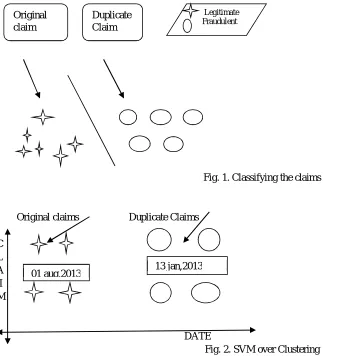
Fig. 1. Classifying the claims
Original claims Duplicate Claims
C L A I M
DATE
Fig. 2. SVM over Clustering
B. Support Vector Machine
A help vector machine is a managed learning framework used as a piece of request. It has a fundamental getting ready stage where data that has recently been portrayed is urged to the computation. After the arrangement stage is done, SVM can predict into which class the new moving toward data will fall into.
SVM Steps
1) Training (Preprocessing Step)
a) Define two class marks viz. "honest to goodness" or "deceitful"
b) Classify claims into two classes utilizing the preparation information set.
c) Choose bolster vectors and locate the most extreme minor hyper plane that isolates the cases into two classes.
2) Classification
a) Identify the new approaching cases into either "true blue" or "deceitful" class.
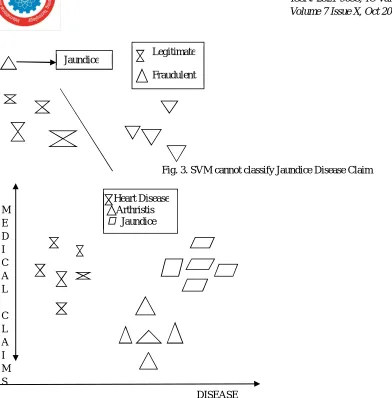
b) Heart Disease
c) Arthritis
d) Dyslexia
e) Diabetes
f) Cancer
g) Kidney Failure
h) Paralysis
i) Alzheimer's Disease
Original claim
Duplicate Claim
Legitimate Fraudulent
©IJRASET: All Rights are Reserved
692
Fig. 3. SVM cannot classify Jaundice Disease ClaimM E D I C A L
C L A I M S
DISEASE
Fig.4. Clustering groups different claims according to disease Type
C. Hybrid Approach
Information mining which is partitioned into two learning procedures viz., administered and unaided is utilized to distinguish fake cases. However, since every one of the above strategies has its own arrangement of preferences and impediments, by joining the upsides of both the systems, a novel cross breed approach for detecting fraudulent claims in health insurance industry is proposed.
D. Block Diagram
Hybrid framework
[image:4.612.50.333.537.728.2]
Satisfied claims
Fig. 5. Hybrid Model
Jaundice Legitimate
Fraudulent
Heart Disease Arthristis Jaundice
Doctor Patient Claims
Hospital
ECM SVM
Insurance company
©IJRASET: All Rights are Reserved
693
E. Advantages
1) The focal points are that all classes are significant to people and it very well may be effectively utilized for example order.
2) Finding those examples which show uncommon conduct.
3) They are not confined to the misrepresentation designs which as of now have predefined class marks like directed learning procedures do.
4) The preferences are it expects to identify anything which doesn't maintain the typical conduct and as a result of the absence of heading.
5) The copy guarantee gets ordered into the deceitful class and thus gets distinguished.
6) We have picked Evolving Clustering Method (ECM) for grouping on the grounds that the information is dynamic and new
information is Generated ceaselessly and Support Vector Machine (SVM) for arrangement.
V. CONCLUSION
As extortion ends up being increasingly refined and the volume of data creates, it ends up being all the more difficult to see distortion from principle part of data. We may not get rid of deception yet rather we can indeed lessen it. Information mining uncovers plans concealed in data to pass on learning. Information digging incorporates generally gathering and bundling techniques. Considering the central focuses and weights of most of the game plan and batching methodologies, ECM is picked as the clustering methodology in light of the way that the data streams in diligently and there is a need to amass dynamic data and SVM as course of action strategy since it gives the flexibility and convenience that are required in an OK quality data mining structure and the idea of theory and straightforwardness of planning of SVM is far past the cutoff points of standard procedures, for instance, neural frameworks and extended reason limits.
The normal example dataset testing results for the proposed SVCs change because of the idea of the cases dataset utilized. This is noted in the bunch of the cases dataset (MDC strength). At the point when the example dataset is highly slanted to one MDC forte (e.g., OPDC), the exhibition of the SVCs could tune to one classifier, particularly the straight SVM, when contrasted with others. Thus, the conduct of the dataset significantly affects order results.
REFERENCES
[1] Dr.Biswendu Bardhan. “Frauds in Health Insurance”, http://healthcare.financialexpress.com/200711/mar ket13.shtml.
[2] Melih Kirlidoga, Cuneyt Asuk(2012) A fraud detection approach with data mining in health insurance. Procedia - Social and Behavioral Sciences 62 ( 2012 ) 989 – 994.
[3] Dan Ventura. Class Lecture, Topic: “SVM Example.” BYU University of Physics and Mathematical Sciences, Mar. 12, 2009.
[4] Shunzhi Zhu, Yan Wang, Yun Wu, "Health Care Fraud Detection Using Nonnegative Matrix Factorization", The 6th International Conference on Computer Science & Education (ICCSE 2011) August 3-5, 2011. SuperStar Virgo, Singapore.
[5] Zhongyuan Zhang, Tao Li, Chris Ding, Xiangsun Zhang, “Binary Matrix Factorization with Applications”, Proceeding ICDM '07 Proceedings of the 2007 Seventh IEEE International Conference on Data Mining Pages 391-400.
[6] Mohammad Sajjad Ghaemi. Class Lecture, Topic: “Clustering and Nonnegative Matrix Factorization”. DAMAS LAB, Computer Science and Software Engineering Department, Laval University. Apr.12, 2013.
[7] Haesun Park. Class Lecture, Topic: “Nonnegative Matrix Factorization for Clustering”. School of Computational Science and Engineering Georgia Institute of Technology Atlanta, GA, USA, July 2012.
[8] Fashoto Stephen G., Owolabi Olumide, Sadiku J., Gbadeyan Jacob A, "Application of Data Mining Technique for Fraud Detection in Health Insurance Scheme Using Knee-Point K-Means Algorithm", Australian Journal of Basic and Applied Sciences, 7(8): 140-144, 2013 ISSN 19918178.
[9] Leonard Wafula Wakoli. “APPLICATION OF THE K-MEANS CLUSTERING ALGORITHM IN MEDICAL CLAIMS FRAUD/ABUSE DETECTION.” MSc Thesis, Jomo Kenyatta University Of Agriculture And Technology, 2012.
[10] Guido Cornelis van Capelleveen, "Outlier based Predictors for Health Insurance Fraud Detection within U.S. Medicaid", University of Twente & University of California, San Diego December 2013.
[11] Qun Song, Nikola Kasabov, "ECM — A Novel On-line, Evolving Clustering Method and Its Applications", Department of Information Science, University of Otago.