Abstract--This paper presents an ontology-based methodology for automatic decomposition of Learning Objects (LOs) into reusable content units, and discusses their dynamic assembly into personalized learning paths within the domain of technology-assisted self-directed learning. PerLE, a learner-centered, adaptive, tutored Personal Learning Environment (PLE), was developed to substantiate our dynamic syllabus approach applicable to authoring tutored adaptive e-courses. PerLE allows the decomposition of LOs into smaller learning units, which can be dynamically assembled into new LO sequences and repurposed for different learning objectives. While focusing on ontologies in the context of user modeling and personalization, we particularly describe the concept of creating dynamically assembled e-course sequences. We describe how PerLE was designed to better respond to psychological issues of self-directed learning through the strategic approach of user profiling, grounded in the Felder-Silverman Learning Style Model (FSLSM). We discuss the system’s conceptual learning architecture rooted in socio-constructivist and connectivist learning theories, and highlight the concept of use of RLOs with reference to the L.U.I.S.A. architecture and its functionalities as a recommender system. In this context, we describe our techno-pedagogical methodology which supports the proposed dynamic syllabus and dynamic assembly approach. Against this psycho-pedagogical backdrop, we question the platform concept and propose the OPUS 3 (OP 3) AI assisted e-Tutoring framework to better support the authoring of tutored adaptive e-courses, as shown in the use case.
Index Terms Adaptive Learning, Behavior Recording, Student Profile and Learning Style, RLO Dynamic Assembly
I. INTRODUCTION
The use of state-of-the-art Artificial Intelligence (AI) technology is rapidly gaining scientific interest and relevance in technology-assisted learning environments. Researchers are currently developing new methodologies and approaches for presenting subject-matter content and designing learning activities which cater for learner profiles.
Manuscript received June 29th, 2012; revised July 23rd, 2012. (submitted
June 27, 2012) .
Francesco Altimari (email: [email protected]) , Anna Franca Plastina (email:[email protected]),Michael D. Cronin (email:[email protected]), Rocco Servidio (email:[email protected]), Maria Caria (email:[email protected]) are with the Department of Linguistics, University of Calabria, Italy Attilio Pedrazzoli (email: [email protected]) Senior Consultant, Zurich, Switzerland.
The broad question addressed in this paper is whether an AI-assisted learning environment today is capable of delivering customized content designed by teachers/authors applying a dynamic assembly approach. We argue that new generation AI-assisted e-learning implementations can enhance learner centered management of educational experiences across a variety of learning scenarios. Our theoretical stance finds practical implementation in the development of PerLE, a learner-centered, adaptive, tutored Personal Learning Environment (PLE).
For the scope of defining the distinctive capabilities of our PLE in this paper, we focus on the following facets: User Profiling which targets content adaptation to identified individual cognitive learning styles; Recommending Learning Objects (LOs), which enhances deep learning potential and ensures standard interoperability in response to diverse pedagogical needs. These principles are applied through the adoption of L.U.I.S.A. as a recommender system; Dynamic Syllabus and Dynamic Assembly of Reusable Learning Objects (RLOs) which is our proposed approach, grounded in the LO principles of cohesion, de-coupling and pedagogical richness; Platform Concept, which defines AI-driven functions including Behavior Recording and Tracking (BRT) engine, Misconception and Excellency Detection based on pedagogical rules; Use Case, which offers a practical example of a self-directed adaptive e-course to demonstrate the feasibility of our techno-pedagogical model in PerLE.
II. USER PROFILING A. Definition
User profiling is a strategic approach to the design and generation of personalized, e-learning implementations can educational content and associated learning paths. Usually, user profiling includes a set of learner parameters such as personal interests, learning strategies, habits and preferred learning tools. Using learner profiles, personalized or adapted educational resources can be applied to match both individual learning preferences and expected competency levels. User profiling allows learners who share the same cognitive properties to be grouped, so that a common tutoring approach, concept and related tools can be adopted. User profiling is also a valid instrument for planning learner-specific didactical rules used by the AI assisted e-tutoring subsystem. The aim is to exploit information on
Authoring Tutored, Adaptive e-Courses in a
Personal Learning Environment: a Dynamic
Syllabus and Dynamic Assembly Approach
learner cognitive styles in order to provide educational guidance and recommendations.
B. Student profile model
In educational psychology, the construct of cognitive styles is used to recognize individual learning differences, given that learning is an active process and each student has different needs. These individual aspects can be defined in terms of several types of learning styles as highlighted in various studies [16]. All these studies share the common goal of summarizing the preferred way or manner adopted by a learner to retrieve and elaborate learning content [17]. It is difficult, however, to find a common definition of cognitive styles as different researchers emphasize various aspects of human personality. With the introduction of e-learning environments, the cognitive-style construct has been considered as an important variable in predicting student cognitive performance to improve their learning processes[18].
In this paper, we focus on the Felder-Silverman Learning Style Model (FSLSM), which describes human cognitive styles according to four main dimensions: sensing/intuitive, active/reflective, visual/verbal, and sequential/global [10].
In this model, sensing learners display preferences for facts and tangible material. They are more interested in exploring details and like hands-on interaction with practical tools. Intuitive learners, who are more creative and original, prefer to elaborate abstract concepts, such as theories, discovering new possibilities and relationships among ideas and things in general.
Active and reflective learners, on the other hand, apply different strategies to process information. Active people get more involved with learning materials. They are interested in establishing relationships with others, working cooperatively, and are more open to discussing concepts. For their part, reflective people prefer to work alone on specific topics.
Visual and verbal learners use different cognitive strategies in order to remember and elaborate concepts. Visuals respond better to pictures, diagrams and other types of graphics. Verbal learners are more productive when confronted with written or spoken language.
Sequential and global learners, on the other hand, differ in terms of their level of understanding. Sequentials progress in a linear-learning mode and use logic strategies to find solutions. Globals use holistic strategies and need more time to learn. They tend to learn new concepts randomly without defining connections. They are able, however, to solve complex problems and reconstruct initial scenarios by shaping new ones.
The FSLSM evaluates each student’s cognitive style, computing their preference according to a scale ranging from -11 to +11. For example, a value of -11 for the visual/verbal style indicates a student with poor learning attitudes towards visual content, whereas values close to +11 denote distinct student preference for verbal content. Hence, the FSLSM represents a valid learning reference framework for instructional design and development of personalized e-learning content. For our present purpose, we note that students with a manifestly high preference for a given cognitive style may present exceptional behavior.
C. The conceptual learning model
Our learning architecture is grounded in social constructivist and connectivist learning theories, assuming the common idea that learning is primarily an active and individualized process. In this view, learning is productive when students can construct conceptual relationships and create meaning with educational tools. This educational approach emphasizes learning-by-doing strategies which contribute to consolidating a range of skills and competences.
The proposed PerLE system has been developed by designing specific learning sequences, which customize educational materials to learner needs. To this end, a set of descriptors has been constructed to determine learner profiles, including learning preferences and background knowledge.
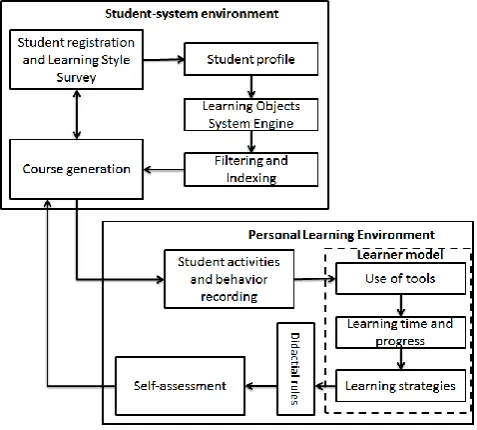
[image:2.595.306.545.326.541.2]In particular, the PerLE architecture includes a set of behavioral modules aimed at monitoring learner activities in order to generate a map of learning processes. Figure 1 illustrates the main properties of the conceptual learning module. Below, we describe the system procedure for a new student.
Fig. 1. The conceptual learning model components.
A new student signs up by using the registration module in order to create a personal profile, which collects information, such as previous knowledge, skills and motivation considered important to the achievement of specific levels of competence. After registration, the e-learning system tests the student’s cognitive style. In this phase, we invite each student to respond to a survey based on the FSLSM. The cognitive style profile indicates the student’s preference related to the perception and elaboration of educational materials. Based on the student’s response, the system defines two main cognitive styles: primary and secondary. Although students may reveal more than one preference, the primary cognitive style is preferred in generating a given course. The system then generates the student’s primary cognitive profile.
III. RECOMMENDING ALTERNATIVE LOS A. Concept
Within a socio-constructivist view of student-centered applications in LMSs, we argue that the aim of promoting deep learning can only benefit from access to and the employment of RLOs complementing integrated use of data, tools and services in a working context characterized by open standard interoperability. The teacher-developer’s capacity seamlessly to prepare and configure a toolkit, a PLE, or a dynamic syllabus to a given purpose depends on the opportunity to avail of LOs which, technically, respond to requirements of standardization and metadata identification. Pedagogically, they derive from sound teaching principles while retaining flexibility and independence in their potential employment.
In consideration of the important paradigm shift in software engineering towards the development of object-oriented programming promoting the use of re-usable component technologies (Douglas:2001), a conception of single elements which are stand-alone and re-employable in different contexts of use is a valid one. By analogy, an LO, once created, can find its place in a range of applications in a component model scenario which foresees its use in terms of elements which are pedagogically rich either in a stand-alone sense or in combination with others.
There are many definitions of LOs, ranging from the large to the small, the granular to the less so. There are LOs which are pre-constituted and ready for use (standardized and tagged) and there are also, importantly, those which can be either repurposed or identified ex novo for new-use scenarios and inclusion in LORs. Hence the need to make use of architectures offering enhanced capabilities for LO searching and identification. This needs to be done compatibly with standardization while preserving LO pedagogical identity and applicability and, importantly, facilitating their description and annotation.
The tendency not to find agreement on a definition for the LO is a fair reflection of the diversity of the uses to which they are put and how they are variously considered in pedagogical terms. In a well-known conception, they were considered as blocks, in Wayne Hodgins’ Lego metaphor, but the fundamental question of reusability, or rather the organization of content for pedagogical aims renders Wiley’s metaphor of the atom (Wiley,2000) more appropriate. We need, however, to bear in mind that an LO should in principle be created on the basis of pedagogical considerations while not suffering from codified forms of constraint that compromise their flexible use either alone or in combination with other atoms (Polsani:2003).
This is particularly the case when instructional designers or course developers have to respond to the complicated curricular requirements of, for example, a language teaching course for university undergraduates. This foresees the development of an extensive series of content elements and assets employed in a process which strives to be holistic and constructivist in character. While having precise pedagogical aims, the course needs flexibly to respond to the needs of student-centeredness, activity driving, feedback and evaluation in itinere. It can emerge that the pre-constituted, multi-component LO available in repositories
may not be suitable to specific needs of this kind. Instructional designers may find that what is available is not necessarily appropriate or useful to their purposes. Therefore, they require LOs which are atomic in a non-neutral interpretation of instructional theory, or component elements of like nature which can be used or re-purposed according to local and specific needs.
Thus, for instructional designers interested in dynamic syllabus design, LOs need to have the following characteristics which combine technological and pedagogical requirements:
- They need to be standardized, describable and identifiable and to have a distinct pedagogical identity
- They need to have discrete characteristics and be constituted of individual components which enable re-use for flexible, pedagogically driven deployment We should bear in mind that “technology can be the enabling factor to enhance and enrich these learning experiences and learn-flows but cannot supplant pedagogical concepts” (Finke :2004:311). Therefore, the relationship between the technical standards to which LOs must respond and their pedagogical purposes is symbiotic and essential to fluent management of instructional design in learning contexts.
We therefore come to the issue of how to develop, maintain and extend local LORs which respond to such needs and the architecture which can be employed to satisfy these requirements.
B. L.U.I.S.A. as a recommender system
In terms of concept, standards and structure, LO creation and use has seen growing levels of compatibility with regard to subject matter and content in LMSs. An important question to resolve in this context is the need for LO reusability in different educational scenarios and for different platforms, in conformity with metadata standards, and overcoming problems related to the integration of distributed LORs.
Efficacious reuse of LOs depends on the ability of Web infrastructure to assist semantic interoperability in their discovery, selection, configuration and mediation. The architecture necessary to this purpose calls for the employment of Semantic Web Services because of their ability to guarantee semantic definition, for systems that require metadata, tags, description and semantic interoperability. Rich semantic definitions in Learning Object Metadata (LOM) add to and complement reliable LMSs supported by Learning Object Repositories (LOR).
L.U.I.S.A. is a Semantic Web Service-based Architecture for LO discovery, selection, negotiation and composition and renders the procedure of query, creation, annotation and composition of LO resources in a manner compatible with the principles of use described in the previous section.
and “Context” (Sicilia: 2006). Semantic Learning Object metadata Repositories (LOMR), in which metadata is expressed in terms of formal ontologies, offer greatly enhanced search capabilities.
Furthermore, the use of an ontology-based approach aimed at the identification of design rationales in such an architecture goes beyond the scope of formal ontology. In our platform, this distinction is fundamental to the stimulation of learning design descriptions or semantic learning designs. In semantic-technological terms, the advantages are improved and facilitated harvesting, retrieval and description of assets.. This approach also acts as a form of driver and constraint vis-à-vis end-point evaluation criteria. It further reflects the ontological choices made at the outset in dynamic syllabus creation (Sicilia:2006 ). IV. DYNAMIC SYLLABUS AND DYNAMIC ASSEMBLY OF
RLOS
In Higher Education (HE), the dominant pedagogy has been found to place emphasis on analytic processes striving towards strategic and deep learning. At the same time, however, tertiary students are spoon-fed and treated as passive recipients of transmitted knowledge (e.g. Boyle et al. 2003; Desmedt et al. 2003). On the other hand, in the attempt to respond to the needs of the current Information Society, in which cooperative relationships, shared decisions, diversity and communication are becoming the dominant values (Gros 2001), HE institutions are striving to adopt e-learning systems. Although the combination of technology and pedagogy offers powerful potential to enhance learning by doing and active learning (Bredo 2000), there is still a wide gap between the theoretical concept and the practical implementation of LOs. University teachers continue to use conventional information delivery, disregarding learner-centered approaches that make effective use of online technologies (Herrington, Reeves & Oliver 2005). Prescriptive syllabi and normative, campus-based teaching experiences (Gulati 2004), grounded in chain-like sequence of linear learning events (Knowles et al. 2011), hinder self-directed processes of learning.
We argue that a successful techno-pedagogical methodology must rely on a relationship-based learning model which combines objectivity about LOs as a generic concept and subjectivity of individual teachers’ integration of LOs into their praxis (cf. Gunn et al. 2005). First and foremost, we assume that this kind of model relies on two interconnected actions, namely, the design of a dynamic syllabus and the dynamic assembly of reusable LOs.
The design of a dynamic syllabus is flexibly configured as a series of hyperlinks that link to LOs (Boyle 2003), i.e., any entity, digital or non-digital, that may be used for learning, education or training in the IEEE Learning Technology Standard (IEEE, 2002). While LOs alone are not adequate for learning and knowledge construction, the design of their context of use within a dynamic syllabus assigns them an educational value in relation to the context in which learning occurs (cf. Lave & Wenger 1991). This presumes that a flexible dynamic syllabus is rooted in the selection of context-free reusable LOs (RLOs): “Reusable learning objects offer a great promise in terms of reducing development time because you can ‘mine’ the work of
others, and for a tailored learning experience that gives learners only the training they need to perform their jobs” (Barrett & lderman 2004: xv-xvi).
In this respect, the dynamic assembly of RLOs must rely on the principles of cohesion, de-coupling and pedagogical richness (Boyle 2003): each LO has one learning objective or goal (cohesion) with minimal bindings to other LOs (de-coupling) in order to make the learning experience effective (pedagogical richness). This challenging design needs to be further oriented towards maximizing LO reuse and repurposing: reusability reduces the time-cost burden placed on content authors and course designers; repurposing LOs allows the pursuit of specific pedagogical objectives and the provision of options for further adaptation by local tutors. Repurposing is thus understood as “a process where the original structure of a learning object is populated with content from a different source and/or subject area and used to develop new learning activities” (Gunn et al. 2005: 191). While content can be recovered from LO repositories and other sources or created by authors themselves, all RLOs need to include content, practice and assessment items as their basic components.
From the learner’s perspective, a dynamic syllabus and a dynamic assembly of RLOs need to empower learners. The creation of dynamic learning paths is crucial in allowing learners to construct their own personal learning paths. It follows that a dynamic-assembly approach will support: a. multiple delivery types, media types, and presentation styles to fit learner needs and preferences; b. multiple learning approaches, ranging from receptive learning to discovery and problem-based learning; c. the acquisition of new skills and knowledge. The overall aim of this approach is to encourage learners to create their own knowledge and develop their skills through self-directed processes in which they engage in critical thinking, become aware of their learning gaps, generate their own content and exchange LOs from individual workspaces to a shared workspace, increasing the reusability of the LOs they have consumed (Farrell et al. 2004).
Finally, we argue that a techno-pedagogical optimization of the configuration of a dynamic syllabus and a dynamic assembly of RLOs is feasible through the creation of a syllabus navigation panel in the form of an interactive concept map, which adheres to the principles of cohesion, de-coupling and pedagogical richness. This kind of configuration also well responds to the principles of reusability and adaptation by local tutors.
V. PLATFORM CONCEPT A. Concept and functionality
PerLE is an advanced, personal, collaborative, tutored e-learning environment, sustained by the AI based OP 3 framework, following current state-of-the-art psycho-pedagogical e-learning paradigms. These emphasize the interplay between social and personal dimensions in the learning design, supporting transparently any chosen Instructional Design model. The platform consists of 3 tightly coupled, software sub-environments:
- Enterprise Class Portal Liferay 6 or Jahia 6 (Java based), fully compliant to the Java Portlet 2.0 specifications;
- OP 3 Artificial Intelligence Environment (Cougaar Framework defined Agent Communities);
- Local Resources, such as local repositories (local document and media repositories, like Alfresco), access to external RLO repositories like MIT-OCW, Merlot, Khan Academy etc., local collaboration and cooperation tools, “Open Social Server” and APIs, external access to the integrated e-Portfolios, RSS management tools and two tightly integrated LMS environments OLAT 7.2 and the extended Moodle / LAMS.
B. Behavior Recording Functionalities
The Behavior Recording Engine is an AI Agent Community able to analyze real-time learner behavior during the learning cycle as well as collaborative activities and participation in group assignments. Detected individual behavior and content parameters serve as input for a defined, associated set of rules for a given sequence or activity. Eventual resulting recommended activities will contribute to the continuation of an adapted, personalized learning path. Suggested activities, dynamically modifiable by a personal human Tutor, can include RLOs and various collaborative actions.
The Behavior Recorder and Tracker (BRT) functionality uses the parameters stored in the original user profile to collect the behavioral data during the learning activity. At the end of a learning section, the BRT analysis engine calculates the learner’s possible behavioral modifications, storing them in the operational user profile. This is used to calculate the actual user model for the Misconception- Excellency Management Engine and the Recommender Engine for future interventions.
VI. Integrated e-Tutoring
The OP 3 e-Tutoring environment is a self-contained, autonomous, AI framework based on a Multi-Agent System Community concept with dedicated, generic Agent pools realized using the Cougaar AI Component Model Framework [14].
A Cougaar Agent is an autonomous software entity, profiled by specific plugins to support a particular organization, business process or algorithm. The definition of a Cougaar Agent Society is a group of Agents that interact to respond to events or categories of events cooperatively. Events are typically associated with course activities, where planned objectives and constraints may be
frequently modified and/or rescheduled in the execution of an activity. Thus, a specific AI Agent society can be one or more logical AI Agent communities, consisting of single, autonomous Agents. The society shares a DNS-like Namespace that allows all agents to resolve mutual references. Behaviors and characteristics are enabled by:
- PLUGINS: software components loaded into an Agent to support a specific functionality of application business logic. The aggregate behavior of all plugins in an agent determines how the Agent responds to requests received from its peers. In most AI-assisted applications, Agents differ only in data handling and in the set of plugin elements;
- BLACKBOARD: the communication component of a Cougaar agent (Agent to Agent communication mechanism), using a fairly traditional-looking dashboard with standard publish/subscribe semantics. Cougaar blackboards are not conceptually distributed, while the Cougaar data space can be viewed as the combination of the blackboards of all related agents. Blackboard modifications are transaction-controlled using a subscription model, as well as in the case of add/remove/modify events.
For interactions between agents, blackboard objects are transformed into messages by domain-specific Logic Providers.
The OP 3 AI-assisted e-Tutoring framework skeleton consists of the following Agent communities:
- OP 3 management community - OP 3 Initializer and Agent supervisor - OP 3 Student management and supervision
community: Student profiler
- OP3 Behavior Recorder and Tracker agent community
- OP 3 Misconception- Excellency Agent community - OP 3 Rule Engine Agent community
- OP 3 e-Tutoring and Hint Agent community - OP 3 personalization / adaptation Agent community - OP 3 Recommender Agent initiator interfacing the
L.U.I.S.A. Engine.
The AI-assisted e-tutoring concept is based on a post- activity, real-time processing of pedagogical rules associated to specific learning activities. The monitored behavior parameters are confronted with the expected results of the learning activity. An excellency or knowledge- misconception condition will be generated for which actions can be recommended according to the computed results. This is realized using the defined, knowledge-based exception schema associated to the learning step and specific rules defined by the subject-matter expert.
The OP 3 e-Tutoring subsystem allows the learner to request “Human Tutoring” intervention whenever required. OP 3 consistently tracks and logs learner activities with a defined, minimum granularity. Teachers/Tutors can monitor the learner’s path, performance, and navigation activities.
VII. USE CASE A. Concept
The present use case is based on the assumption that it is crucial for Educational Technology to shift the focus towards pedagogical flexibility which supports self-directed learning in PLEs. Most e-courses continue to be developed from a teacher-centered perspective in which the provision of new technological services has disregarded the central role of learners as recipients of these courses. The generation of e-learning materials has subsequently neglected learning needs and styles. As a result, such e-courses have been found to hinder the benefits of e-learning due to the negative effect known as one-size-fits-all (Cuthrell & Lyon 2007).
We argue that the implementation of an active e-course needs to be considered as “an open, self-representable and self-organizable document with a flexible structure” (Zhuge & Li 2006: 333). Taking this learner-centered perspective, we describe how an adaptive e-learning approach best responds to the creation of a dynamically tailored e-course here presented as our use case. First, we present the educational scenario in which the e-course was designed and illustrate the theoretical foundations of our techno-pedagogical model. Then, we discuss the core aspect of the e-course: the dynamic organization of learning materials.
B. The Educational Scenario
Post-graduate students training at the School of Clinical Pathology at the University of Calabria in Italy are required to take five English modules during their five-year course as from the academic year 2012. Each module is planned as an intensive 16-hour course, delivered in class following a traditional flat syllabus and a linear course design. In this scenario, we argue that institutional constraints do not sufficiently allow students to engage in practices of self-directed learning. An e-course was thus understood to offer students the opportunity of shifting from being passive recipients of knowledge transmitted in praesentia to engaging actively in personal discovery learning and knowledge construction in PerLE. The blended modality of learning pursued the same pedagogical objective of developing students’ language proficiency and skills in the specific domain of English for Specific Purposes (ESP). For this reason, an e-course on “English 1 for Clinical Pathology” was designed and is presented here as a use case.
C. The Techno-pedagogical Model
The pedagogical model, ECLASS (Gerson 2000), which supports eLesson Markup Language (eLML), an open source XML framework for creating electronic lessons, was referenced to create the e-course. The acronym ECLASS entails the following elements:
- Entry: the introduction to a lesson or a unit (the sub-category of a lesson);
- Clarify: the explanation of some theory, models, principles or facts;
- Look: examples that help students to understand the theory;
- Act: students are invited to become active through task-based activities;
- Self-Assessment: students check if they have fulfilled the learning objectives of the lesson or unit;
- Summary: a brief summary of either the whole lesson or an individual unit is provided.
While, the three elements clarify, look and act are central to the pedagogical process of learning, their technological combination allows the creation of an LO. In addition, these elements can be used multiple times within one LO and in any sequence order. In other words, the flexibility of the ECLASS model satisfies both the technological effectiveness of creating RLOs and the instructional need to create e-courses grounded in sound pedagogical principles in different learning scenarios.
In the present case, however, the ECLASS model was slightly modified to encompass two additional elements, namely, share and store. The first element was added to empower students to make informed decisions and to become critical thinkers through shared learning; the second to allow them to create an e-portfolio of their learning products.
D. The Dynamic Organization of Learning Materials Key to the design of the learning materials was the need to establish distinct organizational layers of structural elements according to the principles of cohesion, de-coupling and pedagogical richness (cf. Section III.). The structural elements were aggregated into the levels of the dynamic syllabus, the e-course, four e-lessons and their underlying units managed by a common concept map: the kernel idea of an active e-course “is to organize learning materials into a ‘concept space’ rather than a ‘page space’ ” (Zhuge & Li 2006: 333).
Concept maps have the functions “of acting as an access layer to content, and to aid the reader’s orientation within the hypertextual structure” (Cantoni & Tardini 2006: 84). In e-course design, this type of representation allows the presentation of content in lessons and units and to clearly visualize the relations that hold between these. Most importantly, the application of the ECLASS model avoided enforcing a sequence which a learner must use to traverse the course, ensuring flexible and self-paced learning. Thus, learners were allowed to freely navigate through the hypertext structure, deciding on which LOs to access and the sequence of accessing them. The links between the LOs stimulated learners to make content associations, thus facilitating cognitive processes, such as remembering, understanding and knowledge enrichment.
more than any other LOs, have the greatest potential for creative, inter-contextual reuse across multiple subject areas” (Conole, Evans & Sims 2003: 165). These LOs further supported intra-contextual use, i.e., the number of times the LO might be reused within the same content area or domain (Wiley 2001). On the other hand, the development of expert knowledge was ensured through the structural element clarify, which included different theoretical principles regarding the specific domain of learning. The structural element act of the LOs was multiple in order to provide learners with hands-on practice according to their own learning preferences.
Together, these three structural elements culminate in the creative use of the materials learned: creating a storyboard about oneself, preparing and broadcasting an oral presentation, creating a Med WordBank, recording one’s pronunciation, writing an article summary and generating its text visualization, writing a pathology report. By working their way through the LO, learners eventually self-assess their achievement of the single learning objective through self-assessment checklists and through short summaries of their expected achievements.
The e-course in the PLE thus allows a flexibility scenario in which students have the maximum freedom to start at the topic and level of aggregation they prefer and study a sequence of LOs of their own choice. In this flexibility scenario, students are equipped with an array of performance-support tools (e.g. widgets) to create, share and store the products of their learning processes.
In sum, the e-course effectively supports learners’ active participation, dynamically organizes and provides adaptive learning content, allows self-evaluation of learning performances and offers guidance for further self-directed learning.
VIII. CONCLUSION
The importance of PerLE lies in the advances it makes in offering an ontology-based methodology and a dynamic syllabus and dynamic assembly approach to monitored self-directed learning. Though in its pilot stage of development, the practical implementation of our proposed approach in PerLE shows promising innovation in technology-assisted learning. Further development of advanced e-learning content using LOMRs will support our goal of creating dynamic e-courses across a variety of learning scenarios.
REFERENCES
[1] G. O. Young, “Synthetic structure of industrial plastics (Book style with paper title and editor),” in Plastics, 2nd ed. vol. 3, J. Peters, Ed. New York: McGraw-Hill, 1964, pp. 15–64.
[2] W.-K. Chen, Linear Networks and Systems (Book style). Belmont, CA: Wadsworth, 1993, pp. 123–135.
[3] H. Poor, An Introduction to Signal Detection and Estimation. New York: Springer-Verlag, 1985, ch. 4.
[4] Cantoni, L., Tardini, S. 2006. Internet (Routledge Introductions to Media and Communications). London -New York: Routledge [5] Conole, G., Evans, J., Sims, E. 2003. Use and reuse of digital images
in teaching and learning. In A. Littlejohn (ed.). Reusing online resources: A sustainable approach to e-learning. London: Kogan Page, pp. 156-170.
[6] Cuthrell, K., Lyon, A. 2007. Instructional Strategies: What Do Online Students Prefer? Journal of Online Learning and Teaching, 3(4), 153-163
[7] Gerson, S. M. 2000. E-CLASS: Creating a Guide to Online Course Development For Distance Learning Faculty. Online Journal of Distance
[8] Wiley, D. A. 2001. Connecting learning objects to instructional design theory: A definition, a metaphor, and a taxonomy. In D. A. Wiley (Ed.), The instructional use of learning objects: Online version. Bloomington, IN: Association for Educational Communications and Technology. http://reusability.org/read/chapters/wiley.doc. Learning Administration, III (IV). State University of West Georgia: Distance & Distributed Education Center.
[9] Zhuge, H., Li, Y. 2006. Learning with an active e-course in the Knowledge Grid environment. Concurrency and Computation: Practice and Experience, 18, 333-356.
[10] Felder,R.M., and R. Brent (2005). Understanding Student Differences. Journal of Engineering Education, 94(1), 57-72, [11]Koedinger K., Stamper J. C., A Data Driven Approach to the
Discovery of Better Cognitive Models, EDM, pp. 325-326 (2010)
[12]Paredes, P., and Rodriguez, P., Considering Learning Styles in Adaptive Web-based Education. Proceedings of the 6th World Multiconference on Systemics, Cybernetics and Informatics en Orlando, Florida, 481-485 (2002)
[13]Pedrazzoli A., OPUS One: An Artificial Intelligence - Multi Agent based Intelligent Adaptive Learning Environment (IALE), American Institute of Physics (AIP) Conference Proceedings, Volume 1247, Title: Iaeng Transactions on Engineering Technologies (Vo. 4), pp. 215-227 (2010) [14]Cougaar Architecture Document, BBN Technologies
Document link:
http://cougaar.org/twiki/pub/Main/CougaarDocuments/CAD_ 11_4.pdf
[15]Cougaar Developers Guide, BBN Technologies Document link:
http://cougaar.org/twiki/pub/Main/CougaarDeveloperGuide/C DG_11_4.pdf
[16] Kozhevnikov, M. (2007). Cognitive styles in the context of modern Psychology: toward an integrated framework of cognitive style. Psychological Bulletin, 133(3), 464-481
[17] Martinsen, Ø. & Kaufmann, G. (2000). The Assimilator-Explorer Cognitive Styles and their Relationship to Affective-Motivational Orientations and Cognitive Performances. In R.J., Riding, & S.G., Rayner, International Perspectives on Individual Differences (vol. 1, pp. 3-40). Stamford, Connecticut: Ablex Publishing Corporation [18] Mampadi, F., Chen, S.Y., Ghinea, G., & Chen, M-P. (2011). Design