A study on Use of Bottom Ash and Fly Ash in
Concrete used in Pavement Construction
Sarvjeet1, Deepak Dalal2 1
M.Tech Scholar, Civil Department,Indus Institute of Engg. And Technology-Jind, 126102, India
2
Assistant professor, Civil Departm
Abstract: Silt soil with low pliability is encountered in most parts of Haryana state and the preliminary investigation shows that it has poor engineering properties. With use of soil as a fine aggregate is getting quite expensive. With building of two thermal power plants in Haryana in panipat the waste of fly ash and bottom ash is produced in large amount as a waste product of Coal. These bottom ash and fly ash can be used as a fine aggregate in nearby areas where the transportation cost is less as the silt soil is quite expensive and removal of soil layer has many disadvantages like soil erosion and effect on the quality of soil .The bottom ash and fly ash is particularly a waste material which dumping costs as much as its transportation and with its qualities as fine aggregate and adhesive properties they both can be used as fine aggregate and cement replacement in certain quantity in concrete .Which deduct the cost of concrete and use of waste material other than discard it. With results showing that sand can be partially replaced with bottom ash. Cement can be replaced with fly ash class C in certain quantity which doesn’t affect much strength of concrete and does not affect the strength and setting time .A certain number of tests and conducted on the concrete construct using bottom ash and fly ash
Keywords: Bottom ash, Fly ash, Cement
I. INTRODUCTION
A. General
The significance was given to expand the sustainability of environment and better ways have been explored to manage wastes materials such as coal ash, plastic, rubber, construction and waste, broken glass, scrap tyres, steel furnace slag etc. which are creating a number of problems in handling and disposing. These waste materials are disposed off either in low lying areas or in land fill sites which result in filling of land fill site at a very fast rate. So, deduct, reusing and recycling are the need of hour to save the natural resources as well as to save the land fill site which are otherwise going to create space problems for discard of waste material. It is estimated that 10-12 million tons of construction and demolition waste (CDW) is generated in India every year which needs a vast space for disposal. It is also surveyed that there is a vast deficit of about 750 million cubic meter aggregates to achieve the targets of road sector in India (www.urbanindia.nic.in). So, CDW can prove to be very useful to meet the demand and supply gap of road sector.
There are many advantages that lead to the use of RCA materials as pavement material in base of roads. The main advantages of using RCA in the construction industry are of sustainable values and environmental issues. The wastes from construction and demolition works are of large volume and increasing over time. To overcome this issue, sustainable construction is one of the strategies to be considered by the construction industry. One way of achieving this is to introduce recycled aggregates from these wastes of construction and demolition works in to pavements.
B. Objectives
1) To assess properties of fly ash & bottom ash mixtures.
2) To find out workability & durability of Highway pavement.
3) To explore optimal use of bottom ash & fly ash for pavement.
4) To check out compressive strength by replacing aggregate with bottom ash & fly ash at different percentage i.e. 0%, 5%, 10%, 15%, 20%.
5) To find suitability of reuse of bottom ash & fly ash in a useful manner.
6) To reduce overall environmental effects of production using these materials as partial replacement.
7) To perform Following tests
a) Water Absorption of Bottom ash/ fly ash
c) Impact Test Bottom ash / Fly ash
d) Crushing strength Test Bottom ash / Fly ash
e) Soundness test of Bottom ash / Fly ash
C. Scope of Work
In modern road pavements that are using waste material, practice utilization of mixtures have been preferred. This reduces pollution and it is cost saving. The fly ash & bottom ash are performing significant role in road pavement. IT is material cost saving as well as compressive strength & durability is provided using such waste material. In construction of rural roads in low lying or flood prone areas, fly ash should have to be considered as normal choice in near future. The physical & chemical properties of fly ash are evaluate first. Then it is discussed what is the utilisation of fly ash in road work. The effectiveness of utilization of cost, especially in rigid pavement construction, is studied. We could also use bottom ash as a fine aggregate in certain percentage from 5% to 40% & we will check its result & as per result it will be used in construction of concrete for road pavements. There are some limitation in using both fly ash & bottom ash as substitute of fine aggregate respectively
II. LITERATURE REVIEW
A. General
With view to carry out this study in a successful way, literature/reports from national & international journals have been referred to understand present status, identify gap areas & emerging issues to make this study more fruitful. Much research has already been undertaken by research scholars Doughnut world. Abstract of most of related & latest literatures are summarized here. Hence an attempt is made to review literature to know latest development in this study area.
B. Review of past works
1) Li Yijin, Zhou Shiqiong(2002) “The effect of fly ash on the fluidity of Cement paste, mortar, and concrete”, International Workshop on Sustainable Development and Concrete Technology[1]: The addition of ultra-fine fly ash to cement paste, mortar and concrete can improve their fluidity, but some coarse fly ash can’t reduce water. This paper investigates the effect of fineness and replacement levels of fly ash on the fluidity of cement paste, mortar, and concrete. The fly ash is collected by electro-static precipitators and airflow classing technology. Three different finenesses were chosen, and their replacement levels were 20%, 30%, and 40%, respectively. The experiment results show that particle size distribution, Zeta potential, density and particle morphologies of fly ash are the major factors affecting their fluidity.
2) Satish Sharma, V.V. Arora, Adarsh Kumar N S (2005) “Study of usage of bottom ash as part replacement of sand for making concrete blocks”: line with the findings of the other authors as outlined in the literature survey carried out in NCB. In the present investigation, laboratory studies have been carried out at NCB laboratory to utilize bottom ash as part replacement of sand in concrete. This study covers manufacturing of concrete blocks without flyash & with bottom ash for making solid blocks as per specification laid down in IS: 2185 using vibro compaction machine available in NCB. Wet density is found to be lower in blocks containing bottom ash & dry shrinkage values are found well within the limits of specifications. Concrete Blocks having bottom ash @ 30% by weight of sand are found suitable for use in the manufacture of concrete blocks.
3) P. Aggarwal, Y. Aggarwal, S.M. Gupta (2007) “Effect of bottom ash as replacement of fine aggregates in concrete”, ASIAN JOURNAL OF CIVIL ENGINEERING (BUILDING AND HOUSING) VOL. 8, NO. 1 (2007): This paper presents the experimental investigations carried out to study the effect of use of bottom ash the coarser material, which falls into furnace bottom in modern large thermal power plants and constitute about 20% of total ash content of the coal fed in the boilers as a replacement of fine aggregates. The various strength properties studied consist of compressive strength, flexural strength and splitting tensile strength. The strength development for various percentages (0-50%) replacement of fine aggregates with bottom ash can easily be equated to the strength development of normal concrete at various ages.
prevent entry of pavement materials into sub grade or sub grade material into pavement materials. Attempts are made to investigate stabilization process with model test tracks over sand soil sub grade. Cyclic plate load tests were carried out on tracks with different reinforcement materials like waste plastics & waste rubber in mudroom / flash sub base course, laid on sand sub grade. Test results show that maximum load carrying capacity associated with less value of rebound deflection is obtained for mudroom reinforced sub base compared to fly ash reinforced sub base.
5) Hashim Mohammed Alhassan (2012) “Characterization of Solid Waste Incinerator Bottom Ash and the Potential for its Use”:
This study investigated the potential use of municipal solid waste incinerator bottom ash as civil engineering construction material. Based on the results obtained from this study, the following conclusions can be drawn: Municipal solid waste incineration, from this study achieved 93% reduction in volume and 62% by weight. The MSWI bottom ash is classified as well graded in the Unified Soil Classification System; Non-plastic A-3 material in AASHTO classification and satisfies the grading of sand particles for zone 2 of the Nigeria General Specification (1997). MSWI bottom ash is a light weight material from the specific gravity compared to natural sand and gravel. This is an advantage in the construction of fills on grounds with low bearing capacity.
III. MATERIALS AND METHODOLOGY
A. Overview
The experimental program involve comparison of properties ofconcrete made using Bottom ash, fly ash in different mixing in M25
grade concrete pavement with reference M25 grade concrete pavement made by Normal mixing approach (NMA). Analysis about material used & their properties is done in this chapter. The basic tests carried out on concrete samples are also discussed in this chapter, followed by description of mix design & curing procedure adopted. Then various tests examined on specimens are discussed.
B. Cement
Cement is a fine powder which is grey on colour. The basic structure of cement is given in table. Cement is mixed with water & materials like gravel, crushed stone & sand to make Pavement The cement & water form a paste that binds other materials together as Pavement hardens
C. Bottom Ash
Properties of bottom ash are not only varying from one plant to another, but also from day to day production within a single plant over time. Therefore, these characteristics reported by researchers just could be taken as references & not absolutes. Power plant’s operating parameters play an important role in validation on characteristics of bottom ash from a given source.
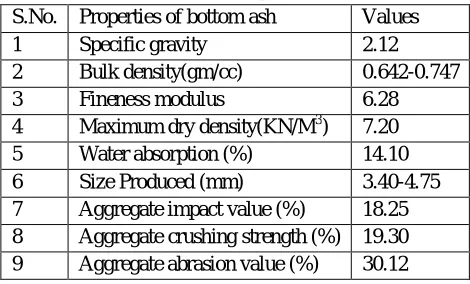
[image:3.612.175.410.571.713.2]1) Physical Properties: Bottom ashes have angular particles with a very porous surface texture. Bottom ash particles range in size from a fine gravel to a fine sand with very low percentages of silt -clay sized particles. The ash is usually a well graded material, although variations in particle size distribution may be encountered in ash samples taken from same power plant at different times. Bottom ash is predominantly sand -sized, usually with 50 to 90% passing a 4.75 mm (No. 4) sieve, 10 to 60% passing a 0.42 mm (No. 40) sieve, 0 to 10% passing a 0.075 mm (No. 200) sieve, & a top size usually ranging from 19 mm (3/4 in) to 38.1 mm (1-1/2 in). Table 1 gives physical properties of bottom ash.
Table 1 Physical Properties of Bottom ash
S.No. Properties of bottom ash Values
1 Specific gravity 2.12
2 Bulk density(gm/cc) 0.642-0.747
3 Fineness modulus 6.28
4 Maximum dry density(KN/M3) 7.20
5 Water absorption (%) 14.10
6 Size Produced (mm) 3.40-4.75
7 Aggregate impact value (%) 18.25
8 Aggregate crushing strength (%) 19.30
2) Chemical Properties: Bottom ash & boiler slag are made essentially out of silica, alumina, & iron, with smaller Percentage of calcium, sulfates, & other compounds. The composition of above particles is controlled principally by source of coal & not by type of furnace. Bottom ash or boiler slag derived from lignite or sub-bituminous coals have a higher percentage of calcium than that from anthracite or bituminous coals. Due to salt content and, in some cases, low pH of bottom ash & boiler slag, these materials could display corrosive properties. When bottom ash or boiler slag is used in an embankment, backfill, sub-base, or even possibly in a base course, potential for corrosion of metal structures that may come in contact with material is of high concern & should be investigated prior to use so that it does not pose any problem.
D. Fly Ash
Fly ash could be used as mineral filler in HMA paving applications. Mineral fillers increase stiffness of asphalt mortar matrix, improving rutting resistance of pavements, & durability of mix.
Fly ash will typically meet mineral filler specifications for gradation, organic impurities, & plasticity. The benefits of fly ash include:
1) Decrease potential for asphalt stripping due to hydrophobic properties of fly ash
2) Lime in some fly ashes may also lower stripping
3) May afford a lesser cost than other mineral fillers
Fly ash is used in Pavement admixtures to enhance performance of Pavement Portland cement contains about 65 % lime. Some of this lime becomes free & available during hydration process. When fly ash is available with free lime, it reacts chemically to form additional cementations materials, improving many of properties of Pavement ..
E. Water
The water employed in mixtures was taken from Indus institute of engineering technology, Pavement laboratory which is tap water. This water was also used in curing tanks.
F. Chosen tests
Each mix underwent a series of tests. These tests were chosen to assess individual characteristic of aggregates as well as strength testing, baby & durability indicators of Pavement A complete list of tests is given below
1) Strength Test
2) Particle Size Distribution
3) Specific Gravity
4) Water Absorption
5) Abrasion Resistance Test
6) Impact Value Test
7) Soundness Test
8) Workability Test
9) Compressive Strength
G. Particle Size Distribution
In this project Particle size distributions were carried out for all fine & Fly ash in accordance with IS 383-1970 with Specification for Coarse & Bottom Ash from Natural Sources for Pavement.
H. Specific gravity
These types of tests have been made in order to find specific gravity. Determined & recorded weight of empty clean & dry
pycnometer is W1. One third of a Bottom ash sample has been placed in pycnometer. Determine & record weight of pycnometer
containing bottom ash, W2.
I. Water absorption of Coarse aggregate
The test is significant to determine the porosity of road aggregates. It is indirect measure to check strength and stones quality. Road stones that are absorbing more water have been considered unsuitable in case of road making. Water absorption has been expressed as percent water absorbed by aggregate in terms of oven dried weight of aggregate.
J. Compressive Strength Test
This test is conducted on cube specimens (150mm x 150mm x 150mm) for determining compressive strength at various ages:- Apparatus:-
Testing Machine:- A reliable type testing machine should be used or it should have sufficient capacity for tests & should be capable of applying load at specified rate. Only ± 2% of Maximum load error is permissible The testing machine will be equipped with two steel bearing platens which have hardened faces. A platen would be fitted with a ball seating in form of a portion of a sphere, its centre coincides with central point of face of platen. other compression platen would be plain rigid bearing block. The bearing faces of both of the platens should be as large at least & larger than nominal size of specimen to which load is applied.
K. Flexure Strength Test
This test is performed on beam specimen (100mm x 100mm x 500mm) to measure its flexure strength at various ages.
Procedure: Before testing, test specimens are stored in water at a temperature of 24º to 30ºC for 48 hours If the specimen are still in a wet condition, it would be tested immediately on removal from water. The dimensions of each specimen would be noted before testing of surfaces, no preparation is required.
L. Concrete workability (SLUMP TEST)
The workability of concrete could be measured by using various methods like Vebe test, Compaction factor test, Ball-penetration test & Slump test. In this study the slump test was performed to determine workability of concrete mixes. It determines consistency of freshly mixed concrete in accordance with ASTM C 143/C 143M-15a (2015) & SANS 5862-1:2006 (2006) specifications.
IV. EXPERIMENTAL RESULTS
A. Cement
Ordinary Portland cement 43 grade conforming to IS: 8112-1939 was used [17]. Its properties are shown in following table.
S no. Characters Experimental value As per IS: 8112 1989
1 Consistency of cement 31.0% -
2 Specific Gravity 3.14 3.15
3 Initial Setting Time 55 Min >30 Min
4 Final setting Time 275 Min <600 Min
5 Fineness of cement 10 % 10 %
6 Compressive Strength i 3 Days
ii 7 days
23.5 N/mm2 35.8 N/mm2
<23 <33
B. Bottom Ash
Bottom ash obtained from Rajeev Gandhi thermal power station at Khedar, Barwala, Hisar (Haryana) in India has been used in investigation. The specific gravity of bottom ash was 1.68. Following figure gives grading curve for bottom ash.
Fig-1
Percentage e passing
0 20 40 60 80 100 120
200 500 900 1100 1500 9000 10000
Sieve size s
p
e
rc
e
n
ta
g
e
e
p
a
s
s
in
g
C. Fine Aggregate
Natural sand conforming to Zone III with specific gravity 2.65, fineness modulus as 2.36 was used. The maximum size of fine aggregate was taken to be 4.75 mm. The testing of sand was done as per Indian Standard Specifications IS: 383-1970 [18].
The sieve analysis results are shown in Table 2.
IS sieve
designation
Wt. Retained on
sieve(gm)
% age
passing
Requirement IS:
383-1970[15]
10mm 0 100 100
4.75mm 16 97.9 90-100
2.36mm 82 91.4 85-100
1.18mm 150 74.8 75-100
600um 133 62.1 60-79
300 298 31.9 12-40
150um 257 6.4 0-10
D. Coarse Aggregate
Coarse aggregate has been used with 20 mm nominal size & specific gravity of 2.67, & fineness modulus 6.9 & have been tested according to Indian Standard specifications IS: 383-1970 [18]. The results of sieve analysis are shown in Table 3
IS Sieve
designation
Wt. Retained on sieve (Kg)
% age
passing
Requirement IS:
383-1970[15]
80mm - 100 100
40mm - 100 100
20mm - 100 95-100
10mm 4.7 9 0-20
4.75mm 0.38 1.8 0-5
E. Workability
The workability measured in terms of compaction factor, decreases with increase of replacement level of fine aggregates with bottom ash. It could be due to extra fineness of bottom ash as replacement level of fine aggregates is increased. Thus, increase in specific surface due to increased fineness & a greater amount of water needed for mix ingredients to get closer packing, results in decrease in workability of mix.
Mix type Batch 1 Batch 2 Batch 3 Batch 4 Batch 5
Table 4 Workability in term of compaction factor
Fig-2
F. Compressive Strength
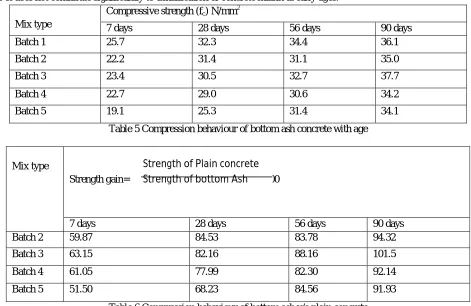
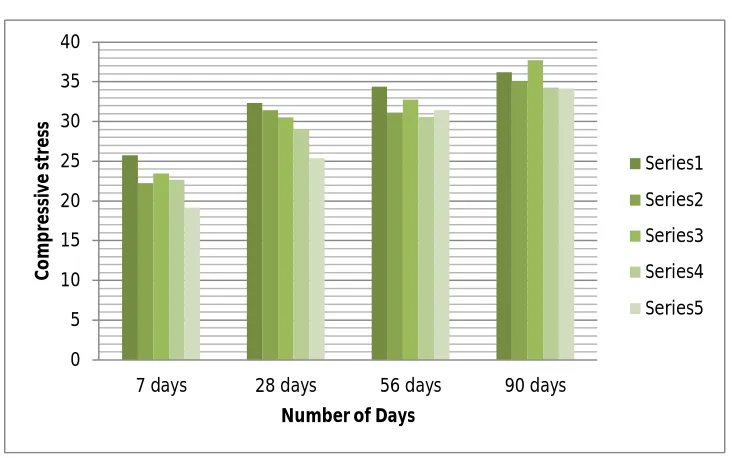
Compressive strength of concrete mixes made with & without bottom ash was determined at 7, 28, 56, 90 days. The test results are given in Table 5,6 & Figures 3,4. The gain of compressive strength by different types of bottom ash concrete with respect to their compressive strength at age of 90 days varies from 56-65% at 7 days 75-85% at 28 days & varies between 86-90% at 56 days. The bottom ash concrete gains strength at a slower rate in initial period & acquires strength at faster rate beyond 28 days, due to pozzolanic action of bottom ash. Also, at early age bottom ash reacts slowly with calcium hydroxide liberated during hydration of cement & does not contribute significantly to densification of concrete matrix at early ages.
Mix type
Compressive strength (fc) N/mm2
7 days 28 days 56 days 90 days
Batch 1 25.7 32.3 34.4 36.1
Batch 2 22.2 31.4 31.1 35.0
Batch 3 23.4 30.5 32.7 37.7
Batch 4 22.7 29.0 30.6 34.2
Batch 5 19.1 25.3 31.4 34.1
Table 5 Compression behaviour of bottom ash concrete with age
Mix type
Strength gain= × 100
7 days 28 days 56 days 90 days
Batch 2 59.87 84.53 83.78 94.32
Batch 3 63.15 82.16 88.16 101.5
Batch 4 61.05 77.99 82.30 92.14
[image:7.612.68.539.416.722.2]Batch 5 51.50 68.23 84.56 91.93
Table 6 Compression behaviour of bottom ash v/s plain concrete 0.76
0.78 0.8 0.82 0.84 0.86 0.88 0.9 0.92
0 20 30 40 50
Compaction factor
Compaction Factor for Bottom ash
Compaction Factor
Fig 3 Chart for Compression behaviour of bottom ash concrete with age
Fig 4 Compressive stress chart
G. Flexural Strength
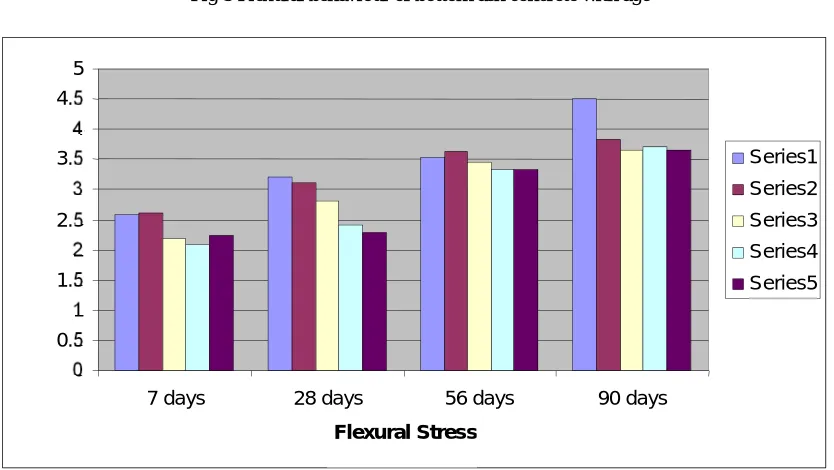
The results of flexural strength test of bottom ash concrete are given in Table 8 & shown in Figures 5 & 6, respectively. Figure 5 shows flexural strength development with age, & Figure 6 shows variation of flexural strength for various percentages of bottom ash. It is found that ‘Batch 4’ mix type gives comparable flexural strength at age of 90 days which could be used for application of pavement. The flexural strength is affected to more extent with increase in bottom ash concrete. The bottom ash concrete gains flexural strength with age that is comparable but less than that of plain concrete. It is believed to be due to poor interlocking between aggregates, as bottom ash particles nature is are spherical.
Mix type
Flexural strength (ft) N/mm2
7 days 28 days 56 days 90 days
Batch 1 2.58 3.22 3.54 4.50
Batch 2 2.60 3.10 3.62 3.82
Batch 3 2.18 2.82 3.46 3.66
Batch 4 2.10 2.42 3.34 3.70
Batch 5 2.24 2.30 3.34 3.66
Table 7 Flexural behaviour of bottom ash concrete with age
0 5 10 15 20 25 30 35 40
7 days 28 days 56 days 90 days
Series1
Series2
Series3
Series4
Series5
0 5 10 15 20 25 30 35 40
7 days 28 days 56 days 90 days
C
o
m
p
re
ss
iv
e
s
tr
e
ss
Number of Days
Series1
Series2
Series3
Series4
[image:8.612.70.546.614.720.2]Fig 5 Flexural behaviour of bottom ash concrete with age
Fig 6 Chart for flexural stress
H. Slump Test
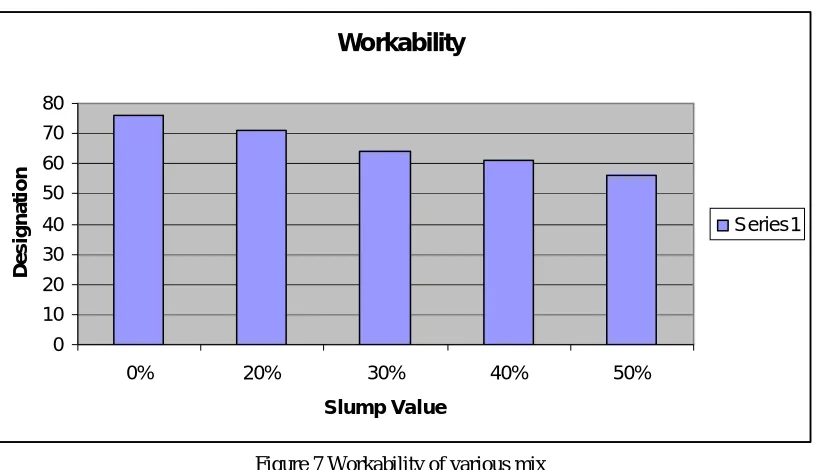
All mixes have a moderate workability level but at least this should be consistent . Average slump values are shown in Table 4.11. The slump was measured twice, once for each batch. Although IS (Standards India 1959) states that for high slumps exceeding 110 mm a tolerance of ± 30 mm is permitted., these high slumps value are too high for practical use in comparison with commercial concrete & is not acceptable in industry.
With such a high workability, special care was taken not to over tamping concrete by rod to avoid segregation of concrete. Figure 7 shows average, upper & lower slump values of mixes.
Table 8 Workability Experienced of Concrete Mixes
Replacement % 0% 20% 30% 40% 50%
Average slump 76 71 64 61 56
Flexural behaviour of bottom ash concrete with age
0 5 10 15 20 25
7 days 28 days 56 days 90 days
Number of Days
F
le
x
u
ra
l
s
tr
e
n
g
th
Series5
Series4 Series3
Series2
Series1
0 0.5 1 1.5 2 2.5 3 3.5 4 4.5 5
7 days 28 days 56 days 90 days
Flexural Stress
Series1 Series2
Series3
[image:9.612.96.513.310.545.2]Figure 7 Workability of various mix
V. FUTURE SCOPE AND CONCLUSION
A. Conclusion
Research has focused on reduction of cost using fly ash and bottom ash in road pavement. Workability of concrete has been reduced with the increase in bottom ash content due to increase in water demand.
1) Density of concrete has been reduced with the increased bottom ash content because of low gravity of bottom ash in
comparison of fine aggregates.
2) Compressive strength, Flexural strength and Splitting tensile strength of fine aggregates has been replaced with bottom ash concrete specimens were lower than control concrete specimens at all the ages.
3) Strength difference between bottom ash concrete specimens and control concrete specimens turn to less distinct after 28 days.
4) In same way workability of sand has been reduced with the increase in fly ash content.
5) The gain of compressive strength of different types of fly ash with respect to their compressive strength at time of 90 days varies from 56-65% at 7 days 75-85% at 28 days & varies between 86-90% at 56 days.
6) Flexural strength test results of both bottom ash and fly ash are have been discussed in this research. Research shows flexural strength development with age, & variation of flexural strength for various percentages of bottom ash.
B. Future scope
The fly ash & bottom ash are performing significant role in road pavement. Such material is cost saving as well as compressive strength & durability is provided using such material. In construction of rural roads in low lying or flood prone areas, fly ash should have to be considered as normal choice in near future. This research would play a significant role in future Taxiways, Parking grounds for heavy weight vehicles, and Heavy Industrial floors such as military tanks.
Industrial floors which have high requirements in terms of flatness & durability & surface exposure to aggressive attacks could use this technology. Long tunnels road pavements may get benefit from this research.
REFERENCES
[1] Li Yijin, Zhou Shiqiong(2002) “The effect of fly ash on the fluidity of Cement paste, mortar, and concrete”, International Workshop on Sustainable Development and Concrete Technology
[2] Satish Sharma, V.V. Arora, Adarsh Kumar N S (2005) “Study of usage of bottom ash as part replacement of sand for making concrete blocks” [3] Dr. D S V Prasad, (2009) “Utilization of Industrial Waste in Flexible Pavement Construction”
[4] Hashim Mohammed Alhassan (2012) “Characterization of Solid Waste Incinerator Bottom Ash and the Potential for its Use” [5] Suman et al, (2012) “Fly ash concrete: a technical analysis for Compressive strength”
[6] P. Aggarwal, Y. Aggarwal, S.M. Gupta (2007) “Effect of bottom ash as replacement of fine aggregates in concrete”, ASIAN JOURNAL OF CIVIL ENGINEERING (BUILDING AND HOUSING) VOL. 8, NO. 1 (2007)
Workability
0 10 20 30 40 50 60 70 80
0% 20% 30% 40% 50%
Slump Value
D
e
s
ig
n
a
ti
o
n
[7] Mahdi Rafieizonooz , Jahangir Mirza , Mohd Razman Salim (2014) “Investigation of coal bottom ash and fly ash in concrete as replacement for sand and cement”,
[8] Shantmurti upadhyaya (2014) “Effects of Fly ash on Compressive Strength of M50 Mix Design Concrete”, International Journal of Scientific & Engineering Research, Volume 5, Issue 6, June-2014
[9] Dr.Suhas V. Patil, Suryakant C. Nawle ,Sunil J. Kulkarni,(2013) “ Industrial Applications of Fly ash: A Review”, International Journal of Science, Engineering and Technology Research (IJSETR) Volume 2, Issue 9, September 2013
[10] Nitin S. Naik, B.M.Bahadure, C.L.Jejurkar (2014) “ Strength and Durability of Fly Ash, Cement and Gypsum Bricks” [11] Soman, Divya Sasi (2014) “Strength properties of concrete with partial replacement of sand by bottom ash”
[12] Syed Afzal Basha, P.Pavithra, B.Sudharshan Reddy “Compressive Strength of Fly Ash Based Cement Concrete” [2014]
[13] A. Sumathi*1, K. Saravana Raja Mohan (2015) “ Compressive Strength of Fly Ash Brick with Addition of Lime, Gypsum and Quarry Dust”, International Journal of ChemTech Research, Vol.7, No.01, pp 28-36,
[14] S. Sivakumar1 and B. Kameshwari (2014) “Influence of Fly Ash, Bottom Ash, and Light Expanded Clay Aggregate on Concrete” [15] Vikas R Nadig, Sanjith J , Ranjith A (2015) “Bottom Ash as Partial Sand Replacement in Concrete- A Review”,
[16] K. SathyaPrabha1, J. Rajasekar (2015) “Experimental Study on Properties of Concrete Using Bottom Ash with Addition of Polypropylene Fibre” [17] Mamta Mishra (2016) “Use of Industrial Waste Materials in Road Construction”
[18] Darzi Musaib A.,Bhumre Shivkumar, Kamble Ashok, Giri Sunil C., Kamble Rupesh, Seham Khaleel (2016) “Effective Partial Replacement Of Cement And Sand With Fly-Ash And Marble Powder To Make Green Concrete”
[19] Shivasheesh Kaushik, Nimisha Raj (2017) “Optimization of Compressive Strength for Fly Ash Building Bricks Using Taguchi Method”
[20] Mohammad Abushad¹, Misbah Danish Sabri²,(2017) “ Comparative Study of Compressive Strength of Concrete with Fly Ash Replacement by Cement”, International Research Journal of Engineering and Technology Volume: 04 Issue: 07 | July -2017