Decomposable Modeling in Natural
Language Processing
R e b e c c a F. Bruce*
University of North Carolina at Asheville
J a n y c e M. W i e b e t
N e w Mexico State University
In this paper, we describe a framework for developing probabilistic classifiers in natural language processing. Our focus is on formulating models that capture the most important interdependencies among features, to avoid overfitting the data while also characterizing the data well. The class of probability models and the associated inference techniques described here were developed in mathematical statistics, and are widely used in artificial intelligence and applied statistics. Our goal is to make this model selection framework accessible to researchers in NLP, and provide pointers to available software and important references. In addition, we describe how the quality of the three determinants of classifier performance (the features, the form of the model, and the parameter estimates) can be separately evaluated. We also demonstrate the classification performance of these models in a large-scale experiment involving the disambiguation of 34 words taken from the HECTOR word sense corpus (Hanks 1996). In lO-fold cross-validations, the model search procedure performs significantly better than naive Bayes on 6 of the words without being significantly worse on any of them.
1. Introduction
This paper describes a framework for developing probabilistic classifiers in natural language processing (NLP). 1 A probabilistic classifier assigns the most probable class to an object, based on a probability model of the interdependencies among the class and a set of input features. This paper focuses on formulating a model that captures the most important interdependencies, to avoid overfitting the data while also characterizing the data well. The goal is to achieve a balance between feasibility and expressive power, which is needed in an area as complex as NLP.
The class of probability models and the associated inference techniques described here were developed in mathematical statistics, and are widely used in artificial intel- ligence and applied statistics. However, these techniques have not been widely used in NLP, although the software required to implement these procedures is freely avail- able. Within this framework, we can unify many of the metrics and types of models currently used in NLP. The class of models, decomposable models, is large and ex- pressive, yet there are computationally feasible model search procedures defined for them. They can include any kind of discrete variable, and the formality of the method supports evaluation.
In this paper, our goal is to make this model selection framework accessible to re- searchers in NLP, by providing a concise explanation of the underlying theor~ pointing
* Department of Computer Science, Asheville, NC 28804-3299. Department of Computer Science, Las Cruces, NM 88003.
Computational Linguistics Volume 25, Number 2
out relationships to existing NLP research, and providing pointers to available soft- ware and important references. In addition, we describe how the quality of the three determinants of classifier performance (the features, the form of the m o d e l and the parameter estimates) can be separately evaluated.
We also demonstrate the classification performance of these models in a large- scale experiment involving the disambiguation of 34 words taken from the HECTOR word sense corpus (Atkins 1993; Hanks 1996). We compare the performance of classi- fiers based on models selected by this algorithm with the performance of naive Bayes classifiers (classifiers based on the naive Bayes model). Naive Bayes classifiers have been found to be remarkably successful in many applications, including word sense disambiguation (Mooney 1996). In 10-fold cross-validations, the model search proce- dure achieves an overall 1.4 percentage point improvement over naive Bayes, and is significantly better on 6 of the words without being significantly worse on any of them.
2. Probabilistic Modeling
We will use word sense disambiguation of the word interest as a concrete example in this section. For simplicity, we will use only two contextual features, the part of speech of the word to the left and the part of speech of the word to the right. Assume that there are 8 senses of interest and 20 part of speech tags. We will map the features to feature variables and the sense tag to the classification variable, yielding a discrete, finite random vector X -- (FV1 . . . Fl,~w, CV) (where w here is 2).
Suppose that there are N occurrences of interest in the training sample. The training sample is viewed as being composed of a set of N independent and identical trials drawn from a three-variable population distribution. The outcome of each trial is a particular combination of the values of the three variables, i.e., one of the 3,200 (8 x 20 x 20) possible configurations of the variables in X. Let y~ be the frequency and
Pi the probability of the i th configuration of the variables in X. Then (/:1 . . . f3,200) has a multinomial distribution with parameters (N, P 1 , . . . , P3,200), where N is fixed. The parameters P1 . . . P3,200 define the joint probability distribution of the variables in X. These parameters could be estimated directly from counts in the training data; that is, we could use the unrestricted maximum-likelihood estimate of Pi (Mood, Graybill, and Boes 1974):
= ~ .
If there is not enough training data for the estimation task at hand, then there are many configurations of the variables that seldom or never occur in the training data. For these, the unrestricted maximum-likelihood estimates are unreliable.
An alternative is to hypothesize conditional independence assumptions of the form: variables FVi and FVj are conditionally independent of one another, given the values of the remaining variables. Then, we need only count the configurations of the sets of variables that are still interdependent.
A simple example will show w h y (Whittaker 1990). Recall that X is a vector of three binary variables, X = (FV1, FV2, CV). There are 3,200 parameters to be estimated, namely:
P(FV1 = 0, FV2 = O, CV = 0), P(FV1 = O, FV2 = O, CV = 1) . . .
Bruce and Wiebe Decomposable Modeling in Natural Language Processing
The joint distribution can be expressed as follows, according to a basic axiom of prob- ability theory (where fVl, fv2, and cv represent particular values of FV1, FV2, and CV, respectively):
P(fvl,fv2, cv) = P(fVl ] y~02, cv)P(fv2 I cv)P(cv) (1) But if fV 1 and fv2 are conditionally independent given the value of cv, then the joint distribution can be expressed as follows:
P(fPl,fv2, cv) = P(fu I ] £v)P(fv 2 ]cv)P(cv) P0COl, cv) P(fv2, cv) n, ,
- - P ( c v )
= P0rvl, cv)P(fv2, cv) (2)
P(cv)
The parameters of the model expressed in (2) are the terms on the right-hand side of the equation. They describe the marginal distributions of just the interdepen- dent variables. Thus, we see that the conditional-independence constraint allows us to express the joint distribution in terms of these smaller marginal distributions.
The marginal distribution of FV1 and C V is the full joint distribution "collapsed" over FV2. For example, the estimate for P(FV1 = O, C V = 0) is the sum of the relative f r e q u e n c i e s of (FV1 = O, C V = O, FV2 = 0), (FV1 = O, C V = 0,FV2 = 1 ) , . . . , ( F V 1 = 0, CV = 0, FV2 = 19), i.e., the relative frequency of configurations for which FV1 -- 0
and C V = 0, whatever the value of FV2. Maximum likelihood estimates of the parame- ters of marginal distributions are more reliable than those of the full joint distribution, because, in a given sample of training data, the frequency of each combination of values of the variables in a marginal distribution is always as large or larger than the frequency of each combination of the values of the variables in the full distribution.
There are many possible sets of noninteraction assumptions that could be made regarding a set of variables. The various possibilities can be formalized as probability m o d e l s . A probability model (more specifical134 its parametric form) expresses the rela- tionships among the variables of the model, and specifies a family of distributions--all distributions in which those relationships hold. For example, the model in which FV1
is conditionally independent of FV2 given the value of C V is the family of all distribu- tions for vector X in which this constraint holds. The differences among the members of this family result from differences in the values of the parameters.
A probabilistic model (a parametric form complete with parameter estimates) forms the basis of a probabilistic classifier. The classifier assigns to each ambigu- ous object the category or tag that has the highest probability of occurring, given the observed values of the feature variables:
P ( C V, j~ol, fv2, fv3 . . . fVn )
P ( C W If'Ol,fOa,dO 3 . . . f?dn) ~- p ( f v l , f v 2 , f v 3 . . . yon ) (3) Since the denominator is the same for all classes, the numerator, i.e., the joint distri- bution defined by the model, determines which class is assigned.
3. The Class of M o d e l s
Computational Linguistics Volume 25, Number 2
The class of
log-linear models
is the most widely used class of probability models for analyzing discrete data. It supports a wide range of noninteraction assumptions and the use of maximum likelihood parameter estimates (Bishop, Fienberg, and Holland1975). Graphical models
are the subset of log-linear models in which the only kind of noninteraction is conditional independence (Whittaker 1990).The interdependencies among the variables in a graphical model can be expressed graphically, in a
dependency graph.
A dependency graph is formed by mapping each variable in the model to a node in the graph and drawing an edge between the nodes corresponding to interdependent variables. All variables that are not directly con- nected are conditionally independent given the values of the variables mapping to the connecting nodes. Therefore, the maximal sets of interdependent variables corre- spond exactly to the cliques of the graph (where a clique is a maximal fully connected component).As shown by Darroch, Lauritzen, and Speed (1980), each graphical model describes a Markov random field. The fundamental property of a Markov random field is that the conditional probability of a variable given the values of the others is the same as the conditional probability of that variable given only the values of the variables corresponding to adjacent nodes. Thus:
P(Xi = xi I X j = xj;j # i) = P(Xi -- xi I Xk = X k , . . . , Xm = Xm)
where Xk through Xm are the adjacent variables. It is this property of conditional independence that was used to formulate equation (2) from (1).
The framework described in this paper uses decomposable models, a subclass of graphical models (Whittaker 1990; Darroch, Lauritzen, and Speed 1980), because they offer m a n y computational advantages while retaining a great deal of expressive power. There are a number of different ways to define the class of decomposable models, one of which is the following: The class of decomposable models is composed of all graphical models that have triangulated dependency graphs, i.e., all cycles of length _> four in the dependency graph contain a chord. A chord is an edge between nonadjacent nodes in the cycle.
Another definition of decomposable models is the following: They are those graph- ical models that express the joint distribution of a set of variables as the product of marginal distributions of those variables, where the new expression is a full factor- ization (Whittaker 1990) of the joint distribution. A product of marginal distributions is a full factorization of a joint distribution if the former is derived from the latter by factorization steps such as that between equations (1) and (2), and "an independence statement corresponding to every pair of non-adjacent vertices in the dependency graph of X is applied exactly once to factorize the joint distribution into the product of marginal distributions" (Whittaker 1990, 393).
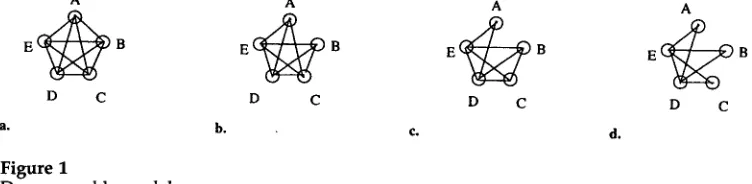
Consider a set of five random variables, X = (A, B, C, D, E) (E, say, might be the classification variable, and the others the feature variables). We will consider the model in which:
CI1: A is conditionally independent of B given the values of C, D, and E; CI2: A is conditionally independent of C given the values of B, D, and E; and CI3: B is conditionally independent of C given the values of A, D, and E.
Bruce and Wiebe Decomposable Modeling in Natural Language Processing
A A
D C D C
[image:5.468.32.408.48.140.2]a. b.
Figure 1
Decomposable models.
A A
B
D C D C
c. d.
joint distribution by applying an independence statement corresponding to each of
(CI1)-(CI3)
in turn. 2As in equation (1), the joint distribution of the variables can be expressed as:
P(a, b, c, d, e) = P(a ] b, c, d, e)P(b [ c, d, e)P(c ] d, e)P(d ] e)P(e)
(4)The dependency graph of the model corresponding to this equation is shown in Figure l(a). Applying
(Ch)
to (4), the following factorization can be performed, by the definition of conditional independence.P(a ] b, c, d, e) = P(a [ c, d, e)
(5)The resulting model is:
P(a, b, c, d, e) = P(a ] c, d, e)P(b ] c, d, e)P(c ] d, e)P(d ] e)P(e)
P(a, c, d, e) P(b, c, d, e) P(c, d, e) P(d, e) p
P(c,d,e)
P(c,d,e)
P(d,e) ~ ( e )
(e)
P(a, c, d, e)P(b, c, d, e)
P(c, d, e)
(6)The dependency graph of the model containing
(CIt)
is shown in Figure l(b). Factorization (5) can be understood in terms of this dependency graph by noting that the neighbors of A in this graph are {C, D, E} (and not {B, C, D, E}).Applying
(CI2)
to (6):P(a I c, d, e) = P(a I d, e)
(7)The resulting model is:
P(a, b, c, d, e) = P(a I d, e)P(b I c, d, e)P(c I d, e)P(d I e)P(e)
P(a, d, e)P(b, c, d, e)
P(d,e)
(8)
The dependency graph of the model containing (CI1)-(CI2) is shown in Figure 1(c). To see that (7) can be performed, note that the neighbors of A in Figure 1(c) are {E, D}, so
Computational Linguistics Volume 25, Number 2
that A is conditionally independent of {B, C} given the values of {E, D}, and it follows from a basic axiom of probability that A is conditionally independent of {C} given the values of {E, D}.
Finally, applying (C/3) to (8):
P(b
I
c, d, e) = P(b
I
d, e)
(9)
The final model incorporating all factorizations is:
n(a, b, c, el, e) = P(a I c l, e)P(b [ d, e)P(c l d, e)P(d l e)P(e )
=
P(a, d, e)P(b, d, e)P(c, d, e)
(10)P(d,e)P(d,e)
The dependency graph of the model containing all three conditional independencies is shown in Figure l(d).
Thus, a decomposable model expresses the joint distribution of a set of variables as a product of the marginal distributions of the maximal sets of interdependent vari- ables (the cliques in the dependency graph) scaled by the marginal distributions of the variables common to two or more of these maximal sets. The fact that this kind of closed-form expression of the joint distribution exists provides one of the key advan- tages in using decomposable models. The parameters of the marginal distributions can be estimated directly from the counts in the data. The joint distribution is expressed in terms of these, as in equations (6), (8), and (10). Thus, we can estimate the parameters from the data without the need for an iterative fitting procedure (as used in NLP max- imum entropy modeling [Berger, Della Pietra, and Della Pietra
1996]).
This property is unique to decomposable models (Pearl 1988; Whittaker 1990).4. M o d e l S e l e c t i o n
We showed above h o w conditional independence assumptions can be used to simplify the expression of the joint distribution. Given a particular set of variables, there are often very many different conditional independence assumptions that could be made. The generation and testing of different sets of assumptions can be computationally realized as a search through a space of probability models, in our case decomposable models. Removing an edge from a dependency graph of a decomposable model is equivalent to adding a conditional independency to the model. Another w a y to view the derivation of equations (6), (8), and (10) is as the process of beginning with the fully connected model, in which all variables are interdependent, and successively removing edges, corresponding to adding conditional independencies
(CI1)-(CI3).
This is h o wbackward
search is done.In forward
search, we start with the fully disconnected model,in which all variables are independent, and successively add edges, corresponding to adding interdependencies. The space of decomposable models is very large, so greedy search is typically done. In a backward search, at each step, all edges in the current model are evaluated, and one is removed; in forward search, at each step, all edges that could be added are evaluated, and one is added. (Note that decomposable models are not closed under the operations of adding and deleting edges, so a test must be performed to assure that all the models considered are decomposable.)
Bruce and Wiebe Decomposable Modeling in Natural Language Processing
The goal of the search process is to find a m o d e l w i t h the fewest i n t e r d e p e n d e n c i e s that fits the data well. The fit of the m o d e l is h o w closely the counts o b s e r v e d in a training sample c o r r e s p o n d to those that w o u l d be expected if the m o d e l b e i n g tested w e r e the true p o p u l a t i o n model. This is m e a s u r e d using a goodness-of-fit statistic.
Read a n d Cressie (1988) h a v e s h o w n that most measures u s e d to evaluate m o d e l fit are instances of the p o w e r d i v e r g e n c e statistic, w h e r e different measures are g e n e r a t e d b y changing a single parameter. These include Pearson's X 2, the Kullback-Leibler i n f o r m a t i o n divergence D, w h i c h is also k n o w n as cross entropy; a n d the log-likelihood ratio statistic, G 2. The two most c o m m o n l y u s e d measures in NLP, D and
G 2,
are trivially expressed in terms of each other. In the general case, D is u s e d to evaluate the difference b e t w e e n a n y two density functions gy and fy for the same r a n d o m vector Y. W h e n D is u s e d to evaluate m o d e l fit, gy is the distribution of Y in the data sample, fy is the distribution of Y predicted b y the model, a n d G 2 is 2N xD(gy;fy).
In the m o d e l search described above, m o d e l s are m o d i f i e d an edge at a time. In evaluating an edge, w e are testing the m o d e l of conditional i n d e p e n d e n c e b e t w e e n the t w o variables connected b y that edge. The i n f o r m a t i o n divergence applied in this case is the same as conditional m u t u a l information, a n o t h e r w i d e l y u s e d m e a s u r e in NLP.
Using d e c o m p o s a b l e m o d e l s affords an i m p o r t a n t a d v a n t a g e in assessing m o d e l fit: the test for conditional i n d e p e n d e n c e of two n o d e s as described above is simplified. Rather than assessing the conditional i n d e p e n d e n c e of the t w o n o d e s c o n d i t i o n e d o n all of the other variables, w e n e e d only consider the other n o d e s in the same clique in the d e p e n d e n c y graph.
In general, a goodness-of-fit statistic can be t h o u g h t of as a cost function, w h e r e a l o w e r value represents a better m o d e l fit. M o d e l selection can be based directly o n the value of a goodness-of-fit statistic, or it can be b a s e d o n a cost function that combines a goodness-of-fit statistic w i t h a p e n a l t y for m o d e l complexity, such as the Akaike i n f o r m a t i o n criterion (AIC) (Akaike 1974) or the Bayesian i n f o r m a t i o n criterion (BIC) (Schwarz 1978).
The final m o d e l selected can be b a s e d on a p r e d e f i n e d cutoff value. In the case of measures such as AIC and BIC, a cutoff on the v a l u e of the m e a s u r e itself can be defined. In the case of statistics such as
G 2,
the a p p r o p r i a t e cutoff is a p r e d e t e r m i n e d threshold defining statistical significance. Alternatively, all the m o d e l s g e n e r a t e d dur- ing search can be considered, and the one with the highest accuracy on a h e l d - o u t p o r t i o n of the training data can be selected as the final m o d e l (Kayaalp, Pedersen, a n d Bruce 1997; Wiebe, Bruce, a n d D u a n 1997). 3The freely available software package CoCo p e r f o r m s f o r w a r d and b a c k w a r d search using all of the measures described above (Badsberg 1995). 4 Pedersen, Bruce, and Wiebe (1997) present the results of e x p e r i m e n t s c o v a r y i n g these m e a s u r e s a n d the direction of search. In addition to these m e t h o d s , Buntine (1996) describes other search strategies a n d measures, such as m i n i m u m description length, that can be u s e d for m o d e l selection.
There are a n u m b e r of other w a y s to utilize the results of a m o d e l search p r o c e d u r e that are extensions to the basic f r a m e w o r k . In m o d e l switching (Kayaalp, Pedersen, and Bruce 1997) a n d the naive mix (Pedersen a n d Bruce 1997), m o r e t h a n one of the m o d e l s g e n e r a t e d d u r i n g search is u s e d to p e r f o r m classification. In Boutilier et al.
3 One could also consider applying this kind of test to evaluate each edge, replacing the goodness-of-fit or cost metric. However, this would be more computationally expensive, and would not directly measure conditional independence.
Computational Linguistics Volume 25, Number 2
(1996), context-sensitive models are formulated. These models include independencies that hold only in certain contexts, that is, they hold only given specific assignments of values to variables.
5. Diagnostic Analysis
As seen above, the model selection framework provides many choices. Because the approach is a formal approach to probabilistic modeling, we can analyze the quality of the three determinants of classifier performance: the features, the form of the m o d e l and the parameter estimates. In the paragraphs below, we describe how to isolate the contribution that each of them makes to classification error. This analysis can provide insight into which choices are most appropriate for a particular data set. 5
Features. For diagnostic purposes, it is revealing to train and test the model on the same data. 6 First, consider training and testing the fully connected model on the same data. Since the fully connected model contains no conditional independence assumptions, and the model parameters are not estimated on a separate training set, the model describes the exact joint distribution of the data. Because of this, classification errors can only be due to a lack of discriminatory power of the features. That is, there must be combinations of feature values that occur with more than one class.
Form of the model. Consider training and testing other models on the same data. As for the fully connected model, the parameter estimates are optimal for that data. However, we have added approximations to the model in the form of conditional independence assumptions. Thus, for the same data and feature set, variations in the performance of different models are due only to the different conditional independence assumptions made in those models.
Parameter estimates. Consider a comparison in which the features, test set, and model form are fixed, but in one case, the parameters are estimated on a separate training set, and in the other case, the parameters are estimated from the test set, as above. Differences in the performance of two such models can only be due to the parameter estimates.
As more conditional independence assumptions are made, the parameter esti- mates become more reliable, in the sense that they are based on the same or greater frequencies (see Section 2). Even so, if important interdependencies are removed from the form of the model, model performance may actually degrade. Thus, by evaluating the contribution that each of the above factors makes to model performance, we can assess how well the model search procedure is balancing model expressiveness and the reliability of the parameter estimates.
6. Shortcomings
We have described a very general and expressive framework, but of course there are some shortcomings. The approach is a supervised learning approach, and therefore re- quires manually tagged training data. In fact, to take full advantage of high-complexity models, a large amount of data may be required. However, by generating models of
Bruce and Wiebe Decomposable Modeling in Natural Language Processing
varying complexity, the model search procedure can adjust the complexity of the final model to the amount of data that is available.
Another point of concern is the computational complexity of the search procedure. Because it is greedy, the search procedure itself is not inefficient: the number of edges evaluated during the search is polynomial in the number of variables. However, the measures used to evaluate edges during the search procedure are inefficient. Section 4 mentions a number of these measures, which can all be expressed as a function of G 2. The complexity of calculating G 2 is a function of the number of configurations of the variables, which is exponential in the number of variables. Therefore, the worst-case time complexity of any search procedure that uses a function of G 2 is exponential in the number of variables. In practice, the method is feasible for a reasonable number of variables (certainly on the order of 100 in the final model), and, once the model is developed during training, the process does not need to be repeated.
7. Relationships to Other Classes of Models
It is common in NLP to simply assume a particular model form rather than searching for one that is appropriate for the data. Two kinds of statistical models widely used in NLP are the n-gram and naive Bayes models. These models a r e decomposable models. In an n-gram m o d e l the variables are the class assigned to the current object and the classes assigned to the previous N - 1 objects, and there are edges between all pairs of variables. A naive Bayes model includes edges between the classification variable and each feature variable (and contains no other edges). Because n-gram and naive Bayes models are decomposable, they are possible candidates during model selection. However, they would be selected only if they appear to be the most appropriate models for the particular data.
In maximum entropy modeling as applied to NLP (Berger, Della Pietra, and Della Pietra 1996; Ratnaparkhi 1997), feature selection and model search are typically com- bined, but the procedure differs from that described here. It is important to note that decomposable models are a subset of maximum entropy models. Even so, no effort is made to select for decomposable models (and take advantage of their benefits), or to demonstrate the need for a broader class of models.
Bayesian networks are extensively used in artificial intelligence. They are popular because of their graphical representations and because there are probability propa- gation algorithms for computing the joint and conditional distributions of the vari- ables. Decomposable models can be represented as Bayesian networks. In fact, in the widely used probability propagation algorithm described by Lauritzen and Spiegel- halter (1988) and Pearl (1988), a Bayesian network is ultimately transformed into a decomposable model, to take advantage of the computational benefits of that class of models (see the triangulation step described in Pearl [1988]).
Although decision trees are not formal probability models, there are similarities between decision tree induction (Breiman et al. 1984) and the model selection frame- work presented here. Both search procedures perform feature selection and reduce the interdependencies between features to avoid overfitting the data. For a further dis- cussion of the relationships between graphical models and decision trees, see Buntine and Roy (1995).
8. Word Sense Disambiguation Results
• Computational Linguistics Volume 25, Number 2
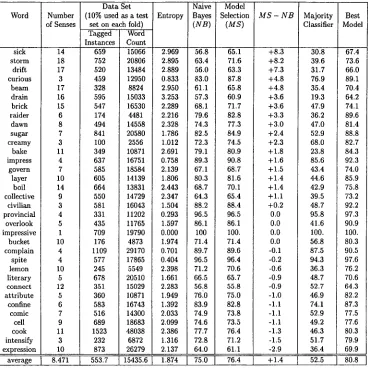
words were not chosen by the authors, but were randomly selected from a set of 38 words included in the training set for the SENSEVAL evaluation project (Kilgarriff 1998). The data set for each word consisted of all sentences containing that word in the corpus. The results are presented in Figure 2. Tenfold cross validation was performed for each word, for a total of 340 experiments. On each fold, a forward search with G 2 as the goodness-of-fit test was performed. In addition, we ensured that naive Bayes was included as a competitor in each fold. For each fold, evaluation on a single held-out portion of the training data was performed to choose the final model. The results of applying this model to the actual test set, averaged over folds, are shown in the column labeled Model Selection. The results of applying naive Bayes exclusively (averaged over folds) are shown in the column labeled Naive Bayes. The column labeled Best Model shows the highest results on the actual test set obtained by any of the models generated during search (again, averaged over folds). The same types of features were used in each model: the part-of-speech tags one place to the left and right of the ambiguous word; the part-of-speech tags two places to the left and right of the word; the part-of-speech tag of the word; and a collocation variable for each sense of the word whose representation is per-class-binary as presented in Wiebe, Bruce, and Duan (1997). 7
Naive Bayes has been shown to be competitive with state-of-the-art classifiers, and has proven remarkably successful on many AI and NLP applications (see, for exam- ple, Leacock, Towell, and Voorhees [1993]; Friedman, Geiger, and Goldszmidt [1997]; Mooney [1996]; Langley, Iba, and Thompson [1992]). As can be seen by comparing columns 5 and 6, the model selection procedure achieves an overall average accuracy that is 1.4 percentage points higher than exclusively using the naive Bayes classifier. Evaluating the results on a per-word basis more clearly shows the benefits of per- forming model selection in these experiments. There are more words for which model selection is better than there are words for which model selection is worse. Further, we assessed the statistical significance of the differences in accuracy presented, in Figure 2 between the two methods for the individual words, using a paired t-test (described in Cohen [1995]) with 0.05 as the significance level. For six of the words, the model selection performance is significantly better than the performance of exclusively using naive Bayes. Further, the model selection procedure is not significantly worse than naive Bayes for any of the words.
In addition, on average, the set of words for which model selection is superior are more difficult than the ones on which naive Bayes is superior: for the former set, the average number of senses is 10 and the average entropy is 2.2; for the latter set, the average number of senses is 7 and the average entropy is 1.7 (see columns 2 and 4 in Figure 2). We can also see that, on average, there is less annotated data available for the words on which model selection does better, a total of 524 tagged instances (see column 3 in Figure 2), than for those on which it does worse, a total of 645 tagged instances. 8 This supports the idea that model selection tailors the complexity of the model to the amount of data that is available.
As shown in column 8, models are generated during model search that provide high accuracy. In fact, the accuracy of the best model generated is consistently higher than that of both naive Bayes and the final model actually selected during the search. This illustrates that there are further potential gains to be exploited by investigating alternative methods for selecting the best model for each fold.
7 The variable for each sense S is binary, corresponding to the absence or presence of any word in a set specifically chosen for S. A word W is chosen for S if P(S I W) > 0.5.
B r u c e a n d W i e b e D e c o m p o s a b l e M o d e l i n g i n N a t u r a l L a n g u a g e P r o c e s s i n g
Data Set Naive Model
Word Number (10% used as a test Entropy Bayes Selection M S - N B Majority Best of Senses set on each fold) ( N B ) ( M S ) Classifier Model
Tagged W o r d Instances Count
sick 14 659 15066 2.969 56.8 65.1 +8.3 30.8 67.4 storm 18 752 20806 2.895 63.4 71.6 +8.2 39.6 73.6 drift 17 520 13484 2.889 56.0 63.3 +7.3 31.7 66.0 curious 3 459 12950 0.833 83.0 87.8 +4.8 76.9 89.1 beam 17 328 8824 2.950 61.1 65.8 +4.8 35.4 70.4 drain 16 595 15033 3.253 57.3 60.9 +3.6 19.3 64.2 brick 15 547 16530 2.289 68.1 71.7 +3.6 47.9 74.1 raider 6 174 4481 2.216 79.6 82.8 +3.3 36.2 89.6 dawn 8 494 14558 2.328 74.3 77.3 +3.0 47.0 81.4 sugar 7 841 20580 1.786 82.5 84.9 +2.4 52.9 88.8 creamy 3 100 2556 1.012 72.3 74.5 +2.3 68.0 82.7 bake 11 349 10871 2.691 79.1 80.9 +1.8 23.8 84.3 impress 4 637 16751 0.758 89.3 90.8 +1.6 85.6 92.3 govern 7 585 18584 2.139 67.1 68.7 +1.5 43.4 74.0 layer 10 605 14139 1.806 80.3 81.6 +1.4 44.6 85.9 boil 14 664 13831 2.443 68.7 70.1 +1.4 42.9 75.8 collective 9 550 14729 2.347 64.3 65.4 +1.1 39.5 73.2 civilian 3 581 16043 1.504 88.2 88.4 +0.2 48.7 92.2 provincial 4 331 11202 0.293 96.5 96.5 0.0 95.8 97.3 overlook 5 435 11765 1.597 86.1 86.1 0.0 41.6 90.9 impressive 1 709 19790 0200 100 100. 0.0 100. 100. bucket 10 176 4873 1.974 71.4 71.4 0.0 56.8 80.3 complain 4 1109 29170 0.701 89.7 89.6 -0.1 87.5 90.5 spite 4 577 17865 0.404 96.5 96.4 -0.2 94.3 97.6 lemon 10 245 5549 2.398 71.2 70.6 -0.6 36.3 76.2 literary 5 678 20510 1.661 66.5 65.7 -0.9 48.7 70.6 connect 12 351 15029 2.283 56.8 55.8 -0.9 52.7 64.3 attribute 5 360 10871 1.949 7610 75.0 -1.0 46.9 82.2 confine 6 583 16743 1.392 83.9 82.8 -1.1 74.1 87.3 comic 7 516 14300 2.033 74.9 73.8 -1.1 52.9 77.5 cell 9 689 18683 2.099 74.6 73.5 -1.1 49.2 77.6 cook 11 1523 48038 2.386 77.7 76.4 -1.3 46.3 80.3 intensify 3 232 6872 1.316 72.8 71.2 -1.5 51.7 79.9 expression 10 873 26279 2.137 64.0 61.1 -2.9 36.4 69.9
[image:11.468.37.405.47.424.2]average 1 8 . 4 7 1 1 5 5 3 . 7 1 1 5 4 3 5 . 6 I 1.874 I 75.0 I 76.4 I +1.4 l 52.5 I 80.8 I
Figure 2
C o m p a r i s o n o f accuracy.
9.
Summary
T h i s p a p e r h a s d e s c r i b e d a n i m p o r t a n t c l a s s o f p r o b a b i l i t y m o d e l s a n d p r o c e d u r e s f o r m o d e l s e l e c t i o n t h a t h a v e n o t b e e n w i d e l y u s e d i n N L P . T h e p r o c e d u r e s c o m p l e m e n t t h e s e t o f a v a i l a b l e m e t h o d s f o r b a l a n c i n g e x p r e s s i v e n e s s a n d f e a s i b i l i t y . T h e f r a m e - w o r k i s u n d e r s t a n d a b l e , p o w e r f u l , a n d c o m p u t a t i o n a l l y f e a s i b l e . I t s e f f e c t i v e n e s s f o r a n N L P p r o b l e m i s d e m o n s t r a t e d h e r e i n a l a r g e - s c a l e w o r d s e n s e d i s a m b i g u a t i o n e x p e r i m e n t .
Acknowledgments
This r e s e a r c h w a s s u p p o r t e d i n p a r t b y t h e Office o f N a v a l R e s e a r c h u n d e r g r a n t n u m b e r N00014-95-1-0776. T h e a u t h o r s t h a n k O U P for u s e o f t h e H E C T O R d a t a for t h e SENSEVAL project. We g r a t e f u l l y
Computational Linguistics Volume 25, Number 2
References
Akaike, Hirotugu. 1974. A new look at the statistical model identification. IEEE Transactions on Automatic Control,
AC-19(6):716-723.
Atkins, Sue. 1993. Tools for computer-aided lexicography: The Hector project. In
Papers in Computational Lexicography: COMPLEX "93, Budapest.
Badsberg, Jens Henik. 1995. An Environment for Graphical Models. Ph.D. thesis, Aalborg
University.
Berger, Adam, Stephen Della Pietra, and Vincent Della Pietra. 1996. A maximum entropy approach to natural language processing. Computational Linguistics,
22(1):39-71.
Bishop, Yvonne, Stephen Fienberg` and Paul Holland. 1975. Discrete Multivariate Analysis: Theory and Practice. MIT Press, Cambridge, MA.
Boutilier, Craig, Nir Friedman, Moises Goldszmidt, and Daphne Koller. 1996. Context-specific independence in Bayesian networks. In Proceedings of the Twelfth Conference on Uncertainty in Artificial Intelligence (UAI-96), Portland, OR. Breiman, Leo, Jerome Friedman, Richard
Olshen, and Charles Stone. 1984.
Classification and Regression Trees.
Wadsworth & Brooks/Cole Advanced Books & Software, Monterey, CA. Bruce, Rebecca and Janyce Wiebe. 1994.
Word-sense disambiguation using
decomposable models. In Proceedings of the 32nd Annual Meeting, pages 139-146. Association for Computational Linguistics.
Bruce, Rebecca, Janyce Wiebe, and Ted Pedersen. 1996. The measure of a model. In Proceedings of the Conference on Empirical Methods in Natural Language Processing (EMNLP-96), pages 101-112, Philadelphia, PA, May. Association for Computational Linguistics SIGDAT.
Buntine, Wray. 1996. A guide to the literature on learning probabilistic networks from data. IEEE Transactions on Knowledge and Data Engineering, 8(3). Buntine, Wray and H. Scott Roy. 1995.
Software for data analysis with graphical models: Basic tools. In Fifth International Artificial Intelligence and Statistics Workshop,
Ft. Lauderdale, FL.
Cohen, Paul. 1995. Empirical Methods for Artificial Intelligence. MIT Press, Cambridge, MA.
Darroch, John, Steffen Lauritzen, and Terry Speed. 1980. Markov fields and log-linear
interaction models for contingency tables.
Annals of Statistics, 8(3):522-539. Friedman, Nir, Dan Geiger, and Moises
Goldszmidt. 1997. Bayesian network classifiers. Machine Learning, 29:131-163. Hanks, Patrick. 1996. Contextual
dependency and lexical sets. International Journal of Corpus Linguistics, 1(1):75-98. Kayaalp, Mehmet, Ted Pedersen, and
Rebecca Bruce. 1997. Statistical decision making method: A case study on prepositional phrase attachment. In
Proceedings of Computational Natural Language Learning (CoNLL-97), Madrid, Spain.
Kilgarriff, Adam. 1998. SENSEVAL: An exercise in evaluating word sense disambiguation programs. In Proceedings of the First International Conference on Language Resources and Evaluation,
pages 581-588, Granada, Spain, May. Langley, Pat, Wayne Iba, and Kevin
Thompson. 1992. An analysis of bayesian classifiers. In Proceedings of the lOth National Conference on Artificial Intelligence (AAAI-92), pages 223-228.
Lauritzen, Steffen and David Spiegelhalter. 1988. Local computations with
probabilities on graphical structures and their application to expert systems.
Journal of the Royal Statistical Society B,
50(2):157-224.
Leacock, Claudia, Geoffrey Towell, and Ellen Voorhees. 1993. Corpus-based statistical sense resolution. In Proceedings of the ARPA Workshop on Human Language Technology, Princeton, NJ.
Mood, Alexander, Franklin Graybill, and Duane Boes. 1974. Introduction to the Theory of Statistics. McGraw-Hill, New York, NY. Mooney, Ray. 1996. Comparative
experiments on disambiguating word senses: An illustration of the role of bias in machine learning. In Proceedings of the Conference on Empirical Methods in Natural Language Processing, pages 82-91. Pearl, Judea. 1988. Probabilistic Reasoning In
Intelligent Systems: Networks of Plausible Inference. Morgan Kaufmann, San Mateo, CA.
Pedersen, Ted and Rebecca Bruce. 1997. A new supervised learning algorithm for word sense disambiguation. In Proceedings of the 14th National Conference on Artificial Intelligence (AAAI-97), Providence, RI. Pedersen, Ted, Rebecca Bruce, and Janyce
Wiebe. 1997. Sequential model selection for word sense disambiguation. In
Bruce and Wiebe Decomposable Modeling in Natural Language Processing
Natural Language Processing (ANLP-97), Washington, DC.
Ratnaparkhi, Adwait. 1997. A linear observed time statistical parser based on maximum entropy. In Proceedings of the Second Conference on Empirical Methods in Natural Language Processing, Providence, RI.
Read, Timothy and Noel Cressie. 1988. Goodness-of-Jit Statistics for Discrete Multivariate Data. Springer-Verlag Inc., New York NY.
Schwarz, Gideon. 1978. Estimating the dimension of a model. The Annals of Statistics, 6(2):461-464.
Whittaker, Joe. 1990. Graphical Models In Applied Multivariate Statistics. John Wiley & Sons, New York NY.
Wiebe, Janyce, Rebecca Bruce, and Lei Duan. 1997. Probabilistic event
categorization. In Proceedings of the Second • International Conference on Recent Advances