Web as Corpus
Adam Kilgarriff
∗Gregory Grefenstette
†Lexicography MasterClass Ltd. and ITRI Clairvoyance Corporation University of Brighton
The Web, teeming as it is with language data, of all manner of varieties and languages, in vast quantity and freely available, is a fabulous linguists’ playground. This special issue of Computational Linguistics explores ways in which this dream is being explored.
1. Introduction
The Web is immense, free, and available by mouse click. It contains hundreds of billions of words of text and can be used for all manner of language research.
The simplest language use is spell checking. Is itspeculater or speculator? Google gives 67 for the former (usefully suggesting the latter might have been intended) and 82,000 for the latter. Question answered.
Language scientists and technologists are increasingly turning to the Web as a source of language data, because it is so big, because it is the only available source for the type of language in which they are interested, or simply because it is free and instantly available. The mode of work has increased dramatically from a standing start seven years ago with the Web being used as a data source in a wide range of research activities: The papers in this special issue form a sample of the best of it. This introduction to the issue aims to survey the activities and explore recurring themes.
We first consider whether the Web is indeed a corpus, then present a history of the theme in which we view the Web as a development of the empiricist turn that has brought corpora center stage in the course of the 1990s. We briefly survey the range of Web-based NLP research, then present estimates of the size of the Web, for English and for other languages, and a simple method for translating phrases. Next we open the Pandora’s box of representativeness (concluding that the Web is not representative of anything other than itself, but then neither are other corpora, and that more work needs to be done on text types). We then introduce the articles in the special issue and conclude with some thoughts on how the Web could be put at the linguist’s disposal rather more usefully than current search engines allow.
1.1 Is the Web a Corpus?
To establish whether the Web is a corpus we need to find out, discover, or decide what a corpus is. McEnery and Wilson (1996, page 21) say
In principle, any collection of more than one text can be called a corpus. . . .But the term “corpus” when used in the context of modern linguistics tends most frequently to have more specific connotations than this simple definition provides for. These may be considered
un-∗Lewes Rd, Brighton, BN2 4JG, UK. E-mail: [email protected]
der four main headings: sampling and representativeness, finite size, machine-readable form, a standard reference.
We would like to reclaim the term from the connotations. Many of the collections of texts that people use and refer to as their corpus, in a given linguistic, literary, or language-technology study, do not fit. A corpus comprising the complete published works of Jane Austen is not a sample, nor is it representative of anything else. Closer to home, Manning and Sch ¨utze (1999, page 120) observe:
In Statistical NLP, one commonly receives as a corpus a certain amount of data from a certain domain of interest, without having any say in how it is constructed. In such cases, having more training data is normally more useful than any concerns of balance, and one should simply use all the text that is available.
We wish to avoid a smuggling of values into the criterion for corpus-hood. McEnery and Wilson (following others before them) mix the question “What is a corpus?” with “What is a good corpus (for certain kinds of linguistic study)?” muddying the simple question “Is corpusx good for tasky?” with the semantic question “Isxa corpus at all?” The semantic question then becomes a distraction, all too likely to absorb energies that would otherwise be addressed to the practical one. So that the semantic question may be set aside, the definition of corpus should be broad. We define a corpus simply as “a collection of texts.” If that seems too broad, the one qualification we allow relates to the domains and contexts in which the word is used rather than its denotation:A corpus is a collection of texts when considered as an object of language or literary study.
The answer to the question “Is the web a corpus?” is yes.
2. History
For chemistry or biology, the computer is merely a place to store and process infor-mation gleaned about the object of study. For linguistics, the object of study itself (in one of its two primary forms, the other being acoustic) is found on computers. Text is an information object, and a computer’s hard disk is as valid a place to go for its realization as the printed page or anywhere else.
The one-million-word Brown corpus opened the chapter on computer-based lan-guage study in the early 1960s. Noting the singular needs of lexicography for big data, in the 1970s Sinclair and Atkins inaugurated the COBUILD project, which raised the threshold of viable corpus size from one million to, by the early 1980s, eight million words (Sinclair 1987). Ten years on, Atkins again took the lead with the develop-ment (from 1988) of the British National Corpus (BNC) (Burnard 1995), which raised horizons tenfold once again, with its 100 million words and was in addition widely available at low cost and covered a wide spectrum of varieties of contemporary British English.1As in all matters Zipfian, logarithmic graph paper is required. Where corpus size is concerned, the steps of interest are 1, 10, 100,. . ., not 1, 2, 3,. . .
Corpora crashed into computational linguistics at the 1989 ACL meeting in Van-couver, but they were large, messy, ugly objects clearly lacking in theoretical integrity in all sorts of ways, and many people were skeptical regarding their role in the disci-pline. Arguments raged, and it was not clear whether corpus work was an acceptable
part of the field. It was only with the highly successful 1993 special issue of this journal, “Using Large Corpora” (Church and Mercer 1993), that the relation between computational linguistics and corpora was consummated.
There are parallels with Web corpus work. The Web is anarchic, and its use is not in the familiar territory of computational linguistics. However, as students with no budget or contacts realize, it is the obvious place to obtain a corpus meeting their specifications, as companies want the research they sanction to be directly related to the language types they need to handle (almost always available on the Web), as copyright continues to constrain “traditional” corpus development,2 as people want to explore using more data and different text types, so Web-based work will grow.
The Web walked in on ACL meetings starting in 1999. Rada Mihalcea and Dan Moldovan (1999) used hit counts for carefully constructed search engine queries to identify rank orders for word sense frequencies, as an input to a word sense dis-ambiguation engine. Philip Resnik (1999) showed that parallel corpora—until then a promising research avenue but largely constrained to the English-French Canadian Hansard—could be found on the Web: We can grow our own parallel corpus using the many Web pages that exist in parallel in local and in major languages. We are glad to have the further development of this work (co-authored by Noah Smith) pre-sented in this special issue. In the student session of ACL 2000, Rosie Jones and Rayid Ghani (2001) showed how, using the Web, one can build a language-specific corpus from a single document in that language. In the main session Atsushi Fujii and Tet-suya Ishikawa (2000) demonstrated that descriptive, definition-like collections can be acquired from the Web.
2.1 Some Current Themes
Since then there have been many papers, at ACL and elsewhere, and we can mention only a few. The EU MEANING project (Rigau et al. 2002) takes forward the exploration of the Web as a data source for word sense disambiguation, working from the premise that within a domain, words often have just one meaning, and that domains can be identified on the Web. Mihalcea and Tchklovski complement this use of Web as corpus with Web technology to gather manual word sense annotations on the Word Expert Web site.3 Santamar´ia et al., in this issue, discuss how to link word senses to Web directory nodes, and thence to Web pages.
The Web is being used to address data sparseness for language modeling. In addition to Keller and Lapata (this issue) and references therein, Volk (2001) gathers lexical statistics for resolving prepositional phrase attachments, and Villasenor-Pineda et al. (2003) “balance” their corpus using Web documents.
The information retrieval community now has a Web track as a component of its TREC evaluation initiative. The corpus for this exercise is a substantial (around 100GB) sample of the Web, largely using documents in the .gov top level domain, as frozen at a given date (Hawking et al. 1999).
The Web has recently been used by groups at Sheffield and Microsoft, among others, as a source of answers for question-answering applications, in a merge of search engine and language-processing technologies (Greenwood, Roberts, and Gaizauskas
2 Lawyers may argue that the legal issues for Web corpora are no different from those around non-Web corpora. However, first, language researchers can develop Web corpora just by saving Web pages on their own computer without any copying, thereby avoiding copyright issues, and second, a Web corpus is a very minor subspecies of the caches and indexes held by search engines and assorted other components of the infrastructure of the Web: If a Web corpus is infringing copyright, then it is merely doing on a small scale what search engines such as Google are doing on a colossal scale.
2002; Dumais et al. 2002). AnswerBus (Zheng 2002) will answer questions posed in English, German, French, Spanish, Italian, and Portuguese.
Naturally, the Web is also coming into play in other areas of linguistics. Agirre et al. 2000) are exploring the automatic population of existing ontologies using the Web as a source for new instances. Varantola (2000) shows how translators can use “just-in-time” sublanguage corpora to choose correct target language terms for areas in which they are not expert. Fletcher (2002) demonstrates methods for gathering and using Web corpora in a language-teaching context.
2.2 The 100M Words of the BNC
One hundred million words is a large enough corpus for many empirical strategies for learning about language, either for linguists and lexicographers (Baker, Fillmore, and Lowe 1998; Kilgarriff and Rundell 2002) or for technologies that need quantitative information about the behavior of words as input (most notably parsers [Briscoe and Carroll 1997; Korhonen 2000]). However, for some purposes, it is not large enough. This is an outcome of the Zipfian nature of word frequencies. Although 100 million is a huge number, and the BNC contains ample information on the dominant meanings and usage patterns for the 10,000 words that make up the core of English, the bulk of the lexical stock occurs less than 50 times in the BNC, which is not enough to draw statistically stable conclusions about the word. For rarer words, rare meanings of common words, and combinations of words, we frequently find no evidence at all. Researchers are obliged to look to larger data sources (Keller and Lapata, this issue; also Section 3.3). They find that probabilistic models of language based on very large quantities of data, even if those data are noisy, are better than ones based on estimates (using sophisticated smoothing techniques) from smaller, cleaner data sets.
Another argument is made vividly by Banko and Brill (2001). They explore the performance of a number of machine learning algorithms (on a representative dis-ambiguation task) as the size of the training corpus grows from a million to a bil-lion words. All the algorithms steadily improve in performance, though the question “Which is best?” gets different answers for different data sizes. The moral: Perfor-mance improves with data size, and getting more data will make more difference than fine-tuning algorithms.
2.3 Giving and Taking
Dragomir Radev has made a useful distinction between NLP “giving” and “taking.”4 NLP can give to the Web technologies such as summarization (for Web pages or Web search results); machine translation; multilingual document retrieval; question-answering and other strategies for finding not only the right document, but the right part of a document; and tagging, parsing, and other core technologies (to improve indexing for search engines, the viability of this being a central information retrieval research question for the last 20 years). “Taking” is, simply, using the Web as a source of data for any CL or NLP goal and is the theme of this special issue. If we focus too closely on the giving side of the equation, we look only at short to medium-term goals. For the longer term, for “giving” as well as for other purposes, a deeper understanding of the linguistic nature of the Web and its potential for CL/NLP is required. For that, we must take the Web itself, in whatever limited way, as an object of study.
Much Web search engine technology has been developed with reference to lan-guage technology. The prototype for AltaVista was developed in a joint project
tween Oxford University Press (exploring methods for corpus lexicography [Atkins 1993]) and DEC (interested in fast access to very large databases). Language identifi-cation algorithms (Beesley 1988; Grefenstette 1995), now widely used in Web search engines, were developed as NLP technology. The special issue explores a “homecom-ing” of Web technologies, with the Web now feeding one of the hands that fostered it.
3. Web Size and the Multilingual Web
There were 56 million registered network addresses in July 1999, 125 million in January 2001, and 172 million in January 2003. A plot of this growth of the Web in terms of computer hosts can easily be generated. Linguistic aspects take a little more work and can be estimated only by sampling and extrapolation. Lawrence and Giles (1999) compared the overlap between page lists returned by different Web browsers over the same set of queries and estimated that, in 1999, there were 800 million indexable Web pages available. By sampling pages, and estimating an average page length of seven to eight kilobytes of nonmarkup text, they concluded that there might be six terabytes of text available then. In 2003, Google claims to search four times this number of Web pages, which raises the number of bytes of text available just through this one Web server to over 20 terabytes from directly accessible Web pages. At an average of 10 bytes per word, a generous estimate for Latin-alphabet languages, that suggests two thousand billion words.
The Web is clearly a multilingual corpus. How much of it is English? Xu (2000) es-timated that 71% of the pages (453 million out of 634 million Web pages indexed by the Excite engine at that time) were written in English, followed by Japanese (6.8%), Ger-man (5.1%), French (1.8%), Chinese (1.5%), Spanish (1.1%), Italian (0.9%), and Swedish (0.7%).
[image:5.612.105.488.566.700.2]We have measured the counts of some English phrases according to various search engines over time and compared them with counts in the BNC, which we know has 100 million words. Table 1 shows these counts in the BNC, on AltaVista in 1998 and in 2001, and then on Alltheweb in 2003. For example, the phrase deep breath appears 732 times in the BNC. It was indexed 54,550 times by AltaVista in 1998. This rose
Table 1
Frequencies of English phrases in the BNC and on AltaVista in 1998 and 2001, and on
AlltheWeb in 2003. The counts for the BNC and AltaVista are for individual occurrences of the phrase. The counts for AlltheWeb are page counts (the phrase may appear more than once on any page).
Sample Phrase BNC WWW WWW WWW
(100 M) Fall 1998 Fall 2001 Spring 2003
medical treatment 414 46,064 627,522 1,539,367
prostate cancer 39 40,772 518,393 1,478,366
deep breath 732 54,550 170,921 868,631
acrylic paint 30 7,208 43,181 151,525
perfect balance 38 9,735 35,494 355,538
electromagnetic radiation 39 17,297 69,286 258,186
powerful force 71 17,391 52,710 249,940
concrete pipe 10 3,360 21,477 43,267
upholstery fabric 6 3,157 8,019 82,633
to 170,921 in 2001. And in 2003, we could find 868,631 Web pages containing the contiguous wordsdeep breathaccording to AlltheWeb. The numbers found through the search engines are more than three orders of magnitude higher than the BNC counts, giving a first indication of the size of the English corpus available on the Web.
We can derive a more precise estimate of the number of words available through a search engine by using the counts of function words as predictors of corpus size. Function words, such as the, with, and in, occur with a frequency that is relatively stable over many different types of texts. From a corpus of known size, we can cal-culate the frequency of the function words and extrapolate. In the 90-million-word written-English component of the BNC, the appears 5,776,487 times, around seven times for every 100 words. In the U.S. Declaration of Independence, the occurs 84 times. We predict that the Declaration is about 84×100/7=1,200 words long. In fact, the text contains about 1,500 words. Using the frequency of one word gives a first approximation. A better result can be obtained by using more data points.
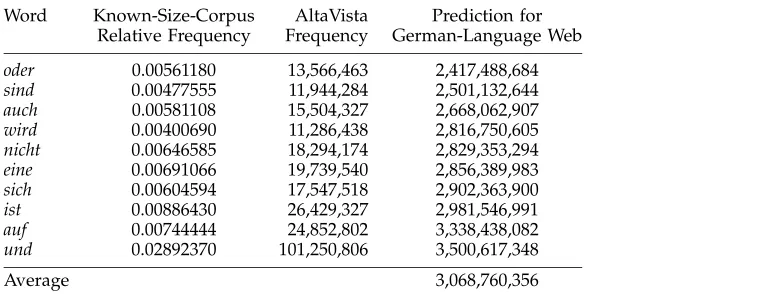
From the first megabyte of the German text found in the European Corpus Ini-tiative Multilingual Corpus,5 we extracted frequencies for function words and other short, common words. We removed from the list words that were also common words in other languages.6 AltaVista provided, on its results pages, along with a page count for a query, the number of times that each query word was found on the Web.7 Ta-ble 2 shows the relative frequency of the words from our known corpus, the index frequencies that AltaVista gave (February 2000), and the consequent estimates of the size of the German-language Web indexed by AltaVista.
We set aside words which give discrepant predictions (too high or too low) as (1) AltaVista does not record in its index the language a word comes from, so the count for the string dieincludes both the German and English occurrences, and (2) a word might be under- or overrepresented in the training corpus or on the Web (consider
[image:6.612.103.487.489.636.2]here, which occurs very often in “click here”). Averaging the remaining predictions gives an estimate of three billion words of German that could be accessed through AltaVista on the day in February 2000 that we conducted our test.
Table 2
Short German words in the ECI corpus and via AltaVista, giving German Web estimates.
Word Known-Size-Corpus AltaVista Prediction for
Relative Frequency Frequency German-Language Web
oder 0.00561180 13,566,463 2,417,488,684
sind 0.00477555 11,944,284 2,501,132,644
auch 0.00581108 15,504,327 2,668,062,907
wird 0.00400690 11,286,438 2,816,750,605
nicht 0.00646585 18,294,174 2,829,353,294
eine 0.00691066 19,739,540 2,856,389,983
sich 0.00604594 17,547,518 2,902,363,900
ist 0.00886430 26,429,327 2,981,546,991
auf 0.00744444 24,852,802 3,338,438,082
und 0.02892370 101,250,806 3,500,617,348
Average 3,068,760,356
5http://www.elsnet.org/resources/eciCorpus.html.
6 These lists of short words and frequencies were initially used to create a language identifier. 7 AltaVista has recently stopped providing information about how often individual words in a query
Table 3
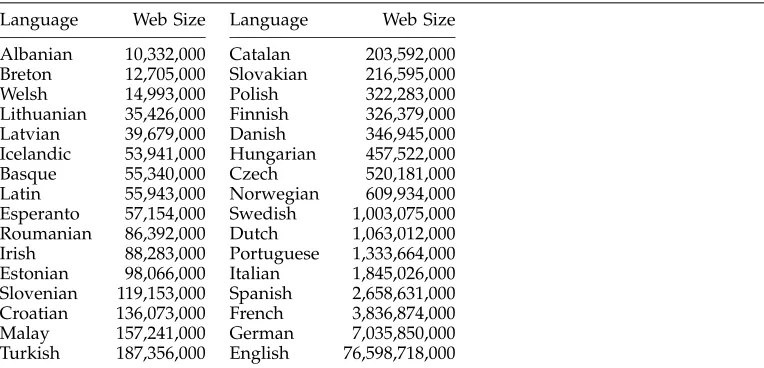
Estimates of Web size in words, as indexed by AltaVista, for various languages.
Language Web Size
Albanian 10,332,000
Breton 12,705,000
Welsh 14,993,000
Lithuanian 35,426,000
Latvian 39,679,000
Icelandic 53,941,000
Basque 55,340,000
Latin 55,943,000
Esperanto 57,154,000
Roumanian 86,392,000
Irish 88,283,000
Estonian 98,066,000
Slovenian 119,153,000
Croatian 136,073,000
Malay 157,241,000
Turkish 187,356,000
Language Web Size
Catalan 203,592,000
Slovakian 216,595,000
Polish 322,283,000
Finnish 326,379,000
Danish 346,945,000
Hungarian 457,522,000
Czech 520,181,000
Norwegian 609,934,000
Swedish 1,003,075,000
Dutch 1,063,012,000
Portuguese 1,333,664,000
Italian 1,845,026,000
Spanish 2,658,631,000
French 3,836,874,000
German 7,035,850,000
English 76,598,718,000
This technique has been tested on controlled data (Grefenstette and Nioche 2000) in which corpora of different languages were mixed in various proportions and found to give reliable results. Table 3 provides estimates for the number of words that were available in 30 different Latin-script languages through AltaVista in March 2001. English led the pack with 76 billion words, and seven additional languages already had over a billion.
From the table, we see that even “smaller” languages such as Slovenian, Croatian, Malay, and Turkish have more than one hundred million words on the Web. Much of the research that has been undertaken on the BNC simply exploits its scale and could be transferred directly to these languages.
The numbers presented in Table 3 are lower bounds, for a number of reasons:
• AltaVista covers only a fraction of the indexable Web pages available (the fraction was estimated at just 15% by Lawrence and Giles [1999]).
• AltaVista may be biased toward North American (mainly
English-language) pages by the strategy it uses to crawl the Web.
• AltaVista indexes only pages that can be directly called by a URL and does not index text found in databases that are accessible through dialog windows on Web pages (the “hidden Web”). This hidden Web is vast (consider MedLine,8 just one such database, with more than five billion words; see also Ipeirotis, Gravano, and Sahami [2001]), and it is not considered at all in the AltaVista estimates.
Repeating the procedure after an interval, the second author and Nioche showed that the proportion of non-English text to English is growing. In October 1996 there
Table 4
AltaVista frequencies for candidate translations ofgroupe de travail.
labor cluster 21
labor grouping 28
labour concern 45
labor concern 77
work grouping 124
work cluster 279
labor collective 423
labour collective 428
work collective 759
work concern 772
labor group 3,977
labour group 10,389
work group 148,331
were 38 German words for every 1,000 words of English indexed by AltaVista. In August 1999, there were 71, and in March 2001, 92.
3.1 Finding the Right Translation
How can these large numbers be used for other language-processing tasks? Consider the compositional French noun phrasegroupe de travail. In theMEMODATAbilingual
dictionary,9 the French word groupe is translated by the English words cluster, group,
grouping, concern, and collective. The French word travail translates as work, labor, or
labour. Many Web search engines allow the user to search for adjacent phrases. Com-bining the possible translations of groupe de travail and submitting them to AltaVista in early 2003 yielded the counts presented in Table 4. The phrase work group is 15 times more frequent than any other and is also the best translation among the tested possibilities. A set of controlled experiments of this form is described in Grefenstette (1999). In Grefenstette’s study, a good translation was found in 87% of ambiguous cases from German to English and 86% of ambiguous cases from Spanish to English.
4. Representativeness
We know the Web is big, but a common response to a plan to use the Web as a corpus is “but it’s not representative.” There are a great many things to be said about this. It opens up a pressing yet almost untouched practical and theoretical issue for computational linguistics and language technology.
4.1 Theory
First, “representativeness” begs the question “representative of what?” Outside very narrow, specialized domains, we do not know with any precision what existing corpora might be representative of. If we wish to develop a corpus of general English, we may think it should be representative of general English, so we then need to define the population of “general English-language events” of which the corpus will be a sample. Consider the following issues:
• Production and reception: Is a language event an event of speaking or writing, or one of reading or hearing? Standard conversations have, for each utterance, one speaker and one hearer. ATimesnewspaper article has (roughly) one writer and several hundred thousand readers.
9 Seehttp://www.elda.fr/cata/text/M0001.html. The basic multilingual lexicon produced by
• Speech and text: Do speech events and written events have the same status? It seems likely that there are orders of magnitude more speech events than writing events, yet most corpus research to date has tended to focus on the more tractable task of gathering and working with text.
• Background language: Does muttering under one’s breath or talking in one’s sleep constitute a speech event, and does doodling with words constitute a writing event? Or, on the reception side, does passing (and possibly subliminally reading) a roadside advertisement constitute a reading event? And what of having the radio on but not attending to it, or the conversational murmur in a restaurant?
• Copying: ifI’d like to teach the world to sing, and, like Michael Jackson or the Spice Girls, am fairly successful in this goal and everyone sings my song, then does each individual singing constitute a distinct language production event?
In the text domain, organizations such as Reuters produce news feeds that are typically adapted to the style of a particular newspaper and then republished: Is each republication a new writing event? (These issues, and related themes of cut-and-paste authorship, ownership, and plagiarism, are explored in Wilks [2003].)
4.2 Technology
Application developers urgently need to know what to do about sublanguages. It has often been argued that, within a sublanguage, few words are ambiguous, and a limited repertoire of grammatical structures is used (Kittredge and Lehrberger 1982). This points to sublanguage-specific application development’s being substantially sim-pler than general-language application development. However, many of the resources that developers may wish to use are general-language resources, such as, for English, WordNet, ANLT, XTag, COMLEX, and the BNC. Are they relevant for building ap-plications for sublanguages? Can they be used? Is it better to use a language model based on a large general-language corpus or a relatively tiny corpus of the right kind of text? Nobody knows. There is currently no theory, no mathematical models, and almost no discussion.
A related issue is that of porting an application from the sublanguage for which it was developed to another. It should be possible to use corpora for the two sublan-guages to estimate how large a task this will be, but again, our understanding is in its infancy.
4.3 Language Modeling
Much work in recent years has gone into developing language models. Clearly, the statistics for different types of text will be different (Biber 1993). This imposes a lim-itation on the applicability of any language model: We can be confident only that it predicts the behavior of language samples of the same text type as the training-data text type (and we can be entirely confident only if training and test samples are random samples from the same source).
Table 5
Hits for Spanishpensar quewith and without possible “dequeismos errors” (spuriousde
between the verb and the relative), from Alltheweb.com (March 2003). Not all items are errors
(e.g., “. . .pienso de que manera. . .”. . . think how. . .). The correct form is always at least 500
times more common than any potentially incorrect form.
pienso de que 388
pienso que 356,874
piensas de que 173
piensas que 84,896
piense de que 92
piense que 67,243
pensar de que 1,640
pensar que 661,883
when the training corpus changes. The lack of theory of text types leaves us without a way of assessing the usefulness of language-modeling work.
4.4 Language Errors
Web texts are produced by a wide variety of authors. In contrast to paper-based, copy-edited published texts, Web-based texts may be produced cheaply and rapidly with little concern for correctness. On Google a search for “I beleave” has 3,910 hits, and “I beleive,” 70,900. The correct “I believe” appears on over four million pages. Table 5 presents what is regarded as a common grammatical error in Spanish, comparing the frequency of such forms to the accepted forms on the Web. All the “erroneous” forms exist, but much less often than the “correct” forms. The Web is a dirty corpus, but expected usage is much more frequent than what might be considered noise.
4.5 Sublanguages and General-Language-Corpus Composition
A language can be seen as a modest core of lexis, grammar, and constructions, plus a wide array of different sublanguages, as used in each of a myriad of human ac-tivities. This presents a challenge to general-language resource developers: Should sublanguages be included? The three possible positions are
• No, none should.
• Some, but not all, should.
• Yes, all should.
The problem with the first position is that, with all sublanguages removed, the residual core gives an impoverished view of language (quite apart from demarcation issues and the problem of determining what is left). The problem with the second is that it is arbitrary. The BNC happens to include cake recipes and research papers on gastro-uterine diseases, but not car manuals or astronomy texts. The third has not, until recently, been a viable option.
4.6 Literature
The recent history of mathematically sophisticated modeling of language variation begins with Biber (1988), who identifies and quantifies the linguistic features associated with different spoken and written text types. Habert and colleagues (Folch et al. 2000; Beaudouin et al. 2001) have been developing a workstation for specifying subcorpora according to text type, using Biber-style analyses, among others. In Kilgarriff (2001) we present a first pass at quantifying similarity between corpora, and Cavaglia (2002) continues this line of work. As mentioned above, Sekine (1997) and Gildea (2001) directly address the relation between NLP systems and text type; one further such item is Roland et al. (2000). Buitelaar and Sacaleanu (2001) explores the relation between domain and sense disambiguation. A practical discussion of a central technical concern is Vossen (2001), which tailors a general-language resource for a domain.
Baayen (2001) presents sophisticated mathematical models for word frequency distributions, and it is likely that his mixture models have potential for modeling sublanguage mixtures. His models have been developed with a specific, descriptive goal in mind and using a small number of short texts: It is unclear whether they can be usefully applied in NLP.
Although the extensive literature on text classification (Manning and Sch ¨utze 1999, pages 575–608) is certainly relevant, it most often starts from a given set of categories and cannot readily be applied to the situation in which the categories are not known in advance. Also, the focus is usually on content words and topics or domains, with other differences of genre or sublanguage remaining unexamined. Exceptions focusing on genre include Kessler, Nunberg, and Sch ¨utze (1997) and Karlgren and Cutting (1994).
4.7 Representativeness: Conclusion
The Web is not representative of anything else. But neither are other corpora, in any well-understood sense. Picking away at the question merely exposes how primitive our understanding of the topic is and leads inexorably to larger and altogether more interesting questions about the nature of language, and how it might be modeled.
“Text type” is an area in which our understanding is, as yet, very limited. Although further work is required irrespective of the Web, the use of the Web forces the issue. Where researchers use established corpora, such as Brown, the BNC, or the Penn Treebank, researchers and readers are willing to accept the corpus name as a label for the type of text occurring in it without asking critical questions. Once we move to the Web as a source of data, and our corpora have names like “April03-sample77,” the issue of how the text type(s) can be characterized demands attention.
5. Introduction to Articles in This Special Issue
One use of a corpus is to extract a language model: a list of weighted words, or combinations of words, that describe (1) how words are related, (2) how they are used with each other, and (3) how common they are in a given domain. Language models are used in speech processing to predict which word combinations are likely interpretations of a sound stream, in information retrieval to decide which words are useful indicators of a topic, and in machine translation to identify good translation candidates.
pages. They also show how this method can be used for automatic acquisition of sense-tagged corpora, from which one could, among other things, produce language models tied to certain senses of words, or for a certain domain.
Unseen words, or word sequences—that is, words or sequences not occurring in training data—are a problem for language models. If the corpus from which a particu-lar model is extracted is too small, there are many such sequences. Taking the second author’s work, as described above, as a starting point, Frank Keller and Mirella Lapata examine how useful the Web is as a source of frequency information for rare items: specifically, for dependency relations involving two English words such as<fulfill OB-JECT obligation>. They generate pairs of common words, constructing combinations that are and are not attested in the BNC. They then compare the frequency of these combinations in a larger 325-million-word corpus and on the Web. They find that Web frequency counts are consistent with those for other large corpora. They also report on a series of human-subject experiments in which they establish that Web statistics are good at predicting the intuitive plausibility of predicate-argument pairs. Other experiments discussed in their article show that Web counts correlate reliably with counts re-created using class-based smoothing and overcome some problems of data sparseness in the BNC.
Other very large corpora are available for English (English is an exception), and the other three papers in the special issue all exploit the multilinguality of the Web. Andy Way and Nano Gough show how the Web can provide data for an example-based machine translation (Nagao 1984) system. First, they extract 200,000 phrases from a parsed corpus. These phrases are sent to three online translation systems. Both original phrases and translations are chunked. From these pairings a set of chunk translations is extracted to be applied in a piecewise fashion to new input text. The authors use the Web again at a final stage to rerank possible translations by verifying which subsequences among the possible translations are most attested.
The two remaining articles present methods for building aligned bilingual corpora from the Web. It seems plausible that such automatic construction of translation dic-tionaries can palliate the lack of translation resources for many language pairs. Philip Resnik was the first to recognize that it is possible to build large parallel bilingual corpora from the Web. He found that one can exploit the appearance of language flags and other clues that often lead to a version of the same page in a different language.10 In this issue, Resnik and Noah Smith present their STRAND system for building bilingual corpora from the Web.
An alternative method is presented by Wessel Kraaij, Jian-Yun Nie, and Michel Simard. They use the resulting parallel corpora to induce a probabilistic translation dictionary that is then embedded into a cross-language information retrieval system. Various alternative embeddings are evaluated using the CLEF (Peters 2001) multilin-gual information retrieval test beds.
6. Prospects
The default means of access to the Web is through a search engine such as Google. Although the Web search engines are dazzlingly efficient pieces of technology and excellent at the task they set for themselves, for the linguist they are frustrating:
• The search engine results do not present enough instances (1,000 or 5,000 maximum).
• They do not present enough context for each instance (Google provides a fragment of around ten words).
• They are selected according to criteria that are, from a linguistic perspective, distorting (with uses of the search term in titles and headings going to the top of the list and often occupying all the top slots).
• They do not allow searches to be specified according to linguistic criteria such as the citation form for a word, or word class.
• The statistics are unreliable, with frequencies given for “pages containing
x” varying according to search engine load and many other factors.
If only these constraints were removed, a search engine would be a wonderful tool for language researchers. Each of the constraints could straightforwardly be re-solved by search engine designers, but linguists are not a powerful lobby, and search engine company priorities will never perfectly match our community’s. This suggests a better solution: Do it ourselves. Then the kinds of processing and querying would be designed explicitly to meet linguists’ desiderata, without any conflict of interest or “poor relation” role. Large numbers of possibilities open up. All those processes of linguistic enrichment that have been applied with impressive effect to smaller corpora could be applied to the Web. We could parse the Web. Web searches could be specified in terms of lemmas, constituents (e.g., noun phrase), and grammatical relations rather than strings. The way would be open for further anatomizing of Web text types and domains. Thesauruses and lexicons could be developed directly from the Web. And all for a multiplicity of languages.11
The Web contains enormous quantities of text, in numerous languages and lan-guage types, on a vast array of topics. Our take on the Web is that it is a fabulous linguists’ playground. We hope the special issue will encourage you to come on out and play!
References
Agirre, Eneko, Olatz Ansa, Eduard Hovy and David Martinez. 2000. Enriching very large ontologies using the WWW. In
Proceedings of the Ontology Learning Workshop of the European Conference of AI (ECAI), Berlin.
Atkins, Sue. 1993. Tools for computer-aided corpus lexicography: The Hector project.
Acta Linguistica Hungarica, 41:5–72. Atkins, Sue, Jeremy Clear, and Nicholas
Ostler. 1992. Corpus design criteria.
Literary and Linguistic Computing, 7(1):1–16.
Baayen, Harald. 2001.Word Frequency
Distributions. Kluwer, Dordrecht. Baker, Collin F., Charles J. Fillmore, and
John B. Lowe. 1998. The Berkeley
FrameNet Project. InProceedings of
COLING-ACL, pages 86–90, Montreal, August.
Banko, Michele and Eric Brill. 2001. Scaling to very very large corpora for natural
language disambiguation. InProceedings of
the 39th Annual Meeting of the Association for Computational Linguistics and the
10th Conference of the European Chapter of the Association for Computational Linguistics, Toulouse.
Beaudouin, Val ´erie, Serge Fleury, Benoˆıt
Habert, Gabriel Illouz, Christian Licoppe, and Marie Pasquier. 2001. Typweb:
d ´ecrire la toile pour mieux comprendre
les parcours. InColloque International sur
les Usages et les Services des
T ´el ´ecommunications(CIUST’01), Paris,
June. Available at
paris3.fr/ilpga/ilpga/sfleury/typweb.htm. Beesley, Kenneth R. 1988. Language
identifier: A computer program for automatic natural-language identification
of on-line text. InLanguage at Crossroads:
Proceedings of the 29th Annual Conference of the American Translators Association, pages 47–54, October 12–16.
Biber, Douglas. 1988.Variation across speech
and writing. Cambridge University Press, Cambridge.
Biber, Douglas. 1993. Using
register-diversified corpora for general
language studies.Computational Linguistics,
19(2):219–242.
Briscoe, Ted and John Carroll. 1997.
Automatic extraction of subcategorization
from corpora. InProceedings of the Fifth
Conference on Applied Natural Language Processing, pages 356–363, Washington, DC, April.
Buitelaar, Paul and Bogdan Sacaleanu. 2001. Ranking and selecting synsets by domain
relevance. InProceedings of the Workshop on
WordNet and Other Lexical Resources: Applications, Extensions and Customizations, NAACL, Pittsburgh, June.
Burnard, Lou. 1995.The BNC Reference
Manual. Oxford University Computing Service, Oxford.
Cavaglia, Gabriela. 2002. Measuring corpus homogeneity using a range of measures
for inter-document distance. InProceedings
of the Third International Conference on Language Resources and Evaluation, pages 426–431, Las Palmas de Gran Canaria, Spain, May.
Church, Kenneth W. and Robert L. Mercer. 1993. Introduction to the special issue on computational linguistics using large
corpora.Computational Linguistics,
19(1):1–24.
Dumais, Susan, Michele Banko, Eric Brill, Jimmy Lin, and Andrew Ng. 2002. Web question answering: Is more always
better? InProceedings of the 25th ACM
SIGIR, pages 291–298, Tampere, Finland. Fletcher, William. 2002. Facilitating
compilation and dissemination of ad-hoc
web corpora. InTeaching and Language
Corpora 2002. Available athttp:// miniappolis.com/KWiCFinder/
KWiCFinder.html.
Folch, Helka, Serge Heiden, Benoˆıt Habert, Serge Fleury, Gabriel Illouz, Pierre Lafon,
Julien Nioche, and Sophie Pr ´evost. 2000.
Typtex: Inductive typological text classification by multivariate statistical analysis for NLP systems
tuning/evaluation. InProceedings of the
Second Language Resources and Evaluation
Conference, pages 141–148, Athens, May–June.
Fujii, Atsushi and Tetsuya Ishikawa. 2000. Utilizing the World Wide Web as an encyclopedia: Extracting term
descriptions from semi-structured text. In
Proceedings of the 38th Meeting of the ACL, pages 488–495, Hong Kong, October. Gildea, Daniel. 2001. Corpus variation and
parser performance. InProceedings of the
Conference on Empirical Methods in NLP, Pittsburgh, PA.
Greenwood, Mark, Ian Roberts, and Robert Gaizauskas. 2002. University of Sheffield TREC 2002 Q & A system. In E. M. Voorhees and Lori P. Buckland, editors,
The Eleventh Text Retrieval Conference (TREC-11), Washington. U.S. Government Printing Office.
Grefenstette, Gregory. 1995. Comparing two language identification schemes. In
Proceedings of the Third International Conference on the Statistical Analysis of Textual Data (JADT’95), pages 263–268, Rome, December 11–13. Available at
www.xrce.xerox.com/competencies/content-analysis/publications/Documents/P49030/
content/gg aslib.pdf.
Grefenstette, Gregory. 1999. The WWW as a resource for example-based MT tasks. Paper presented at ASLIB “Translating and the Computer” conference, London, October.
Grefenstette, Gregory. 2001. Very large lexicons. In Walter Daelemans, Khalil Simaan, Jakub Zavrel, and Jorn Veenstra,
editors,Computational Linguistics in the
Netherlands 2000: Selected Papers from the Eleventh CLIN Meeting, Language and Computers 37. Rodopi, Amsterdam. Grefenstette, Gregory and Julien Nioche.
2000. Estimation of english and
non-english language use on the WWW. InProceedings of the RIAO (Recherche d’Informations Assist ´ee par Ordinateur), pages 237–246, Paris.
Hawking, D., E. Voorhees, N. Craswell, and P. Bailey. 1999. Overview of the TREC8
Web track. InProceedings of the Eighth Text
Retrieval Conference, Gaithersburg, Maryland, November.
Ipeirotis, Panagiotis G., Luis Gravano, and Mehran Sahami. 2001. Probe, count, and classify: Categorizing hidden Web
databases. InProceedings of the SIGMOD
Conference, Santa Barbara, CA. Jones, Rosie and Rayid Ghani. 2000.
Automatically building a corpus for a minority language from the Web. In
Computational Linguistics, Hong Kong, pages 29–36.
Karlgren, Jussi and Douglass Cutting. 1994. Recognizing text genres with simple metrics using discriminant analysis. In
Proceedings of COLING-94, pages 1071–1075, Kyoto, Japan.
Kessler, Brett, Geoffrey Nunberg, and Hinrich Sch ¨utze. 1997. Automatic
detection of text genre. InProceedings of
ACL and EACL, pages 39–47, Madrid. Kilgarriff, Adam. 2001. Comparing corpora.
International Journal of Corpus Linguistics, 6(1):1–37.
Kilgarriff, Adam. 2003. Linguistic search
engine. In Kiril Simov, editor,Shallow
Processing of Large Corpora: Workshop Held in Association with Corpus Linguistics 2003, Lancaster, England, March.
Kilgarriff, Adam and Michael Rundell. 2002. Lexical profiling software and its
lexicographical applications—A case
study. InProceedings of EURALEX ’02,
Copenhagen, August.
Kittredge, Richard and John Lehrberger.
1982.Sublanguage: Studies of Language in
Restricted Semantic Domains. De Gruyter, Berlin.
Korhonen, Anna. 2000. Using semantically motivated estimates to help
subcategorization acquisition. In
Proceedings of the Joint Conference on Empirical Methods in NLP and Very Large Corpora, pages 216–223, Hong Kong, October.
Lawrence, Steve and C. Lee Giles. 1999. Accessibility of information on the Web.
Nature, 400:107–109.
Manning, Christopher and Hinrich Sch ¨utze.
1999.Foundations of Statistical Natural
Language Processing. MIT Press, Cambridge. McEnery, Tony and Andrew Wilson. 1996.
Corpus Linguistics. Edinburgh University Press, Edinburgh.
Mihalcea, Rada and Dan Moldovan. 1999. A method for word sense disambiguation of
unrestricted text. InProceedings of the 37th
Meeting of ACL, pages 152–158, College Park, MD, June.
Nagao, Makoto. 1984. A framework of a mechanical translation between Japanese and English by analogy principle. In Alick Elithorn and Ranan Banerji, editors,
Artificial and Human Intelligence.
North-Holland, Edinburgh, pages 173–180.
Peters, Carol, editor. 2001.Cross-Language
Information Retrieval and Evaluation,
Workshop of Cross-Language Evaluation Forum (CLEF 2000) Lisbon, Portugal, September 21–22, 2000, Revised Papers. Lecture Notes in Computer Science. Springer-Verlag.
Resnik, Philip. 1999. Mining the Web for
bilingual text. InProceedings of the 37th
Meeting of ACL, pages 527–534, College Park, MD, June.
Rigau, German, Bernardo Magnini, Eneko Agirre, and John Carroll. 2002. Meaning: A roadmap to knowledge technologies. In
Proceedings of COLING Workshop on A Roadmap for Computational Linguistics, Taipei, Taiwan.
Roland, Douglas, Daniel Jurafsky, Lise Menn, Susanne Gahl, Elizabeth Elder, and Chris Riddoch. 2000. Verb
subcategorization frequency differences between business-news and balanced corpora: The role of verb sense. In
Proceedings of the Workshop on Comparing Corpora, 38th ACL, Hong Kong, October. Sekine, Satshi. 1997. The domain
dependence of parsing. InProceedings of
the Fifth Conference on Applied Natural Language Processing, pages 96–102, Washington, DC, April.
Sinclair, John M., editor. 1987.Looking Up:
An Account of the COBUILD Project in Lexical Computing. Collins, London. Varantola, Krista. 2000. Translators and
disposable corpora. InProceedings of CULT
(Corpus Use and Learning to Translate), Bertinoro, Italy, November.
Villasenor-Pineda, L., M. Montes y G ´omez,
M. P ´erez-Coutino, and D. Vaufreydaz.
2003. A corpus balancing method for
language model construction. InFourth
International Conference on Intelligent Text Processing and Computational Linguistics (CICLing-2003), pages 393–401, Mexico City, February.
Volk, Martin. 2001. Exploiting the WWW as a corpus to resolve PP attachment
ambiguities. InProceedings of Corpus
Linguistics 2001, Lancaster, England. Vossen, Piek. 2001. Extending, trimming
and fusing WordNet for technical
documents. InProceedings of the NAACL
2001 Workshop on WordNet and Other Lexical Resources, Pittsburgh, June. Available at
http://engr.smu.edu/∼rada/mwnw/
papers/WNW-NACL-205.pdf.gz.
Wilks, Yorick. 2003. On the ownership of
text.Computers and the Humanities.
Forthcoming.
Xu, J. L. 2000. Multilingual search on the
World Wide Web. InProceedings of the
Hawaii International Conference on System Science (HICSS-33), Maui, Hawaii, January. Zheng, Zhiping. 2002. AnswerBus question
answering system. In E. M. Voorhees and
Lori P. Buckland, editors,Proceedings of