Erhard W. Hinrichs
Department of Linguistics University of Illinois
Urbana, IL 61801
This paper describes a compositional semantics for temporal expressions as part of the meaning representation language (MRL) of the JANUS system, a natural language understanding and generation system under joint development by BBN Labs and ISI. The analysis is based on a higher-order intensional logic described in detail in Hinrichs (1987a). Temporal expressions of English are translated into this language as quantifiers over times that bind temporal indices on predicates. The semantic evaluation of time-dependent predicates is defined relative to a set of discourse contexts, which, following Reichenbach (1947), include the parameters of speech time and reference time. The resulting context-dependent and multi-indexed interpretation of temporal expressions solves a set of well-known problems that arise when traditional systems of tense logic are applied to natural language semantics. Based on the principle of rule-to-rule translation, the compositional nature of the analysis provides a straightforward and well-defined interface between the parsing component and the semantic-interpre- tation component of JANUS.
1 INTRODUCTION
JANUS is a natural language understanding and gener- ation system that allows the user to interface with several knowledge bases maintained by the U.S. Navy. The knowledge bases contain, among other things, information about the deployment schedules, locations, and readiness conditions of the ships in the Pacific Fleet.
I. a. Did the admiral deploy the ship? b. List all ships as of 4-1-86. c. Which C3 ships are now C4?
d. When will Vincent arrive in Hawaii? e. Who was Frederick's previous commander?
f. Every admiral has to deploy a ship today.
As the sample queries in (1) demonstrate, much of this information is highly time-dependent: ships change lo- cations in accordance with their deployment schedules. They can incur equipment failures or undergo personnel changes. Such events, in turn, can affect the ships' readiness ratings, which are expressed by codes such as C3 or C4. Much of the information that the JANUS user is trying to access is time-dependent in that an appro- priate answer can be given only if the time of the query and/or the time of the events in question are taken into
account. It is, therefore, imperative that at the level of semantic representation of the natural language input an adequate analysis can be provided for those linguistic expressions that carry time information: for example, tenses, temporal adverbials, and temporal adjectives.
The rest of this paper is organized as follows: In Section 2, I will sketch the basic ideas of the framework of logical semantics, or more specifically, of Montague Grammar, the framework that I will use for my analysis. Section 2 also gives a brief overview of the conceptual modularity of the JANUS system, which demonstrates how Montague Grammar as a linguistic theory can be applied in natural-language processing research. In sec- tions 3-8, I will address the subject matter of temporal semantics itself. My own analysis of temporal semantics is very much a response to the kinds of analyses that have been provided in classical tense logic. Section 3, therefore, provides a brief overview of analyses of the latter type. In Section 4, I will review some well-known problems that arise when one applies classical tense logics to the semantics of natural language. In Section 5, I will show how a logic with multiple indices that is based on Reichenbach's analysis of English tense can overcome most of the problems that standard tense logic cannot. While this richer logic will solve most of our problems, the issue of tense and noun-phrase (NP)
Copyright 1988 by the A s s o c i a t i o n for C o m p u t a t i o n a l Linguistics. P e r m i s s i o n to copy without fee all or part o f this material is granted provided that the copies are not m a d e for direct c o m m e r c i a l a d v a n t a g e and the CL reference and this copyright notice are included on the first page. To copy o t h e r w i s e , or to republish, requires a fee and/or specific permission.
Erhard W. Hinrichs Tense, Quantifiers, and Contexts
quantification does require additional refinements of the analysis. Section 6 will show how giving narrow scope to tense quantifiers enables us to provide adequate scope relations with respect to NP quantifiers. In addi- tion, I will show how a contextual analysis of nouns and noun phrases lets us account for the kind of temporal phenomena that were first discussed in Enc 1981, 1986. In Section 7, I argue that the context-dependent feature of the analysis does not add extra complexity to my treatment of time-dependent expressions, but is needed for purposes of discourse understanding in general. Finally, I will demonstrate in Section 8 how the narrow scope of tense also leads to a compositional syntax and semantics of tensed sentences in English.
2 THE SEMANTIC FRAMEWORK
The semantic theory that I have adopted in my research • is that of truth-conditional semantics. More specifically, I have adopted the framework of Montague Grammar, a version of truth-conditional semantics that has been developed by the logician Richard Montague (cf. Mon- tague 1973).1 Montague Grammar shares the fundamen- tal assumption of all truth-conditional theories of mean- ing, namely that natural language semantics has to relate in a systematic fashion linguistic expressions such as words, phrases, and sentences to nonlinguistic, real- world objects, events, and states of affairs. In particu- lar, a semantic theory has to provide a rigorous defini- tion of the truth conditions for the sentences of a language. The emphasis in Montague Grammar lies on the descriptive aspect of language use. Sentences say something true or false about the world. For a speaker to know the meaning of a sentence amounts to knowing what state of affairs has to obtain in the world, in order for the sentence to be true.
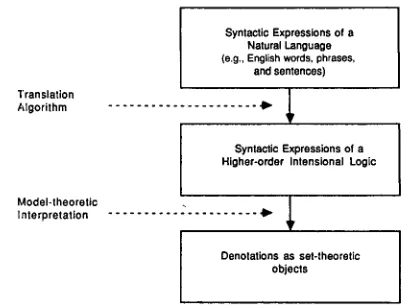
In a Montague Grammar the meanings of sentences, phrases, and words are interpreted relative to a model that assigns meanings of the appropriate type to such linguistic entities. In his papers Montague develops various instantiations of his theory. The one that is most commonly used by linguists is the one that Montague (1973) uses in his paper "The Proper Treatment of Quantification in Ordinary English" (commonly abbre- viated as PTQ). In that paper Montague associates meanings with linguistic expressions in an indirect fash- ion. As shown in Figure 1, syntactic expressions of English are first translated into a language of higher- order intensional logic, which in turn is interpreted model-theoretically. This indirect method of semantic interpretation obeys Frege's Principle of Composition- ality, which says that the meaning of a complex phrase is a function of two things: (1) the meanings of its constituent parts, and (2) the way in which these parts are syntactically combined. Formally speaking, the meaning of a complex expression is the homomorphic image of its syntactic composition. In more practical
Translation .tdgorithm
Syntactic Expressions of a
Natural L a n g u a g e
(e.g., English words, phrases, and sentences)
Syntactic Expressions of a
Higher-order Intensional Logic
Model-theoretic
Interpretation . . .
[image:2.612.329.533.51.205.2]Denotations as set-theoretic objects
Figure 1. Montague Grammar--Syntax and Semantics.
terms, a translation procedure from English into inten- sional logic that is based on Frege's Principle has to specify two things: (1) for each lexical item, the proce- dure has to specify a translation into the appropriate type of the logic, and (2) for each syntactic rule, the procedure has to specify how the translations of the input constituents combine in the translation for the output constituent of the syntactic rule.
Montague Grammar provides a simple and elegant interface between the syntactic and semantic compo- nents of a grammar. Since each syntactic operation is mirrored by a semantic operation, semantic interpreta- tion is in a sense syntax-driven. Moreover, syntactic analysis and semantic interpretation can proceed in paraHeh while a sentence or phrase is being parsed in accordance with the syntactic rules, its logical form can be computed by the translation rules. This inherent parallelism is one of the features that makes Montague Grammar an attractive theory for natural language processing. Everything else being equal, a system in which syntax and semantics can operate in parallel is computationally more efficient than one in which they have to operate sequentially.
Another attractive feature is the strict modularity between syntax and semantics. Modularity is not only good practice in software engineering, it is particularly important in building natural language interfaces. If one wants to extend the coverage of the grammar of a given system, one wants to do so in an incremental fashion and without having to modify the control structure between major components. Montague Grammar allows one to upscale a system in this way: in order to extend the coverage of the grammar, one simply writes addi- tional syntactic rules and translation rules that cover the new data.
Apart from these methodological considerations, it turns out that the same three components (syntax, translation, and model-theoretic interpretation) that are of importance in Montague's theory form an integral part in the functional components of natural language interface systems such as JANUS. z Figure 2 shows that
Syntactic Tree
Ambiguous Semantic Expression (EFL)
Unambiguous Semantic Expression (WML)
Database Language
Expression
English Input
[image:3.612.53.300.52.302.2]Parser
I
... -~ ~
... .
I
EFL-to-WML
Translation
I
WML-Io-DBLI
Translation
[ Code Generation I
I I '°° I I
I
Figure 2. Components of JANUS.
the English input is fed into the syntactic parser of JANUS, which yields as output a parse tree, which in turn forms the input to the translation component. The translation component generates some logical expres- sion that represents the meaning of the English input. This logical expression is then evaluated with respect to the database, which one can take to be a proxy for a partial model of the real world, in the case of JANUS a model of the objects and states of affairs pertaining to the Pacific Fleet.
The translation component of JANUS is somewhat more elaborate than the one Montague 1973 formulates. At the first level of translation, every lexical item of English is translated into some logical expression of an English-oriented formal language called EFL. At the E F L level, no attention is given to the context that may contribute to the interpretation of the English input. Neither is any attempt made at the E F L level to disambiguate lexical meanings. Lexical disambiguation is provided by a domain model, which, among other things, captures all the information about lexical mean- ings known to the s y s t e m )
Apart from domain knowledge, the system keeps track of those aspects of a user's question-answer session that are relevant for determining the reference of context-dependent queries such as (2).
2. a. Question: Where were the carriers yesterday? b. Answer: In the Indian Ocean.
c. Question: How long have they been there?
The discourse model contains parameters such as the time at which the question-answer session is taking place. This parameter is necessary to calculate the referent of deictic time adverbials such as yesterday in (2a). In addition, the discourse model keeps track of
locations such as the Indian Ocean and referents of noun phrases such as the carriers in order to interpret locational adverbs such as there and anaphoric pro- nouns such as they in (2c).
Input from the domain model and the discourse model leads to translation to a w o r l d - m o d e l language (WML), which in turn is translated into expressions of the query language of the appropriate knowledge base: a database IDB, an expert system F R E S H , or a display knowledge base OSGP. In this paper I will for the most part concentrate on the level of syntax to E F L transla- tion, although the context-dependent aspects of my treatment of temporal semantics will lead to some discussion of the discourse model of JANUS in sections 6 and 7 below.
3 APPLYING CLASSICAL TENSE LOGIC TO NATURAL LANGUAGE SEMANTICS
With this much of an introduction, let me now turn to the topic of temporal semantics itself. My own analysis is very much a response to the kinds of analyses that have been provided in classical tense logic. When I refer to classical tense logic, I mean the kinds of logics that originate in the work of the logician Arthur Prior (cf. Prior 1967) and that have subsequently been applied to natural language semantics (cf. Montague 1973 and Mort 1973).
In classical tense logic time-dependency of informa- tion enters into the definition of the notion of a propo- sition. Propositions are defined as functions from a set of times (TI) to the set of truth values ( T - - " t r u e " ) and (F---"false"). Declarative sentences of natural language are taken to express propositions. The sentence It is raining can be taken to be that proposition that yields the value true for those times at which it is raining, and false for those at which it is not.
Tense operators can be defined in such a logic as in (3) and (4). Formula 3 defines a past operator P, which, applied to a proposition p, yields the value true for some time t i f p is true at some time t' prior to t. Likewise, (4) defines a Y operator, where Y is mnemonic for yester- day, with the expected truth conditions: Yp is true at t if p is true at some time t' that falls within the day prior to the day in which t falls.
3. [P P]t = T i f f [ P ] t ' - T for some time t' < t.
4. [Y P i t = T i f f [ P ] t ' ---- T for some time t' C_ [DAY (t) - 1].
Erhard W. Hinrichs Tense, Quantifiers, and Contexts
4. INADEQUACIES OF CLASSICAL TENSE LOGIC
4.1 INTERACTION OF TENSE AND TIME ADVERBIALS
The first such problem, which I pointed out in Hinrichs 1981 and which was independently noted in D o w t y 1982, c o n c e r n s the interaction b e t w e e n tense and time adverbials. If for S e n t e n c e 5, one interprets the past tense in (5) by the P o p e r a t o r and the adverbial
yester-
day
by the Y operator, then one of the two operators has to have scope o v e r the other.5. Vincent left y e s t e r d a y .
6. P [ Y [ leave' (Vincent') ] ]
7. Y [ P [ leave' (Vincent') ] ]
H o w e v e r , neither the formula in (6), nor the one in (7) gives adequate truth conditions for (5). The truth con- ditions imposed by (6) are inadequate, since the sen- tence in (5) would, for example, count as true when uttered on J a n u a r y 15, 1988, if the ship Vincent left not on January 14, 1988, but instead on May 23, 1986. This is b e c a u s e the P o p e r a t o r can shift the temporal evalu- ation of the proposition
Y [leave' (Vincent')]
from the speech time to any past time (t"), for example to some time (t") on May 24, 1986. In this case the Y o p e r a t o r will, in turn, shift evaluation to t' within the day prior to t", i.e., to some time on M a y 23, 1986. H e n c e the propositionleave' (Vincent')
will be evaluated with respect to that day, instead o f the day prior to the speech time.F o r m u l a 7 can assign wrong truth conditions as well. H e r e the Y o p e r a t o r shifts evaluation to some time within the day prior to the speech time. But the P operator, in turn, shifts evaluation to some time prior to that, but necessarily not within the same day.
4.2 INTERACTION OF TENSE AND NEGATION
Similar problems arise when one uses standard tense logic for sentences in which tense interacts with sen- tence negation as in (8). As was first pointed out in Partee 1973, one can assign the past-tense o p e r a t o r (P) either n a r r o w scope with r e s p e c t to negation as in (9), or wide scope as in (10).
8. Vincent did not leave.
9. --1 [ P [ leave' (Vincent') ]]
10. P [ --1 [ leave' (Vincent') ]]
H o w e v e r , neither the formula in (9), nor the one in (10) assigns adequate truth conditions to (8). F o r m u l a 9 says that there exists no time in the past at which the proposition is true, clearly not capturing the meaning o f (8). F o r m u l a 10 makes (8) true if at any time in the past Vincent did not leave. Given that ships participate in events o t h e r than arrivals at some point during their existence, (10) will be trivially satisfied, but does not capture adequately the truth conditions o f (8).
4.3 TENSE AND QUANTIFIED NOUN PHRASES
The third type of inadequacy o f standard tense logic has to do with the interaction o f tense and quantified N P s and was first pointed out in E n c 1981, 1986. E n c points out that Priorean tense operators fail to capture certain readings o f sentences such as (11).
1 I. E v e r y admiral was (once) a cadet.
12. V x [ admiral' (x) --> P [ c a d e t ' (x) ]]
13. P [ V x [ admiral' (x) --> c a d e t ' (x) ]]
Since P is a propositional o p e r a t o r , it can take s c o p e o v e r the c o n s e q u e n t o f the material implication in (12). F o r m u l a 12 represents the reading that e v e r y o n e w h o is an admiral now was a cadet at some time in the past. The second reading in (13), w h e r e P has scope o v e r the entire formula, assigns the s o m e w h a t absurd truth con- ditions that at some time in the past e v e r y admiral was simultaneously a cadet. H o w e v e r , as E n c o b s e r v e s correctly, with propositional tense o p e r a t o r s we c a n n o t obtain the perfectly natural reading that e v e r y o n e who is an admiral now or who was an admiral at some time in the past was a cadet at some time prior to being an admiral.
4.4 TEMPORAL ANAPHORA
T h e r e is a fourth problem that arises w h e n one uses tense operators o f standard tense logic for the semantic interpretation o f pieces o f discourse or o f single sen- tences that describe multiple events.
14. Vincent was hit by a h a r p o o n , was a b a n d o n e d by its crew, and sank.
The most natural interpretation o f (14) is one in which the events are u n d e r s t o o d to have h a p p e n e d in the same temporal order as they are s e q u e n c e d in the sentence. H o w e v e r , if one uses a Priorean P o p e r a t o r to interpret each o c c u r r e n c e o f the past tense in (14), one arrives at an interpretation, which i n c o r r e c t l y allows for any temporal ordering.
5 A TENSE LOGIC WITH MULTIPLE INDICES
It turns out that most o f the problems that we have just discussed can be solved if one recognizes m o r e than one p a r a m e t e r o f temporal evaluation. In the models given to tense logics such as the ones first d e v e l o p e d by Prior, one standardly evaluates propositions with r e s p e c t to a single time that we m a y call the e v e n t time, the time at which an e v e n t happens or at which a state o f affairs obtains. The point o f speech is t a k e n to be a special case of this parameter.
An alternative to models with only one temporal p a r a m e t e r was given in R e i c h e n b a c h 1947. R e i c h e n b a c h argues for distinguishing b e t w e e n t h r e e p a r a m e t e r s , which he calls speech time, event time, and reference time. The meaning o f the first two p a r a m e t e r s should be self-explanatory. It is the third p a r a m e t e r , r e f e r e n c e
time, that requires explanation. Reichenbach conceives of reference time as the temporal perspective from which an event is viewed, as opposed to the event time, the time at which the event occurs. Reference time can be either implicit in the discourse context or explicitly specified by temporal adverbials such as yesterday. For each individual tense, reference time is temporally ordered with respect to the other two parameters. Reference time plays a crucial role in Reichenbach's account of the distinction between the simple past and the present perfect in English. In both cases event time precedes speech time. But while for the simple past, the event time is viewed from a perspective in the past, the event is viewed from the perspective of the present in the case of the present perfect.
As first shown in Aqvist 1976 and Guenthner 1979, Reichenbach's analysis can be formalized in a tense logic in which tense operators are evaluated with re- spect to multiple indices. For example, a Reichen- bachean past operator (P) can be defined as in (15).
15. [P P]ts,tr,te -- T iff [P]ts,tr,t' for some time t' such that t' < ts and t' C_ tr.
The parameters of evaluation in (15), ts, tr, and te, stand for speech time, reference time, and event time, respec- tively. The operator P shifts evaluation of the event time te to some time (t') in the past such that t' falls within some reference time tr. Note that contrary to Reichen- bach's original account of the past tense, the parameters of reference time and speech time are not directly ordered in (15), but only indirectly by virtue of the temporal ordering between event time t' and the speech time ts. This weaker ordering between tr and ts is motivated by sentences such as (16), in which the reference time denoted by the adverbial today contains the speech time ts.
16. Vincent arrived today.
In the intended models of interpretation for the P operator in (15), times are taken to be time intervals. Since (15) requires that the event time t' be located prior to ts and be contained in tr, (15) imposes as a restriction on tr that a subinterval of tr be ordered prior to ts. In order for (16) to be true, the subinterval of tr that lies in the past has to be a proper subinterval of tr, whereas for (17) all of tr has to precede ts.
17. Vincent left yesterday.
Given Reichenbach's parameters, the definition of the Y operator, given earlier in (5), can be modified as in (18).
18. [Y P]ts,tr.te = T i f f [P]ts,DAY(ts)-l,te = T .
Unlike the P operator in (15), Y in (18) does not shift te; instead, it Operates on tr and shifts that parameter to day prior to ts.
With the redefined operators P and Y, one can now give adequate truth conditions for sentences involving
tense and time adverbials. The logical form for (17), for example, can be evaluated as in (19): Y specifies the reference time to be the day prior to the speech time, and the P operator, in turn, correctly locates the event time as being within that reference time.
19. [Y [ P [ leave' (Vincent') ] ] ]ts,tr,te = T i f f [ P [leave' (Vincent') ]ts,[DAY(ts)-l],t = T i f f [ leave' (Vincent') ]ts,[DAY(ts)-l],t' = T for some t' < t and t' C_ [DAY (ts)-l].
The P and Y operators, defined in (15) and (18) above, differ from the operators found in Aqvist, Guenthner, and Dowty in that in my analysis all three of Reichen- bach's parameters are taken to be separate for purposes of evaluation, while Aqvist, Guenthner, and Dowty define operators that are evaluated with respect to two parameters only. This is because Dowty considers the speech time as a special case of the reference time, while Aqvist and Guenthner consider speech time to be a special case of the event time.
As I have argued elsewhere (cf. Hinrichs 1981, 1986) and as was noted independently in Dowty 1982, the need for tense operators with three separate parameters arises in the context of sentences such as (20).
20= Vincent rescued a ship yesterday which is now in Hawaii.
As first noted in Kamp 1971, the interpretation of n o w
requires that the speech point of the utterance be carried along at every stage of evaluating sentences such as (20), whose logical form can be represented as in (21).
21. Y [P [::Ix [ship' (x) & rescue' (Vincent', x) & NOW [be-in' (x,Hawaii')]]]]
In the evaluation of (21), the Y operator, as defined in (18), fixes the reference time as the day prior to ts, while the P operator from (15) shifts the event time to some time within that reference time. NOW, the third tempo- ral operator in (21), appears in the scope of the Y and the P operator. NOW, which can be defined as in (22), can be interpreted correctly in the context of (20), only if the speech time is kept as a separate index and held constant even though reference time and event time have been changed by the P and Y operators.
22. [NOW P]ts,tr,te = T i f f [P]ts,tr',te = T for ts C_ tr'.
Using temporal operators with multiple indices of eval- uation, one can also account correctly for the interac- tion of tenses and negation. In the evaluation of (23) shown in (24), the past operator locates the event time t' prior to speech time and within some reference time tr, which in the case of (23) has to be taken to be contextually specified.
23. Vincent did not leave.
Erhard W. Hinrichs Tense, Quantifiers, and Contexts
[leave' (Vincent') ]ts,tr,t' = F for all times t' such that t' < ts and t' _C tr.
S e n t e n c e 23 is true according to F o r m u l a 24 if there is no time within tr at which the untensed proposition
leave' (Vincent') is true.
It turns out that a multi-indexed tense logic provides the basis for an adequate a c c o u n t o f tense in discourse. By associating e v e n t times with respect to temporally o r d e r e d r e f e r e n c e times, as sketched in (26), one can indirectly induce an ordering among the events them- selves. M o r e o v e r , by updating such r e f e r e n c e times after each e v e n t description, one can o r d e r multiple events as described in (25) in the appropriate way. The relations < and C_ in (26) are meant to stand for temporal precedence and temporal inclusion, respectively.
25. Vincent [was hit by a harpoon]e~, [was a b a n d o n e d by its crew]e2, and [sank]~3.
26. trl < tr2 < tr3
Ul Ul Ul
t e l te2 te3
In o r d e r to induce the c o r r e c t temporal orderings among events and states o f affairs in a given discourse, refer- ence times have to be updated appropriately during discourse processing. F o r m u l a 26 shows the simplest case o f such updating. A new reference time is intro- duced after processing each e v e n t so that the temporal o r d e r o f the events b e c o m e s isomorphic to the o r d e r in which the events are introduced. H o w e v e r , for more complicated pieces o f discourse the conditions u n d e r which new r e f e r e n c e times are introduced can be far more complex. T h e aspectual properties o f the events in question, e v e n t - s u b e v e n t relations, causal connections obtaining among events and states o f affairs, as well as the overall structure o f the discourse itself are among the conditioning factors. It will not be possible to give a detailed a c c o u n t o f these issues here; for a more thor- ough discussion o f how to interpret temporal structures in discourse on the basis o f a multi-indexed tense logic, I refer the r e a d e r to Hinrichs 1981, 1986 and Partee
1984.
L e t us consider next two alternative logical represen- tations for S e n t e n c e 27 in such a multi-indexed logic.
27. Vincent left y e s t e r d a y .
28. [Y [ P [ leave' (Vincent') ] ] ]ts,tr,te
29. 3 t ' [ t ' < t s & t r = [ D A Y ( t s ) - 1 ] & t' C_ tr & leave' (Vincent') (t') ]
T h e formula in (28) we have already discussed. In (28) past tense is translated into a propositional o p e r a t o r w h o s e semantics is implicit in the truth conditions imposed with respect to the model-theory. In (29) the past tense leads to existential quantification o v e r times. The existential quantifier binds variables which appear as e x t r a argument positions on predicates. Thus, leave',
which is ordinarily a one-place predicate, turns into a two-place predicate that takes individuals and times as its arguments. The variables ts and tr o c c u r as free variables in (29) and, as stated earlier, stand for the R e i c h e n b a c h e a n speech time and r e f e r e n c e time, re- spectively.
Although the two formulas in (28) and (29) are logically equivalent in the sense that both are true u n d e r the same set of models, I will a d o p t the style o f logical representation in (29) for the r e m a i n d e r o f this paper. This is because in the c o n t e x t o f the J A N U S s y s t e m it is important to explicitly quantify o v e r times, since in the database times are explicitly e n t e r e d as dates, time stamps, etc. In o r d e r to be able to access them, it is important to incorporate time information explicitly at the level o f logical form.
A second r e a s o n for preferring the style of represen- tation in (29) o v e r the one in (28) c o n c e r n s the interac- tion b e t w e e n tenses and quantified NPs. Since formulas such as (29) explicitly quantify o v e r times, scope rela- tions with respect to quantification o v e r individuals b e c o m e completely transparent.
6 TENSE AND QUANTIFIED NOUN PHRASES
Using the style o f r e p r e s e n t a t i o n exemplified by for- mula (29), let me then return to the issue o f tense and quantification, which is still unresolved. Consider once again the types o f examples that, as E n c points out, c a n n o t be handled in a tense logic that gives temporal operators scope o v e r entire propositions.
30. E v e r y admiral graduated from Annapolis.
31. V x [admiral' (x) --~ P [graduate-from' (x,Annapolis')]]
32. P [Vx [admiral' (x) ~ graduate-from' (x,Annapolis')]]
If tense operators such as P have propositional scope, P can either scope o v e r an entire formula, as in (32), or o v e r the c o n s e q u e n t of the material implication, as in (31). N o w , as we saw earlier, neither formula captures the reading that all present or past admirals graduated from the Naval A c a d e m y in Annapolis prior to their being admirals.
E n c 1981 provides an interesting solution to the problem posed by examples such as (30). H e r solution is based on two assumptions: 1. Semantically, tenses should have scope only o v e r verb meanings, but not over any larger elements in a sentence, and 2. verb meanings as well as noun meanings are indexical in the sense that their interpretations d e p e n d on the c o n t e x t o f the utterance in the same way that d e m o n s t r a t i v e pro- nouns such as that and anaphoric p r o n o u n s such as she
and they do.
As shown in F o r m u l a 33, which r e p r e s e n t s the trans- lation for (30) in my analysis, I a d o p t E n c ' s first
assumption and assign tense scope only o v e r the main verb o f the sentence.
33. V x [3t [ admiral' (x) (t) & R (x) (t) ] 3 t ' [ t ' < t s & t ' C _ t r &
graduate-from' (Annapolis') (x) (t')]]
In a c c o r d a n c e with the R e i c h e n b a c h e a n analysis o f tense outlined in the previous section, the past tense o f sentence (30) contributes to (33) the existential quanti- fication o v e r times t' that p r e c e d e the speech point ts and are contained in some contextually specified refer- ence time tr. Following Enc, tense is thus given scope only o v e r the predicate that c o r r e s p o n d s to the main verb. H o w e v e r , I do not follow E n c in her second assumption, namely, her treatment of nouns and verbs as indexicals. It is characteristic o f true indexicals such as I, there, or you that their denotation is completely determined by a certain aspect of the c o n t e x t of the utterance. I refers to the speaker, you to the address- ee(s), there to some contextually salient location, etc. In contrast to such indexical expressions, the (temporal) evaluation o f nouns and verbs does not always depend on a single contextual p a r a m e t e r . In the case of complex nouns such as former admiral, last readiness rating, or
previous nautical position, temporal evaluation has to be shifted twice: first from the speech point to some contextually salient reference point and then in turn to some second time relative to which the nouns admiral, readiness rating, and nautical positions themselves are evaluated. In o r d e r to a c c o m m o d a t e c o m p l e x temporal evaluations o f nouns and verbs, their corresponding predicates in logical form, such as admiral' and gradu- ate-from' in (36), carry a time-denoting argument posi- tion as part of their function-argument structure. Since the temporal evaluation of such predicates can be shifted freely, their interpretation differs crucially from that o f true indexicals w h o s e interpretation can be completely determined with respect to a single contex- tual parameter.
E v e n though I do not follow Enc in treating nouns and verbs as indexical expressions, I do recognize that the interpretation o f noun phrases such as every admiral
in (30) is in part d e p e n d e n t on the c o n t e x t in which the sentence is used. Speakers asserting (30) are not likely to make the claim that e v e r y admiral who e v e r served in the navy o f any c o u n t r y that has naval forces graduated from the Naval A c a d e m y in Annapolis. Typically, (30) will be used to make a claim about a much restricted set o f admirals, say all the admirals in the U.S. N a v y or all admirals in the Pacific Fleet. E x a c t l y which set o f admirals a speaker focuses on will depend on the discourse c o n t e x t in which the sentence is used. This p h e n o m e n o n o f restricted quantification o f noun phrases is certainly not restricted to the interpretation o f every admiral in (30), but applies to quantified noun phrases in general, as Stalnaker (1973), who cites ex- amples such as (34), was among the first to point out.
34. E v e r y o n e is having a good time.
In (34) the interpretation of everyone typically does not involve the set o f all individuals currently alive, but rather the set o f all individuals in a given context; for example, e v e r y o n e at a certain party, at a certain location, and at a given time.
In order to a c c o m m o d a t e this contextual aspect o f the interpretation of noun phrases in my analysis, I introduce into the translation o f quantified N P s a pred- icate (R), which is meant to range o v e r properties that are salient in a given c o n t e x t and which serve to narrow down the reference o f the noun phrase in question. L e t me illustrate the c o n t e x t - d e p e n d e n t evaluation o f quan- tified NPs by once again focusing on S e n t e n c e 30 and its translation in (33).
30. E v e r y admiral graduated from Annapolis.
33. V x [3t [ admiral' (x) (t) & R (x) (t) ] 3 t ' [ t ' < ts & t' C _ t r &
graduate-from' (Annapolis') (x) (t')]]
Imagine that (30) is uttered in a c o n t e x t in which all current admirals in the Pacific Fleet are u n d e r discus- sion. In that context, R could be instantiated as in (35), i.e., as the intension o f the set o f individuals (x) who are in the Pacific Fleet at a time which equals the speech time ts.
35. A t A y [be-in' (Pac-Fleet') (y) (t) & t = ts]
Substituting (35) for R in (33), we arrive at the formula in (36).
36. ~' x [3t [admiral' (x) (t) & be-in' (Pac-Fleet') (x) (t) & t = ts ] ---~ [3 t' [ t ' < t s & t ' C_ t r &
graduate-from' (Annapolis') (x) (t') ]]
In a c o n t e x t in which all present or past admirals in the Pacific Fleet are u n d e r discussion, a reading that, as we pointed out in Section 4.3, one c a n n o t capture using Priorean tense operators, we can capture by instantiat- ing R as in (37), where -< stands for the relation
temporally preceding or equal to.
37. A t A y [be-in' (Pac-Fleet') (y) (t) & t -< ts ]
N o t i c e that the contextual variable R serves double duty in my analysis. This double role derives from the fact that R is a two-place predicate with individuals and time intervals as its two arguments. The argument ranging o v e r individuals serves to restrict the denota- tion o f the noun that R is associated with; for example, it restricts the denotation o f admiral in (33). T h e argu- ment of R that ranges o v e r time intervals, on the o t h e r hand, serves to restrict the time interval at which the associated noun denotation is evaluated; for example, if R is instantiated by (35) or (37), temporal evaluation o f the associated predicate admiral in (33) is restricted to the speech point or to time intervals prior to or including the speech point.
Erhard W. Hinrichs Tense, Quantifiers, and Contexts
kept separate from the temporal evaluation of predi- cates corresponding to other constituents in the sen- tence. As first pointed out by Enc, this strategy makes it possible to account for sentences such as 1138) and (39), whose translations require that the predicates
secretary
andfugitive
be evaluated relative to a time that is distinct from the evaluation time of the predicate corresponding to the verb. s38. Oliver North's secretary testified before the com- mittee.
39. Every fugitive is now in jail.
In contrast to an analysis that interprets the past tense in terms of a Priorean P operator, the narrow-scope analysis of tense also avoids the dilemma of inducing a simultaneity reading for Sentence 30, if P has scope over the entire formula, as in the Translation 40 of (30).
30. Every admiral graduated from Annapolis.
40. P [ V x [ admiral' (x)
graduate-from' (Annapolis') (x)]]
The reading in (40) is factually implausible for two reasons: I. It imposes simultaneity as part of the truth conditions and requires that all admirals graduated at the same time, and 2. since the P operator forces temporal evaluation of all predicates in its scope at the same index, in the case of (40) it requires that every admiral graduated from Annapolis as an admiral, and not, as is actually the case, subsequent to graduation from the Naval Academy.
Notice that the formula in (33), which represents the translation of (30) in my analysis, avoids both problems associated with (40).
33. V x [ 3 t [ admiral' (x) (t) & R (x) (t) ]--~ 3 t ' [ t ' < ts & t' C_tr&
graduate-from' (Annapolis') (x) (t') ]]
Since temporal evaluation of the predicates
admiral'
andgraduate-from'
are kept separate, the first problem does not arise. Since the predicates are existentially quantified over independently, (33), in contrast to (40), also avoids having to assign a simultaneity reading to (30).As I have outlined in this section, my treatment of tense and quantification is based on two basic assump- tions: 1. Verbal predicates and nominal predicates both have an argument position that ranges over time inter- vals; however, evaluations of verbal and nominal pred- icates are independent of one another. The evaluation of verbal predicates is governed by quantification over time intervals that involve Reichenbach's parameters of speech time, event time, and reference time. 2. The denotation of quantified NPs is restricted by the predi- cate R, which ranges over properties that are salient in the context of utterance. In conjunction with the nar- row-scope analysis of tense, it is this context dependent
feature of my analysis that makes it more flexible than a wide-scope analysis of tense.
One of the counterarguments that one may raise against this context-dependent aspect of my analysis of temporal semantics concerns the fact that tracking the salience of objects and their properties in natural- language discourse is a notoriously difficult problem. However, I will argue in the next section that whatever mechanisms are needed to track saliency, such mecha- nisms are independently motivated by semantic and pragmatic phenomena that go beyond the phenomenon of temporal interpretation.
7 EVALUATING TIME-DEPENDENT PREDICATES IN
CONTEXT
Objects and certain of their properties can receive or maintain salience in a discourse in any number of ways. The notions of focus (Sidner 1983), of c o m m o n g r o u n d (Stalnaker 1973), and of mutual knowledge (Clark and Marshall 1981) are certainly cases in point. In this section I will concentrate on two such mechanisms that play a role in the context-dependent interpretation of time-dependent predicates. In each case I will argue that the mechanism is needed for purposes other than temporal interpretation and, therefore, does not add complexity to my analysis of temporal semantics.
The first such mechanism concerns the way in which objects and their properties can become salient in the discourse context by virtue of the goals that the dis- course participants are trying to accomplish over the course of a given interaction. Consider a user of the JANUS system whose goal it is to deploy a set of ships. As part of achieving this goal, the user interacts with JANUS by asserting (41a) and then by querying (41b), whose translation is given by the formula in (42).
41. a. I need to deploy a ship immediately for a search- and-rescue mission.
b. Which ships are in the Indian Ocean?
42. QUERY [ ^Ax [ x ~ POW [ A y 3 t' [ ship' (y) (t') & R ( y ) ( t ' ) ] ] & 3 t [ t = t s & t C t r &
in' (Indian-Ocean') (x) (t) ]]]
Following Scha 1983, I base the semantics of questions on speech-act operators, such as QUERY, which take the intensional meaning of the question as an argument. The " symbol in (42) stands for the intension operator as defined in Montague 1973. POW stands for the power- set o p e r a t i o n , which I use for the interpretation of plural nouns. 6 POW in (42) is used to form the set of those objects that at some time t have the property of being a ship. 7 For the technical details concerning the seman- tics of the QUERY operator I refer the reader to Scha 1983. For the purposes of this paper, it should suffice that QUERY has the effect of consulting the underlying knowledge bases of the system as to which members of the power set of ships, if any, have the property of being in the Indian Ocean at the time of the query.
The point that I want to concentrate on with respect to the formula in (42) concerns the instantiation of the context-dependent predicate (R) that is associated with the translation of the noun phrase
which ships.
Given that the system recognizes the user's goal to be that of immediate ship deployment for a search-and-rescue mission, ships with a current readiness rating of C3 or better are salient in the context, since only such ships are deployable. By instantiating R appropriately, the formula in (42) turns into (43).43. QUERY [ ^ A x [x ~ POW [h y 3 t' [ ship' (y) (t') & readiness-rating' (y) (t') >- C3 & t' = ts]] & 3 t [t = ts & t C_ tr & in' (Indian-Ocean') (x) (t)]]]
T h e instantiation of R in (42) follows from recognizing the user's plan as that of immediate ship deployment. The importance of plan recognition for designing ques- tion-answering systems that generate cooperative re- sponses was emphasized in Allen/Perrault 1980, Allen 1983, and Pollack 1986. In the context of Example 41, if it turned out that two ships, Frederick and Vincent, are in the Indian Ocean, but both ships are rated C4, then a cooperative response would be (44), instead of merely listing the ship names.
41. a. I need to deploy a ship immediately for a search- and-rescue mission.
b. Which ships are in the Indian Ocean?
44. Frederick and Vincent, but they are rated C4 and cannot be deployed.
Recognizing the user's intention, which in the given context leads to the recognition of the current readiness rating of ships as a salient property, will make such a response possible. It, therefore, turns out that tracking properties that are salient in context is needed not only for evaluating predicates in the approach to temporal semantics that I have developed in this paper, but constitutes a task that is independently needed for the purposes of generating cooperative responses in ques- tion-answering.
The issue of plan recognition in discourse demon- strates that objects and their properties can become salient implicitly in discourse, that is, without explicit linguistic reference. However, salience of objects and properties can, of course, also be achieved at any point within a discourse by virtue of the previous linguistic context. Consider a sequence of user-system interac- tions as in (45).
45. a. Query: Did every admiral deploy a ship yester- day?
b. Answer: Yes.
c. Query: Which ships will arrive in Hawaii?
The person who asks the follow-up query (45c) to the system's affirmative answer to the initial query (45a) is not interested in being informed about all ships that at some time in the future will arrive in Hawaii. Instead,
the user is interested in a much more restricted set of ships that will arrive there, namely, the ones that were deployed by some admiral the day before. The noun
ship
in the final query in (45) has to be interpreted relative to the discourse context, and the temporal evaluation of the predicate is determined with respect to that context, rather by the tense of the sentence, in this case, the future. It turns out that a detailed proposal for how to construct such a mechanism does, in fact, already exist in the literature. Webber (1978, 1983) in her work on the interpretation of pronouns in discourse, has developed a framework that constructs during the interpretation of a discourse a context that consists of a set of what she calls discourse entities. These discourse entities then become available as objects that pronouns can refer to. One of the examples that Webber discusses is the interpretation of the pronounthey
in (47) in the context of sentence (46).46. Every admiral deployed a ship yesterday.
47. They arrived.
Clearly,
they
refers to the set of ships deployed by some admiral} In order to derive the appropriate discourse entity for the interpretation ofthey,
Webber suggests the rule schema such as (48). Formula 48, which is a slightly simplified version of Webber's original rule schema, says that for any formula that meets the structural description (SD), a discourse entity identified by the ID formula is to be constructed.48. SD: V y l . • "Yk3 x [ P - - ~ Q ] ID: A x 3 Yl" " ' Y k [ P & Q ]
Instantiated for Sentence 49 and its translation (50), the rule produces the expression in (51).
49. Every admiral deployed a ship yesterday.
50. V x 3 y,t,t',t" [ admiral' (x) (t) & R~ (x) (t) --~ ship' (y) (t') & R z (y) (t') & tr = [DAY(ts) - 1] & t" < ts & t" C_ tr & deploy' (y) (x) (t") ]
51. A y 3 x,t,t',t" [ ship' (y) (t) & R 2 (y) (t)
& admiral' (x) (t') & R 1 (x) (t') & tr = [DAY(ts) - 1] & t" < ts & t" C tr & deploy' (y) (x) (t") ]
Erhard W. Hinrichs Tense, Quantifiers, and Contexts
Schema 48 applied to (50), further restricts which ships are salient, namely, the set of ships contextually spec- ified by R1, which, in addition, were deployed on the previous day by one of the admirals in question. The discourse entity with the description, in turn, becomes available for the interpretation of the pronoun
they
in a follow-up sentence such as (47).It turns out that the method of constructing discourse entities is not only relevant to the interpretation of pronouns, but also to the contextual interpretation of nouns and noun phrases that I am concerned with here. In particular, the discourse entity with the description in (51) can serve not only for interpreting pronouns, but also for instantiating R for the interpretation of the noun
ship
in (45c) in the context of (45a). 945. a. Query: Did every admiral deploy a ship yester- day?
b. Answer: Yes.
c. Query: Which ships will arrive in Hawaii?
Since the discourse entity in (51), which ranges over a set of ships, is described in terms of the property of having been deployed by some admiral the day prior to the day of the speech point, that property can be taken to be salient in the discourse context. If one substitutes R in Translation 52 of (45c) by this contextually salient property, the temporal evaluation of the predicate
ship'
in resulting Formula 53 is no longer governed by the existential quantifier t for the future tense, but rather by the quantifier t' introduced by the contextually salient property. As a consequence of this instantiation of R, the set of ships under consideration is restricted in the appropriate way.52. QUERY [ ^h z [ z E POW [h y 3 t' [ ship' (y) (t') & R(y) (t')]] & 3 t [ t > ts & t C_ tr
& arrive' (Hawaii') (z) (t) ]]]
53. QUERY [ ^h z [ z @ POW[A y 3 t' [ship' (y) (t') & 3 x, t", t" [admiral' (x) (t") & R 1 (x) (t") & tr = [DAY(ts) - 1] & t ' " _C tr
& deploy' (y) (x) (t'") ]]] & 3 t [ t > ts & t _C tr' & arrive' (Hawaii') (z) (t) ]]]
The mechanism for deriving contextually salient prop- erties that are introduced through the previous linguistic discourse may strike the reader as rather complicated in detail. However, the point that I made earlier in this section with respect to tracking saliency as a side effect of plan recognition applies to the tracking of properties introduced by the linguistic context as well: tracking such properties is important not only for temporal evaluation, but is independently motivated by other discourse phenomena such as anaphoric reference, as Webber (1978, 1983) has convincingly shown.
8 A COMPOSITIONAL SYNTAX AND SEMANTICS OF TENSE
In the previous sections I have focused on the semantic and pragmatic aspects of my analysis of temporal ex- pressions, which concern in particular the features of narrow-scope assignment and of context-dependent in- terpretation of quantified NPs. In this section I will concentrate on matters of syntax and will demonstrate how the narrow-scope analysis makes it possible to construct a straightforward compositional syntax and semantics of tense in the framework of Montague Grammar, the linguistic theory on which my analysis is based.
Syntactically, tenses in English appear as inflectional morphemes on verbs. In the notation of categorial grammar, we may assign a syntactic tree as in (55) to Sentence 54. The infinitival form of the verb
arrive
of Category IV is combined with the past-tense morpheme-ed
to form a tensed intrasensitive verb IV*. Morpho- syntactically, tenses are therefore items that apply to individual words.54. Every ship arrived.
55. Every ship arrived, S
Every ship, S/IV* arrived, IV*
Every, S/IV*/CN ship, CN arrive, IV
Since I assign tense narrow scope in the semantics and let temporal quantifiers bind only the temporal index associated with the main verb, I arrive at an analysis of tense whose syntactic domain coincides with its seman- tic domain. Compared to analyses in which tense is assigned wide scope over formulas that correspond to entire sentences (Montague 1973) or over entire verb phrases (Bach 1980), the narrow-scope analysis, which I have developed in this paper, has the advantage of leading to a straightforward compositional syntax and semantics of tense. In the syntax the tense morpheme turns an untensed verb into its tensed counterpart, while the corresponding translation rule existentially quantifies over the time index of the predicate that translated the untensed verb.
56.
57.
If a E pIV/"NP and then F~ (a) E pIV*/"NP, where F~ = a-ed.
If a E pIV/"NP and a translates into a', then F~ (a) translates i n t o A S ~ . • . S , A x [ 3 t ' [ t ' < t s & t' C_ tr & a' (SO • • (Sn) (X) (t') ]].
Rule S c h e m a 56 ranges o v e r u n t e n s e d intrasensitive v e r b s (IV), transitive v e r b s (IV/NP), ditransitive v e r b s ( I V / N P / N P ) , etc. T h e notation I V / n N p thus stands for an IV followed b y n slashed N P s . T h e c o r r e s p o n d i n g translation s c h e m a in (57) d e n o t e s a function f r o m the t y p e o f meanings associated with object N P s , if any, to functions f r o m individuals to truth values. Although these rule s c h e m a t a are r a t h e r technical, their meaning should b e c o m e clear w h e n one considers a c o n c r e t e e x a m p l e . C o n s i d e r o n c e again E x a m p l e 54, w h o s e syn- tax has b e e n given in (53).
54. E v e r y ship arrived.
• T h e translation o f the entire s e n t e n c e can be built up in a c o m p o s i t i o n a l fashion as in (57), which mirrors the syntactic c o m p o s i t i o n o f (53).
58. a r r i v e d translates as:
A x [ 3 t ' [ t ' < t s & t ' C _ t r & a r r i v e ' ( x ) ( t ' ) ] ]
e v e r y translates as:
A P A Q V x [3 t [ P (x) (t) & R (x) (t) ] ~ Q (x) ]
e v e r y s h i p translates as:
h Q V x [3 t [ ship' (x) (t) & R(x) (t) ] ---> Q(x) ]
E v e r y s h i p a r r i v e d translates as:
1. h Q V x [3 t [ship' (x) (t) & R(x) (t)] ---> Q (x)] (h y [3 t' [t' < ts & t' c_ tr & a r r i v e ' (y) (t')]]) 2. v x [3 t [ship' (x) (t) & R (x) (t)] -->
h y [ 3 t' [t' < ts & t' C_ tr & a r r i v e ' (y) (t')]] (x)] 3. V x [3 t [ship' (x) (t) & R (x) (t)] --> 3 t' [ t' < ts
& t' C_ tr & a r r i v e ' (x) (t') ]]
T h e p h r a s e e v e r y s h i p is f o r m e d by supplying the predicate s h i p ' as an a r g u m e n t to the translation of
e v e r y . N o t i c e that R is introduced b y the translation of the quantifier e v e r y . T h e translation of the entire sen- tence is f o r m e d b y supplying the translation o f the tensed v e r b a r r i v e d , which is p r o d u c e d b y the transla- tion rule in (57), to the translation of the subject NP. T h e r e d u c e d translation results f r o m t w o steps of l a m b d a reduction.
9 CONCLUSION
In this p a p e r I h a v e argued that a logical semantics for t e m p o r a l e x p r e s s i o n s c a n p r o v i d e a d e q u a t e r e p r e s e n t a - tions for natural-language input to an interface such as J A N U S . T h e t e m p o r a l logic is b a s e d on R e i c h e n b a c h ' s models for the s e m a n t i c s o f English tense and uses multiple indices for s e m a n t i c interpretation. This multi- indexed logic o v e r c o m e s the kinds o f p r o b l e m s that arise w h e n s y s t e m s of tense logics are used that rely on j u s t o n e index o f evaluation.
I h a v e d e m o n s t r a t e d h o w giving n a r r o w s c o p e to tense quantifiers enables us to p r o v i d e a d e q u a t e s c o p e relations with r e s p e c t to N P quantifiers and to interpret such N P s relative to a given discourse context. I h a v e argued that the c o n t e x t - d e p e n d e n t f e a t u r e o f the analy-
sis does not add e x t r a c o m p l e x i t y to m y t r e a t m e n t of t i m e - d e p e n d e n t e x p r e s s i o n s , but is n e e d e d for p u r p o s e s o f discourse understanding in general. Finally, I h a v e d e m o n s t r a t e d h o w the n a r r o w s c o p e o f tense results in a fully c o m p o s i t i o n a l s y n t a x and s e m a n t i c s o f tensed sentences in English.
ACKNOWLEDGMENTS
T h e w o r k p r e s e n t e d here w a s s u p p o r t e d u n d e r D A R P A c o n t r a c t #N00014-85-C-0016. T h e views and conclu- sions contained in this d o c u m e n t are those o f the a u t h o r and should not be i n t e r p r e t e d as necessarily r e p r e s e n t - ing official policies, either e x p r e s s e d or implied, o f the D e f e n s e R e s e a r c h Projects A g e n c y or the United States G o v e r n m e n t . An earlier v e r s i o n o f the p r e s e n t p a p e r was p r e s e n t e d at the 1987 meeting of the A C L at Stanford U n i v e r s i t y and w a s published as Hinrichs 1987b. I a m grateful to J o h n N e r b o n n e , R e m k o Scha, B a r r y Schein, and Bonnie W e b b e r for c o m m e n t s on earlier drafts of this paper. M y i n d e b t e d n e s s to the w o r k of H a n s R e i c h e n b a c h and M u r v e t E n c on m a t t e r s o f t e m p o r a l s e m a n t i c s will be evident t h r o u g h o u t the pa- per.
REFERENCES
Allen, James and Ray Perrault 1980. "Analyzing Intention in Di- alogues". Artificial Intelligence 15: 143-178.
Allen, James 1983. "Recognizing Intentions from Natural Language Utterances". In M. Brady and R. Berwick (eds.). Computational Models of Discourse. MIT Press, Cambridge, MA.
Aqvist, Lennart 1976. "Formal Semantics for Verb Tenses as Ana- lyzed by Reichenbach". In: Teun van Dijk (ed.). Pragmatics o f Language and Literature. North Holland: Amsterdam, 229-236. Ayuso, Damaris M., Varda Shaked, and Ralph M. Weischedel 1987.
"An Environment for Acquiring Semantic Information". Proceed- ings of ACL-87. Stanford University, Stanford, CA.
Bach, Emmon 1980. "Tenses and Aspect as Functions of Verb Phrases". In Rohrer, Christian (ed.). Times, Tenses, and Quanti- tiers. Niemeyer, Tuebingen, W. Germany.
Clark, H.H. and Marshall, C.R. 1981. "Definite Reference and Mutual Knowledge". In A. Joshi, B. Webber, and I. Sag (eds.).
Elements of Discourse Understanding. Cambridge University Press: Cambridge, England; 10-63.
Dowty, David R. 1982. "Tenses, Time Adverbs, and Compositional Semantic Theory". Linguistics and Philosophy 5: 23-55. Dowty, David R., Robert E. Wall and Stanley Peters 1981. Introduc-
tion to Montague Semantics. Synthese Language Library 11. D. Reidel, Dordrecht, Netherlands.
Enc, Murvet 1981. Tense without Scope: An Analysis of Nouns as Indexicals. Ph.D. diss. University of Wisconsin-Madison. Distrib- uted by IULC.
Enc, Murvet 1986. "Towards a Referential Analysis of Temporal Expressions". Linguistics and Philosophy 9(4): 405-426. Groenendijk, J. and Stokhof, M. 1982. "Semantic Analysis of Wh-
complements". Linguistics and Philosophy 5(2): 175-234. Guenthner, F. 1979. "Time Schemes, Tense Logic, and the Analysis
of English Tenses". In Guenthner, F. and Schmidt, S.J. (eds.).
Formal Semantics and Pragmatics for Natural Languages. Rei- del, Dordrecht/Boston/London; 201-222.
Erhard W. Hinrichs Tense, Quantifiers, and Contexts
Hinrichs, Erhard 1986. "Temporal Anaphora in Discourses of English". Linguistics and Philosophy 9(1): 63-82.
Hinrichs, Erhard 1987a. "The Syntax and Semantics of a Meaning Representation Language for J A N U S " . In Research and Devel- opment in Natural Language Understanding as Part of the
Strategic Computing Program. Annual Technical Report Decem-
ber 1985-December 1986, BBN Technical Report.
Hinrichs, Erhard 1987b. " A Compositional Semantics of Temporal Expressions in English". Proceedings of ACL-87. Stanford Uni- versity, Stanford, CA.
Kamp, J.A.W. 1971. "Formal Properties of 'Now' ". In Theoria 37: 227-273.
Link, Godehard 1983. "The Logical Analysis of Plurals and Mass Terms". In Baeuerle, Schwarze, and von Stechow (eds.). Mean-
ing, Use and Interpretation of Language. De Gruyter, Berlin, W.
Germany; 250-269.
Montague, Richard 1973. Formal Philosophy. Richmond Thomason (ed.). Yale University Press, New Haven, CT.
Mott, P. 1978. "Dates, Tenseless Verbs, and Token-Reflexivity". In
MIND 82: 73-85.
Partee, Barbara H. 1973. "Some Structural Analogies between Tenses and Pronouns". The Journal of Philosophy 70(18): 601- 609.
Partee, Barbara H. 1984. "Nominal and Temporal Anaphora". Lin-
guistics and Philosophy 7(3): 243-286.
Pollack, Martha 1986. " A Model of Plan Inference that Distinguishes Between the Beliefs of Actors and Observers". Proceedings of the
ACL-86. New York, NY.
Prior, Arthur 1967. Past, Present and Future. Oxford University Press, Oxford, England.
Reichenbach, Hans 1947. Elements of Symbolic Logic. University of California Press, Berkeley, CA.
Scha, Remko 1983. Logical Foundations for Question Answering.
Philips Research Laboratories M.S. 12.331. Eindhoven, Nether- lands.
Sidner, Candace 1983. "Focusing the Comprehension of Definite Anaphora". In Brady, Michael, and Berwick, Robert (eds.).
Computational Models of Discourse. MIT Press, Cambridge, MA;
267-330.
Stalnaker, Robert 1973. "Pragmatics". In Davidson, D. and Harman, G. (eds.). Semantics of Natural Language. Reidel Publishing, Dordrecht; 380-397.
Stalnaker, Robert 1978. " A s s e r t i o n " . In Cole, P. (ed.). Syntax and
Semantics 9: 315-332. Academic Press, New York, NY.
Webber, Bonnie 1978. A Formal Approach to Discourse Anaphora.
BBN Technical Report, no. 3761. Bolt, Beranek and Newman, Inc., Cambridge, MA.
Webber, Bonnie 1983. " S o what can we talk about now?". Brady, Michael and Berwick, Robert (eds.). Computational Models of
Discourse. MIT Press, Cambridge, MA: 331-371.
1.
NOTES
For a detailed introduction to Montague's theory, see Dowty, Wall, and Peters 1981.
2. The components shown in the diagram are based on the architec- ture of the PHLIQUA system described in Scha 1983.
3. For details on how the domain model functions in the overall system see Ayuso, Shaked; and Weischedel 1987.
4. In fairness to Prior, it has to be pointed out that he designed his temporal modal logics as purely formal systems and did not design then't with idea of applying them to natural language. However, Priorean tense logic has, nonetheless, been applied to natural language semantics. It is those studies that are subject to the criticisms presented in sections 4.1-4.4.
5. Recall that Fawn Hall, North's secretary, testified before the committee when she was no longer North's secretary. The example is due to an editorial in the Boston Globe.
6. The reader may prefer some other approach to the semantics of plurals or questions, say the lattice-theoretic approach to plurality developed in Link 1983 or the analysis of questions found in Groenendijk/Stokhof 1982 over the approach based on power sets and the QUERY operator, respectively. These approaches are also consistent with the point that I want to concentrate on with respect to the formula in (42)---that is, the instantiation of the context-dependent predicate (R).
7. Note that it follows from the narrow-scope analysis of tense developed in Section 4 that the time at which the set of objects x are ships need not be the same as the time at which that set of objects is in the Indian Ocean. This aspect of (42) may strike the reader as counterintuitive. Notice, however, that (42) represents the first level of translation (the E F L level of Figure 2 with no input from the domain model). It will be part of the domain knowledge, however, that there are two kinds of properties: a. properties such as being an admiral, which can hold of an individual for certain subperiods; and b. properties such as being a ship, which hold of an entity throughout its existence. It is on the basis of such domain knowledge that at lower levels of translation the two evaluation times at issue in (42) can, in fact, be equated.
8. What is interesting about the example in its own right is that syntactically there is no plural noun phrase in the preceding discourse that could serve as the referent for the plural pronoun
they.
9. I am indebted to Bonnie Webber for pointing out to me that the discourse entity evoked by (45a) can be used to restrict the interpretation of the noun phrase which ships in (45c), only if the answer to (45a) is affirmative. Thus, whether a discourse entity can serve as a restrictor for the interpretation of subsequent N P ' s is in part a function of the type of sentence that evokes the discourse entity. If the expression that evokes a discourse entity occurs in a declarative sentence, the discourse entity will auto- matically be available as a potential restrictor for the interpreta- tion of subsequent NPs. However, if the discourse entity is evoked within an interrogative sentence and the existence of the enZity is not already presupposed by the question, the discourse entity is licensed as a potential restrictor, only if the question has an affirmative answer.