419
A Case Study on Combining ASR and Visual Features
for Generating Instructional Video Captions
Jack Hessel Bo Pang Zhenhai Zhu Radu Soricut
Cornell University Google
[email protected] {bopang,zhenhai,rsoricut}@google.com
Abstract
Instructional videos get high-traffic on video sharing platforms, and prior work suggests that providing time-stamped, subtask annota-tions (e.g., “heat the oil in the pan”) improves user experiences. However, current automatic annotation methods based on visual features alone perform only slightly better than con-stant prediction. Taking cues from prior work, we show that we can improve performance significantly by considering automatic speech recognition (ASR) tokens as input. Further-more, jointly modeling ASR tokens and visual features results in higher performance com-pared to training individually on either modal-ity. We find that unstated background infor-mation is better explained by visual features, whereas fine-grained distinctions (e.g., “add oil” vs. “add olive oil”) are disambiguated more easily via ASR tokens.
1 Introduction
Instructional videos increasingly dominate user at-tention on online video platforms. For example, 86% of YouTube users report using the platform often to learn new things, and 70% of users report using videos to solve problems related to work, school, or hobbies (O’Neil-Hart,2018).
Prior work in user experience has investigated the best way of presenting instructional videos to users. Kim et al. (2014), for example, compare two options; first: presenting users with the video alone, and second: presenting the video with an additional structured representation, including a timeline populated with task subgoals. Users in-teracting with the structured video representation reported higher satisfaction, and external judges rated the work they completed using the videos as having higher quality. Margulieux et al. (2012) and Weir et al. (2015) similarly find that present-ing explicit subgoals alongside how-to videos
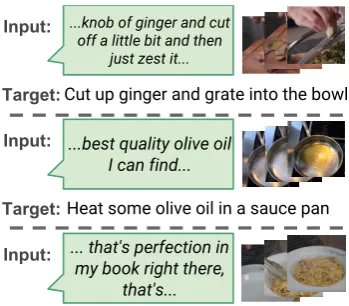
im-...knob of ginger and cut off a little bit and then
just zest it...
Cut up ginger and grate into the bowl Input:
Target:
...best quality olive oil I can find...
Heat some olive oil in a sauce pan Input:
Target:
... that's perfection in my book right there,
that's...
Put the dish on a plate and serve Input:
[image:1.595.329.504.221.374.2]Target:
Figure 1: Illustration of a multimodal dense instruc-tional video captioning task. Models are given access to both video frames and ASR tokens, and must gen-erate a recipe instruction step for each video segment. The speaker in the videosometimes (but not always) references literal objects and actions.
proves user experiences. Thus, presenting instruc-tional videos with addiinstruc-tional structured annota-tions is likely to benefit users.
These studies rely on human annotation of time-stamped subtask goals, e.g., timed captions cre-ated through crowdsourcing. However, human-in-the-loop annotation is infeasible to deploy for popular video sharing platforms like YouTube that receive hundreds of hours of uploads per minute. In this work, we address the task ofautomatically
producing captions for instructional videos at the level of video segments. Ideally, generated cap-tions provide a literal, imperative description of the procedural step occurring for a given video segment, e.g., in the cooking context we consider, “add the oil to the pan.”
instructional video domain, as fine-grained dis-tinctions may be difficult or impossible to make with visual features alone. Visual information can be ambiguous (e.g., distinguishing between “olive oil” vs. “vegetable oil”) or incomplete (e.g., preparation steps may occur off-camera). In our study, a first important finding is that, for the dataset considered, current state-of-the-art, visual-features–only models only slightly outper-form a constant prediction baseline, e.g., by 1.5 BLEU/METEOR points.
To improve performance in this difficult set-ting, we consider theautomatic speech recognition
(ASR) tokens generated by YouTube. These pub-licly available tokens are an ASR model’s attempts to map words spoken in videos into text. How-ever, while a promising potential source for sig-nal, it is not always trivial to transform even accu-rate ASR into the desired imperative target: while there are cases of clear correspondence between the literal actions in the video and the ASR tokens, in other cases, the mapping is imperfect (Fig. 1). For example, when finishing a dish, a user says “that’s perfection in my book right there” rather than “put the dish on a plate and serve.” There are also cases where no ASR tokens are available at all. Despite these potential difficulties, previ-ous work has demonstrated that ASR can be in-formative in a variety of instructional video under-standing tasks (Naim et al.,2014,2015;Malmaud et al.,2015;Sener et al.,2015;Alayrac et al.,2016;
Huang et al., 2017); though less work has fo-cused on instructional caption generation,which is known to be difficult and sensitive to input per-turbations (Chen et al.,2018).
We find that incorporating ASR-token–based features significantly improves performance over visual-features–only models (e.g., CIDEr im-proves 0.53 ⇒ 1.0, BLEU-4 improves 4.3 ⇒
8.5). We also show that combining ASR tokens and visual features results in the highest perform-ing models, suggestperform-ing that the modalities contain complementary information.
We conclude by asking: what information is captured by the visual features that is not cap-tured by the ASR tokens (and vice versa)? Auxil-iary experiments examining performance of mod-els in predicting the presence/absence of individ-ual word types suggest that visindivid-ual signals are su-perior for identifying unspoken, implicit aspects of scenes; for instance, in order to mix
ingredi-ents, they must be placed in a bowl — and al-though bowls are often visually present in the scene, “bowl” is often not explicitly mentioned by the speaker. Conversely, ASR features readily disambiguate between fine-grained entities, e.g., “olive oil” vs.“vegetable oil”, a task that is dif-ficult (and sometimes impossible) for visual fea-tures alone.
2 Related Work
Narrated instructional videos. While several
works have matched audio and video signals in an unconstrained setting (Arandjelovic and Zis-serman,2017;Tian et al.,2018), our work builds upon previous efforts to utilize accompanying speech signals to understand online instructional
videos, specifically. Several works focus on learn-ing video-instruction alignments, and match a fixed set of instructions to temporal video seg-ments (Regneri et al., 2013; Naim et al., 2015;
Malmaud et al., 2015; Hendricks et al., 2017;
Kuehne et al., 2017). Another line of previous work uses speech to extract and align language fragments, e.g., verb-noun pairs, with instructional videos (Gupta and Mooney, 2010; Motwani and Mooney,2012;Alayrac et al.,2016;Huang et al.,
2017,2018;Hahn et al.,2018).Sener et al.(2015), as part of their parsing pipeline, train a 3-gram lan-guage model on segmented ASR token inputs to produce recipe steps.
Dense Video Captioning. Recent work in
com-puter vision addresses dense video captioning ( Kr-ishna et al., 2017; Li et al., 2018; Wang et al.,
2018), a supervised task that involves (i) segment-ing the input video, and, (ii) generatsegment-ing a natural language description for each segment. Here, we focus on the second subtask of generating descrip-tions given a ground-truth segmentation; this set-ting isolates the language generation part of the modeling process.1 Most related to the present work are several dense captioning approaches that have been applied to instructional videos (Zhou et al.,2018b,c).Zhou et al.(2018c) achieve state-of-the-art performance on the dataset we consider; their model is video-only, and combines a region proposal network (Ren et al.,2015) and a Trans-former (Vaswani et al.,2017) decoder.
Multimodal Video Captioning. Several works
1We find that state-of-the-art models perform poorly even
have employed multimodal signals to caption the MSR-VTT dataset (Xu et al., 2016), which con-sists of 2K video clips from 20 general categories (e.g., “news”, “sports”) with an average duration of 10 seconds per clip. In particular,Ramanishka et al.(2016);Xu et al.(2017);Hori et al.(2017);
Shen et al.(2017);Chuang et al.(2017);Hao et al.
(2018) all report small performance gains when incorporating audio features on top of visual fea-tures. However — we suspect that instructional video domain is significantly different than MSR-VTT (where the audio information does not nec-essarily correspond to human speech), as we find that ASR-only models significantly surpass the state-of-the-art video model in our case. Palaskar et al.(2019) andShi et al.(2019), contemporane-ous with the submission of the present work, also examine ASR as a source of signal for generating how-to video captions.
3 Dataset
We focus on YouCook2 (Zhou et al., 2018b), the largest human-captioned dataset of instruc-tional videos publicly available.2 It contains
2000 YouTube cooking videos, for a total of 176 hours, and spans 89 different recipes. Each video averages at 5.26 minutes, and is annotated with an average of 7.7 temporal segments (i.e., start/end points) corresponding to semantically distinct recipe steps. Each segment is associated with an imperative caption, e.g., “add the oil to the pan”, for an average of 8.8 words per caption.
At the time of analysis (June 2018), over 25% of the YouCook2 videos had been removed from YouTube, and therefore we do not consider them. As a result, all our experiments operate on a sub-setof the YouCook2 data. While this makes direct comparison with previous and future work more difficult, our performance metrics can be viewed as lower bounds, as they are trained on less data compared to, e.g., (Zhou et al., 2018c). Unless noted otherwise, our analyses are conducted over 1.4K videos and the 10.6K annotated segments contained therein.
3.1 A Closer Look at ASR tokens
We collected the ASR tokens automatically gener-ated by YouTube (available through the YouTube
2How2 (Sanabria et al., 2018) tackles the different task
of predicting video uploader-provided descriptions/captions, which are not always appropriate summarizations.
Data API3with trackKind = ASR), which are then mapped to their temporally corresponding video segments. We start by asking the following ques-tions: How much narration do users provide for instructional videos? And: can YouTube’s ASR system detect that speech?
Not surprisingly, speakers in videos tend to be more verbose than the annotated groundtruth cap-tions: we find the length distribution of ASR to-kens per segment to be roughly log-normal, with mean/median length being 42/28 tokens respec-tively (compared to a mean of 9 tokens/segment for captions). Over the 10.6K available seg-ments, only 1.6% of them have zero associated to-kens. Furthermore, based on automatic language identification provided by the YouTube API and some manual verification, we estimated that less than 1% of videos contain completely non-English speech (but we do not discard them from our ex-periments).
We also investigate the words-per-minute (WPM) ratio, based on the video segment length. The mean value of 134 WPM is slightly lower than, but comparable to, previously reported fig-ures of English speaking rates (Yuan et al.,2006), which indicates that, for this set of video seg-ments, words are being detected at rates compa-rable to everyday English speech.
3.2 A Closer Look at the Generation Task
To better understand the generation task, we com-puted lower and upper bounds for generation per-formance using a constant-prediction baseline and human performance, respectively.
Lower bound: constant. For all segments at test
time, we predict “heat some oil in a pan and add salt and pepper to the pan and stir.” This sentence is constructed by examining the most common n-grams in the corpus and pasting them together.
Upper bound: human estimate. We conducted a
small-scale experiment to estimate human perfor-mance for the segment-level captioning task. Two of the authors of this paper, after being trained on segment-level captions from three videos, at-tempted to mirror that style of annotation for the segments of 20 randomly sampled videos, to-talling over 140 segment annotations each.4 Both human annotators report low-confidence with the
3
https://developers.google.comyoutube/v3/docs/captions
4These preliminary experiments are not meant to provide
task, in particular, they found it difficult to main-tain a consistent level of specificity in terms of how many factual details to include (e.g., “mix gether” vs. “mix the peppers and mushrooms to-gether.”)
Results: We compute corpus-level performance
statistics using four standard generation evaluation metrics: ROUGE-L (Lin, 2004), CIDEr (Vedantam et al., 2015), BLEU-4 (Papineni et al., 2002) and
METEOR(Banerjee and Lavie,2005) (higher is bet-ter in all cases).
Note that our evaluation is micro-averaged at the segment level, and differs slightly from prior work on this dataset, which has mostly reported metrics macro-averaged at the video level. We switched the evaluation because some metrics like
BLEU-4exhibit undesirable sparsity artifacts when macro-averaging, e.g., any video without a correct 4-gram gets a zero BLEU score, even if there are many 1/2/3-grams correct. Segment-level averag-ing, the standard evaluation practice in fields like machine translation, is insensitive to this sparsity concern, and (we believe) provides a more robust perspective on performance.
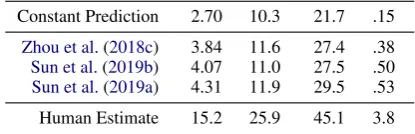
BLEU-4 METEOR ROUGE-L CIDEr
Constant Prediction 2.70 10.3 21.7 .15
Zhou et al.(2018c) 3.84 11.6 27.4 .38 Sun et al.(2019b) 4.07 11.0 27.5 .50 Sun et al.(2019a) 4.31 11.9 29.5 .53
[image:4.595.76.284.413.480.2]Human Estimate 15.2 25.9 45.1 3.8
Table 1: The performance of several state-of-the-art, video-only models, with lower (constant prediction) and upper (human estimate) bounds.
This comparison highlights the gap that remains between the simplest possible baseline, several computer vision based models, and (roughly) how well humans perform at this task. Given thatSun et al. (2019a) is a highly tuned computer vision model transfer learned from a corpus of over 300K cooking videos, from the perspective of building video captioning systems in practice, we suspect that incorporating additional modalities like ASR is more likely to result in performance gains ver-sus building better computer vision models.
4 Models
In addition to the constant prediction baseline, we explore a series of ASR-based baseline methods:
ASR as the Caption (ASC)This baseline returns
the test-time ASR token sequence as the caption. While the result is not a coherent, imperative step, performance of this method offers insight into the extent of word overlap between the ASR sequence and the target groundtruth, as measured by the captioning metrics.
Filtered ASR (FASC) Given that the ASR
to-ken sequences are much longer than groundtruth captions (§ 3.1), the performance of ASC incurs a length (or precision-based) penalty for several metrics. The FASC baseline strengthens ASC by removing word types that are less likely to appear in groundtruth captions, e.g., “ah”, “he”, “hello,” or “wish”. Specifically, we only keep words with highPP((ww||ASRGT))values, i.e., words that would be indicative of the groundtruth class if we were to build a Naive-Bayes classifier with add-one smoothing; probabilities are computed only over the training set to reduce the risk of over-fitting. This baseline produces outputs that are shorter compared to ASC, but it is unlikely to yield fluent, readable text.
ASR-based Retrieval (RET)This retrieval
base-line memorizes the recipe steps in the training set, and represents them each as tf-idf vectors. At test-time, the ASR sequence is converted into a tf-idf vector and compared to each training-set caption via cosine similarity.5 The training caption that is most similar to the test-time ASR according to this metric is returned as the “generated” caption. Note that, although a memorization-based tech-nique, this baseline method produces de-facto cap-tions as outputs.
4.1 Transformer-based Neural Models
We explore neural encoder-decoder models based on Transformer Networks (Vaswani et al.,2017). In contrast to RNNs, Transformers abandon recur-rence in favor of a mix of different types of feed-forward layers, e.g., in the case of the Transformer decoder, self-attention layers, cross-attention lay-ers (attending to the encoder outputs), and fully connected feed-forward layers. We explore two variants of the Transformer, corresponding to dif-ferent hypotheses about what information might be useful for captioning instructional videos.
ASR Transformer (AT)This model learns to map
ASR-token sequences directly to captions using
5We tried several variants of this method, e.g., comparing
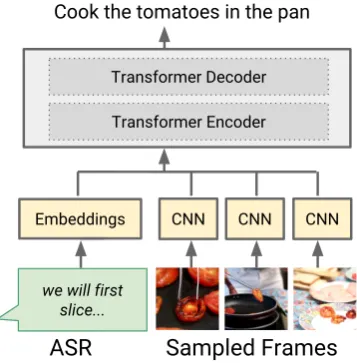
CNN Embeddings
we will first slice...
Sampled Frames ASR
Cook the tomatoes in the pan
CNN CNN
[image:5.595.92.271.62.244.2]Transformer Encoder Transformer Decoder
Figure 2: The AT+Video model. Both the encoder and decoder layers perform cross-modal attention.
a standard sequence-to-sequence Transformer ar-chitecture. The model’s parameters are optimized to maximize the probability of the ground-truth instructions, conditioned on the input ASR se-quences.
Multimodal model (AT+Video) We incorporate
video features into the ASR transformer (Fig 2). For ease of comparison with prior and future work, we use features extracted from ResNet34 (He et al.,2016) pretrained on the ImageNet clas-sification task; these features are provided in the YouCook2 data release. Each video is initially uniformly sampled at 512 frames, with an average of 30 frames per captioned-segment.
To represent each video segment, first,kframes are randomly sampled with replacement. The sampled frames are temporally sorted to pre-serve ordering information, and their correspond-ing ResNet34 feature vectors are projected to the Transformer encoder hidden dimension via a width-1 1D convolution. We use k = 10for all our experiments. The encoder self-attention layers performcross-modal attentionoperations between the visual features and the ASR-token–based fea-tures. For each output token, the decoder attends to previously predicted tokens, and encoder out-puts for all input frames / ASR tokens.
5 Experiments
We perform 10-fold cross-validation with ran-domly sampled 80/10/10 train/dev/test splits (split at the video-level), using the same splits for all models. After discarding the videos that were deleted at the time of data collection, each split
BLEU-4 METEOR ROUGE-L CIDEr
CNST 2.70 10.03 21.69 0.15 Sun et al.(2019a) 4.31 11.91 29.47 0.53
ASC 1.68 14.86 19.24 0.20 FASC 4.32 18.47 30.07 0.59 RET 5.68 14.29 28.06 0.80 AT 8.55 16.93 35.54 1.06
AT+Video 9.01 17.77 36.65 1.12
Table 2: Caption generation performance: AT+Video is a multimodal model that adds visual frame features to AT. A bolded value in a column indicates a statistically-significant improvement, whereas an underline indi-cates a statistical tie for best (p < .01).
contains roughly 1.1K training videos (averaging 8.3K training segments). We report mean perfor-mance over these splits according to four standard captioning accuracy metrics, introduced in §3.2.
ROUGE-L, CIDEr, BLEU-4, and METEOR. We per-form both Wilcoxon signed-rank tests (Demˇsar,
2006) and two-sided corrected resampled t-tests (Nadeau and Bengio,2000) to estimate statistical significance. To be conservative and reduce the chance of Type I error, we take whicheverp-value is larger between these two tests.
Transformer-based model details. For each
cross-validation split, we use a batch size of 128, tie the Transformer model’s feed forward and model dimensionsdf f n = dmodel, and
opti-mize regularized cross-entropy loss using Adam (Kingma and Ba, 2015) with lr = .001. We train models for 100K steps, storing checkpoint files periodically. For each split, we train 8 model variants, conducting a grid search over model dimension, number of encoder/decoder lay-ers, and L2 regularization: we consider all model parameter settings in (dmodel, Nlayer, λreg) ∈ {128,256} × {2,3} × {.0005, .001} for each cross-validation split independently, and select the highest performing, checkpointed model accord-ing toROUGE-Lover the development set for that fold. Transformer models are implemented us-ingtensor2tensor(Vaswani et al.,2018) and Tensorflow (Abadi et al., 2015). The vocab-ulary (average size 800) is determined separately using the training data for each cross-validation split. Words are considered if they occur at least 5 times in the ground-truth of the current training set.6 This leads to an OOV rate of ∼60% in the input. We truncate inputs at 80 tokens (∼10-15%
6Different vocabulary creation schemes, e.g., sub-word
[image:5.595.305.528.74.162.2]"so i just want to go ahead and remove all of this fat from our chicken... cut it into about one inch
pieces so you want pieces"
cut the chicken into pieces
"... color them and then shape them … tongs so as not to burn yourself it goes with total tacos
in a frying pan ...'"
"fattoush salad but you can add in cilantro and some other herbs if you prefer to do that instead of
the parsley and one"
"out of the ball now we're going to cut it and divide it"
"get the colored variety the kashmiri variety is very good one
and a half tablespoon of coriander"
"..." [No ASR Detected]
Video
prepare the tortillas and roll them using
rolling pin
add chopped parsley
to the mixture too cut the circle in half add chile powder
place the chicken on the rice
cut the chicken into pieces
place the tortilla on the pan and roll
add cilantro to the salad
cut the dough into UNK pieces
add the coriander powder coriander...
add the sauce to the pot
ASR
Target
[image:6.595.74.525.62.192.2]Pred.
Figure 3: Example generations from AT+Video in cases where it performswell,okay, andpoorly.
of transcripts are truncated in this process). For simplicity, decoding is done greedily in all cases.
Generation Experiment Results. Table2reports
the performance of each model. For unimodal models, simple baselines like FASC (filtered ASR) and RET (training-caption retrieval) outperform the state-of-the-art video-only model ofSun et al.
(2019a), according to the four automatic evalua-tion metrics. Overall, AT yields the best unimodal performance. Combining ASR and visual signals into a multimodal representation performs even better: the AT+Video model tends to outperform AT (andSun et al.(2019a)), according to ROUGE-L, CIDEr, and METEOR (p <.01). Since AT and AT+Video have identical architectures and differ only in the available inputs, this result provides strong evidence that it is indeed the multimodal-ityof AT+Video that leads to the (statistically sig-nificant) performance gains over the strongest uni-modal models. We present some output examples in Fig.3.
5.1 Diversity of Generated Captions
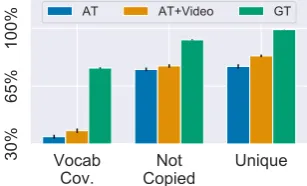
In addition to the automatic quality metrics, we measure how diverse the generated caption are for each model, using the following metrics: vocabu-lary coverage (the percent of vocabuvocabu-lary that was predicted at test-time by each algorithm at least once); proportion not copied (the percent of gener-ated captions that do not appear in the training set verbatim); and output uniqueness (the percent of generated captions that are unique). These metrics are useful because they can highlight undesirable, degenerate behavior for models.7 As an upper-bound, we compute these metrics for the ground-truth (GT) test-time targets. Note that even the
7For instance, the constant prediction baseline we
con-sider would score low in both vocab coverage and unique-ness.
ground-truth targets do not achieve 100% in these diversity metrics: for vocabulary coverage, not all vocabulary items appear in the ground-truth cap-tions for a given cross-validation split; similarly, for proportion not copied/output uniqueness, be-cause there are repeated captions in the label set.
Vocab
Cov. CopiedNot Unique
30%
65%
100%
AT AT+Video GT
Figure 4: The multimodal model AT+Video produces slightly more diverse captions than its unimodal coun-terparts.
According to all metrics, AT+Video outputs are slightly more diverse compared to the AT outputs (Fig.4). This observation suggests that the multi-modal model is not simply exploiting a degeneracy to achieve its performance improvements.
6 Complementarity of Video and ASR
We now turn to the question ofwhy multimodal models produce better captions: what type of sig-nal does video contain that speech does not (and vice versa)? Our initial idea was to quantita-tively compare the captions generated by AT ver-sus AT+Video; however, because the dataset is rel-atively small, we were unable to make observa-tions about the generated capobserva-tions that were statis-tically significant.8
8In general, making concrete statements about the causal
[image:6.595.338.492.331.424.2].50
.75
1.0
ASR Token AUC
t, w
.50
.75
1.0
Vi
de
o A
UC
v,
w
kneadnori 97.897.1 yeast 96.1 mozzarella 95.8 lettuce 95.3 pancake 94.7 wrapper 94.3 patty 93.4 dal 93.0 grill 92.9 pizza 92.9 oven 92.7 bake 92.3(a)Easiest
(AUCµ,w)
4 43.8 bit 51.7 about 52.1 prepare 52.3 mixed 54.5 then 54.5 spoon 54.9 or 55.9 it 56.2 ready 56.7 3 57.1 few 58.3 more 58.5
(b)Hardest (AUCµ,w)
fat 39.7 turn 36.4 sea 35.9 white 31.7 chilies 30.8 dried 30.6 beer 30.3 pancetta 30.0 mustard 29.8 spice 28.4 sliced 28.3 cinnamon 28.0 warm 27.8
(c)ASR Better (AUC∆,w)
sandwich -18.0 stove -15.4 tuna -14.3 again -12.6 mince -11.2 wok -8.9 burger -8.8 pizza -8.4 serve -7.8 4 -6.6 mussels -6.6 tray -6.3 bowl -5.9
[image:7.595.80.503.61.186.2](d)Video Better (AUC∆,w)
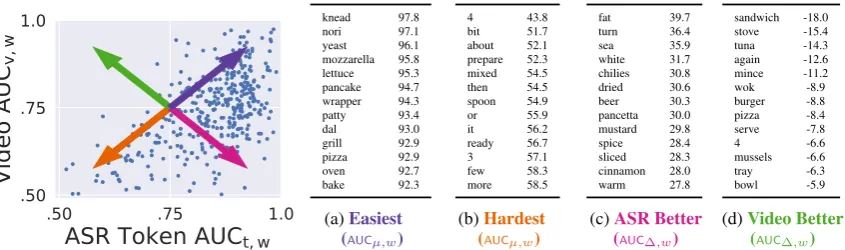
Figure 5: Per-word classification results using ASR and/or Video features. Each point in the scatterplot represents a different word-type; x-coordinate values show how well a word is predicted by ASR-token features; y-coordinate values show how well a word is predicted by video features. Tables (a)-(d) show word types that are easy, univer-sally difficult, better-predicted-by-ASR, and better-predicted-by-video, respectively.
Instead, we examine properties of the ASR-token–based and visual features directly. Follow-ing a procedure inspired from (Lu et al., 2008;
Berg et al.,2012;Dai et al.,2018;Mahajan et al.,
2018), we consider the auxiliary task of predicting presence/absence of unigrams in the ground truth captions from features extracted from correspond-ing segments. We train two unimodal classifiers, one using ASR-token–based features and one us-ing visual features, and measure their relative ca-pacity to predict different word types; the goal is to measure which word types are most-predictable from the ASR tokens and, conversely, which ones are most-predictable from the visual features.
For each segment, we predict the unigram dis-tribution of its corresponding caption using a uni-modal softmax classifier: for simplicity, we use a 2-layer, residual deep averaging network (Iyyer et al., 2015) for both the visual and ASR-based classifier. We measure per-word-type performance usingAUC, which is word-frequency independent.
Specifically — for each word type w (e.g., w = beer) we measure how well w is pre-dicted by the classifier based on ASR / spoken to-kensAUCt,w (e.g.,AUCt,beer = 98) and, conversely, how well w is predicted by the visual classifier AUCv,w(AUCv,beer= 68). For a given word type, we
measure its overall difficulty by averagingAUCt,w
andAUCv,w; we call thisAUCµ,w (AUCµ,beer = 83). Similarly, we measure the difference in difficulty by subtracting AUCt,w andAUCv,w to give AUC∆,w (AUC∆,beer= 30) with higher values indicating that
a word type is predicted better by the spoken-token features compared to the visual features. We plot AUCt,w versusAUCv,w for 382 words in Fig.5 (re-sults are averaged over 10 cross-val splits).
Absolute Performance. Points in the upper-right
quadrant of Fig. 5 represent words that are easy for both visual and ASR-token–based features to predict, whereas points in the lower-left represent words that are more difficult. Specific ingredients, e.g., “nori” and “mozzarella,” are often easy to de-tect, as are actions closely associated with partic-ular objects (e.g., “dough” is almost always the object being “knead”-ed). Conversely, pronouns (e.g., “it”) and conjunctions (e.g., “or”) are uni-versally difficult to predict.
Visual vs. ASR-token–based features. In
gen-eral, ASR-token–based features carry greater pre-dictive power, as evidenced by the skew towards the bottom right in the scatterplot in Fig.5. One pattern in the cases where speech features perform better (Fig. 5c) is that words are often modifiers, e.g., white (pepper), sea (salt), dried (chilies),
olive (oil), etc. Indeed, small, detailed distinc-tions may be often difficult to make from visual features, e.g., “vegetable oil” and “olive oil” may look identical in most YouTube videos.
Nonetheless, there are types better predicted by video features (Fig. 5d). Often, these are cases that require unstated, background knowledge, i.e., references to objects not explicitly stated by the speaker(s). To quantify this observation, for each word type we compute the likelihood that it is
stated by the speaker in the video, given that it appears in the ground-truth caption, i.e., P(w ∈
ρ ≈ 0), stated rate is correlated with AUC∆,w (ρ= 0.44,p < .01).
7 Oracle Object Detection
The results in Table2 indicate that, while adding visual information yields statistically significant improvements to the ASR-only model, the im-provements are not large in magnitude. This leaves open the question of whether (a) any vi-sual information simply does not provide much additional information on top of ASR, or (b) we need better visual modeling. We take a first step in addressing this question by experimenting with an “oracle” object detector that provides perfect-precision predictions.9 If even oracle object detec-tion does not help, then the answer is more likely (a) rather than (b) above.
As part of a YouCook2 data release, bounding box annotations for selected objects in the recipe text (Zhou et al., 2018a) were provided. Unfor-tunately, while these could have served as an ora-cle, the actual annotations are only available for a small fraction of the data. Instead, we consider the set of 62 object labels made available. We sim-ulate a high-precision, oracle object detector by identifying – per video segment – the overlap be-tween (morphology-normalized) groundtruth cap-tion mencap-tions and the 62 object labels available.10 For instance, for the groundtruth caption “put the mushrooms in the pan”, the oracle object detec-tor yields “mushroom” and “pan”. 89% of seg-ments receive at least one oracle object. The or-acle object detections are then fed into the Trans-former encoder (in random order), either by them-selves (Oracle) or along with the ASR token se-quence (AT+Oracle). We perform the same cross-validation experiments as described in §5, and report the average ROUGE-L (we observe similar trends with other metrics):
AT AT+Video Oracle AT+Oracle
ROUGE-L 35.5 36.7 40.8 45.5
Because the AT+Oracle model achieves large improvements over AT+Video, we suspect that building higher-quality visual representations is a promising avenue for future work.
9High-precision object detectors are gaining popularity in
the computer vision community because the training data is easier to annotate, e.g.,Krasin et al.(2017).
10This oracle is unlikely to be achievable, as it assumes
100% precision for the 62 objects considered (which also im-plies modelingwhichobjects to talk about, a non-trivial task in itself (Berg et al.,2012)).
10%
50%
90%
% of Vocab Avail.
30
35
40
45
[image:8.595.351.481.65.192.2]ROUGE-L
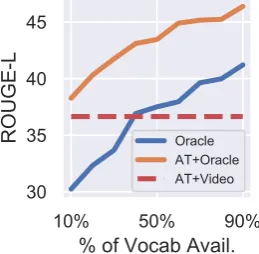
Oracle AT+Oracle AT+VideoFigure 6: The performance of the oracle methods in-creases as they are given access to an increasing num-ber of object types.
How weak of an oracle can still produce high performance? Fig.6shows performances of mod-els usingsubsetsof the 62 objects (most frequent 10% of objects through 90%) over one cross-validation fold. AT+Oracle gives better perfor-mance than AT+Video by detecting just 6 object types,and the oracle by-itself (which is only given access to object sets) achieves comparable perfor-mance to AT+Video with 30 object types. These results suggest that, at least for this task, the Trans-former decoder is likely not the main performance bottleneck, as it is able to paste-together unordered object detections into captions effectively.
8 Conclusion
In this work, we demonstrate the impact of incor-porating both visual and ASR-token–based fea-tures into instructional video captioning models. Additional experiments investigate the comple-mentarity of the visual and speech signals.
Acknowledgements. We would like to thank Maria Antoniak, Nan Ding, Sebastian Goodman, Jean Griffin, Fernando Pereira, Chen Sun, and the anonymous reviewers for their helpful comments.
References
Mart´ın Abadi, Ashish Agarwal, Paul Barham, Eugene Brevdo, Zhifeng Chen, Craig Citro, Greg S. Cor-rado, Andy Davis, Jeffrey Dean, Matthieu Devin, Sanjay Ghemawat, Ian Goodfellow, Andrew Harp, Geoffrey Irving, Michael Isard, Yangqing Jia, Rafal Jozefowicz, Lukasz Kaiser, Manjunath Kudlur, Josh Levenberg, Dandelion Man´e, Rajat Monga, Sherry Moore, Derek Murray, Chris Olah, Mike Schus-ter, Jonathon Shlens, Benoit Steiner, Ilya Sutskever, Kunal Talwar, Paul Tucker, Vincent Vanhoucke, Vijay Vasudevan, Fernanda Vi´egas, Oriol Vinyals, Pete Warden, Martin Wattenberg, Martin Wicke, Yuan Yu, and Xiaoqiang Zheng. 2015. TensorFlow: Large-scale machine learning on heterogeneous sys-tems. Software available from tensorflow.org.
Jean-Baptiste Alayrac, Piotr Bojanowski, Nishant Agrawal, Josef Sivic, Ivan Laptev, and Simon Lacoste-Julien. 2016. Unsupervised learning from narrated instruction videos. InCVPR.
David Alvarez-Melis and Tommi S Jaakkola. 2017. A causal framework for explaining the predictions of black-box sequence-to-sequence models. In
EMNLP.
Relja Arandjelovic and Andrew Zisserman. 2017. Look, listen and learn. InICCV.
Satanjeev Banerjee and Alon Lavie. 2005. Meteor: An automatic metric for mt evaluation with improved correlation with human judgments. In ACL work-shop on Evaluation Measures for MT and Summa-rization.
Alexander C Berg, Tamara L Berg, Hal Daum´e III, Jesse Dodge, Amit Goyal, Xufeng Han, Alyssa Mensch, Margaret Mitchell, Aneesh Sood, Karl Stratos, et al. 2012. Understanding and predicting importance in images. InCVPR.
Hongge Chen, Huan Zhang, Pin-Yu Chen, Jinfeng Yi, and Cho-Jui Hsieh. 2018. Attacking visual language grounding with adversarial examples: A case study on neural image captioning. InACL.
Shun-Po Chuang, Chia-Hung Wan, Pang-Chi Huang, Chi-Yu Yang, and Hung-Yi Lee. 2017. Seeing and hearing too: Audio representation for video caption-ing. In IEEE Automatic Speech Recognition and Understanding Workshop.
Bo Dai, Sanja Fidler, and Dahua Lin. 2018. A neu-ral compositional paradigm for image captioning. In
NeurIPS.
Janez Demˇsar. 2006. Statistical comparisons of classi-fiers over multiple data sets.JMLR.
Sonal Gupta and Raymond J Mooney. 2010. Us-ing closed captions as supervision for video activity recognition. InAAAI.
Meera Hahn, Nataniel Ruiz, Jean-Baptiste Alayrac, Ivan Laptev, and James M Rehg. 2018. Learning to localize and align fine-grained actions to sparse instructions. arXiv preprint arXiv:1809.08381.
Wangli Hao, Zhaoxiang Zhang, and He Guan. 2018. Integrating both visual and audio cues for enhanced video caption. InAAAI.
Kaiming He, Xiangyu Zhang, Shaoqing Ren, and Jian Sun. 2016. Deep residual learning for image recog-nition. InCVPR.
Lisa Anne Hendricks, Oliver Wang, Eli Shechtman, Josef Sivic, Trevor Darrell, and Bryan Russell. 2017. Localizing moments in video with natural language. InICCV.
Chiori Hori, Takaaki Hori, Teng-Yok Lee, Ziming Zhang, Bret Harsham, John R Hershey, Tim K Marks, and Kazuhiko Sumi. 2017. Attention-based multimodal fusion for video description. InICCV.
De-An Huang, Shyamal Buch, Lucio Dery, Animesh Garg, Li Fei-Fei, and Juan Carlos Niebles. 2018. Finding it: Weakly-supervised reference-aware vi-sual grounding in instructional videos. InCVPR.
De-An Huang, Joseph J Lim, Li Fei-Fei, and Juan Car-los Niebles. 2017. Unsupervised visual-linguistic reference resolution in instructional videos. In
CVPR.
Mohit Iyyer, Varun Manjunatha, Jordan Boyd-Graber, and Hal Daum´e III. 2015. Deep unordered compo-sition rivals syntactic methods for text classification. InACL.
Juho Kim, Phu Tran Nguyen, Sarah Weir, Philip J Guo, Robert C Miller, and Krzysztof Z Gajos. 2014. Crowdsourcing step-by-step information extraction to enhance existing how-to videos. InCHI.
Diederik P Kingma and Jimmy Ba. 2015. Adam: A method for stochastic optimization. InICLR.
Ivan Krasin, Tom Duerig, Neil Alldrin, Vittorio Fer-rari, Sami Abu-El-Haija, Alina Kuznetsova, Hassan Rom, Jasper Uijlings, Stefan Popov, Shahab Kamali, Matteo Malloci, Jordi Pont-Tuset, Andreas Veit, Serge Belongie, Victor Gomes, Abhinav Gupta, Chen Sun, Gal Chechik, David Cai, Zheyun Feng, Dhyanesh Narayanan, and Kevin Murphy. 2017. Openimages: A public dataset for large-scale multi-label and multi-class image classification.
Hilde Kuehne, Alexander Richard, and Juergen Gall. 2017. Weakly supervised learning of actions from transcripts. Computer Vision and Image Under-standing.
Yehao Li, Ting Yao, Yingwei Pan, Hongyang Chao, and Tao Mei. 2018. Jointly localizing and describ-ing events for dense video captiondescrib-ing. InCVPR.
Chin-Yew Lin. 2004. Rouge: A package for auto-matic evaluation of summaries. Text Summarization Branches Out.
Yijuan Lu, Lei Zhang, Qi Tian, and Wei-Ying Ma. 2008. What are the high-level concepts with small semantic gaps? InCVPR.
Dhruv Mahajan, Ross Girshick, Vignesh Ramanathan, Kaiming He, Manohar Paluri, Yixuan Li, Ashwin Bharambe, and Laurens van der Maaten. 2018. Ex-ploring the limits of supervised pretraining. In
ECCV.
Jonathan Malmaud, Jonathan Huang, Vivek Rathod, Nick Johnston, Andrew Rabinovich, and Kevin Murphy. 2015. What’s cookin’? interpreting cook-ing videos uscook-ing text, speech and vision. InNAACL.
Lauren E Margulieux, Mark Guzdial, and Richard Catrambone. 2012. Subgoal-labeled instructional material improves performance and transfer in learn-ing to develop mobile applications. InConference on International Computing Education Research.
Antoine Miech, Dimitri Zhukov, Jean-Baptiste Alayrac, Makarand Tapaswi, Ivan Laptev, and Josef Sivic. 2019. HowTo100M: Learning a Text-Video Embedding by Watching Hundred Million Narrated Video Clips. InICCV.
Tanvi S Motwani and Raymond J Mooney. 2012. Improving video activity recognition using object recognition and text mining. InECAI.
Claude Nadeau and Yoshua Bengio. 2000. Inference for the generalization error. InNeurIPS.
Iftekhar Naim, Young C Song, Qiguang Liu, Liang Huang, Henry Kautz, Jiebo Luo, and Daniel Gildea. 2015. Discriminative unsupervised alignment of natural language instructions with corresponding video segments. InNAACL.
Iftekhar Naim, Young Chol Song, Qiguang Liu, Henry A Kautz, Jiebo Luo, and Daniel Gildea. 2014. Unsupervised alignment of natural language instruc-tions with video segments. InAAAI.
Celie O’Neil-Hart. 2018. Why you should lean into how-to content in 2018. www.thinkwithgoogle.com/ advertising-channels/video/
self-directed-learning-youtube/.
Accessed: 2019-09-03.
Shruti Palaskar, Jindrich Libovick`y, Spandana Gella, and Florian Metze. 2019. Multimodal abstractive summarization for how2 videos. InACL.
Kishore Papineni, Salim Roukos, Todd Ward, and Wei-Jing Zhu. 2002. Bleu: a method for automatic eval-uation of machine translation. InACL.
Vasili Ramanishka, Abir Das, Dong Huk Park, Sub-hashini Venugopalan, Lisa Anne Hendricks, Mar-cus Rohrbach, and Kate Saenko. 2016. Multimodal video description. InACM MM.
Michaela Regneri, Marcus Rohrbach, Dominikus Wet-zel, Stefan Thater, Bernt Schiele, and Manfred Pinkal. 2013. Grounding action descriptions in videos.TACL.
Shaoqing Ren, Kaiming He, Ross Girshick, and Jian Sun. 2015. Faster R-CNN: Towards real-time ob-ject detection with region proposal networks. In
NeurIPS.
Ramon Sanabria, Ozan Caglayan, Shruti Palaskar, Desmond Elliott, Lo¨ıc Barrault, Lucia Specia, and Florian Metze. 2018. How2: a large-scale dataset for multimodal language understanding. In Pro-ceedings of the Workshop on Visually Grounded In-teraction and Language (ViGIL). NeurIPS.
Ozan Sener, Amir R Zamir, Silvio Savarese, and Ashutosh Saxena. 2015. Unsupervised semantic parsing of video collections. InICCV.
Zhiqiang Shen, Jianguo Li, Zhou Su, Minjun Li, Yurong Chen, Yu-Gang Jiang, and Xiangyang Xue. 2017. Weakly supervised dense video captioning. InCVPR.
Botian Shi, Lei Ji, Yaobo Liang, Nan Duan, Peng Chen, Zhendong Niu, and Ming Zhou. 2019. Dense proce-dure captioning in narrated instructional videos. In
ACL.
Chen Sun, Fabien Baradel, Kevin Murphy, and Cordelia Schmid. 2019a. Contrastive bidirectional transformer for temporal representation learning.
arXiv preprint arXiv:1906.05743.
Chen Sun, Austin Myers, Carl Vondrick, Kevin Mur-phy, and Cordelia Schmid. 2019b. Videobert: A joint model for video and language representation learning. InICCV.
Yapeng Tian, Jing Shi, Bochen Li, Zhiyao Duan, and Chenliang Xu. 2018. Audio-visual event localiza-tion in unconstrained videos. InECCV.
Ashish Vaswani, Noam Shazeer, Niki Parmar, Jakob Uszkoreit, Llion Jones, Aidan N Gomez, Łukasz Kaiser, and Illia Polosukhin. 2017. Attention is all you need. InNeurIPS.
Ramakrishna Vedantam, C Lawrence Zitnick, and Devi Parikh. 2015. Cider: Consensus-based image de-scription evaluation. InCVPR.
Jingwen Wang, Wenhao Jiang, Lin Ma, Wei Liu, and Yong Xu. 2018. Bidirectional attentive fusion with context gating for dense video captioning. InCVPR.
Sarah Weir, Juho Kim, Krzysztof Z Gajos, and Robert C Miller. 2015. Learnersourcing subgoal la-bels for how-to videos. InCSCW.
Jun Xu, Tao Mei, Ting Yao, and Yong Rui. 2016. MSR-VTT: A large video description dataset for bridging video and language. InCVPR.
Jun Xu, Ting Yao, Yongdong Zhang, and Tao Mei. 2017. Learning multimodal attention lstm networks for video captioning. InACM MM.
Jiahong Yuan, Mark Liberman, and Christopher Cieri. 2006. Towards an integrated understanding of speaking rate in conversation. InInternational Con-ference on Spoken Language Processing.
Luowei Zhou, Nathan Louis, and Jason J Corso. 2018a. Weakly-supervised video object grounding from text by loss weighting and object interaction. InBMVC.
Luowei Zhou, Chenliang Xu, and Jason J Corso. 2018b. Towards automatic learning of procedures from web instructional videos. InAAAI.
Luowei Zhou, Yingbo Zhou, Jason J Corso, Richard Socher, and Caiming Xiong. 2018c. End-to-end dense video captioning with masked transformer. In