Proceedings of the 23rd Conference on Computational Natural Language Learning, pages 778–788 778
TILM: a Neural Language Model with Evolving Topical Influence
Shubhra Kanti Karmaker Santu and Kalyan Veeramachaneni
MIT LIDS
Cambridge, Massachusetts, USA [email protected] [email protected]
ChengXiang Zhai
Department of Computer Science University of Illinois Urbana Champaign
Urbana, Illinois, USA [email protected]
Abstract
Content of text data are often influenced by contextual factors which often evolve over time (e.g., content of social media are often in-fluenced by topics covered in the major news streams). Existing language models do not consider the influence of such related evolv-ing topics, and thus are not optimal. In this paper, we propose to incorporate such topical-influence into a language model to both im-prove its accuracy and enable cross-stream analysis of topical influences. Specifically, we propose a novel language model called Topical Influence Language Model (TILM), which is a novel extension of a neural language model to capture the influences on the contents in one text stream by the evolving topics in another related (or possibly same) text stream. Experi-mental results on six different text stream data comprised of conference paper titles show that the incorporation of evolving topical influence into a language model is beneficial and TILM outperforms multiple baselines in a challeng-ing task of text forecastchalleng-ing. In addition to serv-ing as a language model, TILM further enables interesting analysis of topical influence among multiple text streams.
1 Introduction and Motivation
Language modeling plays a central role in many Natural Language Processing (NLP) tasks and ap-plications. Neural language models have attracted much attention recently due to their superior per-formance (Dieng et al., 2016;Kiros et al., 2014;
Kiddon et al., 2016;Ranzato et al., 2015;Devlin et al.,2018;Peters et al.,2018). One common lim-itation of the existing neural language models is that they cannot model the potential influence of related contextual factors on text content genera-tion. However, as text data are produced by hu-mans based on their observations of the real world, the content of text data are generally influenced by many contextual factors, and thus, it is necessary
to model the influence of those contextual factors on the generation of text content in order to opti-mize language modeling. For example, the content of social media may be influenced by the popular topics in news stream; another example is that the content of research papers in one research commu-nity such asInformation Retrievalare often influ-enced by the topics of research papers published in the same community in the past or research papers published in another related research community such asMachine Learningsince the general algo-rithms developed in the latter may be applied to solve application problems in the former.
In this paper, we propose to incorporate such topical influence into a language model to both im-prove its accuracy and enable cross-stream anal-ysis of topical influences. Specifically, we pro-pose a novel language model called Topical Influ-ence Language Model (TILM), which is a novel extension of a neural language model to capture the influence on the contents in one text stream by the evolving topics in another related (or pos-sibly same) text stream. In other words, TILM is a recurrent neural network-based deep learning architecture that incorporates topical influence to model the generation of a dynamically evolving text stream. Since most text data have time stamps associated with them, which generally indicate the time when a text document was produced, text data can often be regarded as a sequence / stream of text objects ordered by their time stamps. TILM is designed to model the generation of such a text stream, i.e., the generation of text data conditioned on a given time stamp. We also assume that the distributions of words in the text data from two dif-ferent timestamps are somewhat difdif-ferent, which allows us to capture the evolution of topics in the stream data.
The second component is the Topic Generator
which captures the trend of different topics of in-terest within theinfluencing text stream, which can be based on any topic models, e.g., LDA. Finally, the third component is a novel Influence Gener-ator, which ensures that TILM can capture topi-cal influence corresponding to the input timestamp and incorporate it into the generation process to ensure that the generated text is consistent with that particular timestamp from the perspective of topical influence. TILM combines these three es-sential components into a single unified model and learns all their optimal parameter values from a training text stream corpus with time stamps.
We conducted comprehensive experiments with six different sets of publication stream datasets to evaluate the effectiveness of TILM. These datasets contain titles of the papers published in differ-ent machine learning theory and applied machine learning conferences over 20 years, which were collected from the Open Academic Graph. Ex-perimental results show that the incorporation of topical influence into a language model is benefi-cial and TILM outperforms multiple baselines by a clear margin in a challenging task of text fore-casting. We found that effectively capturing the evolving topical influence is the key to improv-ing the accuracy of language modelimprov-ing. In addi-tion to serving as a language model, TILM fur-ther enables interesting analysis of topical influ-ence among multiple text streams.
2 Related Works
There has been a surge of research interest in the use of neural network (NN) architectures for lan-guage modeling and automatic text generation in recent years (Dieng et al.,2016;Kiros et al.,2014;
Kiddon et al., 2016;Ranzato et al., 2015). The first NN-based text generator was proposed by Kukich (Kukich,1987), although generation was done only at the phrase level. Recent advances in recurrent neural network-based language models (RNN-LM) have demonstrated the value of dis-tributed representations and its power to model ar-bitrarily long dependencies (Mikolov et al.,2010,
2011). Sutskever et al. (Sutskever et al., 2011) introduced a simple variant of the RNN that can generate meaningful sentences by learning from a character-level corpus. Mao et.al. have demon-strated how Recurrent Neural Networks, specially, Long-Short-Term-Memory (LSTM) is effective in
solving various text generation tasks (Mao et al.,
2014). TopicRNN proposed by Dieng (Dieng et al., 2016) integrated the merits of RNNs and latent topic models to capture long-range seman-tic dependency. Recently, Generative Adversar-ial Nets (GANs) that use a discriminative model to guide the training of the generative model has shown promising results in automated text gen-eration (Rajeswar et al., 2017; Lin et al., 2017;
Che et al., 2017;Zhang et al., 2017). All these text generation techniques have also been vastly studied for generating summary for text corpora [see (Gambhir and Gupta,2017) for a comprehen-sive survey]. Most recently, BERT (Devlin et al.,
2018) and ELMo (Peters et al.,2018) have shown very promising performance. However, none of these existing methods can model topical influ-ences from related contextual factors on genera-tion of text data. While external topical influences have been studied in the context of search behav-ior modeling (Karmaker Santu et al.,2017,2018), similar study has not been pursued yet for text eration modeling. Specifically, current text gen-eration processes are static processes with no no-tion of time and thus, can not model dynamically evolving text stream data corresponding to evolv-ing influences of related text streams, which the proposed TILM can do.
3 Topical Influence Language Model
We first briefly discuss some preliminaries and no-tations. Next, we present the three major com-ponents that are the building blocks of the pro-posed Topical Influence Language Model (TILM) and then present how TILM combines them into a single unified model.
3.1 Preliminaries and Notations
The goal task involves performing language mod-eling on each text stream within a set of text streams, S = {s1, s2, ..., sm}, where, |S|= m. Each text stream consists of a set of tuples in the form of (document, timestamp) , e.g., s1 =
day or seconds. Each bin is then assigned a discrete timestamp T and all the documents in that bin share the same timestamp, e.g., all pa-per published in different machine learning con-ferences during year 2016 are assigned the times-tampT2016 = [J an2016, Dec2016].
3.2 Sequence Generator
Sequence Generator is the basic component of TILM which generates the next word xi in the sentence given i−1 previous words. Thus, Se-quence Generatoris essentially a language model which generates a probability distribution over a sequence of words that can be used to predict the next word in the sequence. Any sequence model-ing framework, e.g., Hidden Markov Models, Re-current Neural Networks etc. can work as a se-quence generator. For the experiments described in this paper, we chose recurrent neural network with LSTM cells as theSequence Generator due to its recent promising results obtained for lan-guage modeling tasks (Kiros et al., 2014; Kim et al., 2016). Given the previous i words, i.e., x1:i, the recurrent neural network based language models compute the conditional probability for the next wordyi =vforv∈V, the vocabulary set, by computing a hidden statehiand passing it through a Softmax function:
P(yi =v|x1:i)≡P(yi=v|hi) (1)
P(yi|hi)∝exp(WΩhi+BΩ) (2)
hi = Ω(hi−1, xi) (3)
Here, Ω can be a standard RNN cell or more complicated cell like LSTM, GRU etc andW and Bare linear transformation coefficients. Output at step i, i.e., yi is fed as input for stepi+ 1, thus, xi+1=yi.
3.3 Topic Generator
The next component of TILM is the Topic Gen-erator. The primary purpose of this component is to analyze different topics across a related text stream data (let us call its) and compute the evolu-tion of topic distribuevolu-tions within that stream over time. It takes all past text stream data of sas put and applies a probabilistic topic model to in-fer n (a user defined parameter) different topics, each represented with a unique distribution over the entire vocabulary. Again, many different topic models can be potentially used, but in our exper-iments, we chose LDA (Blei et al., 2003) as the
Topic Generator since it has been the most pop-ular topic modeling technique in the last decade. Oncentopics are identified, theTopic Generator
takes all text content from each discrete timestamp T(defined in section3.1) separately and computes the distribution ofn topics over each timestamp, which we denote byθT.
The Topic Generator also provides a sub-component, i.e.,History Extractor, which, given a particular timestampTas input, retrieves the topic distributions of previousr(a user defined param-eter) timestamps computed by LDA. We mathe-matically denote the output of History Extractor
by θT−r:T−1, where, θi:j denotes topic distribu-tions from timestampitojaugmented into a sin-gle vector. This means the cardinality of vector θT−r:T−1 is r×n. In the case of modeling in-fluence from multiple related text streams and as-suming we havem such streams, we can simply concatenateθT−r:T−1 from each stream to create a single vector of dimensionr×n×m.
3.4 Influence Generator
The Influence Generator is a pivotal component of TILM, which models the evolving topical in-fluence during the text generation process. Given a particular timestampT, we represent topical in-fluence by a real valued vector (γT) of dimension K (another user defined parameter), which is es-sentially the output of Influence Generator. The input to theInfluence Generatoris ther×n dimen-sional vector of topic distributions from previousr timestamps of a related text stream, i.e.,θT−r:T−1 (assumingT as the current timestamp). Thus, In-fluence Generatoressentially maps ar×n dimen-sional topic vector to a K dimensional influence vector. Although any function that can perform this mapping can resemble as Influence Generator, we chose a feed-forward neural network for TILM due to its capability of approximating a wide fam-ily of functions. Without loss of generality, we used ReLU activation units in the hidden layers. Once the influence vector (γT) is computed, it is then injected as a bias into theSequence Genera-torwhen generating the next word (xi) in the se-quence (More details in section3.5).
Here, we assume that the influence vector γT
over night, rather their topical shift happens quite gradually. Take for example some particular re-search community like SIGKDD. The topic distri-bution in papers published in a particular year is unlikely dramatically different from the previous two years, rather they are somewhat correlated.
Mathematically, let θT denote the topic distri-bution for the generated text at timestampT, then the function of Influence Generator is expressed as follows (kmeans the concatenation operation):
θT−r:T−1 =θT−rkθT−r+1k....kθT−1 (4)
γT = Γ(θT−r:T−1) =W2Γ·
ReLU(W1Γ·θT−r:T−1+B1Γ)
+B2Γ (5) 3.5 TILM as a Unified Model
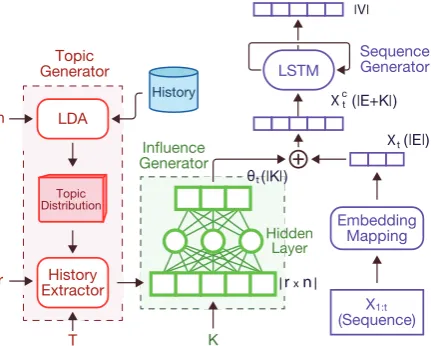
Now that we have presented the three building blocks of TILM, this section presents how these different components interact with each other and work as a unified architecture to model stream text data by capturing the fluctuations of topical in-fluence over time. The process can be thought of as generating text corresponding to a particular timestampT. Thus, the whole process starts with a timestamp T as input and the start-of-sentence marker (let’s call it #) as the sequence generated so far. The next task is to generate one word at a time iteratively until the end-of-sentence marker is generated (let’s call it *). The exact process of generating the next wordyi in the sequence is demonstrated in Figure1.
History
Topic Distribution
n
K T
Topic Generator
Sequence Generator
V
Hidden Layer LDA
LSTM
History Extractor
X (Sequence)1:t Embedding Mapping
Influence Generator
Xct
r x n
( E+K )
Xt( E )
t( K )
θ
[image:4.595.75.291.495.668.2]r
Figure 1: TILM architecture: Topic Generator (Red), Influence Generator (Green) and Sequence Generator (Purple)
The first step of generation process is to infer n different topics from a related (possibly same) historical text stream and compute the topic distri-butions for each unique timestamp observed in the
training data. Next, given a particular timestamp T as input, theHistory ExtractorModule extracts the historical topic distributions corresponding to previous r timestamps and concatenates them to generate a vector representation of the history, i.e., θT−r:T−1 of dimension r ×n (see the previous subsection for details). θT−r:T−1 is then passed throughInfluence GeneratorΓwhich outputs the K dimensional influence vectorγT. For a
partic-ular timestampT,γT is fixed and can be re-used for any text generation task tied to the timestamp T. The bottom middle section (Green Color) of Figure 1 shows the feed-forward neural network ofInfluence Generator.
The next trick in TILM is to concatenate the influence vector (γT) with the vector representa-tion of each word in the sequence generated so far. This means, for each word in{x1, x2, ..., xi}, γT is concatenated to each of their vector repre-sentations to create an augmented representation {xC1, xC2, ..., xCi }, i.e., while generating the next word xi+1 = yi in the sequence, all the previ-ous words in the sequence share the same topi-cal influence represented by vectorγT. This
aug-mented representation essentially allows TILM to capture the dynamic nature of text stream data as the influence vector injects evolving topical influ-ence into the generation process. Finally, the aug-mented representations {xC1, xC2, ..., xCi } are fed into the recurrent neural network model to com-pute a hidden statehi . The final output vectorY is computed by applying a linear transformation onhi. Note that, vectorY is a real-valued vector. We apply a Softmax function on Y to convert it into a valid probability distribution, sampling from which, the next word in the sequence is generated. The mathematical formulas behind the entire gen-eration process is summarized below:
Y =WΩ·hi+BΩ, (6)
hi= Ω(hi−1, xCi ), (7)
xCi =xikγT. (8)
Thus,Y can be written as follows:
Y =WΩ·Ω(hi−1, xikγT) +B
Ω. (9)
Here,γT is obtained as follows:
γT =W
Γ 2 ·
h
ReLU(W1Γ·θT−r:T−1+B1Γ) i
+B2Γ. (10)
Finally, we apply a Softmax function on the out-put vectorY to convert it into a valid probability distributionP(yi|hi), as follows:
P(yi=v|hi) =
exp(Yi) P|V|
j=1exp(Yj)
. (11)
The next wordyi =xi+1in the sequence is gen-erated by sampling from this conditional distribu-tion. TILM repeats this whole process multiple times to generate new words in the sentence until a end-of-sentence marker is generated. The whole process is summarized in Algorithm1, which de-scribes the generation of a single sentence by TILM for a particular timestampT.
Algorithm 1: Topical Influence Language Model (TILM)
1 Process TILM(T,Θ,Γ,Ω, r, n, K, E); Input :T: discrete timestamp
Θ: Topic Generator (n: number of topics) Γ: Influence Generator (K: cardinality of influence vector)
Ω: Sequence Generator (E: cardinality of word vector)
r: History Window
Output:Generated sentenceXcorresponding toT
2 x← {start of sentence marker}
3 θT−r:T−1←Θ(θT−r)kΘ(θT−r+1)k...kΘ(θT−1),
Topic History
4 γT ←Γ(θT−r:T−1), Generate Influence Vector for
timestampT
5 i←1 6 repeat
7 forj←1toido
8 xCj ←xjkγT, where,kis concatenation
operation
9 end
10 computehi←Ω(xC1:i)by applyingΩrecursively
11 Draw wordyi∼P(yi|hi), where
P(yi|hi)∝exp(WΩhi+BΩ)
12 x←x∪ {yi}
13 i←i+ 1
14 untilend of sentence marker is generated;
15 returnx
3.6 Estimation of TILM parameters
In this section, we present the estimation tech-niques for the optimal values of TILM model pa-rameters. Close observation of Equation6-10 re-veals that TILM contains the following set of pa-rameters:
W =WΩ, BΩ, W1Γ, B1Γ, W2Γ, BΓ2 (12)
We find the optimal values for the parameter set
W by maximizing the log-likelihood of the train-ing text stream data. The optimization problem thus can be written as follows:
W∗ =argmax W
logL(x1x2...xn|W) (13)
As maximizing the log-likelihood is the same as minimizing the negative of the log-likelihood function and as we know the exact word which comes next in the sequence during the training process, our optimization problem boils down to minimizing the softmax cross entropy with logits between the conditional distributionP(yi|hi)and the one-hot encoding of the actual word that ap-pears next in the training data. Softmax Cross En-tropy with logits essentially measures the proba-bility error in discrete classification tasks in which the classes are mutually exclusive. Thus,
W∗=argmin
W
{−logL(x1x2...xn|W)} (14)
=argmin
W
−
N X
i=1 X
v∈V
I(xi, v)·logP(xi=v|hi(W))
(15)
Here, N is the total number of words in the training data. I(p, q)is an indicator function that returns1ifp=qand0otherwise.
We used back-propagation to learn the weights of the network connection edges of TILM. Specif-ically, we used Adaptive Moment Estimation, which is a popular stochastic gradient descent technique and commonly known as Adam Opti-mizer, to compute the gradient for minimizing our objective function in Equation 15. Adam Opti-mizer is an update to the RMSProp (Hinton et al.,
2012), which is another popular optimizer. For more details, refer to (Kingma and Ba,2014).
4 Experimental Design
4.1 Dataset
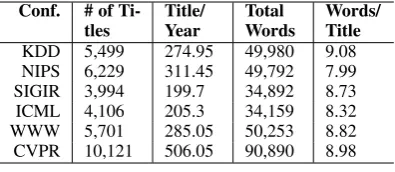
We experimented with six different sets of publi-cation title stream data to evaluate the performance of TILM. These datasets were collected from the Open Academic Graph1(Tang et al., 2008;Sinha et al.,2015). Here, we focused on studying how the paper titles published by different machine learning related conferences evolved over time. As community, we considered both the core machine learning community, e.g., NIPS, ICML as well as research communities that apply a fair share of machine learning, e.g, KDD, SIGIR. Specifically, we considered all the titles of papers published during the years 1996-2015 by the following six conference venues: NIPS, CVPR, ICML, KDD, SIGIR and WWW. For these datasets, the dis-crete timestamp corresponds to a particular year.
Conf. # of Ti-tles
Title/ Year
Total Words
[image:6.595.83.281.62.148.2]Words/ Title KDD 5,499 274.95 49,980 9.08 NIPS 6,229 311.45 49,792 7.99 SIGIR 3,994 199.7 34,892 8.73 ICML 4,106 205.3 34,159 8.32 WWW 5,701 285.05 50,253 8.82 CVPR 10,121 506.05 90,890 8.98
Table 1: Dataset Summary
Each row in these datasets consists of a tuple <timestamp, paper-title>and altogether they con-tain35,650paper titles in total. Again, each paper title can contribute multiple instances for predict-ing the next word which resulted in309,966total instances (see Table1).
4.2 Evaluation Roadmap
For a proper evaluation of TILM, we need a goal task which is both time-sensitive and requires in-fluence modeling. To address this challenge, we evaluate TILM using a text forecasting task, where we attempt to predict the text content at future timestamps in a text stream based on the past data from related (including the same) streams.
As the setup of such a text forecasting task is es-sentially similar to summarizing future text data, we use two popular evaluation metrics from the literature of text summarization, i.e., BLEU ( Pap-ineni et al.,2002) and ROUGE (Lin,2004), where a score is generated by comparing the automat-ically generated text against some reference text written by humans. However, neither BLEU nor ROUGE considers the notion of time, thus we need a time-sensitive customization of both BLEU and ROUGE. The simplest way to do this is to compare a TILM generated text for timestamp T against the original text corresponding to the same timestampT. This means, when TILM is asked to generate a paper title relevant to timestampT, the ground truth paper title against which the gener-ated title is compared must also correspond to the timestamp T. Another challenge is to match the generated title against multiple independent pub-lication titles corresponding to timestamp T. We address it by adopting a simple greedy approach where the TILM-generated title is matched against each ground truth title corresponding to the times-tamp T and paired with the most similar one in terms of BLEU or ROUGE score. The matched ground truth title is then removed from the cor-pus so that the next generated title cannot match with the previously matched title again. This en-sures that TILM is generating a diverse set of titles
rather than just memorizing one single title from each timestamp T. This way, we can use TILM to generate multiple sentences (titles) for a par-ticular timestamp T and then average the scores of all generated sentences to get an evaluation score corresponding to timestampT. This whole computation process is presented in Algorithm2, where we demonstrate the case for time-sensitive BLEU score. The case for ROUGE is exactly sim-ilar. Finally, these average scores across different timestamps can be further averaged to compute the overall forecasting score2.
Algorithm 2:Time aware BLEU score com-putation
1 Time aware BLEU(T, G, R);
Input :T: discrete timestamp G: Generated Text set R: Reference Text set Output:Time sensitive BLEU
2 score←0
3 |G|←number of sentences inG
4 foreach sentenceginGdo 5 foreach sentencerinRdo 6 computeBLEU(g, r)
7 end
8 r∗ =argmax
r
BLEU(g, r)
9 score←score+BLEU(g, r∗)
10 R ←R− {r∗}
11 end
12 return score|G|
4.3 Baseline Methods
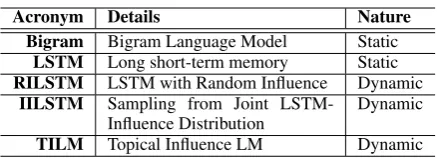
The main questions we want to answer in our ex-periments are whether the incorporation of top-ical influence (from a related stream) is benefi-cial for language modeling and whether the spe-cific configuration of TILM we described earlier is an effective way to capture evolving topical in-fluence. To answer the second question, we com-pare TILM with two baselines which are both vari-ants of TILM but with different ways to capture influence. The first one is calledRILSTMwhich is identical to TILM except that the influence vector of RILSTM is generated randomly as opposed to generating it by theInfluence Generatorof TILM. The second baseline is called IILSTM where we do not inject the influence vector as a bias into
2All the codes and evaluation scripts for
Acronym Details Nature Bigram Bigram Language Model Static
LSTM Long short-term memory Static RILSTM LSTM with Random Influence Dynamic
IILSTM Sampling from Joint LSTM-Influence Distribution
Dynamic
[image:7.595.72.291.59.138.2]TILM Topical Influence LM Dynamic
Table 2: Baselines for Quantitative Comparison.
the vector representation of words, rather, the In-fluence Generator directly computes a probabil-ity distribution for sampling the next word and this probability is multiplied with the probability computed independently by LSTM. To answer the first question, i.e., to verify the benefit of mod-eling the evolution of topical influence, we also compared TILM against two baselines represent-ing static models: simple bigram language model and Long-Short Term Memory (LSTM) ( Hochre-iter and Schmidhuber,1997;Gers et al.,1999). Ta-ble2contains the summary of these baseline algo-rithms along with TILM.
5 Results
This section presents both quantitative and quali-tative evaluation results for TILM. For all the re-sults reported in this section, TILM used the fol-lowing parameter settings:rwas set to3, for both
Sequence GeneratorandInfluence Generator, the number of hidden units was empirically set to256, K (dimension of influence vector) was set to 15, batch size was set to2000instances and the learn-ing rate was set to0.01. For theTopic Generator, n(number of topics) was set to15, θT was com-puted from target text stream itself and LDA was run usingα = 0.1andβ= 0.05.
5.1 Quantitative Evaluation
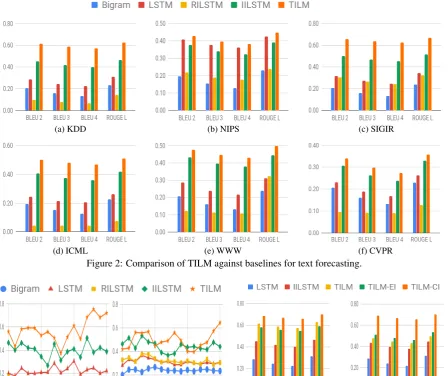
Figure2provides the summary of results for com-paring TILM against multiple baseline methods. Close examination of Figure2reveals that TILM outperforms all other baselines by a clear margin for all six datasets. For example, BLEU-4 score obtained by TILM on KDD Dataset is0.57, while LSTM obtained only a score of0.22. ROUGE-L score obtained by TILM is 0.63, while it is0.31 for LSTM. This clearly indicates that TILM can indeed capture the temporal evolution of KDD pa-per titles over time and given a input timestamp T, can generate text relevant toT. Also note that, RILSTM performs significantly worse compared to LSTM for most datasets which implies that the influence vector plays the key role in helping TILM capture the evolution of the text stream. It
is also noteworthy that IILSTM is the second best performing method which confirms that injecting influence vector as a bias into the word represen-tation works better than using the Joint LSTM-Influence distribution obtained by simply multi-plying influence probabilities with LSTM proba-bilities.
To get more insights into the performance of TILM, we plot the timestamp-wise performance of all compared methods for KDD Dataset (BLEU 4) and WWW Dataset (ROUGE L) in Figure 3
[other plots are similar and omitted due to lack of space]. A general inspection of Figure 3 also demonstrates the superiority of TILM for the text forecasting task, where, for any performance met-ric, TILM obtains the best score across different timestamps for most of the cases.
External Influence: So far, we have only con-sidered the influence of the community for which the text generation is targeted towards. However, other related communities also pose indirect in-fluence on the text content generated within the target community. For example, a shift in the in-terest of theoretical machine learning conferences like ICML often influences the research directions pursued by more applied conferences like KDD or WWW. To test this hypothesis, we conducted a series of experiments where instead of using the influence of the target community (e.g., KDD, WWW) itself, we computed the influence vector from the historical topic distribution of a core ma-chine learning community (e.g. ICML, NIPS). We call this approach TILM-EI where EI means ternal influence. We conducted another set of ex-periments where we computed influence vectors from both the target community and a related ex-ternal community and injected both influence vec-tors into the TILM process. We call this approach TILM-CI where CI stands for combined influence. Two sample results from these experiments are shown in Figure 4, i.e., influence of ICML on KDD and WWW, respectively. Experiments re-sults suggest that, although TILM-EI is not always better than TILM itself, TILM-CI outperforms ba-sic TILM as TILM-CI combines both internal and external influence.
5.2 Qualitative Evaluation
(a) KDD (b) NIPS (c) SIGIR
[image:8.595.74.523.65.441.2](d) ICML (e) WWW (f) CVPR
Figure 2: Comparison of TILM against baselines for text forecasting.
(a) KDD: BLEU 4 (b) WWW: ROUGE L
Figure 3: Year-Wise Performance distribution of TILM against different baseline text generation techniques
Topic Top Keywords
Optimization matrix, gradient, sparse, convex, stochastic
Search Relevance information, retrieval, search, in-dex, document
Rule Mining rule, discovery, association, pattern, mine
Social Networks social, network, recommender, community, topic
SVM Classifiers supervised, learning, support, vec-tor, machine
User Behavior Modeling
log, behavior, personalization, click, feedback
Table 3: Sample topics Extracted from KDD and SI-GIR for year range [1995-2015] Using LDA
set to 15. Table3shows six example topics along with top 5 keywords for each topic. Next, we did some topic trend analysis for SIGIR conference in Figure 5. For SIGIR, we considered two
top-0.00 0.20 0.40 0.60 0.80
BLEU 2 BLEU 3 BLEU 4 ROUGE L
(a) ICML influencing KDD
0.00 0.20 0.40 0.60 0.80
BLEU 2 BLEU 3 BLEU 4 ROUGE L
[image:8.595.307.522.348.482.2](b) ICML influencing WWW
Figure 4: Results of adding external influence into TILM for text forecasting task.
(a)SIGIR(Original): User Behavior Modeling
(b)SIGIR(Generated): User Behavior Modeling
(c)SIGIR(Original): Search & Relevance
[image:9.595.77.522.62.188.2](d)SIGIR(Generated): Search & Relevance
Figure 5: Topic trend analysis to demonstrate how TILM captures evolution of SIGIR research paper titles.
year # Sample Generated Title
2000 1 discovering in hierarchical rules using lexical knowledge
- 2 data mining criteria for tree based regression and classification
2002 3 mining frequent class sets in spatial databases 2007
-1 a framework for community identification in dynamic social networks
2009 2 learning preferences of new users in recom-mender systems
3 data mining for intrusion detection from out-liers
2012
-1 deep model based transfer and multi task learn-ing for biological image analysis
2015 2 a bayesian framework for estimating properties of information network
3 active learning for sparse bayesian classification
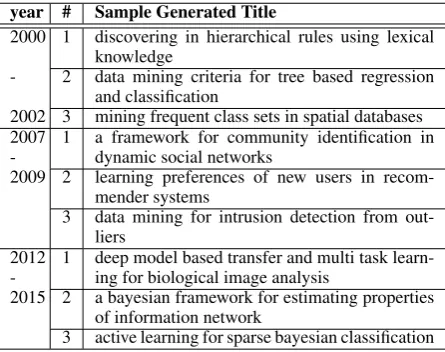
Table 4: Sample titles generated by TILM for confer-ence KDD across different year ranges
effectively by TILM and apparent from the decay-ing trend of Figure5d.
Finally, Table4presents some sample paper ti-tles generated by TILM for different time ranges targeted towards KDD community. A closer look into Table4reveals that TILM can generate syn-tactically correct, semantically coherent and time-sensitive evolving text. It is worth mentioning that, TILM did not store any paper-to-year mapping in-formation. Table4also nicely captures the inter-est shift within KDD community over the years. For example, paper titles generated for year range 2000-2002 include topics like rule mining and tree based classifications, while paper titles generated for year range 2012-2015 include topics like deep learning and active learning, which is consistent with our expectation.
6 Conclusion
We studied how to improve neural language mod-els by incorporating topical influence from contex-tual factors and proposed a novel Topical Influ-ence Language Model (TILM), which includes a novel extension of a basic neural language model
by incorporating both a topic generator (based on topic modeling) and a neural network-based in-fluence modeling component, leading to a gen-eral architecture with three major components: Se-quence Generator,Topic GeneratorandInfluence Generator. We quantitatively evaluated TILM using a text forecasting task on six publication stream datasets and demonstrated that it is bene-ficial to incorporate topical influence in language modeling and TILM outperforms multiple base-line methods by a significant margin. As a novel language model, TILM allows for leveraging re-lated text streams to improve accuracy of language modeling of a target stream, thus potentially help-ing improve many applications where language models are applied. We also show that TILM is able to generate well-structured, meaningful text content corresponding to future time stamps, thus potentially allowing us to predict topical trends in the future, which would be useful for optimizing decision making. Moreover, we also showed the potential that TILM can be used as a tool to com-pare influences of different external streams on a particular target stream, thus facilitating cross-stream influence analysis. While it is not the fo-cus of this paper, such analysis clearly opens up an interesting direction for analyzing multiple text streams to understand their influences in a topic-specific way, a highly promising direction for fu-ture research.
7 Acknowledgement
[image:9.595.73.296.218.394.2]References
David M Blei, Andrew Y Ng, and Michael I Jordan. 2003. Latent dirichlet allocation. Journal of ma-chine Learning research, 3(Jan):993–1022.
Tong Che, Yanran Li, Ruixiang Zhang, R. Devon Hjelm, Wenjie Li, Yangqiu Song, and Yoshua Bengio. 2017. Maximum-likelihood augmented discrete generative adversarial networks. CoRR, abs/1702.07983.
Jacob Devlin, Ming-Wei Chang, Kenton Lee, and Kristina Toutanova. 2018. Bert: Pre-training of deep bidirectional transformers for language understand-ing. arXiv preprint arXiv:1810.04805.
Adji B Dieng, Chong Wang, Jianfeng Gao, and John Paisley. 2016. Topicrnn: A recurrent neural net-work with long-range semantic dependency. arXiv preprint arXiv:1611.01702.
Mahak Gambhir and Vishal Gupta. 2017. Recent auto-matic text summarization techniques: a survey. Ar-tificial Intelligence Review, 47(1):1–66.
Felix A Gers, J¨urgen Schmidhuber, and Fred Cummins. 1999. Learning to forget: Continual prediction with lstm.
G Hinton, N Srivastava, and K Swersky. 2012. Rm-sprop: Divide the gradient by a running average of its recent magnitude. Neural networks for machine learning, Coursera lecture 6e.
Sepp Hochreiter and J¨urgen Schmidhuber. 1997. Long short-term memory. Neural computation, 9(8):1735–1780.
Shubhra Kanti Karmaker Santu, Liangda Li, Yi Chang, and ChengXiang Zhai. 2018. Jim: Joint influence modeling for collective search behavior. In Pro-ceedings of the 27th ACM International Conference
on Information and Knowledge Management, pages
637–646. ACM.
Shubhra Kanti Karmaker Santu, Liangda Li, Dae Hoon Park, Yi Chang, and Chengxiang Zhai. 2017. Mod-eling the influence of popular trending events on user search behavior. InProceedings of the 26th
Interna-tional Conference on World Wide Web Companion,
pages 535–544. International World Wide Web Con-ferences Steering Committee.
Chlo´e Kiddon, Luke Zettlemoyer, and Yejin Choi. 2016. Globally coherent text generation with neural checklist models. InProceedings of the 2016 Con-ference on Empirical Methods in Natural Language Processing, pages 329–339.
Yoon Kim, Yacine Jernite, David Sontag, and Alexan-der M Rush. 2016. Character-aware neural language models. InAAAI, pages 2741–2749.
Diederik Kingma and Jimmy Ba. 2014. Adam: A method for stochastic optimization. arXiv preprint arXiv:1412.6980.
Ryan Kiros, Ruslan Salakhutdinov, and Rich Zemel. 2014. Multimodal neural language models. In Pro-ceedings of the 31st International Conference on
Machine Learning (ICML-14), pages 595–603.
Karen Kukich. 1987. Where do Phrases Come from: Some Preliminary Experiments in Connec-tionist Phrase Generation, pages 405–421. Springer Netherlands, Dordrecht.
Chin-Yew Lin. 2004. Rouge: A package for auto-matic evaluation of summaries. InText summariza-tion branches out: Proceedings of the ACL-04 work-shop, volume 8. Barcelona, Spain.
Kevin Lin, Dianqi Li, Xiaodong He, Zhengyou Zhang, and Ming-Ting Sun. 2017. Adversarial ranking for language generation. CoRR, abs/1705.11001.
Junhua Mao, Wei Xu, Yi Yang, Jiang Wang, Zhiheng Huang, and Alan Yuille. 2014. Deep captioning with multimodal recurrent neural networks (m-rnn).
arXiv preprint arXiv:1412.6632.
Tomas Mikolov, Martin Karafi´at, Luk´as Burget, Jan Cernock´y, and Sanjeev Khudanpur. 2010. Recur-rent neural network based language model. In IN-TERSPEECH 2010, 11th Annual Conference of the International Speech Communication Association,
Makuhari, Chiba, Japan, September 26-30, 2010,
pages 1045–1048.
Tomas Mikolov, Stefan Kombrink, Luk´as Burget, Jan Cernock´y, and Sanjeev Khudanpur. 2011. Exten-sions of recurrent neural network language model.
In Proceedings of the IEEE International
Confer-ence on Acoustics, Speech, and Signal Processing, ICASSP 2011, May 22-27, 2011, Prague Congress
Center, Prague, Czech Republic, pages 5528–5531.
Kishore Papineni, Salim Roukos, Todd Ward, and Wei-Jing Zhu. 2002. Bleu: a method for automatic eval-uation of machine translation. In Proceedings of the 40th annual meeting on association for compu-tational linguistics, pages 311–318. Association for Computational Linguistics.
Matthew E Peters, Mark Neumann, Mohit Iyyer, Matt Gardner, Christopher Clark, Kenton Lee, and Luke Zettlemoyer. 2018. Deep contextualized word rep-resentations. arXiv preprint arXiv:1802.05365.
Sai Rajeswar, Sandeep Subramanian, Francis Dutil, Christopher Joseph Pal, and Aaron C. Courville. 2017. Adversarial generation of natural language.
CoRR, abs/1705.10929.
Marc’Aurelio Ranzato, Sumit Chopra, Michael Auli, and Wojciech Zaremba. 2015. Sequence level train-ing with recurrent neural networks. arXiv preprint
arXiv:1511.06732.
international conference on world wide web, pages 243–246. ACM.
Ilya Sutskever, James Martens, and Geoffrey E. Hin-ton. 2011. Generating text with recurrent neu-ral networks. In Proceedings of the 28th Inter-national Conference on Machine Learning, ICML 2011, Bellevue, Washington, USA, June 28 - July 2, 2011, pages 1017–1024.
Jie Tang, Jing Zhang, Limin Yao, Juanzi Li, Li Zhang, and Zhong Su. 2008. Arnetminer: extraction and mining of academic social networks. In Proceed-ings of the 14th ACM SIGKDD international
con-ference on Knowledge discovery and data mining,
pages 990–998. ACM.
Yizhe Zhang, Zhe Gan, Kai Fan, Zhi Chen, Ricardo Henao, Dinghan Shen, and Lawrence Carin. 2017. Adversarial feature matching for text generation.