Proceedings of the Shared Task on Cross-Framework Meaning Representation Parsing at the 2019 CoNLL, pages 166–176 Hong Kong, November 3, 2019. c2019 Association for Computational Linguistics
166
Peking at MRP 2019: Factorization- and Composition-Based Parsing for
Elementary Dependency Structures
Yufei Chen♠, Yajie Ye♠, Weiwei Sun♠♥
♠Wangxuan Institute of Computer Technology, Peking University ♠The MOE Key Laboratory of Computational Linguistics, Peking University
♥Center for Chinese Linguistics, Peking University
{yufei.chen,yeyajie,ws}@pku.edu.cn
Abstract
We design, implement and evaluate two se-mantic parsers, which represent factorization-and composition-based approaches respec-tively, for Elementary Dependency Struc-tures (EDS) at the CoNLL 2019 Shared Task on Cross-Framework Meaning Representa-tion Parsing. The detailed evaluation of the two parsers gives us a new perception about parsing into linguistically enriched meaning representations: current neural EDS parsers are able to reach an accuracy at the inter-annotator agreement level in the same-epoch-and-domain setup.
1 Introduction
For the CoNLL 2019 Shared Task on Cross-Framework Meaning Representation Parsing
(MRP; Oepen et al., 2019), we concentrate on Elementary Dependency Structures (EDS;Oepen and Lønning, 2006), the graph-based meaning representations derived from English Resource Semantics1 (ERS;Flickinger et al.,2014b) that is the richly detailed semantic annotation associated to English Resource Grammar (ERG;Flickinger,
2000), a domain-independent, linguistically deep and broad-coverage HPSG grammar. The full
ERS andEDS annotations include not only basic predicate–argument structures, but also informa-tion about quantifiers and scopal operators, e.g. negation, as well as analyses of linguistically complex phenomena such as time and date expressions, conditionals, and comparatives.
Following Koller et al. (2019)’s practice, we divide existing work on string-to-semantic-graph parsing into four types, namely factorization-, composition-, transition- and translation-based ap-proaches. Our previous studies (Chen et al.,
2018b; Cao et al., 2019) as well as other inves-tigations on other graph banks indicate that the
1http://moin.delph-in.net/ErgSemantics
factorization- and composition-based approaches obtain currently superior accuracies. In this paper, we fine-tune our factorization- and composition-based parsers and present a detailed evaluation on the MRP data.
Our factorization-based system obtains an over-all accuracy of 94.47 in terms of the official MRP evaluation metrics, and out-performs other sub-mission systems by a large margin with respect to the prediction for labels, properties, anchors and edges. We highlight a new perception: Cur-rent neural parsers are able to reach an accuracy at the inter-annotator agreement level (Bender et al.,
2015) for the linguistically enriched EDS repre-sentations in the same-epoch-and-domain setup. Given the information depth of ERS, we think many NLP applications may benefit from a re-visit of classic discrete semantic representations. The composition-based system reaches a score of 91.84. We do not think the performance gap sug-gests a weakness of the latter approach, but take it a reflection of the fact that a composition-based parser involves more individual modules that have not been fully optimized yet.
2 Parsing to Semantic Graphs
In this section, we present a summary of factorization-, composition-, transition- and translation-based parsing approaches.
Factorization-Based Approach. This type of approach is inspired by the successful design of graph-based dependency tree parsing (McDonald,
2006). A factorization-based parser explicitly models the target semantic structures by defining a score function that is able to evaluate thegoodness
a large set.
To the best of our knowledge, McDonald and Pereira (2006) present the first graph-based syn-tactic dependency parsing algorithm that removes the tree-shape constraint. In the scenario of se-mantic dependency parsing,Kuhlmann and Jons-son(2015) generalize the graph-based framework (aka Maximum Spanning Tree parsing) and pro-pose Maximum Subgraph parsing. Given a di-rected graph G = (V, E) that corresponds to an input sentencex=w0, . . . wn−1and a score func-tion SCOREG. The string-to-graph parsing is for-mulated as a problem of searching for a subset
E0 ⊆ E with the maximum score. Formally, we have the following optimization problem:
(V, E0) = arg max
G∗=(V,E∗⊆E)
SCOREG(G∗) (1)
For semantic dependency parsing,V is the set of surface tokens, andGis, usually, the correspond-ing complete graph.
It is relatively straightforward to extend
Kuhlmann and Jonsson’s framework to cover more types of semantic graphs as follows,
G0 = arg max
G∗∈GEN(x)S
COREG(G∗) (2)
where GEN(x) denotes all plausible semantic
graphs that can be assigned tox.
To make the above combinatorial optimization problems solvable, people usually employ a fac-torizationstrategy, i.e. defining a decomposable score function that enumerates all sub-parts of a candidate graph. This view matches a classic so-lution to structured prediction which captures el-emental and structural information through part-wise factorization. For example, the following for-mula defines a first-order factorization model for semantic dependency parsing,
G0 = arg max
G∗=(V,E∗⊆E)
X
e∈E∗
SCOREEDGE(e) (3)
The essential computational module in this ar-chitecture is the score function, which is usually induced based on moderate-sized annotated sen-tences. Various deep learning models together with vector-based encodings induced from large-scale raw texts have been making advances in shaping a score function significantly (Dozat and Manning,2018). We will detail our factorization-based parser in§3.
Composition-Based Approach. Composition-ality is a cornerstone for many formal semantic theories. Following a principle of compositional-ity, a semantic graph can be viewed as the result of a derivation process, in which a set of lexical and syntactico-semantic rules are iteratively applied and evaluated. On the linguistic side, such rules extensively encode explicit knowledge about nat-ural languages. On the computational side, such rules must be governed by a well-defined gram-mar formalism. In particular, to manipulate graph construction in a principled way, Hyperedge Re-placement Grammar (HRG;Drewes et al., 1997) and AM Algebra (Groschwitz et al., 2017) have been applied to build semantic parsers for various graph banks (Chen et al.,2018b;Groschwitz et al.,
2018;Lindemann et al.,2019).
A composition-based parser explicitly models derivations that yield semantic graphs by defining a score function SCORED. Assume a derivation
D = r1, r2, . . . , rm is a sequence of rules. For-mally, we have the following optimization prob-lem:
G0= arg max
G∗∈GEN(x)
X
D∈DERIV(G∗)
SCORED(D) (4)
To make the above problem solvable, people usu-ally employ a decompositionstrategy, i.e. sum-ming over local scores that correspond to individ-ual derivation steps:
SCORED(D) =
m X
i=1
SCORERULE(ri) (5)
Again, this matches many structured prediction models. Deep learning has been shown very pow-erful to associate scores to individual rule applica-tions, and thus to provide great models for eval-uating a derivation. The general form of (4) is a very complex combinatorial optimization prob-lem. The approximating strategy to search for the best derivation instead has been shown practical yet effective forERSparsing (Chen et al.,2018b). Formally, we solve the below problem,
D0 = arg max
D∗∈GENDERIV(x)
D∗=r1r2···rm m X
i=1
SCORERULE(ri) (6)
whereGENDERIV(x) denotes all sound derivations
Transition-Based Approach. This type of ap-proach is inspired by the successful design of transition-based dependency tree parsing (Yamada and Matsumoto,2003;Nivre,2008). To the best of our knowledge,Sagae and Tsujii(2008) firstly apply this type of approach to predict predicate– argument structures grounded in HPSG (Miyao et al., 2005). A number of new transition sys-tems and disambiguation models have been dis-cussed for parsing into different graphs (Wang et al., 2015; Zhang et al., 2016;Buys and Blun-som,2017;Gildea et al.,2018;Sun et al.,2019)
Translation-Based Approach. This type of ap-proach is inspired by the success of sequence-to-sequence (seq2seq for short) models that are the heart of modern Neural Machine Translation. A translation-based parser takes a family of tic graphs as a foreign language, in that a seman-tic graph is encoded and then viewed as a string fromanotherlanguage (Peng et al., 2017b; Kon-stas et al., 2017; Buys and Blunsom, 2017). A parser knows how to linearize a graph. Data aug-mentation has been shown very helpful (Konstas et al., 2017), partially reflecting the data-hungry natureof seq2seq models.
Simple application of seq2seq models is not sucessful. However, some basic mod-els can be integrated with other types of ap-proaches. Peng et al.(2018) propose to combine the translation- and transition-based approaches.
Zhang et al.(2018) combined the translation- and factorization-based approaches.
3 The Factorization-Based Parser
3.1 Elements in EDS Graphs
The key idea underlying the factorization-based approach is to explicitly model what are expected as elements in target structures. Therefore before introducing the technical details of our parser, we roughly sketch key elements inEDSgraphs. Refer toFlickinger et al. (2014a) for more information about the design ofERS.
We distinguish three kinds of elements: (1) la-beled nodes, (2) node properties and (3) lala-beled edges. Nodes are sometimes called concepts2, where their labels reflect conceptual meaning. The
2
Considering the original design and especially the logic foundation ofERS, the seemly more standard name is pred-icate. In this paper, we call themconcepts, mainly because we want to follow the new tradition of graph-based meaning representations (Kuhlmann and Oepen,2016).
node labels can be divided into two classes: (1)
surface concepts that are exclusively introduced by lexical entries, whose orthography is the source form of a core part of a concept symbol, and (2)
abstract conceptsthat are used to represent the se-mantic contribution of grammatical constructions or more specialized lexical entries. Take the out-put structure in Figure 1 for example: go v 1
and want v 1 indicate surface concepts, while
proper qandnamedindicate abstract concepts. To avoid proliferation of concepts, some con-cepts are parameterized. The parameters can be viewed as properties of nodes. For exam-ple,named("Tom")is anamedconcept with a CARG property of"Tom". For everyEDSgraph, there exists a top concept, which relates to the
tophandle in its originalERSannotation. In Fig-ure1, for example, want v 1is thetop. In this paper, we practically treat whether a node istopas a property whose value can be eithertrueorfalse. Edges are called relations. An edge links ex-actly two nodes and mainly reflects predicate– argument relations. Edges are assigned with a small, fixed inventory of role labels (e.g. ARG1,
ARG2, . . . ).
3.2 The Architecture
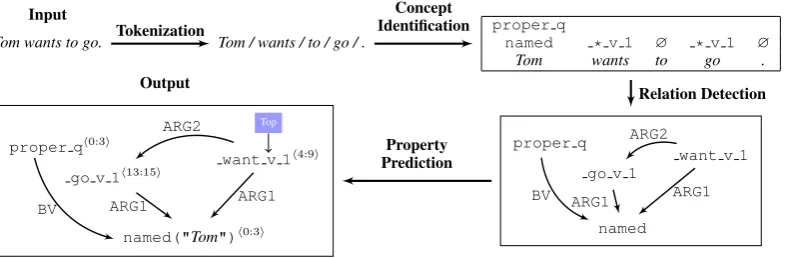
We employ a four-stage pipeline to incrementally construct an EDS graph. Figure 1 illustrates the four steps with a simple sentence. The core idea is to identify concepts from surface strings, and then detect the relations between them.
3.3 Tokenization
Automatic tokenization for English has been widely viewed as a solved problem for quite a long time. Taking the risk of oversimplifying the situation, tokenization does not have a significant impact on downstream NLP tasks, e.g. POS tag-ging and syntactic parsing. When we consider se-mantic parsing, however, it is still a controversial issue which unit is the most basic one that trig-gers conceptual meaning and semantic construc-tion. Therefore, we need to rethink the tokeniza-tion problem in whichtokensmay not be fully con-sistent with their traditional definitions. Moreover, when we consider other languages like German or Chinese, tokenization brings other issues.
In this paper, we take the most basicword-level units3as strings that are separated by whitespaces
in-Tom wants to go.
Input
Tom / wants / to / go / .
proper q
named * v 1 ∅ * v 1 ∅ Tom wants to go .
named
want v 1 go v 1
proper q
ARG1 ARG1
BV
ARG2
named("Tom")h0:3i want v 1h4:9i go v 1h13:15i
proper qh0:3i
Top
ARG1 ARG1
BV
ARG2
Output Tokenization
Concept Identification
Relation Detection
[image:4.595.104.497.66.195.2]Property Prediction
Figure 1: The workflow of our factorization-based parser. Tokenization: To separate an input sentence into se-mantic parsing-oriented tokens. Concept Identification: To generate concepts with a sequence labeling model. Relation Detection: To link concepts with a semantic dependency parsing model. Property Prediction: To predict node properties by classification.
Input string Assets of these short-term funds surged more than$5.5 billion in September.
RegEx match Assets of these short - term funds surged more than$5 . 5 billion in September .
Classification B B B B BB B B B I B B I I B B B B
Our tokens Assets of these short - term funds surged more than$5 . 5 billion in September .
[image:4.595.74.292.420.518.2]PTB tokens Assets of these short - term funds surged more than$5 . 5 billion in September .
Table 1: A tokenization example. Row “Our tokens” shows the result of our tokenizer, while Row “PTB tokens” shows the tokenization results defined by the Penn TreeBank (PTB;Marcus et al.,1993).
Concept Type String
more+than p multi-unit more than
asset n 1 single unit Assets
short a of sub-unit short-term
term n of sub-unit short-term
mis- a error sub-unit misinterpreted
interpret v 1 sub-unit misinterpreted
Table 2: Examples to illustrate the relationships be-tween surface concepts and word-level units. ‘ ’ is an escape character for whitespace.
and punctuation markers. In anEDSgraph, a sur-face concept may be aligned with a sub-unit, a sin-gle unit or multiple units. Table2shows some ex-amples. During concept identification (§3.4), there should exist a surjection from surface concepts to the input tokens. Therefore, tokenization is impor-tant for obtaining a reasonable alignment between concepts and input tokens.
We adopt the character-based word segmenta-tion approach for Chinese (Sun,2010) to find suit-able tokens. We first split an input sentence into
troduce our neural parsing models, we still usewordto relate the units toword embeddings.
a sequence of basic elements with simply defined regular expressions. The core part of our tokenizer is a sequence labeling model over this sequence. In particular, each element is assigned with a po-sitional label that indicates token boundaries. The labels can be eitherB, which means the unit is at the begining of a target token, orI, which means the unit is inside a token. For sequential classifi-cation, we utilize a multi-layer BiLSTM network. Tokens can be retrieved from the predicted labels. See Figure 1 for an example. Note that, Dridan and Oepen(2012) showed that regular expressions are quite powerful to deal with the tokenizaiton problem for different styles.
3.4 Concept Identification
label. For example, boy n 1consists of a lemma (boy) and atype, denoted as * n 1. As lemmas
are much more easily to analyze, our concept iden-tifier targets the type part only.
Some of the rest of abstract concepts are trig-gered by phrasal constructions. For example,
compound is associated to the combination of multiple words. In this case, a concept is origi-nally aligned to a sequence of continuous words. Considering that this type of concepts is a small portion, we propose to handle them in a word-level tagger. To this end, we re-align them to specific tokens with a small set of heuristic rules. For ex-ample,compoundis re-aligned to the first word of a compound. Re-aligning these concepts means discarding their original anchors. To fully fit the MRP goals, we treat anchors as properties of con-cepts, and recover them by predicting the start/end boundaries with a classification model, as to be de-scribed in§3.6.
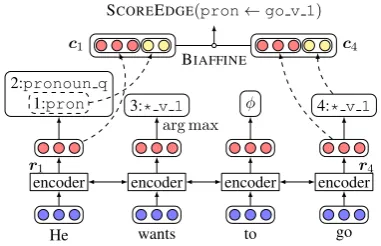
We employ a neural sequence labeling model to predict concepts. A multi-layer BiLSTM is utilized to encode tokens and another two soft-max layers to predict concept-related labels: One for lexicalized concepts and the other for the rest. We also use recently widely-used contextualized word representation models, including ELMo ( Pe-ters et al., 2018) and BERT (Devlin et al.,2018). Figure 2 shows the neural network for concept identication.
3.5 Relation Detection
After finding a set of concepts, the next step is to link them together. Each semantic dependency is treated independently. We use integers as indices to mention concepts nodes. For any two nodes i
and j, we give a score SCOREEDGE(i, j) to the possible arci→j. An arc is included to the final graph if and only if its score is greater than 0. We use a first-order model as described in Eq. (3). Figure2briefly summarizes the neural network for relation detection.
FollowingDozat and Manning(2016,2018), we use a deep biaffine attention to evaluate a candi-date edge:
SCOREEDGE(i, j) =BIAFFINE(ci,cj)
=cTi Ucj+W(ci+cj) +b
where ci/cj is the vector associated to i/j. We consider two information sources to calculate c: a textual partrc2w(i) and a conceptual partni, as
He wants to go
encoder encoder encoder encoder
r1 r4
2:pronoun q
1:pron 3:* v 1 φ 4:* v 1
arg max
c1 c4
BIAFFINE
[image:5.595.319.510.64.187.2]SCOREEDGE(pron←go v 1)
Figure 2: The network architecture for our con-cept identification and relation detection models which share the same architecture in word embedding and contextual encoder layers but with the same sets of pa-rameters. A softmax layer is used for concept identifi-cation. To determine whether the dependencypron← go v 1exists, i.e. unlabeled dependency parsing, the corresponding embeddings c1 and c4, which are the
concatenation of textual embeddings (in the red color) and the conceptual embeddings (in the yellow color), are biaffinely transformed into a score.
following,
ci =rc2w(i)⊕ni
Due to our concept identification method, we have a function “c2w” that takes as input the index of a node and returns as output the index of its an-chored word. rc2w(i) is the contextual vector of the word aligned toi, which is calculated by the word embedding layer and the encoder layers. ni is the randomly-initialized embedding of i’s con-cept type, e.g. * v 1. We also use the deep
bi-affine attention function to calculate each edge’s scores for all labels, according to which we select thebestlabel that achieves the maximum.
For training, we use a margin-based approach to compute loss from the gold graphG∗and the best predicted Gˆ according to current model parame-ters. We define thelossterm as:
loss = max(0,∆(G∗,Gˆ)
−SCOREG(G∗) +SCOREG( ˆG)) (7)
The margin objective ∆ measures the similarity betweenG∗andGˆ. FollowingPeng et al.(2017a), we define ∆ as weighted Hamming to trade off between precision and recall.
3.6 Property Prediction
He wants to go encoder encoder encoder encoder
r1 r4
c1
pron
predicted
concepts PROJ(·)
BIAFFINEs SCOREs(pron,go)
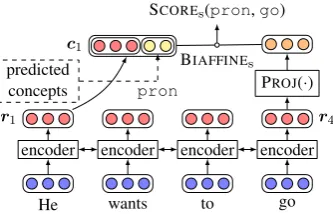
Figure 3: The network architecture for property pre-diction. The vector representations of concepts are ob-tained similarly to relation detection. The only differ-ence is that the labels of concepts are provided by pre-vious stages instead of being predicted by a softmax layer.
consider three types of properties and apply dif-ferent strategies.
Anchors (spans). String anchors are treated as properties of concepts. For a given concept, a classification model is utilized to select two to-kens over all input toto-kens as the start/end bound-ary of the concept respectively. We use exactly the same neural architecture in §3.5 to encode input tokens. See Figure3for a visualized illustration. The score of tokenjwbeing the start/end boundary of nodeican be computed by following equation:
SCOREs/e(i, jw) =BIAFFINEs/e(ci,PROJ(rjw))
Here PROJ(·) represents a feed-forward network with LEAKYRELU activation.
The anchors provided by training dataset are all character-based, so transformation is required be-fore training this model. In the same manner, after retrieving the start/end word of a concept, we need to convert word-based anchors back to character-based anchors. Margin-character-based loss is used again when training this model and the total loss is the sum of losses for both boundaries.
The CARG property. Since the main function of the CARG attribute is to reduce the size of pred-icate names by parameterizing them with regular-ized surface strings, a rule-based system could be effective to predict the CARG information.
Firstly, we decide whether a concept has the CARG property according to its label. For exam-ple,named,cardandordneed CARGs, but not
the q.
Secondly, we use a dictionary which is ex-tracted automatically from the training dataset. Entries of the dictionary are of the form
hlabel,string,CARGi. For example, a concept
named whose anchoring string is D.C. will be mapped to WashingtonDC. Based on a close ob-servation of the data, we introduce several heuris-tic rules if there is no applicable entry for a con-cept in the dictionary. For example, one widely applicable rule is to use1as the CARG value for concepts labeledcardand aligned to a float num-ber which is less than 1.
Finally, if no rule is available, we remove punc-tuation markers at left or right boundaries of an-choring strings and use the remaining part.
Top concept. We cast the precition fortopas a binary classification problem over all nodes in a fi-nal graph. This strategy matches a recent research interest in graph neural networks (Li et al.,2015;
Veliˇckovi´c et al., 2017; Defferrard et al., 2016;
Chen et al.,2018a;Song et al.,2018), one goal of which is to associate vectors to graph nodes. Such vectors can be more easily to be integrated to neu-ral networks for various purposes. We employ a Graph-based LSTM (Song et al.,2018) to encode an EDSgraph and a multi-layer feed-forward net-work to determine whether a node istop. Similar as§3.5, margin-based approach is used to compute thelossterm.
4 The Composition-Based Parser
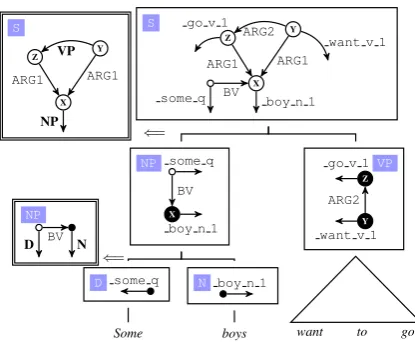
Our composition-based parser is based on our pre-vious work (Chen et al.,2018b). The core engine is a graph rewriting system that explicitly explores the syntactico-semantic recursive derivations that are governed by a synchronousHRG (SHRG). See Figure 4 for an example. Our parser constructs
EDS graphs by explicitly modeling such deriva-tions. In particular, it utilizes a constituent parser to build a syntactic derivation, and then selects se-manticHRGrules associated to syntacticCFGrules to generate a graph. When multiple rules are ap-plicable for a single phrase, a neural network is used to rank them.
One main difference between our submission parer and the parser introduced in Chen et al.
(2018b) is that the syntactic parsing model is a re-implementation ofKitaev and Klein(2018). It uti-lizes transformer layers to capture words’ contex-tual information, denoted asri. After encoding an input sentence, a multiple-layer peceptron (MLP) is employed to get span scores. The score of span
[image:6.595.96.263.64.171.2]X Y Z
boy n 1 some q
want v 1 go v 1
ARG1 ARG1
BV ARG2
S
Y Z
want v 1 go v 1
ARG2
VP
want to go X
boy n 1 some q
BV
NP
boy n 1
N
boys some q
D
Some ⇐= X
Y Z
NP
ARG1 ARG1
VP
S
⇐=
BV
D N
[image:7.595.76.284.62.233.2]NP
Figure 4: AnSHRG-based syntactico-semantic deriva-tion. The derivation can be viewed as a syntactic tree enriched with semantic interpretation rules that are de-fined by anHRG. Each phrase in the syntactic tree is also assigned with a graph which corresonds to a sub-part in the final semantic graph. Moreover, some par-ticular nodes (filled nodes) in a sub-graph is marked as
communication channelsto other meaning parts in the same sentence. In HRG, these nodes are summarized as a hyperedge. Gluing two sub-graphs according to a construction rule follows the graph substitution princi-ple ofHRG. The application of the top rule that intro-duces a reentrancy structure is such an example. The “X” node in the graph of the left branching phrase is unified with the “X” node in the rule, and so do to the “Y” and “Z” nodes.
the two endpoints,riandrj−1:
SBCORE(i, j, L) =MLP(si,j)[L]
si,j =ri⊕ri−1
MLP(x) =W2σ(W1x+b1) +b2
The operator [] denotes index selection. We perform CKY decoding to retrieve the highest-scored constituent tree that agrees with the syn-tacticCFGgrammar.
When a phrase structure tree is available, se-mantic interpretation can be regarded as translat-ing this tree to the derivation of graph construc-tion. As multiple subgraph correspondents in each node are available, the beam search strategy is used to balance the search complexity and quality. To score subgraphs, we use two types of fea-tures. The first type is node feature. For a concept
n aligned with span (i, j), we use the span em-beddingsi,j as features, and score with non-linear transformation:
SCOREPARTconcept(i, j, p) =MLPconcept(si,j)[p]
The second type is edge feature. Note that a se-mantic dependency with labelL from conceptual nodena tonb are aligned to constituents(i1, j1) and (i2, j2) respectively. We calculate this part of score with non-linear transformation from the span embeddingssi1,j1,si2,j2 and random
initial-ized concept embeddingsna,nb:
SCOREPARTarc(i1, j1, i2, j2,pa,pb, L)
=MLParc(si1,j1⊕si2,j2 ⊕pa⊕pb)[L]
For training, again, we use the margin-based loss.
5 Experiments
The MRP2019 training data consists of 35656 sen-tences in total. For convenience, the composition-and factorization-based parsers share the same to-kenization model. Gold token position labels are extracted from DeepBank (Flickinger et al.,2012). For the composition-based parser, we leverage the syntactic information provided by DeepBank to extract synchronous grammars. Therefore, all sen-tences in the MRP2019 data that do not appear in DeepBank 1.1 are removed. Following the same preprocessing of semantic graphs in Chen et al.(2018b) and using the recommended setup in DeepBank, there are 33722 samples for training and 1689 samples for validation. The synchronous grammars are extracted from the training data us-ing coarse-grained labels (Chen et al.,2018b). For factorization-based parser, we use heuristic rules to re-align the non-lexicalized concepts to input tokens. We remove all sentences that do not re-cieve results in this step from our training set. Af-ter re-alignment, 33580 sentences are left for train-ing and 1689 for validation.
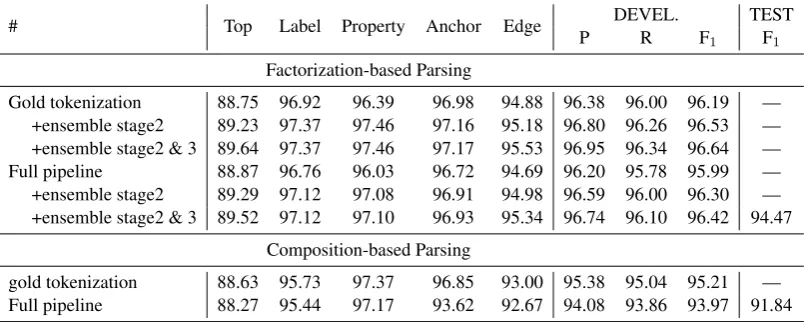
Table3shows the results of both parsers on the validation data using the official evalution tool—
mtool4. Table 4 shows the intermediate results during parsing for both parsers.
For factorization-based parsing, we combine 4 models for concept identification and 5 models for relation detection. We ensemble models by av-eraging the score functions across all stand-alone models. These models use different initial random seeds, different pretraining methods (ELMo or BERT) or different encoder architectures (Trans-former or BiLSTM). All these models achieve a similar performance respectively, but the ensem-ble one achieves a much better performance, as we can conclude from Table3.
# Top Label Property Anchor Edge DEVEL. TEST
P R F1 F1
Factorization-based Parsing
Gold tokenization 88.75 96.92 96.39 96.98 94.88 96.38 96.00 96.19 —
+ensemble stage2 89.23 97.37 97.46 97.16 95.18 96.80 96.26 96.53 —
+ensemble stage2 & 3 89.64 97.37 97.46 97.17 95.53 96.95 96.34 96.64 —
Full pipeline 88.87 96.76 96.03 96.72 94.69 96.20 95.78 95.99 —
+ensemble stage2 89.29 97.12 97.08 96.91 94.98 96.59 96.00 96.30 —
+ensemble stage2 & 3 89.52 97.12 97.10 96.93 95.34 96.74 96.10 96.42 94.47
Composition-based Parsing
gold tokenization 88.63 95.73 97.37 96.85 93.00 95.38 95.04 95.21 —
Full pipeline 88.27 95.44 97.17 93.62 92.67 94.08 93.86 93.97 91.84
Table 3: Results on the development data set. The evaluation algorithm is Maximum Common Edge Subgraph Isomorphism (MRP).Gold tokenizationmeans that the parser uses gold standard tokenization provided by Deep-Bank. Full pipelinemeans that all stages in the pipeline are based on automatic predictions. Columns in the middle block include F1scores with respect to basic evaluation items respectively. The right block shows overall
precision, recall and F1. All numbers are obtained by usingmtool.
Factorization-based Parser Concept Identification (F1) Relation Detection Lexicalized Non-lexicalized Overall Nodes Edges Overall
Gold tokenization 97.04 95.72 96.50 96.94 93.43 95.20
+ensemble stage2 97.40 96.20 96.94 97.30 93.85 95.60
+ensemble stage2 & 3 the same as above row 97.28 94.03 95.67
Composition-based Parser Syntactic Parsing Semantic Interpretation
P R F1 POS Nodes Edges Overall
[image:8.595.98.503.64.225.2]Gold tokenization 92.16 92.16 92.16 95.01 95.63 91.43 93.56
Table 4: Results of each stage for both parsers on the development data.Gold tokenizationhas the same meaning in Table3. Columns in the right block are the SMATCHscores ignoring all the node and edge properties for generated graphs. For factorization-based parser, columns in the middle block include the F1scores of concept identification
with respect tolexicalized,non-lexicalizedand all concepts respectively. For composition-based parser, columns in the middle block are the syntactic parsing results using standard metric and POSconcerns the prediction of preterminals.
Our factorization-based parser achieves rela-tively satisfactory performance in all basic evalua-tion items excepttop. In the in-domain evalution, its performace nearly reaches the inter-annotator agreement reported in Bender et al. (2015). To findtopconcepts, our model encodes the semantic graphs and ignores the input sentences. We take the unsatisfactory result as a confirmation of the challenge to encode complex discrete structures into vectors.
The evalution results of our composition-based parser are not as good as the factorization-based one. We believe that the disagreement between our
SHRG grammar and the original ERG leads to a major part of the performance gap.
6 Conclusion
Current neural ERS parsers work rapidly and re-liably, with an MRP accuracy of over 94% in the same-epoch-and-domain setup. It is com-parable to the inter-annotator agreement (in Ele-mentary Dependency Match) reported in Bender et al. (2015). As ERS parsers become more and more accurate, efficient and robust, they have ex-tensive application prospects in downstream deep language understanding-related tasks.
Acknowledgement
References
Emily M. Bender, Dan Flickinger, Stephan Oepen, Woodley Packard, and Ann A. Copestake. 2015.
Layers of interpretation: On grammar and com-positionality. In Proceedings of the 11th Inter-national Conference on Computational Semantics, IWCS 2015, 15-17 April, 2015, Queen Mary Uni-versity of London, London, UK, pages 239–249.
Jan Buys and Phil Blunsom. 2017. Robust incremen-tal neural semantic graph parsing. InProceedings of the 55th Annual Meeting of the Association for Com-putational Linguistics (Volume 1: Long Papers), pages 1215–1226, Vancouver, Canada. Association for Computational Linguistics.
Junjie Cao, Zi Lin, Weiwei Sun, and Xiao-jun Wan. 2019. A comparative analysis of knowledge-intensive and data-intensive semantic parsers.CoRR, abs/1907.02298.
Jie Chen, Tengfei Ma, and Cao Xiao. 2018a. Fast-gcn: fast learning with graph convolutional net-works via importance sampling. arXiv preprint arXiv:1801.10247.
Yufei Chen, Weiwei Sun, and Xiaojun Wan. 2018b.
Accurate shrg-based semantic parsing. In Proceed-ings of the 56th Annual Meeting of the Associa-tion for ComputaAssocia-tional Linguistics (Volume 1: Long Papers), pages 408–418. Association for Computa-tional Linguistics.
Micha¨el Defferrard, Xavier Bresson, and Pierre Van-dergheynst. 2016. Convolutional neural networks on graphs with fast localized spectral filtering. In
Advances in neural information processing systems, pages 3844–3852.
Jacob Devlin, Ming-Wei Chang, Kenton Lee, and Kristina Toutanova. 2018. Bert: Pre-training of deep bidirectional transformers for language understand-ing. arXiv preprint arXiv:1810.04805.
Timothy Dozat and Christopher D. Manning. 2016.
Deep biaffine attention for neural dependency pars-ing. CoRR, abs/1611.01734.
Timothy Dozat and Christopher D. Manning. 2018.
Simpler but more accurate semantic dependency parsing. InProceedings of the 56th Annual Meet-ing of the Association for Computational LMeet-inguis- Linguis-tics (Volume 2: Short Papers), pages 484–490, Mel-bourne, Australia. Association for Computational Linguistics.
F. Drewes, H.-J. Kreowski, and A. Habel. 1997. Hyper-edge Replacement Graph Grammars. In Grzegorz Rozenberg, editor, Handbook of Graph Grammars and Computing by Graph Transformation, pages 95–162. World Scientific Publishing Co., Inc., River Edge, NJ, USA.
Rebecca Dridan and Stephan Oepen. 2012. Tokeniza-tion: Returning to a long solved problem — a sur-vey, contrastive experiment, recommendations, and toolkit —. InProceedings of the 50th Annual Meet-ing of the Association for Computational LMeet-inguis- Linguis-tics (Volume 2: Short Papers), pages 378–382, Jeju Island, Korea. Association for Computational Lin-guistics.
Dan Flickinger. 2000. On building a more efficient grammar by exploiting types. Natural Language Engineering, 6(1):15–28.
Dan Flickinger, Emily M. Bender, and Stephan Oepen. 2014a. ERG semantic documentation. Accessed on 2019-09-04.
Dan Flickinger, Emily M. Bender, and Stephan Oepen. 2014b. Towards an encyclopedia of compositional semantics: Documenting the interface of the English Resource Grammar. InProceedings of the Ninth In-ternational Conference on Language Resources and Evaluation (LREC-2014), pages 875–881. European Language Resources Association (ELRA).
Daniel Flickinger, Yi Zhang, and Valia Kordoni. 2012. Deepbank: A dynamically annotated treebank of the wall street journal. In Proceedings of the Eleventh International Workshop on Treebanks and Linguistic Theories, pages 85–96.
Daniel Gildea, Giorgio Satta, and Xiaochang Peng. 2018. Cache transition systems for graph parsing. 44(1).
Jonas Groschwitz, Meaghan Fowlie, Mark Johnson, and Alexander Koller. 2017. A constrained graph algebra for semantic parsing with AMRs. InIWCS 2017 - 12th International Conference on Computa-tional Semantics - Long papers.
Jonas Groschwitz, Matthias Lindemann, Meaghan Fowlie, Mark Johnson, and Alexander Koller. 2018.
AMR dependency parsing with a typed semantic al-gebra. InProceedings of the 56th Annual Meeting of the Association for Computational Linguistics (Vol-ume 1: Long Papers), pages 1831–1841. Associa-tion for ComputaAssocia-tional Linguistics.
Nikita Kitaev and Dan Klein. 2018. Constituency parsing with a self-attentive encoder. In Proceed-ings of the 56th Annual Meeting of the Association for Computational Linguistics (Volume 1: Long Pa-pers), pages 2676–2686. Association for Computa-tional Linguistics.
Ioannis Konstas, Srinivasan Iyer, Mark Yatskar, Yejin Choi, and Luke Zettlemoyer. 2017. Neural AMR. Sequence-to-sequence models for parsing and gen-eration.
Marco Kuhlmann and Peter Jonsson. 2015. Parsing to noncrossing dependency graphs. Transactions of the Association for Computational Linguistics, 3:559– 570.
Marco Kuhlmann and Stephan Oepen. 2016. Towards a catalogue of linguistic graph banks. Computa-tional Linguistics, 42(4):819–827.
Yujia Li, Daniel Tarlow, Marc Brockschmidt, and Richard Zemel. 2015. Gated graph sequence neu-ral networks. arXiv preprint arXiv:1511.05493.
Matthias Lindemann, Jonas Groschwitz, and Alexan-der Koller. 2019. Compositional semantic parsing across graphbanks.
Mitchell P. Marcus, Mary Ann Marcinkiewicz, and Beatrice Santorini. 1993. Building a large annotated corpus of English: the penn treebank. Computa-tional Linguistics, 19(2):313–330.
Ryan McDonald. 2006. Discriminative learning and spanning tree algorithms for dependency parsing. Ph.D. thesis, University of Pennsylvania, Philadel-phia, PA, USA.
Ryan McDonald and Fernando Pereira. 2006. Online learning of approximate dependency parsing algo-rithms. In Proceedings of 11th Conference of the European Chapter of the Association for Computa-tional Linguistics (EACL-2006)), volume 6, pages 81–88.
Yusuke Miyao, Takashi Ninomiya, and Jun’ichi Tsu-jii. 2005. Corpus-oriented grammar development for acquiring a head-driven phrase structure gram-mar from the penn treebank. InProceedings of the Second International Joint Conference on Natural Language Processing, pages 684–693.
Joakim Nivre. 2008. Algorithms for deterministic in-cremental dependency parsing. Computational Lin-guistics, 34:513–553.
Stephan Oepen, Omri Abend, Jan Hajiˇc, Daniel Hersh-covich, Marco Kuhlmann, Tim O’Gorman, Nianwen Xue, and Milan Straka. 2019. MRP 2019: Cross-framework Meaning Representation Parsing. pages 1–26.
Stephan Oepen and Jan Tore Lønning. 2006. Discriminant-based mrs banking. In Proceed-ings of the Fifth International Conference on Language Resources and Evaluation (LREC-2006), Genoa, Italy. European Language Resources As-sociation (ELRA). ACL Anthology Identifier: L06-1214.
Hao Peng, Sam Thomson, and Noah A. Smith. 2017a.
Deep multitask learning for semantic dependency parsing. InProceedings of the 55th Annual Meet-ing of the Association for Computational LMeet-inguistics (Volume 1: Long Papers), pages 2037–2048, Van-couver, Canada. Association for Computational Lin-guistics.
Xiaochang Peng, Linfeng Song, Daniel Gildea, and Giorgio Satta. 2018. Sequence-to-sequence models for cache transition systems. pages 1842–1852.
Xiaochang Peng, Chuan Wang, Daniel Gildea, and Ni-anwen Xue. 2017b. Addressing the data sparsity is-sue in neural AMR parsing.
Matthew Peters, Mark Neumann, Mohit Iyyer, Matt Gardner, Christopher Clark, Kenton Lee, and Luke Zettlemoyer. 2018. Deep contextualized word repre-sentations. InProceedings of the 2018 Conference of the North American Chapter of the Association for Computational Linguistics: Human Language Technologies, Volume 1 (Long Papers), volume 1, pages 2227–2237.
Kenji Sagae and Jun’ichi Tsujii. 2008. Shift-reduce dependency DAG parsing. In Proceedings of the 22nd International Conference on Computational Linguistics, pages 753–760, Manchester, UK.
Linfeng Song, Yue Zhang, Zhiguo Wang, and Daniel Gildea. 2018. A graph-to-sequence model for amr-to-text generation. arXiv preprint arXiv:1805.02473.
Weiwei Sun. 2010. Word-based and character-based word segmentation models: Comparison and com-bination. InProceedings of the 23rd International Conference on Computational Linguistics (Coling 2010), pages 1211–1219, Beijing, China. Coling 2010 Organizing Committee.
Weiwei Sun, Yufei Chen, Xiaojun Wan, and Meichun Liu. 2019. Parsing Chinese sentences with gram-matical relations. 45(1).
Petar Veliˇckovi´c, Guillem Cucurull, Arantxa Casanova, Adriana Romero, Pietro Lio, and Yoshua Bengio. 2017. Graph attention networks. arXiv preprint arXiv:1710.10903.
Chuan Wang, Nianwen Xue, and Sameer Pradhan. 2015. A transition-based algorithm for AMR pars-ing.
Hiroyasu Yamada and Yuji Matsumoto. 2003. Statis-tical dependency analysis with support vector ma-chines. InThe 8th International Workshop of Pars-ing Technologies (IWPT2003), pages 195–206.