433
Linguistically-based Deep Unstructured Question Answering
Ahmad Aghaebrahimian Charles University
Faculty of Mathematics and Physics Institute of Formal and Applied Linguistics Malostranske nam. 25, 11800 Praha 1, Czech Republic
Abstract
In this paper, we propose a new linguistically-based approach to answering non-factoid open-domain questions from unstructured data. First, we elaborate on an architecture for textual encoding based on which we in-troduce a deep end-to-end neural model. This architecture benefits from a bilateral attention mechanism which helps the model to focus on a question and the answer sentence at the same time for phrasal answer extraction. Second, we feed the output of a constituency parser into the model directly and integrate linguistic constituents into the network to help it concen-trate on chunks of an answer rather than on its single words for generating more natural out-put. By optimizing this architecture, we man-aged to obtain near-to-human-performance re-sults and competitive to a state-of-the-art sys-tem on SQuAD and MS-MARCO datasets re-spectively.
1 Introduction
Reading, comprehending and reasoning over texts and answering a question about them (i.e. Ques-tion Answering) is a fundamental aspect of com-putational intelligence. Question Answering (QA), as a measure of intelligence, has been even suggested to replace Turing test (Clark and Et-zioni,2016).
The development of large datasets of QA in recent years (Hermann et al., 2015; Hill et al.,
2015;Bordes et al.,2015;Rajpurkar et al.,2016) advanced the field especially for two significant branches of QA namely factoid (Aghaebrahimian and Jurˇc´ıˇcek,2016a,b) and non-factoid QA1( Ra-jpurkar et al.,2016). Non-factoid QA or QA over unstructured data is a somewhat new challenge in
1While the answer to a non-factoid question is a chunk of
one or more adjacent words, the answer to a factoid question is only an entity.
open-domain QA. A non-factoid QA system an-swers questions by reading and comprehending a context. The context in which we assume the an-swer is mentioned may have different granulari-ties from a single sentence or paragraph to larger units of text. A QA system is supposed to extract a phrase answer from the provided paragraph or sentence depending on its granularity level.
The context for answering questions is usually extracted using an Information Retrieval (IR) tech-nique. Then, a QA system should extract the best answer sentence. There are many studies about ex-tracting answer sentences including but not limited to (He et al.,2015;He and Lin, 2016;Yih et al.,
2013; Yu et al., 2016; Rao et al., 2016; Aghae-brahimian,2017a).
Extracting the final or shortest possible answer from a set of candidate answer sentences is ad-dressed in many studies as well (Zhang et al.,
2017;Gong and Bowman,2017;Shen et al.,2016;
Weissenborn et al., 2017a). Instead of reasoning over and making inference on linguistic symbols (i.e., words or characters), almost all of these mod-els use a neural architecture to encode contexts and questions into a vector representation and to rea-son over them.
A typical pattern in most of the current mod-els is the use of a variant of uni- or bi-directional attention schemes (question to context and vice-versa) to encode the semantic content of ques-tions’ words with a focus on their context’s words (Seo et al.,2016;Xiong et al.,2016; Weis-senborn et al., 2017b; Chen et al., 2017; Wang et al.,2017). Compared to these models the nov-elty of our work is in explicitly conducting atten-tion over both the context and the quesatten-tion for each candidate constituent2 answer (every constituent
2Form now on and for the sake of brevity by constituents
Constituents Type Training set Development set
NP 59 % 62 %
ROOT 8 % 6 %
NNP 5 % 4 %
NN 4 % 2 %
JJ 3 % 1 %
VP 3 % 4 %
CD 3 % 2 %
PP 2 % 4 %
S 2 % 2 %
[image:2.595.85.281.61.168.2]others 11 %(each<2%) 13 %(each<2%)
Table 1: The distribution of constituent types of answers in SQuAD training and development sets. For constituency parsing, we used the Standford CoreNLP tool (Manning et al., 2014). To see the full list of available constituency types in the dataset, please refer to AppendixA.
in the context). The fact that this is better than attending only to the question words is investi-gated and proved according to the results reported in Section7.
Another observation is that a majority of recent studies are purely based on data science where one can barely see a linguistic intuition towards the problem. We show that a pure linguistic intuition could help neural reasoning and attention mech-anisms to achieve quantitatively and qualitatively better results in QA.
By analyzing a human-generated QA dataset called SQuAD (Rajpurkar et al., 2016), we real-ized that people tend to answer questions in units called constituents (Table1). We expect an answer to a question to be a valid constituent otherwise it would probably not be grammatical.
Constituents and Constituency relations are the bases of Phrase Structure Grammar first proposed by Noam Chomsky (Chomsky, 1957). Phrase Structure Grammar and many of its variants in-cluding Government and Binding theory ( Chom-sky,1993) or Generalized and Head-driven Phrase Structure Grammar (Gazdar et al., 1994;Pollard and Sag,1994) define hierarchical binary relations between the constituents of a text, and hence help to realize an exact and natural answer boundary for answer extraction.
Having these two points in mind and inspired by attentive pooling networks by Santos et al.
(2016), we designed an attentive bilateral model and trained it on the constituents of questions and answers. We attempted to use some information from the parser, so to go beyond a simple word-based or vector-word-based representations. The results
obtained by the model are near to human perfor-mance on SQuAD dataset and competitive to a state-of-the-art system on MS-MARCO dataset. The contributions of our work are:
• A bilateral linguistically-based attention model for Question Answering
• Integrating linguistic constituents into a DNN architecture for the QA task.
In the next section, we review some of recent QA systems with a focus on unstructured QA. In Section 3, we briefly explain the constituency types. Then in Section 4, we discuss the details of our system architecture. In Section5, we talk about the datasets and the way we prepared them for training. In Sections6and7, we describe the training details and present the results of our ex-periments. Finally, we explain some ablation stud-ies and error analysis in Section8before we con-clude in Section9.
2 Related work
In recent years, QA has been largely benefited from the development of Deep Neural Network (DNN) architectures largely in the form of Con-volution Neural Networks (CNN) (LeCun et al.,
1998) or Recurrent Neural Networks (RNN) ( El-man, 1990). QA systems based on semantic parsing (Clarke et al., 2010; Kwiatkowski et al.,
2010), IR-based systems (Yao and Durme,2014), cloze-type (Kadlec et al., 2016; Hermann et al.,
2015), factoid (Aghaebrahimian and Jurˇc´ıˇcek,
2016b;Bordes et al., 2015) and non-factoid sys-tems (Aghaebrahimian, 2017a; Rajpurkar et al.,
2016) are some of the QA variants that have been improved by DNNs. Among all of these varieties, factoid and non-factoid are two most widely stud-ied branches of QA systems.
In Factoid QA like air traffic information sys-tems (ATIS) or dialogue syssys-tems, we answer the questions by extracting an entity from a structured database like relational databases or knowledge graphs. In contrast, in non-factoid systems, an-swers are extracted mostly from unstructured data like Wikipedia.
2016) and answer trigging (Jurczyk et al., 2016) the goal is to find the best answer sentence given each question. These answer sentences may be non-existent in the provided context for an-swer triggering. In anan-swer extraction (Shen and Klakow, 2006; Sultan et al., 2016), we extract a chunk of a sentence as the shortest possible an-swer.
Answer selection can be used as a measure of machine comprehension (Kadlec et al., 2016;
Hermann et al., 2015). In this setting, a typ-ical QA system reads a text and then answers either multiple-answer (cloze-type) or free-text questions. Cloze-type answers are limited to mul-tiple distinct entities (usually 4 or 5) while a span of words answers free-text questions.
The performance of cloze-type systems is a good indication of machine comprehension. How-ever, in QA systems for a real-life application like in dialogue systems or scientists’ assistants, the answers, their boundaries and their types (e.g., proper noun, adjective or noun phrase) are not known in advance, and it makes this type of QA more challenging. In this setting, free-text QA or QA over unstructured data (Aghaebrahimian,
2017b; Rajpurkar et al., 2016; Cui et al., 2016) is advocated where answers are spans of multiple consecutive words in large repositories of textual data like Wikipedia.
Many successful studies have been performed for free-text (i.e., phrase) answer extraction from SQuAD since its release in 2016. Almost all of these models benefited from a form of DNN ar-chitecture and a majority of them integrated a kind of the attention mechanism. Some of these stud-ies integrated attention to predicting the physical location of answers (Xiong et al.,2016;Cui et al.,
2016;Hu et al., 2017;Seo et al., 2016). Others made an effort to find a match between queries and their contexts (Cui et al.,2016) or to compute a global distribution over the tokens in the con-text given a query (Wang and Jiang, 2016). Still, some other models integrated other mechanisms like memory networks (Pan et al.,2017) or rein-forcement learning (Shen et al.,2016) to enhance their attention performance.
To add to these efforts, we intend to propose a new perspective on using attention and to enhance it by using linguistic constituents as a linguisti-cally motivated feature.
3 Linguistic Constituents
There is hardly a universal agreement upon the definition of the term ‘constituent’. In general, a constituent is an inseparable unit that can ap-pear in different places of a sentence. Instead of defining what a constituent is, linguists define a set of experiments such as replacement or expan-sion to distinguish between constituents and non-constituents.
For instance, let’s consider the sentence ‘Plans for the relay were announced on April 26, 2007, in Beijing, China.’ We can replace or expand some of its constituents and rephrase the sentence as ‘on April 26, 2007, plans for the relay were announced , in Beijing, China.’ or ‘Plans for the great and im-portant relay were announced on April 26, 2007, in Beijing, China.’ while we are sure that these rephrases are not only both syntactically and se-mantically correct but also convey the same mean-ing as the original sentence. Some of the earli-est works which tried to integrate more linguis-tic structures into QA are (Zhang et al.,2017;Xie and Eric,2017). Using TreeLSTM, Zhang et al.
(2017) tried to integrate linguistic structure into QA implicitly. At the prediction step, they used pointer network (Vinyals et al., 2017) to detect the beginning and the end of answer chunks. In contrast, (Xie and Eric,2017) explicitly modeled candidate answers as sequences of constituents by encoding individual constituents using a chain of-trees LSTM (CT-LSTM) and tree-guided attention mechanism. However, their formulation of con-stituents is more complicated than ours and as we will see, a direct use of constituents as answer chunk is much less complicated and yields better results.
4 System Architecture
In this section, we describe how to represent ques-tions, sentences and answers in vector space in Subsection 4.1 and then we train the vectors in Subsection4.2 using a specific loss function and distance measure.
4.1 Representation Learning
between answers when they are attending to ques-tions’ constituents and when they are attending to sentences’ constituents.
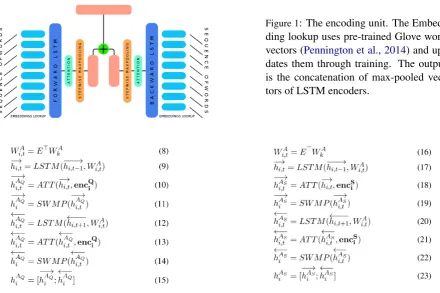
To encode the semantic information in ques-tions and sentences, we used a simple encoding unit (see Equations 1 to6 and Figure1). In this unit,Wk ∈R|V|are words in one-hot vector
repre-sentations wherekthelement of each vector is one and others are 0.V are all vocabularies in training questions and answers. E ∈ R|V|×de is the em-bedding matrix and de is the embedding dimen-sion. The product of the multiplication in Equa-tion1is the word embeddings in which each cell Wi,t is the word in time step tin sample i. Wi,t is the input of forward and backward RNN cells in Equations2and4.
As RNN cell, we used Long Short-Term Mem-ory architecture (LSTM) (Hochreiter and Schmid-huber, 1997). Pan et al. (2017) and Hu et al.
(2017) show that bi-directional LSTM architec-tures provide more accurate representations of tex-tual data. The common practice to form a bidirec-tional LSTM is to concatenate the last vectors in forward and backward LSTMs. Instead, we used a stepwise max pooling (SWMP) mechanism which takes the most important vectors from forward and backward LSTMs in Equations3 and5and con-catenate them in Equations6.
Wi,t =E>Wk (1)
−→
enci,t =LST M(−→enci,t−1, Wi,t) (2) −→
enci =SW M P(−→enci,t) (3) ←−
enci,t =LST M(←−enci,t+1, Wi,t) (4) ←−
enci =SW M P(←−enci,t) (5)
enci = [−→enci;←−enci] (6)
Using our encoding unit we encode questions and sentences and then concatenate the resulted vectors to generate a joint representation of ques-tions and their answer sentences in Equation7.
encQSi = [encQi ;encSi ] (7)
In the next step, we need to encode the con-stituent answers. Our answer encoding unit has two modules, one with attention on questions encQi (equations 8-15) and the other with atten-tion on sentencesencSi (equations 16-23). In both modules, we used an architecture similar to the one in the encoding unit with an additional atten-tion unit.
In the answer encoding unit, again the input to LSTM cells are word embeddings generated by lookup tableWi,tA. Two attention layers in this unit receive the output sequences of the forward and backward LSTM cells and focus once on ques-tions and once on sentences. This is done using an attention mechanism similar to the one proposed bySantos et al.(2016).
In the end, the vectors generated by these two modules are concatenated inhAQS
i = [h AQ i ;h
AS i ]3 to form a general attentive representation of con-stituents with respect to their corresponding ques-tions and sentences.
At training time, we try to learn the vector rep-resentations of questions, sentences, and their con-stituents jointly. However, we like to learn the vec-tors in a way that leads to a small distance between questions and their true constituents and a long distance between them and their false constituents. For this purpose, for each pair of question and sen-tence, we compute one true answerA+QSand some false answerA−QS vectors.
We generated these vectors by passing a correct constituent A+ and a random wrong constituent A− through question-attentive (see equations 8-15) and sentence-attentive (see equations 16-23) modules and by concatenating the outputs.
4.2 Training
In this section, we train our model. Given a ques-tion and the constituents associated with its answer sentence, the model generates a score for each constituent. The score is an estimate of how sim-ilar the constituent to the gold answer is. Taking the argmax over the scores, the model returns the id of its true predicted constituent.
To train the model, we need to compute the dis-tance between questions and their true constituents and to contrast it with the distance between ques-tions and their false constituents.
There are various measures of distance or simi-larity between two vectors each with its own mer-its.Feng et al.(2015) did an exhaustive study on different distance measures for text classification and proposed some new measures including the Geometric mean of Euclidean and Sigmoid Dot product (GESD) (Formula1) which outperformed other measures in their study.
We integrated GESD in our work to estimate
3All concatenations are performed on the last layer (i.e.
Figure 1: The encoding unit. The Embed-ding lookup uses pre-trained Glove word vectors (Pennington et al.,2014) and up-dates them through training. The output is the concatenation of max-pooled vec-tors of LSTM encoders.
Figure 2: Question-aware (equations 16-23) and sentence-aware (equations 8-15) encoding
the distance between questions and their true and false constituents. GESD linearly combines two other measures called L2-norm and inner product. L2-norm is the forward-line semantic distance be-tween two sentences and inner product measures the angle between two sentence vectors.
DIS(Q, A) =1+exp(1−(Q.A))∗ 1 1+||Q−A||
Formula 1: The distance between Question (Q) and Answer (A) vectors.
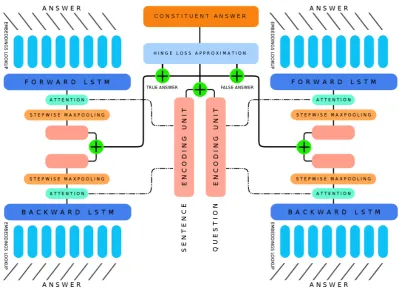
Now everything is ready to train the model. The overall system architecture is illustrated in Fig-ure 3. We use Hinge loss function (Formula 2) to estimate the loss on each question-answer com-bination. Hinge function increases the loss with the distance between a question and its true con-stituents while decreases it with the distance be-tween a question and its false constituents. In Equation2,encQS is the joint vector
representa-tion of quesrepresenta-tions and their answer sentences,hA − QS i is the vector of false answers,hA+QS is the vectors of true answers. Finally,mis the margin between positive and negative answers. It makes a
trade-off between the mistakes in positive and negative classes.
L=P
imax(0, m+DIS(enc QS i , h
A+QS
i )−DIS(enc QS i , h
A−QS
i ))
Formula 2: Hinge function. m is the margin,A−QS are false andA+QSare true answers.
5 Datasets
The Stanford Question Answering Dataset (SQuAD) (Rajpurkar et al., 2016) is a dataset for sentence-level (i.e. answer selection) and word-level (i.e. answer extraction) QA. It in-cludes 107,785 question-answer pairs synthesized by crowd workers on 536 Wikipedia articles. The dataset is randomly shuffled and divided into training (80%), development (10%) and test (10%) sets. Due to its large number of questions compared to previous datasets (Hirschman et al.,
Figure 3: The system architecture. Two answer modules, one with attention on questions and the other on sentences, provide a joint representation containing all required information with respect to questions and sentences for making inference on true constituents.
To control the vocabulary size we needed to elim-inate redundant numeric values, but at the same time, we wanted to parse the contents, and we needed to keep the semantic values of numeric tokens. Hence to preprocess the questions and sentences in the dataset, we removed all non-alphanumeric characters from all contents and then replaced numeric values with ‘9’. Then we used CoreNLP tool (Manning et al.,2014) to tok-enize and to perform constituency parsing on the contents.
After extracting constituents from the tree of sen-tences and comparing them with gold answers, we realized that 72% of the answers are constituents. Other 21% of the answers had slight divergences from a constituent, like lacking or having a deter-miner or punctuation mark which were eventually going to be disregarded in the official evaluation script. The remaining 7% was a combination of two smaller constituents or a part of a larger one. In the training set, to use constituents as answers, we replaced non-matching answers with the small-est and most similar constituents. Since at the
evaluation time, we needed the gold answers and not their replaced constituents, we did not change the answers in the development set.
We extracted a total number of 48 different con-stituents types including both terminal and non-terminal ones from SQuAD. The percentage of each constituent type in training and development sets are presented in Table1. The figures for de-velopment set are computed only based on exact match answers.
are without substituting non-matching answer-constituents. Then, we added other constituents as negative samples.
For evaluation purpose, we used SQuAD’s offi-cial evaluation script which computes the exact match and the F1 score. The exact match is the percentage of predictions which exactly match the gold answer and the F1 (Macro-averaged) score is the average overlap between the prediction and ground truth answer while treating them both as bags of tokens, and computing their F1.
To experiment our model furthermore, we used MS-MARCO dataset (Nguyen et al., 2015). As a machine comprehension dataset, MS-MARCO has two fundamental differences with SQuAD. Every question in MS-MARCO has several pas-sages from which the best answer should be re-trieved. Moreover, the answers in MS-MARCO are not necessarily sub-spans of the provided con-texts so that BLEU and ROUGE are used as the metrics in the official tool of MS-MARCO evalu-ation. During training we used the highest BLEU scored constituent as the answer and in the evalua-tion, we computed the BLEU and ROUGE scores of the constituents selected by the system. As the results in Table7show, our system obtained com-petitive results to another state-of-the-art system trained on the same dataset.
6 Experiment
To evaluate our new architecture and to see how integrating linguistic constituents affects its per-formance we set up two settings. We designed one setting for evaluating the effect of using con-stituents instead of words (constituent-base vs. word-base) and another to evaluate the effect of using attention mechanism on top of vector train-ing modules (uni- vs. bi-attention). Therefore we conducted four experiments on both datasets or eight experiments in total.
In the constituent-base setting, we generated the training and test data as described in Section 5. In word-base however, we replaced constituents with the tokens in answer sentences for both train and test sets and trained our model to compute two scores for initial and final positions of answer chunks. In the constituent-base setting at test time, we directly used the predicted constituent as the final answer. In the word-base setting, however, we got the final answer using the highest-scored words for initial and final positions.
We also investigated the effect of bilateral atten-tion on the model performance. In the bi-attenatten-tion model, we used the model as described in Sec-tion 4. In the uni-attention model, we eliminated the attention on sentences and only used the mod-ule for attention on questions.
For training our model, we used 300-dimensional pre-trained Glove word vectors (Pennington et al.,
2014) to generate the embedding matrix and kept the embedding matrix updated through training. We used 128-dimensional LSTMs for all recur-rent networks and used ’Adam’ with parameters learning rate=0.001, β1 = 0.9, β2 = 0.999 for optimization. We set batch size to 32 and dropout rate to 0.5 for all LSTMs and embedding layers. We performed the accuracy check only on the first best answer.
7 Result
The results of our experiments are summarized in Table 2. By contrasting the results of uni-/bi-attention and word/constituent-base models, we can see that the proposed bi-attention mecha-nism with linguistic constituents integrated into it makes a significant improvement on answer ex-traction. Another interesting observation is that the Exact Match metric benefits from restric-tion to constituents as answers. Concerning the MS-MARCO dataset, the results are competitive to a state-of-the-art system tested on the same dataset (Wang et al.,2017).
8 Ablation and Error Analysis
prepo-SQuAD Development set MS-MARCO Evaluation set Exact-match(%) F1(%) BLEU ROUGE Logistic Regression (Rajpurkar et al.,2016) 40.00 % 51.00 % - -Uni-Attention Word-base (this work) 55.12 % 57.98 % 35.6 35.1 Bi-Attention Word-base (this work) 59.84 % 63.08 % 38.1 38.4 Uni-Attention Constituency-base (this work) 73.82 % 77.43 % 39.6 39.9 TreeLSTM (Zhang et al.,2017) 69.10 % 78.38 % - -BIDAF (Seo et al.,2016) 72.6 % 80.7 % - -CCNN (Xie and Eric,2017) 74.1 % 82.6 % - -R-net (Wang et al.,2017) 75.60 % 82.80 % 42.2 42.9 Bi-Attention Constituency-base (this work) 80.72 % 83.25 % 42.1 42.7 Human Performance (Rajpurkar et al.,2016) 82.30 % 91.22 % -
-Table 2: The performances of different models in the exact match and F1 metrics for SQuAD and BLEU and ROUGE for the MS-MARCO dataset.
NP ROOT NNP NN JJ VP CD PP S Others Constituent Type
0.0 0.2 0.4 0.6 0.8
Pe
rfo
rm
an
ce
[image:8.595.83.516.65.216.2]Model Performance Type Contribution
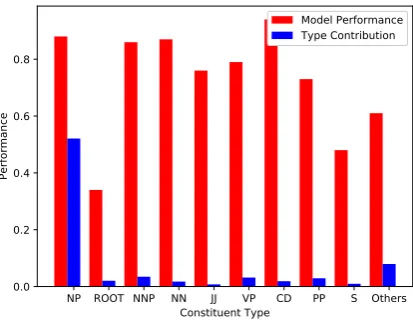
Figure 4: Blue lines are the contribution of each type in the overall system performance using the best model and at the convergence time. Red bars represent the performance of the model in re-trieving each constituent type when the model is converged. Performance is expressed in the ex-act match metric (%). As a guide to how to read the chars, the first blue line for NP type says that 50% of all correctly extracted answers by the sys-tem are NP type-answers. The red line of the same type says that our system managed to re-trieve about 87% of all NP-type answers in the dataset.
sitional phrases. We can also see how the model performed for each constituent. It seems that ex-tracting cardinal numbers is much easier for the model than retrieving roots or full sentences. An analysis of the errors shows that false answer sentence, non-constituent answers, parsing errors, overlapping constituents and unknown words are the primary reasons for the mistakes made by our system. The sentence selection process brought about six percent incorrect answers. The next primary reason for making mistakes is the con-stituents which contain other smaller concon-stituents. While in all cases we extract the smallest stituent, in about three percent of overlapping con-stituents the more extended ones are the correct answer. Parsing errors where the constituents are not retrieved correctly and unknown words where the embeddings are not trained properly are re-sponsible for other four percent of the errors. Fi-nally, non-constituent answers led to around eight percent false answers in the system output.
9 Conclusion and Future Work
We described a new linguistically-based end-to-end DNN for Question Answering from unstruc-tured data. This model is a neural formulation in which linguistic constituents are explicitly mod-eled. It operates an LSTM over the constituents and uses the resulting hidden states to attend both to question and to the encompassing context sen-tence, thereby enriching the constituents represen-tation with both. The use of constituents instead of an arbitrary string of words in answers improves the system performance in three ways.
First, it increases the precision of the system. By looking at the small gap between the F1 and the exact match metrics in our system and compare it to the ones for the other systems, we can see that the ratio of exact-match answers in our system is higher than that of the other ones.
[image:8.595.84.291.283.443.2](Macro-averaged) metric computes the average overlap between the prediction and ground truth answer. While a predicted answer may have a full overlap with the ground truth hence gains a high F1 score, due to the irrelevant words it contains, it poses an incoherent answer to users. The longer the gap between exact match and F1 measures, the more inappropriate words appear in answers. This is primarily an essential factor in the overall quality of dialogue QA systems where users expect to re-ceive a natural and human-generated-like answer. Last but not least, imposing constraints on the can-didate space, limit errors and make the system more efficient by decreasing the search space and weeding out non-relevant answers. In the future, we plan to integrate dependency relations into the model by designing a larger model and evaluating it on other QA datasets.
Acknowledgments
This research was partially funded by the Ministry of Education, Youth and Sports of the Czech Republic (project LM2015071), by Charles Uni-versity SVV project number 260 453 and GAUK 207-10/250098 of Charles University in Prague.
References
Ahmad Aghaebrahimian. 2017a. Constrained deep an-swer sentence selection. InProceedings of the 20th In-ternational Conference on Text, Speech, and Dialogue (TSD).
Ahmad Aghaebrahimian. 2017b. Hybrid Deep Open-Domain Question Answering. InProceedings of the 8th Language and Technology Conference (LTC).
Ahmad Aghaebrahimian and Filip Jurˇc´ıˇcek. 2016a. Constraint-Based Open-Domain Question Answering Using Knowledge Graph Search. InProceedings of the 19th International Conference on Text, Speech and Di-alogue (TSD), LNAI 9924.
Ahmad Aghaebrahimian and Filip Jurˇc´ıˇcek. 2016b. Open-domain Factoid Question Answering via Knowl-edge Graph Search. InProceedings of the Workshop on Human-Computer Question Answering, The North American Chapter of the Association for Computa-tional Linguistics (NAACL).
Antoine Bordes, Nicolas Usunier, Sumit Chopra, and Jason Weston. 2015. Large-scale simple question answering with memory networks. arXiv preprint arXiv:1506.02075.
Danqi Chen, Adam Fisch, Jason Weston, and Antoine Bordes. 2017. Reading wikipedia to answer open- do-main questions. InarXiv:1704.00051, 2017a.
Noam Chomsky. 1957. Syntactic structures. The Hague, Paris: Mouton.
Noam Chomsky. 1993. Lectures on Government and Binding: The Pisa Lectures. Mouton de Gruyter.
Peter Clark and Oren Etzioni. 2016. My computer is an honor student but how intelligent is it? standardized tests as a measure of ai.AI Magazine.
James Clarke, Dan Goldwasser, Ming-Wei Chang, and Dan Roth. 2010. Driving semantic parsing from the worlds response. In Proceedings of the Conference on Computational Natural Language Learning (CoNLL).
Yiming Cui, Zhipeng Chen, Si Wei, Shijin Wang, Ting Liu, and Guoping Hu. 2016. Attention-over-attention neural networks for reading comprehension.
arXiv:1607.04423.
Jeffry L. Elman. 1990. Finding structure in time. Cog-nitive Science, 14(2):179–211.
Minwei Feng, Bing Xiang, Michael R. Glass, Lidan Wang, and Bowen Zhou. 2015. Applying deep learn-ing to answer selection: a study and an open task. In
Proceedings of IEEE ASRU Workshop.
Gerald Gazdar, Ewan H. Klein, Geoffrey K. Pullum, and Ivan A. Sag. 1994. Generalized Phrase Structure Grammar. Blackwell, Oxford.
Yichen Gong and Samuel R Bowman. 2017. Ruminat-ing reader: ReasonRuminat-ing with gated multi-hop attention.
arXiv:1704.07415.
Hua He, Kevin Gimpel, and Jimmy Lin. 2015. Multi-perspective sentence similarity modeling with convolu-tional neural networks. InProceedings of the Confer-ence on Empirical Methods in Natural Language Pro-cessing(EMNLP).
Hua He and Jimmy Lin. 2016. Pairwise word interac-tion modeling with deep neural networks for seman-tic similarity measurement. In Proceedings of The North American Chapter of the Association for Com-putational Linguistics (NAACL).
Karl Moritz Hermann, Tomas Kocisky, Edward Grefenstette, Lasse Espeholt, Will Kay, Mustafa Su-leyman, and Phil Blunsom. 2015. Teaching machines to read and comprehend. InProceedings of Advances in Neural Information Processing Systems.
Felix Hill, Antoine Bordes, Sumit Chopra, and Ja-son Weston. 2015. The goldilocks principle: Reading children’s books with explicit memory representations.
arXiv :1511.02301.
Sepp Hochreiter and Jurgen Schmidhuber. 1997. Long short-term memory.Neural Comput., 9(8).
Minghao Hu, Yuxing Peng, and Xipeng Qiu. 2017. Reinforced mnemonic reader for machine comprehen-sion.arXiv:1705.02798.
Tomasz Jurczyk, Michael Zhai, and Jinho D. Choi. 2016. Selqa: A new benchmark for selection- based question answering. In Proceedings of the 28th In-ternational Conference on Tools with Artificial Intel-ligence.
Rudolf Kadlec, Martin Schmid, Ondrej Bajgar, and Jan Kleindienst. 2016. Text understanding with the atten-tion sum reader network. InProceedings of the Asso-ciation for Computational Linguistics.
Tom Kwiatkowski, Luke Zettlemoyer, Sharon Goldwa-ter, and Mark Steedman. 2010. Inducing probabilistic ccg grammars from logical form with higher-order uni-fication. InProceedings of the Conference on Empiri-cal Methods in Natural Language Processing.
Yann LeCun, Leon Bottou, Yoshua Bengio, and Patrick Haffner. 1998. Gradient-based learning applied to doc-ument recognition. InProceedings of the IEEE.
Christopher D. Manning, Mihai Surdeanu, John Bauer, Jenny Finkel, Steven J. Bethard, and David McClosky. 2014. The Stanford CoreNLP natural language pro-cessing toolkit. Inproceedings of the Association for Computational Linguistics (ACL) System Demonstra-tions.
Tri Nguyen, Mir Rosenberg, Xia Song, Jianfeng Gao, Saurabh Tiwary, Rangan Majumder, and Li Deng. 2015. Ms marco: A human generated machine read-ing comprehension dataset.CoRR, abs/1611.09268.
Boyuan Pan, Hao Li, Zhou Zhao, Bin Cao, Deng Cai, and Xiaofei He. 2017. Memen: Multi-layer embed-ding with memory networks for machine comprehen-sion.arXiv:1707.09098.
Jeffrey Pennington, Richard Socher, and Christo-pher D. Manning. 2014. Glove: Global vectors for word representation. InProcedings of the conference Empirical Methods in Natural Language Processing (EMNLP).
Carl Pollard and Ivan A. Sag. 1994. Head-driven phrase structure grammar. University of Chicago Press, Chicago.
Pranav Rajpurkar, Jian Zhang, Konstantin Lopyrev, and Percy Liang. 2016. Squad: 100,000+ questions for ma-chine comprehension of text. arXiv:1606.05250.
Jinfeng Rao, Hua He, and Jimmy Lin. 2016. Noise-contrastive estimation for answer selection with deep neural networks. InProceedings of the 25th ACM In-ternational on Conference on Information and Knowl-edge Management, CIKM ’16.
Matthew Richardson, Burges, Christopher J.C., and Renshaw Erin. 2013. Mctest: A challenge dataset for the open-domain machine comprehension of text. InProceedings of Empirical Methods in Natural Lan-guage Processing(EMNLP).
Cicero dos Santos, Ming Tan, Bing Xiang, and Bowen Zhou. 2016. Attentive pooling networks.
arXiv:1602.03609v1.
Minjoon Seo, Aniruddha Kembhavi, Ali Farhadi, and Hannaneh Hajishirzi. 2016. Bidirectional attention flow for machine comprehension.arXiv:1611.01603.
Dan Shen and Dietrich Klakow. 2006. Exploring corre-lation of dependency recorre-lation paths for answer extrac-tion. InProceedings of the 21st International Confer-ence on Computational Linguistics.
Yelong Shen, Po-Sen Huang, Jianfeng Gao, and Weizhu Chen. 2016. Reasonet: Learning to stop read-ing in machine comprehension. InProceedings of the Workshop on Cognitive Computation: Integrating neu-ral and symbolic approaches 2016 co-located with the 30th Annual Conference on Neural Information Pro-cessing Systems (NIPS 2016).
Md Arafat Sultan, Vittorio Castelli, and Radu Florian. 2016. A joint model for answer sentence ranking and answer extraction. InTransactions of the Association for Computational Linguistics.
Oriol Vinyals, Meire Fortunato, and Navdeep Jaitly. 2017. Pointer networks. InProceedings of NIPS.
Shuohang Wang and Jing Jiang. 2016. Machine comprehension using match-lstm and answer pointer.
arXiv:1608.07905.
Wenhui Wang, Nan Yang, Furu Wei, Baobao Chang, and Ming Zhou. 2017. Gated self-matching networks for reading comprehension and question answering. In
Proceedings of the Association for Computational Lin-guistics(ACL).
Zhiguo Wang, Haitao Mi, and Abraham Ittycheriah. 2016. Sentence similarity learning by lexical decom-position and comdecom-position.arXiv:1602.07019.
Dirk Weissenborn, Georg Wiese, and Laura Seiffe. 2017a. Fastqa: A simple and efficient neural architec-ture for question answering.arXiv:1703.04816.
Dirk Weissenborn, Georg Wiese, and Laura Seiffe. 2017b. Making neural qa as simple as possible but not simpler. InProceedings of the Computational Natural Language Learning (CoNLL).
Pengtao Xie and Xing Eric. 2017. A constituent-centric neural architecture for reading comprehension. InProceedings of the 55th Annual Meeting of the As-sociation for Computational Linguistics.
Xuchen Yao and Benjamin Van Durme. 2014. Infor-mation extraction over structured data: Question an-swering with freebase. In Proceedings of Association for Computational Linguistics.
Wen-tau Yih, Ming-Wei Chang, Christopher Meek, and Andrzej Pastusiak. 2013. Question answering using enhanced lexical semantic models. In Proceedings of Association for Computational Linguistics(ACL).
Lei Yu, Karl Moritz Hermann, Phil Blunsom, and Stephen Pulman. 2016. Deep learning for answer sen-tence selection. Proceedings of the NIPS Deep Learn-ing Workshop.
Junbei Zhang, Xiaodan Zhu, Qian Chen, Lirong Dai, and Hui Jiang. 2017. Exploring question understand-ing and adaptation in neural-network-based question answering. arXiv:1703.04617.
A Full Constituent types
Other constituent types include: NP, ROOT, NNP, NN, JJ, VP, CD, PP, S, NNS, ADJP, SBAR, NP-TMP, QP, ADVP, VBG, DT, VBN, IN, NNPS, VB, RB, VBD, VBZ, JJR, VBP, UCP, X, CC, FRAG, WHNP, JJS, NAC, NX, FW, TO, RBR, PDT, PRN, INTJ, PRT, WHPP, PRP, SINV, WHADJP, MD, RRC, WHADVP