Neighborhood Mixture Model for Knowledge Base Completion
Dat Quoc Nguyen1, Kairit Sirts1, Lizhen Qu2 and Mark Johnson1
1 Department of Computing, Macquarie University, Sydney, Australia
[email protected], {kairit.sirts, mark.johnson}@mq.edu.au
2 Data61 & Australian National University
Abstract
Knowledge bases are useful resources for many natural language processing tasks, however, they are far from complete. In this paper, we define a novel entity rep-resentation as a mixture of its neighbor-hood in the knowledge base and apply this technique on TransE—a well-known embedding model for knowledge base completion. Experimental results show that the neighborhood information signif-icantly helps to improve the results of the TransE, leading to better performance than obtained by other state-of-the-art embed-ding models on three benchmark datasets for triple classification, entity prediction and relation prediction tasks.
Keywords: Knowledge base completion, embedding model, mixture model, link prediction, triple classification, entity pre-diction, relation prediction.
1 Introduction
Knowledge bases (KBs), such as WordNet (Miller, 1995), YAGO (Suchanek et al., 2007), Freebase (Bollacker et al., 2008) and DBpedia (Lehmann et al., 2015), represent relationships between enti-ties as triples(head entity,relation,tail entity). Even very large knowledge bases are still far from complete (Socher et al., 2013; West et al., 2014). Knowledge base completionorlink prediction sys-tems (Nickel et al., 2015) predict which triples not in a knowledge base are likely to be true (Taskar et al., 2004; Bordes et al., 2011).
Embedding modelsfor KB completion associate entities and/or relations with dense feature vectors or matrices. Such models obtain state-of-the-art performance (Bordes et al., 2012; Bordes et al., 2013; Socher et al., 2013; Wang et al., 2014; Guu
et al., 2015; Nguyen et al., 2016) and generalize to large KBs (Krompa et al., 2015).
Most embedding models for KB completion learn only from triples and by doing so, ignore lots of information implicitly provided by the structure of the knowledge graph. Recently, several authors have addressed this issue by incorporating rela-tion path informarela-tion into model learning (Garc´ıa-Dur´an et al., 2015; Lin et al., 2015a; Guu et al., 2015; Toutanova et al., 2016) and have shown that the relation paths between entities in KBs provide useful information and improve knowledge base completion. For instance, a three-relation path
(head,born in hospital/r1,e1) ⇒(e1,hospital located in city/r2,e2) ⇒(e2,city in country/r3,tail)
is likely to indicate that the fact
(head,nationality,tail) could be true, so the relation path herep ={r1,r2,r3}is useful for predicting the relationship “nationality” between theheadandtailentities.
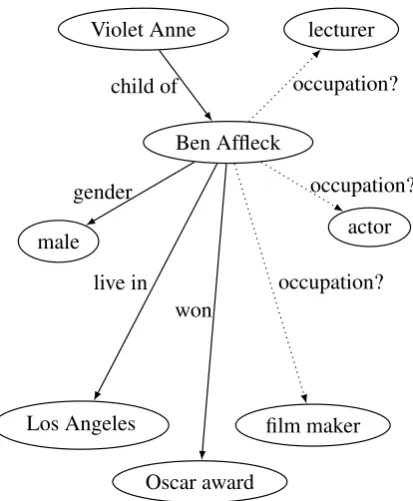
Besides the relation paths, there could be other useful information implicitly presented in the knowledge base that could be exploited for better KB completion. For instance, the whole neigh-borhood of entities could provide lots of useful in-formation for predicting the relationship between two entities. Consider for example a KB fragment given in Figure 1. If we know that Ben Affleck has won an Oscar award and Ben Affleck lives in Los Angeles, then this can help us to predict that Ben Affleck is an actor or a film maker, rather than a lecturer or a doctor. If we additionally know that Ben Affleck’s gender is male then there is a higher chance for him to be a film maker. This intuition can be formalized by representing an entity vector as a relation-specific mixture of its neighborhood as follows:
Ben Affleck
male gender
actor occupation?
film maker occupation?
Oscar award won
Los Angeles live in
lecturer
occupation? Violet Anne
[image:2.595.77.284.59.310.2]child of
Figure 1: An example fragment of a KB.
Ben Affleck =ωr,1(Violet Anne,child of) +ωr,2(male,gender−1)
+ωr,3(Los Angeles,lives in−1) +ωr,4(Oscar award,won−1),
where ωr,i are the mixing weights that indicate how important each neighboring relation is for predicting the relation r. For example, for pre-dicting the occupation relationship, the knowl-edge about thechild of relationship might not be that informative and thus the corresponding mix-ing coefficient can be close to zero, whereas it could be relevant for predicting some other re-lationship, such as parent or spouse, in which case the relation-specific mixing coefficient for the
child of relationship could be high.
The primary contribution of this paper is intro-ducing and formalizing the neighborhood mixture model. We demonstrate its usefulness by apply-ing it to the well-known TransE model (Bordes et al., 2013). However, it could be applied to other embedding models as well, such as Bilinear mod-els (Bordes et al., 2012; Yang et al., 2015) and STransE (Nguyen et al., 2016). While relation path models exploit extra information using longer paths existing in the KB, the neighborhood mix-ture model effectively incorporates information about many paths simultaneously. Our extensive
experiments on three benchmark datasets show that it achieves superior performance over com-petitive baselines in three KB completion tasks: triple classification, entity prediction and relation prediction.
2 Neighborhood mixture modeling
In this section, we start by explaining how to formally construct the neighbor-based entity rep-resentations in section 2.1, and then describe the NeighborhoodMixture Model applied to the TransE model (Bordes et al., 2013) in section 2.2. Section 2.3 explains how we train our model.
2.1 Neighbor-based entity representation
LetE denote the set of entities and R the set of relation types. Denote byR−1 the set of inverse
relationsr−1. Denote by Gthe knowledge graph
consisting of a set of correct tiples(h, r, t), such thath, t ∈ E andr ∈ R. LetK denote the sym-metric closure ofG, i.e. if a triple (h, r, t) ∈ G, then both(h, r, t)and(t, r−1, h)∈ K.
Define:
Ne,r ={e0|(e0, r, e)∈ K}
as a set of neighboring entities connected to entity
ewith relationr. Then
Ne={(e0, r)|r∈ R ∪ R−1, e0∈ Ne,r} is the set of all entity and relation pairs that are neighbors for entitye.
Each entityeis associated with a k-dimensional vector ve ∈ Rk and relation-dependent vectors ue,r ∈Rk, r∈ R ∪ R−1. Now we can define the neighborhood-based entity representationϑe,rfor an entitye ∈ E for predicting the relationr ∈ R
as follows:
ϑe,r =aeve+ X
(e0,r0)∈Ne
br,r0ue0,r0, (1)
aeandbr,r0 are the mixture weights that are con-strained to sum to 1 for each neighborhood:
ae∝δ+ expαe (2)
br,r0 ∝expβr,r0 (3)
In real-world factual KBs, e.g. Freebase (Bol-lacker et al., 2008), some entities, such as “male”, can have thousands or millions neighboring enti-ties sharing the same relation “gender.” For such entities, computing the neighbor-based vectors can be computationally very expensive. To overcome this problem, we introduce in our implementa-tion a filtering threshold τ and consider in the neighbor-based entity representation construction only those relation-specific neighboring entity sets for which|Ne,r| ≤τ.
2.2 TransE-NMM: applying neighborhood mixtures to TransE
Embedding models define for each triple
(h, r, t) ∈ G, a score function f(h, r, t) that measures its implausibility. The goal is to choose
f such that the scoref(h, r, t)of a plausible triple
(h, r, t)is smaller than the scoref(h0, r0, t0)of an implausible triple(h0, r0, t0).
TransE (Bordes et al., 2013) is a simple em-bedding model for knowledge base completion, which, despite of its simplicity, obtains very com-petitive results (Garc´ıa-Dur´an et al., 2016; Nickel et al., 2016). In TransE, both entities eand rela-tionsrare represented with k-dimensional vectors ve∈Rkandvr∈Rk, respectively. These vectors are chosen such that for each triple(h, r, t)∈ G:
vh+vr≈vt (4) The score function of the TransE model is the norm of this translation:
f(h, r, t)TransE=kvh+vr−vtk`1/2 (5)
We define the score function of our new model TransE-NMM in terms of the neighbor-based en-tity vectors as follows:
f(h, r, t) =kϑh,r+vr−ϑt,r−1k`1/2, (6)
using either the `1 or the `2-norm, and ϑh,r and ϑt,r−1 are defined following the Equation 1. The
relation-specific entity vectors ue,r used to con-struct the neighbor-based entity vectors ϑe,r are defined based on the TransE translation operator:
ue,r=ve+vr (7) in which vr−1 = −vr. For each correct triple (h, r, t), the sets of neighboring entitiesNh,r and
Nt,r−1 exclude the entitiestandh, respectively.
If we set the filtering threshold τ = 0 then ϑh,r =vhandϑt,r−1 =vtfor all triples. In this
case, TransE-NMM reduces to the plain TransE model. In all our experiments presented in section 4, the baseline TransE results are obtained with the TransE-NMM withτ = 0.
2.3 Parameter optimization
The TransE-NMM model parameters include the vectors ve,vr for entities and relation types, the entity-specific weights α = {αe|e ∈ E} and relation-specific weightsβ = {βr,r0|r, r0 ∈ R ∪ R−1}. To learn these parameters, we minimize the L2-regularized margin-based objective function:
L= X
(h,r,t)∈G
(h0,r,t0)∈G0 (h,r,t)
[γ+f(h, r, t)−f(h0, r, t0)]
+
+λ2kαk22+kβk22, (8)
where[x]+ = max(0, x), γ is the margin hyper-parameter, λ is the L2 regularization parameter
and
G0(h,r,t)={(h0, r, t)|h0 ∈ E,(h0, r, t)∈ G}/ ∪ {(h, r, t0)|t0 ∈ E,(h, r, t0)∈ G}/
is the set of incorrect triples generated by corrupt-ing the correct triple (h, r, t) ∈ G. We applied the “Bernoulli” trick to choose whether to gener-ate the head or tail entity when sampling an incor-rect triple (Wang et al., 2014; Lin et al., 2015b; He et al., 2015; Ji et al., 2015; Ji et al., 2016).
We use Stochastic Gradient Descent (SGD) with RMSProp adaptive learning rate to minimize
L, and impose the following hard constraints dur-ing traindur-ing: kvek2 61andkvrk2 6 1. We
em-ploy alternating optimization to minimizeL. We first initialize the entity and relation-specific mix-ing parametersαandβto zero and only learn the randomly initialized entity and relation vectorsve andvr. Then we fix the learned vectors and only optimize the mixing parameters. In the final step, we fix again the mixing parameters and fine-tune the vectors. In all experiments presented in sec-tion 4, we train for 200 epochs during each three optimization step.
3 Related work
Model Score functionf(h, r, t) Opt. STransE kWr,1vh+vr−Wr,2vtk`1/2 ;Wr,1,Wr,2∈Rk×k;vr ∈Rk SGD
SE kWr,1vh−Wr,2vtk`1/2 ;Wr,1,Wr,2∈Rk×k SGD
Unstructured kvh−vtk`1/2 SGD
TransE kvh+vr−vtk`1/2 ;vr∈Rk SGD
TransH k(I−rpr>p)vh+vr−(I−rpr>p)vtk`1/2 SGD rp,vr∈Rk;I: Identity matrix sizek×k
TransD k(I+rph>p)vh+vr−(I+rpt>p)vtk`1/2 AdaDelta rp,vr∈Rn;hp,tp∈Rk;I: Identity matrix sizen×k
TransR kWrvh+vr−Wrvtk`1/2 ;Wr∈Rn×k;vr ∈Rn SGD
TranSparse kWh
r(θhr)vh+vr−Wrt(θtr)vtk`1/2;Whr,Wtr ∈Rn×k;θrh,θtr∈R;vr∈Rn SGD
SME (W1,1vh+W1,2vr+b1)>(W2,1vt+W2,2vr+b2) SGD b1,b2∈Rn;W1,1,W1,2,W2,1,W2,2∈Rn×k
DISTMULT v>
hWrvt;Wris a diagonal matrix∈Rk×k AdaGrad
NTN v>rtanh(v>hMrvt+Wr,1vh+Wr,2vt+br) L-BFGS
vr,br ∈Rn;Mr ∈Rk×k×n;Wr,1,Wr,2∈Rn×k
Bilinear-COMP v>hWr1Wr2...Wrmvt;Wr1,Wr2, ...,Wrm∈Rk×k AdaGrad
[image:4.595.76.525.60.354.2]TransE-COMP kvh+vr1+vr2+...+vrm−vtk`1/2;vr1,vr2, ...,vrm∈Rk AdaGrad
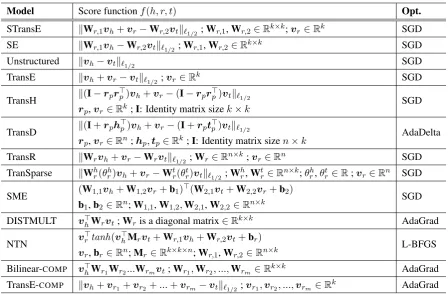
Table 1: The score functionsf(h, r, t)and the optimization methods (Opt.) of several prominent embed-ding models for KB completion. In all of these models, the entitieshandtare represented by vectorsvh andvt∈Rkrespectively.
differ in their score functionf(h, r, t) and the al-gorithm used to optimize their margin-based ob-jective function, e.g., SGD, AdaGrad (Duchi et al., 2011), AdaDelta (Zeiler, 2012) or L-BFGS (Liu and Nocedal, 1989).
The Unstructured model (Bordes et al., 2012) assumes that the head and tail entity vectors are similar. As the Unstructured model does not take the relationship into account, it cannot distinguish different relation types. The Structured Embed-ding(SE) model (Bordes et al., 2011) extends the Unstructured model by assuming that the head and tail entities are similar only in a relation-dependent subspace, where each relation is represented by two different matrices. Futhermore, the SME model (Bordes et al., 2012) uses four different ma-trices to project entity and relation vectors into a subspace. The TransH model (Wang et al., 2014) associates each relation with a relation-specific hyperplane and uses a projection vector to project entity vectors onto that hyperplane. TransD (Ji et al., 2015) and TransR/CTransR (Lin et al., 2015b) extend the TransH model by using two projection vectors and a matrix to project entity vectors into a relation-specific space, respectively. STransE
(Nguyen et al., 2016) and TranSparse (Ji et al., 2016) are extensions of the TransR model, where head and tail entities are associated with their own projection matrices.
The DISTMULT model (Yang et al., 2015) is based on theBilinearmodel (Nickel et al., 2011; Bordes et al., 2012; Jenatton et al., 2012) where each relation is represented by a diagonal rather than a full matrix. The neural tensor network (NTN) model (Socher et al., 2013) uses a bilinear tensor operator to represent each relation. Simi-lar quadratic forms are used to model entities and relations in KG2E (He et al., 2015) and TATEC (Garc´ıa-Dur´an et al., 2016).
Luo et al. (2015) constructed relation paths be-tween entities and viewing entities and relations in the path as pseudo-words applied Word2Vec al-gorithms (Mikolov et al., 2013) to produce pre-trained vectors for these pseudo-words. Luo et al. (2015) showed that using these pre-trained vectors for initialization helps to improve the performance of the TransE, SME and SE models. RTransE (Garc´ıa-Dur´an et al., 2015), PTransE (Lin et al., 2015a) and TransE-COMP(Guu et al., 2015) are extensions of the TransE model. These mod-els similarly represent a relation path by a vec-tor which is the sum of the vecvec-tors of all rela-tions in the path, whereas in the Bilinear-COMP model (Guu et al., 2015), each relation is a trix and so it represents the relation path by ma-trix multiplication. Our neighborhood mixture model can be adapted to both relation path mod-els Bilinear-COMP and TransE-COMP, by replac-ing head and tail entity vectors by the neighbor-based vector representations, thus combining ad-vantages of both path and neighborhood informa-tion. Nickel et al. (2015) reviews other approaches for learning from KBs and multi-relational data.
4 Experiments
To investigate the usefulness of the neighbor mix-tures, we compare the performance of the TransE-NMM against the results of the baseline TransE and other state-of-the-art embedding models on the triple classification, entity prediction and re-lation prediction tasks.
4.1 Datasets
Dataset: WN11 FB13 NELL186
#R 11 13 186
#E 38,696 75,043 14,463
#Train 112,581 316,232 31,134
#Valid 2,609 5,908 5,000
[image:5.595.79.285.538.622.2]#Test 10,544 23,733 5,000
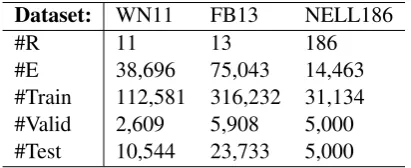
Table 2: Statistics of the experimental datasets used in this study (and previous works). #E is the number of entities, #R is the number of rela-tion types, and #Train, #Valid and #Test are the numbers of correct triples in the training, valida-tion and test sets, respectively. Each validavalida-tion and test set also contains the same number of incorrect triples as the number of correct triples.
We conduct experiments using three publicly
available datasets WN11, FB13 and NELL186. For all of them, the validation and test sets con-taining both correct and incorrect triples have al-ready been constructed. Statistical information about these datasets is given in Table 2.
The two benchmark datasets1, WN11 and
FB13, were produced by Socher et al. (2013) for triple classification. WN11 is derived from the large lexical KB WordNet (Miller, 1995) in-volving 11 relation types. FB13 is derived from the large real-world fact KB FreeBase (Bollacker et al., 2008) covering 13 relation types. The NELL186 dataset2 was introduced by Guo et al.
(2015) for both triple classification and entity pre-diction tasks, containing 186 most frequent rela-tions in the KB of the CMU Never Ending Lan-guage Learning project (Carlson et al., 2010).
4.2 Evaluation tasks
We evaluate our model on three commonly used benchmark tasks: triple classification, entity pre-diction and relation prepre-diction. This subsection describes those tasks in detail.
Triple classification: The triple classification task was first introduced by Socher et al. (2013), and since then it has been used to evaluate vari-ous embedding models. The aim of the task is to predict whether a triple(h, r, t)is correct or not.
For classification, we set a relation-specific threshold θr for each relation type r. If the im-plausibility score of an unseen test triple (h, r, t)
is smaller thanθrthen the triple will be classified as correct, otherwise incorrect. Following Socher et al. (2013), the relation-specific thresholds are determined by maximizing the micro-averaged ac-curacy, which is a per-triple average, on the vali-dation set. We also report the macro-averaged ac-curacy, which is a per-relation average.
Entity prediction: The entity prediction task (Bordes et al., 2013) predicts the head or the tail entity given the relation type and the other en-tity, i.e. predictingh given(?, r, t) or predicting
t given (h, r,?) where ? denotes the missing el-ement. The results are evaluated using a ranking induced by the function f(h, r, t) on test triples. Note that the incorrect triples in the validation and test sets are not used for evaluating the entity pre-diction task nor the relation prepre-diction task.
Each correct test triple(h, r, t)is corrupted by replacing either its head or tail entity by each of the possible entities in turn, and then we rank these candidates in ascending order of their implausi-bility score. This is called as the “Raw” setting protocol. For the “Filtered” setting protocol de-scribed in Bordes et al. (2013), we also filter out before ranking any corrupted triples that appear in the KB. Ranking a corrupted triple appearing in the KB (i.e. a correct triple) higher than the origi-nal test triple is also correct, but is peorigi-nalized by the “Raw” score, thus the “Filtered” setting provides a clearer view on the ranking performance.
In addition to the mean rank and the Hits@10 (i.e., the proportion of test triples for which the target entity was ranked in the top 10 predictions), which were originally used in the entity predic-tion task (Bordes et al., 2013), we also report the mean reciprocal rank (MRR), which is commonly used in information retrieval. In both “Raw” and “Filtered” settings, mean rank is always greater or equal to 1 and lower mean rank indicates bet-ter entity prediction performance. The MRR and Hits@10 scores always range from 0.0 to 1.0, and higher score reflects better prediction result.
Relation prediction: The relation prediction task (Lin et al., 2015a) predicts the relation type given the head and tail entities, i.e. predicting r
given (h,?, t) where ? denotes the missing ele-ment. We corrupt each correct test triple(h, r, t)
by replacing its relation r by each possible rela-tion type in turn, and then rank these candidates in ascending order of their implausibility score. Just as in the entity prediction task, we use two setting protocols, “Raw” and “Filtered”, and evaluate on mean rank, MRR and Hits@10.
4.3 Hyper-parameter tuning
For all evaluation tasks, results for TransE are ob-tained with TransE-NMM with the filtering thresh-oldτ = 0, while we setτ = 10for TransE-NMM. For triple classification, we first performed a grid search to choose the optimal hyper-parameters for TransE by monitoring the micro-averaged triple classification accuracy after each training epoch on the validation set. For all datasets, we chose either the`1 or`2 norm in the score functionf and the initial RMSProp learning rate η ∈ {0.001,0.01}. Following the previous work (Wang et al., 2014; Lin et al., 2015b; Ji et al., 2015; He et al., 2015; Ji et al., 2016), we selected
the margin hyper-parameterγ ∈ {1,2,4}and the number of vector dimensions k ∈ {20,50,100}
on WN11 and FB13. On NELL186, we setγ = 1
andk = 50(Guo et al., 2015; Luo et al., 2015). The highest accuracy on the validation set was ob-tained when usingη = 0.01for all three datasets, and when using `2 norm for NELL186, γ = 4, k = 20 and `1 norm for WN11, and γ = 1, k= 100and`2norm for FB13.
We set the hyper-parameters η, γ, k, and the
`1 or the `2-norm in our TransE-NMM model to
the same optimal hyper-parameters searched for TransE. We then used a grid search to select the hyper-parameter δ ∈ {0,1,5,10} and L2 regu-larizerλ∈ {0.005,0.01,0.05}for TransE-NMM. By monitoring the micro-averaged accuracy after each training epoch, we obtained the highest ac-curacy on validation set when using δ = 1 and
λ = 0.05 for both WN11 and FB13, and δ = 0
andλ= 0.01for NELL186.
For both entity prediction and relation predic-tion tasks, we set the hyper-parameters η, γ,
k, and the `1 or the `2-norm for both TransE
and TransE-NMM to be the same as the opti-mal parameters found for the triple classifica-tion task. We then monitored on TransE the fil-tered MRR on validation set after each training epoch. We chose the model with highest valida-tion MRR, which was then used to evaluate the test set. For TransE-NMM, we searched the hyper-parameter δ ∈ {0,1,5,10} and L2 regularizer
λ ∈ {0.005,0.01,0.05}. By monitoring the fil-tered MRR after each training epoch, we selected the best model with the highest filtered MRR on the validation set. Specifically, for the entity pre-diction task, we selectedδ = 10andλ= 0.005for WN11,δ = 5andλ= 0.01for FB13, andδ = 5
andλ= 0.005for NELL186. For the relation pre-diction task, we selectedδ = 10andλ = 0.005
for WN11, δ = 10 andλ = 0.05 for FB13, and
δ= 1andλ= 0.05for NELL186.
5 Results
5.1 Quantitative results
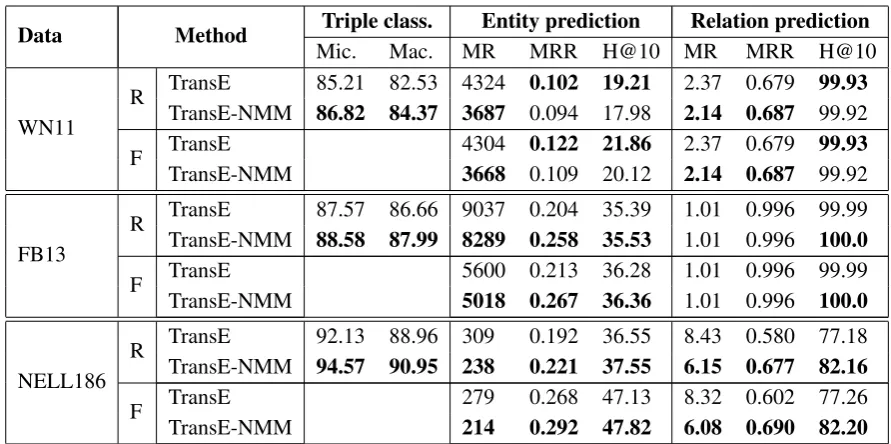
Table 3 presents the results of TransE and TransE-NMM on triple classification, entity prediction and relation prediction tasks on all experimental datasets. The results show that TransE-NMM gen-erally performs better than TransE in all three eval-uation tasks.
Data Method Triple class. Entity prediction Relation prediction
Mic. Mac. MR MRR H@10 MR MRR H@10
WN11
R TransETransE-NMM 85.21 82.53 432486.82 84.37 3687 0.102 19.210.094 17.98 2.37 0.6792.14 0.687 99.9399.92
F TransE 4304 0.122 21.86 2.37 0.679 99.93
TransE-NMM 3668 0.109 20.12 2.14 0.687 99.92
FB13
R TransE 87.57 86.66 9037 0.204 35.39 1.01 0.996 99.99
TransE-NMM 88.58 87.99 8289 0.258 35.53 1.01 0.996 100.0
F TransE 5600 0.213 36.28 1.01 0.996 99.99
TransE-NMM 5018 0.267 36.36 1.01 0.996 100.0
NELL186
R TransE 92.13 88.96 309 0.192 36.55 8.43 0.580 77.18
TransE-NMM 94.57 90.95 238 0.221 37.55 6.15 0.677 82.16
F TransE 279 0.268 47.13 8.32 0.602 77.26
[image:7.595.75.521.60.282.2]TransE-NMM 214 0.292 47.82 6.08 0.690 82.20
Table 3: Experimental results of TransE (i.e. TransE-NMM withτ = 0) and TransE-NMM withτ = 10. Micro-averaged (labeled asMic.) and Macro-averaged (labeled asMac.) accuracy results are for the triple classification task. MR, MRR and H@10 abbreviate the mean rank, the mean reciprocal rank and Hits@10 (in %), respectively. “R” and “F” denote the “Raw” and “Filtered” settings used in the entity prediction and relation prediction tasks, respectively.
Method W11 F13
TransR (Lin et al., 2015b) 85.9 82.5
CTransR (Lin et al., 2015b) 85.7
-TransD (Ji et al., 2015) 86.4 89.1
TranSparse-S (Ji et al., 2016) 86.4 88.2 TranSparse-US (Ji et al., 2016) 86.8 87.5
NTN (Socher et al., 2013) 70.6 87.2
TransH (Wang et al., 2014) 78.8 83.3
SLogAn (Liang and Forbus, 2015) 75.3 85.3
KG2E (He et al., 2015) 85.4 85.3
Bilinear-COMP(Guu et al., 2015) 77.6 86.1 TransE-COMP(Guu et al., 2015) 80.3 87.6
TransE 85.2 87.6
TransE-NMM 86.8 88.6
Table 4: Micro-averaged accuracy results (in %) for triple classification on WN11 (labeled asW11) and FB13 (labeled asF13) test sets. Scores inbold
and underline are the best and second best scores, respectively.
classification results than TransE in all three ex-perimental datasets, for example, with 2.44% ab-solute improvement in the micro-averaged accu-racy on the NELL186 dataset (i.e. 31% reduc-tion in error). In terms of entity predicreduc-tion, TransE-NMM obtains better mean rank, MRR and
Method Triple class. Entity pred.
Mic. Mac. MR H@10
TransE-LLE 90.08 84.50 535 20.02
SME-LLE 93.64 89.39 253 37.14
SE-LLE 93.95 88.54 447 31.55
TransE-SkipG 85.33 80.06 385 30.52
SME-SkipG 92.86 89.65 293 39.70
SE-SkipG 93.07 87.98 412 31.12
TransE 92.13 88.96 309 36.55
[image:7.595.311.526.377.529.2]TransE-NMM 94.57 90.95 238 37.55
Table 5: Results on on the NELL186 test set. Re-sults for the entity prediction task are in the “Raw” setting. “-SkipG” abbreviates “-Skip-gram”.
Hits@10 scores than TransE on both FB13 and NELL186 datasets. Specifically, on NELL186 TransE-NMM gains a significant improvement of
279−214 = 65in the filtered mean rank (which is about 23% relative improvement), while on the FB13 dataset, TransE-NMM improves with
be-cause the number of relation types is small in these two datasets. On NELL186, however, TransE-NMM does significantly better than TransE.
[image:8.595.308.526.61.278.2]In Table 4, we compare the micro-averaged triple classification accuracy of our TransE-NMM model with the previously reported results on the WN11 and FB13 datasets. The first five rows re-port the performance of models that use TransE to initialize the entity and relation vectors. The last eight rows present the accuracy of models with randomly initialized parameters.
Table 4 shows that our TransE-NMM model ob-tains the highest accuracy on WN11 and achieves the second highest result on FB13. Note that there are higher results reported for NTN (Socher et al., 2013), Bilinear-COMP (Guu et al., 2015) and TransE-COMPwhen entity vectors are initial-ized by averaging the pre-trained word vectors (Mikolov et al., 2013; Pennington et al., 2014). It is not surprising as many entity names in Word-Net and FreeBase are lexically meaningful. It is possible for all other embedding models to utilize the pre-trained word vectors as well. However, as pointed out by Wang et al. (2014) and Guu et al. (2015), averaging the pre-trained word vectors for initializing entity vectors is an open problem and it is not always useful since entity names in many domain-specific KBs are not lexically meaningful. Table 5 compares the accuracy for triple classifi-cation, the raw mean rank and raw Hits@10 scores for entity prediction on the NELL186 dataset. The first three rows present the best results reported in Guo et al. (2015), while the next three rows present the best results reported in Luo et al. (2015). TransE-NMM obtains the highest triple classification accuracy, the best raw mean rank and the second highest raw Hits@10 on the entity pre-diction task in this comparison.
5.2 Qualitative results
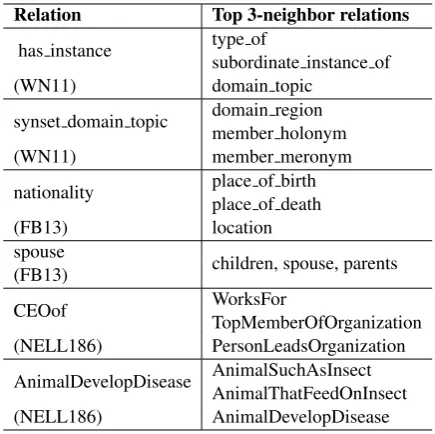
Table 6 presents some examples to illustrate the useful information modeled by the neighbors. We took the relation-specific mixture weights from the learned TransE-NMM model optimized on the en-tity prediction task, and then extracted three neigh-bor relations with the largest mixture weights given a relation.
Table 6 shows that those relations are semanti-cally coherent. For example, if we know the place of birth and/or the place of death of a person and/or the location where the person is living, it is likely
Relation Top 3-neighbor relations
has instance type ofsubordinate instance of (WN11) domain topic
synset domain topic domain regionmember holonym (WN11) member meronym nationality place of birthplace of death (FB13) location
spouse children, spouse, parents (FB13)
CEOof WorksForTopMemberOfOrganization (NELL186) PersonLeadsOrganization AnimalDevelopDisease AnimalSuchAsInsectAnimalThatFeedOnInsect (NELL186) AnimalDevelopDisease
Table 6: Qualitative examples.
that we can predict the person’s nationality. On the other hand, if we know that a person works for an organization and that this person is also the top member of that organization, then it is possible that this person is the CEO of that organization.
5.3 Discussion
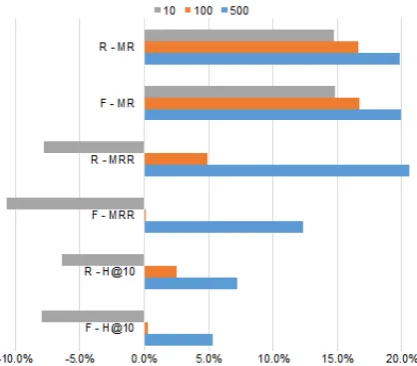
[image:8.595.309.526.64.278.2]Figure 2: Relative improvement of TransE-NMM against TransE for entity prediction task in WN11 when the filtering threshold τ = {10,100,500}
(with other hyper-parameters being the same as selected in Section 4.3). Prefixes “R-” and “F-” denote the “Raw” and “Filtered” settings, respec-tively. Suffixes “-MR”, “-MRR” and “-H@10” ab-breviate the mean rank, the mean reciprocal rank and Hits@10, respectively.
originally published in Bordes et al. (2013).3
As presented in Table 3, for entity predic-tion using WN11, TransE-NMM with the filter-ing threshold τ = 10 only obtains better mean rank than TransE (about 15% relative improve-ment) but lower Hits@10 and mean reciprocal rank. The reason might be that in semantic lexi-cal KBs such as WordNet where relationships be-tween words or word groups are manually con-structed, whole neighborhood information might be useful. So when using a small filtering thresh-old, the model ignores a lot of potential informa-tion that could help predicting relainforma-tionships. Fig-ure 2 presents relative improvements in entity pre-diction of TransE-NMM over TransE on WN11 when varying the filtering threshold τ. Figure 2 shows that TransE-NMM gains better scores with higher τ value. Specifically, when τ = 500 TransE-NMM does significantly better than TransE in all entity prediction metrics.
6 Conclusion and future work
We introduced a neighborhood mixture model for knowledge base completion by constructing 3They did not report the results on WN11 and FB13 datasets, which are used in this paper, though.
neighbor-based vector representations for entities. We demonstrated its effect by extending TransE (Bordes et al., 2013) with our neighborhood mix-ture model. On three different datasets, experi-mental results show that our model significantly improves TransE and obtains better results than the other state-of-the-art embedding models on triple classification, entity prediction and relation prediction tasks. In future work, we plan to ap-ply the neighborhood mixture model to other em-bedding models, especially to relation path mod-els such as TransE-COMP, to combine the useful information from both relation paths and entity neighborhoods.
Acknowledgments
This research was supported by a Google award through the Natural Language Understanding Fo-cused Program, and under the Australian Research Council’s Discovery Projects funding scheme (project number DP160102156). This research was also supported by NICTA, funded by the Australian Government through the Department of Communications and the Australian Research Council through the ICT Centre of Excellence Program. The first author was supported by an International Postgraduate Research Scholarship and a NICTA NRPA Top-Up Scholarship.
References
Kurt Bollacker, Colin Evans, Praveen Paritosh, Tim Sturge, and Jamie Taylor. 2008. Freebase: A Col-laboratively Created Graph Database for Structur-ing Human Knowledge. InProceedings of the 2008 ACM SIGMOD International Conference on Man-agement of Data, pages 1247–1250.
Antoine Bordes, Jason Weston, Ronan Collobert, and Yoshua Bengio. 2011. Learning Structured Embed-dings of Knowledge Bases. In Proceedings of the Twenty-Fifth AAAI Conference on Artificial Intelli-gence, pages 301–306.
Antoine Bordes, Xavier Glorot, Jason Weston, and Yoshua Bengio. 2012. A Semantic Matching En-ergy Function for Learning with Multi-relational Data. Machine Learning, 94(2):233–259.
Antoine Bordes, Nicolas Usunier, Alberto Garcia-Duran, Jason Weston, and Oksana Yakhnenko. 2013. Translating Embeddings for Modeling Multi-relational Data. InAdvances in Neural Information Processing Systems 26, pages 2787–2795.
Mitchell. 2010. Toward an Architecture for Never-ending Language Learning. In Proceedings of the Twenty-Fourth AAAI Conference on Artificial Intel-ligence, pages 1306–1313.
John Duchi, Elad Hazan, and Yoram Singer. 2011. Adaptive Subgradient Methods for Online Learning and Stochastic Optimization. The Journal of Ma-chine Learning Research, 12:2121–2159.
Alberto Garc´ıa-Dur´an, Antoine Bordes, and Nicolas Usunier. 2015. Composing Relationships with Translations. In Proceedings of the 2015 Confer-ence on Empirical Methods in Natural Language Processing, pages 286–290.
Alberto Garc´ıa-Dur´an, Antoine Bordes, Nicolas Usunier, and Yves Grandvalet. 2016. Combining Two and Three-Way Embedding Models for Link Prediction in Knowledge Bases. Journal of Artifi-cial Intelligence Research, 55:715–742.
Matt Gardner and Tom Mitchell. 2015. Efficient and Expressive Knowledge Base Completion Using Subgraph Feature Extraction. InProceedings of the 2015 Conference on Empirical Methods in Natural Language Processing, pages 1488–1498.
Shu Guo, Quan Wang, Bin Wang, Lihong Wang, and Li Guo. 2015. Semantically Smooth Knowledge Graph Embedding. InProceedings of the 53rd An-nual Meeting of the Association for Computational Linguistics and the 7th International Joint Confer-ence on Natural Language Processing (Volume 1: Long Papers), pages 84–94.
Kelvin Guu, John Miller, and Percy Liang. 2015. Traversing Knowledge Graphs in Vector Space. In
Proceedings of the 2015 Conference on Empirical Methods in Natural Language Processing, pages 318–327.
Shizhu He, Kang Liu, Guoliang Ji, and Jun Zhao. 2015. Learning to Represent Knowledge Graphs with Gaussian Embedding. In Proceedings of the 24th ACM International on Conference on Informa-tion and Knowledge Management, pages 623–632. Rodolphe Jenatton, Nicolas L. Roux, Antoine Bordes,
and Guillaume R Obozinski. 2012. A latent factor model for highly multi-relational data. InAdvances in Neural Information Processing Systems 25, pages 3167–3175.
Guoliang Ji, Shizhu He, Liheng Xu, Kang Liu, and Jun Zhao. 2015. Knowledge Graph Embedding via Dynamic Mapping Matrix. In Proceedings of the 53rd Annual Meeting of the Association for Compu-tational Linguistics and the 7th International Joint Conference on Natural Language Processing (Vol-ume 1: Long Papers), pages 687–696.
Guoliang Ji, Kang Liu, Shizhu He, and Jun Zhao. 2016. Knowledge Graph Completion with Adap-tive Sparse Transfer Matrix. In Proceedings of the Thirtieth AAAI Conference on Artificial Intelligence, pages 985–991.
Denis Krompa, Stephan Baier, and Volker Tresp. 2015. Type-Constrained Representation Learning in Knowledge Graphs. InProceedings of the 14th In-ternational Semantic Web Conference, pages 640– 655.
Jens Lehmann, Robert Isele, Max Jakob, Anja Jentzsch, Dimitris Kontokostas, Pablo N. Mendes, Sebastian Hellmann, Mohamed Morsey, Patrick van Kleef, S¨oren Auer, and Christian Bizer. 2015. DBpedia - A Large-scale, Multilingual Knowledge Base Extracted from Wikipedia. Semantic Web, 6(2):167–195.
Chen Liang and Kenneth D. Forbus. 2015. Learn-ing Plausible Inferences from Semantic Web Knowl-edge by Combining Analogical Generalization with Structured Logistic Regression. InProceedings of the Twenty-Ninth AAAI Conference on Artificial In-telligence, pages 551–557.
Yankai Lin, Zhiyuan Liu, Huanbo Luan, Maosong Sun, Siwei Rao, and Song Liu. 2015a. Modeling Re-lation Paths for Representation Learning of Knowl-edge Bases. InProceedings of the 2015 Conference on Empirical Methods in Natural Language Pro-cessing, pages 705–714.
Yankai Lin, Zhiyuan Liu, Maosong Sun, Yang Liu, and Xuan Zhu. 2015b. Learning Entity and Re-lation Embeddings for Knowledge Graph Comple-tion. InProceedings of the Twenty-Ninth AAAI Con-ference on Artificial Intelligence Learning, pages 2181–2187.
D. C. Liu and J. Nocedal. 1989. On the Limited Memory BFGS Method for Large Scale Optimiza-tion. Mathematical Programming, 45(3):503–528.
Yuanfei Luo, Quan Wang, Bin Wang, and Li Guo. 2015. Context-Dependent Knowledge Graph Em-bedding. InProceedings of the 2015 Conference on Empirical Methods in Natural Language Process-ing, pages 1656–1661.
Tomas Mikolov, Wen-tau Yih, and Geoffrey Zweig. 2013. Linguistic Regularities in Continuous Space Word Representations. InProceedings of the 2013 Conference of the North American Chapter of the Association for Computational Linguistics: Human Language Technologies, pages 746–751.
George A. Miller. 1995. WordNet: A Lexical Database for English.Communications of the ACM, 38(11):39–41.
Dat Quoc Nguyen, Kairit Sirts, Lizhen Qu, and Mark Johnson. 2016. STransE: a novel embedding model of entities and relationships in knowledge bases. In
Proceedings of the 2016 Conference of the North American Chapter of the Association for Computa-tional Linguistics: Human Language Technologies, pages 460–466.
Maximilian Nickel, Volker Tresp, and Hans-Peter Kriegel. 2011. A Three-Way Model for Collective Learning on Multi-Relational Data. InProceedings of the 28th International Conference on Machine Learning, pages 809–816.
Maximilian Nickel, Kevin Murphy, Volker Tresp, and Evgeniy Gabrilovich. 2015. A Review of Relational Machine Learning for Knowledge Graphs. Proceed-ings of the IEEE, to appear.
Maximilian Nickel, Lorenzo Rosasco, and Tomaso A. Poggio. 2016. Holographic Embeddings of Knowl-edge Graphs. InProceedings of the Thirtieth AAAI Conference on Artificial Intelligence, pages 1955– 1961.
Jeffrey Pennington, Richard Socher, and Christopher Manning. 2014. Glove: Global Vectors for Word Representation. In Proceedings of the 2014 Con-ference on Empirical Methods in Natural Language Processing, pages 1532–1543.
Richard Socher, Danqi Chen, Christopher D Manning, and Andrew Ng. 2013. Reasoning With Neural Ten-sor Networks for Knowledge Base Completion. In
Advances in Neural Information Processing Systems 26, pages 926–934.
Fabian M. Suchanek, Gjergji Kasneci, and Gerhard Weikum. 2007. YAGO: A Core of Semantic Knowl-edge. InProceedings of the 16th International Con-ference on World Wide Web, pages 697–706. Ben Taskar, Ming fai Wong, Pieter Abbeel, and Daphne
Koller. 2004. Link Prediction in Relational Data. In
Advances in Neural Information Processing Systems 16, pages 659–666.
Kristina Toutanova, Xi Victoria Lin, Wen tau Yih, Hoi-fung Poon, and Chris Quirk. 2016. Composi-tional Learning of Embeddings for Relation Paths in Knowledge Bases and Text. InProceedings of the 54th Annual Meeting of the Association for Compu-tational Linguistics, June.
Zhen Wang, Jianwen Zhang, Jianlin Feng, and Zheng Chen. 2014. Knowledge Graph Embedding by Translating on Hyperplanes. InProceedings of the Twenty-Eighth AAAI Conference on Artificial Intel-ligence, pages 1112–1119.
Robert West, Evgeniy Gabrilovich, Kevin Murphy, Shaohua Sun, Rahul Gupta, and Dekang Lin. 2014. Knowledge Base Completion via Search-based Question Answering. In Proceedings of the 23rd International Conference on World Wide Web, pages 515–526.
Bishan Yang, Wen-tau Yih, Xiaodong He, Jianfeng Gao, and Li Deng. 2015. Embedding Entities and Relations for Learning and Inference in Knowledge Bases. InProceedings of the International Confer-ence on Learning Representations.