Semi-supervised Convolutional Networks for Translation Adaptation with
Tiny Amount of In-domain Data
Boxing Chen
National Research Council Canada 1200 Montreal Road
Ottawa, ON, Canada
Fei Huang Facebook 770 Broadway New York, NY, USA [email protected]
Abstract
In this paper, we propose a method which uses semi-supervised convolutional neu-ral networks (CNNs) to select in-domain training data for statistical machine trans-lation. This approach is particularly effec-tive when only tiny amounts of in-domain data are available. The in-domain data and randomly sampled general-domain data are used to train a data selection model with semi-supervised CNN, then this model computes domain relevance scores for all the sentences in the general-domain data set. The sentence pairs with top scores are selected to train the sys-tem. We carry out experiments on 4 lan-guage directions with three test domains. Compared with strong baseline systems trained with large amount of data, this method can improve the performance up to 3.1 BLEU. Its performances are signifi-cant better than three state-of-the-art lan-guage model based data selection meth-ods. We also show that the in-domain data used to train the selection model could be as few as 100 sentences, which makes fine-grained topic-dependent translation adap-tation possible.
1 Introduction
Statistical machine translation (SMT) systems are trained on bilingual parallel and monolingual data. The training corpora typically come from different sources, and vary across topics, genres, dialects, authors’ written styles, etc., which are usually re-ferred as “general domain” training data. Here the word “domain” is often used to indicate some combination of all above and other possible hid-den factors (Chen et al., 2013). At run time, the
content to be translated may come from a different domain. Due to the mismatch in “domains”, it is possible to achieve better performance by adapting the SMT system to the test domain (in-domain).
However, manually creating training data to match the test domain is not a preferred solu-tion, because 1) sometimes the test domain is not known when training the model, and it could change from sentence to sentence; 2) even if the test domain is pdetermined, the resources re-quired and slow turnaround in data collection cess will still delay the system development pro-cess.
Therefore, training data selection is widely used for domain adaptation in statistical machine trans-lation (Zhao et al., 2004; L¨u et al., 2007; Ya-suda et al., 2008; Moore and Lewis, 2010; Ax-elrod et al., 2011; Duh et al., 2013; AxAx-elrod et al., 2015). Data selection techniques select mono-lingual or bimono-lingual data that are similar to the in-domain seed data based on some criteria, which are incorporated into the training data. The most successful data selection approaches (Moore and Lewis, 2010; Axelrod et al., 2011) train n-gram language models on in-domain text to select sim-ilar sentences from the large general-domain cor-pora according to the cross entropy. Furthermore, (Duh et al., 2013) obtained some gains by extend-ing these approaches from n-gram models to re-current neural network language models (Mikolov et al., 2010). To train the in-domain language model, a reasonable size in-domain data set, which typically includes several thousands of sentences, is required. In (Axelrod et al., 2011; Duh et al., 2013), the sizes of the in-domain data sets are 30K and over 100K sentences respectively.
However, we do not always have access to large or even medium amounts of in-domain data. With the growth of social media, new domains have emerged which need machine translation but
which have very limited in-domain data, maybe just a few hundred sentence pairs. What’s more, if one wishes to build a large scale topic-specific MT system with hundreds of topics, it is pro-hibitively expensive to collect tens of thousands of in-domain sentences for each topic.
In this paper, we try to address this challenge, i.e., domain adaptation with very limited amounts of in-domain data. Inspired by the success of con-volutional neural networks applied to image and text classification (Krizhevsky et al., 2012; Kim, 2014; Johnson and Zhang, 2015a; Johnson and Zhang, 2015b), we propose to use CNN to clas-sify training sentence pairs as in-domain or out-of-domain sentences. To overcome the problem of limited in-domain data, we propose to augment the original model with semi-supervised convolu-tional neural networks for domain classification.
Convolutional neural networks (LeCun and Bengio, 1998) are feed-forward neural networks that exploit the internal structure of data through convolution layers; each computation unit pro-cesses a small region of the input data. CNN has been very successful on image classification. When applying it to text input, the convolution layers process small regions of a document, i.e., a sequence of sentences or words. CNN has been gaining attention, and is now used in many text classification tasks (Kalchbrenner et al., 2014; Zeng et al., 2014; Johnson and Zhang, 2015b; Yin and Sch¨utze, 2015; Wang et al., 2015).
In many of these studies, the first layer of the network converts words to word embeddings us-ing table lookup. The word embeddus-ings are ei-ther trained as part of CNN training, or pre-trained (thus fixed during model training time) on an ad-ditional unlabled corpus. The later is termed semi-supervised CNN. Given tiny amounts of in-domain data, the information learned in these pre-trained word embeddings is very helpful.
We use a small amount of in-domain data, such as the development set, as the positive sample and randomly select the same number of sentences from the general-domain training data as the neg-ative sample to form the training sample for train-ing the CNN classification model. This is a typ-ical supervised learning setting. To compensate the limit of in-domain data size, we useword2vec (Mikolov et al., 2013) to learn the word embed-ding from a large amount of general-domain data. Together with the labeled data, these word
embed-dings are fed to the convolution layer as additional input to train the final classification model. This is a semi-supervised framework. The learned mod-els are then used to classify each sentence in the general-domain training data based on their do-main relevance score. The top N sentence pairs are selected to train the SMT system. We carry out experiments on 4 different language directions with 9-15M sentence pairs in each direction. The test domains include short message (sms), tweets, and Facebook posts. The experimental results show that our method is able to select a small amount of training data that is used to create a sys-tem which outperforms baseline syssys-tems trained with all the general-domain data. For example, we obtain over 3.1 BLEU improvement on the Chinese-to-English sms task with around 3% of the whole training data. Experiments also show that we can reduce the size of the in-domain sam-ple to around 100 sentences and still obtain a 2.1 BLEU improvement.
2 Related Work
2.1 SMT adaptation techniques
Domain adaptation to SMT systems has recently received considerable attention. Based on the availability of in-domain bilingual or monolingual training data, there are several adaptation scenar-ios. Different domain adaptation techniques, in-cluding self-training, data selection, data weight-ing, etc., have been developed for different scenar-ios.
Self-training (Ueffing and Ney, 2007; Schwenk, 2008; Bertoldi and Federico, 2009) uses general-domain bilingual parallel data and in-general-domain monolingual data. An MT system is first trained on bilingual general-domain data, then it is used to translate in-domain monolingual data. The result-ing target sentences or bilresult-ingual sentence pairs are then used as additional training data for language model or translation model training.
and out-domain data, respectively.
Data weighting approaches weight each data item according to its relevance to the in-domain data. Mixture model adaptation (Foster and Kuhn, 2007; Foster et al., 2010; Sennrich, 2012; Foster et al., 2013) assumes that the general-domain data can be clustered to several sub-corpora, with some parts that are not too far from test domain. It com-bines sub-models trained on different sub-corpus data sets linearly or log-linearly with different weights. Vector space model adaptation (Chen et al., 2013) has the same assumption, and it weights each phrase pair based on vector space model (VSM). (Chen et al., 2014) improved the VSM adaptation by extending it to distributed VSM and grouped VSM. Instance weighting adopts a rich set of features to compute weights for each in-stance in the training data; it can be applied to sen-tence pairs (Matsoukas et al., 2009) or phrase pairs (Foster et al., 2010).
If in-domain comparable data are available, (Daume III and Jagarlamudi, 2011; Irvine et al., 2013) propose mining translations from the com-parable data to translate out-of-vocabulary (OOV) words and capture new senses for the new test do-mains. (Dou and Knight, 2012; Zhang and Zong, 2013) learn bilingual lexical or phrase tables from in-domain monolingual data with a decipherment method, then incorporate them into the SMT sys-tem.
All the above approaches assume that either there is an in-domain (mono-lingual, parallel, or comparable) data set with a reasonable size avail-able, or that some sub-corpora are closer to the test domain than others. There is no previous work considering the scenario where only a tiny amount of in-domain data is available: this is the scenario we address in this paper.
2.2 CNNs for text classification
In a text classification task, key phrases (or n -grams) can help in determining the class of the text, regardless of their locations in the text. For example, the word “desktop” in a sentence may indicate this sentence has computers as its topic; the phrase “not satisfactory” may indicate that the sentiment of the entire sentence is negative. This kind of strong local information about the class of a text can appear in different regions in the input. Convolutional neural networks are useful for text classification because convolutional and pooling
layers allow the model to find such local indica-tors, wherever they are in the text.
Recently, CNNs have shown promising results on many text classification tasks, such as senti-ment analysis (Kalchbrenner et al., 2014; Kim, 2014), topic and sentiment classification (Johnson and Zhang, 2015a; Johnson and Zhang, 2015b), paraphrase identification (Yin and Sch¨utze, 2015), entity relation type classification (Zeng et al., 2014; dos Santos et al., 2015), short-text classi-fication (Wang et al., 2015), event extraction and detection (Chen et al., 2015; Nguyen and Grish-man, 2015), question understanding and answer-ing (Dong et al., 2015), and box-office prediction based on reviews (Bitvai and Cohn, 2015).
Within the CNN architecture, people also use word embeddings for text classification. (Kalch-brenner et al., 2014) proposes a CNN frame-work with multiple convolution layers, with la-tent, dense and low-dimensional word embed-dings as inputs. (Kim, 2014) defines a one-layer CNN architecture with comparable performance to (Kalchbrenner et al., 2014). The word em-beddings input to the CNN can be pre-trained, and treated as fixed input, or tuned for a specific task. (Johnson and Zhang, 2015b) extends their “one-hot” CNN in (Johnson and Zhang, 2015a) to take region embeddings trained on unlabeled data as CNN input. CNNs that input word em-beddings trained on unlabeled data are considered to be semi-supervised CNNs.
3 Semi-supervised CNN
A CNN is a feed-forward network consisting of convolutional and pooling layers. Each neuron in the convolutional layer of a CNN processes a seg-ment of input signals, which could be a region in an image or a window of words in a sentence. The convolution layer consists of a set of kernels that compute the dot product between different seg-ments of the input. The kernel associated with the l-th segment of the input x computes:
σ(W·wl(x) +b), (1) where wl(x)∈Rqis the input window vector that represents thel-th segment of data. Weight matrix W∈Rm×q and bias vector b∈Rm are shared by all the kernels in the same layer, and are learned during the training process.
the requirement to select features by hand. Im-portant features in a sentence are automatically se-lected with pooling, which is a form of non-linear down-sampling. It takes the maximum or the av-erage value observed in each of the ddimension vectors over different windows. As a result, infor-mation from multipleddimension vectors is kept in a singleddimensional vector. At training time, both the weight vectors and the bias vectors are learned with stochastic gradient ascent.
3.1 One-hot CNN
When applying CNN to NLP tasks, the first layer of the network takes word embeddings as in-put. Word embeddings can be pre-trained using tools such asword2vec(Mikolov et al., 2013) or GloV e (Pennington et al., 2014), in which case a table lookup is enough. Alternatively, these vectors can be learned from scratch as a step in the network training process. When there are enough in-domain data, training in-domain word embeddings is meaningful. However, when the in-domain data are limited, the word embeddings learned from these data are unreliable. In this case, the input sentence x can be represented with one-hot vectors where each vector’s length is the vocabulary size, value 1 at index i indi-cates wordiappears in the sentence, and 0 indi-cates its absence. A CNN with one-hot vector in-put is called “one-hot CNN” (Johnson and Zhang, 2015a). wl(x) can be either a concatenation of one-hot vectors, in which the order of concatena-tion is the same as the word order in the sentence, or it can be a bag-of-word/n-gram vector. The bag-of-word (BOW) representation loses word or-der information but is more robust to data sparsity. In (Johnson and Zhang, 2015a), a CNN whose in-put being BOW representation is calledbow-CNN while input with concatenation of vectors is called seq-CNN. The window size and stride (distance between the window centers) are meta-parameters. σ in Equation 1 is a component-wise non-linear function such as ReLU. Thus, each kernel gener-ates anm-dimensional vector wheremis the num-ber of weight vectors or neurons. These vectors from all the windows of each sentence are aggre-gated by the pooling layer, by either component-wise maximum (max pooling) or average (average pooling), then used by the top layer as features for classification.
3.2 Semi-supervised CNN
Although the size of the in-domain data is nor-mally small, the unlabeled data from general do-mains are much larger and easier to obtain. To exploit large amounts of unlabeled data, we adopt a semi-supervised learning framework similar to (Johnson and Zhang, 2015b). It first learns word embedding from unlabeled data, then generates the text segment embedding based on these unsu-pervised word embeddings. Both the one-hot vec-tors from the labeled data and the segment embed-dings from unlabeled data are combined to train the CNN classifier.
The word embeddings map each word to a real-valued, dense vector (Bengio et al., 2003). Word embeddings are often learned with an unsuper-vised learning paradigm: each dimension of the continuous word embeddings aims at capturing a latent feature, reflecting certain syntactic and se-mantic meanings of the word. A widely used approach for generating useful word embeddings was proposed in (Mikolov et al., 2013). This method learns the word embeddings such that the likelihood of generating a word based on its con-texts (or generating the context of a given word, aka “skip-gram” model) is maximized. It speeds up the training with the hierarchical softmax strat-egy and a simplified learning objective, which scales very well to very large training corpora. We adopt the skip-gram model, which intuitively learns a classifier that predicts words conditioned on the central word’s vector representation. An advantage of such distributed representations is that words that have similar contexts, and there-fore similar syntactic and semantic properties, will tend to be near one another in the low-dimensional vector space.
Given the word embeddings trained from unla-beled data, a sentence is represented as a sequence ofd-dimensional vectors, which is the input to a convolution network that generates feature vec-tors for each text segment. The segment vecvec-tors and one-hot vectors are fed into another convolu-tion layer, which outputs the classificaconvolu-tion labels. The second network is trained with the labeled in-domain/out-domain data. Therefore, Equation 1 is replaced with:
embed-ding learned from the unlabeled data (general do-main training data), applied to the same segment. We train this model with the labeled data. We up-date the weights W, V, bias b, and the top-layer parameters so that the loss function is minimized on the labeled training data.
4 Adaptation based on data selection We use the in-domain data from the translation task as positive samples, and randomly select the same number of sentences from the general do-main data as negative samples. We train the CNN model on the positive and negative samples with the one-hot CNN or semi-supervised CNN de-scribed previously. The trained CNN model is then used to classify the sentence pairs in the gen-eral domain data. The sentence pairs with high in-domain scores are selected to train the machine translation system.
We classify the source sentence and target sen-tences separately. The CNN model computes two scores for each sentence pair. The sentence pairs are selected based on the source scores, tar-get scores or the sum of source and tartar-get scores (Moore and Lewis, 2010). Experiments show that selection based on the sum of the source and target scores achieves the best performance. We empiri-cally determine the number of selected in-domain sentences for each MT system based on experi-mental results on a separate validation set.
When selecting the negative samples, we either randomly sample from the whole data pool, or se-lect from the sentences which have been labeled as negative in the first round classification. Addi-tional experiments show that the results from these two methods are very similar, so we sample the negative samples from the whole general domain for simplicity.
5 Experiments
Our goal is to adapt the MT system when only a tiny amount of in-domain data is available. So in our experiments, we did not consider any domain information about the training data, such as the source of each corpus. What we have is a small development set (dev) and one or more test sets (test) which are in the same domain.
5.1 Data setting
We carried out experiments in four different data settings. All four have large amounts of
bilin-gual training data: 9-15M sentences. The first two involve translation into English (en) from Chi-nese (zh) and Arabic (ar), while the last two in-volve translation from English to Spanish (es) and Chinese. The training data are all publicly avail-able, either from LDC,1and transcriptions of TED
talks2where the data are the mixture of newswire,
web crawl, UN proceedings and TED talks, etc., or from WMT,3where the data are the mixture of
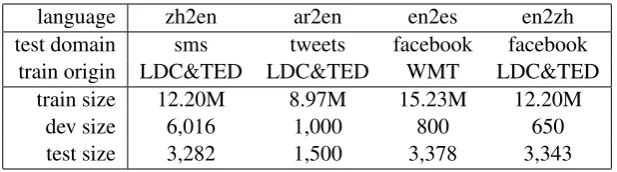
Europarl, web crawl, news-commentary, UN pro-ceedings, etc. The dev and test sets are “short mes-sages (sms)” for the first task, which are also avail-able from LDC; “tweets” for the second task; pub-licly available “Facebook post” for the remaining two tasks. The last three tasks are from social media an intriguing new area of application for MT -where in-domain parallel training data are seldom publicly available. Table 1 summarizes the statis-tics of the training, dev, and test data for all the test sets.
5.2 Experiment setup
We experiment with two CNN-based data selec-tion strategies:
1. ohcnn: Data selection by supervised one-hot CNN (Section 3.1)
2. sscnn: Data selection by semi-supervised CNN (Section 3.2)
We employ the dev set as in-domain data. All the supervised CNN models are trained with the in-domain dev data as positive examples and an equal number of randomly selected general-domain sentences as negative examples. All the meta-parameters of the CNN are tuned on held-out data; we generate both bow-regions and seq -regions and input them to the CNN. We set the region size to 5 and stride size to 1. The non-linear function we chose is “ReLU”, the number of weight vectors or neurons is 500. The pooling method is component-wise maximum (max pool-ing). We use the online available CNN toolkit conT ext.4 To train the general domain word
em-bedding, we used word2vec.5 The size of the
vector was set to 300. We also generate word-embedding-basedbow-regions andseq-regions as additional input to the CNN.
1https://catalog.ldc.upenn.edu/ 2https://wit3.fbk.eu/
3http://statmt.org/wmt15/
language zh2en ar2en en2es en2zh test domain sms tweets facebook facebook
train origin LDC&TED LDC&TED WMT LDC&TED
train size 12.20M 8.97M 15.23M 12.20M
dev size 6,016 1,000 800 650
[image:6.595.145.454.61.147.2]test size 3,282 1,500 3,378 3,343
Table 1: Summary of the data. “sms” means “short message”. “facebook” means “Facebook post”. Data is given as the number of sentence pairs, “M” represents “million”. The tasks “zh2en” and “en2zh” use the same training data.
We compared with four baselines for each task. The first baseline SMT system is trained using all general-domain data. The other three systems are trained with data selected with different LM-based data selection methods as same as in (Duh et al., 2013).6 The four baselines are:
1. alldata: All general-domain data.
2. ngram: Data selection by 3-gram LMs with Witten-Bell 7 smoothing (Axelrod et al.,
2011)
3. rnnlm: Data selection by recurrent neural net-work LM, with the RNNLM Toolkit (Duh et al., 2013)
4. comblm: Data selection by the combined LM using ngram & rnnlm (equal weight) (Duh et al., 2013).
All systems are trained with a standard phrase-based SMT system with standard settings, i.e., GIZA++ alignment, phrase table Kneser-Ney smoothing, hierarchical reordering models, target side 4-gram language model, “gigaword” 5-gram language model for systems with English as the target language, etc.
5.3 Experimental results
We evaluated the system using BLEU (Papineni et al., 2002) score on the test set. Following (Koehn, 2004), we use the bootstrap resampling test to do significance testing. Table 2 summa-rizes the results and numbers of the selected sen-tences for each task. First, we can see that all the data selection methods improved the perfor-mance over the baseline “alldata” with much less
6The code and scripts for the three baselines are available
at http://cl.naist.jp/ kevinduh/a/acl2013/.
7For small amounts of data, Witten-Bell smoothing had
performed better than Kneser-Ney smoothing in our experi-ments.
training data (only around 2.5% to 10% of the whole training data). Consistent with (Duh et al., 2013), the three LM based data selection all got improvements, where “rnnlm” obtained better performance than the “ngram” on average. It is not clear that combining the two language model methods (“comblm”) yields further improvement. While the one-hot CNN method “ohcnn” obtained similar improvement as the three LM-based meth-ods on average. The semi-supervised CNN (sscnn) achieved the best performance for all the tasks: its improvements over the “alldata” baseline are 3.1, 1.4, 0.7 and 1.4 BLEU score respectively. It beats “ohcnn” by about 0.5 BLEU point on average.
There are two results worth noticing. First, task 1 (zh2en sms task) obtained very high BLEU improvement through data selection. This is be-cause in this task, there is a 120K in-domain sub-set within the general-domain data. If we train a system on this in-domain data set, we get 25.7 BLEU on the test set. The LM-based methods did not beat this “in-domain data only (indata)” baseline, while the semi-supervised CNN method performed significantly better than this baseline at p <0.05level. In the top 300K selected sentence pairs, LM-based methods can select around 90K out of 120K in-domain sentence pairs, while both “ohcnn” and “sscnn” can select around 105K in-domain sentence pairs. This demonstrates the ef-fectiveness of the proposed approach. Second, for the other three tasks, there is no in-domain data component in the general-domain data (that we know of). Even in this case, we achieved up to 1.4 BLEU improvement, which also demonstrates the effectiveness of our method: it can select highly suitable domain sentences, even when the in-domain data is very limited.
zh2en ar2en en2es en2zh
#sent BLEU #sent BLEU #sent BLEU #sent BLEU
alldata 12.2M 22.9 8.9M 17.6 15.2M 26.8 12.2M 10.0
ngram 300K 25.3** 800K 18.2** 1600K 26.9 400K 10.5*
rnnlm 300K 25.6** 800K 18.4** 1600K 27.0 400K 10.5*
comblm 400K 25.7** 800K 18.4** 1400K 27.0 500K 10.4*
ohcnn 300K 25.3** 700K 18.2* 1200K 27.1* 400K 11.0**+
[image:7.595.89.508.105.225.2]sscnn 300K 26.0**+ 700K 19.0**++ 1300K 27.5**++ 300K 11.4**++
Table 2: Summary of the results. Data size is given as number of sentence pairs. The number of selected in-domain sentences is determined by the performance on held-out data. “M” represents million, “K” represents thousand. */** means result is significantly better than the “alldata” baseline atp <0.05or p <0.01level, respectively. +/++ means result is significantly better than the best LM-based method at p <0.05orp <0.01level, respectively.
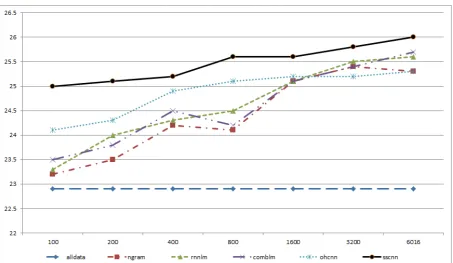
[image:7.595.73.527.394.657.2]data. Fixing the number of MT training sentence pairs to 300K that will be selected by the CNN, we reduce the CNN training data from 6,000 down to 100 sentence pairs in steps. The performance of the resulting MT systems for all five data selection methods is shown in Figure 1.
From Figure 1, we can see that all the data selec-tion methods obtained improvement compared to the “alldata” baseline. When the in-domain train-ing sample is more than 1600 sentence pairs, all the data selection methods obtain reasonable and comparable improvement, while “sscnn” is better than the best LM-based method by 0.3-0.5 BLEU. However, when the in-domain training sample is less than 800 sentence pairs, the difference be-tween the “sscnn” and other methods gets bigger, and CNN-based methods get more stable results than the LM-based methods get. For instance, when the in-domain set increases from 400 to 800, the LM-based methods did not get an improve-ment; “ngram” and “comblm” even got a small loss on BLEU score. When the in-domain sam-ple is reduced to 100 sentence pairs, the LM-based methods only get a small improvement over the baseline, while the “ohcnn” got a 1.2 BLEU score improvement over the baseline and “sscnn” got a 2.1 BLEU improvement over the baseline. Thus, even if we have no domain knowledge about the training data, when we have only 100 sentences in the test domain, the semi-supervised CNN classi-fier can still select a good in-domain subset and achieve good performance.
We obtained 2.1 BLEU improvement even when we randomly select only 100 in-domain sen-tence pairs to train the classification model. Is this just because we luckily sampled a good part of the in-domain data? We repeated the “100 in-domain sentence pairs experiment” three times for our most effective method - “sscnn” - by sampling three different in-domain sets from the whole 6,016-sentence dev set. The average BLEU score we got is 25.03, and the standard deviation is 0.12. This means that our algorithm is quite stable even when the in-domain set is very small.
5.4 Discussion
Why do semi-supervised convolutional neural net-works perform so well for data selection? We think there are two main reasons. The first one is that convolution captures the important domain information of the words in the window, and
the max-pooling operation combines the vectors which, as a result, focuses on the most important “features” in the sentence. Even a highly specific sentence normally contains both domain-specific words and general-domain words. For example, in “I have a Dell desktop and a Mac-book laptop”, the words “Dell, laptop, MacMac-book, laptop” are from the computer domain, while the words “I, have, a, and” are general. However, the topic of this sentence is decided by the domain specific words, not the general-domain words. If the properties of the words “Dell, laptop, Mac-book, laptop” are kept and highlighted, classifi-cation will be more accurate for this sentence. The second reason is the use of word embedding learned from the whole general-domain data. A very important advantage of word embedding is that words that have similar meaning will tend to be grouped together in the vector space. If the word “Lenovo” in the test sentence is not seen in the labeled data, it would be difficult for LM-based models to classify sentences like “I prefer choosing a Lenovo machine” as computer-domain sentence. However, the word embeddings learned from much larger unlabeled data ensure that the word embedding of “Lenovo” is close to that of “Dell”. According to the domain of its neighbor words, the CNN model can still label this sentence as belonging to the computer domain. This prop-erty is particularly useful for fast or fine grained adaptation, where obtaining large amount of in-domain samples may be slow or too expensive.
6 Conclusions and future work
References
Amittai Axelrod, Xiaodong He, and Jianfeng Gao. 2011. Domain adaptation via pseudo in-domain data selection. InEMNLP 2011.
Amittai Axelrod, Philip Resnik, Xiaodong He, and Mari Ostendorf. 2015. Data selection with fewer words. In Proceedings of the Tenth Workshop on Statistical Machine Translation, pages 58–65, Lis-bon, Portugal, September.
Yoshua Bengio, R´ejean Ducharme, Pascal Vincent, and Christian Janvin. 2003. A neural probabilistic lan-guage model. J. Mach. Learn. Res., 3:1137–1155, March.
Nicola Bertoldi and Marcello Federico. 2009. Do-main adaptation for statistical machine translation with monolingual resources. InProceedings of the 4th Workshop on Statistical Machine Translation, Athens, March. WMT.
Zsolt Bitvai and Trevor Cohn. 2015. Non-linear text regression with a deep convolutional neural network. In Proceedings of the 53rd Annual Meeting of the Association for Computational Linguistics and the 7th International Joint Conference on Natural Lan-guage Processing (Volume 2: Short Papers), pages 180–185, Beijing, China, July.
Boxing Chen, Roland Kuhn, and George Foster. 2013. Vector space model for adaptation in statistical ma-chine translation. In Proceedings of the 51st An-nual Meeting of the Association for Computational Linguistics (Volume 1: Long Papers), pages 1285– 1293, Sofia, Bulgaria, August.
Boxing Chen, Roland Kuhn, and George Foster. 2014. A comparison of mixture and vector space tech-niques for translation model adaptation. In Proceed-ings of AMTA, Vancouver, Canada, Oct.
Yubo Chen, Liheng Xu, Kang Liu, Daojian Zeng, and Jun Zhao. 2015. Event extraction via dy-namic multi-pooling convolutional neural networks. In Proceedings of the 53rd Annual Meeting of the Association for Computational Linguistics and the 7th International Joint Conference on Natural Lan-guage Processing (Volume 1: Long Papers), pages 167–176, Beijing, China, July.
Hal Daume III and Jagadeesh Jagarlamudi. 2011. Do-main adaptation for machine translation by mining unseen words. InACL 2011.
Li Dong, Furu Wei, Ming Zhou, and Ke Xu. 2015. Question answering over freebase with multi-column convolutional neural networks. In Proceed-ings of the 53rd Annual Meeting of the Association for Computational Linguistics and the 7th Interna-tional Joint Conference on Natural Language Pro-cessing (Volume 1: Long Papers), pages 260–269, Beijing, China, July.
Cicero dos Santos, Bing Xiang, and Bowen Zhou. 2015. Classifying relations by ranking with con-volutional neural networks. InProceedings of the 53rd Annual Meeting of the Association for Compu-tational Linguistics and the 7th International Joint Conference on Natural Language Processing (Vol-ume 1: Long Papers), pages 626–634, Beijing, China, July.
Qing Dou and Kevin Knight. 2012. Large scale deci-pherment for out-of-domain machine translation. In Proceedings of the 2012 Joint Conference on Empir-ical Methods in Natural Language Processing and Computational Natural Language Learning, pages 266–275, Jeju Island, Korea, July.
Kevin Duh, Graham Neubig, Katsuhito Sudoh, and Ha-jime Tsukada. 2013. Adaptation data selection us-ing neural language models: Experiments in ma-chine translation. InProceedings of the 51st Annual Meeting of the Association for Computational Lin-guistics (Volume 2: Short Papers), pages 678–683, Sofia, Bulgaria, August.
George Foster and Roland Kuhn. 2007. Mixture-model adaptation for SMT. In Proceedings of the ACL Workshop on Statistical Machine Translation, Prague, June. WMT.
George Foster, Cyril Goutte, and Roland Kuhn. 2010. Discriminative instance weighting for domain adap-tation in statistical machine translation. In Proceed-ings of the 2010 Conference on Empirical Methods in Natural Language Processing (EMNLP), Boston. George Foster, Boxing Chen, and Roland Kuhn. 2013. Simulating discriminative training for linear mixture adaptation in statistical machine translation. InMT Summit, Nice, France.
Ann Irvine, Chris Quirk, and Hal Daum´e III. 2013. Monolingual marginal matching for translation model adaptation. InProceedings of the 2013 Con-ference on Empirical Methods in Natural Language Processing, pages 1077–1088, Seattle, Washington, USA, October.
Rie Johnson and Tong Zhang. 2015a. Effective use of word order for text categorization with convo-lutional neural networks. In Proceedings of the 2015 Conference of the North American Chapter of the Association for Computational Linguistics: Hu-man Language Technologies, pages 103–112, Den-ver, Colorado, May–June.
Annual Meeting of the Association for Computa-tional Linguistics (Volume 1: Long Papers), pages 655–665, Baltimore, Maryland, June.
Yoon Kim. 2014. Convolutional neural networks for sentence classification. CoRR, abs/1408.5882. Philipp Koehn. 2004. Statistical significance tests
for machine translation evaluation. InProceedings of the 2004 Conference on Empirical Methods in Natural Language Processing (EMNLP), Barcelona, Spain.
Alex Krizhevsky, Ilya Sutskever, and Geoffrey E. Hin-ton. 2012. Imagenet classification with deep con-volutional neural networks. In F. Pereira, C. J. C. Burges, L. Bottou, and K. Q. Weinberger, editors, Advances in Neural Information Processing Systems 25, pages 1097–1105. Curran Associates, Inc. Yann LeCun and Yoshua Bengio. 1998. Convolutional
networks for images, speech, and time series. In Michael A. Arbib, editor, The Handbook of Brain Theory and Neural Networks, pages 255–258. MIT Press, Cambridge, MA, USA.
Yajuan L¨u, Jin Huang, and Qun Liu. 2007. Improv-ing Statistical Machine Translation Performance by Training Data Selection and Optimization. In Pro-ceedings of the 2007 Conference on Empirical Meth-ods in Natural Language Processing (EMNLP), Prague, Czech Republic.
Spyros Matsoukas, Antti-Veikko I. Rosti, and Bing Zhang. 2009. Discriminative corpus weight estima-tion for machine translaestima-tion. InProceedings of the 2009 Conference on Empirical Methods in Natural Language Processing (EMNLP), Singapore. Tom´aˇs Mikolov, Martin Karafi´at, Luk´aˇs Burget, Jan
ˇCernock´y, and Sanjeev Khudanpur. 2010. Recur-rent neural network based language model. In Pro-ceedings of the 11th Annual Conference of the In-ternational Speech Communication Association (IN-TERSPEECH2010), pages 1045–1048. International Speech Communication Association.
Tomas Mikolov, Kai Chen, Greg Corrado, and Jeffrey Dean. 2013. Efficient estimation of word represen-tations in vector space.CoRR, abs/1301.3781. Robert C. Moore and William Lewis. 2010. Intelligent
selection of language model training data. InACL 2010.
Thien Huu Nguyen and Ralph Grishman. 2015. Event detection and domain adaptation with convolutional neural networks. InProceedings of the 53rd Annual Meeting of the Association for Computational Lin-guistics and the 7th International Joint Conference on Natural Language Processing (Volume 2: Short Papers), pages 365–371, Beijing, China, July. Kishore Papineni, Salim Roukos, Todd Ward, and
Wei-Jing Zhu. 2002. BLEU: A method for automatic evaluation of Machine Translation. InProceedings
of the 40th Annual Meeting of the Association for Computational Linguistics (ACL), pages 311–318, Philadelphia, July. ACL.
Jeffrey Pennington, Richard Socher, and Christo-pher D. Manning. 2014. Glove: Global vectors for word representation. InEmpirical Methods in Nat-ural Language Processing (EMNLP), pages 1532– 1543.
Holger Schwenk. 2008. Investigations on large-scale lightly-supervised training for statistical ma-chine translation. InIWSLT 2008.
Rico Sennrich. 2012. Perplexity minimization for translation model domain adaptation in statistical machine translation. InEACL 2012.
Nicola Ueffing and Hermann Ney. 2007. Word-level confidence estimation for machine translation. Computational Linguistics, 33(1):9–40.
Peng Wang, Jiaming Xu, Bo Xu, Chenglin Liu, Heng Zhang, Fangyuan Wang, and Hongwei Hao. 2015. Semantic clustering and convolutional neural net-work for short text categorization. InProceedings of the 53rd Annual Meeting of the Association for Computational Linguistics and the 7th International Joint Conference on Natural Language Processing (Volume 2: Short Papers), pages 352–357, Beijing, China, July.
Keiji Yasuda, Ruiqiang Zhang, Hirofumi Yamamoto, and Eiichiro Sumita. 2008. Method of selecting training data to build a compact and ef?cient trans-lation model. InInternational Joint Conference on Natural Language Processing.
Wenpeng Yin and Hinrich Sch¨utze. 2015. Convolu-tional neural network for paraphrase identification. InProceedings of the 2015 Conference of the North American Chapter of the Association for Computa-tional Linguistics: Human Language Technologies, pages 901–911, Denver, Colorado, May–June. Daojian Zeng, Kang Liu, Siwei Lai, Guangyou Zhou,
and Jun Zhao. 2014. Relation classification via con-volutional deep neural network. In Proceedings of COLING 2014, the 25th International Conference on Computational Linguistics: Technical Papers, pages 2335–2344, Dublin, Ireland, August. Dublin City University and Association for Computational Linguistics.