Review Article
The efficacy of methylene blue for back pain:
a meta-analysis of randomized controlled trials
Gang Yao1,2, Leming Xu1
1Department of Radiology, The Second Affiliated Hospital of Zhejiang University School of Medicine, Zhejiang, China; 2Department of Radiology, The Affiliated Sir Run Run Hospital of Nanjing Medical University, Nanjing, China
Received April 14, 2019; Accepted June 25, 2019; Epub September 15, 2019; Published September 30, 2019
Abstract: Introduction: The efficacy of methylene blue for back pain remains controversial. We conduct a system-atic review and meta-analysis to explore the impact of methylene blue versus placebo on back pain. Methods: We searched PubMed, EMbase, Web of science, EBSCO, and Cochrane library databases through June 2018 for ran-domized controlled trials (RCTs) assessing the effect of methylene blue versus placebo on the alleviation of back pain. This meta-analysis is performed using the random-effect model. Results: Three RCTs involving 229 patients are included in the meta-analysis. Overall, compared with control group for back pain, methylene blue can remark-ably decrease pain scores at 24-48 h (Std. MD = -1.69; 95% CI = -2.07 to -1.32; P < 0.00001), 2-3 month (Std. MD = -1.09; 95% CI = -1.62 to -0.56; P < 0.0001), and ODI at 2-3 month (Std. MD = -0.85; 95% CI = -1.18 to -0.52; P < 0.00001), as well as moderate-severe functional disability after 3-6 months (RR = 0.46; 95% CI = 0.24 to 0.87; P = 0.02), but has no significant impact on pain scores (Std. MD = -1.60; 95% CI = -3.50 to 0.30; P = 0.10) and ODI (Std. MD = -1.95; 95% CI = -4.34 to 0.44; P = 0.11) at 6 months. Conclusions: Methylene blue can substantially decrease pain scores and ODI within 3 months, as well as moderate-severe functional disability after 3-6 months in patients with back pain.
Keywords: Methylene blue, back pain, pain scores, randomized controlled trials, meta-analysis
Introduction
Chronic back pain has become one of the most important socioeconomic problems [1]. Alth- ough spinal surgery has obtained great prog-ress, some patients still suffer from postopera-tive pain, which results in disability and loss of work productivity, prolonged hospital stays and increased health care costs [1]. In addition, dis-cogenic low back pain is an important cause of low back pain, accounting for 28-43% of the patients with low back pain [1]. Current treat-ment options include medicinal anti-inflamma-tion strategy and invasive procedures (e.g. spine fusion and spinal arthroplasty), but the back pain remains noteworthy [1].
Methylene blue is known as a low-molecular weight, partially liposoluble vital dye [2]. It has been used in various fields of clinical medicine, including destruction of free nociceptive nerve endings for the relief of pain, inhibition of nitric oxide synthesis, a neuroprotective compound, and inhibition of monoamine oxidase [1]. The
local injection of methylene blue can block nerve conduction or destroy nerve endings be- cause of neurotropic effects, and benefit to dif-ferent painful ailments [1]. Several studies have reported the safety and efficacy of the low dose of methylene blue solution in systemic and epi-dural administration [1].
The efficacy of methylene blue on the allevia-tion of back pain has not been well establish- ed. Recently, several studies on the topic have been published, and the results have been conflicting [1]. With accumulating evidence, we therefore perform a systematic review and me- ta-analysis of RCTs to investigate the efficacy of methylene blue versus placebo for back pa- in.
Materials and methods
PRISMA (Preferred Reporting Items for Sy- stematic Reviews and Meta-Analyses) [3].
Search strategy and study selection
Two investigators have independently search- ed the following databases (inception to June 2018): PubMed, EMbase, Web of science, EB- SCO, and Cochrane library databases. The elec-tronic search strategy is conducted using the following keywords: back pain, and methylene blue. We also check the reference lists of the screened full-text studies to identify other po- tentially eligible trials.
The inclusive selection criteria are as follows: (i) population: patients with back pain; (ii) inter-vention: methylene blue injection; (iii) compari-son: normal saline as the placebo; (iv) study design: RCT.
Data extraction and outcome measures
We have extracted the following information: author, number of patients, age, male, over-weight (body mass index ≥ 25 kg/m2), pain duration and detail methods in each group etc. Data have been extracted independently by two investigators, and discrepancies are re- solved by consensus. We also contact the cor-responding author to obtain the data when ne- cessary. No simplifications and assumptions are made.
ies from 0 to 5 points. An article with Jadad score ≤ 2 is considered to be of low quality. If the Jadad score ≥ 3, the study is thought to be of high quality [5].
Statistical analysis
We estimate the standard mean difference (Std. MD) with 95% confidence interval (CI) for continuous outcomes (pain scores at 24-48 h, 2-3 month, and 6 month, ODI at 2-3 month and 6 month) and risk ratio (RR) with 95% CIs for dichotomous outcomes (moderate-severe fun- ctional disability after 3-6 month). A random-effects model is used regardless of heteroge-neity. Heterogeneity is reported using the I2 st- atistic, and I2 > 50% indicates significant het-erogeneity [6]. Whenever significant heteroge-neity is present, we search for potential sourc-es of heterogeneity via omitting one study in turn for the meta-analysis or performing sub-group analysis. Publication bias is not evaluat-ed because of the limitevaluat-ed number (< 10) of included studies. All statistical analyses are performed using Review Manager Version 5.3 (The Cochrane Collaboration, Software Update, Oxford, UK).
Results
Literature search, study characteristics and quality assessment
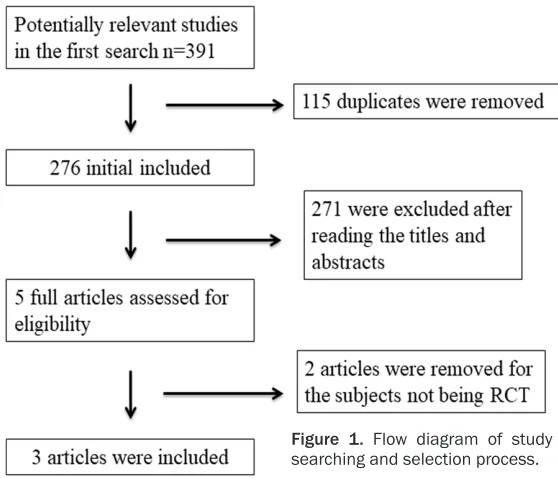
A detailed flowchart of the search and selection results is shown in Figure 1. 391 potentially
rel-The primary outcomes are pain scores at 24-48 h, 2-3 month, and 6 month. Secon- dary outcomes include Oswe- stry Disability Index (ODI) at 2-3 month and 6 month, as well as moderate-severe fun- ctional disability after 3-6 month.
Quality assessment in indi
-vidual studies
Methodological quality of the included studies is indepen-dently evaluated using the modified Jadad scale [4]. The- re are 3 items for Jadad sca- le: randomization (0-2 points), blinding (0-2 points), dropouts and withdrawals (0-1 points). The score of Jadad Scale var-Figure 1. Flow diagram of study
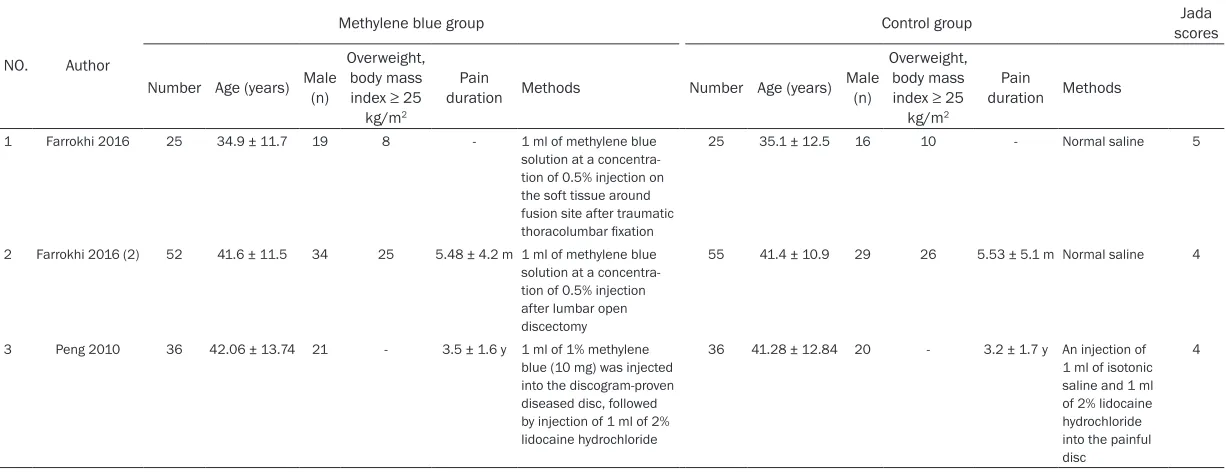
[image:2.612.89.368.71.310.2]Table 1. Characteristics of included studies
NO. Author
Methylene blue group Control group scoresJada
Number Age (years) Male (n)
Overweight, body mass index ≥ 25
kg/m2
Pain
duration Methods Number Age (years) Male (n)
Overweight, body mass index ≥ 25
kg/m2
Pain
duration Methods
1 Farrokhi 2016 25 34.9 ± 11.7 19 8 - 1 ml of methylene blue solution at a concentra-tion of 0.5% injecconcentra-tion on the soft tissue around fusion site after traumatic thoracolumbar fixation
25 35.1 ± 12.5 16 10 - Normal saline 5
2 Farrokhi 2016 (2) 52 41.6 ± 11.5 34 25 5.48 ± 4.2 m 1 ml of methylene blue solution at a concentra-tion of 0.5% injecconcentra-tion after lumbar open discectomy
55 41.4 ± 10.9 29 26 5.53 ± 5.1 m Normal saline 4
3 Peng 2010 36 42.06 ± 13.74 21 - 3.5 ± 1.6 y 1 ml of 1% methylene blue (10 mg) was injected into the discogram-proven diseased disc, followed by injection of 1 ml of 2% lidocaine hydrochloride
36 41.28 ± 12.84 20 - 3.2 ± 1.7 y An injection of 1 ml of isotonic saline and 1 ml of 2% lidocaine hydrochloride into the painful disc
evant articles are identified initially. Finally, three RCTs that meet our inclusion criteria are included in the meta-analysis [1].
The baseline characteristics of the three eligi-ble RCTs in the meta-analysis are summarized in Table 1. The three studies are published between 2010 and 2016, and sample sizes range from 72 to 107 with a total of 229. Two RCTs report local injection of methylene blue after traumatic thoracolumbar fixation [1], and lumbar open discectomy [1]. The remaining RCT reports 1 ml of 1% methylene blue injection into discogram-proven diseased disc, followed by injection of 1 ml of 2% lidocaine hydrochlo-ride versus normal saline and 1 ml of 2% lido-caine hydrochloride into the painful disc [7]. Among the three studies included here, two studies report pain scores at 24-48 h and 2-3 month [1], two studies report pain scores at 6 month [1], two studies report ODI at 2-3 month [1], two studies report ODI at 6 month [1], and two studies report moderate-severe functional disability after 3-6 month [1]. Jadad scores of the three included studies vary from 4 to 5, and all three studies are considered to be high-qual-ity ones according to qualhigh-qual-ity assessment.
Primary outcomes: pain scores at 24-48 h, 2-3
month, and 6 month
These outcome data are analyzed with the ran-dom-effects model, and the pooled estimate of the two included RCTs suggested that com-pared to control group for back pain, methylene blue injection is associated with substantially reduced pain scores at 24-48 h (Std. MD = -1.69; 95% CI = -2.07 to -1.32; P < 0.00001) with low heterogeneity among the studies (I2 = 5%, heterogeneity P = 0.31) (Figure 2), and 2-3 month (Std. MD = -1.09; 95% CI = -1.62 to -0.56; P < 0.0001) with significant heterogene-ity among the studies (I2 = 53%, heterogeneity P = 0.15) (Figure 3). However, there is no sig- nificant difference of pain scores at 6 month between two groups (Std. MD = -1.60; 95% CI = -3.50 to 0.30; P = 0.10) with significant hetero-geneity among the studies (I2 = 95%, heteroge-neity P < 0.00001) (Figure 4).
Sensitivity analysis
[image:4.612.93.519.72.138.2] [image:4.612.91.524.177.250.2]Significant heterogeneity is observed among the included studies for the pain scores at 2-3 month and 6 month, but there are just two RCTs included in the meta-analysis. Thus, we Figure 2. Forest plot for the meta-analysis of pain scores at 24-48 h.
Figure 3. Forest plot for the meta-analysis of pain scores at 2-3 month.
[image:4.612.96.522.285.356.2]do not perform sensitivity analysis via omitting one study in turn or subgroup analysis to detect the heterogeneity.
Secondary outcomes
Methylene blue injection can remarkably re- duce ODI at 2-3 month (Std. MD = -0.85; 95% CI = -1.18 to -0.52; P < 0.00001; Figure 5), but not ODI at 6 month (Std. MD = -1.95; 95% CI = -4.34 to 0.44; P = 0.11; Figure 6). Moderate-severe functional disability after 3-6 month is significantly decreased by methylene blue in- jection compared to control intervention for back pain (RR = 0.46; 95% CI = 0.24 to 0.87; P = 0.02; Figure 7).
Discussion
Several pharmacological and therapeutic me- chanisms are provided for the clinical applica-tion of methylene blue, such as the inhibiapplica-tion of free-radical generation, deactivation of xan-thine oxidase, inhibition of the production of nitric oxide, destruction of free nociceptive ner- ve endings for the relief of pain, reduction of neurotoxic structural and functional damage in brain parenchyma, anxiolytic and
antidepres-sant activities [1]. Methylene blue is known as a potent reversible inhibitor of monoamine oxi-dase-A and has an influence on 5-hydroxytr- yptamine [5-HT, serotonin] levels. Serotonin (5-HT) is released by platelets and mast cells after tissue injury and can exert analgesic ef- fects depending on the site of action and the receptor subtype. 5-HT has strong association with pain processing and modulation in central nervous system, and its release from brain stem structures can produce a spinal analgesic action and contribute to peripheral sensitiza-tion of nerve fibers [1].
[image:5.612.95.519.64.374.2]Many patients experience pain at the surgical site in short time after surgery [1], and the most severe discomfort is caused by soft tissue in- jury, muscle dissection, any surgical manipula-tion, and surgical-site inflammation within 2 months after surgery [8]. Thus, a follow-up peri-od of 2-3 months is important to evaluate the safety and efficacy of methylene blue for pre-venting postoperative pain, and 6 months is thought to be sufficient to assess the pain. In a multicenter prospective study, 40% of the patients with discogenic low back pain have at least 30% pain relief at 6 months after intradis-Figure 5. Forest plot for the meta-analysis of ODI at 2-3 month.
Figure 6. Forest plot for the meta-analysis of ODI at 6 month.
[image:5.612.94.519.71.138.2] [image:5.612.97.521.285.365.2]cal methylene blue injection [1]. In contrast, another study reports no improvement in pain at 6 months after intradiscal methylene blue injection in patients with discogenic low back pain, and the categorical success rate is 33% based on ODI change [1].
One recent meta-analysis includes five studies, among them just one study is RCT. The results reveal the substantial improvement in 3-month, 6-month, and 12-month pain scores and ODI after intradiscal methylene blue injection for low back pain [9]. In contrast, three RCTs are involved in our meta-analysis, and we conclude that compared to control intervention for back pain, methylene blue is associated with signifi-cantly reduced pain scores and ODI within 3 months, as well as moderate-severe functional disability after 3-6 months, but shows no obvi-ous impact on pain scores and ODI at 6 months. Regarding the sensitivity analysis, there is sig-nificant heterogeneity for the pain scores at 2-3 month and 6 month. Several reasons may account for this heterogeneity. First, two RCTs report local injection of methylene blue after spinal surgery, and the remaining RCT reports discogram-proven diseased disc. Second, one study compares methylene blue injection plus lidocaine hydrochloride versus lidocaine hydro-chloride. Third, different use methods include local injection at surgical site and injection into the diseased disc. Intradermal methylene blue injection is reported to be a safe, fast, and effi-cient method for reducing postoperative pain with minimal complications [10]. Intravenous administration of methylene blue can turn ur- ine green or even blue at large doses, but local application of methylene blue does not cause any changes in the color of the patients’ urine and other adverse events [1]. All included RCTs confirm the safety of local injection of methy-lene blue [1].
This meta-analysis has several potential limita-tions that should be taken into account. Firstly, our analysis is based on only four RCTs and two of them have a relatively small sample size (n < 100). More RCTs with large samples should be conducted to confirm this issue. There is signifi-cant heterogeneity, different methods of meth-ylene blue in included RCTs are different, which may have an influence on the pooling results. Finally, back pain caused by different reasons is included in this meta-analysis.
Conclusions
Methylene blue has beneficial effects on pain alleviation and functional improvement in pa- tients with back pain.
Disclosure of conflict of interest
None.
Address correspondence to: Leming Xu, Department of Radiology, The Second Affiliated Hospital of Zhejiang University School of Medicine, No.1, Youyi Road, Zhejiang, China. Tel: 008602389342584; Fax: 008602389342584; E-mail: [email protected] References
[1] Andersson GB. Epidemiological features of chronic low-back pain. Lancet 1999; 354: 581-5.
[2] Wainwright M, Crossley KB. Methylene Blue--a therapeutic dye for all seasons? J Chemother 2002; 14: 431-43.
[3] Moher D, Liberati A, Tetzlaff J, Altman DG; PRISMA Group. Preferred reporting items for systematic reviews and meta-analyses: the PRISMA statement. J Clin Epidemiol 2009; 62: 1006-12.
[4] Jadad AR, Moore RA, Carroll D, Jenkinson C, Reynolds DJ, Gavaghan DJ, Gavaghan DJ, Mc-Quay HJ. Assessing the quality of reports of randomized clinical trials: is blinding neces-sary? Control Clin Trials 1996; 17: 1-12. [5] Kjaergard LL, Villumsen J, Gluud C. Reported
methodologic quality and discrepancies be-tween large and small randomized trials in meta-analyses. Ann Intern Med 2001; 135: 982-9.
[6] Higgins JP, Thompson SG. Quantifying hetero-geneity in a meta-analysis. Stat Med 2002; 21: 1539-58.
[7] Peng B, Pang X, Wu Y, Zhao C, Song X. A ran-domized placebo-controlled trial of intradiscal methylene blue injection for the treatment of chronic discogenic low back pain. Pain 2010; 149: 124-9.
[8] Quaglietta P, Cassitto D, Corriero AS, Corriero G. Paraspinal approach to the far lateral disc herniations: retrospective study on 42 cases. Acta Neurochir Suppl 2005; 92: 115-9. [9] Guo X, Ding W, Liu L, Yang S. Intradiscal
methy-lene blue injection for discogenic low back pain: a meta-analysis. Pain Pract 2019; 19: 118-129.