Using the argumentative structure of scientific literature to improve
information access
Antonio Jimeno Yepes
National ICT Australia Victoria Research Laboratory
Melbourne, Australia
James G. Mork
National Library of Medicine 8600 Rockville Pike Bethesda, 20894, MD, USA
Alan R. Aronson
National Library of Medicine 8600 Rockville Pike Bethesda, 20894, MD, USA
Abstract
MEDLINE/PubMed contains structured abstracts that can provide argumentative labels. Selection of abstract sentences based on the argumentative label has shown to improve the performance of in-formation retrieval tasks. These abstracts make up less than one quarter of all the abstracts in MEDLINE/PubMed, so it is worthwhile to learn how to automatically label the non-structured ones.
We have compared several machine learn-ing algorithms trained on structured ab-stracts to identify argumentative labels. We have performed an intrinsic evalua-tion on predicting argumentative labels for non-structured abstracts and an extrinsic evaluation to predict argumentative labels on abstracts relevant to Gene Reference Into Function (GeneRIF) indexing.
Intrinsic evaluation shows that argumen-tative labels can be assigned effectively to structured abstracts. Algorithms that model the argumentative structure seem to perform better than other algorithms. Extrinsic results show that assigning ar-gumentative labels to non-structured ab-stracts improves the performance on GeneRIF indexing. On the other hand, the algorithms that model the argumentative structure of the abstracts obtain lower per-formance in the extrinsic evaluation.
1 Introduction
MEDLINER/PubMedR is the largest repository of biomedical abstracts. The large quantity of unstructured information available from MED-LINE/PubMed prevents finding information effi-ciently. Reducing the information that users need to process could improve information access and
support database curation. It has been suggested that identifying the argumentative label of the ab-stract sentences could provide better information through information retrieval (Ruch et al., 2003; Jonnalagadda et al., 2012) and/or information ex-traction (Mizuta et al., 2006).
Some journals indexed in MEDLINE/PubMed already provide the abstracts in a structured for-mat (Ripple et al., 2012). A structured abstract1is an abstract with distinct labeled sections (e.g., In-troduction, Background, or Results). In the MED-LINE/PubMed data, these labels usually appear in all uppercase letters and are followed by a colon (e.g.,MATERIALS AND METHODS:). Structured abstracts are becoming an increasingly larger seg-ment of the MEDLINE/PubMed database with al-most a quarter of all abstracts added to the MED-LINE/PubMed database each year being struc-tured abstracts. A recent PubMed query (April 22, 2013) shows 1,050,748 citations from 2012, and 249,196 (23.72%)2of these are considered struc-tured abstracts.
On August 16, 2010, PubMed began display-ing structured abstracts formatted to highlight the various sections within the structured abstracts to help readers identify areas of interest3. The XML formatted abstract from MEDLINE/PubMed sep-arates each label in the structured abstract and in-cludes a mapping to one of five U.S. National Li-brary of Medicine (NLM) assigned categories as shown in the example below:
<AbstractText Label=”MATERIALS AND
METHODS” NlmCategory=”METHODS”>
The five NLM categories that all labels are mapped to are OBJECTIVE, CONCLU-SIONS, RESULTS, METHODS, and BACK-GROUND (Ripple et al., 2011). If a label is new
1
http://www.nlm.nih.gov/bsd/policy/structured abstracts.html
2
hasstructuredabstract AND 2012[pdat]
3http://www.nlm.nih.gov/pubs/techbull/ja10/ja10 structured abstracts.html
or not in the list of reviewed structured abstract la-bels, it will receive a category ofUNASSIGNED. There are multiple criteria for deciding what ab-stracts are considered structured abab-stracts or not. One simple definition would be that an abstract contains one or more author defined labels. A more rigid criterion which is followed by NLM4
is that an abstract must contain three or more unique valid labels (previously identified and cat-egorized), and one of the labels must be an ending type label (e.g.,CONCLUSIONS). The five NLM categories are normally manually reviewed and as-signed once a year to as many new labels as pos-sible. Currently, NLM has identified 1,949 (Au-gust 31, 2012) unique labels and categorized them into one of the five categories. These 1,949 labels make up approximately 98% of all labels and la-bel variations found in the structured abstracts in MEDLINE/PubMed3. An example of structured abstract is presented in Table 1.
Several studies have shown that the labels of the structured abstracts can be reassigned effectively based on a Conditional Random Field (CRF) mod-els (Hirohata et al., 2008). On the other hand, it is unclear if these models are as effective on non-structured abstracts (Agarwal and Yu, 2009).
In this paper, we compare several learning al-gorithms trained on structured abstract data to as-sign argumentative labels to non-structured ab-stracts. We performed comparison tests of the trained models both intrinsically on a held out set of the structured abstracts and extrinsically on a set of non-structured abstracts.
The intrinsic evaluation is performed on a data set of held out structured abstracts that have had their label identification removed to model non-structured abstracts. Argumentative labels are as-signed to the sentences based on the trained mod-els and used to identify label categorization.
The extrinsic evaluation is performed on a data set of non-structured abstracts on the task of iden-tifying GeneRIF (Gene Into Function) sentences. Argumentative labels are assigned to the sentences based on the trained models and used to perform the selection of relevant GeneRIF sentences.
Intrinsic evaluation shows that argumentative labels can be assigned effectively to structured ab-stracts. Algorithms that model the argumentative structure, like Conditional Random Field (CRF), seem to perform better than other algorithms.
Re-4http://structuredabstracts.nlm.nih.gov/Implementation.shtml
sults show that using the argumentative labels as-signed by the learning algorithms improves the performance in GeneRIF sentence selection. On the other hand, models like CRF, which better model the argumentative structure of the struc-tured abstracts, tend to perform below other learn-ing algorithms on the extrinsic evaluation. This shows that non-structured abstracts do not have the same layout compared to structured ones.
2 Related work
As presented in the introduction, one of the ob-jectives of our work is to assign structured ab-stract labels to abab-stracts without these labels. The idea is to help in the curation process of exist-ing databases and to improve the efficiency of information access. Previous work on MED-LINE/PubMed abstracts has focused on learning to identify these labels mainly in the Randomized Control Trials (RCT) domain. (McKnight and Srinivasan, 2003) used a Support Vector Machine (SVM) and a linear classifier and tried to pre-dict the labels of MEDLINE structured abstracts. Their work finds that it is possible to learn a model to label the abstract with modest results. Further studies have been conducted by (Ruch et al., 2003; Tbahriti et al., 2005; Ruch et al., 2007) to use the argumentative model of the abstracts. They have used this to improve retrieval and indexing of MEDLINE citations, respectively. In their work, they have used a multi-class Na¨ıve Bayes classi-fier.
(Hirohata et al., 2008) have shown that the la-bels in structured abstracts follow a certain argu-mentative structure. Using the current set of labels used at the NLM, a typical argumentative struc-ture consists of OBJECTIVE, METHODS, RE-SULTS and CONCLUSION. This notion is some-what already explored by (McKnight and Srini-vasan, 2003) by using the position of the sentence. More advanced approaches have been used that train a model that considers the sequence of labels in the structured abstracts. (Lin et al., 2006) used a generative model, comparing them to discrimina-tive ones. More recent work has been dealing with Conditional Random Fields (Hirohata et al., 2008) with good performance.
<Abstract> <AbstractText Label=”PURPOSE” NlmCategory=”OBJECTIVE”>To explore the effects of cervical loop electrosurgical excision procedure (LEEP) or cold knife conization (CKC) on pregnancy outcomes.</AbstractText> <AbstractText Label=”MATERIALS AND METHODS” NlmCategory=”METHODS”>Patients with cervical intraep-ithelial neoplasia (CIN) who wanted to become pregnant and received LEEP or CKC were considered as the ment groups. Women who wanted to become pregnant and only underwent colposcopic biopsy without any treat-ments were considered as the control group. The pregnancy outcomes were observed and compared in the three groups.</AbstractText>
<AbstractText Label=”RESULTS” NlmCategory=”RESULTS”>Premature delivery rate was higher (p = 0.048) in the CKC group (14/36, 38.88%) than in control group (14/68, 20.5%) with a odds ratio (OR) of 2.455 (1.007 - 5.985); and premature delivery was related to cone depth, OR was significantly increased when the cone depth was more than 15 mm. There was no significant difference in premature delivery between LEEP (10 / 48, 20.83%) and the control groups. The average gestational weeks were shorter (p = 0.049) in the CKC group (36.9 +/- 2.4) than in the control group (37.8 +/- 2.6), but similar in LEEP (38.1 +/- 2.4) and control groups. There were no significant differences in cesarean sections between the three groups. The ratio of neonatal birth weight less than 2,500 g was significantly higher (p = 0.005) in the CKC group (15/36) than in the control group (10/68), but similar in the LEEP and control groups.</AbstractText>
<AbstractText Label=”CONCLUSION” NlmCategory=”CONCLUSIONS”>Compared with CKC, LEEP is relatively safe. LEEP should be a priority in the treatment of patients with CIN who want to become pregnant.</AbstractText> </Abstract>
Table 1: XML example for PMID 23590007
abstracts manually annotated. They found that the performance on full-text was below what was ex-pected. A similar result was found in the manu-ally annotated set. They found, as well, that the abstract sentences are noisy and sometimes the sentences from structured abstracts did not belong with the label they were assigned to.
A large number of abstracts in MEDLINE are not structured; thus intrinsic evaluation of the al-gorithms trained to predict the argumentative la-bels on structured abstracts is not completely real-istic. Extrinsic evaluation has been previously per-formed by (Ruch et al., 2003; Tbahriti et al., 2005; Ruch et al., 2007) in information retrieval results evaluating a Na¨ıve Bayes classifier. We have ex-tended this work by evaluating a larger set of al-gorithms and heuristics on a data set developed to tune and evaluate a system for GeneRIF index-ing on a data set containindex-ing mostly non-structured abstracts. The idea is that GeneRIF relevant sen-tences will be assigned distinctive argumentative labels.
A Gene Reference Into Function (GeneRIF) de-scribes novel functionality of genes. The cre-ation of GeneRIF entries involves the identifica-tion of the genes menidentifica-tioned in MEDLINE cita-tions and the citation sentences describing a novel function. GeneRIFs are available from the NCBI (National Center for Biotechnology Information) Gene database5. An example sentence is shown below linked to the BRCA1 gene with gene id 672 from the citation with PubMedR identifier (PMID) 22093627:
5http://www.ncbi.nlm.nih.gov/sites/entrez?db=gene
FISH-positive EGFR expression is associated with gender and smoking status, but not correlated with the expression of ERCC1 and BRCA1 proteins in non-small cell lung cancer.
There is limited previous work related to GeneRIF span extraction. Most of the available publications are related to the TREC Genomics Track in 2003 (Hersh and Bhupatiraju, 2003). There were two main tasks in this track, the first one consisted of identifying relevant citations to be considered for GeneRIF annotation.
In the second task, the participants had to pro-vide spans of text that would correspond to rel-evant GeneRIF annotations for a set of citations. Considering this second task, the participants were not provided with a training data set. The Dice coefficient was used to measure the similarity be-tween the submitted span of text from the title and abstract of the citation and the official GeneRIF text in the test set.
Surprisingly, one of the main conclusions was that a very competitive system could be obtained by simply delivering the title of the citation as the best GeneRIF span of text. Few teams (EMC (Je-lier et al., 2003) and Berkley (Bhalotia et al., 2003) being exceptions), achieved results better than that simple strategy. Another conclusion of the Ge-nomics Track was that the sentence position in the citation is a good indicator for GeneRIF sentence identification: either the title or sentences close to the end of the citation were found to be the best candidates.
sentence selection. (Lu et al., 2006; Lu et al., 2007) sought to reproduce the results already available from Entrez Gene (former name for the NCBI Gene database). In their approach, a set of features is identified from the sentences and used in the algorithm: Gene Ontology (GO) to-ken matches, cue words and sentence position in the abstract. (Gobeill et al., 2008) combined argu-mentative features using discourse-analysis mod-els (LASt) and an automatic text categorizer to estimate the density of Gene Ontology categories (GOEx). The combination of these two feature sets produced results comparable to the best 2003 Genomics Track system.
3 Methods
As in previous work, we approach the problem of learning to label sentences in abstracts us-ing machine learnus-ing methods on structured ab-stracts. We have compared a large range of ma-chine learning algorithms, including Conditional Random Field. The evaluation is performed in-trinsically on a held out set of structured abstracts and then evaluated extrinsically on a dataset devel-oped for the evaluation of algorithms for GeneRIF indexing.
3.1 Structured abstracts data set
This data set is used to train the machine learning algorithms and to peform the intrinsic evaluation of structured abstracts. The abstracts have been collected from PubMed using the query
hasstruc-turedabstract, selecting the top 100k citations
sat-ifying the query.
The abstract defined within the Abstract at-tribute is split into several AbstractText tags. Each AbstractText tag has the label Label that shows the original label as provided by the journal while
theNlmCategoryrepresents the category as added
by the NLM.
From this set, 2/3 of the citations (66,666) are considered for training the machine learning algo-rithms while 1/3 of the citations (33,334) are re-served for testing. The abstract paragraphs have been split into sentences and the structured ab-stract label has been transferred to them. For in-stance, all the sentences in the INTRODUCTION section are labeled as INTRODUCTION.
An analysis of the abstracts has shown that there are cases in which the article keywords were in-cluded as part of the abstract in aBACKGROUND
section. These were easily recognized by the orig-inal label KEYWORD. We have removed these paragraphs since they are not typical sentences in MEDLINE but a list of keywords. We find that there are sections like OBJECTIVE where the number of sentences is very low, with less than 2 sentences on average, while RESULTS is the sec-tion with the largest number of sentences on aver-age with over 4.5 sentences.
There are five candidate labels identified from the structured abstracts, presented in Table 2. The distribution of labels shows that some labels like CONCLUSIONS, METHODS and RESULTS are very frequent. CONCLUSIONS and METHODS are assigned to more than one paragraph since the number is bigger compared to the number of cita-tions in each set. This seems to happen when more than one journal label in the same citation map to METHODS or CONCLUSION, e.g. PMID: 23538919.
Label Paragraphs Sentences
BACKGROUND 53,348 132,890
CONCLUSIONS 101,830 205,394
METHODS 107,227 304,487
OBJECTIVE 60,846 95,547
RESULTS 95,824 436,653
Table 2: Structured abstracts data set statistics
We have compared the performance of sev-eral learning algorithms. Among other classi-fiers, we use Na¨ıve Bayes and Linear Regression, which might be seen as a generative learner ver-sus discriminative (Jordan, 2002) learner. We have used the implementation available from the Mallet package (McCallum, 2002).
avail-able from the MTI ML package6, previously used in the task of MeSH indexing (Jimeno-Yepes et al., 2012).
The learning algorithms have been trained on the text of the paragraph or sentences from the data set presented above. The text is lowercased and tokenized. In addition to the textual features, the position of the sentence or paragraph from the beginning of the abstract is used as well.
As we have seen, argumentative structure of the abstract labels has been previously modeled using a linear chain CRF (Lafferty et al., 2001). CRF is trained using the text features from sentences or paragraphs in conjunction of the abstract labels to perform the label assignment. In our experiments, we have used the implementation available from the Mallet package, using only an order 1 model.
3.2 GeneRIF data set
We have developed a data set to compare and evaluate GeneRIF indexing approaches (Jimeno-Yepes et al., 2013) as part of the Gene Indexing Assistant project at the NLM7. The current scope of our work is limited to the human species. The development is performed in two steps described below. The first step consists of selecting cita-tions from journals typically associated with hu-man species. During the second step, we apply Index Section rules for citation filtering plus ad-ditional rules to further focus the set of selected citations. Since there was no GeneRIF indexing before 2002, only articles from 2002 through 2011 from the 2011 MEDLINE Baseline8(11/19/2010) were used to build the data set.
A subset of the filtered citations was collected for annotation. The annotations were performed by two annotators. Guidelines were prepared and tested on a small set by the two annotators and re-fined before annotating the entire set.
The data set has been annotated with GeneRIF categories of the sentences. The categories are: Expression, Function, Isolation, Non-GeneRIF, Other, Reference, and Structure. We assigned the GeneRIF category to all the categories that did not belong to Non-GeneRIF. The indexing task is then to categorize the sentences into GeneRIF sen-tences and Non-GeneRIF ones. Based on their an-notation work on the data set, the F-measure for
6
http://ii.nlm.nih.gov/MTI ML/index.shtml
7
http://www.lhncbc.nlm.nih.gov/project/automated-indexing-research
8http://mbr.nlm.nih.gov
the annotators is 0.81. We have used this annota-tion for the extrinsic evaluaannota-tion of GeneRIF index-ing.
This data set has been further split into training and testing subsets. Table 3 shows the distribution between GeneRIF and Non-GeneRIF sentences.
Set Total GeneRIF Non-GeneRIF Training 1987 829 (42%) 1158 (58%) Testing 999 433 (43%) 566 (57%)
Table 3: GeneRIF sentence distribution
In previous work, the indexing of GeneRIF sen-tences, on our data set, was performed based on a trained classifier on a set of features that per-formed well on the GeneRIF testing set (Jimeno-Yepes et al., 2013). Na¨ıve Bayes was the learning algorithm that performed the best compared to the other methods and has been selected in this work as the method to be used to combine the features of the argumentative labeling algorithms.
The set of features in the baseline experiments include the position of the sentence from the be-ginning of the abstract, the position of the sentence counting from the end of the abstract, the sen-tence text, the annotation of disease terms, based on MetaMap (Aronson and Lang, 2010), and gene terms, based on a dictionary approach, and the Gene Ontology term density (Gobeill et al., 2008).
4 Results
As mentioned before, we have performed the eval-uation of the algorithms intrinsically, given a set of structured abstracts, and extrinsically based on their performance on GeneRIF sentence indexing.
4.1 Intrinsic evaluation (structured abstracts)
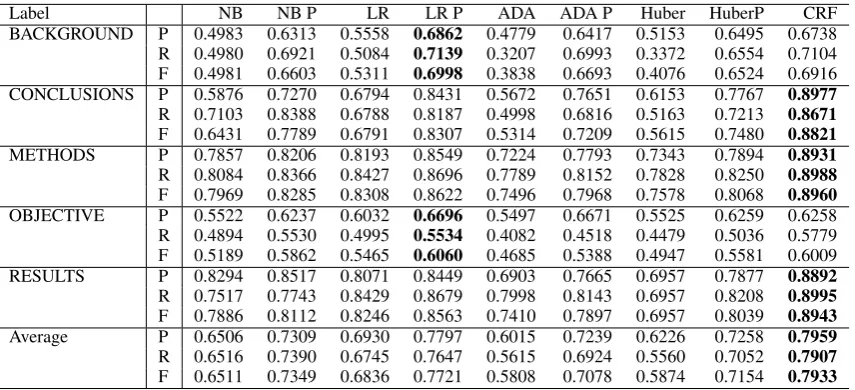
Tables 4 and 5 show the results of the intrinsic evaluation for paragraph and sentence experiments respectively. The algorithms are trained to label the paragraphs or sentences from the structured abstracts. The precision (P), recall (R) and F1
Label NB NB P LR LR P ADA ADA P Huber HuberP CRF BACKGROUND P 0.6047 0.6853 0.6374 0.7369 0.6098 0.7308 0.5862 0.7166 0.7357 R 0.5672 0.7190 0.5868 0.7207 0.3676 0.7337 0.4984 0.6694 0.7093 F 0.5854 0.7017 0.6110 0.7287 0.4587 0.7323 0.5387 0.6922 0.7223 CONCLUSIONS P 0.7532 0.8626 0.8365 0.9413 0.6975 0.8862 0.7578 0.9051 0.9769 R 0.8606 0.9366 0.8675 0.9552 0.8246 0.9404 0.7987 0.9340 0.9784 F 0.8033 0.8981 0.8517 0.9482 0.7557 0.9125 0.7777 0.9193 0.9776 METHODS P 0.9002 0.9278 0.9113 0.9396 0.8256 0.9041 0.8668 0.9116 0.9684 R 0.9040 0.9126 0.9294 0.9493 0.8955 0.9250 0.9012 0.9237 0.9675 F 0.9021 0.9201 0.9203 0.9444 0.8591 0.9144 0.8837 0.9176 0.9680 OBJECTIVE P 0.7294 0.7650 0.7167 0.7531 0.6763 0.7565 0.6788 0.7160 0.7608 R 0.6453 0.7190 0.7255 0.7549 0.6937 0.7228 0.6733 0.7365 0.7759 F 0.6848 0.7413 0.7210 0.7540 0.6849 0.7393 0.6761 0.7261 0.7683 RESULTS P 0.8841 0.9106 0.9086 0.9372 0.8554 0.9157 0.8560 0.9122 0.9692 R 0.8414 0.8542 0.8857 0.9216 0.7842 0.8564 0.8447 0.8846 0.9758 F 0.8622 0.8815 0.8970 0.9294 0.8182 0.8851 0.8503 0.8981 0.9725 Average P 0.7743 0.8303 0.8021 0.8616 0.7329 0.8387 0.7491 0.8323 0.8822 R 0.7637 0.8283 0.7990 0.8604 0.7131 0.8357 0.7433 0.8296 0.8814 F 0.7690 0.8293 0.8005 0.8610 0.7229 0.8372 0.7462 0.8310 0.8818
Table 4: Intrinsic evaluation of paragraph based labeling
Label NB NB P LR LR P ADA ADA P Huber HuberP CRF
BACKGROUND P 0.4983 0.6313 0.5558 0.6862 0.4779 0.6417 0.5153 0.6495 0.6738 R 0.4980 0.6921 0.5084 0.7139 0.3207 0.6993 0.3372 0.6554 0.7104 F 0.4981 0.6603 0.5311 0.6998 0.3838 0.6693 0.4076 0.6524 0.6916 CONCLUSIONS P 0.5876 0.7270 0.6794 0.8431 0.5672 0.7651 0.6153 0.7767 0.8977 R 0.7103 0.8388 0.6788 0.8187 0.4998 0.6816 0.5163 0.7213 0.8671 F 0.6431 0.7789 0.6791 0.8307 0.5314 0.7209 0.5615 0.7480 0.8821 METHODS P 0.7857 0.8206 0.8193 0.8549 0.7224 0.7793 0.7343 0.7894 0.8931 R 0.8084 0.8366 0.8427 0.8696 0.7789 0.8152 0.7828 0.8250 0.8988 F 0.7969 0.8285 0.8308 0.8622 0.7496 0.7968 0.7578 0.8068 0.8960 OBJECTIVE P 0.5522 0.6237 0.6032 0.6696 0.5497 0.6671 0.5525 0.6259 0.6258 R 0.4894 0.5530 0.4995 0.5534 0.4082 0.4518 0.4479 0.5036 0.5779 F 0.5189 0.5862 0.5465 0.6060 0.4685 0.5388 0.4947 0.5581 0.6009 RESULTS P 0.8294 0.8517 0.8071 0.8449 0.6903 0.7665 0.6957 0.7877 0.8892 R 0.7517 0.7743 0.8429 0.8679 0.7998 0.8143 0.6957 0.8208 0.8995 F 0.7886 0.8112 0.8246 0.8563 0.7410 0.7897 0.6957 0.8039 0.8943 Average P 0.6506 0.7309 0.6930 0.7797 0.6015 0.7239 0.6226 0.7258 0.7959 R 0.6516 0.7390 0.6745 0.7647 0.5615 0.6924 0.5560 0.7052 0.7907 F 0.6511 0.7349 0.6836 0.7721 0.5808 0.7078 0.5874 0.7154 0.7933
Table 5: Intrinsic evaluation of sentence based labeling
with the features from text and the position). The results include those based on CRF trained on the text of either the sentence or the paragraph taking into account the labeling sequence.
CRF has the best performance in both tables, with the differences being more dramatic on the paragraph results. These results are comparable to (Hirohata et al., 2008), even though we are working with a different set of labels. Compar-ing the remainCompar-ing learnCompar-ing algorithms, LR per-forms better than the other classifiers. Both Ad-aBoostM1 and SVM perform not as well as NB and LR; this could be due to the noise referred to by (Agarwal and Yu, 2009) that appears in the structured abstract sentences. Considering either the paragraph or the sentence text, the position in-formation helps improve their performance.
CONCLUSIONS, METHODS and RESULTS labels have the best performance, which matches the most frequent labels in the dataset (see Ta-ble 2). BACKGROUND and OBJECTIVE have worse performance compared to the other labels. These two labels have the largest imbalance com-pared to the other labels, which seems to nega-tively impact the classifiers performance.
4.2 Extrinsic evaluation (GeneRIFs)
Extrinsic evaluation is performed on the GeneRIF data set presented in the Methods section. The idea of the evaluation is to assign one of the ar-gumentative labels to the sentences, based on the models trained on structured abstracts, and eval-uate the impact of this assignment in the selec-tion of GeneRIF sentences. From the set of ma-chine learning algorithms intrinsically evaluated, we have selected the LR models trained with and without position information (Pos) and the CRF model. The LR and CRF models are used to la-bel the GeneRIF training and testing data with the argumentative labels.
Table 6 shows the results of the extrinsic evalu-ation. Results obtained with the argumentative la-bel feature and with or without the set of features used in the baseline are compared to the baseline model, i.e. NB and the set of features presented in the Methods section. In all the cases, precision (P), recall (R) andF1using the argumentative
fea-tures improve over the baseline.
The intrinsic evaluation was performed either on sentences or paragraphs. The sentence els perform better than the paragraph based mod-els. We find as well that LR with sentence position performs slightly better than when combined with the baseline features, with higher recall but lower precision. Contrary to the intrinsic results, LR per-forms better than CRF, even though both outper-form the baseline. This means that non-structured sentences do not necessarily follow the same argu-mentative structure as the structured abstracts.
Label P R F
Baseline 0.6210 0.6605 0.6405
LR Par 0.7235 0.6767 0.6993
LR Par + Base 0.7184 0.8014 0.7576 LR Par Pos 0.5978 0.8891 0.7149 LR Par Pos + Base 0.6883 0.8060 0.7426
LR Sen 0.7039 0.7852 0.7424
LR Sen + Base 0.7325 0.7968 0.7633 LR Sen Pos 0.7014 0.9007 0.7887 LR Sen Pos + Base 0.7222 0.8406 0.7769 CRF Par 0.6682 0.6744 0.6713 CRF Par + Base 0.7036 0.8060 0.7513 CRF Sen 0.6536 0.8499 0.7390 CRF Sen + Base 0.7134 0.7875 0.7486
Table 6: GeneRIF extrinsic evaluation
5 Discussion
Results show that it is possible to automatically predict the argumentative label of the structured abstracts and to improve the performance for GeneRIF annotation. Intrinsic evaluation shows that paragraph labeling is easier compared to sen-tence labeling, which might be partly due to the noise in the sentences as identified by (Agarwal and Yu, 2009). The excellent performance for paragraph labeling was already shown by previous work (Hirohata et al., 2008) while sentence label-ing issues for structured abstracts was previously introduced by (Agarwal and Yu, 2009). In both in-trinsic tasks, adding the position of the paragraph or sentence improves the performance of the learn-ing algorithms.
Extrinsic evaluation shows that, compared to the baseline features for GeneRIF annotation, adding argumentative labeling using the trained models improves its performance, which is close to the human performance reported in the Meth-ods section. On the other hand, we find that the CRF models show lower performance compared to the LR models. From the LR models, the po-sition of the sentence or paragraph seems to have better performance.
In addition, the LR model trained on the sen-tences performs better compared to the model trained on the paragraphs. This might be partly due to the fact that sentence based models seem to be better suited than the paragraph based ones as might have been expected. The fact that the CRF models performance is below the LR mod-els denotes that the structured abstracts seem to follow a pattern that is different in the case of non-structured abstracts. Looking closer at the assigned labels, the LR models tend to assign more CONCLUSIONS and RESULTS labels to the GeneRIF sentences compared to the CRF ones.
6 Conclusions and Future Work
other models that do not use the labeling sequence. On the other hand, when applying the trained models to MEDLINE/PubMed non-structured ab-stracts, we find that the extrinsic evaluation of these labeling on the GeneRIF task shows lower performance for the CRF models. This indicates that the structured abstracts follow a pattern that non-structured ones do not follow. The extrin-sic evaluation shows that labeling the sentences with argumentative labels improves the indexing of GeneRIF sentences. The argumentative labels help identifying target sentences for the GeneRIF indexing, but more refined labels learned from non-structured abstracts could provide better per-formance. An idea to extend this research would be evaluating the latent discovery of section labels and to apply this labeling to the proposed GeneRIF task and to other tasks, e.g. MeSH indexing. La-tent labels might accommodate better the argu-mentative structure of non-structured abstracts.
As shown in this work, the argumentative lay-out of non-structured abstracts and structured ab-stracts is not the same. There is still the open ques-tion if there is any layout regularity in the non-structured abstracts that could be exploited to im-prove information access.
7 Acknowledgements
NICTA is funded by the Australian Government as represented by the Department of Broadband, Communications and the Digital Economy and the Australian Research Council through the ICT Centre of Excellence program.
This work was also supported in part by the In-tramural Research Program of the NIH, National Library of Medicine.
References
S Agarwal and H Yu. 2009. Automatically classifying sentences in full-text biomedical articles into Intro-duction, Methods, Results and Discussion. Bioin-formatics, 25(23):3174–3180.
A R Aronson and F M Lang. 2010. An overview of MetaMap: historical perspective and recent ad-vances. Journal of the American Medical Informat-ics Association, 17(3):229–236.
G. Bhalotia, PI Nakov, A S Schwartz, and M A Hearst. 2003. BioText team report for the TREC 2003 ge-nomics track. InProceedings of TREC. Citeseer.
J Gobeill, I Tbahriti, F Ehrler, A Mottaz, A Veuthey, and P Ruch. 2008. Gene Ontology density
estima-tion and discourse analysis for automatic GeneRiF extraction. BMC Bioinformatics, 9(Suppl 3):S9.
W Hersh and R T Bhupatiraju. 2003. TREC genomics track overview. InTREC 2003, pages 14–23.
K Hirohata, Naoaki Okazaki, Sophia Ananiadou, Mit-suru Ishizuka, and Manchester Interdisciplinary Biocentre. 2008. Identifying sections in scientific abstracts using conditional random fields. InProc. of 3rd International Joint Conference on Natural Language Processing, pages 381–388.
R Jelier, M Schuemie, C Eijk, M Weeber, E Mulligen, B Schijvenaars, B Mons, and J Kors. 2003. Search-ing for GeneRIFs: concept-based query expansion and Bayes classification. InProceedings of TREC, pages 167–174.
A Jimeno-Yepes, J G Mork, D Demner-Fushman, and A R Aronson. 2012. A One-Size-Fits-All Indexing Method Does Not Exist: Automatic Selection Based on Meta-Learning. Journal of Computing Science and Engineering, 6(2):151–160.
A Jimeno-Yepes, J C Sticco, J G Mork, and A R Aron-son. 2013. GeneRIF indexing: sentence selection based on machine learning. BMC Bioinformatics, 14(1):147.
S Jonnalagadda, G D Fiol, R Medlin, C Weir, M Fisz-man, J Mostafa, and H Liu. 2012. Automatically extracting sentences from medline citations to sup-port clinicians’ information needs. In Healthcare Informatics, Imaging and Systems Biology (HISB), 2012 IEEE Second International Conference on, pages 72–72. IEEE.
A Jordan. 2002. On discriminative vs. generative classifiers: A comparison of logistic regression and naive bayes. Advances in neural information pro-cessing systems, 14:841.
J D Lafferty, A McCallum, and F Pereira. 2001. Con-ditional random fields: Probabilistic models for seg-menting and labeling sequence data. In Proceed-ings of the Eighteenth International Conference on Machine Learning, ICML ’01, pages 282–289, San Francisco, CA, USA. Morgan Kaufmann Publishers Inc.
J Lin, D Karakos, D Demner-Fushman, and S Khudan-pur. 2006. Generative content models for structural analysis of medical abstracts. InProceedings of the HLT-NAACL BioNLP Workshop on Linking Natural Language and Biology, pages 65–72. Association for Computational Linguistics.
Z Lu, K B Cohen, and L Hunter. 2006. Finding GeneRIFs via gene ontology annotations. InPacific Symposium on Biocomputing. Pacific Symposium on Biocomputing, page 52. NIH Public Access.
A McCallum. 2002. Mallet: A machine learning for language toolkit. URL http://mallet.cs.umass.edu.
L McKnight and P Srinivasan. 2003. Categorization of sentence types in medical abstracts. InAMIA An-nual Symposium Proceedings, volume 2003, page 440. American Medical Informatics Association.
Y Mizuta, A Korhonen, T Mullen, and N Collier. 2006. Zone analysis in biology articles as a basis for infor-mation extraction. International journal of medical informatics, 75(6):468–487.
A M Ripple, J G Mork, L S Knecht, and B L Humphreys. 2011. A retrospective cohort study of structured abstracts in MEDLINE, 1992–2006. Journal of the Medical Library Association: JMLA, 99(2):160.
A M Ripple, J G Mork, J M Rozier, and L S Knecht. 2012. Structured Abstracts in MEDLINE: Twenty-Five Years Later.
P Ruch, C Chichester, G Cohen, G Coray, F Ehrler, H Ghorbel, and V M¨uller, Hand Pallotta. 2003. Re-port on the TREC 2003 experiment: Genomic track. TREC-03.
P Ruch, A Geissbuhler, J Gobeill, F Lisacek, I Tbahriti, A Veuthey, and A R Aronson. 2007. Using dis-course analysis to improve text categorization in MEDLINE. Studies in health technology and infor-matics, 129(1):710.
I Tbahriti, C Chichester, F Lisacek, and P Ruch. 2005. Using argumentation to retrieve articles with similar citations: An inquiry into improving related articles search in the MEDLINE digital library. In Interna-tional Journal of Medical Informatics. Citeseer.
G Tsoumakas and I Katakis. 2007. Multi-label clas-sification: An overview. International Journal of Data Warehousing and Mining (IJDWM), 3(3):1–13.
L Yeganova, Donald C Comeau, W Kim, and J Wilbur. 2011. Text mining techniques for leveraging posi-tively labeled data. InProceedings of BioNLP 2011 Workshop, pages 155–163. Association for Compu-tational Linguistics.