A modular open-source focused crawler for mining monolingual and
bilingual corpora from the web
Vassilis Papavassiliou
Institute for Language and Speech Processing Athena Research and Innovation Center
Athens, Greece
{vpapa, prokopis}@ilsp.gr
Prokopis Prokopidis Gregor Thurmair
Linguatec
Gottfried-Keller-Str. 12, 81245 Munich, Germany
Abstract
This paper discusses a modular and open-source focused crawler (ILSP-FC) for the automatic acquisition of domain-specific monolingual and bilingual corpora from the Web. Besides describing the main modules integrated in the crawler (dealing with page fetching, normalization, clean-ing, text classification, de-duplication and document pair detection), we evaluate sev-eral of the system functionalities in an ex-periment for the acquisition of pairs of par-allel documents in German and Italian for the "Health & Safety at work" domain.
1 Introduction and motivation
There is a growing literature on using the Web for constructing various types of text collections, in-cluding monolingual, comparable, parallel and/or domain-specific corpora. Such resources can be used by linguists studying language use and change (Kilgarriff and Grefenstette, 2003), and at the same time they can be exploited in applied re-search fields like machine translation and multi-lingual information extraction. Moreover, these collections of raw data can be automatically an-notated and used to produce, by means of induc-tion tools, a second order or synthesized deriva-tives: rich lexica (with morphological, syntactic and lexico-semantic information), large bilingual dictionaries (word and multiword based) and trans-fer grammars.
To this end, several tools (i.e. web crawlers, HTML parsers, language identifiers, HTML clean-ers, etc.) have been developed and combined in order to produce corpora useful for specific tasks. However, to the best of our knowledge, most of the available systems either omit some processing tasks or require access to the results of a search en-gine. For instance, the BootCaT toolkit (Baroni et
al., 2006), a well-known suite of Perl scripts for bootstrapping specialized language corpora from the web, uses the Bing search engine and allows up to 5,000 queries per month.
In this paper, we present ILSP-FC, a modular system that includes components and methods for all the tasks required to acquire domain-specific corpora from the Web. The system is available as an open-source Java project1and due to its modu-lar architecture, each of its components can be eas-ily substituted by alternatives with the same func-tionalities. Depending on user-defined configura-tion, the crawler employs processing workflows for the creation of either monolingual or bilingual collections. For users wishing to try the system be-fore downloading it, two web services2allow them to experiment with different configuration settings for the construction of monolingual and bilingual domain-specific corpora.
The organization of the rest of the paper is as fol-lows. In Section 2, we refer to recent related work. In Section 3, we describe in detail the workflow of the proposed system. A solution for bootstrap-ping the focused crawler input is presented in Sec-tion 4. Then, an experiment on acquiring parallel documents in German and Italian for the "Health & Safety at work" domain (H&S) is described in Section 5, which also includes evaluation results on a set of criteria including parallelness and do-main specificity. We conclude and mention future work in Section 6.
2 Related work
Web crawling for building domain-specific mono-lingual and/or parallel data involves several tasks (e.g. link ranking, cleaning, text classification, near-duplicates removal) that remain open issues. Even though there are several proposed methods
1
http://nlp.ilsp.gr/redmine/projects/ ilsp-fc
2http://nlp.ilsp.gr/ws/
for each of these tasks, in this section we refer only to a few indicative approaches.
Olston and Najork (2010) outline the funda-mental challenges and describe the state-of-the-art models and solutions for web crawling. A gen-eral framework to fairly evaluate focused crawling algorithms under a number of performance met-rics is proposed by Srinivasan et al. (2005). A short overview of cleaning methods is presented in Spousta et al. (2008) and the comparison of such methods is discussed in Baroni et al. (2008). Sev-eral algorithms (Qi and Davison, 2009) exploit the main content and the HTML tags of a web page in order to classify a page as relevant to a targeted domain or not. Methods for the detection and re-moval of near-duplicates (i.e. acquired web pages that have almost the same content) are reviewed and compared in Theobald et al. (2008).
Efficient focused web crawlers can be built by adapting existing open-source frameworks like Heritrix3, Nutch4 and Bixo5. For instance, Com-bine6 is an open-source focused crawler that is
based on a combination of a general web crawler and a text classifier. Other approaches make use of search engines APIs to identify in-domain web pages (Hong et al., 2010) or multilingual web sites (Resnik and Smith, 2003). Starting from these pages, Almeida and Simões (2010) try to detect which links point to translations, while Shi et al. (2006) harvest multilingual web sites and extract parallel content from them. Bitextor (Esplà-Gomis and Forcada, 2010) combines language identifica-tion with shallow features that represent HTML structures to mine parallel pages.
Besides structure similarity, systems like PT-Miner (Nie et al., 1999) and WeBiText (Désilets et al., 2008) filtered fetched web pages by keep-ing only those containkeep-ing language markers in their URLs. Chen et al. (2004) proposed the Parallel Text Identification System, which incorporated a content analysis module using a predefined bilin-gual wordlist. Similarly, Zhang et al. (2006) and Utiyama et al. (2009) adopted the use of aligners in order to estimate the content similarity of candi-date parallel web pages or mixed languages pages. Barbosa et al. (2012) proposed the use of bilin-gual dictionaries and generated translations (e.g. by Google Translate and Microsoft Bing) to extract
3http://crawler.archive.org/ 4
http://nutch.apache.org
5
http://openbixo.org/
6http://combine.it.lth.se/
parallel content from multilingual sites.
3 System architecture
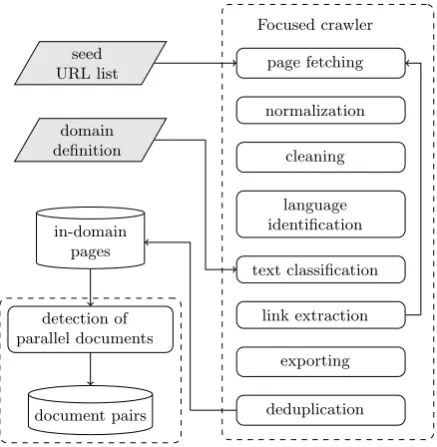
In this section, we describe the main modules inte-grated in ILSP-FC. In general, the crawler initial-izes its frontier (i.e. the list of pages to be visited) from a seed URL list provided by the user (or con-structed semi-automatically, see Section 4), clas-sifies fetched pages as relevant to the targeted do-main, extracts links from fetched web pages and adds them to the list of pages to be visited.
Focused crawler
page fetching
normalization
cleaning
language identification
text classification
link extraction
exporting
deduplication seed
URL list
domain definition
in-domain pages
detection of parallel documents
[image:2.595.308.527.222.446.2]document pairs
Figure 1: System architecture
In order to ensure modularity and scalability, the crawler is built using Bixo, an open source web mining toolkit that allows easy configuration of workflows and runs on top of the Hadoop7 frame-work for distributed data processing.
3.1 Page Fetcher
The first module concerns page fetching. A multithreaded crawling implementation has been adopted in order to ensure concurrent visiting of multiple hosts. Users can configure several set-tings that determine the fetching process, includ-ing number of concurrent harvesters and filterinclud-ing out specific document types. The crawler always respects standard robots.txt files, while politeness can also be affected with the use of settings re-garding time intervals for revisiting URLs from the same website, maximum number of URLs from a specific host per iteration, maximum number of at-tempts to fetch a web page etc.
3.2 Normalizer
The normalizer module uses the Apache Tika toolkit8to parse the structure of each fetched web page and extract its metadata. Extracted metadata are exported at a later stage (see Subsection 3.7) if the web document is considered relevant to the domain. The text encoding of the web page is also detected based on the HTTP Content-Encoding header and the charset part of the Content-Type header, and if needed, the content is converted into UTF-8. Besides default conversion, special care is taken for normalization of specific characters like no break space, narrow no-break space, three-per-em space, etc.
3.3 Cleaner
Apart from its textual content, a typical web page also contains boilerplate, i.e. "noisy" elements like navigation headers, advertisements, disclaimers, etc., which are of only limited or no use for the pro-duction of good-quality language resources. For removing boileplate, we use a modified version of Boilerpipe 9 (Kohlschütter et al, 2010) that also extracts structural information like title, heading andlist item. At this stage, text is also segmented in paragraphs on the basis of specific HTML tags like<p>,<br>and<li>. Paragraphs judged to be boilerplate and/or detected as titles, etc. are prop-erly annotated (see Subsection 3.7).
3.4 Language Identifier
The next processing module deals with language identification. We use the Cybozu10 language identification library that considers n-grams as fea-tures and exploits a Naive Bayes classifier for lan-guage identification. If a web page is not in the targeted language, its only further use is in extrac-tion of new links. Even though the main content of a web page is in the targeted language, it is likely that the web page includes a few paragraphs that are not in this language.Thus, the language iden-tifier is also applied on each paragraph and marks them properly (see Subsection 3.7).
3.5 Text Classifier
The aim of this module is to identify if a page that is normalized and in the targeted language contains data relevant to the targeted domain. To
8
http://tika.apache.org
9
http://code.google.com/p/boilerpipe/
10http://code.google.com/p/language-detection/
this end, the content of the page is compared to a user-provided domain definition. Following the string-matching method adopted by the Com-bine web crawler, the definition consists of term triplets (<relevance weight, (multi-word) term, subdomain>) that describe a domain and, option-ally, subcategories of this domain. Language-dependent stemmers from the Lucene11 project are used to stem user-provided terms and docu-ment content. Based on the number of terms’ oc-currences, their location in the web page and the weights of found terms, a page relevance scorep
is calculated as follows:
p=
N ∑
i=1 4
∑
j=1
nij ·wti·wjl,
whereN is the amount of terms in the domain def-inition,witis the weight of termi,wjl is the weight of locationjandnij denotes the number of occur-rences of termi in locationj. The four discrete locations in a web page are title, metadata, key-words, and plain text, with respective weights of 10, 4, 2, and 1.
Moreover, the amount of unique domain terms found in the main content of the page,m, is calcu-lated. Then, the valuespandmare compared with two predefined thresholds (t1 andt2) and if both
values are higher than the thresholds, the web page is categorized as relevant to the domain and stored. It is worth mentioning that the user can affect the strictness of the classifier by setting the values of both thresholds in the crawler's configuration file.
3.6 Link Extractor
Even when a web page is not stored (because it was deemed irrelevant to the domain, or not in the targeted language), its links are extracted and added to the list of links scheduled to be visited. Since the crawling strategy is a critical issue for a focused crawler, the links should be ranked and the most promising links (i.e. links that point to "in-domain" web pages or candidate translations) should be followed first. To this end, a scoreslis calculated for each linklas follows:
sl =c+p/L+ N ∑ i=1
ni·wi
where L is the amount of links originating from the source page,N is the amount of terms in the domain definition,nidenotes the number of occur-rences of thei-th term in the link's surrounding text andwiis the weight of thei-th term. By using this
formulation, the score link is mainly influenced by the "domainess" of its surrounding text.
The parameter c is only added in case the crawler is used for building bilingual collections. It gets a high positive value if the link under con-sideration originates from a web page in L1 and "points" to a web page that is probably in L2. This is the case when, for example, L2 is Ger-man and the anchor text contains strings like "de", "Deutsch", etc. The insertion of this parameter forces the crawler to visit candidate translations before following other links.
3.7 Exporter
The Exporter module generates an XML file for each stored web document. Each file contains metadata (e.g. language, domain, URL, etc.) about the corresponding document inside a header element. Moreover, a <body> element contains the content of the document segmented in graphs. Apart from normalized text, each para-graph element<p>is enriched with attributes pro-viding more information about the process out-come. Specifically, <p> elements in the XML files may contain the following attributes: i) crawlinfowith possible valuesboilerplate, mean-ing that the paragraph has been considered boil-erplate (see Subsection 3.3), orooi-lang, meaning that the paragraph is not in the targeted language; ii)typewith possible values:title, headingand lis-titem; and iii)topicwith a string value including all terms from the domain definition detected in this paragraph.
3.8 De-duplicator
Ignoring the fact12 that the web contains many near-duplicate documents could have a negative effect in creating a representative corpus. Thus, the crawler includes a de-duplicator module that represents each document as a list containing the MD5 hashes of the main content's paragraphs, i.e. paragraphs without thecrawlinfoattribute. Each document list is checked against all other docu-ment lists, and for each candidate pair, the inter-section of the lists is calculated. If the ratio of the intersection cardinality to the cardinality of the shortest list is more than 0.8, the documents are considered near-duplicates and the shortest is dis-carded.
12Baroni et al. (2009) reported that during building of the
Wacky corpora, the amount of collected documents was re-duced by more than 50% after de-duplication.
3.9 Pair Detector
After in-domain pages are downloaded, the Pair Detector module uses two complementary meth-ods to identify pairs of pages that could be con-sidered parallel. The first method is based on co-occurrences, in two documents, of images with the same filename, while the second takes into account structural similarity.
In order to explain the workflow of the pair de-tection module, we will use the multilingual web-sitehttp://www.suva.chas a running exam-ple. Crawling this website using the processes de-scribed in previous subsections provides a pool of 707 HTML files (and their exported XML counter-parts) that are found relevant to the H&S domain and in the targeted DE and IT languages (376 and 331 files, respectively).
Each XML file is parsed and the following features are extracted: i) the document lan-guage; ii) the depth of the original source page, (e.g. forhttp://domain.org/d1/d2/d3/ page.html, depth is 4); iii) theamount of para-graphs; iv) the length(in terms of tokens) of the clean text; and v) thefingerprintof the main con-tent, which is a sequence of integers that represent the structural information of the page, in a way similar to the approach described by Esplà-Gomis and Forcada (2010). For instance, thefingerprint of the extract in Figure 2 is [-2, 28, 145, -4, 9, -3, 48, -5, 740] withboilerplateparagraphs ignored; -2, -3 and -4 denote that thetypeattributes of corre-sponding<p>elements havetitle,headingand lis-titemvalues, respectively; -5 denotes the existence of thetopicattribute in the last<p>; and positive integers are paragraph lengths in characters.
Thelanguagefeature is used to filter out pairs of files that are in the same language. Pages that have a depth difference above 1 are also filtered out, on the assumption that it is very likely that translations are found at the same or neighbouring depths of the web site tree.
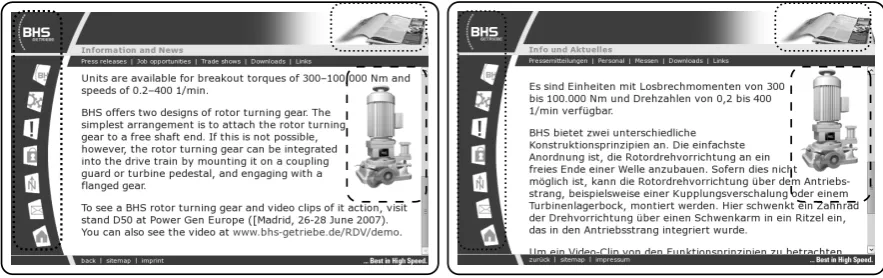
Next, we extract the filenames of the images from HTML source and each document is repre-sented as a list of image filenames. Since it is very likely that some images appear in many web pages, we count the occurrence frequency of each image and discard relatively frequent images (i.e. Face-book and Twitter icons, logos etc.) from the lists.
ex-<p type="title">Strategia degli investimenti</p> <!-- -2, 28-->
<p >I ricavi degli investimenti sono un elemento essenziale per finanziare le rendite e mantenere il potere d'acquisto dei beneficiari delle rendite.</p> <!--145-->
<p type="listitem">Document:</p> <!-- -4, 9 -->
<p crawlinfo="boilerplate" type="listitem">Factsheet "La strategia d'investimento della Suva in sintesi" (Il link viene aperto in una nuova finestra) </p> <!--ignored -->
<p type="heading">Perché la Suva effettua investimenti finanziari?</p> <!-- -3, 48-->
<p topic="prevenzione degli infortuni;infortunio sul lavoro">Nonostante i molti sforzi compiuti nella prevenzione degli infortuni sul lavoro e nel tempo libero ogni anno accadono oltre 2500 infortuni con conseguenze invalidanti o mortali. In questi casi si versa una rendita per invalidità agli infortunati oppure una rendita per orfani o vedovile ai superstiti. Nello stesso anno in cui
attribuisce una rendita, la Suva provvede ad accantonare i mezzi necessari a pagare le rendite future. La maggior parte del patrimonio investito dalla Suva è
[image:5.595.77.519.328.467.2]rappresentato proprio da questi mezzi, ossia dal capitale di copertura delle rendite. La restante parte del patrimonio è costituta da accantonamenti per prestazioni assicurative a breve termine come le spese di cura, le indennità giornaliere e le riserve.</p> <!-- -5, 740-->
Figure 2: An extract of an XML file for an Italian web page relevant to the H&S domain.
Figure 3: Critical (dashed) and common (dotted) images in a multilingual (EN/DE) site.
pect that low/high frequencies correspond to "crit-ical"/"common" images. We employ a non-parametric approach for estimating the probabil-ity densprobabil-ity function (Alpaydin, 2010) of the image frequencies using the following formula:
ˆ
p(x) = M h1
M ∑ t=1
K(x−hxt)
where the random variablexdefines the positions (i.e. images frequencies) at which thepˆ(x)will be estimated,M is the amount of images,xtdenotes the values of data samples in the region of width
h around the variable x, and K(·) is the normal kernel that defines the influence of valuesxtin the estimation of pˆ(x). The optimal value forh, the optimal bandwidth of the kernel smoothing win-dow, was calculated as described in Bowman and Azzalini (1997).
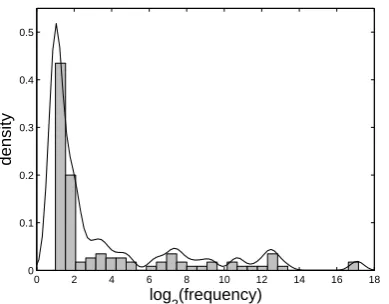
Figure 4 illustrates the normalized histogram of
image frequencies in the example collection and the estimated probability density function. One can identify a main lobe in the low values, which corresponds to "critical" images. Thus, the thresh-old is chosen to be equal to the minimum just af-ter this lobe. The underlining assumption is that if a web page in L1 contains image(s) then the web page with its translation in L2 will contain more or less the same images. In case this assumption is not valid for a multilingual site (i.e. there are only im-ages that appear in all pim-ages, e.g. template icons), probably all images will be included. To eliminate this, we discard images that exist in more than 10% of the total HTML files.
para-0 2 4 6 8 10 12 14 16 18 0
0.1 0.2 0.3 0.4 0.5
log2(frequency)
[image:6.595.82.277.71.223.2]density
Figure 4: The normalized histogram and the esti-mated pdf of the image frequencies.
graphs), b) the ratio of their clean text lengths (in terms of tokens), and c) the Jaccard similarity co-efficient of their image lists, are higher than em-pirically predefined thresholds.
More pairs are detected by examining structure similarity. Since the XML files contain informa-tion about structure, content (i.e. titles, headings, list items) and domain specificity (i.e. paragraphs with thetopicattribute), we use these files instead of examining the similarity of the HTML source. A 3-dimensional feature vector is constructed for each candidate pair of parallel documents. The first element in this vector is the ratio of their fin-gerprint lengths, the second is the ratio of their sizes in paragraphs, and the third is the ratio of the edit distance of the fingerprints of the two docu-ments to the maximum fingerprint length. Clas-sification of a pair as parallel is achieved using a soft-margin polynomial Support Vector Machine trained with the positive and negative examples collected during our previous work (Pecina et al., 2012). Note that the dataset included only candi-date pairs that met the criteria regarding the ratio of paragraphs amounts and the ratio of text lengths, mentioned above. As a result, negative instances (i.e. pairs of documents that have similar structure but are not real pairs) did not heavily outnumber positive ones and thus the training was not imbal-anced (Akbani et al., 2004).
4 Bootstrapping the input of the focused crawler
In the work presented in previous sections, we as-sumed that users had access to already existing lists of seed terms and URLs for the
initializa-tion of the frontier and the classifier. But what if manually compiled resources for a particular do-main/language(s) combination (e.g. ES/FR termi-nology for endocritermi-nology or lists of EN/DE web sites related to floriculture) are impossible or diffi-cult to find? Can we bootstrap such resources and provide them to users for post-editing? In this sec-tion, we present ongoing work towards this goal using the category graph and the external links of multilingual editions of Wikipedia.
We initialize the bootstrapping process by searching for a term defining the domain of in-terest (e.g. "ballet", "automotive accessories") in the category graph of the EN wikipedia. If a cat-egory is found, we recursively collect all pages in this category and its subcategories for a predefined depth. For each page we extract its title and we consider it a term that can participate in a list of domain-related seed terms. We use a set of pattern matching rules that exclude certain titles like those of disambiguation and redirect pages. Other rules exclude titles that refer to lists of related pages or titles that use upper case or title case and are proba-bly abbreviations and named entities, respectively. Obviously, in a different setting where, for exam-ple, a user is interested in discovering named enti-ties related to a domain, these titles should be han-dled differently.
The next step involves utilizing the links from each EN page to articles in wikipedias written in other languages. Based on which languages we are interested in, we again consider each title a seed term in language LANG, this time also storing the information that the term is also a LANG transla-tion of the EN term.
During traversing the EN category graph and visiting corresponding articles in other languages, we also populate a list of seed URLs for the fo-cused crawler, by keeping record of all links to URLs outsidewikipedia.org. At this stage, we have all necessary resources to initiate mono-lingual focused crawls in each language we are in-terested in.
this link points to a translation (in a way similar to the process described in Subsection 3.6). If trans-lation links are found, we store the site as a candi-date for bilingual focused crawling. Also, since it is common that links to multilingual editions of a web site are not present in all of its pages, we re-peat the same process for the home page of the site. Notice that it is a task for the FC to detect whether these sites (or one of their sections) also contain parallel documents in the targeted domain.
In a first set of experiments following this ap-proach, we used September 2012 snapshots13 for English, French, German, Greek, Portuguese and Spanish wikipedias (EN, FR, DE, EL, PT and ES, respectively). Although we leave detailed eval-uation of created resources for future work, we present as example output a list of terms related to "Flowers" in Table 1. Notice that, since the num-ber of articles of multilingual wikipedias varies considerably, the term list extracted for languages like EL is, as expected, smaller compared, for ex-ample, to the 547 and 293 terms collected for EN and ES, respectively. Finally, using the URLs ex-tracted from the articles on the "Flowers" domain, Table 2 contains a sample of web sites detected for containing relevant multilingual content.
5 Evaluation Results
In order to assess the quality of the resources that ILSP-FC can produce, we evaluated it in a task of acquiring pairs of parallel documents in German and Italian for the "Health & Safety at work" (Ar-beitsschutz/Sicurezza sul lavoro) domain. We as-sume that this task is relatively difficult, i.e. that the number of documents in this domain and pair of languages is relatively small in the web. Overall, our system delivered 807 document pairs for H&S, containing 1.40 and 1.21 million tokens for IT and DE, respectively. Numbers refer to tokens in the main content of the acquired web pages, i.e. to to-kens in paragraphs without the attributecrawlinfo (see Subsection 3.7).
A sample of the acquired corpora were evalu-ated against a set of criteria discussed in the fol-lowing subsections. We randomly selected 103 document pairs for manual inspection. The sample size was calculated according to a 95% confidence level and an at most 10% confidence interval.
13We use the Java Wikipedia Library (Zesch et al., 2008) to
convert each snapshot into a database that allows structured access to several aspects of categories, articles, sections etc.
5.1 Parallelness
The number of the correctly identified parallel doc-ument pairs was obviously critical in this particular evaluation setting. We focused on the precision of the pair detector module, since it is not feasible to count how many pairs were missed. In the subset examined, 94 and 4 document pairs were judged as parallel and not parallel, respectively. The other 5 pairs were considered borderline cases, where more than 20% of the sentences in one document were translated in the other. Since about 95% of the crawled data are of good or sufficiently good quality, this shows that they are usable for further processing, e.g. for sentence alignment.
5.2 Domain specificity
We next evaluated how many documents in the se-lected data fit the targeted domain in both the IT and the DE partitions. The overall precision was about 77%, with 79 IT documents and 80 DE docu-ments found relevant to the narrow domain chosen for evaluation.
Reported results on text-to-topic classification sometimes score higher; however they neglect a critical factor of influence, namely the distance be-tween training and prediction datasets. In the "real world", scores between 75% and 85% are realistic to assume. It should be mentioned that the preci-sion of the topic classifier strongly depends on the quality of the seed terms: by inspecting results, modifying the seed term list and crawling, re-sults could easily be improved further.
5.3 Language identification
Since the language identifier is applied on every paragraph of the main content of each web page, we examined how many of the paragraphs have been marked correctly. Overall, 5223 and 4814 paragraphs of IT and DE documents were checked and only 13 and 65 wrong assignments were found, respectively.
EN: 547 DE: 255 EL: 22 ES: 293 FR: 286 IT: 143 PT: 164 Gardenia Gardenien Γαρδένια Gardenia Gardénia Gardenia Gardenia Calendula Ringelblumen Καλέντουλα Calendula Calendula Calendula Calendula
Lilium Lilien Κρίνο Lilium Lys Lilium Lírio
Peony Pfingstrosen Παιώνια Paeoniaceae Pivoine Paeonia Paeoniaceae Tulip Tulpen Τουλίπα Tulipa Tulipe Tulipa Tulipa
Flower Blüte Άνθος Flor Fleur Fiore Flor
[image:8.595.73.519.236.325.2]Crocus Krokusse Κρόκος Crocus Crocus Crocus Crocus Anemone Windröschen Ανεμώνη Anemone Anémone Anemone Anemone
Table 1: Sample seed terms for the "Flowers" domain in 7 languages, collected automatically from multi-lingual editions of Wikipedia. The header of the table refers to the total terms collected for each language.
Wikipedia article Seed URL WebSite Langs
EN: Omphalodes_verna http://goo.gl/msyIc http://www.luontoportti.com de,en,es,fr ES: Tropaeolum http://goo.gl/Ec5uK http://www.chileflora.com de,en,es EN: Erythronium americanum http://goo.gl/nEP2L http://wildaboutgardening.org en,fr DE: Nickendes_Leimkraut http://goo.gl/nuHNe http://www.wildblumen.at de,en,pt DE: Titanenwurz http://goo.gl/rLl9W http://www.wilhelma.de de,en
Table 2: Automatically detected web sites with multilingual content related to the "Flowers" domain. Column 1 presents the original LANG.wikipedia.org article from which the (shortened for readability purposes) seed URLs in column 2 were extracted. The seed URLs led to the 3rd column web sites, in which content in the languages of the 4th column was found.
5.4 Boilerplate removal
For this evaluation aspect, we evaluated how many "good" paragraphs were judged to be boilerplate, and how many "bad" paragraphs were missed. We examined 23178 and 23176 paragraphs of IT and DE documents and found 2326 and 2591 errors with an overall error rate around 10%. It should be noted that different strategies for boilerplate re-moval can be followed. One "classical" option is to remove everything that does not belong to the text, i.e. headers, advertisements etc. that "frame" real content. Another option is to attempt to remove everything which is irrelevant for MT sentence alignment; this goes beyond the first approach as it also removes short textual chunks, copyright dis-claimers, etc. Most of the errors reported here were mainly due to this difference; i.e. they were para-graphs that were deemed not usable for MT align-ment.
6 Conclusions and future work
In this paper we described and evaluated ILSP-FC, a system for mining domain-specific monolingual and bilingual corpora from the web. The system is available as open-source and is modular in the sense that each of its components can be easily
sub-stituted with similar software performing the same functionalities. The crawler can also be tested via web services that allow the user to perform exper-iments without the need to install it.
We have already used the crawler in producing monolingual and parallel corpora and other deriva-tive resources. Evaluation has shown that the sys-tem can be used effectively in collecting resources of high quality, provided that the user can initial-ize it with lists of seed terms and URLs that can be easily found on the web. For domains for which no similar lists are available, we presented ongo-ing work for bootstrappongo-ing them from multilongo-ingual editions of Wikipedia. Future work includes eval-uation and improvement of the bootstrapping com-ponent, more sophisticated methods for text clas-sification, and grouping of collected data based on genre.
Acknowledgments
References
Rehan Akbani, Stephen Kwek, and Nathalie Japkow-icz. 2004. Applying support vector machines to imbalanced datasets. InIn Proceedings of the 15th European Conference on Machine Learning (ECML, pages 39--50.
José João Almeida and Alberto Simões. 2010. Auto-matic parallel corpora and bilingual terminology ex-traction from parallel websites. In3rd Workshop on Building and Using Comparable Corpora .
Ethem Alpaydin. 2010. Introduction to Machine Learning. The MIT Press, 2nd edition.
Luciano Barbosa, Vivek Kumar Rangarajan Sridhar, Mahsa Yarmohammadi, and Srinivas Bangalore. 2012. Harvesting parallel text in multiple languages with limited supervision. InCOLING, pages 201--214.
Marco Baroni, Adam Kilgarriff, Jan Pomikálek, and Pavel Rychlý. 2006. WebBootCaT: Instant Domain-Specific Corpora to Support Human Translators. In Proceedings of the 11th Annual Conference of EAMT, pages 47--252, Norway.
Marco Baroni, Francis Chantree, Adam Kilgarriff, and Serge Sharoff. 2008. Cleaneval: a competition for cleaning web pages. InLREC'08.
Marco Baroni, Silvia Bernardini, Adriano Ferraresi, and Eros Zanchetta. 2009. The WaCky Wide Web: a collection of very large linguistically processed web-crawled corpora. Language Resources and Evalua-tion, 43(3):209--226.
Adrian W. Bowman and Adelchi Azzalini. 1997.
Applied smoothing techniques for data analysis: the kernel approach with S-Plus illustrations, vol-ume 18. Oxford University Press.
Jisong Chen, Rowena Chau, and Chung-Hsing Yeh. 2004. Discovering parallel text from the World Wide Web. InProceedings of ACSW Frontiers '04, vol-ume 32, pages 157--161, Darlinghurst, Australia.
Alain Désilets, Benoit Farley, Marta Stojanovic, and Geneviève Patenaude. 2008. WeBiText: Building Large Heterogeneous Translation Memories from Parallel Web Content. InProceedings of Translat-ing and the Computer (30), London, UK.
Miquel Esplà-Gomis and Mikel L. Forcada. 2010. Combining Content-Based and URL-Based Heuris-tics to Harvest Aligned Bitexts from Multilingual Sites with Bitextor. The Prague Bulletin of Math-emathical Lingustics, 93:77--86.
Gumwon Hong, Chi-Ho Li, Ming Zhou, and Hae-Chang Rim. 2010. An empirical study on web min-ing of parallel data. InProceedings of the 23rd COL-ING, pages 474--482.
Adam Kilgarriff and Gregory Grefenstette. 2003. In-troduction to the special issue on the web as corpus.
Computational Linguistics, 29(3):333--348.
Jian-Yun Nie, Michel Simard, Pierre Isabelle, and Richard Durand. 1999. Cross-language information retrieval based on parallel texts and automatic min-ing of parallel texts from the Web. InProceedings of the 22nd annual international ACM SIGIR con-ference on research and development in information retrieval, pages 74--81, New York.
Christopher Olston and Marc Najork. 2010. Web crawling. Found. Trends Inf. Retr., 4(3):175--246.
Pavel Pecina, Antonio Toral, Vassilis Papavassiliou, Prokopis Prokopidis, and Josef van Genabith. 2012. Domain adaptation of statistical machine translation using web-crawled resources: a case study. In Pro-ceedings of the 16th Annual Conference of EAMT, pages 145--152, Trento, Italy.
Xiaoguang Qi and Brian D. Davison. 2009. Web page classification: Features and algorithms. ACM Com-puting Surveys, 41:11--31.
Philip Resnik and Noah A. Smith. 2003. The Web as a parallel corpus. Computational Linguistics, 29:349--380.
Lei Shi, Cheng Niu, Ming Zhou, and Jianfeng Gao. 2006. A dom tree alignment model for mining paral-lel data from the web. InCOLING/ACL-2006, pages 489--496.
Miroslav Spousta, Michal Marek, and Pavel Pecina. 2008. Victor: the Web-Page Cleaning Tool. In Pro-ceedings of the 4th Web as Corpus Workshop - Can we beat Google?, pages 12--17, Marrakech.
Padmini Srinivasan, Filippo Menczer, and Gautam Pant. 2005. A General Evaluation Framework for Topical Crawlers. Information Retrieval, 8:417--447.
Martin Theobald, Jonathan Siddharth, and Andreas Paepcke. 2008. Spotsigs: robust and efficient near duplicate detection in large web collections. In Pro-ceedings of the 31st annual international ACM SI-GIR conference on research and development in in-formation retrieval, pages 563--570.
Masao Utiyama, Daisuke Kawahara, Keiji Yasuda, and Eiichiro Sumita. 2009. Mining parallel texts from mixed-language web pages. InMT Summit.
Torsten Zesch, Christof Müller, and Iryna Gurevych. 2008. Extracting lexical semantic knowledge from wikipedia and wiktionary. InProceedings of the 6th International Conference on Language Resources and Evaluation, Marrakech.