Making UIMA Truly Interoperable with SPARQL
Rafal Rak and Sophia Ananiadou
National Centre for Text Mining
School of Computer Science, University of Manchester {rafal.rak,sophia.ananiadou}@manchester.ac.uk
Abstract
Unstructured Information Management Architecture (UIMA) has been gaining popularity in annotating text corpora. The architecture defines common data struc-tures and interfaces to support interoper-ability of individual processing compo-nents working together in a UIMA appli-cation. The components exchange data by sharing common type systems—schemata of data type structures—which extend a generic, top-level type system built into UIMA. This flexibility in extending type systems has resulted in the development of repositories of components that share one or several type systems; however, compo-nents coming from different repositories, and thus not sharing type systems, remain incompatible. Commonly, this problem has been solved programmatically by im-plementing UIMA components that per-form the alignment of two type systems, an arduous task that is impractical with a growing number of type systems. We al-leviate this problem by introducing a con-version mechanism based on SPARQL, a query language for the data retrieval and manipulation of RDF graphs. We pro-vide a UIMA component that serialises data coming from a source component into RDF, executes a user-defined, type-conversion query, and deserialises the up-dated graph into a target component. The proposed solution encourages ad hoc con-versions, enables the usage of heteroge-neous components, and facilitates highly customised UIMA applications.
1 Introduction
Unstructured Information Management Architec-ture (UIMA) (Ferrucci and Lally, 2004) is a
frame-work that supports the interoperability of media-processing software components by defining com-mon data structures and interfaces the compo-nents exchange and implement. The architec-ture has been gaining interest from academia and industry alike for the past decade, which re-sulted in a multitude of UIMA-supporting repos-itories of analytics. Notable examples include METANET4U components (Thompson et al., 2011) featured in U-Compare1, DKPro (Gurevych
et al., 2007), cTAKES (Savova et al., 2010), BioNLP-UIMA Component Repository (Baum-gartner et al., 2008), and JULIE Lab’s UIMA Component Repository (JCoRe) (Hahn et al., 2008).
However, despite conforming to the UIMA standard, each repository of analytics usually comes with its own set of type systems, i.e., rep-resentations of data models that are meant to be shared between analytics and thus ensuring their interoperability. At present, UIMA does not fa-cilitate the alignment of (all or selected) types be-tween type systems, which makes it impossible to combine analytics coming from different reposito-ries without an additional programming effort. For instance, NLP developers may want to use a sen-tence detector from one repository and a tokeniser from another repository only to learn that the re-quired inputSentencetype for the tokeniser is defined in a different type system and namespace than the outputSentence type of the sentence detector. Although bothSentencetypes repre-sent the same concept and may even have the same set of features (attributes), they are viewed as two distinct types by UIMA.
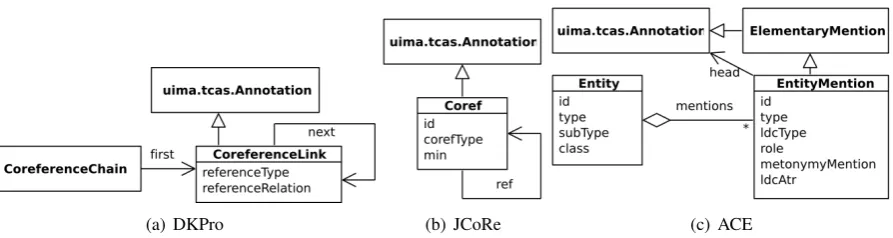
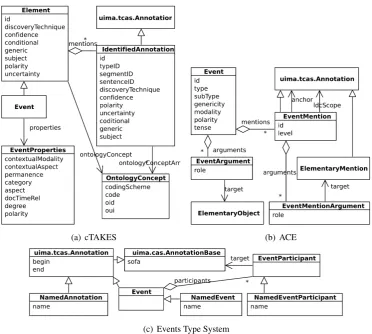
Less trivial incompatibility arises from the same concept being encoded as structurally different types in different type systems. Figures 1 and 2 show fragments of some of existing type systems;
1http://nactem.ac.uk/ucompare/
(a) DKPro (b) JCoRe (c) ACE
Figure 1: UML diagrams representing fragments of type systems that show differences in encoding coreferences.
specifically, they show the differences in encod-ingcoreferencesandevents, respectively. For in-stance, in comparison to the JCoRe type system in Figure 1(b), the DKPro type system in Figure 1(a) has an additional type that points to the beginning of the linked list of coreferences.
Conceptually similar types in two different type systems may also be incompatible in terms of the amount of information they convey. Compare, for instance, type systems in Figure 2 that encode a similar concept, event. Not only are they struc-turally different, but the cTAKES type system in Figure 2(a) also involves a larger number of fea-tures than the other two type systems. Although, in this case, the alignment of any two structures cannot be carried out without a loss or deficiency of information, it may still be beneficial to do so for applications that consist of components that ei-ther fulfill partially complete information or do not require it altogether.
The available type systems vary greatly in size, their modularity, and intended applicability. The DKPro UIMA software collection, for instance, includes multiple, small-size type systems organ-ised around specific syntactic and semantic con-cepts, such as part of speech, chunks, and named entities. In contrast, the U-Compare project as well as cTAKES are oriented towards having a sin-gle type system. Respectively, the type systems define nearly 300 and 100 syntactic and seman-tic types, with U-Compare’s semanseman-tic types biased towards biology and chemistry and cTAKES’s covering clinical domain. Most of the U-Compare types extend a fairly expressive higher-level type, which makes them universally applicable, but at the same time, breaks their semantic cohesion. The lack of modularity and the all-embroiling types suggest that the U-Compare type system is developed primarily to work with the U-Compare
application.
The Center for Computational Pharmacology (CCP) type system (Verspoor et al., 2009) is a radically different approach to the previous sys-tems. It defines a closed set of top-level types that facilitate the use of external resources, such as databases and ontologies. This gives the advan-tage of having a nonvolatile type system, indiffer-ent to changes in the external resources, as well as greater flexibility in handling some semantic mod-els that would otherwise be impossible to encode in a UIMA type system. On the other hand, such an approach shifts the handling of interoperability from UIMA to applications that must resolve com-patibility issues at runtime, which also results in the weakly typed programming of analytics. Addi-tionally, the UIMA’s native indexing of annotation types will no longer work with such a type system, which prompts an additional programming effort from developers.
(a) cTAKES (b) ACE
[image:3.595.112.485.58.392.2](c) Events Type System
Figure 2: UML diagrams representing fragments of type systems that show differences in encoding event structures.
an official W3C Recommendation2. Our approach involves 1) the serialisation of UIMA’s internal data structures to RDF3, 2) the execution of a user-defined, type-conversion SPARQL query, and 3) the deserialisation of the results back to the UIMA structure.
The remainder of this paper is organised as fol-lows. The next section presents related work. Sec-tion 3 provides background informaSec-tion on UIMA, RDF and SPARQL. Section 4 discusses the pro-posed representation of UIMA structures in RDF, whereas Section 5 examines the utility of our method. Section 6 details the available implemen-tation, and Section 7 concludes the paper.
2 Related Work
In practice, type alignment or conversion is the creation of new UIMA feature structures based on the existing ones. Current efforts in this area mostly involve solutions that are essentially
2
http://www.w3.org/TR/2013/REC-sparql11-overview-20130321
3http://www.w3.org/RDF/
(cascaded) finite state transducers, i.e., an in-put stream of existing feature structures is being matched against developers’ defined patterns, and if a match is found, a series of actions follows and results in one or more output structures.
TextMarker (Kluegl et al., 2009) is currently one of the most comprehensive tools that de-fines its own rule-based language. The language capabilities include the definition of new types, annotation-based regular expression matching and a rich set of condition functions and actions. Com-bined with a built-in lexer that produces basic to-ken annotations, TextMarker is essentially a self-contained, UIMA-based annotation tool.
feature structures. This implies that the input of the conversion process must be encoded in XML.
PEARL (Pazienza et al., 2012) is a language for projecting UIMA annotations onto RDF reposito-ries. Similarly to the previous approaches, the lan-guage defines a set of rules triggered upon encoun-tering UIMA annotations. The language is de-signed primarily to work in CODA, a platform that facilitates population of ontologies with the output of NLP analytics. Although it does not directly facilitate the production or conversion of UIMA types, the PEARL language shares similarities to our approach in that it incorporates certain RDF Turtle, SPARQL-like semantics.
Contrary to the aforementioned solutions, we do not define any new language or syntax. Instead, we rely completely on an existing data query and manipulation language, SPARQL. By doing so, we shift the problem of conversion from the def-inition of a new language to representing UIMA structures in an existing language, such that they can be conveniently manipulated in that language. A separate line of research pertains to the for-malisation of textual annotations with knowledge representations such as RDF and OWL4. Buykoet al.(2008) link UIMA annotations to the reference ontology OLiA (Chiarcos, 2012) that contains a broad vocabulary of linguistic terminology. The authors claim that two conceptually similar type systems can be aligned with the reference ontol-ogy. The linking involves the use of OLiA’s as-sociated annotation and linking ontology model pairs that have been created for a number of an-notation schemata. Furthermore, a UIMA type system has to define additional features for each linked type that tie a given type to an annotation model. In effect, in order to convert a type from an arbitrary type system to another similar type sys-tem, both systems must be modified and an anno-tation and linking models must be created. Such an approach generalises poorly and is unsuitable for impromptu type system conversions.
3 Background
3.1 UIMA Overview
UIMA defines both structures and interfaces to facilitate interoperability of individual processing components that share type systems. Type systems may be defined in or imported by a processing component that produces or modifies annotations
[image:4.595.308.526.61.217.2]4http://www.w3.org/TR/owl2-overview/
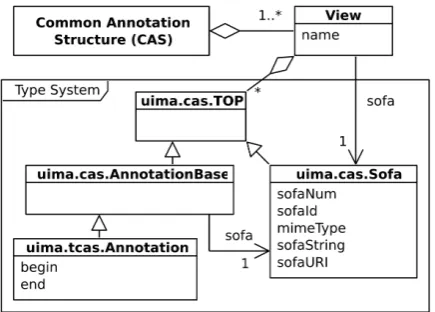
Figure 3: UML diagram representing relationships between CASes, views, and feature structures in UIMA. The shown type system is a fragment of the built-in UIMA type system.
in a common annotation structure (CAS), i.e., a CAS is the container of actual data bound by the type system.
Types may define multiple primitivefeaturesas well as references to feature structures (data in-stances) of other types. The single-parent inheri-tance of types is also possible. The resulting struc-tures resemble those present in modern object-oriented programming languages.
Feature structures stored in a CAS may be grouped into several views, each of which hav-ing its own subject of analysis (Sofa). For in-stance, one view may store annotations about a Sofa that stores an English text, whereas an-other view may store annotations about a dif-ferent Sofa that stores a French version of the same text. UIMA defines built-in types including primitive types (boolean, integer, string, etc.), ar-rays, lists, as well as several complex types, e.g.,
uima.tcas.Annotation that holds a refer-ence to a Sofa the annotation is asserted about, and two features, begin and end, for marking bound-aries of a span of text. The relationships be-tween CASes, views, and several prominent built-in types are shown built-in Figure 3.
The built-in complex types may further
be extended by developers. Custom types
that mark a fragment of text usually extend
UIMA element/representation RDF resource
CAS <uima:aux:CAS>
Access to CAS’s views rdfs:memberorrdf:_1,rdf:_2, ...
View <uima:aux:View>
View’s name <uima:aux:View:name>
View’s Sofa <uima:aux:View:sofa>
Access to view’s feature structures rdfs:memberorrdf:_1,rdf:_2, ...
Access to feature structure’s sequential number <uima:aux:seq>
Typeuima.tcas.Annotation <uima:ts:uima.tcas.Annotation>
Featureuima.tcas.Annotation:begin <uima:ts:uima.cas.Annotation:begin>
[image:5.595.78.522.61.214.2]Access touima.cas.ArrayBaseelements rdfs:memberorrdf:_1,rdf:_2, ...
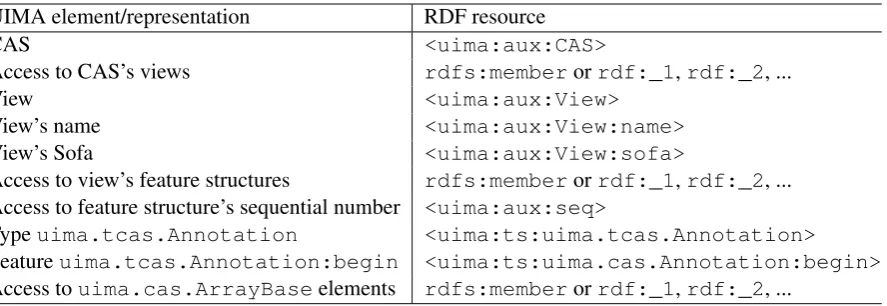
Table 1: UIMA elements and their corresponding RDF resource representations
3.2 RDF and SPARQL
Resource Description Framework (RDF) is a method for modeling concepts in form of making statements about resources using triple subject-predicate-object expressions. The triples are com-posed of resources and/or literals with the latter available only as objects. Resources are repre-sented with valid URIs, whereas literals are val-ues optionally followed by a datatype. Multiple interlinked subject and objects ultimately consti-tuteRDF graphs.
SPARQL is a query language for fetching data from RDF graphs. Search patterns are created using RDF triples that are written in RDF Turtle format, a human-readable and easy to manipulate syntax. A SPARQL triple may containvariables
on any of the three positions, which may (and usu-ally does) result in returning multiple triples from a graph for the same pattern. If the same variable is used more than once in patterns, its values are bound, which is one of the mechanisms of con-straining results.
Triple-like patterns with variables are simple, yet expressive ways of retrieving data from an RDF graph and constitute the most prominent fea-ture of SPARQL. In this work, we additionally utilise features of SPARQL 1.1 Update sublan-guage that facilitates graphmanipulation.
4 Representing UIMA in RDF
We use RDF Schema5as the primary RDF vocab-ulary to encode type systems and feature struc-tures in CASes. The schema defines resources such as rdfs:Class, rdf:type(to denote a membership of an instance to a particular class)
5http://www.w3.org/TR/rdf-schema/
andrdfs:subClassOf(as a class inheritance property)6. It is a popular description language for expressing a hierarchy of concepts, their instances and relationships, and forms a base for such se-mantic languages as OWL.
The UIMA type system structure falls nat-urally into this schema. Each type is ex-pressed as rdfs:Class and each feature as
rdfs:Property accompanied by appropriate
rdfs:domain and rdfs:range statements. Feature structures (instances) are then assigned memberships of their respective types (classes) throughrdf:typeproperties.
A special consideration is given to the type
ArrayBase (and its extensions). Since the or-der of elements in an array may be of impor-tance, feature structures of the typeArrayBase
are also instances of the class rdf:Seq, a se-quence container, and the elements of an ar-ray are accessed through the propertiesrdf:_1,
rdf:_2, etc., which, in turn, are the subprop-erties of rdfs:member. This enables query-ing array structures with preservquery-ing the order of its members. Similar, enumeration-property ap-proach is used for views that are members of CASes and feature structures that are members of views. The order for the latter two is defined in the internal indices of a CAS and follows the order in which the views and feature structures were added to those indices.
We also define several auxiliary RDF resources to represent relationships between CASes, views and feature structures (cf. Figure 3). We intro-duced the scheme name “uima” for the URIs of
Figure 4: Complete SPARQL query that converts the sentence type in one type system to a struc-turally identical type in another type system.
the UIMA-related resources. The fully qualified names of UIMA types and their features are part of the URI paths. The paths are additionally pre-fixed by “ts:” to avoid a name clash against the aforementioned auxiliary CAS and view URIs that, in turn, are prefixed with “aux:”. Table 1 summarises most of the UIMA elements and their corresponding representations in RDF.
5 Conversion Capabilities
In this section we examine the utility of the proposed approach and the expressiveness of SPARQL by demonstrating several conversion ex-amples. We focus on technical aspects of conver-sions and neglect issues related to a loss or defi-ciency of information that is a result of differences in type system conceptualisation (as discussed in Introduction).
5.1 One-to-one Conversion
We begin with a trivial case where two types from two different type systems have exactly the same names and features; the only difference lies in the namespace of the two types. Fig-ure 4 shows a complete SPARQL query that con-verts (copies) their.Sentence feature struc-tures toour.Sentence structures. Both types extend theuima.tcas.Annotationtype and inherit its begin and end features. The WHERE clause of the query consists of patterns that match CASes’ views and their feature structures of the typetheir.Sentencetogether with the type’s begin and end features.
For each solution of the WHERE clause (each retrieved tuple), the INSERT clause then creates a new sentence of the target typeour.Sentence
[image:6.595.307.525.59.423.2](the a property is the shortcut of rdf:type)
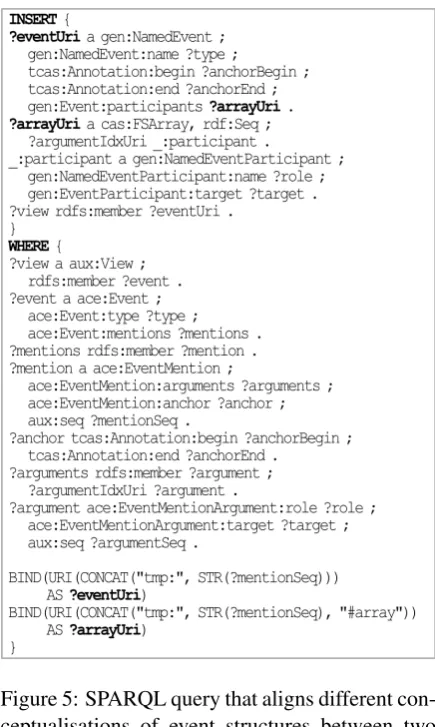
Figure 5: SPARQL query that aligns different con-ceptualisations of event structures between two type systems. Prefix definitions are not shown.
and rewrites the begin and end values to its fea-tures. Theblank node _:sentenceis going to be automatically instantiated with a unique re-source for each matching tuple making each sen-tence node distinct. The last line of the INSERT clause ties the newly created sentence to the view, which is UIMA’s equivalent of indexing a feature structure in a CAS.
5.2 One-to-many Conversion
In this use case we examine the conversion of a container of multiple elements to a set of dis-connected elements. Let us consider event types from the ACE and Events type systems as shown in Figures 2(b) and 2(c), respectively. A single
To avoid confusion, we will refer to the types using their RDF prefixed notations, “ace:” and “gen:”, to denote the ACE and “generic” Events type systems, respectively.
The task is to convert all ace:Events
and their ace:EventMentions into
gen:NamedEvents. There is a
cou-ple of nuances that need to be taken
into consideration. Firstly, although both
ace:EventMentionandgen:NamedEvent
extend uima.tcas.Annotation, the
be-gin and end features have different mean-ings for the two event representations. The
gen:NamedEvent’s begin and end features represent an anchor/trigger, a word in the text that initiates the event. The same type of informa-tion is accessible from ace:EventMention
via its anchor feature instead. Secondly, although it may be tempting to disregard the
ace:Event structures altogether, they contain the type feature whose value will be copied to
gen:NamedEvent’snamefeature.
The SPARQL query that performs that
conversion is shown in Figure 5. In the
WHERE clause, for each ace:Event,
patterns select ace:EventMentions
and for each ace:EventMention,
ace:EventMentionArguments are
also selected. This behaviour resembles
triply nested for loop in programming lan-guages. Additionally, ace:Event’s type,
ace:EventMention’s anchor begin and end
values, and ace:EventMentionArgument’s
role and target are selected. In contrast to the previous example, we cannot use blank nodes for creating event resources in the INSERT clause, since the retrieved tuples share event URIs for each ace:EventMentionArgument. Hence the last two BIND functions create URIs for each ace:EventMention and its array of arguments, both of which are used in the INSERT clause.
Note that in the INSERT clause, if several
[image:7.595.305.527.59.369.2]gen:NamedEventParticipants share the same gen:NamedEvent, the definition of the latter will be repeated for each such participant. We take advantage of the fact that adding a triple to an RDF graph that already exists in the graph has no effect, i.e., an insertion is simply ignored and no error is raised. Alternatively, the query could be rewritten as two queries, one that creates
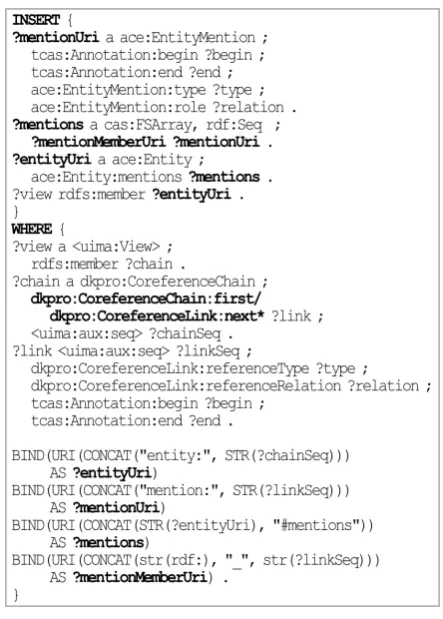
Figure 6: SPARQL query that converts corefer-ences expressed as linked lists to an array repre-sentation. Prefix definitions are not shown.
gen:NamedEvent definitions and another that
createsgen:NamedEventParticipant
def-initions.
To recapitulate, RDF and SPARQL support one-to-many (and many-to-one) conversions by stor-ing only unique triple statements and by providstor-ing functions that enable creating arbitrary resource identifiers (URIs) that can be shared between re-trieved tuples.
5.3 Linked-list-to-Array Conversion
For this example, let us consider two types of structures for storing coreferences from the DKPro and ACE type systems, as depicted in Fig-ures 1(a) and 1(c), respectively.
The idea is to convert DKPro’s chains of links into ACE’s entities that aggregate entity mentions, or—using software developers’ vocabulary—to convert a linked list into an array. The SPARQL query for this conversion is shown in Figure 6.
The WHERE clause first selects all
dkpro:CoreferenceChain instances from
views. Access todkpro:CoreferenceLink
path. Property paths are convenient shortcuts for navigating through nodes of an RDF graph. In this case, the property path expands to the chain’s first feature/property followed by any number (signified by the asterisk) of links’next
feature/property. The pattern with this path will result in returning all links that are accessible from the originating chain; however, according to the SPARQL specification, the order of links is not guaranteed to be preserved, which in coreference-supporting applications is usually of interest. A solution is to make use of the property
<uima:aux:seq> that points to the sequential number of a feature structure and is unique in the scope of a single CAS. Since feature structures are serialised into RDF using deep-first traversal, the consecutive link structures for each chain will have their sequence numbers monotonically in-creasing. These sequence numbers are translated to formrdf:_nnproperties (nnstanding for the number), which facilitates the order of elements in the ace:Entityarray of mentions7. It should be noted, however, that using the sequence num-ber property will work only if the links of a chain are not referred to from another structure. There is another, robust solution (not shown due to space limitation and complexity) that involves multiple INSERT queries and temporary, supporting RDF nodes. RDF nodes that are not directly relevant to a CAS and its feature structures are ignored during the deserialisation process, and thus it is safe to create any number of such nodes.
6 Tool Support
We have developed a UIMA analysis engine, SPARQL Annotation Editor, that incorporates the serialisation of a CAS into RDF (following the protocol presented in Section 4), the execution of a user-defined SPARQL query, and the deseriali-sation of the updated RDF graph back to the CAS. The RDF graph (de)serialisation and SPARQL query execution is implemented using Apache Jena8, an open-source framework for building Se-mantic Web applications.
To further assist in the development of type-conversion SPARQL queries, we have provided two additional UIMA components, RDF Writer and RDF Reader. RDF Writer serialises CASes to
7
Therdf:_nnproperties are not required to be consec-utive in an RDF container
8http://jena.apache.org/
files that can then be used with SPARQL query en-gines, such as Jena Fuseki (part of the Apache Jena project), to develop and test conversion queries. The modified RDF graphs can be imported back to a UIMA application using RDF Reader, an RDF deserialisation component.
The three components are featured in Argo (Rak et al., 2012), a web-based workbench for building and executing UIMA workflows.
7 Conclusions
The alignment of types between different type sys-tems using SPARQL is an attractive alternative to existing solutions. Compared to other solutions, our approach does not introduce a new language or syntax; to the contrary, it relies entirely on a well-defined, standardised language, a character-istic that immediately broadens the target audi-ence. Likewise, developers who are unfamiliar with SPARQL should be more likely to learn this well-maintained and widely used language than any other specialised and not standardised syntax. The expressiveness of SPARQL makes the method superior to the rule-based techniques, mainly due to SPARQL’s inherent capability of random data access and simple, triple-based querying. At the same time, the semantic cohesion of data is maintained by a graph representation.
The proposed solution facilitates the rapid alignment of type systems and increases the flexi-bility in which developers choose processing com-ponents to build their UIMA applications. As well as benefiting the design of applications, the con-version mechanism may also prove helpful in the development of components themselves. To en-sure interoperability, developers usually adopt an existing type system for a new component. This essential UIMA-development practice undeniably increases the applicability of such a component; however, at times it may also result in having the ill-defined representation of the data produced by the component. The availability of an easy-to-apply conversion tool promotes constructing fine-tuned type systems that best represent such data.
Acknowledgments
References
W A Baumgartner, K B Cohen, and L Hunter. 2008. An open-source framework for large-scale, flexible evaluation of biomedical text mining systems. Jour-nal of biomedical discovery and collaboration, 3:1+.
E Buyko, C Chiarcos, and A Pareja-Lora. 2008. Ontology-based interface specifications for a nlp pipeline architecture. InProceedings of the Sixth In-ternational Conference on Language Resources and Evaluation (LREC’08), Marrakech, Morocco.
C Chiarcos. 2012. Ontologies of linguistic annota-tion: Survey and perspectives. InProceedings of the Eighth International Conference on Language Re-sources and Evaluation (LREC’12), pages 303–310.
D Ferrucci and A Lally. 2004. UIMA: An Ar-chitectural Approach to Unstructured Information Processing in the Corporate Research Environment.
Natural Language Engineering, 10(3-4):327–348.
Iryna Gurevych, Max M¨uhlh¨auser, Christof M¨uller, J¨urgen Steimle, Markus Weimer, and Torsten Zesch. 2007. Darmstadt Knowledge Processing Repository Based on UIMA. InProceedings of the First Work-shop on Unstructured Information Management Ar-chitecture at Biannual Conference of the Society for Computational Linguistics and Language Technol-ogy, T¨ubingen, Germany.
U Hahn, E Buyko, R Landefeld, M M¨uhlhausen, M Poprat, K Tomanek, and J Wermter. 2008. An Overview of JCORE, the JULIE Lab UIMA Com-ponent Repository. InProceedings of the Language Resources and Evaluation Workshop, Towards En-hanc. Interoperability Large HLT Syst.: UIMA NLP, pages 1–8.
N Hernandez. 2012. Tackling interoperability is-sues within UIMA workflows. In Proceedings of the Eight International Conference on Language Resources and Evaluation (LREC’12), Istanbul, Turkey. European Language Resources Association (ELRA).
P Kluegl, M Atzmueller, and F Puppe. 2009. TextMarker: A Tool for Rule-Based Information Ex-traction. InProceedings of the Biennial GSCL Con-ference 2009, 2nd UIMA@GSCL Workshop, pages 233–240. Gunter Narr Verlag.
M T Pazienza, A Stellato, and A Turbati. 2012. PEARL: ProjEction of Annotations Rule Language, a Language for Projecting (UIMA) Annotations over RDF Knowledge Bases. InProceedings of the Eight International Conference on Language Resources and Evaluation (LREC’12), Istanbul, Turkey. Euro-pean Language Resources Association (ELRA).
R Rak, A Rowley, W Black, and S Ananiadou. 2012. Argo: an integrative, interactive, text mining-based workbench supporting curation. Database : The Journal of Biological Databases and Curation, page bas010.
G K Savova, J J Masanz, P V Ogren, J Zheng, S Sohn, K C Kipper-Schuler, and C G Chute. 2010. Mayo clinical Text Analysis and Knowledge Extraction System (cTAKES): architecture, component evalua-tion and applicaevalua-tions. Journal of the American Med-ical Informatics Association : JAMIA, 17(5):507– 513.
P Thompson, Y Kano, J McNaught, S Pettifer, T K Attwood, J Keane, and S Ananiadou. 2011. Promot-ing Interoperability of Resources in META-SHARE. In Proceedings of the IJCNLP Workshop on Lan-guage Resources, Technology and Services in the Sharing Paradigm (LRTS), pages 50–58.