Towards a Tool for Interactive Concept Building for Large Scale Analysis
in the Humanities
Andre Blessing1 Jonathan Sonntag2Fritz Kliche3 Ulrich Heid3 Jonas Kuhn1Manfred Stede2
1Institute for Natural Language Processing
Universitaet Stuttgart, Germany
2Institute for Applied Computational Linguistics
University of Potsdam, Germany
3Institute for Information Science and Natural Language Processing
University of Hildesheim, Germany
Abstract
We develop a pipeline consisting of var-ious text processing tools which is de-signed to assist political scientists in find-ing specific, complex concepts within large amounts of text. Our main focus is the interaction between the political scien-tists and the natural language processing groups to ensure a beneficial assistance for the political scientists and new application challenges for NLP. It is of particular im-portance to find a “common language” be-tween the different disciplines. Therefore, we use an interactive web-interface which is easily usable by non-experts. It inter-faces an active learning algorithm which is complemented by the NLP pipeline to provide a rich feature selection. Political scientists are thus enabled to use their own intuitions to find custom concepts.
1 Introduction
In this paper, we give examples of how NLP meth-ods and tools can be used to provide support for complex tasks in political sciences. Many con-cepts of political science are complex and faceted; they tend to come in different linguistic realiza-tions, often in complex ones; many concepts are not directly identifiable by means of (a small set of) individual lexical items, but require some in-terpretation.
Many researchers in political sciences either work qualitatively on small amounts of data which they interpret instance-wise, or, if they are in-terested in quantitative trends, they use compara-tively simple tools, such as keyword-based search in corpora or text classification on the basis of terms only; this latter approach may lead to
im-precise results due to a rather unspecific search as well as semantically invalid or ambigious search words. On the other hand, large amounts of e.g. news texts are available, also over longer periods of time, such that e.g. tendencies over time can be derived. The corpora we are currently working on contain ca. 700,000 articles from British, Irish, German and Austrian newspapers, as well as (yet unexplored) material in French.
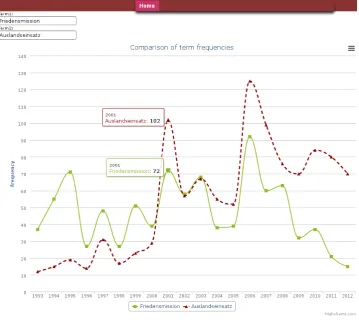
Figure 1 depicts a simple example of a quantita-tive analysis.1 The example shows how often two terms, Friedensmission(‘peace operation’), and
Auslandseinsatz(‘foreign intervention’) are used in the last two decades in newspaper texts about interventions and wars. The long-term goal of the project is to provide similar analysis for complex concepts. An example of a complex concept is the evocation of collective identities in political contexts, as indirect in the news. Examples for such collective identities are: the Europeans, the French, the Catholics.
The objective of the work we are going to dis-cuss in this paper is to provide NLP methods and tools for assisting political scientists in the ex-ploration of large data sets, with a view to both, a detailed qualitative analysis of text instances, and a quantitative overview of trends over time, at the level of corpora. The examples discussed here have to do with (possibly multiple) collective identities. Typical context of such identities tend to report communication, as direct or as indirect speech. Examples of such contexts are given in 1.
(1) Die The
Europ¨aer Europeans
w¨urden would
die the
L¨ucke gap
f¨ullen, fill,
1The figure shows a screenshot of our web-based prototype.
Figure 1: The screenshot of our web-based system shows a simple quantitative analysis of the frequency of two terms in news articles over time. While in the 90s the term Friedensmission (peace operation) was predominant a reverse tendency can be observed since 2001 with Auslandseinsatz (foreign intervention) being now frequently used.
sagte said
R¨uhe. R¨uhe.
,,The Europeans would fill the gap, R¨uhe said.”
The tool support is meant to be semi-automatic, as the automatic tools propose candidates that need to be validated or refused by the political sci-entists.
We combine a chain of corpus processing tools with classifier-based tools, e.g. for topic clas-sifiers, commentary/report clasclas-sifiers, etc., make the tools interoperable to ensure flexible data ex-change and multiple usage scenarios, and we embed the tool collection under a web (service) -based user interface.
The remainder of this paper is structured as fol-lows. In section 2, we present an outline of the ar-chitecture of our tool collection, and we motivate the architecture. Section 3 presents examples of implemented modules, both from corpus process-ing and search and retrieval of instances of com-plex concepts. We also show how our tools are
re-lated to the infrastructural standards in use in the CLARIN community. In section 4, we exemplify the intended use of the methods with case studies about steps necessary for identifying evocation: being able to separate reports from comments, and strategies for identifying indirect speech. Section 6 is devoted to a conclusion and to the discussion of future work.
2 Project Goals
summary of the goals from the perspective of each of the two disciplines, and then describe the text corpus that is used in the project. Section 3 will describe our approach to devising a system archi-tecture that serves to realize the goals.
2.1 Social Science Research Issue
Given the complexity of the underlying research issues (cf. Section 1) and the methodological tra-dition of manual text coding by very well-trained annotators in the social science and particular in political science, our project does not aim at any fully-automatic solution for empirical issues in po-litical science. Instead, the goal is to provide as much assistance to the human text analyst as possi-ble, by means of a workbench that integrates many tasks that otherwise would have to be carried out with different software tools (e.g., corpus prepro-cessing, KWIC searches, statistics). In our project, the human analyst is concerned specifically with manifestations of collective identities in newspa-per texts on issues of war and military interven-tions: who are the actors in political crisis man-agement or conflict? How is this perspective of responsible actors characterized in different news-papers (with different political orientation; in dif-ferent countries)? The analyst wants to find doc-uments that contain facets of such constellations, which requires search techniques involving con-cepts on different levels of abstraction, ranging from specific words or named entities (which may appear with different names in different texts) to event types (which may be realized with different verb-argument configurations). Thus the text cor-pus should be enriched with information relevant to such queries, and the workbench shall provide a comfortable interface for building such queries. Moreover, various types and (possibly concurrent) layers of human annotations have to complement the automatic analysis, and the manual annota-tion would benefit from automatic control of code-book2compliance and the convergence of coding decisions.
2.2 Natural Language Processing Research Issue
Large collections of text provide an excellent op-portunity for computational linguists to scale their methods. In the scenario of a project like ours, this becomes especially challenging, because standard
2or, in NLP terms: annotation scheme.
automatic analysis components have to be com-bined with manual annotation or interactive inter-vention of the human analyst.
In addition to this principled challenge, there may be more mundane issues resulting from pro-cessing corpora whose origin stretches over many years. In our case, the data collection phase coin-cided with a spelling reform in German-speaking countries. Many aspects of spelling changed twice (in 1996 and in 2006), and thus it is the responsi-bility of the NLP branch of the project to provide an abstraction over such changes and to enable to-day’s users to run a homogeneous search over the texts using only the current spelling. While this might be less important for generic web search ap-plications, it is of great importance for our project, where the overall objective is a combination of quantitative and qualitative text analysis.
In our processing chain, we first need to harmo-nize the data formats so that the processing tools operate on a common format. Rather than defin-ing these from scratch, we aim at compatibility with the standardization efforts of CLARIN3 and DARIAH4, two large language technology infras-tructure projects in Europe that in particular target eHumanities applications. One of the objectives is to provide advanced tools to discover, explore, exploit, annotate, analyse or combine textual re-sources. In the next section we give more details about how we interact which the CLARIN-D in-frastructure (Boehlke et al., 2013).
3 Architecture
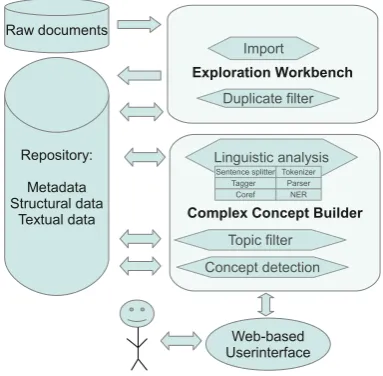
The main goal is to provide a web-based user-interface to the social scientist to avoid any soft-ware installation. Figure 2 presents the workflow of the different processing steps in this project. The first part considers format issues that occur if documents from different sources are used. The main challenge is to recognize metadata correctly. Date and source name are two types of metadata which are required for analyses in the social sci-ences. But also the separation of document con-tent (text) and metadata is important to ensure that only real content is processed with the NLP meth-ods. The results are stored in a repository which uses a relational database as a back-end. All fur-ther modules are used to add more annotations to the textual data. First a complex linguistic
pro-3
cessing chain is used to provide state-of-the-art corpus linguistic annotations (see Section 3.2 for details). Then, to ensure that statistics over oc-currence counts of words, word combinations and constructions are valid and not blurred by the mul-tiple presence of texts or text passages in the cor-pus, we filter duplicates. Duplicates can occur if our document set contains the same document twice or if two documents are very similar, e.g. they differ in only one sentence.
Raw documents
Repository: Metadata Structural data
Textual data
Topic filter Duplicate filter
Linguistic analysis
Sentence splitter Tokenizer
Web-based Userinterface
Tagger Parser Coref NER
Import
Exploration Workbench
Concept detection
[image:4.595.98.290.234.422.2]Complex Concept Builder
Figure 2: Overview of the complete processing chain.
We split the workflow for the user into two parts: The first part is only used if the user im-ports new data into the repository. For that he can use the exploration workbench (Section 3.1). Secondly, all steps for analyzing the data are done with the Complex Concept Builder (Section 3.2).
3.1 Exploration Workbench
Formal corpus inhomogeneity (e.g. various data formats and inconsistent data structures) are a ma-jor issue for researchers working on text corpora. The web-based “Exploration Workbench” allows for the creation of a consistent corpus from vari-ous types of data and prepares data for further pro-cessing with computational linguistic tools. The workbench can interact with to existing computa-tional linguistic infrastructure (e.g. CLARIN) and provides input for the repository also used by the Complex Concept Builder.
The workbench converts several input formats (TXT, RTF, HTML) to a consistent XML
repre-sentation. The conversion tools account for differ-ent file encodings and convert input files to Uni-code (UTF-8). We currently work on newspa-per articles wrapped with metadata. Text mining components read out those metadata and identify text content in the documents. Metadata appear at varying positions and in diverse notations, e.g. for dates, indications of authors or newspaper sec-tions. The components account for these varia-tions and convert them to a consistent machine readable format. The extracted metadata are ap-pended to the XML representation. The result-ing XML is the startresult-ing point for further compu-tational linguistic processing of the source docu-ments.
The workbench contains a tool to identify text duplicates and semi-duplicates via similarity mea-sures of pairs of articles (Kantner et al., 2011). The method is based on a comparison of 5-grams, weighted by significance (tf-idf measure (Salton and Buckley, 1988)). For a pair of documents it yields a value on a “similarity scale” ranging from
0 to 1. Values at medium range (0.4 to 0.8) are considered semi-duplicates.
Data cleaning is important for the data-driven studies. Not only duplicate articles have a nega-tive impact, also articles which are not of interest for the given topic have to be filtered out. There are different approaches to classify articles into a range of predefined topics. In the last years LDA (Blei et al., 2003; Niekler and J¨ahnichen, 2012) is one of the most successful methods to find top-ics in articles. But for social scientists the cate-gories typically used in LDA are not sufficient. We follow the idea of Dualist (Settles, 2011; Settles and Zhu, 2012) which is an interactive method for classification. The architecture of Dualist is based on MALLET (McCallum, 2002) which is easily integrable into our architecture. Our goal is to design the correct feature to find relevant articles for a given topic. Word features are not sufficient since we have to model more complex features (cf. Section 2.1).
3.2 Complex Concept Builder
A central problem for political scientists who in-tend to work on large corpora is the linguistic va-riety in the expression of technical terms and com-plex concepts. An editorial or a politician cited in a news item can mobilize a collective identity which can be construed from e.g. regional or so-cial affiliation, nationality or religion. A reason-able goal in the context of the search for collec-tive identity evocation contexts is therefore to find all texts which (possibly) contain collective iden-tities. Moreover, while we are training our inter-active tools on a corpus on wars and military in-terventions the same collective identities might be expressed in different ways in a corpus i.e. on the Eurocrisis.
From a computational point of view, many dif-ferent tools need to be joined to detect interest-ing texts. An example application could be a case where a political scientist intends to extract news-paper articles that cite a politician who tries to rally support for his political party. In order to detect such text, we need a system to identify di-rect and indidi-rect speech and a sentiment system to determine the orientation of the statement. These systems in turn need various kinds of preprocess-ing startpreprocess-ing from tokenization over syntactic pars-ing up to coreference resolution. The Complex Concept Builder is the collection of all these sys-tems with the goal to assist the political scientists. So far, the Complex Concept Builder imple-ments tokenization (Schmid, 2009), lemmatisation (Schmid, 1995), part-of-speech tagging (Schmid and Laws, 2008), named entity detection (Faruqui and Pad´o, 2010), syntactical parsing (Bohnet, 2010), coreference analysis for German (Lappin and Leass, 1994; Stuckardt, 2001), relation extrac-tion (Blessing et al., 2012) and sentiment analysis for English (Taboada et al., 2011).
It is important for a researcher of the humanities to be able to adapt existing classification systems according to his own needs. A common procedure in both, NLP and political sciences, is to annotate data. Therefore, one major goal of the project and the Complex Concept Builder is to provide ma-chine learning systems with a wide range of pos-sible features — including high level information like sentiment, text type, relations to other texts, etc. — that can be used by non-experts for semi-automatic annotation and text selection. Active learning is used to provide immediate results that
can then be improved continuously. This aspect of the Complex Concept Builder is especially im-portant because new or adapted concepts that may be looked for can be found without further help of natural language processing experts.
3.3 Implementation
We decided to use a web-based platform for our system since the social scientist needs no software installation and we are independent of the used operating system. Only a state-of-the-art web-browser is needed. On the server side, we use a tomcat installation that interacts with our UIMA pipeline (Ferrucci and Lally, 2004). A HTML-rendering component designed in the project (and parametrizable) allows for a flexible presentation of the data. A major issue of our work is interac-tion. To solve this, we use JQuery and AJAX to dynamically interact between client- and server-side.
4 Case Study
In this section we explore the interaction between various sub-systems and how they collaborate to find complex political concepts. The following Section 4.1 describes the detection of direct and indirect speech and its evaluation follows in Sec-tion 4.2. SecSec-tion 4.3 is a general exploraSec-tion of a few selected sub-systems which require, or benefit from direct and indirect speech. Finally, Section 4.4 discusses a specific usage scenario for indirect speech.
4.1 Identifying Indirect Speech
The Complex Concept Builder provides analy-ses on different linguistic levels (currently mor-phosyntax, dependency syntax, named entities) of annotation. We exploit this knowledge to identify indirect speech along with a mentioned speaker. Our indirect speech recognizer is based on three conditions: i) Consider all sentences that contain at least one word which is tagged as subjunctive (i.e. “*.SUBJ”) by the RFTagger. ii) This verb has to be a direct successor of another verb in the dependency tree. iii) This verb needs to have a subject.
Figure 3 depicts the dependency parse tree of sentence 2.
Einsatz mission
the Der
, , ausgesetzt stopped
werde
wegen because of
Risiko risks
teilte
informed
will be head of missionMissionschef
Mood
Mood
Robert
Robert
mit am
SaturdaySamstag on
. .
SB OC
VFIN.Aux.3.Sg.Pres.Subj
[image:6.595.98.294.93.293.2]VFIN.Full.3.Sg.Past.Ind RFTags
Figure 3: Dependency parse of a sentence that contains indirect speech (see Sentence 2).
Missionschef Robert Mood am Samstag mit.
The mission will be stopped because of the risks to the unarmed observers, informed Head of Mission Robert Mood on Saturday.
The speaker of the indirect speech in Sentence 2 is correctly identified asMissionschef (Head of Mission) and the corresponding verb isteilte mit
(frommitteilen) (to inform).
The parsing-based analysis helps to identify the speaker of the citation which is a necessary in-formation for the later interpretation of the cita-tion. As a further advantage, such an approach helps to minimize the need of lexical knowledge for the identification of indirect speech. Our er-ror analysis below will show that in some cases a lexicon can help to avoid false positives. A lexi-con of verbs of communication can easily be boot-strapped by using our approach to identify candi-dates for the list of verbs which then restrict the classifier in order to achieve a higher precision.
4.2 Indirect Speech Evaluation
For a first impression, we present a list of sen-tences which were automatically annotated as pos-itive instances by our indirect speech detector. The sentences were rated by political scientists.
Additionally, for each sentence we extracted the
speaker and the used verb of speech. We man-ually evaluated 200 extracted triples (sentence,
speaker,verb of speech): The precision of our system is:92.5%
Examples 2, 3 and 4 present good candidates which are helpful for further investigations on col-lective identities. In example 3 Cardinal Lehmann is a representative speaker of the Catholic commu-nity which is a collective identity. Our extracted sentences accelerate the search for such candidates which amounts to looking manually for needles in a haystack.
example speaker verb of speech
(2) Robert Mood teilte (told) (3) Kardinal Karl Lehmann sagte (said) (4) Sergej Ordzhonikidse sagte (said)
(5) Bild (picture) tr¨uben (tarnish) (6) sein (be) sein (be)
Examples 5 and 6 show problems of our first approach. In this case, the speaker is not a person or an organisation, and the verb is not a verb of speech.
(3) Ein Angriffskrieg jeder Art sei ” sit-tlich verwerflich ”, sagte der Vorsitzende der Bischoffskonferenz, Kardinal Karl Lehmann.
Any kind of war of aggression is ”morally reprehen-sible,” said the chairman of the Bishops’ Conference, Cardinal Karl Lehmann.
(4) Derartige Erkl¨arungen eines Staatschefs seien im Rahmen der internationalen Beziehungen inakzeptabel, sagte der UN-Generaldirektor Sergej Ordzhonikidse gestern in Genf.
Such statements of heads of states are unacceptable in the context of international relations, said UN General Director Sergei Ordzhonikidse in Geneva yesterday.
(5) W¨urden die Wahlen verschoben, tr¨ubte sich das gesch¨onte Bild.
Would the elections be postponed, the embellished im-age would tarnish.
(6) Dies sei alles andere als einfach, ist aus Of-fizierskreisen zu h¨oren.
sagen (say) erklären (explain) meinen (state) berichten (report) mitteilen (share) schreiben (write) haben (have) werden (will) betonen (emphasize) erzählen (tell)
0.00% 5.00% 10.00% 15.00% 20.00% 25.00% 30.00% 35.00% 40.00%
[image:7.595.97.295.78.178.2]most used speech verbs
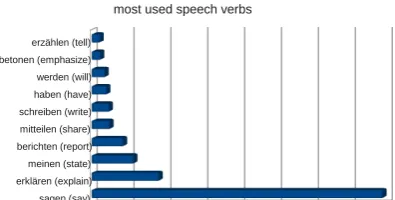
Figure 4: 10 most used verbs (lemma) in indirect speech.
4.3 Using Indirect Speech
Other modules benefit from the identification of indirect speech, as can be seen from Sentence 7. The sentiment system assigns a negative polarity of −2.15 to the sentence. The nested sentiment sources, as described by (Wiebe et al., 2005), of this sentence require a) a direct speech with the speaker “Mazower” and b) an indirect speech with the speaker “no one” to be found.5
(7) ”There were serious arguments about what should happen to the Slavs and Poles in east-ern Europe,” says Mazower, ”and how many of them should be sent to the camps and what proportion could be Germanised. . .No one ever came out and directly said Hitler had got it wrong, but there was plenty of implied crit-icism through comparisons with the Roman empire. [...]”6
A collective identity evoked in Sentence 7 is “the Germans”— although the term is not explic-itly mentioned. This collective identity is de-scribed as non-homogeneous in the citation and can be further explored manually by the political scientists.
The following are further applications of the identified indirect speeches a) using the frequency of speeches per text as a feature for classifica-tion; e.g. a classification system for news re-ports/commentaries as described in Section 4.4 b) a project-goal is to find texts in which collective
5The reported sentiment value for the whole sentence is applicable only to the direct speech. The indirect speech (i.e. “Hitler had got it wrong”) needs a more fine-grained polarity score. Since our Complex Concept Builder is very flexible, it is trivial to score each component separately.
6http://www.guardian.co.uk/education/2008/jul /01/academicexperts.highereducationprofile
identities are mobilised by entities of political de-bate (i.e. persons, organisations, etc.); the detec-tion of indirect speech is mandatory for any such analysis.
4.4 Commentary/Report Classification
A useful distinction for political scientists dealing with newspaper articles is the distinction between articles that report objectively on events or back-grounds and editorials or press commentaries.
We first extracted opinionated and objective texts from DeReKo corpus (Stede, 2004; Kupietz et al., 2010). Some texts were removed in order to balance the corpus. The balanced corpus contains 2848 documents and has been split into a develop-ment and a training and test set. 570 docudevelop-ments were used for the manual creation of features. The remaining 2278 documents were used to train and evaluate classifiers using 10-fold cross-validation with the WEKA machine learning toolkit (Hall et al., 2009) and various classifiers (cf. Table 1).
The challenge is that the newspaper articles from the training and evaluation corpus come from different newspapers and, of course, from differ-ent authors. Commdiffer-entaries in the yellow press tend to have a very different style and vocabulary than commentaries from broadsheet press. There-fore, special attention needs to be paid to the in-dependence of the classifier from different authors and different newspapers. For this reason, we use hand-crafted features tailored to this problem. In return, this means omitting surface-form features (i.e. words themselves).
The support vector machine used the SMO al-gorithm (Platt and others, 1998) with a polynomial kernelK(x, y) =< x, y >ewithe= 2. All other algorithms were used with default settings.
precision recall f-score
SVM 0.819 0.814 0.813
Naive Bayes 0.79 0.768 0.764 Multilayer
Percep-tron
0.796 0.795 0.794
Table 1: Results of a 10-fold cross-validation for various machine learning algorithms.
[image:7.595.307.536.573.654.2]uses of direct and indirect speech by the author can provide insight into the intention of the author. A common way to voice one’s own opinion, without having to do so explicitly, is to use indirect speech that the author agrees with. Therefore, the number of direct and indirect speech uses will be added to the classifier. First experiments indicate that the inclusion of direct and indirect speech increase the performance of the classifier.
5 Related Work
Many approaches exist to assist social scientists in dealing with large scale data. We discuss some well-known ones and highlight differences to the approach described above.
The Europe Media Monitor (EMM) (Stein-berger et al., 2009) analyses large amounts of newspaper articles and assists anyone interested in news. It allows its users to search for specific top-ics and automatically clusters articles from differ-ent sources. This is a key concept of the EMM, because it collects about 100,000articles in ap-proximately50languages per day and it is impos-sible to scan through these by hand. EMM users are EU institutions, national institutions of the EU member states, international organisations and the public (Steinberger et al., 2009).
The topic clusters provide insight into “hot” topics by simply counting the amount of articles per cluster or by measuring the amount of news on a specific topic with regards to its normal amount of news. Articles are also data-mined for geo-graphical information, e.g. to update in which geographical region the article was written and where the topic is located. Social network infor-mation is gathered and visualised as well.
Major differences between the EMM and our approach are the user group and the domain of the corpus. The complex concepts political sci-entists are interested in are much more nuanced than the concepts relevant for topic detection and the construction of social networks. Additionally, the EMM does not allow its users to look for their own concepts and issues, while this interactivity is a central contribution of our approach (cf. Sec-tions 1, 2.1 and 3.2).
The CLARIN-D project also provides a web-based platform to create NLP-chains. It is called WebLicht (Hinrichs et al., 2010), but in its cur-rent form, the tool is not immediately usable for social scientists as the separation of metadata and
textual data and the encoding of the data is hard for non-experts. Furthermore, WebLicht does not yet support the combination of manual and au-tomatic annotation needed for text exploration in the social science. Our approach is based on the webservices used by WebLicht. But in contrast to WebLicht, we provide two additional components that simplify the integration (exploration work-bench) and the interpretation (complex concept builder) of the research data. The former is in-tended, in the medium term, to be made available in the CLARIN framework.
6 Conclusion and Outlook
We developed and implemented a pipeline of var-ious text processing tools which is designed to as-sist political scientists in finding specific, complex concepts within large amounts of text. Our case studies showed that our approach can provide ben-eficial assistance for the research of political entists as well as researcher from other social sci-ences and the humanities. A future aspect will be to find metrics to evaluate our pipeline. In recently started annotation experiments on topic classifica-tion Cohen’s kappa coefficient (Carletta, 1996) is mediocre. It may very well be possible that the complex concepts, like multiple collective identi-ties, are intrinsically hard to detect, and the anno-tations cannot be improved substantially.
The extension of the NLP pipeline will be an-other major working area in the future. Examples are sentiment analysis for German, adding world knowledge about named entities (e.g. persons and events), identification of relations between enti-ties.
Finally, all these systems need to be evaluated not only in terms of f-score, precision and recall, but also in terms of usability for the political scien-tists. This also includes a detailed investigation of various political science concepts and if they can be detected automatically or if natural language processing can help the political scientists to de-tect their concepts semi-automatically. The defini-tion of such evaluadefini-tion is an open research topic in itself.
Acknowledgements
References
David M. Blei, Andrew Y. Ng, and Michael I. Jordan. 2003. Latent dirichlet allocation. J. Mach. Learn. Res., 3:993–1022, March.
Andre Blessing, Jens Stegmann, and Jonas Kuhn. 2012. SOA meets relation extraction: Less may be more in interaction. In Proceedings of the Work-shop on Service-oriented Architectures (SOAs) for the Humanities: Solutions and Impacts, Digital Hu-manities, pages 6–11.
Volker Boehlke, Gerhard Heyer, and Peter Wittenburg. 2013. IT-based research infrastructures for the hu-manities and social sciences - developments, exam-ples, standards, and technology. it - Information Technology, 55(1):26–33, February.
Bernd Bohnet. 2010. Top accuracy and fast depen-dency parsing is not a contradiction. InProceedings of the 23rd International Conference on Computa-tional, pages 89–97.
Jean Carletta. 1996. Assessing agreement on classi-fication tasks: The kappa statistic. Computational Linguistics, 22(2):249–254.
Manaal Faruqui and Sebastian Pad´o. 2010. Train-ing and evaluatTrain-ing a german named entity recog-nizer with semantic generalization. InProceedings of KONVENS 2010, Saarbr¨ucken, Germany.
D. Ferrucci and A. Lally. 2004. UIMA: an architec-tural approach to unstructured information process-ing in the corporate research environment. Natural Language Engineering, 10(3-4):327–348.
Mark Hall, Eibe Frank, Geoffrey Holmes, Bernhard Pfahringer, Peter Reutemann, and Ian H Witten. 2009. The weka data mining software: an update. ACM SIGKDD Explorations Newsletter, 11(1):10– 18.
Erhard W. Hinrichs, Marie Hinrichs, and Thomas Za-strow. 2010. WebLicht: Web-Based LRT Services for German. InProceedings of the ACL 2010 System Demonstrations, pages 25–29.
Cathleen Kantner, Amelie Kutter, Andreas Hilde-brandt, and Mark Puettcher. 2011. How to get rid of the noise in the corpus: Cleaning large samples of digital newspaper texts. International Relations Online Working Paper, 2, July.
Marc Kupietz, Cyril Belica, Holger Keibel, and An-dreas Witt. 2010. The german reference corpus dereko: a primordial sample for linguistic research. In Proceedings of the 7th conference on interna-tional language resources and evaluation (LREC 2010), pages 1848–1854.
Shalom Lappin and Herbert J Leass. 1994. An algo-rithm for pronominal anaphora resolution. Compu-tational linguistics, 20(4):535–561.
Andrew Kachites McCallum. 2002. Mal-let: A machine learning for language toolkit. http://www.cs.umass.edu/ mccallum/mallet.
Andreas Niekler and Patrick J¨ahnichen. 2012. Match-ing results of latent dirichlet allocation for text. In Proceedings of ICCM 2012, 11th International Conference on Cognitive Modeling, pages 317–322. Universit¨atsverlag der TU Berlin.
John Platt et al. 1998. Sequential minimal optimiza-tion: A fast algorithm for training support vector machines. technical report msr-tr-98-14, Microsoft Research.
Gerard Salton and Christopher Buckley. 1988. Term-weighting approaches in automatic text retrieval. In-formation processing & management, 24(5):513– 523.
Helmut Schmid and Florian Laws. 2008. Estima-tion of condiEstima-tional probabilities with decision trees and an application to fine-grained POS tagging. In Proceedings of the 22nd International Conference on Computational Linguistics (Coling 2008), pages 777–784, Manchester, UK, August.
Helmut Schmid. 1995. Improvements in part-of-speech tagging with an application to german. In Proceedings of the ACL SIGDAT-Workshop, pages 47–50.
Helmut Schmid, 2009. Corpus Linguistics: An In-ternational Handbook, chapter Tokenizing and Part-of-Speech Tagging. Handbooks of Linguistics and Communication Science. Walter de Gruyter, Berlin.
Burr Settles and Xiaojin Zhu. 2012. Behavioral fac-tors in interactive training of text classifiers. In Pro-ceedings of the 2012 Conference of the North Amer-ican Chapter of the Association for Computational Linguistics: Human Language Technologies, pages 563–567. Association for Computational Linguis-tics.
Burr Settles. 2011. Closing the loop: Fast, inter-active semi-supervised annotation with queries on features and instances. InProceedings of the Con-ference on Empirical Methods in Natural Language Processing, pages 1467–1478. Association for Com-putational Linguistics.
Manfred Stede. 2004. The potsdam commentary corpus. In Proceedings of the 2004 ACL Work-shop on Discourse Annotation, DiscAnnotation ’04, pages 96–102, Stroudsburg, PA, USA. Association for Computational Linguistics.
Roland Stuckardt. 2001. Design and enhanced evalua-tion of a robust anaphor resoluevalua-tion algorithm. Com-putational Linguistics, 27(4):479–506.
Maite Taboada, Julian Brooke, Milan Tofiloski, Kim-berly Voll, and Manfred Stede. 2011. Lexicon-based methods for sentiment analysis. Computa-tional linguistics, 37(2):267–307.