D S Sharma, R Sangal and A K Singh. Proc. of the 13th Intl. Conference on Natural Language Processing, pages 178–187, Varanasi, India. December 2016. c2016 NLP Association of India (NLPAI)
Wisdom of Students: A Consistent Automatic
Short Answer Grading Technique
Shourya Roy† Sandipan Dandapat‡ Ajay Nagesh∗ Y. Narahari§
†Xerox Research Centre India, Bangalore, ‡Microsoft India, Hyderabad, ∗University of Massachusetts, Amherst,
§Indian Institute of Science, Bangalore
[email protected], [email protected], [email protected], [email protected]
Abstract
Automatic short answer grading (ASAG) techniques are designed to automatically assessshortanswers written in natural lan-guage having a length of a few words to a few sentences. In this paper, we report an intriguing finding that the set of short answers to a question, collectively, share significant lexical commonalities. Based on this finding, we propose an unsuper-vised ASAG technique that only requires sequential pattern mining in the first step and an intuitive scoring process in the sec-ond step. We demonstrate, using multi-ple datasets, that the proposed technique effectively exploitswisdom of students to deliver comparable or better performance than prior ASAG techniques as well as distributional semantics-based approaches that require heavy training with a large corpus. Moreover, by virtue of being in-dependent of instructor provided model answers, our technique offersconsistency
by overcoming the limitation of undesired variability in performance exhibited by ex-isting unsupervised techniques.
1 Introduction
Automatic grading systems have been in practice in the educational domain for many years now, but primarily forrecognitionquestions where students have to choose the correct answer from given op-tions such as multiple choice quesop-tions (MCQs). Prior research has shown that such recognition questions are deficient as they do not capture mul-tiple aspects of acquired knowledge such as rea-soning and self-explanation (Wang et al., 2008). In contrast,recallquestions that seek students’ con-structed answers in natural language have been found to be more effective in assessing their
ac-quired knowledge. However, automating assess-ment of such answers is non-trivial owing to lin-guistic variations (a given answer could be artic-ulated in different ways); subjective nature of as-sessment (multiple possible correct answers or no correct answer); lack of consistency in human rat-ing (non-binary scorrat-ing on an ordinal scale within a range); etc. Consequently, this has remained a repetitive and tedious job for teaching instruc-tors and is often seen as an overhead and non-rewarding. This paper is about a computational technique for automatically grading constructed student answers in natural language. In particular, we are interested inshort answers: a few words to a few sentences long (everything in between fill-in-the-gap and essay type answers (Burrows et al., 2015)) and refer to the task asAutomatic Short An-swer Grading(ASAG). An example ASAG task is shown in Table 1.
Question How are overloaded functions differentiated by the compiler? Model
Ans Based on the function signature. When an overloaded function is called,the compiler will find the function whose signature is closest to the given function call.
Stud#1 It looks at the number, types, and order of arguments in the function call Stud#2 By the number, and the types and order of the parameters.
Table 1: Example of question, model answer, and student answers from an undergraduate computer science course (Mohler and Mihalcea, 2009). These will be used as the running example through out the paper.
A large fraction of prior work in ASAG sys-tems mostly comprises techniques that require ex-tensive intervention from instructors (Roy et al., 2015; Burrows et al., 2015). In one group of such works, the instructors are expected to list key concepts (and their possible variations) to look for in student responses and grade them using
unlikely to generalize and moreover tend to lead to a large number of false negatives owing to un-specified linguistic variations. The other group of techniques requires instructors to grade a fraction of student answers (typically ranging from half to three-quarter) to train supervised learning al-gorithms(Sukkarieh et al., 2011; Madnani et al., 2013) as training data for building classification or regression models. Unlike many applications where generation of labelled data is a one-time exercise, ASAG does not fit into train-once-and-apply-forevermodel. Every ASAG task is unique and would require ongoing instructor involvement to create labelled data. Requirement of such on-going involvement of instructors limits the bene-fits of automation in practical and real-life appli-cations.
The other broad group of work (corpus-based
and document similarity-based techniques) uses various document similarity measures to grade student answers. These techniques largely reduce the need for human involvement. They do not require instructors to list all possible variations of model answers; rather rely on the measures to assess similarity between student and model answers. Unlike supervised techniques there is no ongoing instructor involvement as providing model answer is a one time task that does not de-pend on size of the student population. However, these techniques suffer from multiple other short-comings. First, there is no standardization around how model answers are written across datasets or even within a dataset. The model answer in Table 1 is more detailed and self-contained than the model answer ‘‘Abstraction and reusability’’ for another question ‘‘What are the main advantages associated with object-oriented programming?’’ from the
same dataset. This immediately hints at the fact that the same measure is unlikely to work for both questions. Second, variations in model answers can affect the performance of ASAG technique significantly. Using another valid model answer for the question in Table 1 ‘‘The compiler selects a proper function to execute based on number, types and order of arguments in the function call.’’,
causes correlation of ASAG scores with hu-man scores vary significantly.1 Finally, many similarity-based ASAG techniques require access
1We will see evidence of such variations in Section 4.3.
to rich knowledge-bases which may not be available for all languages and all subject matters thereby limiting their applicability.
In this paper, we first report an intriguing find-ing that short answers to a question contain signifi-cant lexical overlap among them and such overlap-ping text are typically related to the correct answer to the question. We convert this finding into a tech-nique assuming (and validating for datasets used) that such commonalities are characteristics of cor-rect answers as typically there are fewer ways of expressing correct answers than incorrect ones.2
The proposed technique can be implemented in two steps. In the first step, we pose a variant of sequential pattern mining problem (Agrawal and Srikant, 1995) to identify sequential word patterns that are more common (than the rest of the pat-terns) among student answers. In the second step, based on our intuition driven hypothesis, that pres-ence of such common patterns is indicative of cor-rect answers, we deduce the scores using an in-tuitive scoring method (assigning weights to pat-terns by their length along with frequencies). The approach is truly unsupervised as it does not re-quire human supervision in terms of pre-graded answers or manually crafted key concepts. Un-like similarity-based techniques, it does not suf-fer from non-standardization of model answers. Other than minimal pre-processing, we do not per-form any feature engineering which is typical of ASAG solutions and thus our approach general-izes better. In the sequel, we use the words ap-proach,methodandtechniquesynonymously.
Our contributions: The contributions and nov-elty of this work are summarized below.
• We report a novel and potentially surprising finding regarding the extent of lexical overlap between students’ short answers to a ques-tion. Exploiting the finding, we propose a new ASAG technique which is completely unsupervised, consistent, and generalizable (§3).
2Before describing the technique, we acknowledge that
this assumption may not be true for all questions. For exam-ple, occasionally instructors design difficult and tricky ques-tions which mislead students to incorrect answers. Nonethe-less, we empirically demonstrate that the proposed technique is comparable to existing document similarity based ASAG techniques on standard datasets and thereby providing a truly unsupervised strong baseline at the least. We provide addi-tional discussion as future work in Section 5 towards lever-aging the proposed technique for designing more practical ASAG techniques.
• We demonstrate with quantitative results on
multiple datasets that the proposed tech-nique delivers comparable or better perfor-mance than similarity-based ASAG tech-niques on various dimensions. In particu-lar, it offers consistency by overcoming the limitation of performance variability exhib-ited by similarity-based techniques caused by switches to equivalent model answers(§4.2).
• We provide detailed qualitative analysis with examples from our datasets to portray how the proposed technique would work even un-der different scenarios such as when most student answers are not perfect or when there are multiple model answers (§4.4).
• We create and offer a new dataset on high-school English reading comprehension task in a Central Board of Secondary Education (CBSE) school in India. The dataset contains 14 questions answered by 58 students. The answers were graded by two human raters based on model answers and an optional scor-ing scheme (§4.1).
2 Prior Art
Two recently written survey papers by Roy et. al (2015) and Burrows et. al. (2015) provide com-prehensive views of research in ASAG. Both of them have grouped prior research based on the types of approaches used as well as extent of hu-man supervision needed. In this section, we re-view similarity-based ASAG techniques (e.g. lex-ical, knowledge-based, vector space etc.).
Similarity based ASAG techniques are premised on measuring similarity between model and student answers. Higher the similarity, higher the score a student answer receives and vice versa. Various types of similarity measures have been used in prior art of ASAG. Among thelexical measures, Evaluating Responses with BLEU (ERB) due to P´erez et al. (2004) is one of the earliest work. It adapted the most popular evaluation measure for machine translation, BLEU (Papineni et al., 2001) for ASAG with a set of Natural Language Processing (NLP) techniques such as stemming, closed-class word removal, etc. This work initially appeared as a part of an ASAG system,Atenea (Alfonseca and P´erez, 2004) and later as Willow (P´erez-Mar´ın and Pascual-Nieto, 2011). Mohler and Mihalcea (2009) conducted a comparative study of different
semantic similarity measures for ASAG including knowledge-based measures using Wordnet as well as vector space-based measures such as Latent Semantic Analysis (LSA) (Landauer et al., 1998) and Explicit Semantic Analysis (ESA) (Gabrilovich and Markovitch, 2006). LSA has remained as a popular approach for ASAG and been applied in many variations (Graesser et al., 2000; Wiemer-Hastings and Zipitria, 2001; Kanejiya et al., 2003; Klein et al., 2011). Lexical and semantic measures have been combined to validate natural complementarity of syntax and semantics for ASAG tasks (P´erez et al., 2005). Combination of different string matching and overlap techniques were studied by G¨utl on a small scale dataset (2008). Gomaa and Fahmy compared several lexical and corpus-based simi-larity algorithms (13 string-based and 4 corpus) and their combinations for grading answers in 0-5 scale (2012). Irrespective of the underlying similarity measure used, these techniques rely solely on the instructor provided model answer for scoring student answers. This central reliance on model answer leads to significant variation in performances even when the model answer is replaced by another equivalent model answer. Dzikovska et al. conducted a 5-way (non-ordinal scale) Student Response Analysis challenge as a part of SemEval-2013 (2013). However, the task had more emphasis on giving feedback on student answers possibly using textual entailment techniques.
3 Proposed Approach
In this section, we provide intuition and details of our proposed approach.
3.1 The Intuition: Wisdom of Students In similarity-based ASAG techniques, every stu-dent answer is compared against the model an-swerindependentlyto arrive at a score indicating the goodness of the student answer. These meth-ods ignore the fact that student answers to a ques-tion, as a collecques-tion, is expected to share more lex-ical commonalities than any arbitrary collection of text snippets. While the extent of commonality varies, we observe such commonalities for almost all questions in the datasets we dealt with. An ex-ample is shown in “Sex-ample Answers” to our run-ning example question in Table 2.
dent answers are expected to containmoreof these commonalities than incorrect ones. For our run-ning example, words such as argument, number,
order, execute,typeare among the most frequent ones and are related to the correct answer to the question (“Sample Patterns” in Table 2). If we can identify these commonalities from student an-swers, then we wondered, can the same be used to score them as well? We hypothesize that the correct student answers are expected to contain
moreof these commonalities than incorrect ones and propose an intuitive scoring technique based on such commonalities.
Sample The number and type of its parameters.
Answers The compiler selects the proper functions to execute based on number, types and order of arguments in the function call.
It selects the proper function to execute based on number, types and order of arguments in the function call.
The compiler selects proper function to execute based on number, types and order of arguments in the function call.
Is based on number, types, and order of arguments in the function call. Compiler selects proper function to execute based on number, types and order of arguments in the function call.
Sample (number, type, order, argument, call) Patterns (select, proper, execut, base, number)
(base, number, type, order) (execut, base, number, type) (proper, execut, base)
Table 2: Illustration: A few student answers and a selection of sequential patterns of stemmed words identified for the question and model an-swer shown in Table 1.
3.2 Proposed Technique
We model the task of finding commonalities from student answers in a manner similar to the sequen-tial pattern miningproblem (Agrawal and Srikant, 1995). Sequential patterns in the context of text has been used to capture non-contiguous sequence of words for classification and clustering (Jaillet et al., 2006). Prior work has reported that for such tasks sequential patterns have more reliable statis-tical properties than commonly used lexical fea-tures e.g. n-grams in NLP domain (Sebastiani,
2002). For short answers too, our observation was that sequential patterns are more statistically sig-nificant and less noisy thann-grams.
The following two steps, namely, mining se-quential patterns and scoring answers are re-peated for all questions by making two passes over all students answers.
Step 1: Mining Sequential Patterns
The objective of this step is to extract commonly occurring patterns and quantify the notion of com-monalities usingsupport:
1. A student answer (si) is converted to a
se-quence of words (w1i, wi2, . . . , win) by
remov-ing stopwords and stemmremov-ing content words to their respective base forms. We optionally re-move words which appear in the corresponding question to avoid giving importance to parrot answering.
2. A sequential pattern (SP), p of length l, is
a sequence of l tokens from si i.e. p =
wi1, wi2, . . . , wilsuch thati1 < i2 < . . . < il.
3. Support ofpis defined assup(p) = |{si :p ∈
si}|i.e. the number of student answers contain-ingp. Connecting to our intuition, patterns with
high support are commonalities among answers we are looking for. Lower part of Table 2 shows some of the common patterns obtained from all student answers for the question in Table 1.
4. Whilesup(p)captures importance of a pattern,
they ignorelexical diversity(Johansson, 2009) of student answers across questions. Consider two sequential patterns p1 and p2 with equal
supporttfor two different questionsq1andq2.
If we consider only support values then bothp1
andp2 will contribute equally to score student
answers. However, if student answers toq1 are
morediversethanq2, then the fact thatp1has a
support oftis more significant thanp2 having
the same supportt. We quantify this factor by
extending the well known measure type-token ratio(TTR) (Lieven, 1978) for lexical diversity. TTR values are in range [0,1] and higher values indicate higher diversity.
T T R(d) = #distinct patterns of lengthd #patterns of lengthd
Step 2: Scoring Answers
In this step, we make a second pass over all an-swers and use the statistics gathered in the previ-ous step to score them:
1. Again a student answer (si) is represented as a
sequence of words (wi
1, wi2, . . . , win) by doing the same pre-processing.
2. Building on our intuition, score ofsi is a func-tion of support of all patterns p ∈ si. We
re-alize that longer patterns will have (much) less support but their presence are stronger indica-tions than presence of shorter patterns. Hence score ofsi(Sc(si)) should be a function of sup-port of all patternsp insi weighed by respec-tive pattern length. We tried different weigh-ing schemes and found exponential weighing (sup(p)len(p)) to work the best with respect to
correlation with human scores. This indeed matches with our intuition that longer patterns are significantly more important than shorter ones.
3. Subsequently, we use lexical diversity values to bring down contribution of a patternpif there is less diversity among student answers by modi-fyingSc(si)as below :
Sc(si) =
X
p∈si
sup(p)len(p)×T T R(len(p))
4. Sc(si) values are normalized using min-max normalization and scaled by maximum obtain-able marks in a question.
3.3 Discussion on the Proposed Technique Step-1 of the proposed technique is similar to the classical sequential pattern mining algorithm but with a couple of differences. Firstly, in our con-text a common support threshold does not make sense as support values of patterns vary widely across questions depending on nature of answers expected as well as their difficulty levels. Sec-ondly, typically in the literature closedand max-imalfrequent patterns are of interest as they sub-sume smaller length frequent patterns(Tan et al., 2006). However, we consider all patterns to score answers in step-2 but differentially weigh them based on their length.
The basic intuition of the proposed technique can be traced back to the concept based systems of early days of ASAG (Burstein et al., 1998; Nielsen et al., 2008) where instead of (or along with) model answers, a list of concepts were speci-fied. ASAG systems scored student answers based on presence or absence of listed concepts or varia-tions thereof. However, those systems needed the concepts to be specified by the instructor, whereas our endeavour is to identify the important concepts in an unsupervised manner. Recently Ramachan-dran et al. demonstrated effectiveness of using
student answers to a question to extract patterns for ASAG (Ramachandran et al., 2015). They used a graph based approach to extract patterns from groups of questions and their answers to-wards constructing regular expression alike pat-terns. While they use a supervised approach using the extracted patterns as features, our approach is completely unsupervised - hence easier to test on new datasets and deploy in real life. Secondly, we opine that regular expression based features can be constraining towards generalization and real life usage for free text answers.
4 Experimental Results
4.1 Experimental Protocols
Datasets: The recent survey papers referred to in Section 2 noted that rarely any ASAG work re-ported results on multiple (standard) datasets (Bur-rows et al., 2015; Roy et al., 2015). They empha-sized the need for sharing of datasets and struc-tured evaluations on them. Towards that, we evalu-ated the proposed technique and compared against multiple similarity-based baseline techniques on three datasets:
• CSD: This is one of the earliest ASAG datasets consisting of 21 questions with 30 student answers evaluated each on a scale of 0-5 from an undergraduate computer science course (Mohler and Mihalcea, 2009). Stu-dent answers were indepenStu-dently evaluated by two annotators and automatic techniques are measured against their average.
• X-CSD: This is an extended version of
CSD with 81 questions by the same authors (Mohler et al., 2011).
• RCD: We created a new dataset on a
read-ing comprehension assignment for Standard-12 students in Central Board of Secondary Education (CBSE) in India. The dataset con-tains 14 questions answered by 58 students. The answers were graded by two expert hu-man raters based on model answers, again on a scale of 0-5.
All datasets have less than (total number of questions×total number of students) answers as presumably some students did not answer some questions. We mark such missing entries as “No Answer” and corresponding groundtruth scores as zero.
Metrics: A wide variety of evaluation metrics has been used in the literature for measuring good-ness of ASAG techniques. We use Pearson’s
r in this paper as it has been one of the most
popular metrics though its appropriateness have been questioned (Mohler and Mihalcea, 2009). For every question we compute Pearson’s r
be-tween groundtruth and predicted scores and aver-age across all questions are reported.
4.2 Quantitative Results
We compare the proposed technique against word similarity based ASAG techniques briefly de-scribed in Section 2. The basic premise of word similarity based ASAG techniques is: higher the similarity between the model and a student an-swer, higher the score the latter receives. Given two texts, model answerM and a student answer S, we conduct standard pre-processing operations
such as stopword removal and stemming. The score ofS with respect toM is then defined as:
asym(M, S) = 1
k
k
X
i=1 max
sj∈S(sim(mi,sj)) (1) wheremiandsj are pre-processedn-grams ofM andSrespectively andkis the number ofn-grams
inM. Forn= 1,miandsj are words ofM and
S; andkis the length ofM with respect to number
of words. sim(., .)is a textual similarity measure
of one of the following types:
• Lexical: In this category, we consider lexical
overlap (LO) between model and student an-swers. It is a simple baseline measure which looks for exact match for every content word (post pre-processing e.g. stopword removal and stemming).
• Knowledge based: These measures employ
a background ontology to arrive at word level semantic similarity values based on various factors such as distance between two words, lowest common ancestor, etc. Mohler and Mihalcea (2009) compared eight different knowledge-based measures to compute sim-ilarities between words in the model and stu-dent answers using Wordnet (Miller, 1995). We select the two best performing measures from their work viz. shortest path (SP) and the measure proposed by Jiang and Conrath (JCN) (Jiang and Conrath, 1997).
• Vector space based: In this category, we
have chosen one of the most popular mea-sures of semantic similarity, namely, Latent
Semantic Analysis (LSA) (Landauer et al., 1998) trained on a Wikipedia dump. We also consider the recently popular word2vec tool (W2V) (Mikolov et al., ) to obtain vector rep-resentation of words which are trained on 300 million words of Google news dataset and are of length 300. Both LSA and W2V build on several related ideas towards capturing im-portance of context to obtain vector represen-tation of words e.g. the distributional hypoth-esis “Words will occur in similar contexts if and only if they have similar meanings” (Har-ris, 1968). Similarity between words is mea-sured as the cosine distance between corre-sponding word vectors in the resultant vector space using the well known dot product for-mula.
4.3 Results
In this section first we present comparative per-formance of the proposed technique against word similarity based ASAG techniques. Secondly, we expose a vulnerability of word similarity based ASAG techniques owing to their sole reliance on instructor provided model answer and thereby bringing out another benefit of the proposed tech-nique.
Performance with respect to instructor pro-vided model answers: Table 3 shows compar-ative performances of the proposed technique against unsupervised ASAG techniques for CSD. For each question as well as aggregate across all questions, winners are emphasized. In aggregate, the proposed technique performs comparatively and better than LO and knowledge based measures (JCN and SP) but a few points worse than LSA and W2V. Secondly, it is evident that, no one tech-nique consistently outperforms others. In fact, the proposed technique has more question wise win-ners than LO, SP, JCN, and LSA. For example, for (Q19) (which is our running example in this paper), it has much better performance than the rest supporting our argument that leveraging stu-dent answer corpus is effective. Finally, variations across questions are significant - while high cor-relation is achieved for Q1, Q15etc. but they
re-mained low for Q12 and Q16. Considering such
high variations across different questions, it is un-likely that any one method would perform the best across all types of questions in a general setting.
Q# Proposed LO JCN SP LSA W2V 1 0.56 0.79 0.84 0.81 0.78 0.85
2 0.55 0.42 0.34 0.40 0.27 0.35 3 0.32 0.33 0.27 0.46 0.51 0.62
4 0.75 0.81 0.81 0.86 0.80 0.81 5 0.69 0.68 0.68 0.83 0.84 0.73 6 0.67 0.82 0.75 0.76 0.73 0.78 7 0.71 0.49 0.49 0.50 0.64 0.63 8 0.68 0.79 0.73 0.74 0.67 0.79
9 0.58 0.55 0.57 0.54 0.43 0.58
10 0.67 0.73 0.67 0.50 0.66 0.75
11 0.54 0.43 0.49 0.61 0.52 0.64
12 0.46 0.14 0.14 -0.10 0.24 0.30 13 0.70 0.57 0.75 0.69 0.76 0.67 14 0.52 0.48 0.52 0.45 0.68 0.68
15 0.56 0.55 0.80 0.69 0.95 0.84 16 0.05 0.30 0.30 0.30 0.24 0.29 17 0.68 0.83 0.84 0.81 0.71 0.76 18 0.23 0.55 0.17 0.33 0.61 0.46 19 0.51 0.37 0.43 0.50 0.43 0.44 20 0.69 0.55 0.51 0.35 0.61 0.50 21 0.76 0.78 0.76 0.68 0.75 0.80
[image:7.612.79.303.35.277.2]Agg. 0.57 0.57 0.56 0.56 0.61 0.63 Table 3: Question wise Pearson’s r of the
pro-posed technique against unsupervised ASAG tech-niques.
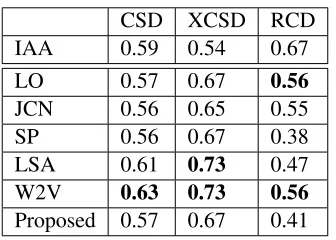
proposed technique against word similarity based ASAG techniques. The top row of the table shows the inter-annotator agreement (IAA) for all datasets. For CSD and XCSD, performance of the proposed technique is respectively comparable and better than IAA. For both the datasets, its per-formance is comparable or better than lexical and knowledge-based methods but about 0.06 worse
than the vector space methods.
CSD XCSD RCD
IAA 0.59 0.54 0.67
LO 0.57 0.67 0.56
JCN 0.56 0.65 0.55
SP 0.56 0.67 0.38
LSA 0.61 0.73 0.47
W2V 0.63 0.73 0.56
Proposed 0.57 0.67 0.41
Table 4: Comparison of Pearson’s r of unsuper-vised ASAG techniques against the proposed tech-nique.
Variation with changes in model answers: The word similarity based ASAG techniques suffer from a surprising shortcoming. Vari-ation in model answers can significantly af-fect their performance. Consider another pos-sible model answer of our running
exam-ple “based on number, types and and order of arguments in the function call.”
Re-placing the instructor provided model answer with this is not expected to change human evaluation of student answers. However doing so make unsuper-vised ASAG techniques exhibit significant change in performance (Pearson’srfor LO, JCN, SP, LSA
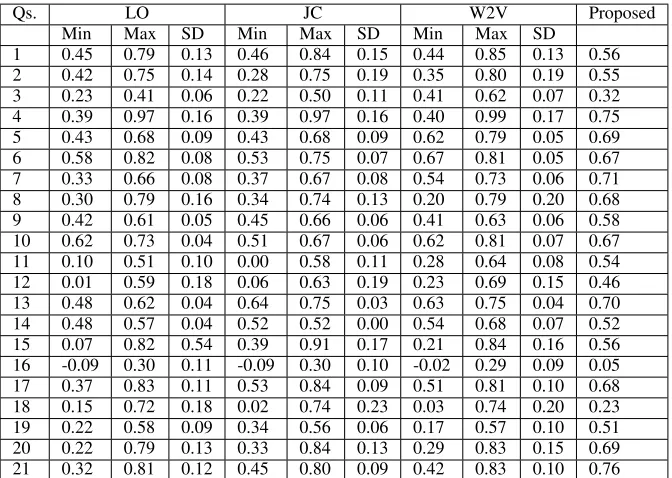
and W2V get changed by 43%, 23%, 2%, 19% and 20% respectively). Towards systematically exploring this, for each question we select those student answers which were graded as perfect 5/5 by the instructor with respect to the model answer. We consider each of them (and the instructor pro-vided model answer) as a model answer in turn and grade remaining student answers. Resulting variation is shown in Table 5 in terms of mini-mum and maximini-mum Pearson’s r obtained as well
as standard deviation ofr values.3 Careful obser-vation of Table 5 reveals that all word similarity based ASAG technique show variation in perfor-mance for almost all questions. In some cases cor-relation with human provided groundtruth scores goes to a low minimum (even negative) and very high maximum correlation. Standard deviation values indicate high degree of variation in Pear-son’sr. On the other hand, the proposed technique
due to its independence with model answers, does not exhibitanyfluctuation. It is interesting to note that for all questions the minimum correlation ob-tained by all word similarity based ASAG tech-niques is worse than corresponding correlation of the proposed technique. In fact, for multiple ques-tions the proposed technique performs compara-bly to the maximum correlation obtained by the word similarity based ASAG techniques. While further studies will be required to understand the root causes of these variation, it is unlikely that any one method would work the best for all ques-tions.
4.4 Qualitative Analysis
In this section, we provide qualitative analysis to address a few questions which an intrigued reader might have:
• Proposed technique will work only if
all/most student answers are perfect: No -even if most student answers are imperfect
3Owing to space constraint we show numbers for one
rep-resentative technique from lexical, knowledge-based and vec-tor space categories but we note similar variations for other techniques too.
[image:7.612.107.275.474.594.2]Qs. LO JC W2V Proposed
Min Max SD Min Max SD Min Max SD
[image:8.612.139.475.36.275.2]1 0.45 0.79 0.13 0.46 0.84 0.15 0.44 0.85 0.13 0.56 2 0.42 0.75 0.14 0.28 0.75 0.19 0.35 0.80 0.19 0.55 3 0.23 0.41 0.06 0.22 0.50 0.11 0.41 0.62 0.07 0.32 4 0.39 0.97 0.16 0.39 0.97 0.16 0.40 0.99 0.17 0.75 5 0.43 0.68 0.09 0.43 0.68 0.09 0.62 0.79 0.05 0.69 6 0.58 0.82 0.08 0.53 0.75 0.07 0.67 0.81 0.05 0.67 7 0.33 0.66 0.08 0.37 0.67 0.08 0.54 0.73 0.06 0.71 8 0.30 0.79 0.16 0.34 0.74 0.13 0.20 0.79 0.20 0.68 9 0.42 0.61 0.05 0.45 0.66 0.06 0.41 0.63 0.06 0.58 10 0.62 0.73 0.04 0.51 0.67 0.06 0.62 0.81 0.07 0.67 11 0.10 0.51 0.10 0.00 0.58 0.11 0.28 0.64 0.08 0.54 12 0.01 0.59 0.18 0.06 0.63 0.19 0.23 0.69 0.15 0.46 13 0.48 0.62 0.04 0.64 0.75 0.03 0.63 0.75 0.04 0.70 14 0.48 0.57 0.04 0.52 0.52 0.00 0.54 0.68 0.07 0.52 15 0.07 0.82 0.54 0.39 0.91 0.17 0.21 0.84 0.16 0.56 16 -0.09 0.30 0.11 -0.09 0.30 0.10 -0.02 0.29 0.09 0.05 17 0.37 0.83 0.11 0.53 0.84 0.09 0.51 0.81 0.10 0.68 18 0.15 0.72 0.18 0.02 0.74 0.23 0.03 0.74 0.20 0.23 19 0.22 0.58 0.09 0.34 0.56 0.06 0.17 0.57 0.10 0.51 20 0.22 0.79 0.13 0.33 0.84 0.13 0.29 0.83 0.15 0.69 21 0.32 0.81 0.12 0.45 0.80 0.09 0.42 0.83 0.10 0.76
Table 5: Fluctuation in performance (minimum (Min), maximum (Max) and standard deviation (SD)) of ASAG techniques with different model answers. The proposed technique does not exhibit any fluctua-tion.
the proposed technique could work well. This is because partially correct answers contribute towards boosting up support values of common patterns. For example, only 3out of 31 students got perfect5/5in
(Q2) of CSD: ‘‘ What stages in the software life cycle are influenced by the testing stage?’’. In spite of that
proposed method has significantly better correlation than all word similarity based ASAG techniques. It is obvious that the proposed technique would perform the best when all answers are correct in the same manner and worst if in an unlikely case all are wrong in the same manner.
• This will not work if there are multiple
correct answers: As long as a large enough fraction of students have written a correct answer, the proposed technique would work. Among various types, example seeking ques-tions would fall in this category. Consider Q4 of RCD: ‘‘Give two examples of people who are most vulnerable to RSI.’’ where proposed method (0.40) has
a better correlation than W2V (0.26) and JC
(0.33). In fact, similarity-based techniques would not work well, if correct examples are not semantically similar.
• Instructors won’t have any control on
as-sessment: True - while we do not see this as a major drawback, we are working on an ex-tension which will offer teachers more con-trol.
5 Conclusion and Future Work
References
Rakesh Agrawal and Ramakrishnan Srikant. 1995. Mining Sequential Patterns. InProceedings of the Eleventh International Conference on Data Engi-neering, pages 3–14.
Enrique Alfonseca and Diana P´erez. 2004. Automatic Assessment of Open Ended Questions with a Bleu-Inspired Algorithm and Shallow NLP. In EsTAL, volume 3230 ofLecture Notes in Computer Science, pages 25–35. Springer.
Lyle F. Bachman, Nathan Carr, Greg Kamei, Mikyung Kim, Michael J. Pan, Chris Salvador, and Yasuyo Sawaki. 2002. A Reliable Approach to Auto-matic Assessment of Short Answer Free Responses. In Proceedings of the International Conference on Computational Linguistics (COLING).
Steven Burrows, Iryna Gurevych, and Benno Stein. 2015. The Eras and Trends of Automatic Short An-swer Grading. International Journal of Artificial In-telligence in Education, 25(1):60–117.
Jill Burstein, Karen Kukich, Susanne Wolff, Chi Lu, and Martin Chodorow. 1998. Computer Analysis of Essays. Educational Testing Service.
Jill Burstein, Susanne Wolff, and Chi Lu. 1999. Using lexical semantic techniques to classify free-responses. InBreadth and depth of semantic lexi-cons, pages 227–244. Springer.
Myroslava O. Dzikovska, Rodney D. Nielsen, Chris Brew, Claudia Leacock, Danilo Giampiccolo, Luisa Bentivogli, Peter Clark, Ido Dagan, and Hoa T Dang. 2013. SemEval-2013 task 7: The Joint Stu-dent Response Analysis and 8th Recognizing Tex-tual Entailment Challenge. Technical report, DTIC Document.
Evgeniy Gabrilovich and Shaul Markovitch. 2006. Overcoming the Brittleness Bottleneck using Wikipedia: Enhancing Text Categorization with En-cyclopedic Knowledge. InAAAI, pages 1301–1306. AAAI Press.
Wael H. Gomaa and Aly A. Fahmy. 2012. Short An-swer Grading Using String Similarity and Corpus-based Similarity.International Journal of Advanced Computer Science and Applications (IJACSA), 3(11).
Arthur C. Graesser, Peter M. Wiemer-Hastings, Katja Wiemer-Hastings, Derek Harter, and Natalie K. Per-son. 2000. Using Latent Semantic Analysis to Eval-uate the Contributions of Students in AutoTutor. In-teractive Learning Environments, 8(2):129–147. Christian G¨utl. 2008. Moving Towards a Fully
Automatic Knowledge Assessment Tool. Interna-tional Journal of Emerging Technologies in Learn-ing, 3(1):1–11.
Zellig Harris. 1968. Mathematical Structures of Lan-guage. John Wiley and Son, New York.
Simon Jaillet, Anne Laurent, and Maguelonne Teis-seire. 2006. Sequential Patterns for Text Catego-rization. Intelligent Data Analysis, 10(3):199–214. Jay J. Jiang and David W. Conrath. 1997.
Seman-tic Similarity Based on Corpus StatisSeman-tics and Lexi-cal Taxonomy. InProceedings of the International Conference on Research in Computational Linguis-tics, pages 19–33.
Victoria Johansson. 2009. Lexical Diversity and Lex-ical Density in Speech and Writing: A Develop-mental Perspective. Working Papers in Linguistics, 53:61–79.
Dharmendra Kanejiya, Arun Kumar, and Surendra Prasad. 2003. Automatic Evaluation of Students’ Answers using Syntactically Enhanced LSA. In Proceedings of the HLT-NAACL workshop on Build-ing Educational Applications usBuild-ing Natural Lan-guage Processing, pages 53–60.
Richard Klein, Angelo Kyrilov, and Mayya Tokman. 2011. Automated assessment of short free-text re-sponses in computer science using latent semantic analysis. InITiCSE, pages 158–162. ACM.
Thomas K Landauer, Peter W. Foltz, and Darrell La-ham. 1998. An Introduction to Latent Semantic Analysis.Discourse Processes, 25:259–284. Claudia Leacock and Martin Chodorow. 2003.
C-rater: Automated Scoring of Short-answer Ques-tions. Computers and the Humanities, 37(4):389– 405.
Elena VM Lieven. 1978. Conversations Between Mothers and Young Children: Individual Differ-ences and their Possible Implication for the Study of Language Learning.
Nitin Madnani, Jill Burstein, John Sabatini, and Tenaha O’Reilly. 2013. Automated Scoring of a Summary Writing Task Designed to Measure Reading Com-prehension. InProceedings of the 8th workshop on innovative use of nlp for building educational appli-cations, pages 163–168.
Tomas Mikolov, Kai Chen, Greg Corrado, and Jeffrey Dean. Efficient Estimation of Word Representations in Vector Space.arXiv preprint arXiv:1301.3781. George A. Miller. 1995. WordNet: A Lexical
Database for English.Communications of the ACM, 38(11):39–41.
Tom Mitchell, Terry Russell, Peter Broomhead, and Nicola Aldridge. 2002. Towards Robust Comput-erized Marking of Free-Text Responses. In Pro-ceedings of International Computer Aided Assess-ment Conference (CAA).
Michael Mohler and Rada Mihalcea. 2009. Text-to-text semantic similarity for automatic short answer grading. In Proceedings of the Conference of the European Chapter of the Association for Computa-tional Linguistics (EACL), pages 567–575.
Michael Mohler, Razvan C. Bunescu, and Rada Mi-halcea. 2011. Learning to Grade Short Answer Questions using Semantic Similarity Measures and Dependency Graph Alignments. InProceedings of the Conference of the Association for Computational Linguistics (ACL), pages 752–762.
Rodney D. Nielsen, Jason Buckingham, Gary Knoll, Ben Marsh, and Leysia Palen. 2008. A Taxonomy of Questions for Question Generation. In Proceed-ings of the Workshop on the Question Generation Shared Task and Evaluation Challenge.
Kishore Papineni, Salim Roukos, Todd Ward, and Wei-Jing Zhu. 2001. BLEU: a Method for Automatic Evaluation of Machine Translation. Technical re-port, IBM Research Report.
Diana P´erez, Enrique Alfonseca, and Pilar Rodr´ıguez. 2004. Application of the BLEU Method for Eval-uating Free-text Answers in an E-learning Environ-ment. InLREC. European Language Resources As-sociation.
Diana P´erez, Alfio Gliozzo, Carlo Strapparava, En-rique Alfonseca, Pilar Rodriguez, and Bernardo Magnini. 2005. Automatic Assessment of Stu-dents’ Free-Text Answers Underpinned by the Com-bination of a BLEU-Inspired Algorithm and Latent Semantic Analysis. InProceedings of the Interna-tional Florida Artificial Intelligence Research Soci-ety Conference (FLAIRS).
Diana P´erez-Mar´ın and Ismael Pascual-Nieto. 2011. Willow: a system to automatically assess students free-text answers by using a combination of shallow NLP techniques. International Journal of Continu-ing EngineerContinu-ing Education and Life Long LearnContinu-ing, 21(2-3):155–169.
Lakshmi Ramachandran, Jian Cheng, and Peter Foltz. 2015. Identifying Patterns for Short Answer Scoring using Graph-based Lexico-semantic Text Matching. InProceedings of the Tenth Workshop on Innovative Use of NLP for Building Educational Applications, pages 97–106.
Shourya Roy, Y. Narahari, and Om D. Deshmukh. 2015. A Perspective on Computer Assisted As-sessment Techniques for Short Free-Text Answers. In Proceedings of the International Conference on Computer Assisted Assessment (CAA), pages 96– 109. Springer.
Fabrizio Sebastiani. 2002. Machine Learning in Auto-mated Text Categorization.ACM computing surveys (CSUR), 34(1):1–47.
Jana Z. Sukkarieh, Ali Mohammad-Djafari, Jean-Franc¸ois Bercher, and Pierre Bessie´ re. 2011. Us-ing a MaxEnt Classifier for the Automatic Content Scoring of Free-text Responses. InProceedings of the AIP Conference American Institute of Physics, volume 1305, page 41.
Pang-Ning Tan, Michael Steinbach, Vipin Kumar, et al. 2006. Introduction to data mining, volume 1. Pear-son AddiPear-son Wesley Boston.
Hao-Chuan Wang, Chun-Yen Chang, and Tsai-Yen Li. 2008. Assessing Creative Problem-solving with Au-tomated Text Grading. Computers and Education, 51(4):1450–1466.
P. Wiemer-Hastings and I. Zipitria. 2001. Rules for Syntax, Vectors for Semantics. In Proceedings of the 23rd Annual Conference of the Cognitive Science Society, Mahwah, NJ. Erlbaum.