Clinical Text Prediction
with Numerically Grounded Conditional Language Models
Georgios P. Spithourakis Department of Computer Science
University College London [email protected]
Steffen E. Petersen
William Harvey Research Institute Queen Mary University of London
Sebastian Riedel
Department of Computer Science University College London
Abstract
Assisted text input techniques can save time and effort and improve text quality. In this pa-per, we investigate how grounded and condi-tional extensions to standard neural language models can bring improvements in the tasks of word prediction and completion. These ex-tensions incorporate a structured knowledge base and numerical values from the text into the context used to predict the next word. Our automated evaluation on a clinical dataset shows extended models significantly outper-form standard models. Our best system uses both conditioning and grounding, because of their orthogonal benefits. For word prediction with a list of 5 suggestions, it improves recall from 25.03% to 71.28% and for word com-pletion it improves keystroke savings from 34.35% to 44.81%, where theoretical bound for this dataset is 58.78%. We also perform a qualitative investigation of how models with lower perplexity occasionally fare better at the tasks. We found that at test time numbers have more influence on the document level than on individual word probabilities.
1 Introduction
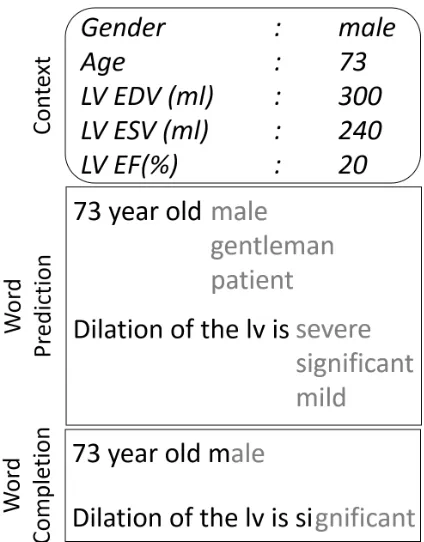
[image:1.612.320.532.239.510.2]Text prediction is the task of suggesting the next word, phrase or sentence while the user is typing. It is an assisted data entry function that aims to save time and effort by reducing the number of keystrokes needed and to improve text quality by preventing misspellings, promoting adoption of standard termi-nologies and allowing for exploration of the vocabu-lary (Sevenster and Aleksovski, 2010; Sevenster et al., 2012).
Figure 1: Word prediction and completion tasks. A system makes suggestions (in grey) for the next word and to complete a word as it is being typed, respectively. The context is often relevant to the quality of the suggestions.
Text prediction originated in augmentative and alternative communication (AAC) to increase text generation rates for people with motor or speech impairments (Beukelman and Mirenda, 2005). Its scope has been extended to a gamut of applica-tions, such as data entry in mobile devices (Dun-lop and Crossan, 2000), interactive machine trans-lation (Foster et al., 2002), search term
completion (Bast and Weber, 2006) and assisted clinical report compilation (Eng and Eisner, 2004; Cannataro et al., 2012).
In this paper, we explore the tasks of word predic-tion, where a system displays a list of suggestions for the next word before the user starts typing it, and word completion, where the system suggests a sin-gle possible completion for the word, while the user is typing its characters. The former task is relevant when the user has not yet made a firm decision about the intended word, thus any suggestions can have a great impact in the content of the final document. In the latter case, the user is thinking of a particular word that they want to input and the system’s goal is to help them complete the word as quickly as possi-ble. Figure 1 shows examples for both tasks.
Often, the user’s goal is to compose a document describing a particular situation, e.g. a clinical re-port about a patient’s condition. An intelligent pre-dictive system should be able to account for such contextual information in order to improve the qual-ity of its suggestions. Challenges to modelling struc-tured contexts include mixed types of values for the different fields an schema inconsistencies across the entries of the structure. We address these issues by employing numerically grounded conditional lan-guage models (Spithourakis et al., 2016).
The contribution of this work is twofold. First, we show that conditional and numerically grounded models can achieve significant improvements over standard language models in the tasks of word pre-diction and completion. Our best model with a list of 5 suggestions raises recall from 25.03% to 71.28% and keystroke savings from 34.35% to 44.81%. Sec-ond, we investigate in depth the behaviour of such models and their sensitivity to the numerical values in the text. We find that the grounded probability for the whole document is more sensitive to numer-ical configurations than the probabilities of individ-ual words.
2 Related Work
There have been several applications of text predic-tion systems in the clinical domain. Word comple-tion has been a feature of discharge summary (Chen et al., 2012), brain MRI report (Cannataro et al., 2012) and radiology report (Eng and Eisner, 2004)
compilation systems. Aiming towards clinical docu-ment standardisation, Sirel (2012) adopted the ICD-10 medical classification codes as a lexical resource and Lin et al. (2014) built a semi-automatic annota-tion tool to generate entry-level interoperable clini-cal documents.
Hua et al. (2014) reported 13.0% time reduc-tion and 3.9% increase of response accuracy in a data entry task. Gong et al. (2016) found a per-formance of 87.1% for keystroke savings, a 70.5% increase in text generation rate, a 34.1% increase in reporting comprehensiveness and a 14.5% reduction in non-adherence to fields when reporting on patient safety event. In non-clinical applications, a survey of text prediction systems (Garay-Vitoria and Abas-cal, 2006) reports keystroke savings ranging from 29% to 56%.
The context provided to the predictive system can have a significant effect on its performance. Fazly and Hirst (2003) and Van Den Bosch and Bogers (2008) obtained significantly better results for word completion by considering not only the prefix of the current word but also previous words and characters, respectively. Wandmacher and Antoine (2008) ex-plored methods to integrate n-gram language mod-els with semantic information and Trnka (2008) used topic-adapted language models for word pre-diction. More recently, Ghosh et al. (2016) incor-porated sentence topics as contextual features into a neural language model and reported perplexity im-provements in a word prediction task. None of these systems considers structured background informa-tion or numerical values from the text as addiinforma-tional context.
The motivation to include this information as con-text to con-text prediction system is based on the impor-tance of numerical quantities to textual entailment systems (Roy et al., 2015; Sammons et al., 2010; MacCartney and Manning, 2008; De Marneffe et al., 2008). In medical communications, sole use of ver-bal specifications (e.g. adjectives and adverbs) has been associated with less precise understanding of frequencies (Nakao and Axelrod, 1983) and prob-abilities (Timmermans, 1994). A combination of structured data and free text is deemed more suit-able for communicating clinical information (Lovis et al., 2000).
text prediction systems (Bickel et al., 2005; Wand-macher and Antoine, 2008; Trnka, 2008; Ghosh et al., 2016). Several tasks call for generative lan-guage models that have been conditioned on vari-ous contexts, e.g. foreign language text for machine translation (Cho et al., 2014), images (Vinyals et al., 2015; Donahue et al., 2015) and videos (Yao et al., 2015) for captioning, etc. Grounded language mod-els represent the relationship between words and the non-linguistic context they refer to. Grounding can help learn better representations for the atoms of lan-guage and their interactions. Previous work grounds language on vision (Bruni et al., 2014; Silberer and Lapata, 2014), audio (Kiela and Clark, 2015), video (Fleischman and Roy, 2008) and the olfactory perception (Kiela et al., 2015). Spithourakis et al. (2016) use numerically grounded language models and language models conditioned on a lexicalised knowledge base for the tasks of semantic error de-tection and correction. We directly use their models to perform word prediction and completion.
3 Methodology
In this section we present a solution to the word prediction and completion tasks (Subsection 3.1). Then, we discuss how language models, which can be grounded on numeric quantities mentioned in the text and/or conditioned on external context can be used in our framework (Subsection 3.2). Finally, we describe our automated evaluation process and var-ious evaluation metrics for the two tasks (Subsec-tion 3.3).
3.1 Word prediction and completion
Let{w1, ..., wT}denote a document, wherewtis the
word at positiont. Documents are often associated with external context that can be structured (e.g. a knowledge base) or unstructured (e.g. other docu-ments). Let’s consider the case where our context is a knowledge base (KB), that is a set of tuples of the form< attribute, value >, where attributes are de-fined by the KB schema. Different attributes might take values from different domains, e.g. strings, bi-nary values, real numbers etc., and some of the val-ues might be missing.
In the word prediction task, the system presents a ranked list of suggestions for the next word to
Algorithm 1Word completion
Input: Vis set of vocabulary words,scorerreturns score for word in current position
Output: next word to be written
1: functionCOMPLETEWORD(V,scorer) 2: prefix←‘’
3: lexicon← V
4: loop
5: lexicon ← {tokens in lexicon starting
withprefix}
6: best← argmax
token∈lexiconscorer(token) 7: Displaybest
8: char←read next char 9: ifchar=T ABthen
10: returnbest .Auto-complete
11: else ifchar=W HIT ESP ACEthen
12: returnprefix .Next word
13: else
14: prefix←prefix+char .Append
15: end if
16: end loop
17: end function
the user, before the user starts typing. The user can consult this list to explore the vocabulary and guide their decision for the next word to write. The ranking of the items in the list is important, with more strongly endorsed words appearing higher up. Too many displayed options can slow down skilled users (Langlais and Lapalme, 2002), therefore the list should not be too long.
Typically, a language model is used to estimate the probability of the next wordwt given the typed
word historyw1, .., wt−1 and external context. The N-best list of the words with the highest probability is presented as the suggestions.
Word completion is a more interactive task, where the system makes suggestions to complete the cur-rent word as the user types each character. Here, the user has a clear intention of typing a specific word and the system should help them achieve this as quickly as possible. A single suggestion is pre-sented and the user can choose to complete the word, typically by typing a special character (e.g. tab).
Algo-rithm 1. The algoAlgo-rithm takes as input the set of known vocabulary words and a scoring function that returns the goodness of a word in the current posi-tion and context, which again can be the word prob-ability from a language model. Initialisation sets the prefix to an empty string and the lexicon to the whole vocabulary (lines 2-3). Iteratively, words that do not match with the prefix are removed from the lexicon (line 5), the best word from the lexicon according to the scorer is found and displayed to the user (lines 6-7) and the user can respond with a key (line 8). If the user inputs the special character, the best word is automatically completed (lines 9-10). If the user inputs a whitespace character, the algorithm termi-nates (11-12). This is the case when no matching word is found in the vocabulary. If any other charac-ter is typed, it is appended to the prefix and another iteration begins.
3.2 Neural language models
A language model (LM) estimates the probabil-ity of the next token given the previous tokens, i.e. p(wt|w1, ..., wt−1). Recurrent neural networks (RNNs) have been successfully used for language modelling (Mikolov et al., 2010). Letwtalso denote
the one-hot representation of thet-th token, i.e. wt
is a sparse binary vector with a single element set to 1, whose index uniquely identifies the token among a vocabulary ofV known words. A neural LM uses a matrix,Ein∈RD×V, to derive word embeddings,
ew
t =Einwt, whereDis a latent dimension. A
hid-den state from the previous time step,ht−1, and the current word embedding,ew
t, are sequentially fed to
an RNN’s recurrence function to produce the current hidden state,ht ∈ RD. The conditional probability
of the next word is estimated assoftmax(Eoutht),
whereEout ∈ RV×D is an output embeddings
ma-trix.
We use two extensions to the baseline neural LM, described in Spithourakis et al. (2016). A language model can beconditionedon the external context by using an encoder-decoder framework. The encoder builds a representation of the context,hKB, which
is then copied to the initial hidden state of the lan-guage model (decoder). To build such a representa-tion for our structured context, we can lexicalise the KB by converting its tuples into textual statements of the form ”attribute : value”, which can then
be encoded by an RNN. This approach can incorpo-rate KB tuples flexibly, even when values of some attributes are missing.
The document and lexicalised KB will frequently contain numerical tokens, which are typically asso-ciated with high out-of-vocabulary rates. To make the LM more sensitive to such numerical informa-tion, we can define the inputs of the RNN’s recur-rence function at each time step as a concatenation ofew
t andent, where the latter is a representation of
the numeric value ofwt. We set ent = float(wt),
wherefloat(.)returns a floating point number from the string of its input or zero, if the conversion fails. When we train such a model, the representations for the words will be associated with the numerical values that appear in their context. Therefore, this model is numericallygrounded.
3.3 Automated evaluation
We run an automated evaluation for both tasks and all systems by simulating a user who types the text character by character. The character stream comes from a dataset of finalised clinical reports. For the word prediction task, we assume that the word from the dataset is the correct word. For the word comple-tion task, we assume that the user types the special key to autocomplete the word as soon as the correct suggestion becomes available.
In practice, the two tasks can be tackled at the same time, e.g. a list of suggestions based on a language model is shown as the user types and they can choose to complete the prefix with the word on the top of the list. However, we chose to decouple the two functions because of their conceptual differ-ences, which call for different evaluation metrics.
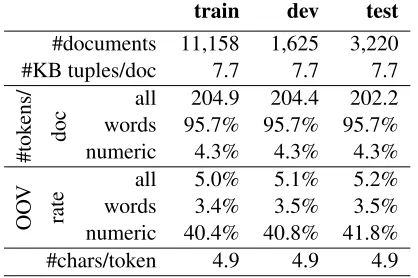
train dev test
#documents 11,158 1,625 3,220 #KB tuples/doc 7.7 7.7 7.7
#tok
ens/
doc
all 204.9 204.4 202.2 words 95.7% 95.7% 95.7% numeric 4.3% 4.3% 4.3%
OO
V
rate
[image:5.612.83.292.62.201.2]all 5.0% 5.1% 5.2% words 3.4% 3.5% 3.5% numeric 40.4% 40.8% 41.8% #chars/token 4.9 4.9 4.9 Table 1:Statistics for clinical dataset. Counts for non-numeric (words) andnumerictokens reported as percentage of counts for alltokens. Out-of-vocabulary (OOV) rates are for vocabulary of 1000most frequent words in the train data.
a common evaluation metric for language models. For word completion, the main goal of the sys-tem should be to reduce input time and effort for the intended word that is being typed by the user.
Keystroke savings(KS) measures the percentage re-duction in keys pressed compared to character-by-character text entry. Suggestions that are not taken by the user are a source of unnecessary distractions. We define anunnecessary distractions(UD) metric as average number of unaccepted character sugges-tions that the user has to scan before completing a word.
KS= keysunaidedkeys−keyswith prediction
unaided (1)
UD= count(suggested, not accepted)
count(accepted) (2)
Bickel et al. (2005) note that KS corresponds to a recall metric and UD to a precision metric. Thus, we can use the F1 score (harmonic mean of precision and recall) to summarise both metrics.
P recision= countcount((suggestedaccepted)) (3)
Recall= count(accepted)
count(total characters) (4)
4 Data
Our dataset comprises 16,003 anonymised clinical records from the London Chest Hospital. Table 1 summarises descriptive statistics of the dataset.
Each patient record consists of a text report and accompanying structured KB tuples. The latter de-scribe metadata about the patient (age and gender) and results of medical tests (e.g. end diastolic and systolic volumes for the left and right ventricles as measured through magnetic resonance imaging). This information was extracted from the electronic health records held by the hospital and was avail-able to the clinician at the time of the compilation of the report. In total, the KB describes 20 possible attributes. From these, one is categorical (gender) and the rest are numerical (age is integer and test results are real valued). On average,7.7 tuples are completed per record.
Numeric tokens account for a large part of the vocabulary (>40%) and suffer from high out-of-vocabulary rates (>40%), despite constituting only a small proportion of each sentence (4.3%).
5 Results and discussion
In this section we describe the setup of our exper-iments (Subsection 5.1) and then present and dis-cuss evaluation results for the word prediction (Sub-section 5.2) and word completion (Sub(Sub-section 5.3) tasks. Finally, we perform a qualitative evaluation (Subsection 5.4).
5.1 Setup
model PP MRR Recall@1 Recall@3 Recall@5 Recall@10
system
baseline 14.96 17.19 8.36 18.38 25.03 36.66
+c 14.52 54.49 45.27 59.97 65.18 71.18
+g 9.91 31.91 21.13 35.45 43.66 53.72
+c+g 9.39 60.71 51.76 66.36 71.28 77.10
ablation
+c -kb 16.64 52.54 43.07 57.89 63.66 70.45 +g -v 13.16 56.08 46.58 61.96 67.30 73.49 +c+g -kb 10.82 58.72 49.46 64.31 69.71 75.98 +c+g -v 11.84 57.31 47.52 63.47 68.92 75.30 +c+g -kb-v 11.81 56.61 46.68 62.78 68.48 74.87
Table 2:Word-level evaluation results for next word prediction on the test set. Perplexity (PP), mean reciprocal rank (MRR) and Recall at different ranks. Recall@1 is equivalent to Precision@1. Best system values inbold.
model P UD KS(R) F1
bound
theoretical 100.0 0.00 58.87 74.11 vocabulary 100.0 0.00 54.48 70.54
system
baseline 13.96 6.17 34.35 19.85 +c 24.34 3.11 43.17 31.13 +g 18.60 4.38 39.31 25.25
+g+c 26.60 2.76 44.81 33.38
ablation
+c -kb 24.61 3.06 44.22 31.62 +g -v 26.74 2.74 45.71 33.74 +c+g -kb 26.73 2.74 45.72 33.74 +c+g -v 27.01 2.70 45.86 33.99 +c+g -kb-v 26.90 2.72 45.79 33.89 Table 3: Character-level evaluation results for word comple-tion on the test set. Unnecessary distraccomple-tions (UD) is inversely related to precision (P). Keystroke savings (KS) are equivalent with recall (R). Best system values inbold.
The vocabulary contains theV = 1000most fre-quent tokens in the training set. Out-of-vocabulary tokens are substituted with<num>, if numeric, and
<unk>, otherwise. We note that the numerical rep-resentations are extracted before any masking. Mod-els are trained to minimise a cross-entropy loss, with
20epochs of back-propagation and gradient descent with adaptive learing rates (AdaDelta) (Zeiler, 2012) and minibatch size set to64. Hyperparameters are based on a small search on the development set around values commonly used in the literature.
5.2 Word prediction
We show our evaluation results on the test set for the word prediction task in Table 2. The conditioned model (+c) achieves double the MRR and quadruple
the Recall@1 of the baseline model, despite bring-ing only small improvements in perplexity. The grounded model (+g) achieves a more significant perplexity improvement (33%), but smaller gains for MRR and Recall@1 (85% and 150% improvement, respectively). Contrary to intuition, we observe that a model with higher perplexity performs better in a language modelling task.
The grounded conditional model (+c+g) has the best performance among the systems, with about 5 points additive improvement across all evaluation metrics over the second best. The benefits from con-ditioning and grounding seem to be orthogonal to one another.
Recall increases with the length of the suggestion list (equivalent to rank). The increase is almost lin-ear for the baseline, but for the grounded conditional it has a decreasing rate. The Recall@5 for the best model is similar to Recall@10 for the second best, thus allowing for halving the suggestions at the same level of recall.
In the test time ablation experiments, all evalua-tion metrics become slightly worse with the notable exception of the grounded without numerical values (+g-v), for which MRR and recall at all ranks are dramatically increased. Again, we observe that a worse perplexity does not always correlate with de-creased performance for the rest of the metrics.
5.3 Word completion
document system: baseline +c +g +c+g
left ventricular function analysis results end diastolic volume<num>
ml end systolic volume
<num>ml stroke volume<num>ml ejection fraction<num>
% [...] lv systolic function is moderately impaired . non dilated atria. non dilated rv [...] lv is<word>dilated. [...]
suggestions
rank
1 non normal normal preserved 2 normal preserved dilated normal 3 dilated non not dilated 4 preserved good preserved not
5 not mild non with
ranks
suggestion
non-dilated 10 11 8 13
dilated 3 8 2 3
non 1 3 5 7
moderately 41 33 37 36
mildly 6 6 7 6
[image:7.612.94.522.60.250.2]severely 29 23 28 27
Table 4:Word prediction for sample document from the development set. Top-5 suggestion lists for<word>(original document has “non”) and ranks for interesting terms from the complete lists of different systems.
numerical configuration non mild severe
<
w
ord
> non 85.83 50.45 26.81 mildly 11.99 36.27 46.46
severely 2.18 13.28 26.73
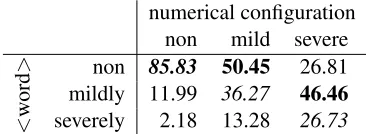
Table 5:Document probabilities for different<word>choices and different numerical configurations. The probabilities are re-normalised over the three displayed choices. Probabilities for highest scoring word inboldand for correct word initalics.
keystroke savings (Trnka and McCoy, 2008). The
theoreticalbound comes from an ideal system that retrieves the correct word after the user inputs the only the first character. The vocabulary bound is similar but only makes any suggestion if the correct word is in the known vocabulary. We extend these bounds to the rest of the evaluation metrics.
The conditioned model (+c) improves the keystroke savings by 25% over the baseline, while halving the unnecessary distractions. The grounded model (+g) achieves smaller improvements over the baseline. The grounded conditional model (+c+g) again has the best performance among the sys-tems. It yields keystroke savings of 44.81%, al-most halfway to the theoretical bound, and the low-est number of unnecessary distractions.
For this task, the desired behaviour of a system is to increase the keystroke savings without introduc-ing too many unnecessary distractions (as measured by the number of wrongly suggested characters per
word). Since the two quantities represent recall and precision measurements, respectively, a trade-off is expected between them (Bickel et al., 2005). Our extended models manage to improve both quantities without trading one for the other.
The theoretical and vocabulary bounds represent ideal systems that always make correct suggestions (UD=0). This translates into very high precision (100%) and F1 values (>70%) that purely represent upper bounds on these performance metrics. For ref-erence, a system with the same keystroke savings as the theoretical bound (58.87%) and a single un-necessary character per word (UD=1) would achieve precision of 50% and an F1 score of 54.07%.
In the test time ablation experiments, all evalu-ation metrics have slightly better results than their corresponding system. In fact, some models per-form similarly to the best system, if not marginally better.
5.4 Qualitative results
The previous results revealed two unexpected situa-tions. First, we observed that occasionally a model with worse perplexity fares better at word predic-tion, which is a language modelling task. Second, we observed that occasionally a run time ablation of a conditional or grounded model outperforms its system counterpart. We carried out qualitative ex-periments in order to investigate these scenarios.
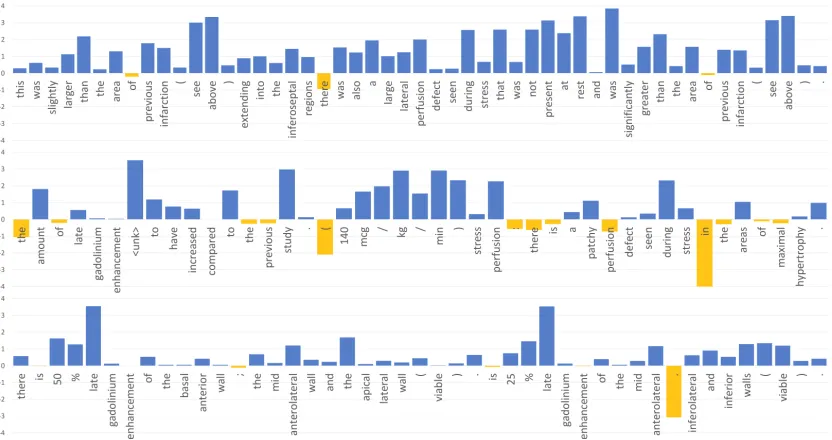
[image:7.612.94.277.295.362.2]Figure 2:Word likelihood ratios (grounded conditional to baseline) for sample sentences from the development set.
set and identified a word of interest and numeric values that can influence the user’s choice for that word. In Table 4, we show the selected document and the 5 top suggestions for the word by different systems. The systems do not have access to tokens from<word>onwards. We also show the ranks for several other semantically relevant choices that ap-pear deeper in the suggestion list. Grounding and conditioning change the order in which the sugges-tions appear.
We proceeded to substitute the numeric values to more representative configurations that would each favour a particular word choice from the set{“non”, “mildly”, “severely”}. We found that changing the values does not have a significant effect to the sug-gestion probabilities and causes no reordering of the items in the lists shown in Table 4. This is in agree-ment with our previous results for test time abla-tions and can be attributed to the fact that many more parameters have been used to model words than numerical values. Thus, the systems rely less on numerical information at test time, even though at training time it helps to improve the language mod-els.
Next, for the different numeric configurations we set<word>to each of the three choices and com-puted the probability of observing the whole docu-ment under the grounded model. This is done by
multiplying together the probabilities for all individ-ual words. Table 5 shows the resulting document probabilities, re-normalised over the three choices. We observe that the system has a stronger preference to “non”, which happens to be the majority class in the training data. In contrast to word probabilities, document probabilities are influenced by the numer-ical configuration.
The reason for this difference in sensitivities is that the tiny changes in individual word probabilities accumulate multiplicatively to bring on significant changes in the document probability. Additionally, selecting a particular word influences the probabil-ities of the following words differently, depending on the numerical configuration. This also explains the observed differences between the perplexity of ablated systems, which accumulates small changes over the whole corpus, and the rest of the metrics, which only depend on per word suggestions. Our training objective, cross-entropy, is directly related to perplexity. Through this, numerical values seem to mediate at training time to learn a better language model.
can interpret the values on the vertical axis as how many times the word is more likely under the ex-tended model versus the baseline. The probability of most words was increased, even at longer distances from numbers (first example). This is reflected in the improved perplexity of the language model. Words and contingent spans directly associated with num-bers, such as units of measurement and certain sym-bols, also receive a boost (second example). Finally, the system would often recognise and penalise mis-takes because of their unexpectedness (dot instead of a comma in the last example).
6 Conclusion
In this paper we showed how numerically grounded language models conditioned on an external knowl-edge base can be used in the tasks of word predic-tion and complepredic-tion. Our experiments on a clinical dataset showed that the two extensions to standard language models have complimentary benefits. Our best model uses a combination of conditioning and grounding to improve recall from 25.03% to 71.28% for the word prediction task. In the word completion task, it improves keystroke savings from 34.35% to 44.81%, where the upper theoretical bound is 58.78% for this dataset. We found that perplexity does not always correlate with system performance in the two downstream tasks. Our ablation experi-ments and qualitative investigations showed that at test time numbers have more influence on the docu-ment level than on individual word probabilities.
Our approach did not rely on ontologies or fine grained data linkage. Such additional information might lead to further improvements, but would limit the ability of our models to generalise in new set-tings. While our automated evaluation showed that our extended system achieves notable improvements in keystroke savings, a case study would be required to measure the acceptance of such a system and its impact on clinical documentation processes and pa-tient care. In the past, deployment of text prediction systems in clinical settings has lead to measurable gains in productivity (Hua et al., 2014; Gong et al., 2016).
In the future, we will investigate alternative ways to encode numerical information, in an attempt to improve the utilisation of numerical values at test
time. We will also experiment with multitask objec-tives that consider numerical targets.
Acknowledgments
The authors would like to thank the anonymous re-viewers. This research was supported by the Farr In-stitute of Health Informatics Research and an Allen Distinguished Investigator award.
References
Holger Bast and Ingmar Weber. 2006. Type less, find more: fast autocompletion search with a succinct in-dex. InProceedings of the 29th annual international ACM SIGIR conference on Research and development in information retrieval.
David Beukelman and Pat Mirenda. 2005.Augmentative and alternative communication. Brookes.
Steffen Bickel, Peter Haider, and Tobias Scheffer. 2005. Predicting sentences using n-gram language models. InProceedings of Human Language Technology and Empirical Methods in Natural Language Processing. Elia Bruni, Nam-Khanh Tran, and Marco Baroni. 2014.
Multimodal distributional semantics. Journal of Arti-ficial Intelligence Research, 49:1–47.
Mario Cannataro, Orlando Alfieri, and Francesco Fera. 2012. Knowledge-based compilation of magnetic res-onance diagnosis reports in neuroradiology. In25th International Symposium on Computer-Based Medical Systems (CBMS). IEEE.
Chi-Huang Chen, Sung-Huai Hsieh, Yu-Shuan Su, Kai-Ping Hsu, Hsiu-Hui Lee, and Feipei Lai. 2012. Design and implementation of web-based discharge summary note based on service-oriented architecture.
Journal of medical systems, 36(1):335–345.
Kyunghyun Cho, Bart Van Merri¨enboer, Caglar Gul-cehre, Dzmitry Bahdanau, Fethi Bougares, Holger Schwenk, and Yoshua Bengio. 2014. Learning phrase representations using rnn encoder-decoder for statisti-cal machine translation. InProceedings of EMNLP. Marie-Catherine De Marneffe, Anna N Rafferty, and
Christopher D Manning. 2008. Finding Contradic-tions in Text. InProceedings of ACL.
Jeffrey Donahue, Lisa Anne Hendricks, Sergio Guadar-rama, Marcus Rohrbach, Subhashini Venugopalan, Kate Saenko, and Trevor Darrell. 2015. Long-term re-current convolutional networks for visual recognition and description. InProceedings of the IEEE Confer-ence on Computer Vision and Pattern Recognition. Mark D Dunlop and Andrew Crossan. 2000. Predictive
John Eng and Jason M Eisner. 2004. Informatics in radi-ology (inforad) radiradi-ology report entry with automatic phrase completion driven by language modeling. Ra-diographics, 24(5):1493–1501.
Afsaneh Fazly and Graeme Hirst. 2003. Testing the ef-ficacy of part-of-speech information in word comple-tion. InProceedings of the EACL 2003 Workshop on Language Modeling for Text Entry Methods.
Michael Fleischman and Deb Roy. 2008. Grounded Lan-guage Modeling for Automatic Speech Recognition of Sports Video. InProceedings of ACL.
George Foster, Philippe Langlais, and Guy Lapalme. 2002. User-friendly text prediction for translators. In
Proceedings of the ACL-02 conference on Empirical methods in natural language.
Nestor Garay-Vitoria and Julio Abascal. 2006. Text pre-diction systems: a survey. Universal Access in the In-formation Society, 4(3):188–203.
Shalini Ghosh, Oriol Vinyals, Brian Strope, Scott Roy, Tom Dean, and Larry Heck. 2016. Contex-tual lstm (clstm) models for large scale nlp tasks.
arXiv:1602.06291.
Yang Gong, Lei Hua, and Shen Wang. 2016. Lever-aging user’s performance in reporting patient safety events by utilizing text prediction in narrative data en-try. Computer methods and programs in biomedicine, 131:181–189.
Sepp Hochreiter and J¨urgen Schmidhuber. 1997. Long short-term memory. Neural computation, 9(8):1735– 1780.
L Hua, S Wang, and Y Gong. 2014. Text prediction on structured data entry in healthcare: A two-group randomized usability study measuring the prediction impact on user performance. Applied Clinical Infor-matics, 5:249–263.
Douwe Kiela and Stephen Clark. 2015. Multi- and Cross-Modal Semantics Beyond Vision: Grounding in Auditory Perception. InProceedings of EMNLP. Douwe Kiela, Luana Bulat, and Stephen Clark. 2015.
Grounding Semantics in Olfactory Perception. In Pro-ceedings of ACL.
Philippe Langlais and Guy Lapalme. 2002. Trans type: Development-evaluation cycles to boost translator’s productivity.Machine Translation, 17(2):77–98. Ching-Heng Lin, Nai-Yuan Wu, Wei-Shao Lai, and
Der-Ming Liou. 2014. Comparison of a semi-automatic annotation tool and a natural language processing ap-plication for the generation of clinical statement en-tries. Journal of the American Medical Informatics Association, 22:132–142.
Christian Lovis, Robert H Baud, and Pierre Planche. 2000. Power of expression in the electronic patient record: structured data or narrative text? International Journal of Medical Informatics, 58:101–110.
Bill MacCartney and Christopher D Manning. 2008. Modeling semantic containment and exclusion in nat-ural language inference. InProceedings of the 22nd International Conference on Computational Linguis-tics.
Tom´aˇs Mikolov, Martin Karafi´at, Luk´aˇs Burget, Jan ˇCernock´y, and Sanjeev Khudanpur. 2010. Recurrent neural network based language model. InInterspeech. Michael A Nakao and Seymour Axelrod. 1983. Num-bers are better than words: Verbal specifications of frequency have no place in medicine. The American Journal of Medicine, 74(6):1061–1065.
Subhro Roy, Tim Vieira, and Dan Roth. 2015. Reasoning about Quantities in Natural Language. Transactions of the Association for Computational Linguistics, 3:1– 13.
Mark Sammons, VG Vydiswaran, and Dan Roth. 2010. Ask not what textual entailment can do for you... In
Proceedings of the 48th Annual Meeting of the Associ-ation for ComputAssoci-ational Linguistics.
Merlijn Sevenster and Zharko Aleksovski. 2010. Snomed ct saves keystrokes: quantifying semantic au-tocompletion. In Proceedings of American Medical Informatics Association (AMIA) Annual Symposium. Merlijn Sevenster, Rob van Ommering, and Yuechen
Qian. 2012. Algorithmic and user study of an auto-completion algorithm on a large medical vocabulary.
Journal of biomedical informatics, 45(1):107–119. Carina Silberer and Mirella Lapata. 2014.
Learn-ing Grounded MeanLearn-ing Representations with Autoen-coders. InProceedings of ACL.
Raul Sirel. 2012. Dynamic user interfaces for syn-chronous encoding and linguistic uniforming of tex-tual clinical data. InHuman Language Technologies– The Baltic Perspective: Proceedings of the 5th Inter-national Conference Baltic HLT.
Georgios P. Spithourakis, Isabelle Augenstein, and Se-bastian Riedel. 2016. Numerically grounded language models for semantic error correction. InProceedings of EMNLP.
Dani¨elle Timmermans. 1994. The roles of experience and domain of expertise in using numerical and verbal probability terms in medical decisions.Medical Deci-sion Making, 14(2):146–156.
Keith Trnka and Kathleen F McCoy. 2008. Evaluating word prediction: framing keystroke savings. In Pro-ceedings of the 46th Annual Meeting of the Associ-ation for ComputAssoci-ational Linguistics on Human Lan-guage Technologies.
Antal Van Den Bosch and Toine Bogers. 2008. Efficient context-sensitive word completion for mobile devices. InProceedings of the 10th international conference on Human computer interaction with mobile devices and services.
Oriol Vinyals, Alexander Toshev, Samy Bengio, and Du-mitru Erhan. 2015. Show and tell: A neural image caption generator. InProceedings of the IEEE Confer-ence on Computer Vision and Pattern Recognition. Tonio Wandmacher and Jean-Yves Antoine. 2008.
Methods to integrate a language model with seman-tic information for a word prediction component. In
Proceedings of EMNLP.
Li Yao, Atousa Torabi, Kyunghyun Cho, Nicolas Bal-las, Christopher Pal, Hugo Larochelle, and Aaron Courville. 2015. Describing videos by exploiting tem-poral structure. InProceedings of the IEEE Interna-tional Conference on Computer Vision.