Beyond Chart Parsing: An Analytic Comparison of Dependency Chart
Parsing Algorithms
Meixun Jin, Hwidong Na and Jong-Hyeok Lee Department of Computer Science and Engineering Pohang University of Science and Technology (POSTECH)
San 31 Hyoja Dong, Pohang, 790-784, Republic of Korea meixunj,leona,[email protected]
Abstract
In this paper, we give a summary of vari-ous dependency chart parsing algorithms in terms of the use of parsing histories for a new dependency arc decision. Some pars-ing histories are closely related to the tar-get dependency arc, and it is necessary for the parsing algorithm to take them into con-sideration. Each dependency treebank may have some unique characteristics, and it re-quires for the parser to model them by cer-tain parsing histories. We show in experi-ments that proper selection of the parsing al-gorithm which reflect the dependency anno-tation of the coordinate structures improves the overall performance.
1 Introduction
In data-driven graph-based parsing, a chart parser is frequently combined with a learning method to derive and evaluate the parse forest and output the optimal parse tree (Chen et al., 2010; Koo and Collins, 2010). The proper selection of a parsing algorithm is important for efficiency and correct-ness.
Chart parsing is the realization of dynamic pro-gramming for syntactic analysis. It is suitable for ambiguous grammars, for example, the gram-mars of natural languages. Practically, accord-ing to the diverse implementations of dynamic programming for dependency syntactic analysis, there are a number of dependency chart parsing algorithms. In this paper, we list a number of bottom-up dependency chart parsing algorithms in terms of their use of the parsing histories (sec-tion 2).
Incorporating parsing histories into parse tree decoding requires changes to the parsing algo-rithm. For instance, when decoding a dependency by including the most recently detected sibling
arc, a modified parsing algorithm has been used
in (McDonald et al., 2006) in contrast to the al-gorithm used in (McDonald et al., 2005). Parsing histories are partial results generated from previ-ous parsing steps. In a chart parser, these histories can be used in subsequent parsing steps. Previous works have shown that the use of parsing histories helps to resolve syntactic ambiguities (Yamada and Mastumoto, 2003; Nivre et al., 2007b; Mc-Donald et al., 2006; Carreras, 2007; Chen et al., 2010). Obviously, using more histories provides better parsing disambiguation. However, there is a trade-off between using more histories and pars-ing efficiently. One option is to incorporate only important histories. The selection of different his-tories requires changes to the parsing algorithm.
Another reason for the careful selection of pars-ing algorithms is from the diverse dependency an-notation strategies. The dependency anan-notations for the same linguistic structures, i.e., coordinate structures can vary (Section 3.1). Additionally, in our opinion, some linguistic or corpus-oriented characters exist for each training data set. Differ-ent parsing algorithms are required to deal with the diversity of the corpus.
2 Dependency Chart Parsing Algorithms
A chart parser is the realization of dynamic pro-gramming for syntactic analysis. It parses all the substrings of the input sentence and stores the corresponding sub-parse-trees in a data structure called a chart. Dependency chart parsers can be categorized intoconstituent-based andspan-based parsers depending on the type of substring each cell of the chart yields.
The main difference between constituent-based and span-based algorithms lies in the type of sub-strings they process. A constituent-based algo-rithm identifies and parses substrings correspond-ing to constituents and a span-based algorithm does on substrings corresponding tospans.
A constituent-based algorithm is a modification
of a phrase-structure (PS) chart parsing algorithm. In a constituent-based dependency parser, the head word of the substring is derived instead of the non-terminal of PS parsing, and information related to the head word is stored in corresponding cell of the chart. In a modified CYK algorithm(Younger, 1967), the cell reserves the possibility for each word of the substring to be the head. Thus,nkinds of sub-dependency-trees are reserved for process-ing a substrprocess-ing of lengthn. The space complexity for a cell is O(n), and the overall space complexity is O(n3) and time complexity is O(n5) for parsing of a sentence of lengthn. For a detailed descrip-tion, refer to (Nivre, 2006).
A span is a half-constituent that is formed by splitting a constituent at the position of its head
(Eisner and Satta, 1999). The span is character-ized by the head being located either on the left or right edge. In the span-based dependency chart parser proposed by (Eisner and Satta, 1999), there are two kinds of subtrees reserved in each cell of the chart, i.e., the head is the left-most word or the right-most word. Given this condition, Eisner’s al-gorithm can parse with a time complexity of O(n3) and a space complexity of O(n2).
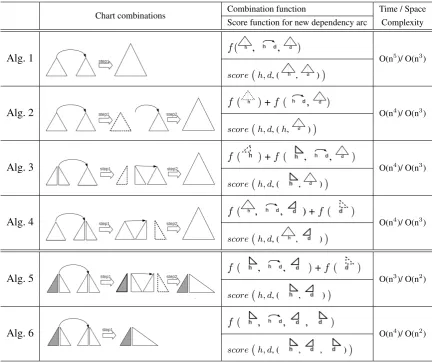
In bottom-up parsing, either a constituent-based or a span-based algorithm derives parse tree for a sequence by combining two (or more) sequences with a new dependency arc. These sub-sequences have been parsed in earlier steps, and they are called as parsing histories. These histo-ries are frequently used for a better evaluation of the new dependency arc (Chen et al., 2010). Ta-ble 1 lists a number of dependency chart parsing algorithms. Each of them adopts different method to derive a new parse tree from couple of smaller sequences. In the following, we discuss in detail how these algorithms differ in their use of the pars-ing histories for the new dependency arc decision.
2.1 Constituent-Based Algorithms
Table 1 lists the step for various dependency chart parsing algorithms to decide a new dependency arc connectingh(ead) andd(ependent). and present the constituents dominated byhandd re-spectively.
The derivation of the new constituent in Alg. 1 (Table 1) is processed in step, and the one-step processing can be defined as the function f
of Alg. 1, which involves three parameters: two constituents and and the evaluation of the
dependency arc . The dependency between (h, d) is evaluated by score(h, d, ( , )) de-fined in Table 1. Here, ( , ) is the context of parsing histories, which are available for the new dependency arc detection in Alg. 1.
Algs. 2-4 listed in Table 1 are variants of Alg. 1, and the derivation of the new constituent over smaller constituents in these algorithms is pro-cessed intwosteps. In Alg. 2, the first step com-bines one constituent with the detection of the de-pendency arc, and the process is represented by the functionf( , ); the combination of the sec-ond constituent represented asf( ), is processed at the second step (Table 1, Alg. 2). With such a two-step operation, parsing histories available for the decision of the arc in Alg. 2 is (h, ). Comparing to Alg.1 of ( , ), the histories in-cluded in is not available in Alg.2. One benefit of such a two-step operation is that it reduces the time complexity O(n5) of Alg. 1 to O(n4).
In Algs. 3 and 4, one of the constituents is di-vided into two parts (spans). The first step com-bines the constituent with the closer span and makes a decision about the new dependency arc. The other span is attached to the result of the first step. The available parsing histories is ( , ) for Alg.3, and ( , ) for Alg.4.
The two-step processing requires the reserva-tion of the partial results generated at the first step: for Alg. 2, for Alg. 3, and for Alg. 4 (Table 1). Reserving these partial results in the chart in addition to the constituent , only in-creases theconstant factor, the overall space com-plexity remains as O(n3).
For more information on Algs. 2 and 3 see (Eis-ner and Satta, 1999). and Alg. 4 see (Jin, 2011).
2.2 Span-Based Algorithms
Chart combinations Combination function Time / Space Score function for new dependency arc Complexity
Alg. 1
f( , , )
O(n5)/ O(n3)
score(h, d, ( , ))
Alg. 2
f ( )+f ( , )
O(n4)/ O(n3)
score(h, d, (h, ))
Alg. 3
f ( )+f ( , , )
O(n4)/ O(n3)
score(h, d, ( , ))
Alg. 4
f ( , , ) +f ( )
O(n4)/ O(n3)
score(h, d, ( , ))
Alg. 5
f ( , , )+f ( )
O(n3)/ O(n2)
score(h, d, ( , ))
Alg. 6
f ( , , , )
O(n4)/ O(n2)
[image:3.595.82.516.61.423.2]score(h, d, ( , , ))
Table 1: Comparison of various dependency chart parsing methods. The dashed part is attached in step2. Algs. 5-6 arespan-basedalgorithms, during the step of right-side span construction, the shadowed left-side span remains
unchange.
of (Koo and Collins, 2010) is a similar propose of the method of Alg. 2 on span-based algorithms.
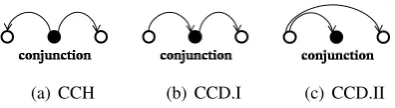
In terms of the use of the parsing histories, the amount of information available for a new depen-dency arc decision with Alg. 5 is ( , ), which is abouthalfof ( , ) of Alg.1. Some common but important relations between pair of dependents for some corpora, such as the relation between the left and right dependents of a head (the pair of de-pendency arcs shown in Fig. 1(a)), cannot be mod-eled using such an algorithm.
Alg. 6 (Table 1), is an alternative to Alg. 5. The two-step operation in Alg. 5 merges and be-comes a one-step operation in Alg. 6 by direct processing over three spans ( , , ) . Such a ternary-span combination increases the parsing histories from ( , ) of Alg.5 tothreespans as ( , , ) (see the score function of Alg. 6 in Table 1). However, the time complexity of Alg.6
increases from O(n3) of Alg.5 to O(n4). Compar-ing to other O(n4) algorithms, Algs.2-4, Alg. 6 is more efficient with a small constant factor. The space complexity is also modest as O(n2) which is the same as that for Alg. 5.
The relation between the left and right depen-dents of a head can be modeled using Alg. 6. In span-based algorithms, the left and right spans sharing the head are treated independently, and the relations between the left and right dependents are often ignored in previous span-based algorithms. To our knowledge, Alg. 6 is the first span-based algorithm to model this. For detailed implementa-tion of Alg.5 refer to (Eisner and Satta, 1999), and Alg.6 to (Jin, 2011).
3 Diverse Dependency Annotation Strategies
(a) CCH (b) CCD.I (c) CCD.II
Figure 1: (a) CCH; (b) and (c) two cases of CCD, with
leftconjunct as head.
it has become common to construct a universal
parser to derive parse trees of diverse languages in aunifiedway, with less consideration about the varieties among corpora.
In addition to the variations of different lan-guage, there are some variations because of the diverse strategies for dependency annotations. It is clear that a subject or an object takes a verb as its head. However, for the case of preposi-tion vs. noun, or complementizer vs. verb in sub-clauses, there are various dependency anno-tation strategies. Such diversities of dependency annotation need corresponding changes for pars-ing algorithms. Since the same lpars-inguistic struc-tures are presented differently with different an-notation strategies. In section 3.1, we discuss for such changes required for the case of coordinate structures.
3.1 Diversity for Denpendency Annotation of Coordinate Structures
There are various strategies for annotating depen-dencies of coordinate structures. These include,
coordinate conjunction as head (CCH), and co-ordinate conjunction as dependent(CCD) strate-gies (McDonald and Nivre, 2007), and CCD can further be categorized into two cases illustrated in Figures 1(b) and 1(c).
Coordinate structures are characterized by sym-metries between conjuncts. The symsym-metries are important clues for the disambiguation of coor-dinate structure. The different dependency anno-tation strategies for coordinate structures require different methods to model the symmetry shar-ing between conjuncts. For CCH-type coordinate structures, it is essential for the parser to model the pair of dependents shown in Figure 1(a). Existing span-based approaches (McDonald et al., 2006; Carreras, 2007; Koo and Collins, 2010) do not model such relations. That explains why the av-erage performance for CCH-type coordinate struc-tures is about 15% to 20% lower than that of CCD-type in the work of (McDonald et al., 2006), ac-cording to the analysis given in (McDonald and
Corpus
2nd-order1 Alg. 6 (McDonald et al., 2006)
overall coord. overall coord. Chinese 88.29% 81.66% 89.41% 85.09% Slovene 78.93% 58.79% 80.32% 74.06%
1 The results of MSTParser(V0.2), which is available from
[image:4.595.79.277.61.115.2]http://www.seas.upenn.edu/˜strctlrn/MSTParser/MSTParser.html
Table 2: Results of experiment.
Nivre, 2007). Considering the frequent use of co-ordinate structures among sentences, for hight per-formance parsing, it is crucial to select a parsing algorithm that can parse such structures well.
4 Experiments
We conduct our experiments on two data sets, the Chinese corpus of CoNLL’07 (Nivre et al., 2007a), and the Slovene corpus of CoNLL’06 (Buchholz and Marsi, 2006) shared task formultilingual de-pendency parsing track. Both corpora are of the CCH-type.
Table 2 lists the performance of two systems, i.e., the 2nd-order system of (McDonald et al., 2006) and the proposed system with Alg. 6 (Ta-ble 1) as the parse tree decoder. As the discussions given in the previous section, the2nd-order gives low performance for coordinate structures com-pared to the overall parsing results. The proposed system gives better coordinate disambiguation by modeling the relation between dependents located on different-sides of the head.
5 Conclusion
In this paper, we categorize bottom-up depen-dency chart parsing algorithms into constituent-based and span-constituent-based algorithms according to the strings each identifies and parses. We further cat-egorize algorithms in terms of the use of parsing histories for new dependency arc detection. We show that proper selection of the parsing algorithm helps to improve the overall parsing performance.
Acknowledgments
[image:4.595.307.525.62.120.2]References
Sabine Buchholz and Erwin Marsi. 2006. Conll-x shared task on multilingual dependency pars-ing. In Proceedings of the 10th Conference on Natural Language Learning(CoNLL-X), New York City, USA, June. Association for Compu-tational Linguistics.
Xavier Carreras. 2007. Experiments with a higher-order projective dependency parser. In
Proceedings of the CoNLL Shared Task Ses-sion of EMNLP-CoNLL 2007, pages 957–961, Prague, Czech Republic, June. Association for Computational Linguistics.
Wenliang Chen, Jun’ichi Kazama, Yoshimasa Tsuruoka, and Kentaro Torisawa. 2010. Im-proving graph-based dependency parsing with decision history. In Coling 2010: Posters, pages 126–134, Beijing, China, August. Coling 2010 Organizing Committee.
Jason M. Eisner and Giorgio Satta. 1999. Ef-ficient parsing for bilexical context-free gram-mars and head automaton gramgram-mars. In Pro-ceedings of the 37th Annual Meeting of the As-sociation for Computational Linguistics. Asso-ciation for Computational Linguistics.
Jason M. Eisner. 1996. Three new probabilis-tic models for dependency parsing: An explo-ration. InProceedings of the 34th Annual Meet-ing of the Association for Computational Lin-guistics, pages 340–345. Association for Com-putational Linguistics.
Meixun Jin. 2011. Dependency chart parsing al-gorithms. Technical Report, POSTECH.
Terry Koo and Michael Collins. 2010. Efficient third-order dependency parsers. InProceedings of the 48th Annual Meeting of the Association for Computational Linguistics, pages 1–11, Up-psala, Sweden, July. Association for Computa-tional Linguistics.
Ryan McDonald and Joakim Nivre. 2007. Char-acterizing the errors of data-driven dependency parsing models. In Proceedings of the 2007 Joint Conference on Empirical Methods in Nat-ural Language Processing and Computational Natural Language Learning (EMNLP-CoNLL), pages 122–131.
Ryan McDonald, Fernando Pereira, Kiril Ribarov, and Jan Hajic. 2005. Non-projective depen-dency parsing using spanning tree algorithms. In Proceedings of Human Language Technol-ogy Conference and Conference on Empiri-cal Methods in Natural Language Processing, pages 523–530, Vancouver, British Columbia, Canada, October. Association for Computa-tional Linguistics.
Ryan McDonald, Kevin Lerman, and Fernando Pereira. 2006. Multilingual dependency anal-ysis with a two-stage discriminative parser. In Conference on Natural Language Learning (CoNLL).
Joakim Nivre, Johan Hall, Sandra K¨ubler, Ryan McDonald, Jens Nilsson, Sebastian Riedel, and Deniz Yuret. 2007a. The CoNLL 2007 shared task on dependency parsing. In Proceedings of the CoNLL Shared Task Session of EMNLP-CoNLL 2007, pages 915–932, Prague, Czech Republic, June. Association for Computational Linguistics.
Joakim Nivre, Johan Hall, Jens Nilsson, Atanas Chanev, Gulsen Eryigit, Sandra Kubler, Sve-toslav Marinov, and Erwin Marsi. 2007b. Malt-parser:a language-independent system for data-driven dependency parsing. Natural Language Engineering, 2(13):95–135.
Joakim Nivre. 2006. Inductive dependency pars-ing. Text, Speech and Language Technology, 34.
Hiroyasu Yamada and Yuji Mastumoto. 2003. Statistical dependency analysis with support vector machines. In Proceedings of the 8th International Workshop on Parsing Technolo-gies(IWPT), pages 195–206.