Using Manual and Parallel Aligned Corpora for Machine Translation
Services within an On-line Content Management System
Cristina Vertan University of Hamburg
Monica Gavrila University of Hamburg
gavrila@informatik. uni-hamburg.de
Abstract
Web content management systems (WCMSs) are a popular instrument for gathering, navigating and assessing infor-mation in environments such as Digital Libraries or e-Learning. Such environ-ments are characterized not only through a critical amount of documents, but also by their domain heterogeneity, relative to format, domain or date of production, and their multilingual character. Methods from Information and Language Technol-ogy are the “plug-ins” necessary to any WCMS in order to ensure a proper func-tionality, given the features mentioned above. Among these “plug-ins”, machine translation (MT) is a key component, which enables translation of meta-data and content either for the user or for other components of the WCMS (i.e. cross-lingual retrieval component). However, the MT task is extremely challenging and lacks frequently the availability of adequate training data. In this paper we will present a WCMS including ma-chine translation, explain the related MT challenges, and discuss the employment of corpora as training material, which are manually and automatically parallel aligned.
1 Introduction
During the last couple of years, the number of ap-plications which are entirely Web-based or offer at least some Web front-ends has grown dramati-cally. As a response to the need of managing all this data, a new type of systems appeared: the web-content management systems. In this article we will refer to this type of systems as WCMS. Existent WCMSs focus on storage of documents
in databases and provide mostly full-text search functionalities. These types of systems have lim-ited applicability, due to reasons such as the fol-lowing:
• data available on-line is often multilingual;
• documents within a content management sys-tem (CMS) are semantically related (share some common knowledge or belong to simi-lar topics).
Shortly, currently available CMSs do not exploit modern techniques from information technology like text mining, semantic web or machine trans-lation.
The recently launched ICT PSP EU project AT-LAS (Applied Technology for Language-Aided CMS1) aims to fill in this gap by providing three
innovative Web services within a WCMS. These three Web services (Librarian, EUDocLib and i-Publisher) are not only thematically different, but also offer different levels of intelligent information processing.
The ATLAS WCMS makes use of state-of-the-art text technology methods in order to extract in-formation and cluster documents according to a given hierarchy. A text summarization module and a machine translation engine, as well as a cross-lingual semantic search engine are embedded. The system is addressing for the moment seven lan-guages (Bulgarian, Croatian, English, German, Greek, Polish and Romanian) from four different language families. However, the chosen frame-work allows additions of new languages at a later point.
Machine Translation is a key component of the ATLAS-WCMS and it will be embedded in all three services of the system. The development of the engine is particularly challenging as the trans-lation should be used in different domains and on
1http://www.atlasproject.eu.
different text-genres. Additionally, the considered language-pairs belong most of them to the lesser resourced group of languages, for which bilingual training and test material is available only in lim-ited amount.
The availability of adequate and comparable training data for all language pairs in the ATLAS system played an important role in the architec-tural design of the MT-engine. The selection of training data was preceded by experiments on se-lected language pairs. Through these experiments we intended to investigate if small parallel corpora can be also used and with which implications on the translation quality. We investigated addition-ally the automatic (sentence) alignment in larger corpora in order to understand which implications alignment errors may have on the translation pro-cess.
In the following sections we report about our findings as follows: in Section 2 we present briefly the ATLAS functionality and describe the corre-sponding challenges for the machine translation engine. In section 3 we present the data we used for experiments and analyze it from the linguis-tic point of view. Section 4 deals with experi-ments which investigate the dependency between the amount of the training data and the translation quality. Section 5 gives an overview of future ex-periments and implementation steps.
2 MT-challenges in the ATLAS-System
2.1 The ATLAS-System
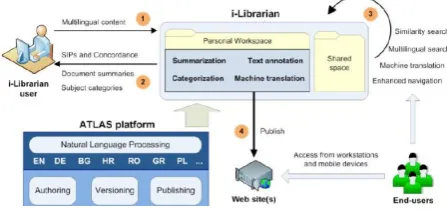
The core on-line service of the ATLAS platform is i-Publisher, a powerful Web-based instrument for creating, running and managing content-driven Web sites. It integrates language-based technolo-gies to improve content navigation e.g. by in-terlinking documents based on extracted phrases, words and names, providing short summaries and suggested categorization concepts. Currently two different thematic content-driven Web sites are being built on top of ATLAS platform, us-ing Publisher as content management layer: i-Librarian and EUDocLib. i-i-Librarian is intended to be a user-oriented web site which allows vis-itors to maintain a personal workspace for stor-ing, sharing and publishing various types of doc-uments and have them automatically categorized into appropriate subject categories, summarized and annotated with important words, phrases and names. EUDocLib is planned as a publicly
acces-Figure 1: The iLibrarian Architecture
sible repository of EU legal documents from the EUR-Lex collection with enhanced navigation and multilingual access. All three services operate in the multilingual setting described in Section 1. To justify the need of embedded language technology tools within the ATLAS platform we detail here only the functionalities of i-Librarian.
The i-Librarian service (see Figure 2.1):
• addresses the needs of authors, students,
young researchers and readers,
• gives the ability to easily create, organize and publish various types of documents,
• allows users to find similar documents in different languages, to share personal works with other people, and to locate the most es-sential texts from large collections of unfa-miliar documents.
[image:2.595.307.531.72.179.2]part-of-speech (PoS) annotation necessary for fac-tored models and ensure named entity recognition. Other bricks of the ATLAS architecture feed infor-mation into the translation engine as follows:
1. the document categorization gives informa-tion about the domain of a particular docu-ment;
2. the automatic summarization deals with anaphora resolutions and pre-processes the document in order to simplify the translation task.
2.2 Challenges of the MT-Task
The machine translation (MT) engine is integrated in two distinct ways into the ATLAS platform:
• the MT-engine is serving as a translation aid
tool for publishing multilingual content for i-Publisher. Text is submitted to the translation engine and the result is subject to the human post processing;
• for i-Librarian and EuDocLib, the MT-engine provides a translation for assimilation, which means that the user retrieving documents in different languages will use the engine in or-der to get a clue about the documents, and decide if he wants to store them. If the trans-lation is considered as acceptable, it will be stored into a database.
The integration of a machine translation en-gine into a web based content management sys-tem, presents from the user point of view two main challenges:
• the user may retrieve documents from
differ-ent domains. Domain adaptability is a major issue in machine translation, and in particular in corpus-based methods. Poor lexical cov-erage and false disambiguation are the main issues when translating documents out of the training domain;
• the user may retrieve documents from various time periods. As language changes over time, language technology tools developed for the modern languages do not work, or perform with higher error rate, on diachronic docu-ments.
[image:3.595.309.532.62.179.2]With the current available technology it is not possible to provide a translation system which is
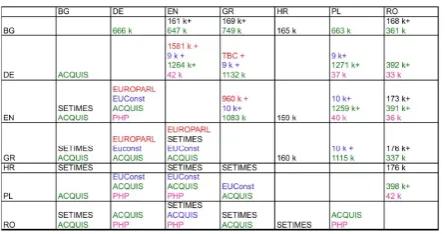
Figure 2: Available parallel corpora for all lan-guage pairs within the ATLAS system.
domain and language variation independent and works for a couple of heterogeneous language pairs. Therefore our approach envisage a system of user guidance, so that the availability and the foreseen system-performance is transparent at any time.
From the development point of view the main challenge is provided by the high number of lan-guage pairs2, most of them involving languages
with rich morphology and belonging to structural different language families. For most of the lan-guage pairs a limited number of parallel aligned corpora are available. Additionally, the ATLAS platform should provide a basic comparable func-tionality for all language pair, so we cannot train models for different language pairs on completely different corpora.
After collecting information regarding parallel corpora for all involved language pairs, we de-cided to focus the development of basic training models on those summarized in Figure 2.23.
It can be observed that with exception of Croa-tian, for all other involved languages the JRC-Acquis4 corpus offers a good training basis
(cov-erage and size). In order to ensure domain porta-bility we decided to train domain factored models as in (Niehues and Waibel, 2010). This approach allows the usage of small domain specific corpora. Small corpora have the advantage that they can be manually aligned, or at least manually corrected. In order to see how the translation engine behaves when exposed to large but automatically trained corpora and to small but manually aligned texts, we performed several analyses described in
sec-2More than 40 language-pairs.
3We do not consider in this table the recent additions from February 4th, 2011 concerning the Europarl corpus.
tion 4.
3 Manually Aligned Small Corpora vs. Automatically Aligned Large Corpora We decided to make selective experiments on cor-pora involving following language pairs: English, Romanian and German. Our choice is based on the availability of human evaluators speaking all three languages, but also by the fact that the languages belong to structural different families (Romania is in the Latin language family, English and German are Germanic languages). Additionally Romanian and German are highly inflected.
3.1 JRC-Acquis
The JRC-Acquis Communautaire is nowadays one of the mostly used parallel aligned corpus for training models in statistical machine translation (Koehn et al., 2009). We do not make here an extensive presentation of the SMT system but present in Table 1 and 2 just a comparative statis-tics on the three selected languages5. From these
tables we can infer that the size of the training ma-terial has large variations across different language pairs within the JRC-Acquis.
Language pair No. of documents No. of links German-Romanian 6558 docs 391972 links German-English 23430 docs 1264043 links English-Romanian 6557 docs 391334 links
Table 2: JRC-Acquis alignment statistics (docs=documents).
The corpus is automatically paragraph-aligned, where a paragraph is a simple or complex sentence or a sub-sentential phrase (such as noun-phrase).
3.2 RoGER
RoGER (Romanian German English, Russian) is a parallel corpus, manually aligned at sentence level. It is domain-restricted, as the texts are from a users’ manual of an electronic device. The lan-guages included in the development of this corpus are Romanian, English, German and Russian. The corpus was manually compiled. It is not annotated and diacritics are ignored. The corpus was man-ually verified: the translations and the (sentence) alignments were manually corrected.
The initial PDF-files of the manual were auto-matically transformed into text files (.RTF), where 5Information source: http://wt.jrc.it/lt/
Acquis/JRC-Acquis.3.0/.
pictures were either left out (pictures around the text), or replaced with text (pictures inside the text). The initial text was preprocessed by replac-ing numbers, websites and images with “meta-notions” as follows: numbers by NUM, pictures by PICT and websites by WWWSITE. In order to simplify the translation process, some abbrevi-ations were expanded. The sentences were man-ually aligned, first for groups of two languages. This way we obtained two alignment files. Finally, the two alignment files obtained were merged, so that, after all, RoGER contained all four lan-guages. The merged text files are XML encoded, as shown below:
<?xml version=’’1.0’’ encoding=’’UTF-8’’?> <sentences>
... <sentence id=’’1010’’>
<en>Press Options and some of the following options may be available .</en>
<de>Druecken Sie Optionen . und
einige der folgenden Optionen sind ggf. verfuegbar .</de>
<ro>Apasati Optiuni dupa care unele din urmatoarele optiuni pot fi disponibile .</ro>
<ru>...</ru> </sentence>
... </sentences>
The corpus contains 2333 sentences for each language. More statistical data about the corpus is presented in Table 3. The average sentence length is eleven tokens for English, Romanian and Ger-man and nine for Russian. Punctuation signs are considered tokens. More about the RoGER corpus can found in (Gavrila and Elita, 2006)
3.3 Linguistic Analysis of the Corpora
From both corpora we randomly extracted about 100 sentences, i.e. 100 sentences from the JRC-Acquis corpus for Romanian-English and 100 sen-tences from the RoGER corpus and the same lan-guage pair and direction of translation. These sen-tences were analyzed with respect to translation divergences and translation mismatches.
Language No. texts No. words No. words No. words Total no. words (Text body) (Signatures) (Annexes) (Whole document) German 23541 32059892 2542149 16327611 50929652 English 23545 34588383 3198766 17750761 55537910 Romanian 6573 9186947 514296 11185842 20887085 (version 1)
[image:5.595.128.471.63.160.2]Romanian 19211 30832212 - - 30832212 (version 2)
Table 1: JRC-Acquis statistics.
Feature English Romanian German Russian
No. tokens 26096 25850 27142 22383
Vocabulary size 2012 3104 3031 3883
Vocabulary 1231 1575 1698 1904
(Word-frequency higher than two)
Table 3: Statistics on RoGER.
divergences are presented in the literature in (Dorr et al., 1999) and (Dorr, 1994). In the case of a translation mismatch the information that can be extracted from the SL and TL sentence is not the same. Translation mismatches have received less attention in the literature (Kameyama et al., 1991), but for corpus-based approaches they are impor-tant, as they directly influence the translation pro-cess.
Following translation challenges were observed within the JRC-Acquis:
• Divergences
– Noun (NN) - adjective (Adj) inversion
– Noun-Preposition-Noun (NN-prep-NN) translated as adjective-Noun (Adj- NN)
– Subordinate clause translated as adjec-tive
– Different argument structure
– Different type of articles
– Voice change (for verbs)
• Mismatches
– Extra information (the TL sentence is more explicit than the SL one)
– Reformulations
• Wrong translation (due to incorrect align-ment)
All these phenomena have a direct (negative) in-fluence on the automatic evaluation scores. Al-though the corpus is domain restricted, the like-lihood of at least one divergence or mismatch type occurring in a sentence is high. Only in ap-proximately 10% of the sentences no phenomenon
was encountered. As we encountered totally wrong translations in the corpus, it shows that the (paragraph-) alignments in JRC-Acquis are not al-ways correct.
We also analyzed 100 sentences from the center of the RoGER corpus. We noticed that the diver-sity of the challenges is reduced, while the num-ber of challenges is sometimes higher compared to what had been encountered in JRC-Acquis, with up to five challenges in an example (a sentence and its translation). Usually there is a one-to-one translation. Only in 12% of cases additional infor-mation appeared for one of the languages and in only 9% reformulations have been used. Two phe-nomena have been found most often: NN-prep-NN translated as NN-prep-NN-NN-prep-NN (or NN-prep-NN) and Adj-NN inversions.
3.4 JRC-Acquis vs. RoGER
The average number of challenges in JRC-Acquis (1.89 challenges per sentences) is lower than the average number in RoGER (2.20 challenges per sentence) for the languages analyzed. How-ever, challenges with a more negative impact on the translation quality (such as “Wrong transla-tion”or “Reformulations”) appear more frequently in JRC-Acquis. The phenomenon encountered more often for the language-pair analyzed is noun-adjective inversions.
4 Implications on the Design of the MT-Engine in ATLAS
[image:5.595.136.456.177.231.2]and size of the training data The linguistic analysis above shows that both corpora present translation challenges which influence negative any further automatic processing. Therefore we argue that small domain specific corpora should be aligned manually at sentence level, or at least the align-ment has to be checked manually.
Additional experiments presented in (Gavrila and Vertan., 2011) shown that using ROGER as training and test corpus, the performance of the system does not decrease dramatically. Our ex-planation relies on the linguistic observations in Section 3. The linguistic challenges are balanced by the manual alignment. In this way the corpus, although small has a more correct sentence ment which triggers a more correct word align-ment.
These experiments lead to the conclusion that for the ATLAS-System:
• JRC-Acquis will be used as basis training corpus, without making an manual correc-tions. This is impossible by the size of the corpus
• Small domain specific corpora will be first
manually aligned at sentence level and after-wards injected in domain factored models.
5 Conclusion and Further Work
In this paper we described the integration of a ma-chine translation engine within a WCMS system, dealing with a large number of less resourced lan-guages. We investigated the linguistic characteris-tics of two parallel corpora and show how these in-fluence the translation quality. Further work con-cerns a statistical relevant analysis of the linguistic phenomena presented in Section 3, involving other manually built corpora and other language-pairs. Acknowledgments
The present work contains ideas from the AT-LAS EU-Project, supported through the ICT-PSP-Programme of the EU-Commission (Topic “Multi-lingual Web”)(Sections 2 and 4) and from Monica Gavrila’s Ph.D research conducted at the Univer-sity of Hamburg (Section 3).
References
Bonnie J. Dorr, Pamela W. Jordan, and John W. Benoit. 1999. A survey of current paradigms in machine translation. Advances in Computers, 49:2–68.
Bonnie J. Dorr. 1994. Machine translation diver-gences: A formal description and proposed solution.
Computational Linguistics, 20(4):597–633,
Decem-ber.
Monica Gavrila and Natalia Elita. 2006. Roger -un corpus paralel aliniat. InIn Resurse Lingvistice s¸i Instrumente pentru Prelucrarea Limbii Romˆane
Workshop Proceedings, pages 63–67, 63-67,
De-cember. Workshop held in November 2006, Pub-lisher: Ed. Univ. Alexandru Ioan Cuza, ISBN: 978-973-703-208-9.
Monica Gavrila and Cristina Vertan. 2011. Training data in statistical machine translation - the more, the better? InProceedings of the RANLP-2011 Confer-ence, Hissar, Bulgaria, September.
Megumi Kameyama, Ryo Ochitani, and Stanley Pe-ters. 1991. Resolving translation mismatches with information flow. In Proceedings of the 29th an-nual meeting on Association for Computational Lin-guistics, ACL ’91, pages 193–200, Stroudsburg, PA, USA. Association for Computational Linguistics.
Philipp Koehn, Alexandra Birch, and Ralf Steinberger. 2009. 462 machine translation systems for europe.
InProceedings of the MT Summit XII, pages 65–72,
Ottawa, Canada, August.
Jan Niehues and Alex Waibel. 2010. Domain adapta-tion in statistical machine translaadapta-tion using factored translation models. InProceedings of EAMT 2010, Saint-Raphael.