ELECTROLYTIC REDUCTION OF ORGANIC COMPOUNDS
FRANK D. POPP AND HARRY P. SCHULTZ
Department of Chemistry, University of Miami, Coral gables 46, Florida
Received March 8, 1961 CONTENTS
I.
11.
Introduction, . . . . General principles, A. Introduction to
. . .
19...
20electroorganic reduction.
...
201. Cathode reactions.
...
202. Theories of reduction a t the cathode.. ... 20
3. Disadvantages and advantages of electroCirganic reduction.
...
20B. Factors that influence electro6rganic reduction.
...
211. The cathode potential. . . 21
2. The cathode overvoltage.. . . 21
3. Cathode material and condition.,
...
4. Current density... . .
5. Solvent, pH, and concentration.....
226. Temperature.. . . 23
7. Catalysts.. ... 23
8. Agitation and miscellaneous factors.. ... 23
C. Methods and apparatus for electroorganic reductions..
. . .
1. Use of diaphragms..
2. Cathode materials. .. . .
3. The catholyte.. . . 4. The anode and the anolyte...
6. Control of temperature....
...
5. Source, memurement, and control of current and potential. ... 7. Agitation.. . .
...
2624 26 111. Electroihganic reductions.
...
26A. Reduction of carbon-carbon unsaturated compounds. .
. . .
261. Ethylenicbonds
...
2. Aromatic unsaturation, . . . 3. Acetylenes., . . . B. Reduction of carbon-nitrogen unsaturated compounds. C. Reduction of carbonyl compounds. . . 1. Aldehyd ea.... . .
. . .
2. Ketones . . .. . .
. . . 3. Carboxylic acids, esters, and lactones.. . . 4. Amides, imides, and related compounds.. . .
D. Hydrogenolysis of alcohols. ... E. Reduction of nitrogen-xygen unsaturated compounds. 1. Hydroxylamines. ... 2. Nitroso compounds.. ... . . . 313. Azoxy compounds.. ... 4. Aliphatic nitro compounds. ... 5. Aromatic nitro compounds.
...
F. Reduction of nitrogen-nitrogen unsaturated compounds..
1. Azo compounds.. . . 2. Diazonium salts.. ... G . Reduction of sulfur-containing organic compounds. . . 34H. Reduction of miscellaneous or . . . 35
IV. References. ,
.
. . . . . . . . . 35I. INTRODUCTION While no pretense is made to include all of the litera- This review covers solely the electrochemical reduc- ture on the subject, the authors have attempted to tion of organic compounds at the cathode. Other present Complete coverage Of the subject Since 1940. related types of reduction such as polarographic Where it is necessary for complete discussions, refer- reduction (360) are not discussed, nor is the interesting ence is made to papers published prior to 1940. The area of anodic reductions. reader is also referred to several excellent books and
20 FRANK D. POPP AND HARRY P. SCHULTZ bihliographies for earlier work (8, 103, 322, 323).
Many books, chapters in books, and short reviews on specific aspects of electrochemical reduction are also available (31, 37, 56, 59, 125, 145, 168, 343). Through- out this review the nomenclature of the original authors has been used as much as possible. This prac- tice should assist the reader to locate more readily the specific examples in the original papers, for many of the references contain only one or two examples of electro- reduction buried in a large amount of other material.
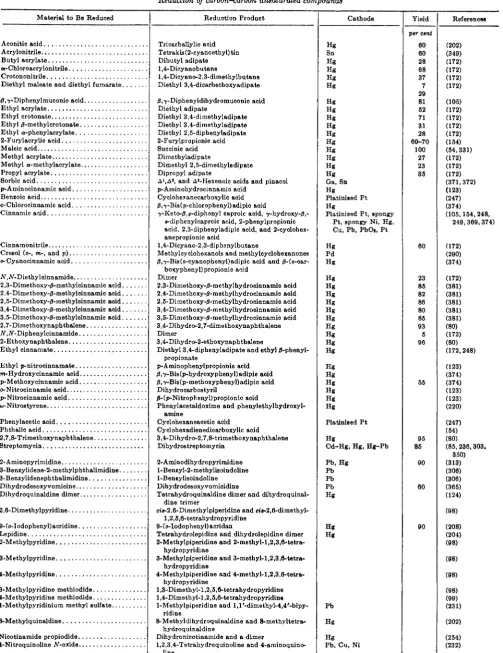
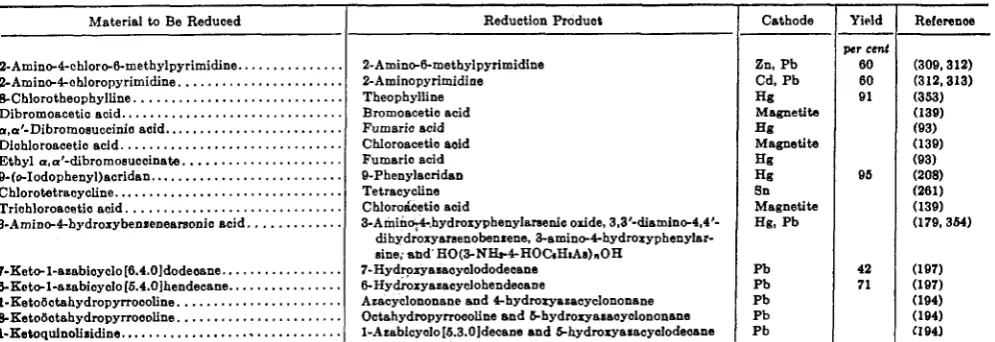
To conserve space and make the data more available to the reader, much of the informattion on reductions published since 1940 is presented in the form of tables. Compounds in which more than one functional group have been reduced are, with the exception of some of the more interesting and unusual cases, generally included in one table only. Yields are included where available and where only one product has been obtained. Gener- ally, the yields lie in about the same range as those obtained by other methods of reduction (when these other methods have been applied).
11. GENERAL PRINCIPLES
A . INTRODUCTION TO ELECTROORGANIC REDUCTION
1. Cathode reactions
The passage of electricity through two electrodes immersed in an electrolyte results in the deposition of a metal or the evolution of hydrogenfrom the cathode. Reducing conditions exist a t the cathode of sufficient power to enable the electrolytic hydrogen to add to unsaturated organic molecules or to remove oxygen from organic molecules. Unlike the reduction of most inorganic substances, the reduction of organic com- pounds is sometimes reversible (e.g., quinone-hydro- quinone, azobenzene-hydrazobenzene, nitrosobenzene- phenylhydroxylamine). Definitions of many of the terms used are included in earlier reports on electro- chemistry (323) and are not discussed here.
6. Theories of reduction at the cathode
Several theories have attempted to account for the reducing action of the cathode. The most reasonable theory, first proposed by Haber (130) and later sup- ported by Creighton (55), states that hydrogen atoms are released a t the cathode by the discharge of a proton with an electron. The atomic hydrogen thus formed reacts with the organic compound:
H + + e + Ho
R + 2H0 + RHz
or RO
+
2H0 -+ R+
H10The hydride ion has been considered to be the active reducing agent (109). Other workers (51, 368) believe electrolytic reduction to be a phenomenon of simul- taneous electrolytic and chemical reduction. Certainly,
the electrolytic reduction of an organic compound in a
basic solution a t a mercury cathode could conceivabiy be due to the chemical activity of the electrolytically formed amalgam. There may also be the phenomenon of simultaneous electrolytic and catalytic reduction; the activity of platinized platinum and nickelized nickel cathodes probably is due to the catalytic effect of the finely divided cathodic surface. Evidence has been presented (171, 198) that reduction may take place by direct transfer of electrons from the electrode to the substance heing reduced; this hypothesis presumes the addition of the highly mobile proton to a negative center. It has been observed (342) that an unstable, benzene-soluble, reducing substance is formed at platinum or lead cathodes. This unknown substance was shown not to be a gas, tritium, or ferrous ion; it was not, however, further identified. Some investigators (115, 186, 337) have stated that the cathode may enter into the electroorganic reduction; they have reported the formation of organometallic compounds, partic- ularly when carbonyl groups were reduced a t lead or mercury cathodes.
It appears that to a large extent the mechanism of electroreduction depends upon many factors. In the case of the electroreduction of diphosphopyridine nucleotide (167), it appears that the process involves proton transfers, rather than a direct transfer of hydro- gen atoms, since no dependence is found on the use of ~b variety of electrodes of different overvoltages.
Antropov (16) has presented a mathematical treat- ment which supports the theory that nonpolar groups of compounds such as phenol, acetylene, vinylacetyl- ene, crotonic acid, oleic acid, and sorbic acid are reduced on low-overvoltage cathodes by hydrogen atoms adsorbed on the electrode surface, while polar groups of acetone, acetaldehyde, l-acetyl-2-propanol, acetophenone, benzophenone, salicylaldehyde, and oxalic acid are reduced on cathodes of high overvoltage by hydrogen ions activated in the double layer. Many other papers have appeared which discuss the mech- anism of electroorganic reduction in specific systems (140, 218).
3. Disadvantages and advantages of electroorganic reduction
The two main disadvantages which have been of- fered for electroorganic reductions (116, 320) are that the reductions are usually of a low velocity and that the process requires careful control of many condi- tions.
ELECTROLYTIC
REDUCTION OF ORGANIC COMPOUNDS 21 complished (208) ;(4)
electroorganic reductions havebeen successful in the presence of compounds that usually poison catalytic reductions, and such substances
as mercury, halides, hydrogen sulfide, and arsenic sulfide have been demonstrated to be electrocatalytic
(163). Electroorganic reduction can also be developed into procedures suitable for large-scale preparative work (80).
B. FACTORS THAT INFLUENCE ELECTROORGANIC REDUCTION
1. T h e cathode potential
It has been stated (208) that the cathode potential is the factor that determines the success or failure of electroorganic reductions. This fact has long been recognized and conceded by responsible investiga- tors} but very few have described the cathode po- tential used during reduction. Rather, a host of less important factors have been enumerated and described. Haber (129, 130) first recognized the importance of controlled cathode potential for electroorganic reduc- tions. He showed that in an alkaline solution a t a platinum cathode nitrobenzene was reduced in good yield to pure azoxybenzene when the cathode potential was held a t 0.9 v.; a potential of -1.3 v. gave good yields of pure hydrazobenzene. This use of cathode potential has been found to lead to purer products in many cases. I n the electroreduction of 8-chlorotheo- phylline (353), to theophylline the cathode potential was varied until the potential which gave the purest product was found. At all other potentials mix- tures of products were obtained. Acetylene has been selectively reduced (32) to ethylene or ethane a t a
platinum cathode by controlling the cathode potential. Other workers also have stated (10, 12, 80, 207) that the cathode potential was of primary importance for controlled electroorganic reductions, and additional examples will be found later in this review. The electro- reduction of nitrobenzene a t an empirically established cathode potential of about - 1.5 v. has been studied at
a number of different cathodes (210). In all cases about 60 per cent yields of azoxybenzene and 40 per cent yields of aniline were obtained a t zinc, copper, platinum, tin, and nickel cathodes.
The above work has been reiterated and pushed even further by the determination} polarographically, of the optimum cathode potential for the reduction of
9-(o-iodophenyl)acridine to 9-(o-iodophenyl)dihydro-
acridine at a mercury cathode (208). Although all previous methods and attempts to carry out this re- duction had failed, because of an excessive reduction that removed the iodine atom, the use of the polaro- graphically determined, constant cathode potential gave the desired product quantitatively. Although other workers (165, 256) also have shown that the potential
found in polarographic work is confirmed by electro- reductions, it has been pointed out (80, 92) that polaro- graphic data alone do not rigidly demonstrate the efficacy of a preparative method; therefore polarographic data have not been included in this review (see refer- ence 360 for a review of such data).
2. The cathode overvoltage
Two definitions of overvoltage have been presented
(58): (1) the overvoltage of a gas upon a specific elec- trode is the polarization involved in the evolution of that gas on that cathode a t a specified current density;
( 2 ) the overvoltage of a gas on a specified electrode is the minimum polarization a t which visible evolution of gas occurs, or at which there is a marked increase in current density.
The higher the overvoltage value of any cathode, the greater is the reducing power of that cathode toward any organic depolarizer. Tafel (333, 335) was the first to recognize the relation between high overvoltage and a high reducing power. One of the early examples of this relationship was the inability of a smooth platinum cathode of low overvoltage to reduce cinnamic acid to hydrocinnamic acid; this reduction was accomplished, however, a t the high-overvoltage lead and mercury cathodes.
The concept of overvoltage is important, since in an electroorganic reduction when a depolarizer is present, the potential a t which hydrogen is evolved as a gas from the cathode marks that potential as the critical point above which the hydrogen is not absorbed by the depolarizer. Below this potential the atomic hydrogen reacts with the depolarizer as fast as it is formed.
Various theories of overvoltage have been discussed in great detail (118). The most acceptable view is that the metals of lower overvoltage function as catalysts for the reaction H +
+
e + Ha by decreasing the energy of activation for the process. Metals of high overvoltage have a large energy of activation, and hydrogen atoms formed a t a metal of high overvoltage have a much greater potential energy than those liberated a t metals of low hydrogen overvoltage.Considerable study of overvoltages of various metals has demonstrated that the absolute values obtained have little import; only the relative differences in hydrogen overvoltages are of significance. Many of the existing data on overvoltage have been summarized
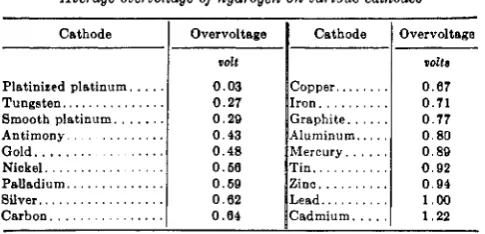
(58,183). The average overvoltage, obtained by averag- ing various literature values (49, 58, 183, 335), of hydrogen on various cathodes is presented in table 1.
It should be reemphasized that the absolute values given in this table are of no significance; only the ap- proximate order of arrangement of the cathodes should be considered.
22 FRANK D. POPP AND HARRY P. SCHULTZ
TABLE 1
Average overvoltage of hydrogen m various cathodes
Cathode
Platinized platinum, . . . . 0 . 0 3 Tungsten, . . . 0 . 2 7 Smooth platinum, . . . 0 . 2 9
Antimony. . . . 0 . 4 3 Gold. . . . 0 . 4 8 Nickel, . . . 0 . 6 0
Palladium. . . . 0.69
Silver, . . . 0 . 0 2
Carbon . . . 0 . 0 4
Copper.. . . .
I r o n . . . .
Graphite. . . . Aluminum.. . . . Mercury. . . . Tin. . . . Zinc. . . . Lead.. . . . Cadmium. . . . .
0 . 0 7 0 . 7 1 0 . 7 7 0 . 8 0 0.89 0 . 9 2 0 . 9 4 1.00 1 . 2 2
(1) an increase in current density decreased the over- voltage; (2) an increase in temperature decreased the overvoltage; (3) an increase in pressure decreased the overvoltage;
(4) the overvoltage increased with
time; (6) an alternating current superimposed on a direct current lowered the overvoltage; (6) the over- voltage (116) is less in an alkaline solution than in an acid solution.3. Cathode material and condition
The cathode material and its condition are rather intimately connected with the cathode potential and cathode overvoltage, but several observations on cathode materials properly belong by themselves, In addition to the more specific property of cathode over- voltage, the cathode material and condition have an effect upon electroorganic reductions.
The purity of the cathode is of prime importance.
It has been demonstrated (333, 334) that when lead is used as a cathode, its reducing power is nil when there is present as little as 3 mg. of copper, 0.5 mg. of silver, or 0.04 mg. of platinum per square decimeter of lead surface. The difference between 99.9 per cent lead and
99.99 per cent lead is often enough to cause failure in an electroorganic reduction (320). All leads, tabs, and connections of a metaI different from the cathode were shown to be deleterious to the cathode activity.
The physical state of the cathode may often play a leading role in an electroreduction. Generally a rough cathode has a lower overvoltage than a smooth one; but since it also has a greater surface area, the de- polarizer has more opportunity to react with atomic hydrogen on it. Cinnamic acid failed to undergo reduc- tion a t a smooth platinum cathode but reacted at a
platinized platinum cathode. It was found (203) that the rate of cathodic reduction of compounds such as aconitic acid and quinoline was increased by continuous renewal of the mercury surface, while the rate of re-
duction was decreased with naphthalene and anthra- cene. I n these experiments, the surface of the mercury was renewed by motion, and a t a high rate of motion reduction was stopped in many cases. It was concluded that if the mercury had a catalytic effect, renewal accelerated the reduction; if the reduction were due to
electrolytically produced amalgam, then renewal coun- teracted the reduction; and finally that if renewal had no effect, as is the case of sorbic acid, then the reduction was truly electrolytic and depended only on the cathode potential.
The history of a cathode is of importance. A case has been cited (320) in which commercial cadmium, pre- sumably of a microcrystalline character, was unfit for use as a cathode until melted and recast. Cathodes which have been used previously as anodes have been shown to have special activity as cathodes.
In addition to the above observations, it has been ascertained that certain cathodes appear to have a definite catalytic effect upon certain reactions which is unexplained in terms of cathode potential or over- voltage. Only platinized platinum, the cathode of lowest overvoltage, reduced aromatic nuclei (24, 25, 102). At a copper cathode, unlike other cathodes, nitro- benzene was reduced completely to aniline in both acid and alkaline solutions.
4 .
Current densityCurrent density is usually defined as the amperes of
current applied per square decimeter of cathode surface. Too much importance has been placed upon the in- fluence of current density in electroorganic reductions.
Its importance lies primarily in the fact that it is a means of controlling the cathode potential. Usually the current density is the major experimental point in the literature (it is sometimes even listed in papers which do not mention what the cathode material is), but it has been shown (10) that the current density is of little value in reproducing work unless everything else is reproduced exactly, and that quite often electro- organic reductions are somewhat independent of cur- rent density and applied voltage.
6. Solvent, p H , and concentration
Because of the water insolubility of most organic compounds, a solvent must be used that conducts an electric current and also dissolves organic compounds. Generally this end is attained by adding acetone, alcohol, or lower-molecular-weight organic acids to a water solution of the electrolyte. Organic solvents raise the resistance of an electrolyte and lower the overvoltage of the cathode (116). Another disadvantage is the possibility of reaction of the organic solvent either a t the cathode, with the depolarizer, or with the reduction product.
Use of concentrated water solutions of sodium and potassium aromatic sulfonates to increase the solu-
bility of the depolarizer has been found to be of ad-
[image:4.613.54.297.104.221.2]ELECTROLYTIC
REDUCTION
OF ORGANIC COMPOUNDS 23surface-active agents, as emulsifying aids, decrease current efficiencies during electroorganic reductions.
When the reducible group forms the negative part, of a dipole the lowering of the dielectric constant of the solvent, as in the addition of dioxane to water (108),
forces the reducible group away from the cathode and thus lowers the reduction efficiency. This has been found to be true with p-nitrophenol and nitrobenzene; however, with benzaldehyde and phthalimide the increase in solubility overbalances the change of dielectric constant and the reduction efficiency is increased (108). Other workers (358) have pointed out the importance of the polarity of the organic compound being reduced and emphasized that only the dipole moment of the group being reduced is important. A compound can be reduced if its dipole moment is greater than that of the solvent.
The hydrogen-ion concentration of the catholyte plays an important role in electroorganic reductions. The course of a reduction may be controlled by altering the pH, and the formation of intermediate condensation products may be accelerated with certain pH condi- tions. As examples of the first effect: (1) it has been shown (268) that the reduction of carbon dioxide to formic acid takes place only in a very strong acid; (2) aromatic carboxylic acids are reduced to benzyl alcohols in acid solution (224), whereas in alkaline medium a nuclear reduction occurs; and (3) reduction
of levulinic acid gave the hydroxy acid in acid solution and valeric acid in a basic solution (338).
The reduction of nitrobenzene in a basic solution leads to products with two aromatic rings (89, 90, 137, 21 l ) , presumably formed by a base-catalyzed conden- sation of such intermediates as nitrosobenzene and phenylhydroxylamine. The formation of bimolecular products from the reduction of carbonyl compounds in acid solutions may also be cited (91, 116, 117, 164, 184, 185) as examples of the effect of the pH of the reduction solution.
Generally it has been observed (116, 118) that the rate of reduction is higher in a high concentration of depolarizer than in a low one. High concentrations of depolarizer often give a more rapid reduction, but no increase in yields (84). The effects of the type of com- pound being reduced can be seen in Section 111 of this review ; compounds which contain unsaturated nitro- gen are generally the easiest to reduce, while aromatic benzenoid compounds are by far the most difficult to reduce.
6. Temperature
Temperature influences three factors (116): the cathode overvoltage, the rate of reduction, and the rate of diffusion of the depolarizer to the cathode. I n addition, certain side reactions can be influenced by the temperature. The cathode overvoltage loss in most
metals amounts to about 0.02-0.03 v. for every ten- degree rise in temperaturs. Despite this drawback, the rate of reduction in some instances is so low a t room temperature that heat is necessary to bring about reduction (267,336,339,359). The increase in reduction, or velocity of reduction, with heat probably is caused by an increase in the rate of diffusion of the depolarizer to the cathode (184). The heating of the cathode itself has been found to be of no value in at least one case
(228).
7. Catalysts
Catalysts for electroreduction can be divided into three types (116,119) : (1) salts of metals such as copper, tin, lead, and mercury which plate out on the cathode, thereby altering its nature and catalytic action; ( 2 )
salts of metals such as titanium and vanadium, which are reduced a t the cathode from a higher to a lower valence state and in this latter state reduce the organic material; (3) finely divided metals with a true catalytic surface, either suspended in the catholyte or fixed to the cathode surface. The influence of catalyst poisons has been studied (295), and it has been found that the addition of arsenic trioxide increased the yields of aniline, but decreased the yields of glyoxalic acid from oxalic acid in electroreduction. From this it was deduced that the reduction of nitrobenzene was based on atomic hydrogen, but that the latter reduction depended on the hydrogen overvoltage.
8. Agitation and miscellaneous factors
As has been mentioned, the rate of diffusion of a depolarizer to the cathode during reduction limits the velocity of reduction. If electrons are supplied to protons faster than the atomic hydrogen is used to saturate the depolarizer, a state of concentration polarization may be attained and gaseous hydrogen evolved. I t has been shown (184, 229) that the reaction velocity depends upon the diffusion of the depolarizer to the cathode. I n a stirred solution, however, one can reach a point where the velocity of reduction is in- dependent of the rate of diffusion (184).
I n a few cases (242, 251) electroorganic reductions have been carried out under a pressure of either hydro- gen or carbon dioxide. In many cases the yields are increased a t increased pressure, but the results have been variable.
The use of ultrasonics (181) in the reduction of nitrobenzene has been found to give a ten- to fifteen- fold increase in the limiting current.
C. METHODS A N D APPARATUS FOR ELECTROdRGANIC
REDUCTIONS
I . Use of diaphragms
24 FRANK D. POPP A N D HARRY P. SCHULTZ cell; otherwise the organic compound could diffuse
into the anolyte and be oxidized. I n most cases this end is accomplished by enclosing or separating the cathode section of the electrolytic cell from the anode section with a partition which conducts an electric current but prevents diffusion of the depolarizer to the anode. Partitions have been constructed of porous clay, alundum, wood, sintered glass, and paper. Because of the high resistance of partitions and their tendency to become impervious, as a result of the formation of tar, such diaphragms are but a poor solu- tion to the problem of anodic oxidation. Many attempts to solve this problem by rendering the anode passive to the depolarizer have met with failure. However, several investigations (95, 96, 265, 277, 298, 299) have been reported wherein an effective separation of the catho- lyte mas accomplished by using either two immiscible solutions, or solutions of considerably different specific gravity. I n these cases, of course, the cathode and anode are arranged one above the other. It has been reported
(230) that no diaphragm was needed for the reduction of fumaric acid, whereas reduction of maleic acid required a diaphragm.
2. Cathode materials
Cathodes may be prepared from metallic sheets, wire, gauze, rods, or wool. The materials from which cathodes have been made are platinized platinum, platinum, tungsten, antimony, gold, nickelized nickel, nickel, tantalum (386)
,
palladium, silver, carbon, tin, copper, iron, graphite, bismuth, aluminum, mercury, zinc, lead, lead dioxide, gallium (371), cadmium, thallium (385), and amalgams of several of these metals. Platinum, mercury, and lead appear to be the most widely used cathodes. I n many instances the pH of the catholyte governs the choice of the cathode.Although, as mentioned earlier, the purity of the cathode has been shown to be of prime importance, there have been several instances reported in which alloys, amalgams, and plated cathodes have proven of value. The use of the following cathodes has been reported : iron-nickel alloys (1 15), cadmium-bismuth alloys (263), Monel (215), bronze (215), and amalga- mated cadmium. Cathodes have been studied in which tin was plated on copper and lead; lead, copper, zinc, nickel, iron, and silver were plated onto porous graphite; and nickel, tin, and copper were plated onto nickel.
3. The catholyte
The catholyte may consist of either an aqueous or a nonaqueous medium. In the event. water is the catho- lyte, insoluble organic compounds are brought into so-
lution by adding such solubilizersas methanol, ethanol, formic acid, or acetic acid. Concentrated aqueous solu- tions of sodium or potassium benzene-, toluene-, or xylenesulfonates have been shown (215) to be excel-
lent hydrotropic agents. Some instances have been reported in which the insoluble organic compounds were emulsified in water by adding Igepon T, Nekol BX, sodium lauryl sulfate, cetylpyridinium bromide (260), or a cellulose ether (278).
In order to make aqueous solutions more conductive to an electric current, acids such as sulfuric acid, hydrochloric acid, hydrocyanic acid, and ammonium hydrogen sulfate have been utilized. A basic conducting medium has been attained by adding ammonium hydroxide, sodium hydroxide, or sodium carbonate to
water. Nearly neutral aqueous solutions have been prepared by adding ammonium chloride, ammonium sulfate, or sodium acetate to water.
Methanol, ethanol, formaldehyde, formic acid, acetic acid, ethyl acetate, hydrogen cyanide, liquid ammonia, and fuming sulfuric acid have served as nonaqueous. catholytes. Sodium and potassium acetates have been added to many of the above catholytes to increase t h e conductivity of the electrolyte.
4.
T h e anode and the anolyteThe anode should be a nonattackable electrode such as platinum, carbon, lead, nickel, or iron. Generally, the anolyte should be of the same material and concen- tration as the catholyte, for this reduces to a minimum complications that may arise because of diffusion through the diaphragm.
6. Source, measurement, and control of current a n d potential
Six-volt storage cells are the best source of power for electroorganic reduction. The consumption of current may be measured by an ammeter, and the potential drop across the cell by a voltmeter. A variable resist- ance must be included in the circuit in order to control the current density a t the cathode. Many varieties of power packs and converters are also now available.
The determination of the quantity of electricity (coulombs) passed through a cell may be accomplished by recording accurately the time intervals and the. amperes. An easier method is the utilization of silver, copper, or gas coulometers. The silver or copper cou- lometers are less desirable for routine work, for the gas coulometer visibly evolves gas in direct proportion to the current passed through the reduction cell, and may be referred to with ease as the reduction proceeds. I n some investigations the cathode of the reduction cell itself is enclosed so that any gas escaping from it may be measured. If the gas evolved by the coulometer and by the cathode is known, the absorption of hydrogen. by the depolarizer may be determined easily. Almost all references contain some description of the apparatus and many include wiring diagrams. The above appa- ratus has been described in an excellent manner (260).
ELECTROLYTIC REDUCTION OF ORGANIC COMPOUNDS
TABLE 2
Reduction of carbon-carbon unsaturated compounds ~~
Material to Be Reduced
Aconitic acid ... Acrylonitrile. ...
a-Chloroacrylonitrile ... Crotononitrile
...
6, y-Diphenylmuconic acid ..
Ethyl acrylate ... Ethyl crotonate
...
. . .Ethyl a-phenylacrylate
.
. . . 2-Furylacrylic acid . . .Maleic acid ... . . . Methyl acrylate ... Methyl u-methylacrylate
..
Propyl acrylate ...
Benzoic aeid ... o-Chlorocinnamic acid . . . . . . . Cinnamic acid ...
Cinnamonitrile ... . . . Cresol ( 0 - . m-. and p) ... o-Cyanocinnamic acid ...
N.N-Diethylcinnamide ... 2.3.Dimethoxy. 8-methylcinnamic acid. . . 2.4.Dimethoxy- p-methylcinnarnic acid . . . 2.5.Dimethoxy. @.methylcinnamic acid . . . 3.4-Dimethoxy. p-methylcinnamic acid . . . 3.SDimothoxy. 8-methylcinnamic acid. . . 2.7-Dimethoxynaphthalene . . . N. N-Diphenylcinnamide . . . 2.Ethoxynaphthalene ... Ethyl cinnamate
...
Ethyl pnitrocinnamate. ... m-Hydroxycinnamic acid
...
p-Methoxycinnamic acid. . . o-Nitrocinnamic acid ... pNitrocinnamic acid. .
. . .o- Nitrostyrene ... Phenylacetic acid
...
Phthalic acid ...2.7.&Trimethoxynaphthalene
...
Streptomycin.
...
2.Aminopyrimidine
. . .
3-Benzylidene-2-methylph3-Bencylidenephthalimidine . ... Dihydrodesoxyvomicine . . . Dihydroquinaldine dimer
...
2.6.Dimethylpyridine ...
94o.Iodophenyl)acridine
....
. . . . Lepidine ... 2-Methylpyridine...
3-Methylpyridine , ...
4-Methylpyridine
...
3-Methylpyridine methiodide .
4-Methylpyridine methiodide . . . 1-Methylpyridinium methyl sulfate . . .
SMethylquinaldine
...
Nicotinamide propiodide . . . 4-Nitroquinoline N-oxide.
...
Reduction Product
Tricarballylic acid Tetrakia (2-cyanoethyl) tin Dibutyl adipate 1. 4.Dicyanobutane
1.4.Dicyano-2. 3.dimethylbutane Diethyl 3. 4.dicarbethoxyadipate
@. y.Dipheny1dihydromuconic acid Diethyl adipate
Diethyl 3. 4.dirnethyladipate Diethyl 3. 4.dimethyladipate Diethyl 2. 5.diphenyladipate 2-Furylpropionic acid Succinic acid Dimcthyladipate
Dimethyl 2.5-dimethyladipate Dipropyl adipate
A1.A’. and As-Hexenoic acids and pinacol pAminohydrooinnamic acid
Cyclohexanecarboxylic acid @.y.Bis( g.chlorophenyl)adipic acid
y.Keto-b. ediphenyl caproic acid. y.hydr0xy.p.. e-diphenylcaproic acid. 2-phenylpropionic acid. 2. 3.diphenyladipic acid. and 2-cyclohex- anepropionic acid
1.4.Dioyano.2. 3.diphcnylbutane
Methylcyclohexanols and methylcyclohexanones @.y.Bis( o.cyanopheny1)adipic acid and p-(o-car-
Dimer
2.3.Dimethoxy. ~.methylhydrocinnamic acid 2.4.Dimethoxy. p.methylhydrocinnamic acid 2.5.Dimethoxy. p.methylhydrocinnamio acid 3.4.Dimethoxy. p.methylhydrocinnamic acid 3.5.Dimethoxy. @.methylhydrocinnamic acid 3.4.Dihydro-2. 7.dimethoxynaphthalene Dimer
3.4.Dihydro- 2.ethoxynaphthalene
Diethyl 3. 4.diphenyladipate and ethyl pphenyl-
pAminophenylpropionic acid
B. y.Bis(phydroxypheny1) adipic acid 8 . r-Bis(p-methoxyphenyl) adipic acid Dihydrooarboatyril
@-(pNitropheny1)propionic acid
Phenylacetaldoxime and phenylethylhydroxyl-
Cyclohexaneacetic acid Cyclohexadienedicarboxylic acid 3.4.Dihydro-2.7. &trimethoxynaphthalene Dihydrostreptomycin
2-Aminodihydropyrimidine
1-Benzyl-2-methylisoindoline
I-Beneylisoindoline
Dih ydrodesoxyvomicidine
Tetrahydroquinaldine dimer and dihydroquinal-
cia-2. 6.Dimethylpiper/dine and cis-Z.&dimethy I.
94o-Iodophenyl) acridan
Tetrahydrolepidine and dihydrolepidine dimer Z-Methylpiperidine and 2.methyl.1.2.3.6-tetr a-
3-Methylpiperidine and 3.methyl.l.2.3.etet.r a-
4-Methylpiperidine and 4.methyl.1.2.3.6.tetr a-
1.3.Dimcthyl.l.2.5. &tetrahydropyridine 1.4-Dimethyl.l.2.5. 6.tetrahydropyridine I-Methylpiperidine and l.l’.dimethyl.4.4’.bip y.
SMethyldihydroquinaldine and 8-methyltetra- Dihydronicotinamide and a dimer
1.2.3. 4.Tetrahydroquinoline and 4-aminoquino- boxypheny1)propionic acid
propionate
amine
dine trimer
1.2,5,6-tetrahydropyridine
hydropyridine
hydropyridine
hydropyridine
ridine
hydroquinaldine
line
Cathode
P b
H s
H s Pb. Cu. Ni
Yield
per cant 60 60 28 68 37 7 29 81 62 71 31 28 60-70 100 27 23 35
60
23 85 82 86 80 85 93 5 96
55
95 86
90
60
90
[image:7.613.72.576.105.759.2]26 FRANK D. POPP AND HARRY P. SCHULTZ
Material to Be Reduced
4-Nitropyridine N-oxide.
. . . .
. . .
,.
.
,.
.
.
. . .
Pyridine...
Pyrrole..
. . . .
.
.
.
.
. . . .
. .
. . .
.
..
.
. . .
Quinaldine,.
,. .
.
. . .
.
. .
.
. .
. . .
.. . . .
.
. Quinoline...
Strychnine.. . .
.
. . .
.
. . .
3-Veratrylidinephthalimidins .
. .
,.
,. . .
Vomicine methosulfate... .
..
.
..
.
.
..
.
. . .
. 3-(Isoamoxymethoxy)-3-methyl-l-butyne... .
3-(Butoxymethoxy)-3-methyl-l-butyne... .
,.
&Decy ne..
. .
,. . .
.
. . .
Dimethylacetylenecarbinol
. . .
.. .
.
.
..
.
I . .. .
Diphenylacetylene
.
.
. . .
. . ..
. .
.
. .
. . .
..
..
..
3-(Ethoxymethoxy)-3-methyl-l-butyne.. . . .
.
3-(Ethoxymethoxy)-3-methyl-l-pentyno. ,.
..
3-Ethyl-1-pentyn-3-01..
. . .. . .
.. . .
. 1-Heptyne.. . . .
.3-(Methoxymethoxy)d-methyl-l-butyne.
.
..
3-(iVethoxymethoxy)-3-methyl-l-pentyne.. .
Methylcyclopropylethynylcarbinol. . . .
.. . . .
Methylethylacet.ylenecarbino1..
. .
..
..
.
. .
. ..
hlethylisobutylethynylcarbinol..
. .
. . .
Methyl-p-tolylethynylcarhinol. . .
4-Octyne ... Phenylacetylene. . .
. .. . .
. ..
..
.. . .
.. .
. ..
Phenyl-ptolylethynylcarbinol. . .
..
. .. .
..
3-(2-Propoxymethoxy)-3-methyl-l-butyne,.
.3,4,4-Trimethyl-l-pentyn-3-01,
. . .
,. . .
,. .
. . .
TABLE 2-Con~lWled
Reduction Produot
4,4'-Amdipyridlne N. "-oxide Piperidine
Dihydroquinaldine and tetrahydroquinaldine Dihydroquinoline and tetraquinoline
Strychnidine, tetrahydrmtrychnine, and dihy drostrychnidine
1-Veratrylisoindoline Salt of methylvomicidine
3-(Amoxymethoxy)-3-rnethyl-l-butene 3 4 Butoxyrnethoxy)-3-methyl-l-butene cis-6Decene
2,7-Dimethyl-3,6octadiene-2,7-diol and dl-
cia-Stilbene
3-(Ethoxymethoxy)-3-methyl-l-butene
3-(Ethoxymethoxy)-3-methyl-l-pentene
3-Ethyl-1-pentcne-3-01 1-Heptene
3 4 Methoxyrnethoxy)-3-methyl-l-hutene 3-(Methoxymethoxy)-3-methyl-l-pentene
Methylcyclopropylvinylcarbinol 3,&Dimethyl-4.5deoadiene-3,~dlol 3-Hydroxy-3-isobutyl-1-butene Methyl-p-tolylvinylcarbinol cia-4-Octene
EthSlbenzcne and styrene
Phenyl-ptolylvinylcarbinol
3-(2-Propoxymethoxy)-3-methyl-l-butene 3,4,4-Trimethyl-l-pentene-3-01
rnethylvinylcarbinol
Csthode
c u Pb, Cd, Sn P b
Pb, Hg, Zn Hg
Na-Hg. Hg
P b P b Cu-Ag Cu-Ag Spongy Ni Ni, Pd
Spongy Ni Cu-Ag Cu-Ag Cu-Ag
Cu-Ag Cu-Ag c u Ni CU, Cu-Ag Cu-Ag Spongy Ni
Spongy Ni Spongy Ni Cu-Ag
Ag-Cu Cu-Ag
Yield
p d ~ cent
78
48 54 75
80
52 55 80 65 42 33 70
80
46 52
Referenaea
use of a probing electrode, potentiometer, and standard cell; a description of this apparatus has been presented
(208). Designs of several pieces of apparatus which can be used to maintain constant cathode potential have been described (3, 107, 207). An apparatus to maintain constant cathode potentials as high as -6 v.
has been described in both a micro and a macro form (10). A simple potentiostat, which requires no pre- liminary adjustment or calibration and which is sensitive to *0.01 v. up to 25 v., has been reported
(207).
6. Control of temperature
The temperature of a cell may be controlled by plac- ing the entire cell in an ice bath, on a steam cone, or in a constant-temperature bath. A glass coil in the catho- lyte may be used to circulate cold or hot water; oc- casionally the cathodes themselves are hollow tubes through which cold or hot water circulates.
7. Agitation
Stirring may be accomplished by the usual types of paddle stirrers, by rotating a cylindrical cathode, or by circulating the liquid by means of a small pump. I n some cases bubbling of air or other gas through the catholyte provides su6cient agitation.
111. ELECTRO~RGANIC REDUCTIONS A. REDUCTION O F CARBON-CARBON UNSATURATED
COMPOUNDS
1 . Ethylenic bonds
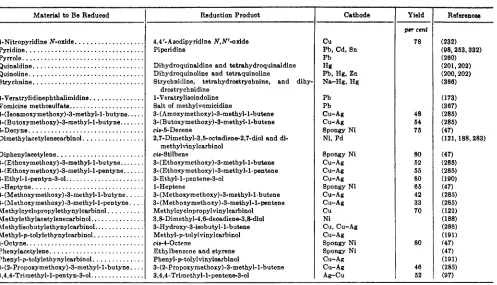
Carbon-carbon unsaturation, which is found in isolated ethylenic bonds, is very resistant to electro- organic reduction. The only successful attempts to reduce isolated ethylenic bonds have utilized cathodes with a spongy surface (for example see reference 258).
It is to be questioned whether these reductions are bona fide electrolytic reductions, or merely reduc- tions by molecular hydrogen a t a catalytic surface. Examples of the reduction of isolated ethylenic bonds as well as other carbon-carbon unsaturation are included in table 2.
[image:8.611.60.557.93.378.2]ELECTROLYTIC
REDUCTION
OF ORQANIC COMPOUNDS 27diphenylhydromuconic acid via 1,4-addition (105). The olefinic group in acids with a double bond be- tween a benzene ring and the carboxyl group, or be- tween two carboxyl groups, can be reduced using lead or mercury cathodes. I n acidic solutions at a mercury cathode certain acids undergo bimolecular reduction to adipic acids (172), but this is not general (374). The electrolytic rcduction of 3-nitrocinnamic acid to
P-
(Bnitropheny1)propionic acid (293) was very unusual, for the nitro group is generally more easily reduced a t the cathode than is the ethylenic group. Reduction of dimethylmaleic and dimethylfumaric acids a t a mer- cury cathode gave racemic acid and meso-a,a'-dimethyl- succinic acid, respectively. This is apparently the first clear case of trans addition a t an electrode (266).
2. Aromatic unsaturation
A number of carbon-to-carbon double bonds in nitrogen heterocyclic compounds, including some alkaloids, have been reduced. Generally, but not always, either high-overvoltage cathodes or especially activated cathodes were necessary to bring about these electroreductions. Aromatic rings containing a nitrogen atom were reduced with relative ease a t high-over- voltage cathodes, particularly lead. A comparison of the activity of heterocyclic and homocyclic rings may be noted in the reduction of quinoline to 1,4-dihydro- quinoline and 1,2,3,4-tetrahydroquinoline (200).
Platinized platinum cathodes were required for the complete reduction of the benzene nucleus. Claims that aromatic carboxylic acids were completely reduced in thP nucleus under basic conditions at lead or mercury cathodes (223) appear to be ill-founded (224). Several 2-alkoxynaphthalenes have been reduced to 3,4- dihydronaphthalenes by use of a tetrabutylammonium iodide catholyte a t a mercury cathode maintained at a
constant potential (80).
3. Acetylenes
Nickelized nickel, platinized platinum, and silver- plated copper cathodes served adequately for the re- duction of acetylenes to ethylenes or saturated hydro- carbons. Acetylene can be reduced to ethylene by controlling the cathode potential (32). I n a number of cases ethynes have been reduced to cis olefins (47) I
B . REDUCTION OF CARBON-NITROGEN
UNSATURATED COMPOUNDS
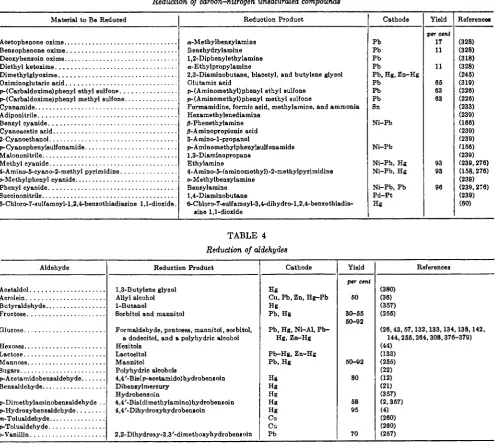
Carbon-nitrogen unsaturation has been reduced under electrolytic conditions in IL variety of compounds. Ketoximes and aldoximes have been reduced to amines in acid solution, generally a t a lead cathode. These, as well as other carbon-nitrogen unsaturated compounds, are presented in table 3.
The reduction of imino ethers to amines involves not only the saturation of a carbon-to-nitrogen double
bond, but also the hydrogenolysis of an ethoxy group
to
give ethanol (362).
Reduction of Schiff bases to secondary amines and related compounds has been carried out at high-over- voltage cathodes of lead or mercury in an acid solution, With some Schiff bases derived from ketones the use of a lead cathode and an alkaline solution has been reported (149). The reduction of a nitro compound in the presence of a carbonyl-cont,aining compound may also lead to a secondary amine, the Schiff base prob- ably being an intermediate.
Carbon-nitrogen unsaturation in heterocyclic com- pounds has also been reduced electrolytically, in many cases a t the same time as carbon-carbon unsatu- ration (some of these compounds are therefore listed in table 2).
A lead cathode is generally necessary for the reduc- tion of the carbon-to-nitrogen triple bond. Unlike the other carbon-nitrogen compoiinds, a neutral solution appeared to be the most favorable for the reduction of cyanides to amines. It has been shown (235) that yields of amines by electroreduction of cyanides fell off as the catholyte was made either acidic or basic. I n some cases, however, an acidic solution has been used successfully (239). A cyano group attached directly to a benzene ring gives good yields of a benzylamine upon electro- reduction, but benzyl cyanide is hardly reduced a t all to the corresponding amine (235) (however, see reference 166).
C. REDUCTION OF CARBONYL COMPOUNDS
1. Aldehydes
The electrochemical reduction of carbonyl com- pounds has been studied almost as extensively as has that of the nitro group. The reduction of saturated aliphatic aldehydes may take several routes. Mono- molecular reduction appeared to be favored by an acidic catholyte. Use of a mercury or lead cathode generally gave an alcohol, while a t a cadmium cathode, of highest overvoltage, reduction of an aldehyde to a hydrocarbon may bake place. An example of bimo- lecular reduction is the reduction of glyoxylic acid to tartaric acid at a lead or mercury cathode in alkaline, neutral, or acid solution (42). Conjugated unsaturated aldehydes were more easily reduced than the isolated carbonyl groups. The data on the electroreduction of aldehydes are included in table 4.
As with the aliphatic aldehydes, the electrolytic reduction of aromatic aldehydes may take several courses :
ArUHO I
1 1 1 1
ArCHlOH (ArCH0H)Z ArCH, ArCH=CHAr
28
Aldehyde
Acetaldol.
.
, ,.
.
.
.
,. . .
. . .
.
.
.
.
.
.
Acrolein.. . . .
.. . .
.. .
.
.. . . .
. Butyraldehyde...
Fructose.. . .
,. . .
.. . .
.FRANK D. POPP AND HARRY P. SCHULTZ
Reduction Product
l,a-Butylene glycol Allyl alcohol 1-Butanol
Sorbitol and mannitol
TABLE 3
Redwlion of carbon-nitrogen unsaturated compounds Reduction Product
I
Material to Be ReducedAcetophenone oxime.,
. . .
, , ,. . .
, ,. . .
.. . .
. . .
. . .
. .
Benzophenone oxime... . .
Deoxybenaoin oxime..
. . .
Diethyl ketoxime.. . .
,. . . .
Dimethylglyoxime.
,. . . .
. .
Oximinoglutaric acid. ,. .
.
p(Carba1doxime)phenyl ethyl sulfone.
. . . .
.p(Carba1doxime)phenyl methyl sulfone. .
. . .
. Cyanamide..
.
.
. . . .
.
.
.
. .
Adiponitrile
.
,.
. . .
. .
. .
. ..
. . .. .
. .
. ..
.Beneyl cyanide.
. .
,.
. . .
,. .
..
..
. .. . .
..
..
. . . . Cyanoacetic acid.2- Cyanoethanol , .
. . .
..
. ..
.. . .
. ..
. ..
.. . .
.
. .p-Cyanophenylsulfonamide
. . .
. .. . .
. .. . . .
. . ..
..
..
Malononitrile. .
. . .
.. . . .
. . .. .
..
..
. . ..
.. . . .
,. . .
Methyl cyanide ... 4-Arnino-5-cyano-2-methyl pyrimidine. , ,o-Methylphenyl cyanide..
.
.
.. . . .
.
. .
.. . .
..
.. . .
Phenyl cyanide. ,.
. . . .
.. . .
Succinonitrile.
. . .
.
. . . .
.. . .
..
[image:10.613.54.550.100.544.2]6-Chlor~7-sulfamoyl-1,2,4-benzothiadiasine 1,l-dioxide
.
. . . . . . .... . .
. . .
....,...
o-Methylben~ylamine Benahydrylamine 1,2-Diphenylethylamine a-Ethylpropylamine
2,3-Diaminobutane, biacetyl, and butylene glyool Glutamic acid
p(Aminomethy1)phenyl ethyl sulfone p(Aminomethy1)phenyl methyl eulfone
Formamidine, formic acid, methylamine. and ammonia Hexamethylenediamine
8-Phenethylamine 8-Aminopropionic acid 3-Amino-1-propanol
p-Aminomethylphenylaulf onamide 1,3-Diaminopropane
Ethylamine
4-Amino-bfaminomethyl)-2-methylpyrimidine o-Methylbensylamine
Ben z y I a mi n e 1,4-Diaminobutaae
13-Chloro-7-sulfamoyl-3,4-dihydr~-l.2,4-benzothiadia- sine 1,l-dioxide
TABLE 4
Reduction of aldehydes
Glucose. . .
. .
. , . ..
. . .
.. . .
.
. . .
Hexoses.. .
.
,. .
. . .
.
.
. . .
Lactos* ... Mannose.. . . .
.
.
.
. .
.
.
.
.
.
. . .
.
.
.
.
Srigara ... pAcetamidobencaldehyde..
..
.. .
Ben~aldehyde..
.
..
..
.. . .
.. . . .
p-Diniethylaminoben%aldehyde .
.
pHydroxybenzaldehyde
. . .
. m-Tolualdeh yde. . .
.
. .
..
.. .
pTolualdehyde , ..
..
.. .
. .. . .
o-Vanillin.
,.
..
. ..
. . .. . . .
. .. .
..
Formaldehyde, pentoses, mannitol, sorbitol,
Hexitols Lactoaitol Mannitol Polyhydric alcohole
4,4’-Bia(p-acetamido)hydrobenioin Dibensylmercury
Hydrobenzoin
4,4’-Bis(dimethylamino) hydrobenzoin 4,4’-Dihydroxyhydrobenroin
a dodecitol, and a polyhydric alcohol
conditions for the electroreduction of aromatic satu- rated aldehydes. An acidic catholyte and high-over- voltage cathodes appeared to be most desirable, although good yields also were reported from basic solutions. It has been stated (287) that copper, the cathode of lower overvoltage, favors bimolecular reduction.
1. Ketones
The electrolytic reduction of keto groups to methyl- ene groups in aliphatic compounds has been reviewed by Swann (324). This reduction generally takes place only in acid solution; an amalgamated zinc cathode appears to be the most active. Reduction of aliphatic ketones a t cathodes of high overvoltage, generally in alkaline solu- tion, tends to lead to pinacol formation, although this re- action is not general for all aliphatic ketones. A host of
Cathode
Hg
Cu, Pb, Zn, Hg-Pb Hg
Pb, Hg
Pb, Hg, Ni-AI, P b He, Z p H g
Pb-Hg, Zn-Hg Pb, Hg
H s Hg Hg Hg
cu
c u P b
Yield
pa7 can: 50
30-55 60-92
50-92
80
58 95
70
Cathode
Pb P b P b P b
Pb, Hg, Zn-Hg P b
P b P b Sn
Ni-Pb
Ni-Pb
Ni-Pb. Hg Ni-Pb. Hg
Ni-Pb, P b Pd-Pt Hg
-
Yield)(IT csnl
17
11
11
65 63 63
-
93 03
06
-
References
other products have been isolated from the electroreduc- tion of aliphatic ketones. Table 5 contains a summary of the electroreduction of various ketones. Generally the reduction of aldehydes can be accomplished a little more readily than the reduction of ketones.
Acetone has been reduced to isopropyl alcohol and pinacol in aqueous solution at a mercury cathode (141).
It is believed that the acetone is first adsorbed on the mercury, forming a covalent bond. This may then dissociate as a free radical to form pinacol, or may first add a proton and then dissociate from the mercury mrface as an ion, which adds a second proton to give the alcohol.
ELECTROLYTIC
REDUCTION OF ORGANICCOMPOUNDS
Ketone
Acetone
...
I-Acetyl-Z- propanol .
...
Carbon monoxide...
4.Dibutylsminc-2.butanone....
Dimethylaminoacetone....
4-Dimetbylamino-2-butanone...
Methyl ethyl ketone...
Methyl propyl ketone...
n-Propylketone...
Acetophenone...
p-Acetamido-a-dimetbylaminopropiophenone
hydrochloride
...
3.Acetylpyridine. .
...
&Acetyl pyridine. ... 2.Acetylpyridine...
p-Aminoacetophenone ... p-Aminopropiopbenone ... p-Carboxyacetophenone...
p-Dimethylaminoacetophenone
...
p-Dimetbylarninopropiophenone...
Hexanoylresorcinol...
pHydroxyacetopbenone...
4-Methoxyacetophenone and 4-aminoaceto- phenone...
4-Methoxyacetopbenone and 4-dimethylamino-acetophenone
...
p-Metboxypropiophenone...
1-Piperonylidene.2.beptanone...
Benzophenone...
a-Methyldeoxybenzoin...
Androsta.l.4-dien.17.j3-ol.3-one...
Androstenedione ... ALAndrostene-3 17-dione...
1-Azabicyclo [6.4.0ldodecan-7.one
...
I-Azabicyclo [6.4.0]hendecan-B-one....
Benzo[cl-7.oxc-l-~eobicyclo[4.4.O]decane ...Bezno(jl-7-oxo- l.azabicyclo[6.4.0]dodecane
....
Benzo[c~.7.oxo.l.azabicycio[4.3.0]nonane
...
Beneo ti]-6-oxo-1-azabicyclo [6.4.0 lundecane
....
4.Choleaten.3.one
...
3 4 2 - Diethylaminoet hyl)-4-oxo-4 H-octahydro-
quinolizine)
...
2.6Dimethylcyclobex~none
...
Estrone
...
Z.Ethyl.l.methyl.3.piperidone...
1-Butyl-3-pyrrolidone.,
...
l.Methyl.4.piperidone
...
Hexahydro-1 (2 H)pyrrocolinone...
Hexahydro-8(6H)pyrrocolinone
...
6Methyl-4-oxoheptanoic acid
...
Octahydro-l~.quinalicin.l.one...
7-0xo-5-cholesten-3p-yl acetate20-Ox.-S.le.pregnadien.3 a.yl acetate
...
A~Pregnene-3.20.dione...
Progesterone...
2,2,4.4-Tetraphenyl-3-oxetanone,...
TABLE 5
Reduction of ketones
Reduction Product
Propane. pinacol. and 2-propanol
2-Pentanol Formaldehyde
4-Dibutylamino-2-butanol Dimethylamine
4-Dimethylsmino-2-butanol
2.Butanol. butane. and 8 pinacol Pentane
No reduction
Methylphenylcarbinol. ethylbenzene. sym-dimethyl- diphenylglycol. and bida-methylbenayl ether)
3.4.Bis(pacetarnidopbenyl ).l .&bia(dirnetbyl a. mino).3. 4.hexanediol
2. 3.Bb (3.pyridyl).2. 3.butanediol 2. 3.Bh (4.pyridyl).2. 3.butanediol 2. 3.Bis (2.pyridyl).2. 3.butanediol p.p’.Diamino-a. a’.dimethylhydrobenzoin p.p’.Diamino-u.a ‘.dethylbydrobensoin 2.3.Bia(pcarboxyphenyl).Z. 3.butanediol 2.3.Bis(pdirnethylarninopbenyl)bntan.2. 3.diol Two isomers of u.a’.di( 2.dimethylarninoethyl) hy-
drobenzoin Hexylresorcinol
p.p’.Dihydroxy.u.o ’.dimethylhydrobenaoin
Mixed pinacol
Mixed pinacol
a.u’.Diethyl.4.4 ’.dimethoxyhydrobencoin
1.(3.4.Methylenedioxyphenyl). 3.octanone Benehydrol
Erythro-1.2.diphenyl. 1.propanol A pinacol
A pinacol (mixture) Testosterone
1-Azacyclododecan-7-01 I-Azacyclohendecan-6-01
Benso [~]-1-az~bicy~lo[6.3.0]decane, benso[cl-7-h~- droxy.l.~sabicyclo[4.~.~]decane. and bensolcl-7-
Benco [c]-1-828biCyClO [6.6.0]dodecane, hydroxyaaocyclodecane or benso [jl-
1-828biCyClO [6.4.0]dodecane and (maybe) bensc-
[e]-7-hydroxyaa~cyclododeoane
Benso[c]-~-828biOyC~O[4.3.0]~0~8ne, and benao [cl-7- hydroxy-1-aeabicyclononane or benao-7-hydroxy-
BemoIc]. l.ac8bicyclo [6.4.0]undecane and benso[cl-
Bi(3j3-hydroxy-Pcholestn-3a-yl) and bi(3.E-oholes
.
8Z8CyClOIlOnEIle7-hydroxyazacyclobendecane
tadien-3- yl)
3-(2-Diethylaminoethyl) octahydroquinolicine 2. 6.Dimethylcyclohexanol (tram)
(cis) (mixed) Estradiol
2.Ethyl.l.methyl.3.piperidinol. 1-methyl-2-propyl- pyrrolidine. l.methyl.2.ethyl.3.piperidinol. N-
methybeptylamine. and 1-methyl-2-propyl-AL pyrroline
butylamine-3.butanol. 1-butyi-3-hydroxypyrroli- dine. and 1-butylamino-3-butanol
Dihutylarnine. l.butyl.3.hydrorypyrrolidine. 1-
1-Methylpiperidine
A58CyClOnOn8n-4-0~ and aaacyclononane Acyclononan-6-01 and octahydropyrrocoline 5-Methylheptanoic acid
A pinacol
Mixture incl
.
bi(3B-bydroxyoxo-6-pregnen-16yI)ALPregnen-20-ol-3-one A pinacol
2.2.4.4.Tetrapbenyl. 3.oxetanoI and (possibly) Aa8cyclodeC8n-6-01 and l-8cabicyclo[5.3.0]decane
1.1.3.3.tetraphenyl. 2.propanol
Cathode
Pb. Hg. CU. Pb- cu Cd Pb Pb Cd Pb Zn Cd-Bi Orapbite Pb. Cu. Pt. Hg
.
graphite rig Hg As Hg Hg Be Hg Hg Hg HE. Zn-Hg Cu-Ni Graphite Hg Hg H g
Pb. Nl. Cu. C. P t P b P b P b P b P b P b Hg P b
Hg. P b c u
Ni
Pb. C
Cu. Cd. P b
Cd Cd P b Ph P b P b Hg Hg
Pb. Ni. Cu. C. P t Hg
HE
field. %
50 trace 69 26 e2 65 32 e8 98 68 63 57 96 82 and 11
[image:11.620.69.569.108.750.2]30 FRANK D. POPP AND HARRY P. SCHULTZ
Reduction of saturated aromatic ketones at a lead cathode in slightly basic solutions gave high yields of secondary alcohols. An acidic catholyte generally produced a mixture of the pinacol and the benzhydrol; if the catholyte was strongly acidic, rearrangement to the pinacolone sometimes occurred. o-Nitrobenzophe- none was reduced in alkaline solution a t a lead cathode
to o-hydroxylaminobenzohydrol, which loses water to form l12-dihydroanthranil (23.) To reduce aromatic ketones to hydrocarbons it is generally necessary to use amalgamated zinc cathodes. The reductive coupling of 4-methoxyacetophenone with 4-amino- and 4- dimethylaminoacetophenones to yield mixed pinacols is achieved by electrolysis a t a mercury cathode (14).
It is of interest to note that 2,3-bis(p-aminophenyl)- 2,3-butanediol can be obtained only by electrolytic reduction of the appropriate ketone in an aqueous hydrochloric acid medium at a mercury cathode (10, 11). The usual chemical methods gave only the carbinol. It is also of interest to note in regard to the reduction of p-aminoacetophenone that using an aqueous hydrochloric acid solution a t a mercury cath- ode with a reference potential of -1.1 v. gave the carbinol, while a reference potential of -1.5 v. (10, 11) or a tin cathode (196) gave the pinacol. A number of Mannich bases also have been reduced to pinacols (12). Depending upon the reference potential used, either a low-melting or a high-melting form of the pinacol was obtained from p-dimethylaminoaceto- phenone ( 5 ) .
An acid solution with a high-overvoltage cathode, such as lead or mercury, is best for the reduction of cyclic ketones. Alcohols, pinacols, pinacolones, and hydrocarbons have been isolated from the electro- reduction of cyclic ketones. Reduction of 2-methyl- cyclohexanone a t a mercury or lead cathode gave pure
trans-2-methylcyclohexanol, a t a nickel cathode a mixture was obtained, a t a copper cathode pure cis-2- methylcyclohexanol was obtained, and a t a platinum cathode no reduction took place (18). The reduction of
2-ethyl-l-methyl-3-piperidone has been reported to give products such as 1-methyl-2-propylpyrroline1
2-ethyl-3-hydroxy-l-methylpiperidine, N-methylheptyl- amine, and l-methyl-2-propyl-2-pyrroline (193) de- pending on the cathode and the temperature. Thus reductions, and rearrangements of the Clemmensen type, can be obtained by electrolysis.
Reduction of keto acids and keto esters may take several courses. Generally an acidic catholyte allowed complete reduction to hydrocarbons with hydrogenol- ysis of the ester group. A basic catholyte usually gives a less reduced product than an acidic catholyte.
Quinones are reduced easily a t the cathodes of lowest overvoltage in acid solution. For example, the following gave the corresponding hydroquinones : an- thraquinone (244)
,
3,6-bis( 1,4-dihydroxyphenyl)-l14-benzoquinone (127), naphthoquinone (243), and qui- none (1, 170).
3. Carboxylic a i d e , esters, and lactones
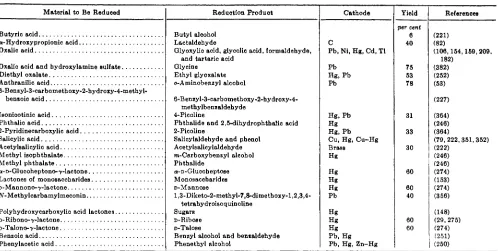
An acid solution at a lead or mercury cathode was preferred for the electroreduction of aliphatic carbox- ylic acids to aldehydes, alcohols, or hydrocarbons. With these cathodes, ethyl oxalate in ethanolic sul- furic acid has been reduced to ethyl glyoxylate ethyl hemiacetal (252). The products of the electroreduction of carboxylic acids, esters, and lactones are presented in table 6.
Aromatic carboxylic acids are reduced to alcohols in a sulfuric acid catholyte using a lead or mercury cathode.
It is possible to reduce certain aromatic acids to alde- hydes in alkaline solution in the presence of the borate ion a t a mercury cathode (227). Isonicotinic acid has been reduced to 4-picoline a t an amalgamated lead cathode (364).
Aromatic carboxylic acid esters have been reduced to the corresponding ethers or alcohols in an acid catho- lyte a t mercury or lead cathodes.
4. Amides, imides, and related compounds
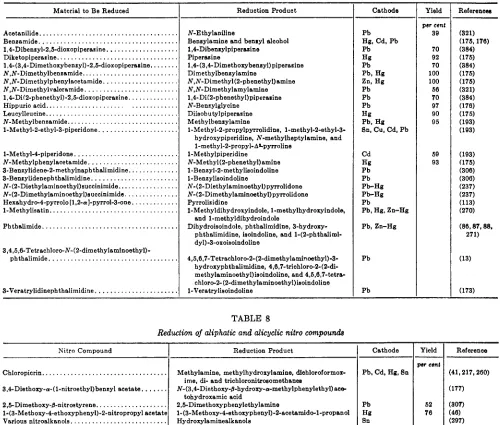
The reduction of amides to amines has been carried out in acidic catholytes (some aliphatic amides have been reduced in basic solutions) a t lead cathodes. The more substituted the amide nitrogen, the better the yield of amine; a phenyl group attached to the amide group increases the yield of substituted benzyl- amine. I n fact, any aryl group linked directly to the carbonyl function gave good results, indicating that the greater the electron-donating effect of substituents on the amide nitrogen and the a-carbon atom, the greater the ease of reduction. A few instances of hydro- genolysis of the nitrogen compound to give ammonia or a simple amine have been reported. These reductions of amides, as well as the reduction of imides and related compounds, are included in table7.
Attempts to reduce p-aminobenzanilide have been without success a t many cathodes (38).ELECTROLYTIC
REDUCTION
OF ORGANIC C O M P O U N D S 31TABLE 6
Reduction of carbozylic acids and derivdivee
Material to Be Reduoed
Butyrio acid ... o-Hydroxypropionic acid.. ... Oxalic acid
Oxalio acid and hydroxylamine sulfate Diethyl oxalate. . . Anthranilic acid., ... 6-Benzyl-3-carbomethoxy-2-hydroxy-4-methyl- benGoioacid ...
Phthalic acid, ...
Salicylic acid. . . Acetylsalicylic acid.
Methyl isophthalate Methyl phthalate..
o-o-Glucoheptono- y-lactone ...
D-Mannono-ylactone. ... N-Methylcarbamylmeconin
. . . , . . , . , . , .
. . .
Phenylacetic acid. . .
Reduotion Produot
Butyl alcohol Lactaldehyde
Glyoxylio acid, glycolio acid, formaldehyde,
Glycine Ethyl glyoxalate o-Aminobenzyl alcohol
6-Benzyl-3-carbomethoxy-2-hydroxy-4-
4-Picoline
Phthalide and 2,5dihydrophthalio acid 2-Picoline
Salicylaldehyde and phenol Acetylsalicylaldehyde m-Carboxybenzyl alcohol Phtbalide
a-D-Glucoheptose Monosaccharides D-Mannose
1,3-Diketo-2-methyl-7,8-dimethoxy-l,2,3,4-
Sugars o-Ribose D-Talose
Benzyl aloohol and bensaldehyde Phenethyl alcohol
and tartaric acid
methylbensaldehyde
tetrahydroisoquinoline
Csthode
C
Pb, Ni, Hg, Cd, TI P b
Hg, P b P b
D. HYDROGENOLYSIS OF ALCOHOLS
Aside from the possible reduction of carbonyl groups to methylene groups that may conceivably proceed through the alcohol, there are very few examples known of the hydrogenolysis of an alcohol to the methylene compound. A few of these have been in- cluded in other tables. I n the case of leucopterin the hydrogenolysis of all the hydroxyl groups does not take place, and the product is 2-amino-7-hydroxy- pteridine (366). The hydrogenolysis of hydroxy- sparteine to sparteine (112) may also be cited in this section.
E. R E D U C T I O N O F NITROGEN-OXYGEN
UNSATURATED COMPOUNDS
1. Hydroxylamirws
A nickel cathode and a basic catholyte were pre- ferred for the reduction of aromatic hydroxylamines to
azoxy compounds or to amines. Liquid ammonia has been used as a solvent in the reduction of phenyl- hydroxylamine to benzenediazoic acid (289).
2. Nitroso compound
The reduction of a nitrogen-nitroso compound to the corresponding hydrazine was best carried out in an acidic catholyte a t cathodes of copper, lead, mercury, and cadmium, while a nickel or platinum cathode and a basic catholyte were preferred for the reduction of a carbon-nitroso compound to the corresponding amine. For example, 1,l-dimethylhydrazine was obtained in 90 per cent yield by the electroreduction of N-nitroso-
Yield
9er cent 6
40
79 63 78
31
33
30
60
80 40
60 60
--
References
dimethylamine in aqueous sulfuric acid a t a lead cathode (152) and 2,4,5-triamino-6-hydroxypyrimidine
was obtained in 80-85 per cent yield by the reduction of 2,4-diamino-6-hydroxy-5-nitrosopyrimidine in dilute alkali (383), or by the reduction of the 5-isonitroso compound in aqueous hydrochloric acid or 1 per cent sodium hydroxide (28).
3. Azoxy compounds
The reduction of aaoxy compounds to azo, hydrazo, or amino compounds took place quit,e readily in an acid solution. I n this manner, azoxybenzene gave azo- benzene, hydrazobenzene, benzidine, and aniline (30).
4.
Aliphatic nitro compoundsThe reduction of aliphatic nitro compounds was carried out in an acidic catholyte a t a wide variety of
cathodes. Generally, the cathodes of lower over- voltage such as copper, tin, or nickel, permitted partial reduction of the hydroxylamine (which can be reduced further under certain conditions as mentioned above), whereas the cathodes of higher overvoltage, such as mercury and lead, favored the complete reduction of the nitro group to the amino group. Table 8 includes the various aliphatic and alicyclic nit,ro compounds that have been reduced electrolytically since 1940.
A number of 2-aminoethyl compounds have been prepared by the reduction of alp-unsaturated nitro compounds at a lead cathode in hydrochloric acid.
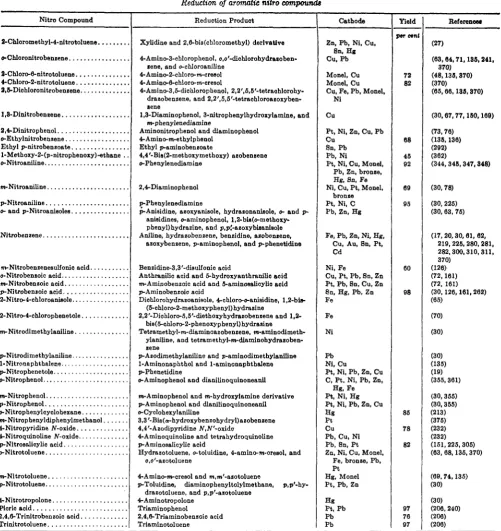
6. Aromatic nitro compounds
[image:13.615.64.562.110.361.2]