Towards End-to-End Learning for Dialog State Tracking and
Management using Deep Reinforcement Learning
Tiancheng Zhao and Maxine Eskenazi Language Technologies Institute
Carnegie Mellon University {tianchez, max+}@cs.cmu.edu
Abstract
This paper presents an end-to-end frame-work for task-oriented dialog systems using a variant of Deep Recurrent Q-Networks (DRQN). The model is able to interface with a relational database and jointly learn policies for both lan-guage understanding and dialog strategy. Moreover, we propose a hybrid algorithm that combines the strength of reinforce-ment learning and supervised learning to achieve faster learning speed. We evalu-ated the proposed model on a 20 Question Game conversational game simulator. Re-sults show that the proposed method out-performs the modular-based baseline and learns a distributed representation of the latent dialog state.
1 Introduction
Task-oriented dialog systems have been an im-portant branch of spoken dialog system (SDS) research (Raux et al., 2005; Young, 2006; Bo-hus and Rudnicky, 2003). The SDS agent has to achieve some predefined targets (e.g. book-ing a flight) through natural language interac-tion with the users. The typical structure of a task-oriented dialog system is outlined in Fig-ure 1 (Young, 2006). This pipeline consists of several independently-developed modules: natural language understanding (the NLU) maps the user utterances to some semantic representation. This information is further processed by the dialog state tracker (DST), which accumulates the input of the turn along with the dialog history. The DST out-puts the current dialog state and the dialog policy selects the next system action based on the dia-log state. Then natural language generation (NLG) maps the selected action to its surface form which
is sent to the TTS (Text-to-Speech). This process repeats until the agent’s goal is satisfied.
Figure 1: Conventional pipeline of an SDS. The proposed model replaces the modules in the dotted-line box with one end-to-end model.
The conventional SDS pipeline has limitations. The first issue is the credit assignment problem. Developers usually only get feedback from the end users, who inform them about system performance quality. Determining the source of the error re-quires tedious error analysis in each module be-cause errors from upstream modules can propa-gate to the rest of the pipeline. The second lim-itation is process interdependence, which makes online adaptation challenging. For example, when one module (e.g. NLU) is retrained with new data, all the others (e.g DM) that depend on it become sub-optimal due to the fact that they were trained on the output distributions of the older version of the module. Although the ideal solution is to re-train the entire pipeline to ensure global optimal-ity, this requires significant human effort.
Due to these limitations, the goal of this study is to develop an end-to-end framework for task-oriented SDS that replaces 3 important modules: the NLU, the DST and the dialog policy with a sin-gle module that can be jointly optimized. Devel-oping such a model for task-oriented dialog
[image:1.595.310.524.259.391.2]tems faces several challenges. The foremost chal-lenge is that a task-oriented system must learn a strategic dialog policy that can achieve the goal of a given task which is beyond the ability of standard supervised learning (Li et al., 2014). The second challenge is that often a task-oriented agent needs to interface with structured external databases, which have symbolic query formats (e.g. SQL query). In order to find answers to the users’ re-quests from the databases, the agent must formu-late a valid database query. This is difficult for conventional neural network models which do not provide intermediate symbolic representations.
This paper describes a deep reinforcement learning based end-to-end framework for both dia-log state tracking and diadia-log policy that addresses the above-mentioned issues. We evaluated the pro-posed approach on a conversational game sim-ulator that requires both language understanding and strategic planning. Our studies yield promis-ing results 1) in jointly learnpromis-ing policies for state tracking and dialog strategies that are superior to a modular-based baseline, 2) in efficiently incor-porating various types of labelled data and 3) in learning dialog state representations.
Section 2 of the paper discusses related work; Section 3 reviews the basics of deep reinforce-ment learning; Section 4 describes the proposed framework; Section 5 gives experimental results and model analysis; and Section 6 concludes.
2 Related Work
Dialog State Tracking:The process of constantly representing the state of the dialog is called di-alog state tracking (DST). Most industrial sys-tems use rule-based heuristics to update the di-alog state by selecting a high-confidence output from the NLU (Williams et al., 2013). Numerous advanced statistical methods have been proposed to exploit the correlation between turns to make the system more robust given the uncertainty of the automatic speech recognition (ASR) and the NLU (Bohus and Rudnicky, 2006; Thomson and Young, 2010). The Dialog State Tracking Chal-lenge (DSTC) (Williams et al., 2013) formalizes the problem as a supervised sequential labelling task where the state tracker estimates the true slot values based on a sequence of NLU outputs. In practice the output of the state tracker is used by a different dialog policy, so that the distribution in the training data and in the live data are
mis-matched (Williams et al., 2013). Therefore one of the basic assumptions of DSTC is that the state tracker’s performance will translate to better dia-log policy performance. Lee (2014) showed posi-tive results following this assumption by showing a positive correlation between end-to-end dialog performance and state tracking performance.
Reinforcement Learning (RL): RL has been a popular approach for learning the optimal dia-log policy of a task-oriented diadia-log system (Singh et al., 2002; Williams and Young, 2007; Georgila and Traum, 2011; Lee and Eskenazi, 2012). A dialog policy is formulated as a Partially Observ-able Markov Decision Process (POMDP) which models the uncertainty existing in both the users’ goals and the outputs of the ASR and the NLU. Williams (2007) showed that POMDP-based sys-tems perform significantly better than rule-based systems especially when the ASR word error rate (WER) is high. Other work has explored methods that improve the amount of training data needed for a POMDP-based dialog manager. Gaˇsi´c (2010) utilized Gaussian Process RL algo-rithms and greatly reduced the data needed for training. Existing applications of RL to dialog management assume a given dialog state represen-tation. Instead, our approach learns its own dia-log state representation from the raw diadia-logs along with a dialog policy in an end-to-end fashion.
End-to-End SDSs: There have been many at-tempts to develop end-to-end chat-oriented dialog systems that can directly map from the history of a conversation to the next system response (Vinyals and Le, 2015; Serban et al., 2015; Shang et al., 2015). These methods train sequence-to-sequence models (Sutskever et al., 2014) on large human-human conversation corpora. The resulting mod-els are able to do basic chatting with users. The work in this paper differs from them by focusing on building a task-oriented system that can inter-face with structured databases and provide real in-formation to users.
RL and jointly optimizing state tracking beyond standard supervised learning.
3 Deep Reinforcement Learning
Before describing the proposed algorithms, we briefly review deep reinforcement learning (RL). RL models are based on the Markov Decision Pro-cess (MDP). An MDP is a tuple (S, A, P, γ, R), whereSis a set of states;Ais a set of actions;P defines the transition probabilityP(s0|s, a);R
de-fines the expected immediate rewardR(s, a); and γ ∈ [0,1)is the discounting factor. The goal of reinforcement learning is to find the optimal pol-icyπ∗, such that the expected cumulative return is
maximized (Sutton and Barto, 1998). MDPs as-sume full observability of the internal states of the world, which is rarely true for real-world appli-cations. The Partially Observable Markov Deci-sion Process (POMDP) takes the uncertainty in the state variable into account. A POMDP is defined by a tuple(S, A, P, γ, R, O, Z). Ois a set of ob-servations andZ defines an observation probabil-ityP(o|s, a). The other variables are the same as the ones in MDPs. Solving a POMDP usually re-quires computing the belief stateb(s), which is the probability distribution of all possible states, such thatPsb(s) = 1. It has been shown that the belief state is sufficient for optimal control (Monahan, 1982), so that the objective is to findπ∗ :b → a
that maximizes the expected future return. 3.1 Deep Q-Network
The deep Q-Network (DQN) introduced by Mnih (2015) uses a deep neural network (DNN) to parametrize the Q-value function Q(s, a;θ)
and achieves human-level performance in playing many Atari games. DQN keeps two separate mod-els: a target networkθ−i and a behavior network θi. For every K new samples, DQN uses θi− to
compute the target valuesyDQN and updates the
parameters inθi. Only after everyCupdates, the
new weights ofθiare copied over toθ−i .
Further-more, DQN utilizesexperience replayto store all previous experience tuples (s, a, r, s0). Before a
new model update, the algorithm samples a mini-batch of experiences of sizeM from the memory and computes the gradient of the following loss function:
L(θi) =E(s,a,r,s0)[(yDQN −Q(s, a;θi))2] (1)
yDQN =r+γmax a0 Q(s
0, a0;θ−
i ) (2)
Recently, Hasselt et al. (2015) leveraged the over-estimation problem of standard Q-Learning by in-troducing double DQN and Schaul et al. (2015) improves the convergence speed of DQN via pri-oritized experience replay. We found both modifi-cations useful and included them in our studies.
3.2 Deep Recurrent Q-Network
An extension to DQN is a Deep Recurrent Q-Network (DRQN) which introduces a Long Short-Term Memory (LSTM) layer (Hochreiter and Schmidhuber, 1997) on top of the convolutional layer of the original DQN model (Hausknecht and Stone, 2015) which allows DRQN to solve POMDPs. The recurrent neural network can thus be viewed as an approximation of the belief state that can aggregate information from a sequence of observations. Hausknecht (2015) shows that DRQN performs significantly better than DQN when an agent only observes partial states. A similar model was proposed by Narasimhan and Kulkarni (2015) and learns to play Multi-User Dungeon (MUD) games (Curtis, 1992) with game states hidden in natural language paragraphs.
4 Proposed Model
4.1 Overview
Figure 2: An overview of the proposed end-to-end task-oriented dialog management framework.
success labels with state tracking labels.
[image:4.595.74.284.62.162.2]4.2 Learning from the Users and Databases Figure 2 shows an overview of the framework. We consider a task-oriented dialog task, in which there are S slots, each with cardinality Ci, i ∈ [0, S).
The environment consists of a user, Eu and a
databaseEdb. The agent can send verbal actions,
av ∈ Av to the user and the user will reply with
natural language responsesou and rewardsru. In
order to interface with the database environment Edb, the agent can apply special actionsah ∈Ah
that can modify a query hypothesis h. The hy-pothesis is a slot-filling form that represents the most likely slot values given the observed evi-dence. Given this hypothesis,h, the database can perform a normal query and give the results as ob-servations,odband rewardsrdb.
At each turnt, the agent applies its selected ac-tionat ∈ {Av, Ah}and receives the observations
from either the user or the database. We can then define the observationotof turntas,
ot=
oaut
t
odb t
(3)
We then use the LSTM network as the dialog state tracker that is capable of aggregating information over turns and generating a dialog state represen-tation, bt = LST M(ot, bt−1), where btis an
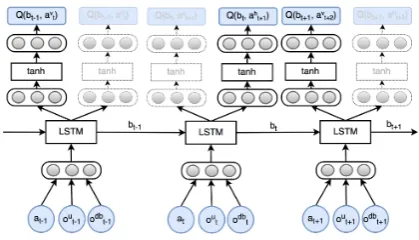
ap-proximation of the belief state at turnt. Finally, the dialog state representation from the LSTM net-work is the input toS+ 1policy networks imple-mented as Multilayer Perceptrons (MLP). The first policy network approximates the Q-value function for all verbal actionsQ(bt, av)while the rest
esti-mate the Q-value function for each slot,Q(bt, ah),
as shown in Figure 3.
Figure 3: The network takes the observationotat
turnt. The recurrent unit updates its hidden state based on both the history and the current turn em-bedding. Then the model outputs the Q-values for all actions. The policy network in grey is masked by the action mask
4.3 Incorporating State Tracking Labels The pure RL approach described in the previous section could suffer from slow convergence when the cardinality of slots is large. This is due to the nature of reinforcement learning: that it has to try different actions (possible values of a slot) in order to estimate the expected long-term payoff. On the other hand, a supervised classifier can learn much more efficiently. A typical multi-class classifica-tion loss funcclassifica-tion (e.g. categorical cross entropy) assumes that there is a single correct label such that it encourages the probability of the correct la-bel and suppresses the probabilities of the all the wrong ones. Modeling dialog state tracking as a Q-value function has advantages over a local clas-sifier. For instance, take the situation where a user wants to send an email and the state tracker needs to estimate the user’s goal from among three pos-sible values: send, edit anddelete. In a classifi-cation task, all the incorrect labels (edit, delete) are treated as equally undesirable. However, the cost of mistakenly recognizing the user goal as
delete is much larger than edit, which can only be learned from the future rewards. In order to train the slot-filling policy with both short-term and long-term supervision signals, we decompose the reward function forAhinto two parts:
Qπ(b, ah) = ¯R(b, a) +γX
b0
P(b0|b, ah)Vπ(b0)
(4)
¯
R(b, a, b0) =R(b, ah) +P(ah|b) (5)
whereP(ah|b) is the conditional probability that
cur-rent belief state. In practice, instead of training a separate model estimatingP(ah|b), we can
re-place P(ah|b) by 1(y = ah) as the sample
re-wardr, wherey is the label. Furthermore, a key observation is that although it is expensive to col-lect data from the userEu, one can easily sample
trajectories of interaction with the database since P(b0|b, ah)is known. Therefore, we can
acceler-ate learning by generating synthetic experiences, i.e. tuple (b, ah, r, b0)∀ah ∈ Ah and add them
to the experience replay buffer. This approach is closely related to the Dyna Q-Learning proposed in (Sutton, 1990). The difference is that Dyna Q-learning uses the estimated environment dynamics to generating experiences, while our method only uses the known transition function (i.e. the dy-namics of the database) to generate synthetic sam-ples.
4.4 Implementation Details
We can optimize the network architecture in sev-eral ways to improve its efficiency:
Shared State Tracking Policies: it is more ef-ficient to tie the weights of the policy networks for similar slots and use the index of slot as an in-put. This can reduce the number of parameters that needs to be learned and encourage shared struc-tures. The studies in Section 5 illustrate one ex-ample.
Constrained Action Mask: We can constrain the available actions at each turn to force the agent to alternate between verbal response and slot-filling. We define Amask as a function that
takes statesand outputs a set of available actions for:
Amask(s) =Ah new inputs from the user (6)
=Av otherwise (7)
Reward Shaping based on the Database: the reward signals from the users are usually sparse (at the end of a dialog), the database, however, can provide frequent rewards to the agent. Reward shaping is a technique used to speed up learning. Ng et al. (1999) showed that potential-based re-ward shaping does not alter the optimal solution; it only impacts the learning speed. The pseudo re-ward functionF(s, a, s0)is defined as:
¯
R(s, a, s0) =R(s, a, s0) +F(s, a, s0) (8) F(s, a, s0) =γφ(s0)−φ(s) (9)
Let the total number of entities in the database beDandPmaxbe the max potential, the potential
φ(s)is:
φ(st) =Pmax(1−Ddt) ifdt>0 (10)
φ(st) = 0 ifdt= 0 (11)
The intuition of this potential function is to encourage the agent to narrow down the possi-ble range of valid entities as quickly as possipossi-ble. Meanwhile, if no entities are consistent with the current hypothesis, this implies that there are mis-takes in previous slot filling, which gives a poten-tial of 0.
5 Experiments
5.1 20Q Game as Task-oriented Dialog In order to test the proposed framework, we chose the 20 Question Game (20Q). The game rules are as follows: at the beginning of each game, the user thinks of a famous person. Then the agent asks the user a series of Yes/No questions. The user honestly answers, using one of three answers: yes, no or I don’t know. In order to have this resemble a dialog, our user can answer with any natural utterance representing one of the three in-tents. The agent can make guesses at any turn, but a wrong guess results in a negative reward. The goal is to guess the correct person within a max-imum number of turns with the least number of wrong guesses. An example game conversation is as follows:
Sys: Is this person male?
User: Yes I think so.
Sys: Is this person an artist?
User: He is not an artist. ...
Sys: I guess this person is Bill Gates.
User: Correct.
5.2 Simulator Construction
We constructed a simulator for 20Q. The simulator has two parts: a database of 100 famous people and a user simulator.
We selected 100 people from Freebase (Bol-lacker et al., 2008), each of them has 6 attributes:
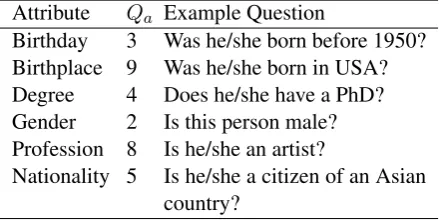
birthplace, degree, gender, profession and birth-day. We manually designed several Yes/No ques-tions for each attribute that is available to the agent. Each question covers a different set of pos-sible values for a given attribute and thus carries a different discriminative power to pinpoint the person that the user is thinking of. As a result, the agent needs to judiciously select the question, given the context of the game, in order to narrow down the range of valid people. There are 31 ques-tions. Table 1 shows a summary.
Attribute Qa Example Question
Birthday 3 Was he/she born before 1950? Birthplace 9 Was he/she born in USA? Degree 4 Does he/she have a PhD? Gender 2 Is this person male? Profession 8 Is he/she an artist?
Nationality 5 Is he/she a citizen of an Asian country?
Table 1: Summary of the available questions. Qa
is the number of questions for attributea.
At the beginning of each game, the simula-tor will first uniformly sample a person from the database as the person it is thinking of. Also there is a 5% chance that the simulator will consider
unknown as an attribute and thus it will answer with unknown intent for any question related to it. After the game begins, when the agent asks a question, the simulator first determines the an-swer (yes, no or unknown) and replies using natu-ral language. In order to generate realistic natunatu-ral language with theyes/no/unknownintent, we col-lected utterances from the Switchboard Dialog Act (SWDA) Corpus (Jurafsky et al., 1997). Table 2 presents the mapping from the SWDA dialog acts toyes/no/unknown. We further post-processed re-sults and removed irrelevant utterances, which led to 508, 445 and 251 unique utterances with intent respectively yes/no/unknown. We keep the fre-quency counts for each unique expression. Thus at run time, the simulator can sample a response according to the original distribution in the SWDA
Corpus.
Intent SWDA tags
Yes Agree, Yes answers, Affirma-tive non-yes answers
No No answers, Reject, Negative non-no answers
Unknown Maybe, Other Answer
Table 2: Dialog act mapping from SWDA to
yes/no/unknown
A game is terminated when one of the four con-ditions is fulfilled: 1) the agent guesses the cor-rect answer, 2) there are no people in the database consistent with the current hypothesis, 3) the max game length (100 steps) is reached and 4) the max number of guesses is reached (10 guesses). Only if the agent guesses the correct answer (condition 1) treated as a game victory. The win and loss re-wards are30and−30and a wrong guess leads to a−5penalty.
5.3 Training Details
The user environmentEuis the simulator that only
accepts verbal actions, either a Yes/No question or a guess, and replies with a natural language utter-ance. Therefore Av contains |Q|+ 1actions, in
which the first |Q|actions are questions and the last action makes a guess, given the results from the database.
The database environment reads in a query hy-pothesish and returns a list of people that satisfy the constraints in the query. h has a size of |Q|
and each dimension can be one of the three values:
yes/no/unknown. Since the cardinality for all slots is the same, we only need 1 slot-filling policy net-work with 3 Q-value outputs foryes/no/unknown, to modify the value of the latest asked question, which is the shared policy approach mentioned in Section 4. ThusAh ={yes, no, unknown}. For
example, consideringQ= 3and the hypothesish is: [unknown, unknown, unknown]. If the lat-est asked qulat-estion isQ1 (1-based), then applying actionah=yeswill result in the new hypothesis: [yes, unknown, unknown].
To represent the observation ot in vectorial
[image:6.595.72.292.312.422.2]The hyper-parameters of the neural network model are as follows: the size of turn embedding is 30; the size of LSTMs is 256; each policy network has a hidden layer of 128 with tanh activation. We also add a dropout rate of 0.3 for both LSTMs andtanhlayer outputs. The network has a total of 470,005 parameters. The network was trained throughRMSP rop(Tieleman and Hinton, 2012). For hyper-parameters of DRQN, the behavior net-work was updated every 4 steps and the interval between each target network updateCis 1000. -greedy exploration is used for training, whereis linearly decreased from 1 to 0.1. The reward shap-ing constantPmaxis 2 and the discounting factor
γ is 0.99. The resulting network was evaluated every 5000 steps and the model was trained up to 120,000 steps. Each evaluation records the agent’s performance with a greedy policy for 200 indepen-dent episodes.
5.4 Dialog Policy Analysis
We compare the performance of three models: a strong modular baseline, RL and Hybrid-RL. The baseline has an independently trained state tracker and dialog policy. The state tracker is also an LSTM-based classifier that inputs a dialog history and predicts the slot-value of the latest question. The dialog policy is a DRQN that assumes per-fect slot-filling during training and simply con-trols the next verbal action. Thus the essential difference between the baseline and the proposed models is that the state tracker and dialog policy are not trained jointly. Also, since hybrid-RL ef-fectively changes the reward function, the typical average cumulative reward metric is not applica-ble for performance comparison. Therefore, we directly compare the win rate and average game length in later discussions.
Win Rate (%) Avg Turn
Baseline 68.5 12.2
RL 85.6 21.6
Hybrid-RL 90.5 19.22
Table 3: Performance of the three systems
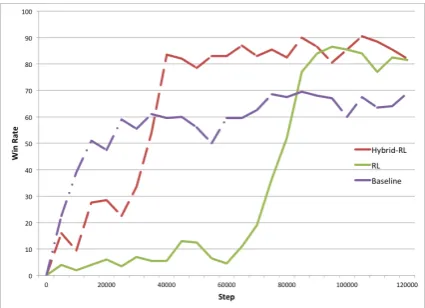
Table 3 shows that both proposed models achieve significantly higher win rate than the base-line by asking more questions before making guesses. Figure 4 illustrates the learning process of the three models. The horizontal axis is the total number of interaction between the agent and either
[image:7.595.310.523.316.470.2]the user or the database. The baseline model has the fastest learning speed but its performance sat-urated quickly because the dialog policy was not trained together with the state tracker. So the dia-log policy is not aware of the uncertainty in slot-filling and the slot-filler does not distinguish be-tween the consequences of different wrong labels (e.g classifyyestonoversus tounknown). On the other hand, although RL reaches high performance at the end of the training, it struggles in the early stages and suffers from slow convergence. This is due to that fact that correct slot-filling is a pre-requisite for winning 20Q, while the reward signal has a long delayed horizon in the RL approach. Fi-nally, the hybrid-RL approach is able to converge to the optimal solution much faster than RL due to the fact that it efficiently exploits the information in the state tracking label.
Figure 4: Graphs showing the evolution of the win rate during training.
5.5 State Tracking Analysis
One of the hypotheses is that the RL approach can learn a good state tracker using only dialog success reward signals. We ran the best trained models using a greedy policy and collected 10,000 sam-ples. Table 4 reports the precision and recall of slot filling in these trajectories. The results
indi-Unknown Yes No
Baseline 0.99/0.60 0.96/0.97 0.94/0.95 RL 0.21/0.77 1.00/0.93 0.95/0.51 Hybrid-RL 0.54/0.60 0.98/0.92 0.94/0.93
Table 4: State tracking performance of the three systems. The results are in the format of preci-sion/recall
dif-ferent strategy compared to the baseline. The RL model aims for high precision so that it predicts
unknownwhen the input is ambiguous, which is a safer option than predicting yes/no, because con-fusing betweenyesandnomay potentially lead to a contradiction and a game failure. This is very different from the baseline which does not dis-tinguish between incorrect labels. Therefore, al-though the baseline achieves better classification metrics, it does not take into account the long-term payoff and performs sub-optimally in long-terms of overall performance.
5.6 Dialog State Representation Analysis Tracking the state over multiple turns is crucial be-cause the agent’s optimal action depends on the history, e.g. the question it has already asked, the number of guesses it has spent. Furthermore, one of the assumptions is that the output of the LSTM network is an approximation of the belief state in the POMDP. We conducted two studies to test these hypotheses. For both studies, we ran the Hybrid-RL models saved at 20K, 50K and 100K steps against the simulator with a greedy policy and recorded 10,000 samples for each model.
The first study checks whether we can recon-struct an important state feature: the number of guesses the agent has made from the dialog state embedding. We divide the collected 10,000 sam-ples into 80% for training and 20% for testing. We used the LSTM output as input features to a lin-ear regression model with l2 regularization. Ta-ble 5 shows the correlation of determinationr2 in-creases for the model that was trained with more data.
Model 20K 50K 100K
r2 0.05 0.51 0.77
Table 5: r2 of the linear regression for predicting the number of guesses in the test dataset.
The second study is a retrieval task. The la-tent state of the 20Q game is the true inla-tent of the users’ answers to all the questions that have been asked so far. Therefore, the true state vector,shas a size of 31 and each slot,s[k], k ∈ [0,31)is one of the four values:not yet asked, yes, no, unknown. Therefore, if the LSTM outputbis in fact implic-itly learning the distribution over this latent states, they must be highly correlated for a well-trained model. Therefore, for each bi, i ∈ [0,10,000),
we find its nearest 5 neighbors based on cosine distance measuring and record their latent states, N(bi) :B →[S]. Then we compute the empirical
probability that each slot of the true statesdiffers from the retrieved neighbors:
pdiff(s[k]) =Esi
P4
n=01(N(bi)[n][k]6=si[k]) 5
[image:8.595.312.505.233.363.2]
(12) where1is the indicator function,kis the slot in-dex andnis the neighbor index.
Figure 5: Performance of retrieving similar true dialog states using learned dialog state embedding.
Figure 5 shows that the retrieval error contin-ues to decrease for the model that was trained bet-ter, which confirms our assumption that the LSTM output is an approximation of the belief state.
6 Conclusion
This paper identifies the limitations of the conven-tional SDS pipeline and describes a novel end-to-end framework for a task-oriented dialog system using deep reinforcement learning. We have as-sessed the model on the 20Q game. The proposed models show superior performance for both nat-ural language understanding and dialog strategy. Furthermore, our analysis confirms our hypothe-ses that the proposed models implicitly capture es-sential information in the latent dialog states.
7 Acknowledgements
This work was funded by NSF grant CNS-1512973. The opinions expressed in this paper do not necessarily reflect those of NSF. We would also like to thank Alan W Black for discussions on this paper.
References
Dan Bohus and Alexander I Rudnicky. 2003. Raven-claw: Dialog management using hierarchical task decomposition and an expectation agenda.
Dan Bohus and Alex Rudnicky. 2006. A k
hypothe-ses+ otherbelief updating model. In Proc. of the
AAAI Workshop on Statistical and Empirical Meth-ods in Spoken Dialogue Systems.
Kurt Bollacker, Colin Evans, Praveen Paritosh, Tim Sturge, and Jamie Taylor. 2008. Freebase: a col-laboratively created graph database for structuring
human knowledge. InProceedings of the 2008 ACM
SIGMOD international conference on Management of data, pages 1247–1250. ACM.
Pavel Curtis. 1992. Mudding: Social phenomena in text-based virtual realities. High noon on the elec-tronic frontier: Conceptual issues in cyberspace, pages 347–374.
M Gaˇsi´c, F Jurˇc´ıˇcek, Simon Keizer, Franc¸ois Mairesse, Blaise Thomson, Kai Yu, and Steve Young. 2010. Gaussian processes for fast policy optimisation of
pomdp-based dialogue managers. In Proceedings
of the 11th Annual Meeting of the Special Interest Group on Discourse and Dialogue, pages 201–204. Association for Computational Linguistics.
Kallirroi Georgila and David R Traum. 2011. Rein-forcement learning of argumentation dialogue
poli-cies in negotiation. InINTERSPEECH, pages 2073–
2076.
Matthew Hausknecht and Peter Stone. 2015. Deep recurrent q-learning for partially observable mdps.
arXiv preprint arXiv:1507.06527.
Matthew Henderson, Blaise Thomson, and Steve Young. 2014. Word-based dialog state tracking with
recurrent neural networks. In Proceedings of the
15th Annual Meeting of the Special Interest Group on Discourse and Dialogue (SIGDIAL), pages 292– 299.
Sepp Hochreiter and J¨urgen Schmidhuber. 1997.
Long short-term memory. Neural computation,
9(8):1735–1780.
Dan Jurafsky, Elizabeth Shriberg, and Debra Biasca. 1997. Switchboard swbd-damsl shallow-discourse-function annotation coders manual. Institute of Cog-nitive Science Technical Report, pages 97–102.
Sungjin Lee and Maxine Eskenazi. 2012. Pomdp-based let’s go system for spoken dialog challenge. In Spoken Language Technology Workshop (SLT), 2012 IEEE, pages 61–66. IEEE.
Sungjin Lee. 2014. Extrinsic evaluation of dialog state tracking and predictive metrics for dialog policy
op-timization. In 15th Annual Meeting of the Special
Interest Group on Discourse and Dialogue, page 310.
Lihong Li, He He, and Jason D Williams. 2014. Temporal supervised learning for inferring a
dia-log policy from example conversations. InSpoken
Language Technology Workshop (SLT), 2014 IEEE, pages 312–317. IEEE.
Volodymyr Mnih, Koray Kavukcuoglu, David Silver, Andrei A Rusu, Joel Veness, Marc G Bellemare, Alex Graves, Martin Riedmiller, Andreas K Fidje-land, Georg Ostrovski, et al. 2015. Human-level
control through deep reinforcement learning.
Na-ture, 518(7540):529–533.
George E Monahan. 1982. State of the arta survey of partially observable markov decision processes:
the-ory, models, and algorithms. Management Science,
28(1):1–16.
Karthik Narasimhan, Tejas Kulkarni, and Regina Barzilay. 2015. Language understanding for text-based games using deep reinforcement learning.
arXiv preprint arXiv:1506.08941.
Andrew Y Ng, Daishi Harada, and Stuart Russell. 1999. Policy invariance under reward transforma-tions: Theory and application to reward shaping. In
ICML, volume 99, pages 278–287.
Antoine Raux, Brian Langner, Dan Bohus, Alan W Black, and Maxine Eskenazi. 2005. Lets go pub-lic! taking a spoken dialog system to the real world. Inin Proc. of Interspeech 2005. Citeseer.
Tom Schaul, John Quan, Ioannis Antonoglou, and David Silver. 2015. Prioritized experience replay.
arXiv preprint arXiv:1511.05952.
Iulian V Serban, Alessandro Sordoni, Yoshua Bengio, Aaron Courville, and Joelle Pineau. 2015. Build-ing end-to-end dialogue systems usBuild-ing generative
hi-erarchical neural network models. arXiv preprint
arXiv:1507.04808.
Lifeng Shang, Zhengdong Lu, and Hang Li. 2015. Neural responding machine for short-text conversa-tion. arXiv preprint arXiv:1503.02364.
Ilya Sutskever, Oriol Vinyals, and Quoc V Le. 2014. Sequence to sequence learning with neural
net-works. InAdvances in neural information
process-ing systems, pages 3104–3112.
Richard S Sutton and Andrew G Barto. 1998.
Intro-duction to reinforcement learning. MIT Press. Richard S Sutton. 1990. Integrated architectures
for learning, planning, and reacting based on
ap-proximating dynamic programming. InProceedings
of the seventh international conference on machine learning, pages 216–224.
Blaise Thomson and Steve Young. 2010. Bayesian update of dialogue state: A pomdp framework for spoken dialogue systems. Computer Speech & Lan-guage, 24(4):562–588.
Tijmen Tieleman and Geoffrey Hinton. 2012. Lecture 6.5-rmsprop: Divide the gradient by a running
av-erage of its recent magnitude. COURSERA: Neural
Networks for Machine Learning, 4:2.
Hado Van Hasselt, Arthur Guez, and David Silver. 2015. Deep reinforcement learning with double q-learning.arXiv preprint arXiv:1509.06461. Oriol Vinyals and Quoc Le. 2015. A neural
conversa-tional model. arXiv preprint arXiv:1506.05869. Tsung-Hsien Wen, Milica Gasic, Nikola Mrksic,
Lina M Rojas-Barahona, Pei-Hao Su, Stefan Ultes,
David Vandyke, and Steve Young. 2016. A
network-based end-to-end trainable task-oriented
di-alogue system. arXiv preprint arXiv:1604.04562.
Jason D Williams and Steve Young. 2007. Partially observable markov decision processes for spoken
dialog systems. Computer Speech & Language,
21(2):393–422.
Jason Williams, Antoine Raux, Deepak Ramachan-dran, and Alan Black. 2013. The dialog state
track-ing challenge. InProceedings of the SIGDIAL 2013
Conference, pages 404–413.