Morphological Complexity Influences Verb–Object Order
in Swedish Sign Language
Johannes Bjerva♦♣ Carl B¨orstell♣
♦Center for Language and Cognition, University of Groningen, The Netherlands ♣Department of Linguistics, Stockholm University, Sweden
[email protected], [email protected]
Abstract
Computational linguistic approaches to sign languages could benefit from investigating how com-plexity influences structure. We investigate whether morphological comcom-plexity has an effect on the order of Verb (V) and Object (O) in Swedish Sign Language (SSL), on the basis of elicited data from five Deaf signers. We find a significant difference in the distribution of the order-ingsOVvs.VO, based on an analysis of morphological weight. While morphologically heavy verbs exhibit a general preference forOV, humanness seems to affect the ordering in the opposite direction, with[+human]Objects pushing towards a preference forVO.
1 Introduction
Word order is one of the most well-documented grammatical features of the (spoken) languages of the world. One specific case regarding word order is the order of a Verb Vand its (direct) ObjectO in a simple transitive clause. In a sample of 1,519 languages of the world, 46.9% (n= 713) of the languages have a dominantOVorder, whereas 46.4% (n= 705) have a dominantVOorder (Dryer, 2013).1
For signed languages, the two observed dominant word orders areSOV andSVO, for which the lat-ter has been generalised as a grammatical order in most sign languages. However, a number of factors are said to affect the ordering ofOandV, for instance that morphologically complex verbs (e.g., those exhibiting morphological reduplication, handshape or directional object agreement, or coinciding with non-manual marking) prefer a verb-final position, hence occurringafterits object. One reason for this ordering preference has been suggested to relate directly to the interaction between the verb and its ob-ject, since some complexity features involve types of “agreement” with the object. Thus, the idea is that the object needs to be introducedbeforeverb agreement with the object is available on the verb (Napoli and Sutton-Spence, 2014). This relates directly to findings from spoken languages, for which it has been noted that the ordering of verb and controller NP affects the agreement realisation, such that verbs pre-ceding their controller NP do not always agree with the controller (Corbett, 2006). Furthermore, among spoken languages, word order also interacts with the presence or absence of morphological marking. For instance,SOV languages generally differentiate Subject and Object on the basis of morphological marking (e.g., case), whileSVO languages differentiate these argument roles by word order alone (i.e., by linear distance between the arguments) (Sinnem¨aki, 2010). In a study looking at young, emerging sign languages, it was argued that humanness as an animacy feature accounts for word order preferences, in thatSOVis preferred unless bothSandOare[+human], in which caseSVOis preferred (Meir et al., in press).
For Swedish Sign Language (SSL), the dominant word order has been identified asSVO(Bergman and Wallin, 1985), which has also been corroborated by a small-scale corpus study more recently (B¨orstell et al., 2016). Although different types of morphological complexity (e.g., reduplication and agreement) have been suggested to influence word order in SSL (Bergman and Wallin, 1985; Bergman and Dahl, This work is licensed under a Creative Commons Attribution 4.0 International Licence. Licence details: http:// creativecommons.org/licenses/by/4.0/
1The remaining 101 languages in the sample allow for both orders, neither being dominant.
Table 1: Features of morphological complexity in SSL
Handshape Whether an Object classifier was present in the verb’s handshape (Emmorey, 2003).
Directionality Whether an Object location was present in the verb’s movement (Padden, 1988).
Reduplication Whether the verb was reduplicated (Bergman and Dahl, 1994).
Non-manual Whether a non-manual morpheme accompanied the verb (Crasborn, 2006).
1994), no study has explicitly addressed this issue. Thus, the aim of this study is to use statistical boot-strapping methods to establish whether morphological complexity affects the order of Object and Verb in SSL. By doing so, we seek to tease apart the different factors influencing word order patterns in SSL, and incorporate the notion of morphological complexity more explicitly as a property of signed language grammar, particularly with regard to the interaction between morphology and syntax. Uncovering the intricacies of this interaction can also be helpful for developing sign language technology, and can serve as a starting point when annotating sign language corpora. Information about the effect of complexity can be used to inform machine learning systems, e.g., by including this information as features, or by predicting a verb’s complexity as an auxiliary task in a neural network (see, e.g., Plank et al. (2016) and Bjerva et al. (2016)).
2 Data and Methodology 2.1 Data and Annotations
The data consisted of video recorded descriptions of 17 transitive events (see Table 2) by five Deaf signers of SSL (4 male; aged 18–44), all using SSL as their first language. The signers were individually recorded describing the stimuli events to another signer, who was instructed to correctly identify the described event from three different options. Descriptions were annotated in the ELAN software (Wittenburg et al., 2006). In total, 145 individual transitive verbs were annotated for the categories in Table 1.
Handshape and Directionality involve morphological complexity dependent on the Object: Object classifier handshapes are selected on the basis of the Object’s physical properties; Directionality involves the incorporation of referential locations in signing space, such that the verb moves between – oragrees
with – locations established for various discourse referents (here, the Object(s)). Both of these categories entail the verb form being altered according to its Object, in a sense making the verb formdependenton physical and spatial properties of the Object. This has been suggested to influence the order ofOandV, such that an Object-dependent Verbfollowsits Object, i.e.,OV(Napoli and Sutton-Spence, 2014).
The latter two categories also involve morphological complexity, but rather independent from the Object: Reduplication involves phonological repetition, for signed language often associated with aspec-tual and/or pluractional morphology (Fischer and Janis, 1990; Bergman and Dahl, 1994); Non-manual concerns the addition of non-manual markers (e.g., facial expression, or so-called oral adverbs2)
accom-panying a verb. These are associated with both phonological and morphological weight, and are also found to be associated with a post-Object position (Napoli and Sutton-Spence, 2014).
Each individual verb in the data set was coded for these four categories by one of the authors of this paper. If a verb occurred with two objects (i.e., a direct and an indirect object), the verb token was counted as two items: once for each object. The annotations were binary features (yesvs.no), but for the Object-dependent categories (i.e., Handshape and Directionality) also matched to the relevant object. That is, the Handshape valueyeswould only be assigned for the object indexed by the handshape. Each item in the data set was also annotated for whether its Object washumanorinanimate.3 Thus, we
could differentiate the four complexity features’ effect on word order on the basis of the animacy of the Object in question.
Each Object was also annotated as Overt or Elliptical: that is, if the Object occurred within the same clause as its Verb, it was coded as Overt; if the Object was present in an adjoining clause, it was coded
Table 2: Video clips for the clause elicitation task
Valency Event
Monotransitive
A girl tearing a paper
A man placing a book on a bookshelf A girl pulling a cart through a living room A man tapping a watermelon on a table A woman lifting a box onto a table A girl pulling a man by the hand A woman looking at a man A girl feeding a woman
A woman rolling a ball on the floor A woman pushing a girl
A man tapping a girl by the shoulder A girl brushing a woman’s hair A man washing a plate
Ditransitive
A woman giving a shirt to a man A man throwing a ball to a girl A man showing a woman a picture
[image:3.595.146.453.357.421.2]A woman taking a pair of scissors from a girl
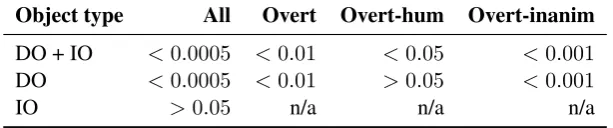
Table 3: Comparison betweenOVandVOorders per condition. Numbers indicatep-values as obtained by the bootstrap test, withp-values indicating the probability that theOVcondition is not significantly more complex than theVOcondition.n/aindicates a too small sample size to examine the difference in question.
Object type All Overt Overt-hum Overt-inanim DO + IO <0.0005 <0.01 <0.05 <0.001
DO <0.0005 <0.01 >0.05 <0.001
IO >0.05 n/a n/a n/a
as Elliptical.4 For the latter, the order ofVandOwas determined by linear order on the utterance level.
2.2 Statistical Analysis
In order to avoid making unwarranted assumptions about the distribution of the variable we investigate (verb complexity), we chose to use a non-parametric bootstrapping test (Efron and Tibshirani, 1990; Efron and Tibshirani, 1994). Instead of fitting the parameters of a distribution specified a priori to our data, we repeatedly resample from our original sample (the data) to estimate the amount of variation and thus the significance of our results. For a high-level introduction to this statistical method, we refer the reader to Calmettes et al. (2012).
In the data set used in this paper, we compare annotations of 145 verbs. We calculate the complexity of each verb as being the number of features present, divided by the maximum number of features (see Table 1). We then use bootstrap resampling to estimate the populations as divided into two groups, comparing the complexity betweenOVandVO items.5 We subdivide our data into groups depending
on whether or not the argument is overt, and if so whether or not this argument is[+human] or
[+inanimate]. Additionally, we investigate whether the Object in question is direct (DO) or indirect (IO). This leads to a total of 12 possible comparisons between theOVandVOorders.
3 Results and Analysis
Running a bootstrap resampling test with resampling, using 10,000 iterations estimating the mean of the populations, yields differences at thep-levels reported in Table 3, withp <0.05indicating that the mean complexity ofOVis significantly higher than that ofVO.
4Cases of covert, implicit (i.e., semantic) Objects were excluded from the data set.
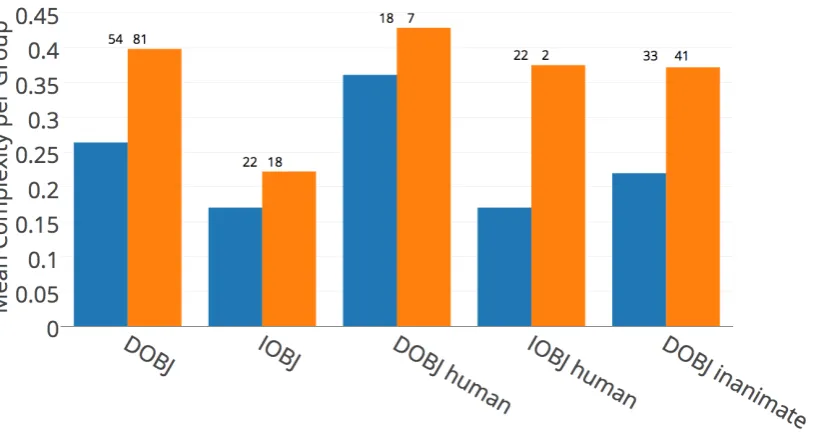
Figure 1: Mean complexity (y-axis) and number of samples (numbers above each bar) per condition. IOBJ inanimate is not plotted as the condition contains no data.
We see a division here on the basis of animacy. For all tokens (DO + IO), we see that the mean complexity inOVis significantly higher than that ofVOacross conditions. For theDOtokens, the same is true for all conditions but theovert-human. For theIOtokens, there is no significant difference betweenOVandVObased on complexity. Instead, an important aspect here is that theIOrow contains several n/a cells. This is due to that fact that for the IO tokens (of which all are [+human]), the distribution of VOvs.OVis so skewed that practically all items fall into the former category, making statistical testing impossible (see Figure 1).6 This should be taken as an indication that humanness is,
in fact, associated with theVOorder to a high degree, which corroborates the findings by Meir et al. (in press). Thus, while morphologically complex verbs prefer theOVorder, humanness pushes towardsVO. 4 Discussion and Conclusions
We have shown that morphological complexity is a relevant factor when investigating word order patterns in SSL. From a computational perspective, this suggests that machine learning approaches to SSL could benefit from using morphological complexity and animacy as features. As claimed for other sign lan-guages (Napoli and Sutton-Spence, 2014), the incorporation of Object features (Handshape classifiers and Directionality) together with other morphological features (Reduplication and Non-manual mark-ing) influence the ordering ofVandOin SSL. Furthermore, animacy features of the Object also affect the ordering ofVandO, such that[+human]Objects push towards the orderVO. As argued by, e.g., Meir et al. (in press), this would be explained by disambiguation strategies in reversible sentences, ob-servable in several emerging sign languages. That is, for sentences in which bothSandOare possible Agents, the roles are disambiguated by separatingSfromOby puttingVin between the two. In the case of non-reversible sentences, this strategy is not needed, and other preferences may play a larger role. For general linguistic theory, this relates to the notion of Differential Object Marking (Bossong, 1985; Aissen, 2003), and the preference of explicitly marking Objects that are high in the prominence hierarchy (e.g., animacy).
Acknowledgements
We thank Wendy Sandler and Irit Meir for sharing their elicitation stimuli that were used to obtain the data for this study, and the anonymous reviewers for their helpful suggestions.
References
Judith Aissen. 2003. Differential Object Marking: Iconicity vs. Economy. Natural Language & Linguistic Theory, 21(3):435–483.
Brita Bergman and ¨Osten Dahl. 1994. Ideophones in Sign Language? The place of reduplication in the tense-aspect system of Swedish Sign Language. In Carl Bache, Hans Basbøll, and Carl-Erik Lindberg, editors,Tense, Aspect and Action. Empirical and Theoretical Contributions to Language Typology, pages 397–422. Mouton de Gruyter.
Brita Bergman and Lars Wallin. 1985. Sentence structure in Swedish Sign Language. In William C. Stokoe and Virginia Volterra, editors,Sign language research ’83, pages 217–225, Silver Spring, MD. Linstok Press. Johannes Bjerva, Barbara Plank, and Johan Bos. 2016. Semantic Tagging with Deep Residual Networks. In
Proceedings of COLING 2016, Osaka, Japan, December.
Carl B¨orstell, Mats Wir´en, Johanna Mesch, and Moa G¨ardenfors. 2016. Towards an annotation of syntactic struc-ture in Swedish Sign Language. In Eleni Efthimiou, Stavroula-Evita Fotinea, Thomas Hanke, Julie Hochgesang, Jette Kristoffersen, and Johanna Mesch, editors, Proceedings of the 7th workshop on the Representation and Processing of Sign Languages: Corpus Mining, pages 19–24, Paris. European Language Resources Association (ELRA).
Georg Bossong. 1985. Differentielle Objektmarkierung in den Neuiranischen Sprache. Gunter Narr Verlag, T¨ubingen.
Guillaume Calmettes, Gordon B Drummond, and Sarah L Vowler. 2012. Making do with what we have: use your bootstraps. Advances in physiology education, 36(3):177–180.
Greville Corbett. 2006.Agreement. Cambridge University Press, New York, NY.
Onno Crasborn. 2006. Nonmanual Structures in Sign Language. In Keith Brown, editor,Encyclopedia of Lan-guage & Linguistics, number 1999, pages 668–672. Elsevier, Oxford.
Matthew S. Dryer. 2013. Order of object and verb. In Matthew S. Dryer and Martin Haspelmath, editors,The World Atlas of Language Structures Online. Max Planck Institute for Evolutionary Anthropology, Leipzig. Bradley Efron and Robert Tibshirani. 1990. Statistical data analysis in the computer age. University of Toronto,
Department of Statistics.
Bradley Efron and Robert Tibshirani. 1994.An introduction to the bootstrap. CRC press.
Karen Emmorey, editor. 2003. Perspectives on classifier constructions in sign languages. Lawrence Erlbaum Associates, Mahwah, NJ.
Susan D. Fischer and Wynne Janis. 1990. Verb sandwiches in American Sign Language. In Siegmund Prillwitz and Tomas Vollhaber, editors,Current trends in European sign language research, number 2, pages 279–293, Hamburg. Signum Verlag.
Irit Meir, Mark Aronoff, Carl B¨orstell, So-One Hwang, Deniz Ilkbasaran, Itamar Kastner, Ryan Lepic, Adi Lifshitz Ben Basat, Carol Padden, and Wendy Sandler. in press. The effect of being human and the basis of grammatical word order: Insights from novel communication systems and young sign languages. Cognition.
Donna Jo Napoli and Rachel Sutton-Spence. 2014. Order of the major constituents in sign languages: Implications for all language.Frontiers in Psychology, 5:1–18.
Carol Padden. 1988. Interaction of morphology and syntax in American Sign Language. Garland Publishing, Inc., New York, NY & London.
Barbara Plank, Anders Søgaard, and Yoav Goldberg. 2016. Multilingual part-of-speech tagging with bidirectional long short-term memory models and auxiliary loss. InProceedings of ACL 2016.
Kaius Sinnem¨aki. 2010. Word order in zero-marking languages.Studies in Language, 34(4):869–912.