Expert Stance Graphs for Computational Argumentation
Orith Toledo-Ronen Roy Bar-Haim Noam Slonim
IBM Research - Haifa
{oritht,roybar,noams}@il.ibm.com
Abstract
We describe the construction of anExpert Stance Graph, a novel, large-scale knowl-edge resource that encodes the stance of more than 100,000experts towards a va-riety of controversial topics. We suggest that this graph may be valuable for various fundamental tasks in computational argu-mentation. Experts and topics in our graph are Wikipedia entries. Both automatic and semi-automatic methods for building the graph are explored, and manual assess-ment validates the high accuracy of the re-sulting graph.
1 Introduction
Background knowledge plays an important role in many NLP tasks. However,computational ar-gumentation is one area where little work has been done on developing specialized knowledge resources.
In this work we introduce a novel knowledge resource that may support various tasks related to argumentation mining and debating technologies. This large-scale resource, termed Expert Stance Graph, is built fromWikipedia, and provides back-ground knowledge on the stance of experts to-wards debatable topics.
As a motivating example, consider the follow-ingstance classificationsetting, where the polarity of the following expert opinion onAtheism(Proor
Con) should be determined:
Dawkins sums up his argument and states, “The temptation (to attribute the appear-ance of a design to actual design itself) is a false one, because the designer hypothe-sis immediately raises the larger problem of who designed the designer. The whole prob-lem we started out with was the probprob-lem of
explaining statistical improbability. It is ob-viously no solution to postulate something even more improbable.” (Dawkins, 2006, p. 158)
Inferring the stance directly from the above text is a difficult and complex task. However, this complexity may be circumvented by utilizing background knowledge about (Richard) Dawkins, who is a well-known atheist. Dawkins’ page in Wikipedia1includes various types of evidence for
his stance towards atheism:
1. Categories: Dawkins belongs to the follow-ing Wikipedia categories: Antitheists, Athe-ism activists,Atheist feministsandCritics of religions2.
2. Article text: The article text contains state-ments such as“Dawkins is a noted atheist”
and“Dawkins is an outspoken atheist”. 3. Infobox: Dawkins has aknown-for relation
with“criticism of religion”.
2 Expert Stance Graphs
The Expert Stance Graph (ESG)is a directed bi-partite graph comprising two types of nodes: (a)
concept nodes, which represent debatable topics such asAtheism, Abortion, Gun controland Same-sex marriage, and (b) expert nodes, represent-ing persons whose stance towards one or more of the concepts can be inferred from Wikipedia. Stance is represented as labeled directed edges from an expert to a concept, e.g. Richard Dawkins−−→P ro Atheism. Each concept and each ex-pert have their own article in Wikipedia. We use the termExpertsinclusively to refer to academics,
1https://en.wikipedia.org/wiki/ Richard_Dawkins
2InferringProstance forAtheismfromCritics of religions depends on knowing the contrast relation betweenAtheism andReligion.
writers, religious figures, politicians, activists, and so on.
3 Applications
Expert opinions are highly valuable for mak-ing persuasive arguments, and expert evidence (premise) is a commonly used type of argumen-tation scheme (Walton et al., 2008). Rinott et al. (2015) describe a method for automatic evi-dence detection in Wikipedia articles. Three com-mon evidence types are explored: Study, Expert, andAnecdotal. The proposed method uses type-specific features for detecting evidence. For in-stance, in the case of expert evidence, a lexicon of words describing persons and organizations with relevant expertise is used.
The process of incorporating expert opinions on a given topic into an argument involves several steps. First, we need to retrieve from our corpus articles that contain expert opinions related to the given topic. Second, the exact boundaries of these opinions should be identified. Finally, the stance of the expert opinion towards the topic (Pro or Con) should be determined, to ensure it matches the stance of the argument we are making. Each of these steps is a challenging task by itself.
The expert stance graph may facilitate each of the above subtasks. If an expert E is known to be a supporter or an opponent of some topic T, then the Wikipedia page ofE is likely to contain relevant opinions onT. Furthermore, a mention of E can be a useful feature for identifying relevant expert opinions forT in a given article.
Finally, perhaps the most important use of the graph for expert evidence is stance classification. Previous work on stance classification has shown that it can be much improved by utilizing exter-nal information beyond the text itself. For exam-ple, posts by the same author on the same topic are expected to have the same stance (Thomas et al., 2006; Hasan and Ng, 2013). Similarly, as shown in the previous example, external knowledge on expert stance towards a topic can improve stance classification of expert opinions.
4 Building the Graph
We consider two complementary settings for building the graph: (a)Offline, in which the set of concepts is predefined, and minimal human super-vision is allowed, and (b)Online, where our goal is to find ad-hocProandConexperts for an unseen
concept, in a fully-automatic fashion.
For both settings, our approach is based on Wikipedia categories and lists, which have sev-eral advantages: (a) they provide an easy access to large collections of experts, (b) their stance classi-fication is relatively easy, and (c) their hierarchical structure can be exploited.
4.1 Concepts
Offline construction of the graph starts with de-riving the set of concepts. We started with Wikipedia’s list of controversial issues3, which
contains about 1,000 Wikipedia entries, grouped into several top-level categories. We manually se-lected a subset of 12 categories , and filtered out the remaining 3 categories.4
One of the authors selected from the remain-ing list concepts that represent a two-sided de-bate (Meaning of life, for instance, is a controver-sial topic but does not represent a two-sided de-bate). Persons and locations were filtered out as well. This list was expanded manually by identi-fying relevant concepts in Wikipedia article titles that contain the words “Debate” or “Controversy”. Finally, two annotators assessed the resulting list according to the above guidelines. Concepts that were rejected by both annotators were removed. The final list contained 201 concepts.
4.2 Candidate Expert Categories
Next, we search relevant Wikipedia categories and lists for each concept. The process starts with creating search terms. The concept itself is a search term, as well as any lexical deriva-tion of the concept that represents a person (e.g.
Atheism→Atheist), which we termperson deriva-tions. Person derivations are found using WordNet (Miller, 1995; Fellbaum, 1998): we look for lexi-cal derivations of the concept that have“person”
as a direct or inherited hypernym.
We then find all Wikipedia categories and lists5
that contain the search terms. For example, given the search termsatheismandatheist, some of the categories found areAtheism activists, American
3https://en.wikipedia.org/wiki/ Wikipedia:List_of_controversial_issues
4The selected categories were Politics and economics, History, Religion, Science biology and health, Sexuality, En-tertainment, Environment, Law and order, Philosophy, Psy-chiatry, Technology, and Sports. The excluded categories wereLinguistics, Media and culture, andPeople.
atheists, List of atheist authors, Converts to Chris-tianity from atheism or agnosticismandCritics of atheism. The set of categories is further expanded with subcategories of the categories found in the previous step. This step adds more relevant cate-gories that do not contain the search terms, such asAntitheistsforAtheism. To avoid topic drifting, we only add one level of subcategories.
Next, the persons associated with each cate-gory6are identified by considering outgoing links
from the category page which are of type “Per-son”, based on DBPedia’s rdf:type property for the page (Lehmann et al., 2014). Categories with fewer than five persons are discarded. We also removed three concepts, for which the num-ber of categories was too large: Christianity,
Catholicism, and Religion. The resulting set in-cluded 4,603 categories containing 121,995 per-sons. Categories were found for 132 of the 198 concepts.
4.3 Category Stance Annotation
Finally, category names are manually annotated for stance. The annotation process has two stages: first, determine whether the category explicitly de-fines membership in a group of persons. For in-stance,Swedish women’s rights activistsand Fem-inist bloggers meet this criterion, but Feminism and historydoes not. We apply this test since we observed that it is much easier to predict with con-fidence the stance of persons in these categories.
Categories that do not pass this filter are marked asIrrelevant. Otherwise, the annotators proceed to the second stage, where they are asked to deter-mine the stance of the persons in the given cate-gory towards the given concept, based on the cat-egory name. Possible labels are:
1. Pro:supporting the concept. 2. Con:opposing the concept.
3. None:The stance towards the concept cannot be determined based on the category name. For instance, for the concept Communism
we will have British communists and Cana-dian Trotskyistsclassified asPro,Moldovan anti-communistsclassified asCon, andWestern writers about Soviet Russiaclassified asNone. Annotators may also consider direct parent categories for de-termining stance. In the previous example, know-ing thatCanadian communistsis a parent category
6For convenience, we will refer in the following to cate-gories and lists collectively as “catecate-gories”.
Polarity Concepts Categories Experts
Pro 105 3,221 93,570
[image:3.595.324.505.63.94.2]Con 40 272 10,666
Table 1: Statistics on the Expert Stance Graph
ofCanadian Trotskyists may help classifying the latter asProforCommunism.
The categories were labeled by a team of six annotators, with each category labeled by two an-notators. The overall agreement was 0.92, and the average inter-annotator Cohen’s kappa coefficient was 0.79, which corresponds tosubstantial agree-ment(Landis and Koch, 1997). Cases of disagree-ment were labeled by a third annotator and were assigned the majority label. Category annotation was completed rather quickly - about 260 cate-gories were annotated per hour. The total number of annotation hours invested in this task was 37.
The resulting ESG is composed of all experts in the categories labeled asProandCon. A total of 104,236 experts were found for 114 out of the 132 concepts, and for 31 concepts, bothPro and
Conexperts were found. The number of concepts, categories and experts for each stance is given in Table 1. As shown in the table, the vast major-ity of categories and experts found arePro. Over-all, our method efficiently constructs a very large ESG, while only requiring a small amount of hu-man annotation time.7
4.4 Category Stance Classification
The offline list of concepts we started with is un-likely to be complete. Therefore, we would like to be able to find on-the-flyProandConexperts also for new, unseen concepts. This requires the devel-opment of a stance classifier for categories. We randomly split the 198 concepts into two equal-size subsets and used one subset for development and the other for testing. As a result, the 132 concepts for which categories were found are split into a development set, containing 69 concepts and their associated 2,069 categories, and a test set, containing 63 concepts and 2,534 categories. The development set was used for developing a simple rule-based classifier.
The logic of the rule-based classifier is
Input: categoryCAT; concept C ; person derivation PD for the concept
Output: stance classification ofCATinto PRO/CON/NONE
ifCAT=∼critics ofCthen return CON
else ifCAT=∼anti|former|...PDthen
return CON
else ifCAT=∼PDdissident|... then
return CON
else ifCAT=∼PDthen
return PRO
else ifCAT=∼anti|former|...C PERSONthen
return CON
else ifCAT=∼C PERSONthen
return PRO
else
return NONE
Algorithm 1:Category stance classification
marized in Algorithm 1. “=∼” denotes pattern matching, and PERSON is any hyponym of the
word “person” in WordNet, e.g. activist, provider, andwriter. “. . . ” denotes omission of some lexi-cal alternatives.
[image:4.595.307.521.61.139.2]The algorithm is first applied to the category it-self, and if it fails to make aProorConprediction (i.e returnsNone), it is applied to its direct parent categories, and the classification is made based on the majority of theirProandConpredictions.
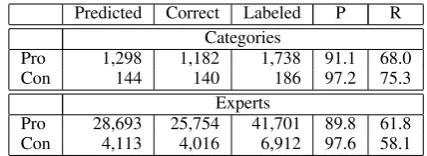
Table 2 shows the performance of the classifier on the test set, with respect to both categories and experts. Expert-level evaluation is done by label-ing all the experts in each category with the cate-gory label. The following measures are reported for Proand Con classes: number of predictions, number of correct predictions, number of labeled instances for this class, precision (P) and recall (R). Overall, the classifier achieves high precision for Pro and Con, both at the category and at the expert level, while covering most of the labeled instances. Yet, the coverage of the classifier is in-complete. As an example of its limitations, con-sider the categoriesAmerican pro-choice activists
andAmerican pro-life activists, which areProand
Conabortion, respectively. Their stance cannot be determined from the category itself according to our rules, because they do not contain the concept
Abortion, and both were added as subcategories of
Abortion in the United States, a category that does not have a clear stance (and indeed has both Pro
andConsubcategories).
5 Expert-Level Assessment
So far we assumed that experts’ stances can be predicted precisely from their category names. In
Predicted Correct Labeled P R Categories
Pro 1,298 1,182 1,738 91.1 68.0
Con 144 140 186 97.2 75.3
Experts
Pro 28,693 25,754 41,701 89.8 61.8 Con 4,113 4,016 6,912 97.6 58.1
Table 2: Category stance classification results
Predicted Correct Labeled P R Manual Annotation
Pro 200 181 189 90.5 95.8
Con 200 173 178 86.5 97.2
Classifier
Pro 76 60 189 78.9 31.7
[image:4.595.69.293.65.240.2]Con 87 81 178 93.1 45.5
Table 3: Expert stance assessment
this section we put this assumption to the test. We sampled 200 Pro experts and 200 Con experts from the test set. The polarity of the experts was derived from the manual labeling of their category. For each sampled instance, we first randomly se-lected one of the concepts in the test set, and then randomly picked an expert with the requested po-larity. If the concept did not have any experts with that polarity, the above procedure was repeated un-til such an expert was found.
We then asked three human annotators to deter-mine the stance of the experts towards their associ-ated concept (Pro/Con/None), based on any infor-mation found on their Wikipedia page, and con-sidered the majority label. As with the previous task, the annotators achieved substantial agree-ment (average kappa of 0.65). We evaluated the expert stance inferred from the category labeling by both the manual annotation and the rule-based classifier against these 400 labeled experts. The results are summarized in Table 3.
[image:4.595.308.519.172.251.2]6 Conclusion and Future Work
We introduced Expert Stance Graphs, a novel, large scale knowledge resource that has many po-tential use cases in computational argumentation. We presented an offline method for constructing the graph with minimal supervision, as well as a fully-automated method for finding experts for un-seen concepts. Both methods show promising re-sults.
In future work we plan to improve coverage by considering additional sources of information, such as the text of the expert’s page in Wikipedia. We will also apply the graph in different tasks re-lated to the detection and stance classification of expert evidence.
We also plan to enrich the graph with additional types of knowledge, which may be utilized to pre-dict missing stance edges. Semantic relations be-tween concepts, such as contrast (e.g. Atheismvs.
Religion), may support such inferences, as experts are expected to have opposite stances towards con-trasting concepts. Another possible extension of the graph isinfluencelinks between experts, which may indicate similar stances for these experts. In-fluence information is available from Wikipedia infoboxes.
Finally, we would like to apply collabora-tive filtering techniques to predict missing expert-concept stance relations. This is based on the intu-ition that experts who tend to have same (or oppo-site) stances on a set of topics, are likely to follow a similar pattern on topics for which we only have partial stance information.
References
Richard Dawkins. 2006. The God Delusion. Bantam Press.
Christiane Fellbaum, editor. 1998. WordNet: An Elec-tronic Lexical Database. Language, Speech and Communication. MIT Press.
Kazi Saidul Hasan and Vincent Ng. 2013. Stance clas-sification of ideological debates: Data, models, fea-tures, and constraints. InProceedings of IJCNLP. J. R. Landis and G. G. Koch. 1997. The measurements
of observer agreement for categorical data. Biomet-rics, 33:159–174.
Jens Lehmann, Robert Isele, Max Jakob, Anja Jentzsch, Dimitris Kontokostas, Pablo N. Mendes, Sebastian Hellmann, Mohamed Morsey, Patrick van Kleef, S¨oren Auer, and Christian Bizer. 2014. DB-pedia - a large-scale, multilingual knowledge base extracted from Wikipedia. Semantic Web Journal.
G. A. Miller. 1995. WordNet: A lexical database for English. Communications of the ACM, pages 39–41. Ruty Rinott, Lena Dankin, Carlos Alzate Perez, Mitesh M. Khapra, Ehud Aharoni, and Noam Slonim. 2015. Show me your evidence - an auto-matic method for context dependent evidence detec-tion. InProceedings of EMNLP.
Matt Thomas, Bo Pang, and Lillian Lee. 2006. Get out the vote: Determining support or opposition from Congressional floor-debate transcripts. In Proceed-ings of EMNLP.