MuLLinG: multilevel linguistic graphs for knowledge extraction
Vincent Archer
Laboratoire I3S (équipe RL), Université de Nice Sophia Antipolis
Sophia Antipolis, France
[email protected]
Abstract
MuLLinG is a model for knowledge extrac-tion (especially lexical extracextrac-tion from cor-pora), based on multilevel graphs. Its aim is to allow large-scale data acquisition, by mak-ing it easy to realize automatically, and simple to configure by linguists with limited knowledge in computer programming. In MuLLinG, each new level represents the in-formation in a different manner (more and more abstract). We also introduce several as-sociated operators, written to be as generic as possible. They are independent of what nodes and edges represent, and of the task to achieve. Consequently, they allow the de-scription of a complex extraction process as a succession of simple graph manipulations. Fi-nally, we present an experiment of colloca-tion extraccolloca-tion using MuLLinG model.
1
Introduction
Natural language processing systems often pro-duce low-quality results, because of ambiguities and particular linguistic phenomena. One major reason is the lack of linguistic data needed to de-tect these phenomena or to solve ambiguities. To fill this lack, new linguistic resources should be produced. It could be done quickly with automat-ic processes, but quality would be unsatisfactory; on the contrary, manual work by linguists allows precise results, but takes lot of time. To get both rapidity and precision, we must combine ma-chine and human abilities, by giving automatic processing tools to linguists, and allowing them to guide the process. Existing tools are often too centered on a task, and require too much know-ledge in computer programming: they are not ap-propriate for linguists with few knowledge in coding. We should thus develop generic tools.
In this article, we first focus on how to make the resource gathering easier. Then, we introduce
MuLLinG, our multilevel graph model for lin-guistic extraction, with several associated opera-tions. Finally, we present an application of that model on collocation extraction.
2
Knowledge extraction
There are several manners to collect resources with automatic processes (machine learning, col-laborative interfaces, etc.). We focus here on (lin-guistic and statistic) extraction of candidates. More precisely, our goal is to facilitate the large-scale production of candidates by extraction.
2.1 Simplify programming
Making a particular extraction task is not easy, as there is often no dedicated tool. It forces to write ad hoc tools (most of the time not unveiled). Moreover, ad hoc tools are not written to be uni-versal. They generally depend on the data model, it is therefore difficult or impossible to use a new resource with a different format (such as an ana-lysis from an other parser). To be really useful, an extraction tool should be generic (able to handle different data models) and easy to under-stand and to use. The data model on which the tool rely must be simple, expressive (complex structure should be represented easily), and uni-versal (for monolingual or multilingual corpora, dictionaries, etc.). It should also provide simple generic, task-independent, high-level operations that can be combined to describe a complex task.
We choose to introduce a graph-based model. Graphs are understandable quickly by humans, easy to use in automatic processes, and flexible enough to represent various data types. Using graphs for knowledge extraction is quite classic. They can represent relations between words (pro-duced by dependency analysers from corpora), and be used to produce semantically close terms (Widdows & Dorrow, 2002) or to group similar n-tuples (Hassan et al., 2006). Graphs also can be
generated from dictionaries, and used to produce knowledge bases (Richardson et al., 1998) or proximity information (Gaume et al., 2006).
2.2 Existing graph models
Influenced by “existential graphs” (Peirce, 1931-1935) where relations between elements are rep-resented by nodes, “conceptual graphs” (Sowa, 1976) are bipartite graphs with two node types: concepts and conceptual relations (edges only as-sociate relations and concepts). That relation ma-terialization is useful, as it allows to handle eas-ily n-ary relations, without hypergraphs.
Another interesting network is the “lexical system” one (Polguère, 2006), defined as ori-ented, weighted, unhierarchical and, above all,
heterogeneous: there is no constraint on what is modelized (it could be terms, meanings, colloca-tions, etc.). It avoids the separation between dic-tionary-like and network-like lexical databases, and shows the same representation can be used for each kind of data and relation.
Finally, graphs can be multilevel, to represent different kinds of information. Links are gener-ally allowed only in a same level or between two adjacent levels, like in “hypertexts” (Agosti and Crestani, 1993) made of three specified levels (documents, terms, concepts), or in Multi-Level Association Graphs (Witschel, 2007) in which there is no constraint on the number of levels. We believe that the use of several levels to rep-resent various content types is pertinent in an ex-traction process, as it allows to handle both the occurrences of terms, and the terms themselves.
3
MuLLinG model
We introduce MuLLinG (Multi-Level Linguistic Graph), our own graph model. Divided in several ordered and distinct levels, it contains two kinds of edges: intra-level ones (between nodes from same level) and inter-level ones (from a node on level i to a node on level i+1). Intra-level edges are not unique (several edges are allowed between two nodes): every level is a multigraph. On the contrary, a node can be the source of only one inter-level edge; this association means that the target node (on the superior level) is a more global representation of the source node (it defines a hierarchy of precision).
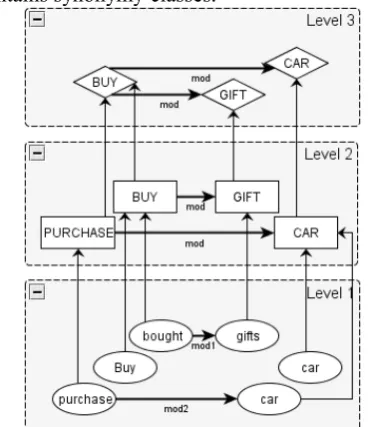
Finally, in order to allow the heterogeneity of represented data, nodes and intra-level edges can carry any attribute (with no limit on kind or num-ber). Figure 1 shows an example of a MuLLinG graph, in which 1st level contains occurrences of
words, 2nd level contains lemmas, and 3rd level
contains synonymy classes.
3.1 Definition
More precisely, a MuLLinG graph is an oriented multigraph Gn=
(
V,E,F,A,Φ,aV,aE)
(for nlevels) where:
• V: set of nodes, made of n disjoint sub-sets V1,… ,Vn (for the n levels);
• E: set of intra-level edges, made of n dis-joint subsets E1,… ,En; A: set of functions
{
n}
iV V Ei i i
i: → × ∈ 1,,
α associating
an edge and its two extremities;
• F: set of inter-level edges, in n-1 disjoint sets
F
1,
…
,
F
n−1 defined as( )
{
x,y V V |y= x}
=
Fi ∈ i× i+1 ϕ ; Φ: set
of functions ϕi:Vi → Vi+1 i∈
{
1,,n}
, as-sociating a node (on a given level) and a node on the superior level);• aV =
{
f:V→ ΣV}
, aE={
f :E→ ΣE}
(
Σ
V,
Σ
E are alphabets for attributes of objects from E and V) model attributes.3.2 Associated operators
[image:2.595.319.505.93.307.2]also operations to compute measures, to realize a
conditional manipulation on nodes or edges (it can be use to filter the graph, by deleting nodes depending on the value of a given attribute). All these basic operations should not be directly used, but rather be called by more elaborate ones. These operations (modifying the graph struc-ture) take parameters fixed by the user: the level, the filtering function (which graph elements are concerned by the operation?), and computation functions (to produce attribute values for newly created elements). Graph coherence is guaran-teed if the user provides correct parameters.
Emergence is the essential operation associ-ated with MuLLinG. Its aim is to generate a su-perior level, by grouping elements (from the ini-tial level) in equivalence classes. In the newly created level, each node (resp. edge) represent a equivalence class of nodes (resp. edges) from the initial level. The identification of equivalence classes is a parameter of the emergence (the user provides it). The operation goes in two steps:
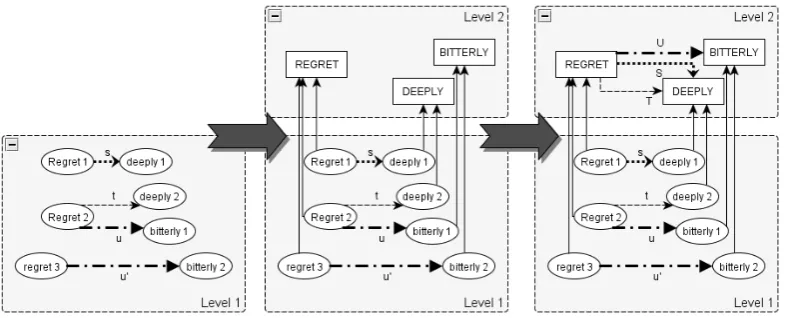
• node emergence: for each equivalence class of nodes, it creates a node on the su-perior level to represent this class (and each node in the class is linked to the newly created node); figure 2 shows the emergence of nodes representing equival-ence classes containing all occurrequival-ences of a same word;
• edge emergence: each edge added on the superior level between nodes A and B de-pict a set of equivalent edges between an element of A class and an element of B
class; in figure 2, equivalent u and u' are grouped in a sole edge U, whereas s and t
(not equivalent) are represented by two distinct edges S and T.
Finally, some other operations have been defined to mix information from two graphs in a
third one. The intersection contain elements (nodes, edges) present in both graphs, with uni-fication of identical elements. The union contain all elements from the two graphs, with unifica-tion of identical elements. The difference contain all elements from the first graph that are not identical to an element from the second one.
It is essential to recognize the identity between two nodes or two edges: identity functions are parameters for these “mix” operations, and should be provided by the user. Among paramet-ers, there are also, depending on the case, func-tions for fusion (production of attributes for uni-fied nodes or edges) or copy (production of at-tributes for elements present in only one graph).
To handle n-ary relations, we also provide a
complex version of MuLLinG, where relations can be materialized. In that case, a relation is represented by a standard node and numbered argument edges linking that node to the argu-ments of the relation. It also allows the represent-ation of relrepresent-ations between relrepresent-ations themselves.
We made an implementation of MuLLinG as a C++ library1, based on Boost (open-source C++
libraries), especially for graph access and itera-tions. It can read and write MuLLinG graphs in GraphML format (Brandes et al., 2001).
4
Application to collocation extraction
4.1 Extraction process
We realized several experiments using our lib-rary. We remind the reader that our goal was not to obtain the more efficient method for extrac-tion, but rather to introduce tools for simplifying the programming of extraction tasks. We present here experiments about collocation extraction.
Collocations are particular expressions where a term is chosen arbitrarily, depending on the other
1 Available at http://mulling.ligforge.imag.fr/ (under
[image:3.595.102.495.69.228.2]CeCILL free software license)
term, to express a particular meaning (like in “driving rain”, where “driving” is used to express intensity). As the choice differs between lan-guages2, it causes big issues to machine
transla-tion systems (which lack resources to handle them correctly). In our experiment, the initial graph is made of relations produced by a depend-ency analyzer, on 1st level.
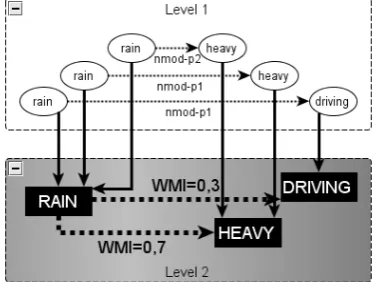
Firstly, we use the filtering operator to keep only pertinent relations (nouns modified by ad-jectives, like in figure 3, or verbs modified by adverbs), according to the analyzer. There are re-lations between term occurrences on 1st level, but
we want relations between terms themselves: we generate them on 2nd level using emergence. So
we proceed node emergence by considering that nodes with same attribute “lemma” are equival-ent, then edge emergence by considering that edges expressing a modification are equivalent.
The “collocation” candidates are all 2nd-level
edges created during the emergence. To rank them, we use the computation operation (with occurrence and co-occurrence frequencies) to fix an association measure on those nodes. Figure 3 shows an example of a MuLLinG graph after emergence and computation operations.
To facilitate the description, our library con-tains lots of pre-defined generic functions. By example, a filter (used as a parameter of emer-gence) can be based on an excepted value, a threshold, etc. We also described numerous asso-ciation measures; for now, new ones should be written in the C++ program.
We used our library to carry out the extraction as described previously, with LeMonde95 corpus (news articles) analyzed by Xerox's XIP parser. Thanks to MuLLinG structure, it is very easy to get all potential collocations (heavy/driving rain): these are the relations of which it is the source.
2By example, a “heavy smoker” is big in French (“gros
fumeur”) and strong in German (“starker Raucher”).
Experiments verb-adverb noun-adjective
Level 1 nodes 1 155 824 1 319 474
edges 1 780 759 2 009 051
Level 2 nodes 6 813 33 132
[image:4.595.307.524.71.141.2]edges 144 586 273 655
Table 1. Nodes and edges produced during ex-periments on collocation extraction
4.2 Advantages and drawbacks
With MuLLinG library, we reproduced exactly
some experiments on collocation extraction we made before (with ad hoc programs): results are obviously coherent. The production is currently slightly slower (around 20% more time) but speed is not crucial, and could be optimized. MuLLinG has a great advantage while writing the program: it only calls functions (and declare parameters). Consequently, task description with our library is much faster (source lines of code are divided by 5), it also avoids errors. It requires less knowledge in programming, so it is far more accessible. Nevertheless, usability should still be improved: we must describe a high-level lan-guage (we believe it should be a request one). Furthermore, there is no constraint on input re-sources, so programs could easily be re-used with other relations (from other parsers). Finally, as graphs with millions of elements can reach RAM limits, we plan to allow database storage.
We also made bilingual experiments on col-locations, taking advantage of MuLLinG com-plex version to materialize monolingual “colloc-ation” nodes, and to describe bilingual relations between collocations as edges between them.
5
Conclusion
Facing the lack of tools for extraction of lexical knowledge, we looked for a new one, simple and generic. We specified MuLLinG, multilevel graph model (with no constraint on the data), as-sociated with several simple manipulation opera-tions (which could be combined to realize com-plex tasks). The ensuing tool allows to program linguistic tasks in a resource-independent man-ner, simpler and more efficient. One major pro-spect of this work concerns its implementation. As explained before, we must provide a high-level language. It is also necessary to facilitate the import and to optimize memory management. In order to provide a less NLP-centered tool, we should extend it with new operations, and with algorithms related to classic problems of graph theory. It would also be interesting to interact with semantic web tools (RDF/SPARQL).
[image:4.595.86.277.314.455.2]References
Maristella Agosti and Fabio Crestani. 1993. A Meth-odology for the Automatic Construction of a Hy-pertext for Information Retrieval. In Proceedings of 1993 ACM Symposium on Applied Computing, 745-753.
Ulrik Brandes, Markus Eiglsperger, Ivan Herman, Mi-chael Himsolt and M. Scott Marshall. 2001. GraphML Progress Report - Structural Layer Pro-posal. In Proceedings of 9th International Sym-posium Graph Drawing (GD'01), 501-512.
Hany Hassan, Ahmed Hassan and Sara Noeman. 2006. Graph based semi-supervised approach for information extraction. In Proceedings of HLT-NAACL-07 Workshop on Textgraphs-06, 9-16. Bruno Gaume, Karine Duvignau and Martine
Van-hove. 2008. Semantic associations and confluences in paradigmatic networks. In Martine Vanhove (Ed.), From Polysemy to Semantic Change To-wards a typology of lexical semantic associations, John Benjamins, 233-264.
Charles Sanders Peirce. 1931-1935. Collected Papers of C. S. Peirce (C. Hartshorne & P. Weiss, eds.), Cambridge: Harvard University Press.
Alain Polguère. 2006. Structural Properties of Lexical Systems: Monolingual and Multilingual Perspect-ives. In Proceedings of Workshop on Multilingual Language Resources and Interoperability (COL-ING/ACL 2006), 50-59.
Stephen D. Richardson, William B. Dolan, and Lucy Vanderwende. 1998. MindNet: acquiring and structuring semantic information from text. In Pro-ceedings of COLING 1998. 1098-1102.
John F. Sowa. 1976. Conceptual graphs for a database interface. IBM Journal of Research and Develop-ment 20:4, 336-357.
Dominic Widdows and Beate Dorow. 2002. A Graph Model for Unsupervised Lexical Acquisition. In Proceedings of 19th International Conference on Computational Linguistics(COLING 2002). 1093-1099.