Voltage Stability Constrained Optimal Power
Flow Using NSGA-II
Sandeep Panuganti1, Preetha Roselyn John1, Durairaj Devraj2, Subhransu Sekhar Dash1 1Department of Electrical and Electronics Engineering, Sri RamaswamyMemorial, Chennai, India
2DEAN (Research), Kalasalingam University, Krishnankoil, India Email:[email protected], [email protected]
Received November 30, 2012; revised December 30, 2012; accepted January 8, 2013
ABSTRACT
Voltage stability has become an important issue in planning and operation of many power systems. This work includes multi-objective evolutionary algorithm techniques such as Genetic Algorithm (GA) and Non-dominated Sorting Genetic Algorithm II (NSGA-II) approach for solving Voltage Stability Constrained-Optimal Power Flow (VSC-OPF). Base case generator power output, voltage magnitude of generator buses are taken as the control variables and maximum L-index of load buses is used to specify the voltage stability level of the system. Multi-Objective OPF, formulated as a multi-objective mixed integer nonlinear optimization problem, minimizes fuel cost and minimizes emission of gases, as well as improvement of voltage profile in the system. NSGA-II based OPF—case 1—Two objective-Min Fuel cost and Voltage stability index; case 2—Three objective—Min Fuel cost, Min Emission cost and Voltage stability index. The above method is tested on standard IEEE 30-bus test system and simulation results are done for base case and the two severe contingency cases and also on loaded conditions.
Keywords: Voltage Stability; Optimal Power Flow; Multi Objective Evolutionary Algorithms
1. Introduction
GA, invented by Holland in the early 1970s, is a stochas- tic global search method that mimics the metaphor of natural biological evaluation.Genetic Algorithms (GA) [1] operates on a population of candidate solutions encoded to finite bit string called chromosome. In order to obtain optimality, each chromosome exchanges the information using operators borrowed from natural genetic to produce the better solution. The combined Economic-Emission multiobjective problem seeks to simultaneously mini- mize both fuel costand the emissions produced by power plants. Environmental concerns on the effect of SO2 and
NOX emissions producedby the fossil-fueled power plants led to the inclusion ofminimization of emissions as an objective in the OPF formulation.
1.1. Voltage Stability
Voltage instability stems from the attempt of load dy- namics to restore power consumption beyond the capa- bility of the combined transmission and generation. Vol- tage stability constrained OPF—Voltage stability indica- tor is incorporated in the OPF formulation through the L-index value. The voltage stability index is an appropri- ate measure of the closeness of the system to voltage collapse. NSGA-II is a popular non-domination based
genetic algorithm for multi-objective optimization which has a better sorting algorithm and incorporates elitism and no sharing parameter needed to be chosen as com- pared to the original NSGA. Emission cost of generators also play a vital role and is thus formulated in the mini- mization OPF problem. Since OPF was introduced in 1968, several methods have been employed to solve this problem, e.g. Gradient base, Linear programming me- thod and Quadratic programming. However all of these methods suffer from three main problems. Firstly, they may not be able to provide optimal solution and usually getting stuck at local optima [2]. Secondly, all these me-thods are based on assumption of continuity and differen- tiability of objective function which is not actually al- lowed in a practical system.
1.2. VSC-OPF
The Contingencies such as unexpected line outages in a stressed system may often result in voltage instability, which may lead to voltage collapse. After a voltage col- lapse, the system becomes dismantled owing to the widespread operation of protective devices. Studies have been performed to predict the voltage instability with both static and dynamic approaches.
base case OPF as a single objective optimization problem is solved using GA [3]. In the second case VSC-OPF problem is formulated in MOGA with minimization of fuel cost and L-index value. In the third case economic emission of gases along with VSC-OPF problem is con- sidered as a multi-objective problem and L-index is solved using the NSGA-II approach in an IEEE 30 bus system. NSGA [4] is a popular non-domination based genetic algorithm for multi-objective optimization. It is a very effective algorithm but has been generally criticized for its computational complexity, lack of elitism and for choosing the optimal parameter value for sharing pa- rameter σ share. A modified version, NSGA-II [5] was developed, which has a better sorting algorithm, incur- porates elitism and no sharing parameter needs to be chosen a priori.
2. Voltage Stability Index
The voltage stability analysis involves determination of an index known as voltage collapse proximity indicator. This index is an approximate measure of the closeness of the system to voltage collapse. There are various methods of determining the voltage collapse proximity indicator. One such method is the L-index method proposed in Kessel and Glavitsch. It is based on load flow analysis. Its value ranges from 0 (no load condition) to 1 (voltage collapse). The bus with the highest L-index value will be the most vulnerable bus in the system. The technique is incorpo- rated from [6]. The L-index calculation for a power sys-tem is briefly discussed below.
Consider an N-bus system in which there are Nggen-
erators. The relationship between voltage and current can be expressed by the following expression:
·
bus bus bus
I Y V
(1) By segregating the load buses (PQ) from generator buses (PV), Equation (1) can write as
GG GL
G
LG LL
G
L L
Y Y
I V
Y Y
I V
(2)
where IG, ILand VG, VL represent currents and voltages at
the generator buses and load buses. Rearranging the above equation we get:
L LL LG L
G GL GG G
V Z F I
I K Y V
(3)
where:
1
LG LL LG
F Y Y
The L-index of the jth node is given by the expression:
1 1 Ng i
j i JI ji i j
j
V
L F
V
(4)where:
Vi Voltage magnitude of ith generator
Vj Voltage magnitude of jth generator
θji Phase angle of the term Fji
δi Voltage phase angle of ith generator unit
δj Voltage phase angle of jth generator unit
Ng Number of generating units.
VL, IL: Voltages and Currents for PQ buses; VG, IG: Voltages and Currents
for PV buses; Where, ZLL,FLG,KGL,YGG: sub matrices generated from Ybus
partial inversion.
Lj: L-index voltage stability indicator for bus k.
The values of Fji are obtained from the matrix FLG. The
L-indices for a given load condition are computed for all the load buses and the maximum of the L-indices (Lmax)
gives the proximity of the system to voltage collapse. The L-index has the advantage of indicating voltage in- stability proximity of the current operating point without calculation of the information about the maximum load- ing point.
3. Problem Formulation
In general, the OPF problem is formulated as an optimi- sation problem in which a specific objective function is minimised while satisfying a number of equality and inequality constraints[7]. The objectives of the OPF pro- blem considered here are minimisation of fuel cost in the normal state and the minimisation of the voltage stability index Lmax in the emergency state. Power flow equations
are the equality constraints of the problem, while the inequality constraints include the limits on real and reac- tive power generation and bus voltage magnitude as fol- lows.
1 1 Minimise G
N
i Gi i Gi i
i
F a P b P c
(5)max. 2
Minimise F
L (6)
3 1
Minimise NG
i Gi i Gi i
i
F
d P e P gD
(7)
min. max.
Inequality constraintsPGi GiPGi PGi (8)
min. max.
i i i
V V V (9)
min. max.
Gi Gi Gi
Q Q Q (10)
Equality Constraints PG P (11) where:
N the number of total buses
NGthe number of generator buses
NLthe number of load buses
Nbthe number of transmission lines
Pi,Qi real and reactive power injected at bus i i
The equality constraints given by the above equations are satisfied by running the power flow program. The active power generation (Pgi) (except the generator at the
slack bus) and generator terminal bus voltages (Vgi) are
the optimization variables and they are self-restricted by the optimization algorithm.
4. Non-Dominated Sorting Genetic
Algorithm II (NSGA-II)
NSGA introduced by Srinivas and Deb [8], implements the idea of a selection method based on classes of domi- nance of all solutions. This algorithm identifies non- dominated solutions in the population, at each generation, to form non-dominated fronts, based on the concept of non-dominance of Pareto. After this, the usual selection, crossover, and mutation operators are performed.
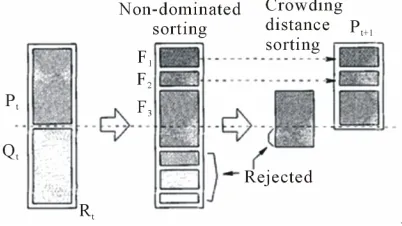
However, there are some disadvantages in NSGA. It has been generally criticized for its computational com- plexity, lack of elitism and for choosing the optimal pa- rameter value for sharing parameter σshare. A modified version, NSGA-II was developed, which has a better sorting algorithm, incorporates elitism and no sharing parameter needs to be chosen a priori [9]. In this algo- rithm, the population is initialized as random, and the number of population is N. Once the population in ini- tialized the population is sorted based on non-domina- tion into each front. The first front being completely non-dominant set in the current population and the sec- ond front being dominated by the individuals in the first front only and the front goes so on. Each Individual in the each front are assigned rank values or based on front in which they belong to. Then, crowding distance is cal- culated for each individual. The crowding distance is a measure of how close an individual is to its neighbours.
[image:3.595.72.273.608.721.2]The NSGA-II procedure is also shown in Figure 1. Parents are selected from the population by using binary tournament selection based on the rank and crowding distance. The individual with lesser rank or greater crowding distance is selected. The selected population generates offspring from crossover and mutation opera- tors. The population with the current population and cur- rent offspring is sorted again based on non-domination
Figure 1. NSGA-II procedure.
and only the best N individuals are selected. The selec- tion is based on rank and on crowding distance on the last front. Then the new population will be selected as parents at the next round.
4.1. Population Initialization
The population is initialized based on the problem range and constraints if any.
4.2. Non-Dominated Sort
The The initialized population is sorted based on non- domination.The fast sort algorithm is described as below.
For each individual p in main population P do the following
Initialize Sp=. this set would contain all the indi- viduals that are being dominated by p.
Initialize np = 0. This would be the number of indi-
viduals that dominate p. For each individual q in P
If p dominated q then Add q to the set Sp
Else if q dominated p then
Increment the dominated counter for p i.e. np = np + 1.
If np= 0 i.e. no individual dominate p then p belongs
to the first front, set rank of individual p to one i.e.
prank = 1. Update the first front set by adding p to front
one i.e. F1 F1
p This is carried out for all the individuals in main population P.
Initialize the front counter to one I = 1.
Following is carried out while the ith front is non-
empty i.e. Fi≠.
Q = . The set for storing the individuals for (i + 1)th
front.
For each individual p in front Fi
For each individual q in Sp (Sp is the set of individuals
dominated by p)
nq= nq− 1, decrement the domination count for indi-
vidual q.
If nq = 0 then none of the individuals in the
subse-quent fronts would dominate q. hence set qrank = i + 1.
Update the set Q with individual qi.e. Q Q q. Increment the front counter by one.
Now the set Q is the next front and hence Fi = Q.
This algorithm is better than NSGA [10] since it utilize the information about the set that an individual dominate (Sp) and number of individuals that dominate the indi-
vidual (np).
4.3. Crowding Distance
in the population are assigned a crowding distance value. Crowding distance is assigned front wise and comparing the crowding distance between two individuals in differ- ent front is meaningless. The crowing distance is calcu- lated as below
For each front Fi, n is the number of individuals.
Initialize the distance to be zero for all the individuals
i.e. Fi(dj) = 0, where j corresponds to the jth individ-
ual in front Fi.
For each objective function m.
Sort the individuals in front Fi based on objective m
i.e., i = sort (Fi, m).
Assign infinite distance to boundary values for each individual in Fii.e. I d
1 and I Dn
. For k = 2 to (n− 1)
max
min
1 1
.
k k
m m
I k m I k m
I d I d
f f
(12) I(k)·m is the value of the mth objective function of the
kth individual in I.
The basic idea behind the crowing distance is finding the euclidian distance between each individual in a front based on their m objectives in the m dimensional hyper space. The individuals in the boundary are always se- lected since they have infinite distance assignment.
4.4. Selection
Once the individuals are sorted based on non-domination and with crowding distance assigned, the selection is carried out using a crowded-comparison-operator (an).
The comparison is carried out as below based on 1) Non-domination rank pranki.e. individuals in front Fi
will have their rank as prank = i.
2) Crowding distance Fi(dj)
panq if
prank < qrank
or if p and q belong to the same front Fithen Fi(dp) >
Fi(dq) i.e. the crowing distance should be more.
The individuals are selected by using a binarytourna- ment selection with crowed-comparison-operator.
4.5. Genetic Operators
NSGA-II use Simulated Binary Crossover (SBX)
[10,11] and polynomial mutation [10,12].
4.5.1 Simulated Binary Crossover
The Simulated binary crossover simulates the binary crossover observed in nature and is give as below.
1, 1, 2,
2, 1, 2,
1 1 1
2 1
1 1
2
k k k k
k k k k
C p C p
where Ci,k is the ith child with kth component, Pi,k is the-
selected parent and βk (≥) is a sample from a random number generated having the density
21 1 ,if 0 1
2
1 1
1 ,if 1 2 c c c c p p (14)
This distribution can be obtained from a uniformly sampled random number u between (0, 1). ηc is the dis-
tribution index for crossover. That is
1 1 1 1 21 2 1
u u u u (15)
4.5.2. Polynomial Mutation
u l
k k k k
c p p p k (16)
where ck is the child and pk is the parent with being
the upper boundon the parent component, is the lower bound and k
u k p l k p
is small variation which is calcu- lated from a polynomial distribution by using
1 1 1 12 1,if 0.5
1 2 1 ,if 0.5
m
m
k k k
k k k
r r r r (17)
rkis an uniformly sampled random number between (0,1)
and ηm is mutation distribution index.
4.6. Recombination and Selection
The offspring population is combined with the current generation population and selection is performed to set the individuals of the next generation. Since all the pre- vious and current best individuals are added in the popu- lation, elitism is ensured. Population is now sorted based on non-domination. The new generation is filled by each front subsequently until the population size exceeds the current population size. If by adding all the individuals in front Fj the population exceeds N then individuals in front Fj are selected based on their crowding distance in the descending order until the population size is N. And hence the process repeats to generate the subsequent generations.
5. Best compromised Solution
k k p p (13)
Upon having the pareto-optimal set of non-dominated solution, the proposed approach [8] presents a best com- promise solution tothe decision maker. Due to the impre- cise nature of the decision maker’s judgement, the ith
min
max
min max
max min
max 1,
,
0,
i i
i i
i i
i i
i i
J J
J J
i i
J J J J
J J
J J
(18)
where max
i
J and min
i
J are the maximum and minimum values of the ith objective function among all non-domi-
nated solutions.
For each non-dominated solution k, the normalized membership function K
D
is calculated as
15
1 1
K
K K
i I
K K
i k
D
i J
J
(19)6. Simulation Results
The proposed NSGA-II approach has been applied to solve the VSC-OPF problem in an IEEE 30-bus test sys- tem. The system has six generator buses, 24 load buses and 41 transmission lines.The generator cost coefficients and the transmission line parameters are taken from [12]. Three different cases were considered for simulation, one without considering the voltage stability i.e, to solve the VSC-OPF problem using MOGA and the second one is solved having economic emission of gases including VSC-OPF in NSGA-II.These simulations were imple- mented using the MATLAB program. The results of these simulations are presented, Figure 2.
In this case the two objectives are minimization of fuel cost and minimization of L-index using multi-objective Genetic Algorithm. The results of VSC-OPF using MOGA is shown in Table 1.
6.1. (Case 1): VSC-OPF Using NSGA-II
The voltage stability index (L-index) was included as the second objective function of the OPF problem along with the base fuel cost. The NSGA-II based algorithm was applied to solve this VSC-OPF problem. The optimal control variable setting obtained in this case is presented in Table 2 alongwith the L-index value. In Figure 4
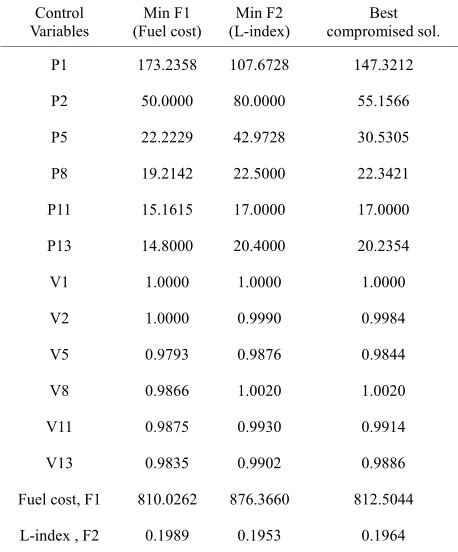
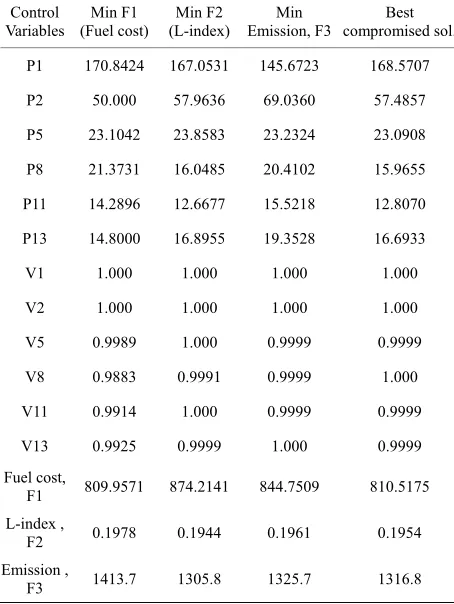
shows the pareto optimal front of generation cost and L-index is shown and the Table 2 shows the line outage 27 - 28 along with line outage 27 - 30 is shown in Table 3.The solution is a set of non-dominated solutions. The comparison of the results obtained in NSGA-II and three objective is shown in Table 5. From this table it is clear that the performance of NSGA-II is better than MOGA in VSC-OPF problem.
Contingency analysis was conducted on the system with 125% loaded condition by simulating the single line outages and in each case the maximum L-index value was evaluated. From the contingency analysis it was found that line outage 28 - 27 is the most severe one
Table 1. NSGA-II base case.
Control Variables
Min F1 (Fuel cost)
Min F2 (L-index)
Best compromised sol.
P1 169.6545 140.9243 168.6642
P2 50.0000 80.0000 50.4760
P5 23.9893 42.9811 24.1108
P8 22.0474 18.9395 22.1680
P11 13.2559 17.0000 13.4598
P13 14.8000 20.4000 14.8000
V1 1.0000 1.0000 1.0000
V2 1.0000 1.0040 1.0000
V5 0.9826 1.0000 0.9991
V8 0.9884 1.0000 0.9891
V11 0.9899 0.9903 0.9918
V13 0.9874 0.9888 0.9933
Fuel cost, F1 807.1765 872.7911 807.9227
L-index , F2 0.1101 0.1075 0.1095
800 810 820 830 840 850 860 870 880
0.107 0.1075 0.108 0.1085 0.109 0.1095 0.11 0.1105 0.111 0.1115 0.112
L
-IND
E
X
FUEL COST
Figure 2. NSGA-II base case.
from the voltage security point of view during this con- tingency state.
Table 6 gives the fuel cost, Lmax and minimum voltage
value of the contingency constrained VSC-OPF using NSGA-II. This reduction in Lmax is obtained at the ex-
pense of increased fuel cost. Figure 5 shows the pareto optimal front of contingency constrained VSC-OPF.
The line outage for 27 - 30 as shown in Figure 4, in
Tables 4, 5 and is also performed along with the same loaded condition as in line outage 27 - 28 as shown in
Table 2. NSGA II—Line outage 27 - 28.
Control Variables
Min F1 (Fuel cost)
Min F2 (L-index)
Best compromised sol.
P1 174.9058 112.3927 149.0853
P2 50.000 80.0000 61.6056
P5 22.0000 41.7412 27.7161
P8 22.500 22.4915 19.6752
P11 12.8957 16.1521 16.8888
P13 14.8000 20.3995 20.4000
V1 1.000 1.0000 1.0000
V2 1.000 0.9901 0.9988
V5 0.9874 0.9874 0.9856
V8 0.9917 1.0040 0.9911
V11 0.9903 0.9902 1.0000
V13 0.9866 0.9866 0.9859
Fuel cost, F1 814.0790 876.6776 814.2402
[image:6.595.55.287.101.371.2]L-index, F2 0.2905 0.2877 0.2895
Table 3. NSGA-2—Line outage 27 - 30.
Control Variables
Min F1 (Fuel cost)
Min F2 (L-index)
Best compromised sol.
P1 173.2358 107.6728 147.3212
P2 50.0000 80.0000 55.1566
P5 22.2229 42.9728 30.5305
P8 19.2142 22.5000 22.3421
P11 15.1615 17.0000 17.0000
P13 14.8000 20.4000 20.2354
V1 1.0000 1.0000 1.0000
V2 1.0000 0.9990 0.9984
V5 0.9793 0.9876 0.9844
V8 0.9866 1.0020 1.0020
V11 0.9875 0.9930 0.9914
V13 0.9835 0.9902 0.9886
Fuel cost, F1 810.0262 876.3660 812.5044
L-index , F2 0.1989 0.1953 0.1964
6.2. (Case 2): Economic Emission Based VSC-OPF Using NSGA-II
The economic emission of the gases are included as the third objective along with the voltage stability index and
810 820 830 840 850 860 870 880 890 0.288
0.289 0.29 0.291 0.292 0.293 0.294 0.295 0.296 0.297
L-IN
D
E
X
FUEL COST
Figure 3. NSGA-II—Line outage 27 - 28.
Figure 4. NSGA-2—Line outage 27 - 30.
Figure 5. NSGA 2—3 Objective base case.
[image:6.595.56.285.393.669.2]Table 4. NSGA-II—3 objective line outage 27 - 28.
Control
Variables (Fuel cost) Min F1 (L-index)Min F2 Emission, F3 Min compromised sol.Best
P1 160.3011 165.1097 169.5373 162.3011
P2 65.7505 60.3991 57.8956 66.7505
P5 23.3074 25.8083 22.000 24.3172
P8 16.6748 14.5257 15.4874 16.6738
P11 12.8745 13.0869 14.3629 12.6730
P13 14.8000 14.9005 14.8981 14.8230
V1 1.000 1.000 1.000 1.000
V2 1.000 1.000 1.000 1.000
V5 0.9999 1.000 0.9999 0.9999
V8 0.9999 1.000 0.9999 0.9899
V11 0.9999 1.000 1.000 0.9994
V13 0.9999 0.9999 1.000 0.9999
Fuel cost,
F1 807.0019 853.6211 856.5133 809.0019
L-index,
F2 0.1102 0.1077 0.1083 0.1099
Emission,
[image:7.595.56.287.103.431.2]F3 1424.5 1324.0 1316.2 1386.5
Table 5. NSGA-2—Line outage 27 - 30.
Control Variables
Min F1 (Fuel cost)
Min F2 (L-index)
Min Emission, F3
Best compromised sol.
P1 170.8424 167.0531 145.6723 168.5707
P2 50.000 57.9636 69.0360 57.4857
P5 23.1042 23.8583 23.2324 23.0908
P8 21.3731 16.0485 20.4102 15.9655
P11 14.2896 12.6677 15.5218 12.8070
P13 14.8000 16.8955 19.3528 16.6933
V1 1.000 1.000 1.000 1.000
V2 1.000 1.000 1.000 1.000
V5 0.9989 1.000 0.9999 0.9999
V8 0.9883 0.9991 0.9999 1.000
V11 0.9914 1.000 0.9999 0.9999
V13 0.9925 0.9999 1.000 0.9999
Fuel cost,
F1 809.9571 874.2141 844.7509 810.5175
L-index ,
F2 0.1978 0.1944 0.1961 0.1954
Emission ,
F3 1413.7 1305.8 1325.7 1316.8
[image:7.595.57.291.118.736.2]Figure 6. NSGA-2—Line outage 27 - 28.
Figure 7. NSGA-2—Line outage 27 - 30.
7. Conclusion
[image:7.595.57.284.434.736.2]improved in NSGA-II than multi-objective GA of the proposed algorithm than the other approaches.
REFERENCES
[1] N. Srinivas and K. Deb, “Multi-Objective Optimization Using Nondominated Sorting Ingenetic Algorithms,” Technical Report, Department of Mechanical Engineering, Indian Institute of Technology, Kanpur, 1993.
[2] N. Srinivas and K. Deb, “Multi-Objective Optimization Using Nondominated Sortingin Genetic Algorithms,” Evo- lutionary Computation, Vol. 2, No. 3, 1994, pp. 221-248. doi:10.1162/evco.1994.2.3.221
[3] A. J. Wood and B. F. Wollenberg, “Power Generation Ope- ration and Control,” John Wiley & Sons, Inc., New York, 1996.
[4] M. S. Kumari, “Enhanced Genetic Algorithm Based Com- putation Technique for Multi-Objective, Optimal Power Flow Solution,” Electrical Power and Energy Systems, Vol. 32, No. 6, 2010, pp. 736-742.
[5] K. O. Alawode, A. M. Jubril and O. A. Komolafe, “Multi- Objective Optimal Power Flow Using Hybrid Evolutiona- ry Algorithm,” International Journal of Electrical Power & Energy Systems Engin, Vol. 3, No. 3, 2010, p. 196. [6] D. Devaraj and J. P. Roselyn, “Improved Genetic
Algo-rithm for Voltage Security Constrained Optimal Power Flow Problem,” International Journal of Energy Tech-
nology and Policy, Vol. 5, No. 4, 2007, pp. 475-488. doi:10.1504/IJETP.2007.014888
[7] H. Sadat, “Power Systems Analysis,” McGraw Hill Pub- lication, New Delhi, 1997.
[8] O. Alsac, and B. Scott, “Optimal Load Flow with Steady State Security,” IEEE Transactions on Power Systems, Vol. PAS-93, No. 3, 1974, pp.745-751.
doi:10.1109/TPAS.1974.293972
[9] H. W. Dommel and W. F. Tinney, “Optimal Power Flow Solutions,” IEEE Transactions on Power Apparatusand Sys- tems, Vol. PAS-87, No. 10, 1968, pp. 1866-1876. [10] S. Dhanalakshmi, S. Kannan, K. Mahadevan and S. Bas-
kar, “Application of Modified NSGA-II Algorithm to Com- bined Economicand Emission Dispatch Problem,” Inter- national Journal of Electrical Power & Energy Systems, Vol. 33, No. 4, 2011, pp. 992-1002.
[11] R. He, G. A. Taylor and Y. H. Song, “Multi-Objective Optimal Reactive Power Flow including Voltage Security and Demand Profile Classification,” International Jour- nal of Electrical Power & Energy Systems, Vol. 30, No. 5, 2008, pp. 327-336.