User Type Classification of Tweets with Implications for Event
Recognition
Lalindra De Silva and Ellen Riloff
School of Computing University of Utah Salt Lake City, UT 84112
{alnds,riloff}@cs.utah.edu
Abstract
Twitter has become one of the foremost platforms for information sharing. Conse-quently, it is beneficial for the consumers of Twitter to know the origin of a tweet, as it affects how they view and inter-pret this information. In this paper, we classify tweets based on their origin, ex-ploiting only the textual content of tweets. Specifically, using a rich, linguistic fea-ture set and a supervised classifier frame-work, we classify tweets into two user types - organizations and individual per-sons. Our user type classifier achieves an 89% F1-score for identifying tweets that
originate from organizations in English and an 87% F1-score for Spanish. We
also demonstrate that classifying the user type of a tweet can improve downstream event recognition tasks. We analyze sev-eral schemes that exploit user type infor-mation to enhance Twitter event recogni-tion and show that substantial improve-ments can be achieved by training separate models for different user types.
1 Introduction
Twitter has become one of the most widely used social media platforms, with users (as of March 2013) posting approximately 400 million tweets per day (Wickre, 2013). This public data serves as a potential source for a multitude of informa-tion needs, but the sheer volume of tweets is a bot-tleneck in identifying relevant content (Becker et al., 2011). De Choudhury et al. (2012) showed that the user type of a Twitter account is an impor-tant indicator in sifting through Twitter data. The knowledge of a tweet’s origin has potential impli-cations on the nature of the content to an end user (e.g., credibility, location, etc). Also, certain types
of events are more likely to be reported by individ-ual persons (e.g., local events) whereas organiza-tions generally report events that are of interest to a wider audience.
The first part of our research focuses on user type classification in Twitter. De Choudhury et al. (2012) addressed this problem by examining meta-information derived from the Twitter API. In contrast, the goal of our work is to classify tweets,based solely on their textual content. We highlight several reasons why this can be advanta-geous. One reason is that people frequently share content from other sources, but the shared con-tent often appears in their Twitter timeline as if it was their own. Consequently, a tweet that was posted by an individual may have originated from an organization. Moreover, meta-information can sometimes be infeasible to obtain given the rate limits1and there are times when profile
informa-tion for a user account is unavailable or ambigu-ous (e.g., users often leave their profile informa-tion blank or write vague entries). Therefore, we believe there is value in being able to infer the type of user who authored a tweet based solely on its textual content. Potentially, our methods for user type classification based on textual content can also be combined with methods that examine user profile data or other meta-data, since they are complementary sources of information.
In this paper, we present a classifier that tries to determine whether a tweet originated from an or-ganization or a person using a rich, linguistically-motivated feature set. We design features to rec-ognize linguistic characteristics, including senti-ment and emotion expressions, informal language use, tweet style, and similarity with news head-lines. We evaluate our classifier on both English and Spanish Twitter data and find that the classifier achieves an 89% F1-score for identifying tweets
that originate from organizations in English and a
1https://dev.twitter.com/docs/rate-limiting/1.1/limits
87% F1-score for Spanish.
The second contribution of this paper is to demonstrate that user type classification can im-prove event recognition in Twitter. We conduct a study of event recognition for civil unrest events and disease outbreak events. Based on statistics from manually annotated tweets, we found that organization-tweets are much more likely to men-tion these events than person-tweets. We then in-vestigate several approaches to incorporate user type information into event recognition models. Our best results are produced by training sepa-rate event classifiers for tweets from different user types. We show that user type information con-sistently improves event recognition performance for both civil unrest events and disease outbreak events and for both English and Spanish tweets.
2 Related Work
Our work is most closely related to that of De Choudhury et al. (2012), which proposed methods to classify Twitter users into three categories: 1) Journalists/media bloggers, 2) Organizations and 3) Ordinary Individuals. They employed features derived from social network structure, user ac-tivity and users’ social interaction behaviors, and named entities and historical topic distributions in tweets. In contrast, our work classifies isolated tweets into two different user types, based on their textual content. Consequently, our work can pro-duce different user type labels for different tweets by the same user, which can help identify shared content not authored by the user.
Another body of related work tries to classify Twitter users along other dimensions such as eth-nicity and political orientation (Pennacchiotti and Popescu, 2011; Cohen and Ruths, 2013). Gender inference in Twitter has also garnered interest in the recent past (Ciot et al., 2013; Liu and Ruths, 2013; Fink et al., 2012). Researchers have also fo-cused on user behaviors showcased in Twitter in-cluding the types of messages posted (Naaman et al., 2010), social connections (Wu et al., 2011), user responses to events (Popescu and Pennac-chiotti, 2011) and behaviors related to demograph-ics (Volkova et al., 2013; Mislove et al., 2011; Rao et al., 2010).
Event recognition is another area that continues to attract a lot of interest in social media. Previ-ous work has investigated event identification and extraction (Jackoway et al., 2011; Becker et al.,
2009; Becker et al., 2010; Ritter et al., 2012), event discovery (Benson et al., 2011; Sakaki et al., 2010; Petrovi´c et al., 2010), tracking events over time (Kim et al., 2012; Sayyadi et al., 2009) and event retrieval over archived Twitter data (Metzler et al., 2012). While our work focuses on user type classification, we show that the user type of a tweet is an important piece of information that can be beneficial in event recognition models.
3 Twitter User Types
Twitter user types can be analyzed in different granularities and across different dimensions. We follow a high-level categorization of user types into organizations and individual persons. While we acknowledge the existence of other user types, such as automated bots, we focus only on the orga-nizationandindividual person user types for our research.
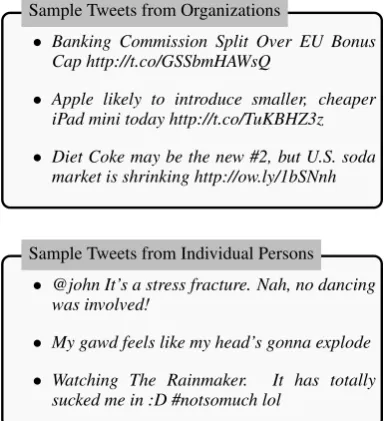
• Banking Commission Split Over EU Bonus Cap http://t.co/GSSbmHAWsQ
• Apple likely to introduce smaller, cheaper iPad mini today http://t.co/TuKBHZ3z
• Diet Coke may be the new #2, but U.S. soda market is shrinking http://ow.ly/1bSNnh Sample Tweets from Organizations
• @john It’s a stress fracture. Nah, no dancing was involved!
• My gawd feels like my head’s gonna explode
• Watching The Rainmaker. It has totally sucked me in :D #notsomuch lol
[image:2.595.319.513.341.552.2]Sample Tweets from Individual Persons
Figure 1: Sample tweets from individual persons and organizations
3.1 Data Acquisition for User Types
To create our data sets, we archived tweets (us-ing Twitter Stream(us-ing API) for six months, be-ginning February 1st, 2013. We then used a lan-guage filter (Lui and Baldwin, 2012) to separate out the English and Spanish tweets. Also, in the data sets we created (see below), we removed du-plicates, retweets and any tweet with less than 5 words. Given that large-scale human annotation is expensive, we explored several heuristics to re-liably compile a large gold standard collection of person- and organization-tweets.
3.1.1 Acquiring Person-tweets
To acquire person-tweets, we devised a person heuristic, focusing on thenameand theprofile de-scription fields in each user account correspond-ing to a tweet. We first gathered lists of person names (first names and surnames), for both En-glish and Spanish, using census data2 and online
resources3. We also compiled a list of common
organization terms (e.g.,agency, institute, com-pany, etc) in both English and Spanish.
Theperson heuristiclabels a tweet as a person-tweet if no organization term is in the name or the profile description fieldsANDall the words in the name field are person namesORthe profile description field starts with either ‘I’m’or‘I am’
4
. To assess the accuracy of theperson heuris-tic, we also performed a manual annotation task. We employed two annotators and provided them with guidelines of what constitutes an individual person’s Twitter account. We defined an individ-ual person as someone who uses Twitter in their day-to-day life to post information about his/her daily activities, update personal status messages, comment about societal issues and/or interact with close social circles. The annotators were able to see thename,profile description,locationandurl
fields of the Twitter user account and were asked to label each account asindividual,not individualor undetermined. To calculate annotator agreement between the two annotators, we gave them 100 Twitter accounts, corresponding to English tweets collected using the person heuristic. The inter-annotator agreement (IAA) was .98 (raw agree-ment) and .97 (G-Index score). We did not use
2http://www.census.gov/genealogy/www/
data/1990surnames/names_files.html
3http://genealogy.familyeducation.com/
browse/origin/spanish
4Corresponding terms were used for Spanish
Cohen’s Kappa (κ) as it is known to underestimate agreement (known as Kappa Paradox) when one category dominates. We then released another 250 accounts to each of the annotators, giving us a total of 600 manually labeled accounts5.
In the distribution of labels assigned by the hu-man annotators for these 600 accounts, 91.5% was confirmed as belonging toindividualpersons. 5% was identified asnot individualwhereas 3.5% was labeled asundetermined. These numbers corrob-orate our claim that theperson heuristicis a valid approximation for acquiring person-tweets.
However, limiting our person-tweets to those from accounts identified with the person heuris-ticcould introduce bias (i.e., it may consider only the people who provided more complete profile information). To address this issue, we looked into additional heuristics that are representative of individual persons’ Twitter accounts. We ob-served that applications designed specifically for hand-held devices (e.g.,twitter for iphone) are fre-quently used to author tweets and used by individ-ual persons. Organizations, on the other hand, pri-marily use the Twitter web tool and content man-agement software applications to create, manage and post content to Twitter.
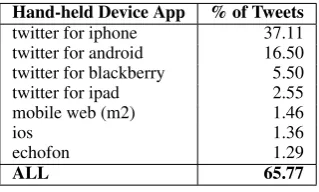
To further investigate our observation, we ex-tracted the source information (i.e., the software applications used to author tweets) for a collection of 1.2 million English tweets from our tweet pool, for a random day, and identified those that were clearlyhand-held device appsand covered at least 1% of the tweets. Table 1 shows the distribution of thesehand-held device apps, which together ac-counted for approximately 66% of all tweets.
Hand-held Device App % of Tweets
twitter for iphone 37.11 twitter for android 16.50 twitter for blackberry 5.50
twitter for ipad 2.55
mobile web (m2) 1.46
ios 1.36
echofon 1.29
[image:3.595.336.496.557.653.2]ALL 65.77
Table 1: Percentage of (English) tweets authored from hand-held device apps
To evaluate our hypothesis that a high percent-age of these tweets are person-tweets, we carried out another manual annotation task. We selected
5We adjudicated the disagreements in the initial 100
100 English Twitter accounts whose tweets were generated using one of the above hand-held de-vice apps and asked the two annotators to label them using the same guidelines. For this task, the IAA was .84 (raw agreement) and .76 (G-Index score). As before, we released another 250 ac-counts to each of the annotators. In these 600 user accounts, 87.1% was confirmed to be individual persons. Only 1% was judged to be clearly not individual whereas 11.9% was labeled as unde-termined.
3.1.2 Acquiring Organization-tweets
Designing similar heuristics to identify organization-tweets proved to be difficult. Organizations describe themselves in numerous ways, making it difficult to automatically identify their names in user profiles. Furthermore, organi-zation names often appear in individual persons’ accounts because they mention their employers (e.g.,I’m a software engineer at Microsoft Corpo-ration). Therefore, to acquire organization-tweets, we relied on web-based directories of organiza-tions (e.g., www.twellow.com) and gathered their tweets using the Twitter API. We used 58 organization accounts for English tweets and 83 accounts for Spanish.
3.1.3 Complete Data Set
We created a data set of 200,000 tweets for each language, consisting of 90% person-tweets and 10% organization-tweets. Among the 180,000 person-tweets, 132,000 (66% of 200,000) were tweets whose source was a hand-held device app. To collect the remaining 48,000 (24% of 200,000) of the person-tweets, we relied on the person heuristic. Finally, we gathered 20,000 organization-tweets using the web directo-ries mentioned previously. In doing so, to ensure that we had a balanced mix of organizations, each organization contributed with a maximum of 500 tweets.
4 User Type Classification
To automatically distinguish person-tweets from organization-tweets, we trained a supervised clas-sifier using N-gram features, an organization heuristic, and a linguistic feature set categorized into six classes. For the classification algorithm, we employed a Support Vector Machine (SVM) with a linear kernel, using the LIBSVM package (Chang and Lin, 2011). For the features that rely
on part-of-speech (POS) tags, we used the English Twitter POS tagger by Gimpel et al. (2011) and another tagger trained on the CoNLL 2002 shared task data for Spanish (Tjong Kim Sang, 2002) us-ing the OpenNLP toolkit (OpenSource, 2010).
4.1 N-gram Features
We started off by introducing N-gram features to capture the words in a tweet. Specifically, we trained a supervised classifier using unigram and bigram features encoded with binary values. In se-lecting the gram features, we discarded any N-gram that appears less than five times in the train-ing data.
4.2 Organization Heuristic
Following observations by Messner et al. (2011), we combined two simple heuristic rules to flag tweets that are likely to be from an organization. The first observation is that ‘replies’ (i.e., @user mentions at the beginning of a tweet) are uncom-mon in organization-tweets. Hence, if a tweet is a reply, it is likely to be a person-tweet. The second observation is that organization-tweets frequently include a web link to external content.
Our organization heuristic, therefore, com-bined these two properties. If the tweet is not a replyAND contains a web link, we labeled it as an organization-tweet. Otherwise, we labeled it as a person-tweet. In Section 5, we evaluate this heuristic as a classification rule on its own, and also incorporate its label as a feature in our classi-fier.
4.3 Linguistic Features
In the following sections, we describe our linguis-tic features and the intuitions in designing them.
4.3.1 Emotion and Sentiment
Twitter is a platform where individuals often ex-press emotion. We detected emotions using four feature types: 1) interjections, 2) profanity, 3) emoticons and 4) overall sentiment of the tweet.
web for both English6 and Spanish7 and regular
expression patterns for emoticons.
We also included sentiment features using the sentiment140 API8 (Go et al., 2009). This API
provides a sentiment label (positive, negative or neutral) for a tweet corresponding to its overall sentiment. We expect person-tweets to show more positive and negative sentiment and organization-tweets to be more neutral.
4.3.2 Similarity to News Headlines
Earlier, we observed that organization-tweets are often similar to news headlines. To exploit this ob-servation, we introduced four features using lan-guage models and verb categories.
First, we collected 3 million person-tweets, for each language, using the person heuristic de-scribed in Section 3.1. Second, we collected an-other 3 million news headlines from each of the English and Spanish Gigaword corpora (Parker et al., 2009; Mendonca et al., 2009). Using these two data sets, we built unigram and bigram language models (with Laplace smoothing) for person-tweets and for news headlines. Given a new tweet, we calculated the probability of the tweet using both the person-tweet and headline language models. We defined a binary feature that indicates which unigram language model (person-tweet model vs. headline model) produced the highest probability. A similar feature is defined for the bigram language models.
We also observed that certain verbs are pre-dominantly used in news headlines and are rarely associated with colloquial language (therefore, in person-tweets). Similarly, we observed verbs that are much more likely to be used by individual per-sons. To identify the most discriminating verbs, we ranked verbs appearing more than 5 times in the collected news headlines and person-tweets based on the following probabilities:
p(h|verb) =Frequency ofFrequency ofverbverbininall instancesheadlines
p(pt|verb) = Frequency ofFrequency ofverbverbininperson-tweetsall instances
The verbs were sorted by probability and we re-tained two disjoint sets of verbs, 1) the verbs most
6http://www.noswearing.com/dictionary 7http://nawcom.com/swearing/mexican_
spanish.htm
8http://help.sentiment140.com/api
representative of headlines (i.e., headline verbs), selected by applying a threshold of p(h|verb) > 0.8 and 2) verbs most representative of person-tweets (i.e.,personal verbs), with a similar thresh-old of p(pt|verb) > 0.8. We introduced two bi-nary features that look for verbs in the tweet from these two learned verb lists. The top-ranked verbs for each category are displayed in Table 2. The learned headline verbs tend to be more formal and are often used in business or government con-texts (e.g.,revoke,granting,etc) whereas the per-sonal verbs tend to represent perper-sonal activities, communications, and emotions (e.g., hate, sleep,
etc). In total, we learned 687 headline verbs and 2221 personal verbs for English, and 1924 head-line verbs and 5719 personal verbs for Spanish.
Headline verbs: aided, revoke, issued, broaden, tes-tify, leads, postponing, forged, deepen, hijacked, raises, granting, honoring, pledged, departing, suspending, cit-ing, compensate, preserved, weakencit-ing, differing
Personal verbs: raining, sleep, hanging, hate, march-ing, teachmarch-ing, sway, havmarch-ing, risk, lurk, screammarch-ing, tag-ging, disturb, baking, exaggerate, pinch, enjoy, shred-ding, force, hide, wreck, saved, cooking, blur, told Table 2: Top-ranked representative verbs learned from headlines and person-tweets
4.3.3 1stand 2ndPerson Pronouns
Person-tweets often include self-references, in the form of first-person pronouns and their vari-ant forms (e.g., possessive, reflexive), while organization-tweets rarely contain self-references. Also, organizations often address their audience using second-person pronouns in tweets (e.g.,Will youHigh Five the #Bruins or #Blackhawks? Sign up for a chance to win a trip to the Cup Final: http://t.co/XQP8ZDOINV). To capture these char-acteristics, we included two binary features that look for 1stand 2ndperson pronouns in a tweet.
4.3.4 NER Features
English Spanish
P R F1 P R F1
ULM: Unigram Language Model 71.63 63.18 67.14 66.14 60.43 63.16
BLM: Bigram Language Model 81.46 49.17 61.32 80.03 51.08 62.36
NGR: SVM with N-grams 86.02 62.76 72.57 85.76 66.56 74.95
OrgH: Organization Heuristic 66.87 91.08 77.12 65.32 81.44 72.49
NGR + OrgH 82.26 86.82 84.48 83.85 85.17 84.50
[image:6.595.124.473.68.153.2]NGR + OrgH + Linguistic Features 89.01 89.40 89.20† 87.59 85.47 86.52†
Table 3: User type classification results with Precision (%), Recall (%) and F1-Score (%). † denotes
statistical significance atp <0.01compared toNGR + OrgH
4.3.5 Informal Language Features
Person-tweets often showcase erratic and casual use of language, whereas organization-tweets tend to have (relatively) more grammatical language usage. Hence, we introduced a feature to deter-mine the informalityof a tweet. Specifically, we check if a tweet begins with an uppercase letter or not, and whether sentences are properly separated with punctuation. To accomplish this, we used regular expression patterns that look for capital-ized characters following punctuation and white-space characters. We also added a feature to check if all the letters in the tweet are lowercased. Use of elongated words (e.g.,cooooooool) for emphasis, is another property of person-tweets and we cap-tured this property by identifying words with three or more repetitions of the same character.
To comply with the 140 character length restric-tion of a tweet, person-tweets often employ ad-hoc short-hand usage of words that omit or replace characters with a phonetic substitute (e.g.,2mrw,
good n8). We used lists of common abbreviations found in social media9collected from the web and
a binary feature was set if a tweet contained an in-stance from these lists.
4.3.6 Twitter Stylistic Features
One can also notice structural properties that are prevalent in either user type. News organiza-tions often append a topic descriptor to the be-ginning of a tweet (e.g.,Petraeus affair: Woman who complained of harassing emails identified http://t.co/hpyLQYeL). To encode this behavior, we employed a simple heuristic that looked for a semicolon or a hyphen within the first three words of a tweet. Also, person-tweets employ heavy use of hashtags so we included the frequency of hash-tags in a tweet as a single feature. We added two more features in the form of the length of the tweet
9http://www.noslang.com/dictionary/
full/
and the frequency of @user mentions in the tweet.
5 Evaluation of User Type Classification
In this section, we discuss and evaluate our user type classifier. All of the experiments were carried out using five-fold cross-validation, using data sets described in Section 3.1. In these experiments, we maintained the separation of organization-tweets at a user-account level in order to avoid tweets from one organization appearing in both train and test sets.
5.1 User Type Classifier Results
We first evaluated several baseline systems to as-sess the difficulty of the user type classification task. We report precision, recall and F1-score with
organization-tweets as the positive class.
To evaluate our hypothesis that organization-tweets are similar to news headlines, we first pre-dicted user types using only the unigram and bi-gram language models described in Section 4.3.2. As shown in Table 3 (ULM & BLM), unigram models were capable of discerning organization-tweets with 71% and 66% precision on English and Spanish tweets, respectively. This is sub-stantial performance given that the random chance of labeling an organization-tweet (i.e., precision) is merely 10%. The bigram models show ≥ 80% precision whereas the unigram models show higher recall.
As another baseline, we evaluated an SVM clas-sifier that uses only N-gram features. As Table 3 shows, the N-gram classifier (NGR) achieved very high precision (86%) for both English and Spanish tweets. However, it yielded relatively moderate re-call (63% for English and 67% for Spanish).
English Spanish
P R F1 P R F1
NGR + OrgH 82.26 86.82 84.48 83.85 85.17 84.50
+ Emotion and Sentiment Features 86.58 86.41 86.50 85.91 84.19 85.05 + Features Derived from News Headlines 87.83 87.10 87.46 86.68 84.05 85.35 + 1stand 2ndPerson Pronouns 87.88 88.53 88.20 86.61 84.38 85.48
+ NER Features 88.05 88.75 88.40 86.71 84.69 85.69
+ Informal Language Features 88.39 89.14 88.77 86.89 85.31 86.09 + Twitter Stylistic Features 89.01 89.40 89.20 87.59 85.47 86.52
[image:7.595.119.480.69.174.2]NGR + OrgH + Linguistic Features 89.01 89.40 89.20 87.59 85.47 86.52
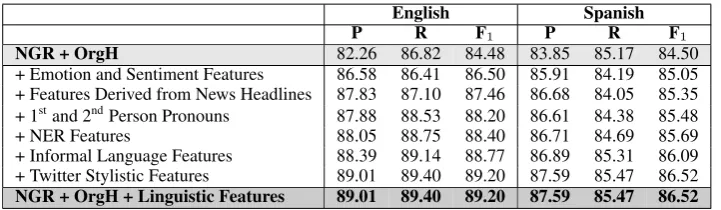
Table 4: Linguistic feature ablation withPrecision (%),Recall (%) andF1-Score (%)
with mediocre precision.
These results show that the N-gram classifier achieved high precision whereas the organization heuristic achieved high recall. To exploit the best of both worlds, we evaluated another model (NGR + OrgH) that added the organization heuristic as an additional feature for the N-gram classifier. This system fares better than all the previous mod-els, achieving 82% precision with 87% recall for English and 84% precision with 85% recall for Spanish.
Next, we show the benefits obtained from adding the linguistic feature set. As the final row in Table 3 shows, having incorporated all the lin-guistic features, our final system showed an im-provement of 7% precision and 3% recall on En-glish tweets for an overall F1-score gain of
approx-imately 5%. On Spanish tweets, the same incre-ments were 4%, 0.3% and 2%, respectively. This final classifier is statistically significantly better than the model without linguistic features (NGR + OrgH) for both languages at the p < 0.01level, analyzed using a paired booststrap test drawing
106 samples with repetition from test data, as
de-scribed in Berg-Kirkpatrick et al. (2012).
5.2 Analysis of Linguistic Features
Having observed that linguistic features improved user type classification, we evaluated the impact of each type of linguistic feature using an ablation study. Table 4 shows the classifier performance when each of the features types was added cumu-latively over theNGR+OrgHbaseline.
We immediately see a 4% and 2% precision gain by adding emotion and sentiment features, for English and Spanish, respectively. Adding fea-tures derived from news headlines, we observe that the classifier fares better, improving precision for both languages and improving recall for En-glish. 1st and 2nd person pronouns improved
re-call on English data but had little impact on Span-ish data. The NER features produced very small gains in both languages. The informal language features increased recall from 84.69% to 85.31% on Spanish tweets. Finally, the Twitter stylistic features gained 0.7% more precision for both lan-guages. Overall, the feature types that contributed the most were the emotion/sentiment features, the news headline features, and the Twitter stylistic features.
6 Twitter Event Recognition
Twitter provides a facility where users can search for tweets using keywords. However, keyword-based queries for events can often lead to myriad irrelevant results due to different senses of key-words (polysemy) and figurative or metaphorical use of keywords. For instance, a Twitter search for civil unrest events with a few representative keywords (e.g., strike, rally, riot, etc.) can often lead to results referring to sports events, such as a
bowling strikeor atennis rallyor where the key-words are used figuratively (e.g.,She’s a riot!). In this section, we investigate if the user type of a tweet can help cut through such ambiguity. Specif-ically, we hypothesize that event keywords may be used more consistantly and with less ambiguity in organization-tweets, and therefore user type infor-mation may be helpful in improving event recog-nition.
To explore our hypothesis that the user type can influence the event relevance of a tweet, we con-structed a set of experiments using two types of events - civil unrest events and disease outbreaks. Civil unrest refers to forms of public disturbance that affect the order of a society (e.g., strikes,
English Spanish
Civil Unrest Disease Outbreaks Civil Unrest Disease Outbreaks
Person-tweets 5.27% 9.52% 9.32% 5.00%
Organization-tweets 36.54% 39.34% 51.66% 44.06%
[image:8.595.107.489.69.123.2]All-tweets 12.50% 20.07% 14.72% 13.22%
Table 6: Percentage of event-relevant tweets in 4000 tweets with keywords for each category
English Civil Unrest: protest, protested, protesting, riot, rioted, rioting, rally, rallied, rallying, marched, marching, strike, striked, striking
English Disease Outbreaks: outbreak, epidemic, in-fluenza, h1n1, h5n1, pandemic, quarantine, cholera, ebola, flu, malaria, dengue, hepatitis, measles
Spanish Civil Unrest: protesta, protestar, amoti-naron, protestaron, protestaban, protestado, amotinarse, amotinaban, marcha, huelga, amotinando, protestando, amotinado
Spanish Disease Outbreaks: brote, epidemia, in-fluenza, h1n1, h5n1, pandemia, cuarantena, sarampi´on, c´olera, ebola, malaria, dengue, hepatitis, gripe
Table 5: Keywords used to query Twitter for two types of events in English and Spanish
6.1 Data Acquisition for Event Recognition
We began by collecting tweets that contained at least one of the keywordslisted in Table 5, using the Twitter search API, and we set up an annota-tion task using Amazon Mechanical Turk (AMT) annotators. First, we created guidelines to distin-guish event-relevant tweets from irrelevant tweets and annotated 300 tweets for each of the four cat-egories (i.e., English Civil Unrest, Spanish Civil Unrest, English Disease Outbreaks and Spanish Disease Outbreaks).
We released 200 tweets in each category for annotation to three AMT annotators10. We used
these 200 tweets to calculate pair-wise IAA using Cohen’s Kappa (κ) which we report in Table 7. The IAA scores were generally good, ranging from 0.67 to 0.89. Each annotator subsequently la-beled 2000 tweets, yielding a total of 6000 tweets for each category. In each of these 6000 tweet sets, we randomly separated 2000 tweets as tuning data and 4000 as test data.
First, we applied our user type classifier to these tweets and analyzed the number of true event tweets for each user type. Table 6 shows the per-centage of true event tweets in the entire test set, as well as the percentage of event tweets for each
10We first released 100 tweets in each category to AMT
and enlisted 10 annotators. After calculating IAA on these 100 tweets, we retained 3 annotators who had the highest agreement with our annotations.
English Spanish Civil Unrest .89, .88, .77 .74, .74, .67
Disease Outbreaks .82, .73, .68 .84, .83, .80 Table 7: Pair-wise inter-annotator agreement (IAA) measured using Cohen’s Kappa (κ) on 200 tweets among the three AMT annotators for each event type in each language
user type. Overall, the percentage of true event tweets in each test set is≤20%. This means that most of the tweets (>80%) with event keywords do notdiscuss an event, confirming the unreliabil-ity of using event keywords alone.
However, there is a substantial difference in the density of true event tweets between the two user types. Across both civil unrest and dis-ease outbreaks, and for both languages, we see a much higher percentage of organization-tweets with event keywords mentioning an event than person-tweets with event keywords. Table 6 shows that, in English civil unrest category, organization-tweets are 7 times more likely (36.54% as opposed to 5.27%) to report an actual event than person-tweets with the same keywords. In the English dis-ease outbreaks category, organization-tweets are 4 times more likely to report an event (39.34% vs. 9.52%). We notice similar observations in the Spanish tweets too.
6.2 Event Recognition Results
In this section, we evaluate the impact of user type information by introducing a simple baseline ex-periment for Twitter event recognition followed by several schemes that we devised to incorporate user type information in more principled ways.
First, we trained a supervised classifier to pre-dict the probability of a tweet being event-relevant using only unigrams and bigrams as features, en-coded with binary values. This baseline system is
ap-English Spanish
P R F1 P R F1
Civil Unrest Events
User type-agnostic classifier 80.97 50.20 61.98 77.51 60.37 67.88 User type included as a feature 80.00 50.40 61.84 77.19 61.56 68.50 (θp, θo) optimized for F1-score 60.50 72.60 66.00 64.97 78.57 71.13
User type-specific classifier 79.34 63.61 70.61† 79.20 81.89 80.52†
Disease Outbreak Events
User type-agnostic classifier 83.15 55.99 66.92 80.49 56.14 66.15 User type included as a feature 83.46 55.36 66.57 80.93 59.36 68.48 (θp, θo) optimized for F1-score 75.10 66.58 70.58 68.94 72.58 70.71
[image:9.595.134.461.68.196.2]User type-specific classifier 80.35 66.07 72.51† 82.20 74.26 78.03†
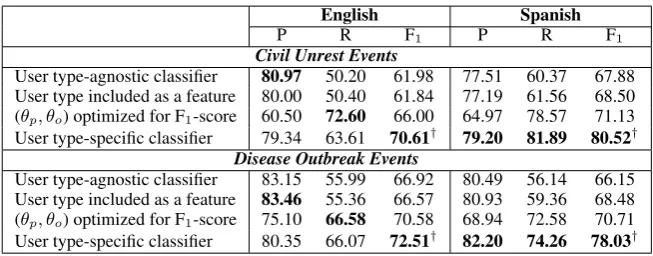
Table 8: Event recognition results showing Precision (%), Recall (%) and F1-Score (%), for the two
event types in English and Spanish. † denotes statistical significance at p < 0.01 compared to the baseline (User type-agnostic classifier)
proach achieved 62% F1-score in English and 68%
F1-score in Spanish, for civil unrest events. For
disease outbreak events, the corresponding values were 67% and 66%.
As our first attempt to incorporate user type in-formation, we added the user type label as one ad-ditional feature. As shown in Table 8, the added feature yielded small gains for Spanish but made little difference for English.
Given our initial hypothesis (and evidence in Table 6) about events and organization-tweets, we would prefer to be aggressive in labeling organization-tweets as event-relevant. One way to accomplish this with a trained probabilistic classi-fier is to assign different probability thresholds to person- and organization-tweets. To acquire the optimal threshold parameters for person-tweets (θp) and organization-tweets (θo), we performed a grid-based threshold sweep on tuning data and op-timized with respect to F1-scores. Table 8 shows
that this approach yielded substantial recall gains for all four categories and produced the best F1
-scores thus far.
A more principled approach is to create two completely different classifiers, one for each user type. Each classifier can then model the vocabu-lary and word associations that are most likely to occur in tweets of that type. Using five-fold cross-validation, we train separate models for person-and organization-tweets. During event recogni-tion, we first apply our user type classifier to a tweet and then apply the appropriate event recog-nition model. As shown in the final rows in Ta-ble 8, this method consistently outperforms the other approaches. Compared to the best compet-ing method, the user type-specific classifiers pro-duced F1-score gains of 4.6% and 9.4% for
En-glish and Spanish civil unrest events, and F1-score
gains of 2% and 7.3% for English and Spanish dis-ease outbreak events.
7 Conclusion
In this work, we tackled the problem of classify-ing tweets into two user types, organizations and individual persons, based on their textual content. We designed a rich set of features that exploit different linguistic aspects of tweet content, and demonstrated that our classifier achieves F1-scores
of 89% for English and 87% for Spanish. We also presented results showing that organization-tweets with event keywords have a much higher den-sity of event mentions than person-tweets with the same keywords and showed the benefits of incor-porating user type information into event recog-nition models. Our results showed that creating separate event recognition classifiers for different user types yields substantially better performance than using a single event recognition model on all tweets.
8 Acknowledgments
References
Hila Becker, Mor Naaman, and Luis Gravano. 2009. Event identification in social media. InWebDB. Hila Becker, Mor Naaman, and Luis Gravano. 2010.
Learning similarity metrics for event identification in social media. InProceedings of the Third ACM International Conference on Web Search and Data Mining, WSDM ’10, pages 291–300, New York, NY, USA. ACM.
H. Becker, M. Naaman, and L. Gravano. 2011. Select-ing quality twitter content for events. In Proceed-ings of the Fifth International AAAI Conference on Weblogs and Social Media (ICWSM11).
E. Benson, A. Haghighi, and R. Barzilay. 2011. Event discovery in social media feeds. InThe 49th Annual Meeting of the Association for Computational Lin-guistics, Portland, Oregon, USA. To appear. Taylor Berg-Kirkpatrick, David Burkett, and Dan
Klein. 2012. An empirical investigation of statis-tical significance in nlp. InProceedings of the 2012 Joint Conference on Empirical Methods in Natural Language Processing and Computational Natural Language Learning, pages 995–1005. Association for Computational Linguistics.
Chih-Chung Chang and Chih-Jen Lin. 2011. LIB-SVM: A library for support vector machines. ACM Transactions on Intelligent Systems and Technol-ogy, 2:27:1–27:27. Software available athttp:// www.csie.ntu.edu.tw/˜cjlin/libsvm. Morgane Ciot, Morgan Sonderegger, and Derek Ruths.
2013. Gender inference of twitter users in non-english contexts. InProceedings of the 2013 Con-ference on Empirical Methods in Natural Language Processing, Seattle, Wash, pages 18–21.
Raviv Cohen and Derek Ruths. 2013. Classifying po-litical orientation on twitter: Its not easy! InSeventh International AAAI Conference on Weblogs and So-cial Media.
M. De Choudhury, N. Diakopoulos, and M. Naaman. 2012. Unfolding the event landscape on twitter: classification and exploration of user categories. In
Proceedings of the ACM 2012 conference on Com-puter Supported Cooperative Work, pages 241–244. ACM.
Clayton Fink, Jonathon Kopecky, and Maksym Morawski. 2012. Inferring gender from the content of tweets: A region specific example. InICWSM. K. Gimpel, N. Schneider, B. O’Connor, D. Das,
D. Mills, J. Eisenstein, M. Heilman, D. Yogatama, J. Flanigan, and N.A. Smith. 2011. Part-of-speech tagging for twitter: annotation, features, and exper-iments. InProceedings of the 49th Annual Meet-ing of the Association for Computational LMeet-inguis- Linguis-tics: Human Language Technologies: short papers-Volume 2, pages 42–47. Association for Computa-tional Linguistics.
Alec Go, Richa Bhayani, and Lei Huang. 2009. Twit-ter sentiment classification using distant supervision.
CS224N Project Report, Stanford, pages 1–12.
A. Jackoway, H. Samet, and J. Sankaranarayanan. 2011. Identification of live news events using twit-ter. In Proceedings of the 3rd ACM SIGSPATIAL International Workshop on Location-Based Social Networks, page 9. ACM.
M. Kim, L. Xie, and P. Christen. 2012. Event diffusion patterns in social media. InSixth International AAAI Conference on Weblogs and Social Media.
Wendy Liu and Derek Ruths. 2013. Whats in a name? using first names as features for gender inference in twitter.
Marco Lui and Timothy Baldwin. 2012. langid. py: An off-the-shelf language identification tool. In
Proceedings of the ACL 2012 System Demonstra-tions, pages 25–30. Association for Computational Linguistics.
Angelo Mendonca, David Andrew Graff, Denise DiPersio, Linguistic Data Consortium, et al. 2009.
Spanish gigaword second edition. Linguistic Data Consortium.
M. Messner, M. Linke, and A. Eford. 2011. Shov-eling tweets: An analysis of the microblogging engagement of traditional news organizations. In
International Symposium on Online Journalism, UT Austin, available at: http://online. journalism. utexas. edu/2011/papers/Messner2011. pdf (last ac-cessed April 3, 2011).
D. Metzler, C. Cai, and E. Hovy. 2012. Structured event retrieval over microblog archives. In Proceed-ings of the 2012 Conference of the North Ameri-can Chapter of the Association for Computational Linguistics: Human Language Technologies, pages 646–655.
Alan Mislove, Sune Lehmann, Yong-Yeol Ahn, Jukka-Pekka Onnela, and J Niels Rosenquist. 2011. Understanding the demographics of twitter users.
ICWSM, 11:5th.
M. Naaman, J. Boase, and C.H. Lai. 2010. Is it re-ally about me?: message content in social aware-ness streams. InProceedings of the 2010 ACM con-ference on Computer supported cooperative work, pages 189–192. ACM.
OpenSource. 2010. Opennlp: http :
//opennlp.sourceforge.net/.
Robert Parker, Linguistic Data Consortium, et al. 2009. English gigaword fourth edition. Linguistic Data Consortium.
Saˇsa Petrovi´c, Miles Osborne, and Victor Lavrenko. 2010. Streaming first story detection with applica-tion to twitter. InHuman Language Technologies: The 2010 Annual Conference of the North American Chapter of the Association for Computational Lin-guistics, pages 181–189. Association for Computa-tional Linguistics.
A.M. Popescu and M. Pennacchiotti. 2011. Dancing with the stars, nba games, politics: An exploration of twitter users response to events. InProceedings of the International AAAI Conference on Weblogs and Social Media.
Delip Rao, David Yarowsky, Abhishek Shreevats, and Manaswi Gupta. 2010. Classifying latent user at-tributes in twitter. In Proceedings of the 2nd in-ternational workshop on Search and mining user-generated contents, pages 37–44. ACM.
Alan Ritter, Sam Clark, Mausam, and Oren Etzioni. 2011. Named entity recognition in tweets: An ex-perimental study. InProceedings of the Conference on Empirical Methods in Natural Language Pro-cessing, EMNLP ’11, pages 1524–1534, Strouds-burg, PA, USA. Association for Computational Lin-guistics.
A. Ritter, O. Etzioni, S. Clark, et al. 2012. Open domain event extraction from twitter. In Proceed-ings of the 18th ACM SIGKDD international con-ference on Knowledge discovery and data mining, pages 1104–1112. ACM.
T. Sakaki, M. Okazaki, and Y. Matsuo. 2010. Earth-quake shakes twitter users: real-time event detection by social sensors. InProceedings of the 19th inter-national conference on World wide web, pages 851– 860. ACM.
H. Sayyadi, M. Hurst, and A. Maykov. 2009. Event detection and tracking in social streams. In Proceed-ings of International Conference on Weblogs and So-cial Media (ICWSM).
Erik F. Tjong Kim Sang. 2002. Introduction to the conll-2002 shared task: Language-independent named entity recognition. InProceedings of the 6th Conference on Natural Language Learning - Volume 20, COLING-02, pages 1–4, Stroudsburg, PA, USA. Association for Computational Linguistics.
Svitlana Volkova, Theresa Wilson, and David Yarowsky. 2013. Exploring demographic lan-guage variations to improve multilingual sentiment analysis in social media. In Proceedings of the 2013 Conference on Empirical Methods on Natural Language Processing.
K Wickre. 2013. Celebrating #twitter7.
https://blog.twitter.com/2013/ celebrating-twitter7. Accessed: 03/20/2014.
S. Wu, J.M. Hofman, W.A. Mason, and D.J. Watts. 2011. Who says what to whom on twitter. In