Reducing the Impact of Data Sparsity in Statistical Machine Translation
Karan Singla1, Kunal Sachdeva1, Diksha Yadav1, Srinivas Bangalore2, Dipti Misra Sharma1
1LTRC IIIT Hyderabad,2AT&T Labs-Research
Abstract
Morphologically rich languages generally require large amounts of parallel data to adequately estimate parameters in a statis-tical Machine Translation(SMT) system. However, it is time consuming and expen-sive to create large collections of parallel data. In this paper, we explore two strate-gies for circumventing sparsity caused by lack of large parallel corpora. First, we ex-plore the use of distributed representations in an Recurrent Neural Network based lan-guage model with different morphological features and second, we explore the use of lexical resources such as WordNet to over-come sparsity of content words.
1 Introduction
Statistical machine translation (SMT) models es-timate parameters (lexical models, and distortion model) from parallel corpora. The reliability of these parameter estimates is dependent on the size of the corpora. In morphologically rich languages, this sparsity is compounded further due to lack of large parallel corpora.
In this paper, we present two approaches that address the issue of sparsity in SMT models for morphologically rich languages. First, we use an Recurrent Neural Network (RNN) based language model (LM) to re-rank the output of a phrase-based SMT (PB-SMT) system and second we use lexical resources such as WordNet to minimize the impact of Out-of-Vocabulary(OOV) words on MT quality. We further improve the accuracy of MT using a model combination approach.
The rest of the paper is organized as follows. We first present our approach of training the base-line model and source side reordering. In Section 4, we present our experiments and results on re-ranking the MT output using RNNLM. In Section
5, we discuss our approach to increase the cover-age of the model by using synset ID’s from the English WordNet (EWN). Section 6 describes our experiments on combining the model with synset ID’s and baseline model to further improve the translation accuracy followed by results and obser-vations sections.We conclude the paper with future work and conclusions.
2 Related Work
In this paper, we present our efforts of re-ranking the n-best hypotheses produced by a PB-MT (Phrase-Based PB-MT) system using RNNLM (Mikolov et al., 2010) in the context of an English-Hindi SMT system. The re-ranking task in ma-chine translation can be defined as re-scoring the n-best list of translations, wherein a number of language models are deployed along with fea-tures of source or target language. (Dungarwal et al., 2014) described the benefits of re-ranking the translation hypothesis using simple n-gram based language model. In recent years, the use of RNNLM have shown significant improvements over the traditional n-gram models (Sundermeyer et al., 2013). (Mikolov et al., 2010) and (Liu et al., 2014) have shown significant improvements in speech recognition accuracy using RNNLM . Shi (2012) also showed the benefits of using RNNLM with contextual and linguistic features. We have also explored the use of morphological features (Hindi being a morphologically rich language) in RNNLM and deduced that these features further improve the baseline RNNLM in re-ranking the n-best hypothesis.
Words in natural languages are richly diverse so it is not possible to cover all source language words when training an MT system. Untranslated out-of-vocabulary (OOV) words tend to degrade the accuracy of the output produced by an MT model. Huang (2010) pointed to various types of OOV words which occur in a data set –
mentation error in source language, named enti-ties, combination forms (e.g. widebody) and ab-breviations. Apart from these issues, Hindi being a low-resourced language in terms of parallel cor-pora suffers from data sparsity.
In the second part of the paper, we address the problem of data sparsity with the help of English WordNet (EWN) for English-Hindi PB-SMT. We increase the coverage of content words (exclud-ing Named-Entities) by incorporat(exclud-ing sysnset in-formation in the source sentences.
Combining Machine Translation (MT) systems has become an important part of statistical MT in past few years. Works by (Razmara and Sarkar, 2013; Cohn and Lapata, 2007) have shown that there is an increase in phrase coverage when com-bining different systems. To get more coverage of unigrams in phrase-table, we have explored sys-tem combination approaches to combine models trained with synset information and without synset information. We have explored two methodolo-gies for system combination based on confusion matrix(dynamic) (Ghannay et al., 2014) and mix-ing models (Cohn and Lapata, 2007).
3 Baseline Components
3.1 Baseline Model and Corpus Statistics
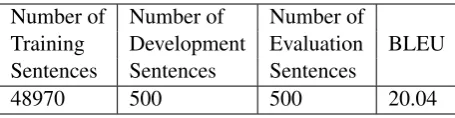
We have used the ILCI corpora (Choudhary and Jha, 2011) for our experiments, which contains English-Hindi parallel sentences from tourism and health domain. We randomly divided the data into training (48970), development (500) and testing (500) sentences and for language modelling we used news corpus of English which is distributed as a part of WMT’14 translation task. The data is about 3 million sentences which also contains MT training data.
We trained a phrase based (Koehn et al., 2003) MT system using the Moses toolkit with word-alignments extracted from GIZA++ (Och and Ney, 2000). We have used the SRILM (Stolcke and others, 2002) with Kneser-Ney smoothing (Kneser and Ney, 1995) for training a language model for the first stage of decoding. The result of this base-line system is shown in Table 1.
3.2 English Transformation Module
Hindi is a relatively free-word order language and generally tends to follow SOV (Subject-Object-Verb) order and English tends to follow SVO (Subject-Verb-Object) word order. Research has
Number of Number of Number of
Training Development Evaluation BLEU Sentences Sentences Sentences
[image:2.595.308.536.61.120.2]48970 500 500 20.04
Table 1: Baseline Scores for Phrase-based Moses Model
shown that pre-ordering source language to con-form to target language word order significantly improves translation quality (Collins et al., 2005). We created a re-ordering module for transform-ing an English sentence to be in the Hindi order based on reordering rules provided by Anusaaraka (Chaudhury et al., 2010). The reordering rules are based on parse output produced by the Stanford Parser (Klein and Manning, 2003).
The transformation module requires the text to contain only surface form of words, however, we extended it to support surface form along with its factors such as lemma and Part of Speech (POS).
Input: the girl in blue shirt is my sister
Output: in blue shirt the girl is my sister.
Hindi: neele shirt waali ladki meri bahen hai ( blue) ( shirt) (Mod)(girl)(my)(sister)(Vaux)
With this transformation, the English sentence is structurally closer to the Hindi sentence which leads to better phrase alignments. The model trained with the transformed corpus produces a new baseline score of 21.84 BLEU score an improvement over the earlier baseline of 20.04 BLEU points.
4 Re-Ranking Experiments
In this section, we describe the results of re-ranking the output of the translation model us-ing Recurrent Neural Networks (RNN) based lan-guage models using the same data which is used for language modelling in the baseline models.
Unlike traditional n-gram based discrete lan-guage models, RNN do not make the Markov as-sumption and potentially can take into account long-term dependencies between words. Since the words in RNNs are represented as continuous val-ued vectors in low dimensions allowing for the possibility of smoothing using syntactic and se-mantic features. In practice, however, learning long-term dependencies with gradient descent is difficult as described by (Bengio et al., 1994) due to diminishing gradients.
100 200 300 400 500 22
24 26 28 30
Number of Hypotheses
BLEU
scores
[image:3.595.74.281.59.261.2]Baseline POS NONE Lemma Oracle All
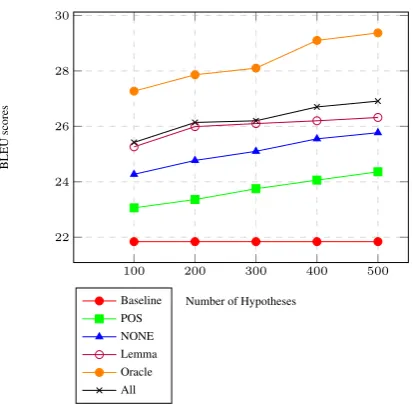
Figure 1: BLEU Scores for Re-ranking experi-ments with RNNLM using different feature com-binations.
n-best output using RNNLM which has also been shown to be helpful by (Liu et al., 2014). Shi (2012) also showed the benefits of using RNNLM with contextual and linguistic features. Follow-ing their work, we used three type of features for building an RNNLM for Hindi : lemma (root), POS, NC (number-case). The data used was a Wikipedia dump, MT training data, news arti-cles which had approximately 500,000 Hindi sen-tences. Features were extracted using paradigm-based Hindi Morphological Analyzer1
Figure 1 illustrates the results of re-ranking per-formed using RNNLM trained with various fea-tures. TheOraclescore is the highest achievable score in a re-ranking experiment. This score is computed based on the best translation out of n-best translations. The n-best translation is found us-ing the cosine similarity between the hypothesis and the reference translation. It can be seen from Figure 1, that the LM with only word and POS in-formation is inferior to all other models. However, morphological features like lemma, number and case information help in re-ranking the hypothesis significantly. The RNNLM which uses all the fea-tures performed the best for the re-ranking exper-iments achieving a BLEU score of 26.91, after re-scoring 500-best obtained from the pre-order SMT model.
1We have used the HCU morph-analyzer.
System BLEU
Baseline 21.84
Rescoring 500-best with RNNLM
Features
NONE 25.77
POS 24.36
[image:3.595.306.524.62.159.2]Lemma(root) 26.32 ALL(POS+Lemma+NC) 26.91
Table 2: Rescoring results of 500-best hypotheses using RNNLM with different features
5 Using WordNet to Reduce Data Sparsity
We extend the coverage of our source data by us-ing synonyms from the English WordNet (EWN). Our main motivation is to reduce the impact of OOV words on output quality by replacing words in a source sentence with their corresponding synset IDs. However, choosing the appropriate synset ID based upon its context and morphologi-cal information is important. For sense selection, we followed the approach used by (Tammewar et al., 2013), which is also described further in this section in the context of our task. We ignored words that are regarded as Named-Entities as in-dicated by Stanford NER tagger, as they should not have synonyms in any case.
5.1 Sense Selection
Words are ambiguous, independent of their sen-tence context. To choose an appropriate sense ac-cording to the context for a lexical item is a chal-lenging task typically termed as word-sense dis-ambiguation. However, the syntactic category of a lexical item provides an initial cue for disam-biguating a lexical item. Among the varied senses, we filter out the senses that are not the same POS tag as the lexical item. But words are not just am-biguous across different syntactic categories but are also ambiguous within a syntactic category. In the following, we discuss our approaches to select the sense of a lexical item best suited in a given context within a given category. Also categories were filtered so that only content words get re-placed with synset IDs.
5.1.1 Intra-Category Sense Selection
lexical item are ordered in the descending order of their frequencies of usage in the lexical resource.
Merged Sense: In this approach, we merge all the senses listed in EWN corresponding to the POS-tag of the given lexical item. The motivation behind this strategy is that the senses in the EWN for a particular word-POS pair are too finely clas-sified resulting in classification of words that may represent the same concept, are classified into dif-ferent synsets. For example : travel andgo can mean the same concept in a similar context but the first sense given by EWN is different for these two words. Therefore, we merge all the senses for a word into a super sense ( synset ID of first word occurred in data), which is given to all its syn-onyms even if it occurs in different synset IDs.
5.2 Factored Model
Techniques such as factored modelling (Koehn and Hoang, 2007) are quite beneficial for Trans-lation from English to Hindi language as shown by (Ramanathan et al., 2008). When we replace words in a source sentence with the synset IDˆas, we tend to lose morphological information associ-ated with that word. We add inflections as features in a factored SMT model to minimize the impact of this replacement.
We show the results of the processing steps on an example sentence below.
Original Sentence : Ram is going to market to buy apples
New Sentence : Ram is Synset(go.v.1) to Synset(market.n.0) to Synset(buy.v.1) Synset(apple.n.1)
Sentence with synset ID: Ram E is E Synset(go.v.1) ing to E Synset(market.n.0) E to E Synset(buy.v.1) E Synset(apple.n.1) s Then English sentences were reordered to Hindi word-order using the module discussed in Section 3.
Reordered Sentence: Ram E Synset(apple.n.1) s Synset(buy.v.1) E to E Synset(market.n.0) E to E Synset(go.v.1) ing is E
In Table 3, the second row shows the BLEU scores for the models in which there are synset IDs for the source side. It can be seen that the factored model also shows significant improvement in the results.
6 Combining MT Models
Combining Machine translation (MT) systems has become an important part of Statistical MT in the past few years. There are two dominant ap-proaches. (1) a system combination approach based on confusion networks (CN) (Rosti et al., 2007), which can work dynamically in combin-ing the systems. (2) Combine the models by lin-early interpolating and then using MERT to tune the combined system.
6.1 Combination based on confusion networks
We used the tool MANY (Barrault, 2010) for sys-tem combination. However, since the tool is con-figured to work with TERp evaluation metric, we modified it to use METEOR (Gupta et al., 2010) metric since it has been shown by (Kalyani et al., 2014), that METEOR evaluation metric is better correlated to human evaluation for morphologi-cally rich Indian Languages.
6.2 Linearly Interpolated Combination
In this approach, we combined phrase-tables of the two models (Eng (sysnset) - Hindi and Base-line) using linear interpolation. We combined the two models with uniform weights – 0.5 for each model, in our case. We again tuned this model with the new interpolated phrase-table using stan-dard algorithm MERT.
7 Experiments and Results
System #OOV words BLEU Meteor
Baseline 253 21.8 .492
Eng(Synset ID)-Hindi Baseline*factor(inflections) 225237 19.220.3 .494.506
Ensembled Decoding 213 21.0 .511
[image:5.595.118.485.62.146.2]Mixture Model 210 21.2 .519
Table 3: Results for the model in which there were Synset ID’s instead of word in English data
results with significant reduction in OOV words and also some gains in METEOR score.
8 Observations
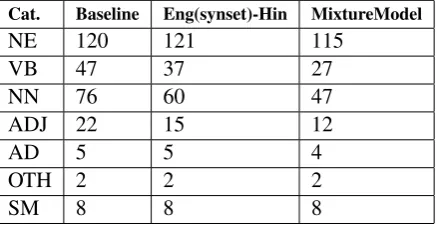
In this section, we study the coverage of different models by categorizing the OOV words into 5 cat-egories.
• NE(Named Entities) : As the data was from Health & Tourism domain, these words were mainly the names of the places and medicines.
• VB: types of verb forms
• NN: types of nouns and pronouns
• ADJ: all adjectives
• AD: adverbs
• OTH: there were some words which did not mean anything in English
• SM : There were some occasional spelling mistakes seen in the test data.
Note: There were no function words seen in the OOV(un-translated) words
Cat. Baseline Eng(synset)-Hin MixtureModel
NE 120 121 115
VB 47 37 27
NN 76 60 47
ADJ 22 15 12
AD 5 5 4
OTH 2 2 2
SM 8 8 8
Table 4: OOV words in Different Models
As this analysis was done on a small dataset and for a fixed domain, the OOV words were few in number as it can be seen in Table 4. But the OOV words across the different models reduced as ex-pected. The NE words remained almost the same
for all the three models but OOV words from cate-gory VB,NN,ADJ decreased for Eng(synset)-Hin model and Mixture model significantly.
9 Future Work
In the future, we will work on using the two ap-proaches discussed: Re-Ranking & using lexical resources to reduce sparsity together in a system. We will work on exploring syntax based features for RNNLM and we are planning to use a better method for sense selection and extending this con-cept for more language pairs. Word-sense disam-biguation can be used for choosing more appro-priate sense when the translation model is trained on a bigger data data set. Also we are looking for unsupervised techniques to learn the replacements for words to reduce sparsity and ways to adapt our system to different domains.
10 Conclusions
In this paper, we have discussed two approaches to address sparsity issues encountered in training SMT models for morphologically rich languages with limited amounts of parallel corpora. In the first approach we used an RNNLM enriched with morphological features of the target words and show the BLEU score to improve by 5 points. In the second approach we use lexical resource such as WordNet to alleviate sparsity.
References
Lo¨ıc Barrault. 2010. Many: Open source machine translation system combination. The Prague Bul-letin of Mathematical Linguistics, 93:147–155.
Yoshua Bengio, Patrice Simard, and Paolo Frasconi. 1994. Learning long-term dependencies with gra-dient descent is difficult. Neural Networks, IEEE Transactions on, 5(2):157–166.
[image:5.595.74.293.555.670.2]and Knowledge Engineering (NLP-KE), 2010 Inter-national Conference on, pages 1–6. IEEE.
Narayan Choudhary and Girish Nath Jha. 2011. Cre-ating multilingual parallel corpora in indian lan-guages. InProceedings of Language and Technol-ogy Conference.
Trevor Cohn and Mirella Lapata. 2007. Ma-chine translation by triangulation: Making ef-fective use of multi-parallel corpora. In AN-NUAL MEETING-ASSOCIATION FOR COMPU-TATIONAL LINGUISTICS, volume 45, page 728. Citeseer.
Michael Collins, Philipp Koehn, and Ivona Kuˇcerov´a. 2005. Clause restructuring for statistical machine translation. In Proceedings of the 43rd annual meeting on association for computational linguis-tics, pages 531–540. Association for Computational Linguistics.
Piyush Dungarwal, Rajen Chatterjee, Abhijit Mishra, Anoop Kunchukuttan, Ritesh Shah, and Pushpak Bhattacharyya. 2014. The iit bombay hindi-english translation system at wmt 2014. InProceedings of the Ninth Workshop on Statistical Machine Transla-tion, pages 90–96, Baltimore, Maryland, USA, June. Association for Computational Linguistics.
Sahar Ghannay, France Le Mans, and Loıc Barrault. 2014. Using hypothesis selection based features for confusion network mt system combination. In Pro-ceedings of the 3rd Workshop on Hybrid Approaches to Translation (HyTra)@ EACL, pages 1–5. Ankush Gupta, Sriram Venkatapathy, and Rajeev
San-gal. 2010. Meteor-hindi: Automatic mt evaluation metric for hindi as a target language. In Proceed-ings of ICON-2010: 8th International Conference on Natural Language Processing.
Chung-chi Huang, Ho-ching Yen, and Jason S Chang. 2010. Using sublexical translations to handle the oov problem in mt. In Proceedings of The Ninth Conference of the Association for Machine Transla-tion in the Americas (AMTA).
Aditi Kalyani, Hemant Kamud, Sashi Pal Singh, and Ajai Kumar. 2014. Assessing the quality of mt systems for hindi to english translation. In In-ternational Journal of Computer Applications, vol-ume 89.
Dan Klein and Christopher D Manning. 2003. Ac-curate unlexicalized parsing. InProceedings of the 41st Annual Meeting on Association for Computa-tional Linguistics-Volume 1, pages 423–430. Asso-ciation for Computational Linguistics.
Reinhard Kneser and Hermann Ney. 1995. Im-proved backing-off for m-gram language modeling. InAcoustics, Speech, and Signal Processing, 1995. ICASSP-95., 1995 International Conference on, vol-ume 1, pages 181–184. IEEE.
Philipp Koehn and Hieu Hoang. 2007. Factored trans-lation models. InEMNLP-CoNLL, pages 868–876. Citeseer.
Philipp Koehn, Franz Josef Och, and Daniel Marcu. 2003. Statistical phrase-based translation. In Proceedings of the 2003 Conference of the North American Chapter of the Association for Computa-tional Linguistics on Human Language Technology-Volume 1, pages 48–54. Association for Computa-tional Linguistics.
X Liu, Y Wang, X Chen, MJF Gales, and PC Wood-land. 2014. Efficient lattice rescoring using recur-rent neural network language models.
Tomas Mikolov, Martin Karafi´at, Lukas Burget, Jan Cernock`y, and Sanjeev Khudanpur. 2010. Recur-rent neural network based language model. In IN-TERSPEECH, pages 1045–1048.
Franz Josef Och and Hermann Ney. 2000. Improved statistical alignment models. InProceedings of the 38th Annual Meeting on Association for Computa-tional Linguistics, pages 440–447. Association for Computational Linguistics.
Ananthakrishnan Ramanathan, Jayprasad Hegde, Ritesh M Shah, Pushpak Bhattacharyya, and M Sasikumar. 2008. Simple syntactic and morpho-logical processing can help english-hindi statistical machine translation. InIJCNLP, pages 513–520. Majid Razmara and Anoop Sarkar. 2013. Ensemble
triangulation for statistical machine translation. In Proceedings of the Sixth International Joint Confer-ence on Natural Language Processing, pages 252– 260.
Antti-Veikko I Rosti, Spyridon Matsoukas, and Richard Schwartz. 2007. Improved word-level sys-tem combination for machine translation. In AN-NUAL MEETING-ASSOCIATION FOR COMPU-TATIONAL LINGUISTICS, volume 45, page 312. Citeseer.
Yangyang Shi, Pascal Wiggers, and Catholijn M Jonker. 2012. Towards recurrent neural networks language models with linguistic and contextual fea-tures. InINTERSPEECH.
Andreas Stolcke et al. 2002. Srilm-an extensible lan-guage modeling toolkit. InINTERSPEECH. Martin Sundermeyer, Ilya Oparin, J-L Gauvain, Ben
Freiberg, R Schluter, and Hermann Ney. 2013. Comparison of feedforward and recurrent neural network language models. InAcoustics, Speech and Signal Processing (ICASSP), 2013 IEEE Interna-tional Conference on, pages 8430–8434. IEEE. Aniruddha Tammewar, Karan Singla, Srinivas