Annotating corpus data for a quantitative, constructional analysis of
motion verbs in Modern Standard Arabic
Dana Abdulrahim
University of Bahrain
[email protected]
Abstract
This article proposes an annotation method of corpus data for the purposes of providing a constructionist account of lexical behavior. The lexical items in ques-tion are seven verbs of moques-tion in Modern Standard Arabic that pertain to the events of COME (atā, ǧā’a,
ḥaḍara, and qadima) and GO (ḏahaba, maḍā, and
rāḥa). The tag set selected for the annotation of the
COME and GO data frames consists of morpho-syntactic tags that characterize verb usage as well as semantic tags that aim to highlight the semantic com-ponent of, for instance, adverbial and adpositional phrases that accompany the verb. I will briefly demonstrate the analytical potential of such data frame by discussing the various kinds of statistical tests such data frame is designed to undergo, as a means of better understanding lexical behavior in con-text, and, eventually, arriving at a better understand-ing of lexical and constructional choices made by native speakers of Arabic, as demonstrated in corpora.
1
Introduction
The core tenets of constructionist theories of language claim that the basic unit of linguistic organization is a construction. According to Croft and Cruse (2004:257), a construction “con-sist[s] of pairings of form and meaning that are at least partially arbitrary”, where ‘meaning’ is re-ferred to as the conventionalized function of a construction. This conventionalization of a con-struction’s meaning/function includes not only the literal meaning of an utterance, but also the discourse situation of that utterance, as well as any pragmatic implication conveyed by that ut-terance (Croft and Cruse, 2004).
The concept of a ‘construction’ in cognitive approaches to grammar, therefore, relates to both the idiomatic portions of language, where the meaning of an utterance is not predictable from the component parts of which it consists (e.g. raining cats and dogs), as well as the co-occurrence of any two (free or bound) mor-phemes that reflect general morphosyntactic structures and where the meaning of an utterance is fully predictable from its component parts (e.g. I need to sleep). Such view of grammar postu-lates that “the interaction of syntax and lexicon is
much wider and deeper than the associations of certain verbs with certain complements” (Bybee, 2010:77), and that a considerable part of our lin-guistic knowledge consists of conventionalized expressions, or constructions (Langacker, 1987).
In light of these constructionist assump-tions, therefore, the behavior of a lexical item is best understood in its context of use and not in isolation, an idea that stretches back decades (cf. Firth, 1957). This includes not only lexical collo-cates, but also the entire morphosyntactic frame that hosts a lexical item. All these elements con-tribute to the composed or conventionalized meaning/function expressed by a particular lin-guistic item. In order to examine lexical behav-ior, therefore, we need to move beyond single semantic, morphological, or syntactic properties of a lexical item and scrutinize the entire lexico-syntactic frame in which it occurs. Increasingly, this is done through examination of corpus data. The availability of corpora facilitates and moti-vates such highly contextualized analytical ap-proach, since corpora provide a large amount of naturally occurring, contextualized uses (as op-posed to the reliance on introspective and elicited data that may not reflect actual language usage at all). Moreover, corpora provide large amounts of linguistic data, which allows the researcher to conduct extensive quantitative analyses of the phenomenon in question.
In Modern Standard Arabic, the existence of several verbs denoting the motion events COME
(atā, ǧā’a, ḥaḍara, and qadima) and GO (ḏahaba, maḍā, and rāḥa)provides an excellent case study for a constructionist, corpus-based examination of the features that characterize the usage of sup-posedly near-synonymous lexical items. In Abdulrahim (2013) I have argued that the four
COME verbs – as well as the three GO verbs – can be interchangeably used in contexts where the event depicts a strictly deictic and physical mo-tion event, as in (1) and (2).
(1) راطملا ىلإ يتدج تمدق / ترضح / تءاج / تتأ
atā / ǧā’a / ḥaḍara / qadima.PERF.3SG.F
grandmother.CL.1SG.GEN
came my grandmother
ALL ART=airport to the airport
‘My grandmother came to the airport’
(2) ةطرشلا زكرم ىلإ بلأا حار\ ىضم\ بهذ
ḏahaba / maḍā / rāḥa.PERF.3SG.M
ART=father-NOM ALL
went the father to
station ART=police station the police
‘The father went to the police station’
However, these verbs diverge greatly in their metaphorical and idiomatic uses, in addition to showing idiosyncratic patterns of lexico-syntactic behavior. For instance, The sentence in (1) would not admit all four verbs when the as-pect inflection on the verb is changed. To illus-trate, in (3), if we hold all constructional features constant and change verb inflection from perfec-tive to jussive, this results in a preference for atā and ḥaḍara by native speakers of Arabic over ǧā’a or qadima.
(3) راطملا ىلإ يتدج مدقت؟ / رضحت / ءيجت؟ / تأت مل
NEG atā / ǧā’a / ḥaḍara / qadima.JUSS.3SG.F
did not come
grandmother.CL.1SG.GEN ALL ART=airport my grandmother to the airport
‘My grandmother did not come to the airport’
The above example stresses the need to in-vestigate features of the lexico-syntactic con-struction that each COME verb most typically as-sociates with. For these purposes, I have adopted the methodological approach outlined in Gries (2006), Gries & Divjak (2009), and Gries & Otani (2010) for a constructionist description of the Behavioral Profile of a lexical item. I have also employed logistic regression – namely polytomous logistic regression, outlined in detail in Arppe (2008) – as a statistical method that models lexical or constructional choices as a function of a wide range of contextual features.
The quantitative approach to lexical analysis presented in this paper involves constructing a data frame for every lexical item under study, in which numerous corpus concordance lines are
individually marked-up for an extensive set of linguistic features (morphological, syntactic, and semantic). This includes, for examples, specific elements pertaining to verb morphology, phrase structure, as well as the different elements that co-occur with the verb in specific constructions. Such data frame can undergo numerous explora-tory and multi-variate statistical tests as a means of zeroing in on the kinds of constructions asso-ciated with the verbs in question.
2
The corpus
In order to construct the multi-variate data frame for the analysis of motion verbs in Arabic, I chose ArabiCorpus (arabicorpus.byu.edu) as the source for data. ArabiCorpus is a free online corpus developed by Dilworth Parkinson at Brigham Young University. As of October 2012, the corpus contains around 146,000,000 word tokens from different written and spoken genres. At the time of data collection (Fall 2010) the corpus contained around 69,000,000 word to-kens. Additional MSA as well as pre-modern texts have been added to the corpus since the beginning of 2011. Texts included in ArabiCorpus almost exclusively belong to the written genre, save for a small sub-corpus of spoken Egyptian Arabic. The written genres cov-ered in ArabiCorpus vary from newspaper writ-ing, pre-modern writwrit-ing, modern literature, to nonfiction. These genres are represented in the corpus in varying proportions with newspaper writing accounting for over 90% of the total size of the entire corpus. News articles included in this sub-section of ArabiCorpus cover issues from 1996 to 2010 and are extracted from peri-odicals published in different parts of the Arab world (North Africa, Egypt, Arabian Gulf, the Levant, etc.). For this study, the MSA sub-corpora that were queried for COME and GO uses are related to newspaper, modern literature, and nonfiction writing. As expected, most examples returned from corpus queries were in fact drawn from the newspaper genre.
for querying these particular forms. What may complicate any search in an Arabic written cor-pus is the lackof short vowels which are indicat-ed by certain diacritics written over or under-neath a letter. Naturally,it was necessary to filter corpus returns manually to eliminate any irrele-vant forms that may have been returned in the corpus search.
Despite the time-consuming nature of such corpus querying steps, ArabiCorpus proved to be a reliable and rich source for contextualized lan-guage uses. Add to that the fact that even though the online interface of ArabiCorpus only displays 10 words before and after the KWIC (key word in context), the researcher can still retrieve the entire text hosting that sentence. Therefore when the analysis or the annotation requires going be-yond the 10 word window to examine the entire phrase structure, it is possible to retrieve such information from ArabiCorpus. Another added benefit of using the online interface of ArabiCorpus is the ease of downloading all re-turned hits of a certain lexical item or construc-tion to be viewed in a spreadsheet, which was a major step in the collection of data for this re-search.
3
COMEand
GOdata frames
In Abdulrahim (2013) I proposed a quantita-tive (as well as a qualitaquantita-tive) analysis based on the construction of a data frame for each one of the seven verbs of motion. Each individual data frame is typically composed of a large number of corpus concordance lines (500 concordance lines) involving the KWIC (i.e. verb under inves-tigation) in its natural context of use. Every con-cordance line is thoroughly examined and tagged for a wide range of morphosyntactic and seman-tic features. These constructional features include the syntactic structure that hosts the verb, the patterns of verbal inflections for every instance of verb use (e.g. subject number, person, and gender, as well as other morphosyntactic aspects of the Arabic verb), the semantic properties of other components of the construction (e.g. se-mantic properties of the subject), as well as the inclusion or exclusion of phrases, lexical items, or clitics denoting a starting point of the event (SOURCE), a terminal point of the event (GOAL),
etc.
Such a heavily annotated dataset has the po-tential of being explored statistically in multiple ways via simple frequency count methods as well as complex multi-variate statistical model-ing. Such quantitative approach to analyzing
corpus data aims to define the specific character-istics of the constructions associated with the various meanings and functions of each MSA
COME and GO verb involved in this study. In the following section I will elaborate on the selection of these contextual features for the annotation of
COME and GO data frames.
3.1 Selection of contextual features and the annotation of corpus data
The first step for creating a multi-variate da-ta frame is to generate a list of features or varia-bles which are relevant to the motion event schemas in questions and which reflect the morphosyntax of Modern Standard Arabic. Along the lines of Gries’s study on the polysemy of the English verb run (2006), Gries and Divjak’s (2006) investigation of Russian verbs of
TRY, as well as Gries and Otani’s (2010) analysis
of the synonymy and polysemy of adjectives of size in English, I developed a large set of mor-phological, syntactic, and semantic features that reflect the usage of MSA motion verbs.
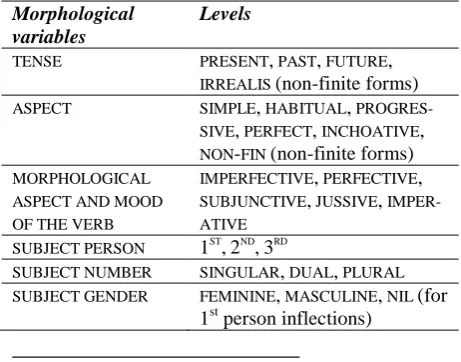
The variable set includes nominal variables (multiple levels) and binary variables (YES/NO
values indicating absence or presence of feature). Table 1 shows the different categories of varia-bles subsumed under morphological, syntactic, and semantic variables. In Appendix A, I provide examples and illustrations of the different anno-tations of levels within semantic variables taken from the actual data frame. 1
Morphological variables
Levels
TENSE PRESENT, PAST, FUTURE,
IRREALIS (non-finite forms)
ASPECT SIMPLE, HABITUAL, PROGRES-SIVE, PERFECT, INCHOATIVE,
NON-FIN (non-finite forms)
MORPHOLOGICAL ASPECT AND MOOD OF THE VERB
IMPERFECTIVE, PERFECTIVE,
SUBJUNCTIVE, JUSSIVE, IMPER-ATIVE
SUBJECT PERSON 1ST
,2ND
,3RD
SUBJECT NUMBER SINGULAR, DUAL, PLURAL SUBJECT GENDER FEMININE, MASCULINE, NIL (for
1st person inflections)
1
[image:3.595.300.531.488.669.2]Syntactic variables Levels
TRANSITIVITY YES, NO INTERROGATIVE YES, NO NEGATIVE YES, NO PREPOSITIONAL
PHRASE
YES, NO
LOCATIVE ADVERB PHRASE
YES, NO
ADVERBIAL PHRASE YES, NO SERIAL VERB
CON-STRUCTION
YES, NO
Semantic variables Levels
SUBJECT CATEGORY ACTIVITY, ANIMAL, ATTRIB-UTE, BODY, COGNITION, COM-MUNICATION, CONTENT (of a document/speech), DEMON-STRATIVE, DUMMY SUBJECT,
EVENT, GROUP, HUMAN, LOCA-TION, NOTION,
OB-JECT/ARTIFACT, SENSE, STATE,
SUBSTANCE, TIME GOAL PHRASE YES, NO
[image:4.595.305.528.385.525.2]SOURCE PHRASE YES, NO MANNER PHRASE YES, NO SETTING PHRASE YES, NO PATH PHRASE YES, NO PURPOSIVE PHRASE YES, NO COMITATIVE PHRASE YES, NO TEMPORAL PHRASE YES, NO DEGREE PHRASE YES, NO
Table 1. A selection of variables GO and COME
corpus hits were coded for.
As mentioned earlier, the primary motiva-tion for this set of 23 linguistic features/tags has been the lexico-syntactic properties of deictic motion event schemas in MSA. For instance, a deictic motion event is likely to include a phrase specifying a GOAL and/or a SOURCE of the mo-tion event. In addimo-tion, it may include MANNER
of motion and the inclusion of a COMITATIVE
phrase (i.e. accompaniment by an ob-ject/individual in the GO or COME event). Each verb usage was also coded for the semantic cate-gory of the sentential subject or, conceptually speaking, the moving entity involved in the mo-tion event. These categories include HUMAN, OB-JECT or ARTIFACT, and also more abstract/non-physical entities such as EVENT, COMMUNICA-TION (e.g. a statement), COGNITION (e.g. an
idea), etc. As for the morphosyntactic features selected for tagging motion verbs, these reflect the inflectional properties of the MSA verb (MORPHOLOGICAL ASPECT AND MOOD, NUMBER,
PERSON, and GENDER) as well as TENSE and AS-PECT. The variable labeled TRANSITIVITY, only pertains to certain uses of COME verbs in MSA where COME verbs can appear in transitive con-structions in which the direct object is the GOAL
of the motion event.
Text genre was not considered a variable since, as I mentioned earlier, the majority of the annotated 3,500 corpus hits belong to the genre of newspaper writing. Results obtained from ex-amining this data frame should, therefore, be considered as mostly reflective of the usage of
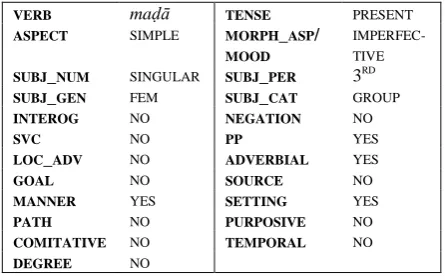
COME and GO verbs in newspaper writing. Sen-tence (4) is an example of a contextualized verb use annotated for the features listed above.
(4) اهتارماؤم يف ةعرسب يضمت يهو
CONJ=PP maḍā.IMPF.3SG.F INST=speed and she goes quickly
LOC conspiracies-CL.3SG.F.GEN
in her conspiracies
‘And it’s [i.e. Israel] quickly going ahead with its conspiracies’
VERB maḍā TENSE PRESENT
ASPECT SIMPLE MORPH_ASP/
MOOD
IMPERFEC-TIVE
SUBJ_NUM SINGULAR SUBJ_PER 3RD
SUBJ_GEN FEM SUBJ_CAT GROUP
INTEROG NO NEGATION NO
SVC NO PP YES
LOC_ADV NO ADVERBIAL YES
GOAL NO SOURCE NO
MANNER YES SETTING YES
PATH NO PURPOSIVE NO
COMITATIVE NO TEMPORAL NO
DEGREE NO
4
Statistical analyses
A wide range of statistical tests can be ap-plied in order to explore the data frames de-scribed above for various purposes.2 For in-stance, we can simply run the COME and GO data frames through mono-variate exploratory tests such as chi-square tests as a means of zeroing in on the distribution of contextual elements per each GO and COME verb. This kind of analysis would constitute a first step towards identifying divergence in usage patterns associated with each MSA motion verb. This preliminary step further motivates and justifies the examination of inter-action patterns among the contextual features, as
2
well as the identification of clusters of features that are closely tied to certain verb uses. A multi-variate analysis eventually facilitates the identifi-cation of prototypical uses of each verb as well as the less prototypical uses. In the following I will briefly discuss three types of statistical methods that can be applied to the MSA COME
and GO data frames: (i) chi-square test; (ii) clus-ter analysis; and (iii) polytomous logistic regres-sion analysis.3
4.1 Chi-square tests
The primary purpose of subjecting the
COME and GO data frames to chi-square test of independence is to examine whether the distribu-tion of the different levels of variables (tags) do not vary as a function of verb (null hypothesis), or, if they actually do vary as a function of verb (alternative hypothesis). For instance, if we ex-amine the occurrence of a GOAL phrase per each
GO verb, would the distribution of variables be
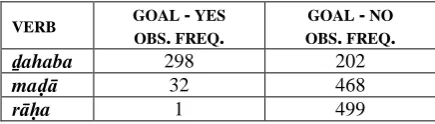
the same or different across the three verbs. To test this hypothesis –where we have an inde-pendent variable (verb) and a deinde-pendent variable (GOAL) –we can run a chi-square test on variable distribution. Table 2 shows the observed fre-quencies for the occurrence/absence of a GOAL
phrase per each GO verb, while Table 3 shows the expected frequencies calculated by the com-mand chisq.test()$expected in R (www.r-project.org).
VERB GOAL - YES
OBS. FREQ.
GOAL - NO OBS. FREQ.
ḏahaba 298 202
maḍā 32 468
[image:5.595.303.521.399.488.2]rāḥa 1 499
Table 2. Observed values for the variable GOAL
by GO verb.
VERB GOAL - YES
EXP. FREQ.
GOAL - NO EXP. FREQ.
ḏahaba 110.3333 389.6667
maḍā 110.3333 389.6667
rāḥa 110.3333 389.6667
Table 3. Expected values for the variable GOAL
by GO verb.
3
See Abdulrahim (2013) for further description of the prop-erties and applications of these statistical analyses on the MSA COME and GO data frames.
The calculated Pearson’s chi-square test for the distribution given in Table 4 proved to be quite significant: X2 = 277.1034, df = 6, p-value < 2.2e-16. This indicates that the distribution the variable GOAL for each GO verb deviates highly significantly from the expected distribution.
We can also examine the cell-wise diver-gences from a uniform distribution for this par-ticular contingency table by conducting a stand-ardized Pearson’s residual (discussed in Agresti 2002: 81; Arppe, 2008: 83-84). These test statis-tics can either be retrieved in R by using the command chisq.test()$std or by running the func-tion chisq.posthoc(), which is part of the statisti-cal package {polytomous} developed by Antti Arppe (2012). Table 4 contains the calculated values, which indicate whether the observed co-occurrence frequency reported in each individual cell is significantly more or less than expected.4 The chisq.posthoc()function presents an easier way to interpret these figures, in that it assigns +/–/0 values for each cell, which can be inter-preted as insignificant (0), significantly more than expected (+), or significantly less than ex-pected (–).
VERB GOAL - YES GOAL - NO
ḏahaba 24.78665
(+)
-24.78665 (–)
maḍā -10.34611 (–)
10.34611 (+)
rāḥa -14.44053 (–)
14.44053 (+)
TABLE 4. Standardized Pearson’s residuals for the occurrence of GOAL by GO verb.
As discussed earlier, these exploratory tests constitute a first attempt at understanding the distributional patterns of selected variables among the different verbs. Such mono-variate methods undoubtedly set the stage for the more complex multi-variate analyses that will follow and to which I turn next.
4.2 Cluster analysis
Clustering methods can help us examine the joint effect on the overall verbal behavior for each verb in the GO and COME verb set. One such method is referred to as hierarchical
4
[image:5.595.65.283.475.537.2]tive cluster analysis (explained more in detail in Gries, 2006; Diviaj and Gries, 2006; Gries and Otani, 2010, among others). Generally speaking, this clustering method groups together the lexical elements that are most similar to one another and, at the same time, the ones that are highly dissimilar to other elements in other clusters. Therefore, what we expect to see from this statis-tical method is a clustering dendrogram that shows us which COME or GO verbs overlap in their usage as opposed to the ones with which they hardly share any characteristics.
This method requires generating a table that lists relative frequencies (or proportions) of co-occurrence values of dependent variables per independent variable (the GO and COME verbs under study). A similarity/dissimilarity matrix is first computed, followed by computing a cluster structure based on a specific amalgamation rule.5 The resulting cluster structure can then be visual-ly represented in a dendrogram. The calculations involved in the different stages of hierarchical agglomerative cluster analysis have been made easier to conduct using BP 1.01 script, a program written by Stefan Gries (2009) for R. This R-based script uses a host of statistical methods required in the stages mentioned above. It initial-ly generates a co-occurrence table of relative fre-quencies of the different levels (IDTAG-LEVELs) within variables (IDTAGs).6 Table 5 shows a sample of such output table generated by BP 1.01 for the distribution of TENSE by COME verb.
IDTAG-
LEVEL atā ḥaḍara ǧā'a qadima
FUT 0.028 0.076 0 0.002 columns IRR 0.188 0.126 0.022 0.022 sum PAST 0.162 0.694 0.97 0.966 to PRES 0.622 0.104 0.008 0.01 1.0
Table5. Sample of a co-occurrence table gener-ated by the BP 1.01 script for the variable (IDTAG) TENSE by COME verb.
The BP 1.01 script returns a comprehensive table with similar values for all dependent by independent variable co-occurrences that have been fed into the script. This particular table can
5
An amalgamation rule is what determines whether or not two items are sufficiently similar in order to be linked or clustered together.
6
The idea of an ID tag was introduced by Atkins (1987) in her work on danger, where she examined collocates, colli-gations, POS, as well as other characteristics of the key word. An ID tag was therefore used to refer to the individual contextual features co-occurring with the keyword.
be subjected to a number of tests including the hierarchical agglomerative cluster analysis. For this particular clustering technique I relied on the (dis)similarity metric ‘Canberra’, and ‘Ward’ as the amalgamation rule that computes a cluster structure.7
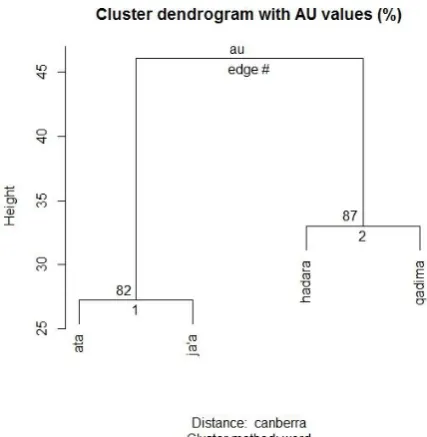
The dendrogram in Figure 1 shows two ma-jor divides between the four verbs that the hier-archical agglomerative cluster analysis deemed significant. The first cluster (on the left) formed in this analysis appears to group the verbs atā and ǧā’a together, while the other cluster groups ḥaḍara and qadima together. Here, we find that the AU p-value (Approximately Unbiased) – which is a probability measure computed through multi-scale bootstrap resampling – for the cluster containing ḥaḍara and qadima is calculated to approximate 87%, while the AU p-value for the cluster of atā and ǧā’a is 82%. Again, this does not necessarily imply that ḥaḍara and qadima are highly similar, but that they are very dissimi-lar from atā and ǧa’a in their usage. Indeed, sub-sequent mutli-variate as well as qualitative anal-yses showed that atā and ǧā’a shared more usage patterns than they did with the other COME verbs.
Figure 1. Dendrogram based on the COME multi-variate data frame.
4.3 Polytomous logistic regression
Another multi-variate analysis that can be applied to this kind of data frame for the purpose of examining patterns of variable interaction is logistic regression. Polytomous logistic regres-sion analysis (explained in detail in Arppe,
7
[image:6.595.308.522.397.616.2]2008), in particular, applies advanced algorithms in order to determine the relative effects of mul-tiple predictor variables (the tags/contextual fea-tures) on the choice of more than two outcome variables (i.e. the four COME verbs and the three
GO verbs). Generally speaking, logistic regres-sion would estimate probabilities of the occur-rence of each COME or GO verb given a particular context of use, and is therefore compatible with the view that linguistic choices are probabilistic rather than categorical (Bresnan, 2006; Arppe, 2007, 2008, 2009; among others). In a nutshell, polytomous logistic regression estimates variable parameters which can be interpreted “naturally” as odds (Harrell 2001). In other words, it deter-mines the extent to which the existence of a vari-able (i.e. feature/tag) in the context increases (or decreases) the chances of a particular outcome (i.e. verb) to occur, with all the other explanatory variables being equal.
To illustrate, we can conduct such analysis on the annotated COME data frame. The first step is to select a set of variables to include in the model. Note, however, that the binary and nomi-nal variables listed in Table 1 need to be con-verted into the form of logical variables in order to be included in the logistic regression model.8 The selection of these variables relies, first of all, on a mono-variate analysis (such as the inspec-tion of standardized Pearson’s residuals) as a means of figuring out which variables seem to have explanatory potential as opposed to those that do not. A second criterion for variable selec-tion relies on inspecting pair-wise associaselec-tion patterns between variables. That is to say, we need to examine the extent to which certain vari-ables have a high rate of co-occurrence, as a means of reducing collinearity in the regression model. The model listed in (5) includes 30 logi-cal variables as the independent variables and the
COME verb as a dependent variable.
(5) VERB ~TENSE.FUT + TENSE.PAST +
TENSE.PRES + ASPECT.HAB + ASPECT.SIMPLE + MORPH_ASP.MOOD.SUBJN + TRANSITIVITY.YES +
SUBJ_NUM.PL + SUBJ_PER.1ST + SUBJ_PER.3RD
+
SUBJ_GEN.FEM + SUBJ_CAT.ACTIVITY +
8
Every level of variable is turned into an individual (logical) variable with the levels TRUE/FALSE indicating whether this variable has or has not been observed in the context of use. For instance, the variable TENSE has four levels: PRESNT /
PAST / FUTURE / NIL. When turned into logical variables, we end up with four different variables (TENSE_PRESENT,
TENSE_PAST, TENSE_FUTURE and TENSE_NIL), the presence or absence of which is indicated by TRUE or FALSE.
SUBJ_CAT.COMMUNICATION +
SUBJ_CAT.DEMONSTRATIVE + SUBJ_CAT.EVENT
+ SUBJ_CAT.GROUP + SUBJ_CAT.INDIVIDUAL +
SUBJ_CAT.STATE + SUBJ_CAT.TIME + NEGA-TION.YES + PP.YES + LOC_ADV.YES + ADVERBI-AL.YES + GOAL.YES + SOURCE.YES + MAN-NER.YES + SETTING.YES + PURPOSIVE.YES +
COMITATIVE.YES + TEMPORAL.YES
The overall accuracy rate calculated for this model is 0.845. The accuracy measure (Menard, 1995: 28-30; Arppe, 2008: 129-132) corresponds to the number of times the model assigned the highest probability estimate to the actually ob-served verb in a given annotated context. We can also examine the individual accuracy rates per verb as a means of zeroing in on which particular verb(s) the model was more successful in pre-dicting. We can now examine the probability estimates that the polytomous logistic regression analysis assigns to each of the COME verbs per
annotated context (4 verbs * 2,000 sentences). These estimated probabilities range from very high values (approaching 1.00) to very low val-ues (approaching 0.00) and any valval-ues in be-tween, depending on the set of predictors (i.e. contextual features) present in a particular con-text of use. We can illustrate with sentences (6) and (7) which are extracted from the original da-ta frame. In (6) the verb received an almost cate-gorical probability estimate, while in (7) the verb received a less categorical probability estimate. It is also possible to examine the set of contextual features that each sentences was tagged for and which were used as predictor variables in the logistic regression model
(6)
atā = 0.022 ḥaḍara = 0.000
ǧā’a = 0.978
(observed) qadima = 0.000
contextual features used (in the model):
TENSE.PAST + ASPECT.SIMPLE
+ SUBJ_PER.3RD
+
SUBJ_CAT.DEM +
LOC_ADV.YES + SETTING.YES
ءاج ديشروخ ريزولا اهب ىلدأ تاحيرصت للاخ كلذ ǧā’a.PERF.3SG.M DEM ADV
came that during
statements declare.PERF.3SG.M
statements declared
INST=CL.3SG.F ART=minister Khurshid by it the minister Khurshid
(7)
atā = 0.199
ḥaḍara = 0.137
(observed) ǧā’a = 0.247 qadima = 0.146
contextual features used (in the model):
TESNE.PAST + ASPECT.SIMPLE +
SUBJ_PER.3RD
+
SUBJ_CAT.HUMAN + PP.YES +
LOC.ADV.YES + MANNER.YES +
COMITATIVE.YES
هئلامز نم اددع هعمو روفلا يلع بلأا رضح دقو ءابطلأا
CONJ=DM ḥaḍara.PERF.3SG.M ART=father LOC
and already came the father on
ART=immediately CONJ=COM-CL.3SG.M number the immediately and with him number
ABL colleagues-CL.3SG.M.GEN ART=doctors of his colleagues the doctors
‘And the father came immediately with a number of his physician colleagues’
The sentence in (6) can be considered as a prototypical use of the verb ǧā’a. In (7), howev-er, note that the verb which received the highest probability estimate was not the actually ob-served verb in that context. Nevertheless, all four verbs were assigned more-or-less equal probabil-ity estimates. This may indicate that this is one context of use in which the four COME verbs can be used interchangeably. Relying on my native speaker intuition, substituting the observed verb with the other COME verbs in (7) does not raise any red flags, especially since this particular con-texts of use indicates physical motion of a HU-MAN agent, as I discussed earlier in this paper.
Of course, not all predictions made by the model were accurate. Among the sentences for which a single verb received a very high proba-bility estimate, a number of instances in which the predicted verb was not the observed verb were found. Such sentences proved to be worthy of scrutiny due to the fact that some of these “mis-predictions” were associated with less typi-cal uses of the verb that was actually observed in context. For instance, in (8), the verb qadima was the verb observed in context, yet the model chose ḥaḍara instead as the verb that was most fitting in that context.
(8)
atā = 0.022
ḥaḍara = 0.962
(predicted) ǧā’a = 0.005
qadima = 0.011
(observed)
contextual features used (in the model):
SUBJ_PER.3RD
+
SUBJ_CAT.HUMAN + ADVERBI-AL.YES + GOAL.YES + MAN-NER.YES + TRANSITIVITY.YES
شيرق تلطع ارمتعم وأ اجاح ةكم مدق اذإ الله دبع نب يلع ناكو اهسلاجم
wa=kāna ʽali bin ʽabdillah iḏā
CONJ=be.PERF.3SG.M Ali Bin Abdullah COND
and was Ali Bin Abdullah if
qadima makka-ta ḥāǧǧan aw
qadima.PERF.3SG.M Mecca-ACC pilgrim CONJ
he came Mecca pilgrim or
muʽtamiran ʽaṭṭalat
pilgrim suspend.PERF.3SG.F
minor.pilgrim suspended
qurayš maǧālisa-ha
Quraysh meetings-CL.3SG.F
Quraysh its meetings
‘When Ali bin Abdullah used to come to Mecca on a pilgrimage Quraysh would suspend its meetings’
Interestingly, this particular usage of qadima in (8) can be found in a specific genre, that of historical narrative. While atā, ǧā’a, and ḥaḍara may all appear in transitive constructions in MSA, qadima normally does not. It is, howev-er, used in transitive constructions to signal a shift in register, as in the example in (8). Since such pattern of use occurs less frequently than the general overall usage of qadima, the model assigns ḥaḍara instead as the most plausible verb choice for such context. Careful inspection of “mis-predictions” such as the above is, therefore, an important step to identify the less typical uses of verbs, as well as to decide whether the varia-ble set chosen for the model has or has not been effective in accounting for verb usage. The prob-ability estimates calculated for the GO data frame did not yield such satisfying results, and did not necessarily agree with my native speaker’s intui-tion. In Abdulrahim (2013: 101) I attributed such findings to the set of variables that GO verbs
were coded for in the data frame (which, more or less, resembled the variable set COME verbs were
coded for). More specifically I suggested that the data frame should include more lexical or collocational variables.
5
Conclusions
defin-ing the behavior of a ldefin-inguistic item. The creation of a 500-row data frame per verb has allowed us to probe into the frequency and distribution facts regarding the usage of seven highly frequent mo-tion verbs in MSA. Moreover, the annotamo-tion of each corpus return for a wide range of contextual and semantic features offered the possibility of foregrounding the most prototypical aspects of use for each verb, as well as highlighting shared patterns of usage among the near-synonymous verbs in a set. In this paper, I have argued that the value of constructing a data frame of this type lies in developing more sophisticated lexico-syntactic frames of linguistic items, in that it allows us to extract preferred profiles of the lexical or constructional items under study.
Thankfully, there is a wide range of statisti-cal tests that have made the examination of and search for lexico-syntactic patterns in large data frames easier and more manageable. These sta-tistical tests vary from simple, mono-variate ex-ploratory test to complex and multi-variate pre-dictive models. Each one of the three statistical analyses discussed in this paper serves to high-light a particular aspect of variable distribution and variable interaction and, thus, helps us un-derstand the complexity of the relationship be-tween the near-synonymous COME and GO verbs. Generally speaking, the application of such sta-tistical tests to large, multi-variate data frames helps us examine the particular linguistic features that characterize lexical and constructional choices, which may have direct applications in natural language generation. In addition, the identification of prototypical and marginal uses of verbs – discussed particularly in 4.3 – can possibly contribute to developing readability as-sessment of texts for learners of MSA.9
Finally, lexicographic treatments of the highly frequent motion verbs discussed in this paper, as exhibited in bilingual and, mostly, monolingual dictionaries, range from almost ad-equate to completely mis-representative descrip-tions of the major and minor senses of these verbs (Abdulrahim, 2013). Many monolingual dictionaries follow a traditional and highly ideo-logical system of lexical representation whereby archaic uses of a lexical item are foregrounded and little attention is paid to more contemporary uses. The quantitative (and qualitative) analysis of a data frame such as the ones described here
9
I would like to thank an anonymous reviewers of this pa-per for pointing out these particular applications of the sta-tistical methods discussed here.
can help tease apart the different idiosyncratic uses for each of the seven motion verbs as well as identify the most and the least prototypical uses. One of the practical applications of such a data frame, therefore, is to create extensive, us-age-based dictionary entries that are more repre-sentative of contemporary language use and that would be useful for the native speaker of the lan-guage, the language learner, and the language researcher.10
Acknowledgments
I would like to thank Professors Antti Arppe, John Newman, and Sally Rice at the Uni-versity of Alberta for their constant guidance and feedback throughout the various stages of the creation of this data frame, the application of statistical tests, and the linguistic analysis. I would also like to thank the ANLP 2014 review-ers of this paper for their encouraging feedback and insights.
References
Abdulrahim, Dana. 2013. A corpus study of basic motion events in Modern Standard Arabic. Un-published doctoral dissertation. University of Alberta. Edmonton, Alberta. To be found on http://hdl.handle.net/10402/era.33921
Abdulrahim, Dana. (submitted). Quantitative ap-proaches to analyzing COME constructions in Modern Standard Arabic. To appear in A. Har-die, A. T. McEnrey (eds.), Arabic Corpus Lin-guistics.
Agresti, Alan. 2002. Categorical data analysis (2nd ed.). Hoboken: John Wiley & Sons, Hoboken.
Arppe, Antti. 2007. Multi-variate methods in corpus-based lexicography: A study of synonymy in finnish. Proceedings from the Corpus Linguis-tics Conference (CL2007), Birmingham, United Kingdom.
10
Arppe, Antti. 2008. Univariate, bivariate and multi-variate methods in corpus-based lexicography - a study of synonyms. (PhD, University of Hel-sinki). Publications of the Department of Gen-eral Linguistics, 44.
Arppe, Antti. 2009. Linguistic choices vs. probabili-ties - how much and what can linguistic theory explain? In: Featherston, Sam & Winkler, Su-sanne (eds.) The Fruits of Empirical Linguistics 1, pp 1-24. Berlin: de Gruyter.
Atkins, Beryl. T. S. 1987. Semantic ID tags: Corpus evidence for dictionary senses. Proceedings of the Third Annual Conference of the UW Cen-tre for the New Oxford English Dictionary, pp17–36.
Bresnan, Joan. 2006. Is syntactic knowledge probabil-istic? Experiments with the English dative alter-nation. Pre-Proceedings of the International Conference on Linguistic Evidence, Tübingen, Germany. (pp. 2-4).
Bybee, Joan. 2010. Language, usage and cognition. Cambridge: Cambridge University Press.
Croft, William. & Allan. D. Cruse. 2004. Cognitive linguistics. Cambridge: Cambridge University Press.
Divjak, Dagmar. S., & Stefan T. Gries. 2006. Ways of trying in Russian: Clustering and comparing be-havioral profiles. Corpus Linguistics and Lin-guistic Theory, 2(1), 23-60.
Firth, John. R. 1957. A synopsis of linguistic theory, 1930-1955. In J. R. Firth. 1968. Selected Papers of J. R. Firth 1952-1959 (pp. 168-205). London: Longman.
Gries, Stefan Th. 2006. Corpus-based methods and cognitive semantics: The many meanings of to run. In S. Th. Gries, & A. Stefanowitsch (Eds.),
Corpora in cognitive linguistics: Corpus-based approaches to syntax and lexis,pp 57-99. Ber-lin/New York: Mouton de Gruyter.
Gries, Stefan Th. 2009. Statistics for linguistics with R: A practical introduction. Berlin: De Gruyter Mouton.
Gries, Stefan Th. & Dagmar S. Divjak. 2009. Behav-ioral profiles: A corpus-based approach towards cognitive semantic analysis. In Vyvyan Evans, & S. S. Pourcel (Eds.), New directions in cogni-tive linguistics, pp 57-75.
Amster-dam/Philadelphia: John Benjamins.
Gries, Stefan. Th. & Naoki Otani. 2010. Behavioral profiles: A corpus-based perspective on synon-ymy and antonsynon-ymy. ICAME Journal,34, pp 121-150
Harrell, Frank E. 2001. Regression modeling strate-gies: With applications to linear models, logistic regression and survival analysis. New York: Springer-Verlag.
Hastie, Trevor, Robert Tibshirani, & Jerome Fried-man. 2009. The elements of statistical learning: Data mining, inference, and prediction. New York: Springer.
Langacker, Ronald. 1987. Foundations of cognitive grammar, vol. I: Theoretical prerequisites. Stanford, Calif.: Stanford University Press.
Menard, Scott. 1995. Applied logistic regression analysis. Thousand Oaks: Sage Publications.
Data sets and R scripts
Abdulrahim, Dana. (forthcoming). Arabic come and go. A micro-corpus of 3500 occurrences of seven motion verbs in MSA (atā, ǧā’a, ḥaḍara,
qadima, ḏahaba, maḍā, and rāḥa), annotated for a wide range of morphological, syntactic, and semantic variables
Arppe, Antti. 2012. polytomous: Polytomous Logistic Regression for fixed and mixed effects. R pack-age version 0.1.4.
Gries, Stefan. Th. (2009). BehavioralProfiles 1.01. A program for R 2.7.1 and higher.
Appendix A. Examples for annotation for
semantic variables
variable sample of annotation
SUBJECT
CATE-GORY:
ACTIVITY موجه ‘attack’, تايلمع ‘operations’,
تيوصت ‘voting’
ANIMAL داوج ‘horse’, بلك ‘dog’ ATTRIBUTE مرك ‘generosity’, ةرهش ‘fame’ BODY نويع ‘eyes’, مدق ‘foot’
COGNITION ريكفت ‘thought’, لايخ ‘imagination’
COMMUNICA-TION
لاؤس ‘question’, ريرقت ‘report’
CONTENT (of a
docu-ment/speech)
نايبلا يف ءاج ǧā’a.PERF.3SG.M LOC ART=statement ‘came in the statement…’,
DEMONSTRA-TIVE
كلذ ءاج ǧā’a.PERF.3SG.M LOC DEM
‘that came…’,
اذه ءاج ǧā’a.PERF.3SG.M LOC DEM
‘this came…’, etc.
EVENT عامتجإ ‘meeting’, ةودن
‘sympo-sium’, ةمق ‘summit’
GROUP (repre-senting humans collectively)
نابايلا ‘Japan’, بختنملا ‘varsity’, ةموكحلا ‘the government’
HUMAN دلاولأا ‘the boys’, ابابلا ‘the Pope’ LOCATION عقوم ‘location’, ندملا ‘the cities’ NOTION ةيذلأا ‘harm’, ردصم ‘source’ PHYSICAL
OB-JECT/ARTIFACT
حنم ‘grants’, حمقلا ‘wheat’
SENSE توص ‘voice/sound’
STATE توملا ‘the death’, ةلحرم ‘phase’ SUBSTANCE قئارح ‘fires’, رطم ‘rain’ TIME مسوم‘season’, دغلا ‘tomorrow’
GOAL PHRASE:
YES
ناشيشلا ىلإ بهذت انتادعاسم aid.CL.1PL.GEN
ḏahaba.IMPF.3SG.FALL ART=Chechnya
‘Our aid goes to Chechnya’ SOURCE
PHRASE:
YES
دنهلا نم تمدق يتلا ةيبونجلا تارجهلا
ART=immigrations ART=southern
RP qadima.PERF.3SG.F ABL ART=India
‘The southern immigrations that came from India…’
MANNER
PHRASE:
YES
ارده بهذت مل دوهجلا هذه
DEM ART=efforts NEG ḏahaba.JUSS.3SG.F vain.ADV ‘These efforts weren’t in vain’ SETTING
PHRASE:
YES
لماش ططخم راطا يف يتأت لب
CONJ atā.IMPF.3SG.F LOC frame plan comprehensive
‘It, however, comes as part of a comprehensive plan’
PATH PHRASE:
YES
كنبلا لامسأر ىلع تتأ ةراسخ deficit atā.PERF.3SG.F LOC capi-tal ART=bank
‘A deficit that destroyed the bank’s capital’
PURPOSIVE
PHRASE:
YES
هتلأسو هترايزل تبهذ
ḏahaba.PERF.1SG
PURP=visit.CL.3SG.M.ACC CONJ=ask.CL.3SG.M.ACC
‘I went to visit him and asked him’
COMITATIVE
PHRASE:
YES
ديدجب تأي مل مكجمانرب show.CL.3PL.M.GEN NEG atā.PERF.3SG.M COM=new
‘Your show did not come up with anything new’
TEMPORAL
PHRASE:
YES
تقو يأ يف ميرك سيأ لوانتل بهذأ
ḏahaba.IMPF.1SG PURP=have.VN
ice cream LOC any time
‘I go to have ice cream at any time’
DEGREE
PHRASE:
YES
مظتنملا وطسلا تايلمع ربع امئاد يتأت