Aligning Chinese-English Parallel Parse Trees: Is it Feasible?
Dun Deng and Nianwen Xue
Computer Science Department, Brandeis University 415 South Street, Waltham MA, USA
[email protected], [email protected]
Abstract
We investigate the feasibility of aligning Chinese and English parse trees by examining cases of incompatibility between Chinese-English parallel parse trees. This work is done in the context of an annotation project where we construct a parallel treebank by doing word and phrase alignments simultaneously. We discuss the most common incompatibility patterns identified within VPs and NPs and show that most cases of incompatibility are caused by divergent syntactic annotation standards rather than inherent cross-linguistic differences in language itself. This suggests that in principle it is feasible to align the parallel parse trees with some modification of existing syntactic annotation guidelines. We believe this has implications for the use of parallel parse trees as an important resource for Machine Translation models.
1 Introduction
Parallel treebanks have been proved to be a valuable resource in Machine Translation research (Gildea, 2003; Liu et al., 2009; Sun et al., 2010; Chiang, 2010; Xiao and Zhu, 2013), but one issue that hampers their utility is the incompatibility between the syntactic parse trees for a sentence pair (Chiang, 2010), as the trees are annotated based on independently developed monolingual syntactic annotation standards. For example, even though the Penn Chinese Treebank (Xue et al., 2005) and English TreeBank (Marcus et al., 1993) are often referred to collectively as the Penn series of treebanks and are both annotated with phrase structure trees in very similar annotation frameworks, different annotation decisions have led to divergent tree structures (Chiang, 2010). The purpose of this study is to investigate to what extent the divergences between Chinese-English parallel parse trees are caused by different annotation styles (and therefore can be avoided by revising the annotation guidelines), and to what extent they are caused by cross-linguistic differences inherent in language. The answer to this question would shed light on whether it is possible to align the parse trees in parallel treebanks, and on the feasibility of building Machine Translation systems based on these aligned parallel treebanks.
phrase-level alignments. We analyze two of them and show how they make certain phrase alignments impossible. In Section 4, we discuss the third and also the most common type of incompatibility, which is caused by different annotation decisions as specified in the Penn Chinese and English Treebank syn-tactic bracketing guidelines (Xue and Xia, 2000; Bies et al., 1995). We propose modifications to the tree structures for the purpose of aligning the parse trees, which means that proper phrase alignment is possible if certain common patterns of incompatibility in syntactic parse trees are fixed. We conclude our paper in Section 5 and touch on the workshop theme. We argue that the quality and level of linguistic sophistication of an linguistic annotation project is tied to the purpose of the resource, and how it is going to be used.
2 Overview of the HACEPT Project
The purpose of the HACEPT (Hierarchically Aligned Chinese-English Parallel TreeBank) Project is to perform word-level and phrase-level alignments between parallel parse trees to develop a linguistic re-source for Machine Translation models. We are currently in the process of aligning about 9,000 sentence pairs where syntactic parses already exist for sentences on both the Chinese and English side.
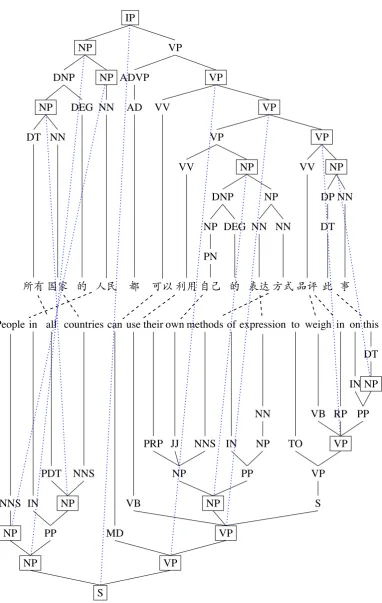
In our project, the annotator is presented with a pair of parallel Chinese-English sentences which have parse trees. The task of the annotator is to do both word and phrase alignments between the two parse trees. The reason for doing word alignments and phrase alignments simultaneously is to make sure word alignments and syntactic structures are harmonized to avoid both redundancies and incompatibilities. Let us use the concrete example in Figure 1 to illustrate the point.
A big challenge to word alignment comes from language-particular function words that do not have counterparts in the translation language. Take the sentences in Figure 1 for instance, the Chinese pre-nominal modification marker的has no English counterpart. Similarly, the English infinitive markerto
has no Chinese counterpart. Word alignments done without taking syntactic structures into considera-tion generally glue a funcconsidera-tion word such as的andtohere to a neighboring content word which has a counterpart and align the two words together to the counterpart of the content word (Li et al., 2009). Under this practice, the first的will be glued to国家/country, and the two words国家/country的as a whole will be aligned tocountries. Similarly,towill be glued toweigh inand the whole stringto weigh inwill be aligned to品评/weigh in. In our project, we take a different approach to word alignments: we leave all the words without a counterpart unaligned on the word level and mark them as "extra". For each unaligned word, we locate the appropriate phrase which contains the unaligned word and has a phrasal counterpart on the other side. By aligning the two phrases, the unaligned word is captured in its appropriate context. Under this new strategy, the Chinese的and the Englishtoare both left unaligned on the word level. For的, we align the NP所有/all国家/country的 人民/people with the NPpeople in all countries, because the Chinese NP is the relevant context where的appears (的is used in the NP to indicate that所有/all国家/country is the modifier of the noun人民/people) and matches in meaning with the English NP. Forto, we align the VPuse their own methods of expression to weigh in on thiswith the VP利用/use自己/own的 表达/expression方式/method品评/weigh in此/this事/thing, becauseto
is used in the English VP to connectuse their own methods of expressionandweigh in on thisand also because the English VP and the Chinese one matches in meaning.
.... IP. .... .. VP. .... .. VP. .... .. VP. .... .. VP. .... .. NP. .... .. NN... ..
事
. .. .. DP... .. DT... ..
此
. ..
.. VV...
..
品评
. .. .. VP. .... .. NP. .... .. NP. .... .. NN... ..
方式
. ..
.. NN...
..
表达
. .. .. DNP. .... .. DEG... ..
的
. .. .. NP... .. PN... ..
自己
. ..
.. VV...
..
利用
. ..
.. VV...
..
可以
. .. .. ADVP... .. AD... ..
都
. .. .. NP. .... .. NP... .. NN... ..
人民
. .. .. DNP. .... .. DEG... ..
的
. .. .. NP. .... .. NN... ..
国家
. ..
.. DT...
..
所有
[image:3.595.110.493.86.690.2]. ..S. .... .. VP. .... .. VP. .... ..S... .. VP. .... .. VP. .... .. PP. .... .. NP... .. DT... .. this . .. .. IN... .. on . .... .. RP... ..in . .. .. VB... .. weigh . .. .. TO... ..to . .... .. NP. .... .. PP. .... .. NP... .. NN... .. expression . .. .. IN... .. of . .. .. NP. .... .. NNS... .. methods . .... ..JJ... .. own . .. .. PRP... .. their . .. .. VB... .. use . .. .. MD... .. can . .. .. NP. .... .. PP. .... .. NP. .... .. NNS... .. countries . .. .. PDT... .. all . .. .. IN... ..in . .. .. NP... .. NNS... .. People
string to品评/weigh in sinceto weigh inis not even a constituent in the English parse tree. For a more comprehensive and detailed description of the HACEPT project, see (Deng and Xue, 2014).
A natural question arises for our approach: cross-linguistic divergences between languages may cause parse tree incompatibilities to arise, which calls into question the possibility of doing phrase alignments to a useful extent. The fact is that we did find incompatibilities between parse trees in our annotation. In the next section, we report three types of parse tree incompatibilities we have encountered.
3 Three types of parse tree incompatibilities
During the annotation process, we encountered three types of parse tree incompatibilities that make some phrase alignments impossible. The three types are distinguished by the sources of their occurrence and are listed below:
Three types of incompatibilities between parallel parse trees:
a. Incompatibilities caused by lexical-semantic differences between the two languages b. Incompatibilities caused by translation-related reasons
c. Incompatibilities caused by different annotation standards
Let us look at the first type. On the lexical level, languages differ in terms of whether or not a piece of semantic information is encoded in a lexical item. For instance, Chinese does not have a verb that ex-presses the meaning of the English verbprioritize, which needs to be translated using a phrase. This does not necessarily cause problems for phrase alignments. Takingprioritizefor instance, the English phrase
prioritize transportation projectsis translated as安排/arrange交通/transportation项目/project的 优 先/priority 顺序/order (literally arrange transportation projects' priority order, i.e., prioritize trans-portation projects). Note that a phrase alignment can be made between the two VPs and also the two NPstransportation projectsand交通/transportation项目/project despite the fact that the meaning of
prioritizeis expressed by a discontinuous phrase in Chinese (安排/arrange… 的 优先/priority顺序 /or-der, i.e.,arrange the priority order of ...). The most extreme case in this category which usually causes incompatibilities and makes phrase-level alignment impossible is idiomatic expressions. An idiom is a single lexical item just like a word and its meaning generally has to be expressed literally in another language. For instance, the idiomatic part inMarkets function best so long asno one has a finger on the scaleis translated as (只要/so long as)大家/everyone公正/justly行事/act (市场/market运作 /func-tion最/most好/good), which literally iseveryone justly acts. The parse tree for both the English idiom and its Chinese translation is given in Figure 2. No phrase alignment is possible between the idiom and its translation except that between the two root nodes that dominate each string. Phrase alignments are reduced to a minimal extent in cases like this.
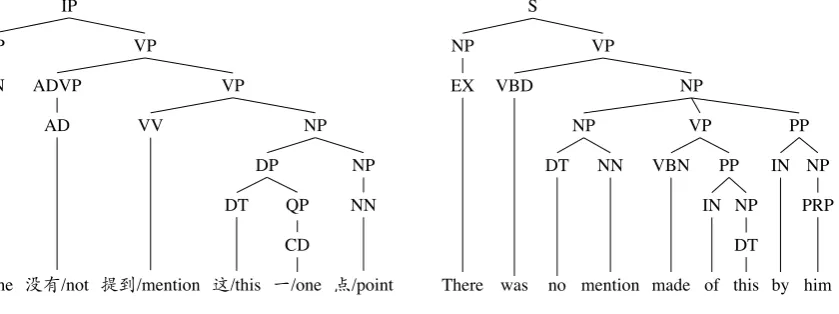
Now let us discuss the second type. Consider this example, where the Chinese sentence他/he没有/not
提到/mention这/this一/one点/point (He did't mention this point) is translated asThere was no mention made of this by him. Given this particular translation, it is impossible to make a phrase alignment between the Chinese VP没有/not 提到/mention这/this一/one点/point andno mention made of thisalthough the two strings match in meaning. This is because, as shown in Figure 3, the NP node that dominates the English string also dominates the PPby him. Note thathimin the PP corresponds to他/he, which is outside the Chinese VP. The issue here is caused by the translation. Note that the Chinese sentence is in active voice, but the given translation is in passive voice, which is why the PPby himappears at the end of the sentence and causes the problem. If the more literal translationHe didn't mention this point
were provided,没有/not提到/mention这/this一/one点/point could be aligned withdidn't mention this point, and提到/mention这/this一/one点/point could be aligned withmention this point, which is also impossible with the given translation. Phrase alignments are reduced by some extent in cases like this.
.... CP. .... .. IP. .... .. VP. .... .. VP... .. VV... ..
行事/act . .. .. ADVP... .. AD... ..
公正/justly . .. .. NP... .. PN... ..
大家/everyone . .. .. ADVP... .. CS... ..
只要/so long as
(a) Chinese literal translation of the idiom
.... ADVP. .... .. SBAR. .... ..S. .... .. VP. .... .. NP. .... .. PP. .... .. NP. .... .. NN... .. scale . .. .. DT... .. the . .. .. IN... .. on . .. .. NP. .... .. NN... .. finger . .. .. DT... ..a . .. .. VB... .. has . .. .. NP. .... .. NN... .. one . .. .. DT... .. no . .. .. IN... .. as . .. .. ADVP.... .
.. RB... .. long . .. .. RB... .. so
[image:5.595.182.495.132.300.2](b) An English idiom
Figure 2: Structural divergence caused by idiomatic expressions
.... IP. .... .. VP. .... .. VP. .... .. NP. .... .. NP... .. NN... .. 点/point . .. .. DP. .... .. QP... .. CD... .. 一/one .
..
.. DT...
.. 这/this .
..
.. VV...
.. 提到/mention . .. .. ADVP... .. AD... .. 没有/not . .. .. NP... .. PN... .. 他/he
(a) Chinese sentence
....S. .... .. VP. .... .. NP. .... .. PP. .... .. NP... .. PRP... .. him . .. .. IN... .. by . .... .. VP. .... .. PP. .... .. NP... .. DT... .. this . .. .. IN... .. of . .. .. VBN... .. made . .. .. NP. .... .. NN... .. mention . .. .. DT... .. no . .. .. VBD... .. was . .. .. NP... .. EX... .. There
[image:5.595.93.513.485.642.2](b) Non-literal English translation
.... VP. ....
.. XP .
....
.. NP .
....
..V .
..
.. ADVP
(a) PTB structure for VP
.... VP. ....
.. VP. ....
.. NP/QP .
..
..V .
..
.. XP
(b) CTB structure for VP
Figure 4: Bracketing decisions for VP made by PTB and CTB. XP = {PP, ADVP, S}
Idioms which make phrase-level alignment impossible are rare in our corpus. On average, there are about 5 cases in a file of 500 sentence pairs. As for the incompatibilities caused by translation, it is possible for the phrase alignments missed in those cases to be made up if the phrases involved reappear in a more literal translation. These two issues do not pose a real threat to our approach. As annotators, we cannot do much about these two issues, especially the latter one, since our data is got as is. Due to these two reasons, we will not discuss them further in this paper.
Next let us turn to the last type of incompatibility. Use the sentence pair in Figure 1 for instance. Note that the Chinese VP利用/use自己/own的 表达/expression方式/method matches the English string
use their own methods of expressionin terms of both grammaticality and meaning. However, the English parse tree has no phrasal node for the string that could form an alignment to the Chinese VP. Similarly, the Chinese NP表达/expression方式/method corresponds to the English stringmethods of expression, but again, no phrasal node is present in the English parse tree that could be aligned with the Chinese NP. Our statistics shows that, in a file with 500 sentence pairs, there are approximately 50 instances of the incompatibility in VPs illustrated here and 20 in NPs (an instance is a case where a legitimate phrase alignment cannot be made). These are both quite high frequency. In the next section, we discuss the reason for the incompatibility and give a solution to fix the issue.
4 A common incompatibility pattern and its solution
There is a pattern for the incompatibility illustrated at the end of Section 3. The cause for the incom-patibility is the bracketing annotation of the complement-adjunct distinction made by the Penn Treebank (PTB) bracketing guidelines (Bies et al., 1995). The pattern is found in both VPs and NPs.
Let us discuss VPs first. To see the pattern, we need some background information about the internal composition of both English and Chinese VPs and how VPs are parsed according to PTB and CTB annotation standards. Let us start with the English VP. Besides the verb, there can be both preverbal and postverbal constituents in an English VP. Preverbal constituents are much more restricted than postverbal constituents in terms of both phrase types and the number of constituents allowed. Most commonly seen in our corpus, an ADVP is present before the verb if there is a preverbal constituent at all. By contrast, various kinds of constituents (NP, PP, ADVP, S) can appear post-verbally and more than one of these phrases can co-occur. When there is more than one post-verbal constituent, quite often one of them is the complement of the verb and the others are adjuncts. Due to engineering considerations, the PTB bracketing guidelines decided on a flat structure for the English VP, where preverbal and postverbal constituents and the verb are treated as sisters that are directly attached to the VP-node (Bies et al., 1995). A general structure for the English VP is given in Figure 4a, where it can be seen that the complement-adjunct distinction is not made.
the complement of the verb or one particular kind of phrase, namely QP, which includes counting phrases such asthree timesas inwent there three times, and duration phrases such asfor three yearsas inlived there for three years. Adjuncts including ADVP, PP, and different kinds of adverbial clauses come be-fore the verb. The second difference is that Chinese strongly favors no more than one constituent after the verb. In theory, a complement phrase and a QP can co-occur after the verb, but in reality, if the two co-occur in a sentence, the complement will most likely be preposed to the left of the verb by either topicalization or the introduction of the function word把, leaving QP the only post-verbal element. The structure of a Chinese VP stipulated by the CTB bracketing standards (Xue and Xia, 2000) is provided in Figure 4b.
Now let us compare the two structures in Figure 4. Note that in the English VP there is no phrasal node that dominates the verb and its immediate sister on the right, which, in many cases, is the complement of the verb. By contrast, there is a node in the Chinese VP (the boxed VP) that groups together the verb and a post-verbal constituent, which could be either the complement or a QP (some QPs are complements and some others are adjuncts, an issue that does not need to bother us here). This is where the incompatibility arises: the boxed VP-node in the Chinese tree has no node-counterpart to align with in the English tree, but the string dominated by that boxed VP has a match in the English sentence. The example in Figure 1 illustrates the issue, where the Chinese VP dominating the string利用/use自己/own的 表达/expression
方式/method has no possible phrase alignment although the string corresponds in meaning to the English stringuse their own methods of expression.
To eliminate the incompatibility, an extra layer of projection is needed in the English tree. To be specific, we need to combine the verb and its complement to create a VP node, which then can be aligned to the boxed VP in the Chinese tree. Still using the example in Figure 1 for instance, we need to create a VP node by combining the English verbuseand its object NPtheir own methods of expression, so that the Chinese VP利用/use自己/own的 表达/expression方式/method can be aligned with the resultant VP. This can be done through binarization.
Now let us turn to the pattern in NPs. We will look at the English NP first. There can be constituents both before and after the head in an English NP. Post-nominal constituents can be either a PP or an S whereas pre-nominal constituents can be one or more than one of the following kinds of elements: deter-miners (the/a/an), demonstratives (this/thatetc.), quantifiers (some,manyetc.), numerals and adjectives. The PTB bracketing guidelines make the decision that all pre-nominal elements and the head be grouped together using a flat structure to form a NP, which then is treated as a sister of a post-nominal constituent, be it a complement or an adjunct. As for the Chinese NP, the major difference between a Chinese NP and an English one is that there can only be pre-nominal constituents in Chinese NPs. In other words, the head noun is the rightmost element in a Chinese NP and nothing comes after it.
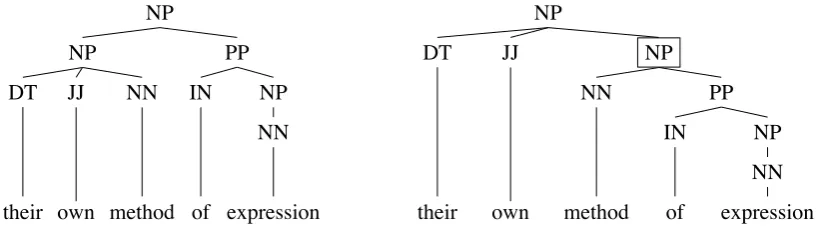
The incompatibility has to do with the complement-adjunct distinction. The complement of an English noun can be either a PP or an S, which always comes after the noun. Due to space limit, we only discuss PP below. An English noun and its PP complement, because of the close semantic relationship between the two, are usually translated as a compound noun in Chinese. For instance,student of linguisticsis translated as the N-N compound语言学/linguistics学生/student. A compound is treated by the CTB bracketing standard as an NP dominating all its components. Unfortunately, the English head noun and its complement do not form a constituent, which, if present, can be aligned with the node for the Chinese compound. This causes incompatibility to arise. Take Figure 1 for instance, the English stringmethods of expressionis translated as the Chinese compound noun表达/expression方式/method. As shown by the structure, the nounmethodand its PP complement do not form a constituent. As a result, the Chinese compound noun has no alignment.
.... NP. ....
.. PP. ....
.. NP...
.. NN...
.. expression .
.. .. IN...
.. of .
.. .. NP. ....
.. NN...
.. method .
.... ..JJ...
.. own .
.. .. DT...
.. their
(a) Current structure
.... NP. ....
.. NP. ....
.. PP. ....
.. NP...
.. NN...
.. expression .
.. .. IN...
.. of .
.. .. NN...
.. method .
....
..JJ...
.. own .
.. .. DT...
.. their
[image:8.595.104.516.73.196.2](b) Proposed new structure
Figure 5: A proposed revision for the existing structure of English NPs
method) is combined with its complement (such as the PPof expression) first to create an NP, which then is modified by, say, an adjective (such asown) and a determiner (such astheir). From the semantic point of view, a pre-nominal adjective is an adjunct to the head noun that is not as closely related to the head noun as its complement. The new structure given in Figure 5b reflects this semantic fact by combining the complement with the head before the adjective.
5 Conclusion
In this paper, we argue that it is feasible to align Chinese-English parallel parse trees despite incompat-ibility issues. We show that the most common incompatincompat-ibility is caused by bracketing guideline design, which can be fixed by changing the existing structures stipulated by the current annotation standards. The revised structures we proposed to avoid the incompatibility are deeper than the existing PTB struc-tures and respect the complement-adjunct distinction, which is a well-established notion in linguistics that has been shown to manifest itself in different kinds of phenomena cross-linguistically. In syntax, the distinction is made by combining the head and its complement first to form a constituent, which then is combined with an adjunct. This way of representing the distinction is standard and gives arise to a struc-ture that is binary-branching and deep. In syntactic annotation, linguistic sophistication which requires the parse tree to reflect well-established linguistic notions such as the complement-adjunct distinction is an important consideration and generally gives arise to deeper structures. In addition to linguistic sophis-tication, another important consideration in syntactic annotation is engineering economy, which requires the annotation to be economical in the sense that it can be carried out in a convenient and efficient manner to save annotation effort and time. This means that the parse tree needs to be as flat as possible since shal-low structures are much easier to annotate than deep ones. These two competing considerations interact to influence the establishment of bracketing standards.
treebanks with hierarchical alignments.
Acknowledgements
The HACEPT project, under which the work presented in this paper is done, is supported by the IBM subcontract No. 4913014934 under DARPA Prime Contract No. 0011-12-C-0015 entitled "Broad Oper-ational Language Translation". We would like to thank Libin Shen and Salim Roukos for their inspiration and discussion during early stages of the project, Abe Ittycheriah and Niyu Ge for their help with setting up the data, Loretta Bandera for developing and maintaining the annotation tool, and three anonymous reviewers for their helpful comments. We are grateful for the hard work of our four annotators: Hui Gao, Shiman Guo, Tse-ming Wang and Lingya Zhou. Any opinions, findings, conclusions or recommenda-tions expressed in this material are those of the authors and do not necessarily reflect those of the sponsor or any of the people mentioned above.
References
Ann Bies, Mark Ferguson, Karen Katz, Robert MacIntyre, Victoria Tredinnick, Grace Kim, Mary Ann Marcinkiewicz, and Britta Schasberger. 1995. Bracketing guidelines for Treebank II style Penn Treebank project. Technical report, University of Pennsylvania.
David Chiang. 2010. Learning to translate with source and target syntax. InProceedings of the 48th Annual Meeting of the Association for Computational Linguistics, pages 1443--1452.
Dun Deng and Nianwen Xue. 2014. Building a Hierarchically Aligned Chinese-English Parallel Treebank. In
Proceedings of the 25th International Conference on Computational Linguistics (COLING 2014).
Daniel Gildea. 2003. Loosely tree-based alignment for machine translation. InProceedings of the 41st Annual Meeting on Association for Computational Linguistics-Volume 1, pages 80--87.
Xuansong Li, Niyu Ge, and Stephanie Strassel. 2009. Tagging guidelines for Chinese-English word alignment. Technical report, Linguistic Data Consortium.
Yang Liu, Yajuan Lü, and Qun Liu. 2009. Improving tree-to-tree translation with packed forests. InProceedings of the Joint Conference of the 47th Annual Meeting of the ACL and the 4th International Joint Conference on Natural Language Processing of the AFNLP, pages 558--566.
Mitchell P. Marcus, Beatrice Santorini, and Mary Ann Marcinkiewicz. 1993. Building a Large Annotated Corpus of English: The Penn Treebank. Computational Linguistics, 19(2):313--330.
Jun Sun, Min Zhang, and Chew Lim Tan. 2010. Exploring syntactic structural features for sub-tree alignment using bilingual tree kernels. InProceedings of the 48th Annual Meeting of the Association for Computational Linguistics, pages 306--315.
Tong Xiao and Jingbo Zhu. 2013. Unsupervised sub-tree alignment for tree-to-tree translation.Journal of Artifi-cial Intelligence Research, 48:733--782.
Nianwen Xue and Fei Xia. 2000. The bracketing guidelines for Penn Chinese Treebank project. Technical report, University of Pennsylvania.