Roo:
A Framework for Real-Time Threads
Chris
Zimmermann
Vinny
Cahill
Distributed Systems Group, Department of Computer Science, Trinity College, Dublin 2, Ireland {czimmerm, vjcahill}Odsg.cs.tcd.ie
http://www.dsg.cs.tcd.ie/dsg-people/{czimmerm/czimmerm.html, vjcahill/vjcahill.html}
Abstract
Traditional object-oriented real-time s y s t e m s are of-
t e n limited in that t h e y provide only one approach t o real-time object support. Taking the increasing de- m a n d for flexible and extensible object support envi- r o n m e n t s i n t o account, we discuss t h e design and im- p l e m e n t a t i o n of a s m a l l object-oriented real-time exec- utive based o n a sub-framework which we call Roo. Roo is a component of t h e T i g g e r f r a m e w o r k ( o u r proposal
for a n extensible object support operating s y s t e m ) and i s intended t o support different object models provad- ing soft real-time behaviour. Roo provides support for
different m e c h a n i s m s and policies for real-time thread m a n a g e m e n t , scheduling and synchronization. In t h i s
it serves as a basis for other components of the Tagger f r a m e w o r k .
1
Introduction
Traditional object-oriented real-time systems like [16, 111 are often limited in that they provide only one ap- proach t o real-time object support. As [21] points out, for programmers using these systems this sometimes presents a severe limitation: they are constrained by the mechanisms and policies provided by these sys- tems and are unable to adapt them to their specific needs. To support such cases, an approach based on an extensible, object-oriented framework providing different mechanisms and policies for real-time sup- port, from which the programmer is free to choose the most appropriate mechanisms, is required.
This paper discusses the design and implementa- tion of a small sub-framework named Roo forming an executive for the support of soft real-time applications such as multimedia and interactive simulations. De- veloped as part of the Tigger project [7], this sub- framework will be used as a basis for the support of
different active object models.
The remainder of the paper is structured as fol- lows: after a brief discussion of the Tigger architec- ture including the ways in which active objects can be supported, Roo itself is described. First, the internal structure of Roo is described followed by the the build- ing blocks from which Roo is composed. The following section outlines the benefits of this approach for the programmer using and extending Roo. A status re- port including some preliminary performance figures and an outlook conclude the paper.
2
Tigger Overview
This section gives a brief overview of the Tigger project and discusses our approach to supporting active objects and distributed real-time behaviour within Tigger.
2.1
Tigger
The Tigger project is developing a framework for the construction of a family-the Tigger Pride-of dis- tributed object-support operating systems [7]. Mem- bers of the Tigger Pride will be hosted on top of bare hardware, (real-time) micro-kernels and conventional operating systems.
The framework describes the fundamental abstrac- tions supported by each instantiation and allows tai- lored implementations to be provided. Unusually, the Tigger framework is self-hosting thereby allowing in- stantiations t o be built using distributed and persis- tent objects.
The baseline for the Tigger project is a set of min- imal object-support operating systems supporting a t least four primitive abstractions: distributed objects; persistent objects; activities (i.e. distributed threads of control) and extents (i.e. protected collections of objects). Members of the Tigger Pride may provide additional abstractions supporting, for example, se- curity and transaction services. The result is that a
Tigger which provides the necessary services for the target application domain can be constructed.
2.2
Concurrent Object Models
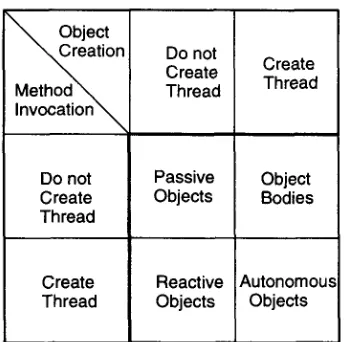
In order t o provide maximum flexibility t o the lan- guage designer, Tigger has t o cater for different con- current object models like asynchronous method invo- cation and object-bodies [26]. Therefore, Tigger sup- ports a number of possible ways of associating threads and objects, allowing very fine-grained concurrency. In general, the way in which thread creation is associ- ated with the creation of a n object and the invocation of a method characterizes the object model. Fig. 1
summarizes the most important options. It should be realized t h a t , in each case, whether or not a thread is actually created, may depend on factors such as the allowable degree of concurrency within a given object
or other synchronization constraints
Object Creation
Method
\
InvocationDo not Create Thread
Create Thread
Do not Create Thread
Passive Objects
Reactive Objects
Create Thread
Object Bodies
[image:2.618.101.273.469.640.2]4utonomou Objects
Figure 1: Degrees of Concurrency Inside an Object
0 Passive Objects: This is the traditional object
model supported by object-oriented programming languages and support systems. During a method invocation, the thread of control active within the caller travels to the callee to carry out the invo- cation. New threads are created independently of object creation and method invocation.
0 Reactive Objects: Each time a method invoca-
tion arrives at the callee, a new thread dedicated to this invocation is created. This models asyn- chronous invocation as discussed in [17]. A ma- jor advantage of this mechanism is that if the caller does not care about the return value of the method invocation, it can continue processing without having to wait for the callee t o execute the method.
0 Object Bodies: When an object is created, a dedi-
cated thread of control is also created which is ac- tive inside the object during its lifetime [l]. This thread of control can be used for tasks not re- lated to any particular method invocation such as
checkpointing the state of an object while method invocations are carried out by the calling thread.
0 Autonomous Objects: This variant combines fea-
tures of the two previous models. Each time an object is instantiated, a thread is created to ex- ecute its body. In addition, each time a method invocation arrives, a new thread is created' for this invocation.
2.3
Supporting Distributed Real-Time
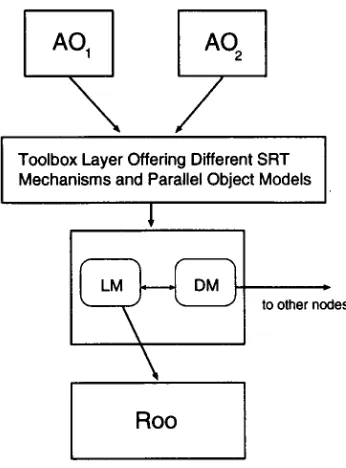
Based on the Tigger framework described above, Fig.
2 depicts our architecture for supporting application objects ( A O S ) ~ which require a distributed real-time environment.
This architecture is structured into several layers which are introduced briefly below. A more detailed description of this architecture can be found in [27].
The topmost layer offers a Toolbox Interface, from which higher, more application-oriented layers can choose certain object characteristics associated with
Applications in Tigger
'Note that the creation of per-invocation threads can be done by the thread executing the object's body.
n
n
Toolbox Layer Offering Different SRT
Mechanisms and Parallel Object Models
I
b to other nodes
I
[image:3.613.91.264.58.292.2] [image:3.613.315.551.58.235.2]I
Roo
Figure 2: Overall System Architecture
real-time support like scheduling policies, synchroniza- tion mechanisms and the degree of concurrency inside an object specified by the number of active threads that can be attached t o that object.
This interface allows very precise customization of the real-time behaviour of object execution, providing the programmer with a variety of mechanisms instead of constraining him or her t o only one. This offers a
flexible way of tailoring objects to specific needs.
The intermediate layer deals mainly with the man- agement of the mechanisms offered by the Toolbox layer. It is subdivided into a distribution manager (DM), which interacts with DMs on other nodes of the distributed system in order to maintain real-time guarantees in the distributed case, and a local man- ager (LM) which controls the real-time behaviour of threads managed by the local real-time executive whose main responsibility is the provision of appro- priate support for real-time threads, scheduling and synchronization as discussed in the remainder of this paper.
All layers including and below the Toolbox Inter- face define the soft real-time part (SRT) of the Tigger framework.
Thread
I I
Machine- Independent Framework
I
Machine-dependent C++"1
ca. 1 kLOCI
ca. 0.3 kLOC
Figure 3: Software Architecture of Roo
3
Roo
Given the description of the overall architecture above, this section describes the real-time executive of Tigger-Roo.
3.1
Internal Structure of Roo
Since a major concern of Tigger is portability, Roo is divided into a machine-dependent part, which has t o be kept to a minimum since it will have t o be mostly rewritten whenever Roo is ported t o a different hardware platform, and a machine-independent part, which forms the actual real-time support framework and resides on top of the machine-dependent part as
depicted in Fig. 3.
This machine-dependent part is further subdivided into a small assembly language module, which con- tains functionality that cannot be expressed in ordi- nary C++3 code such as context-switching and stack- manipulation, and a set of C++ modules offering a well- defined interface to the machine-independent part.
One could argue that the machine-dependent part
as a whole could be implemented in assembly language in order to maximize efficiency and to gain additional speed-up. We decided to sacrifice these possible ben- efits in the hope that we could even reuse parts of this machine-dependent part when porting Roo t o a
different hardware platform. For this reason the func- tionality of the assembly language module is kept to
a minimum and wherever possible we decided to use C++ instead of assembly language. Currently, this
machine-dependent part of the i486 port of our archi- tecture consists of approximately 1000 lines of well- documented source-code of which 300 lines are actu- ally assembly language.
The real-time support framework is layered above this machine-dependent part and consists of three major building blocks providing thread management, scheduling and synchronization primitives. Each of these blocks is discussed in the following sections.
3.2
Thread Management
This building block provides an interface for the cre- ation and destruction of threads as well as other ser- vices such as the ability to wait for a thread to ter- minate. As discussed above, Tigger supports different notions of active objects. By using this thread man- agement interface, other components of Tigger can at- tach threads t o an object at creation time as well as
t o individual invocations of object methods as appro- priate.
From a conceptual point of view, the attachment of threads t o individual objects resembles aggregation [5]. This is motivated by the fact that threads them- selves are represented by objects and, apart from the passive object model, every object has at least one thread attached t o it during its lifetime as discussed above.
Therefore, the functionality of the thread manage- ment building block is vital for the Toolbox layer as
depicted in Fig. 2, since a major function of the Tool- box layer is the support of multiple object models.
3.3
Scheduling
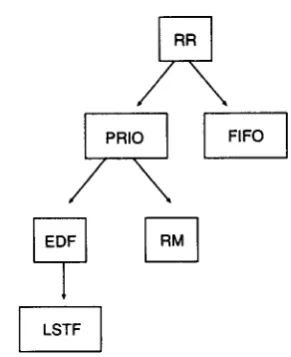
Real-time scheduling is provided by the second major building block of the Roo framework as a class hier- archy. To achieve different real-time scheduling poli- cies like Earliest Deadline First (EDF) or Rate Mono- tonic (RM) scheduling [18] within the framework a method called scheduler stacking4 is employed which also enjoys the benefits of applying object-oriented techniques such as inheritance t o achieve code-reuse.
Fig. 4 shows the overall structure of the scheduling class hierarchy. Here, an arrow denotes inheritance [4] and points t o the derived class. Apart from simple inheritance of code, an arrow further stresses the fact a derived class like EDF makes strong use of methods supplied by its base classes.
The scheduler class hierarchy depicted works as
4The meaning of this term is motivated below.
[image:4.615.361.507.60.239.2]40
4Figure 4: Inheritance Graph for Schedulers
follows5. The basis of the class hierarchy is a simple round robin scheduler (RR) which manages a circular list of runnable threads. This scheduler offers methods to place a thread a t a certain position on the queue and t o remove a thread from the queue. Preempting the currently running thread and selecting the next thread t o be executed is not expensive; since the list of runnable threads is organized as a circular list, a simple pointer switch is all that is required.
A first-in-first-out scheduler (FIFO) is implemented on top of this RR scheduler: the only additional func- tionality that is required is removing the thread from the list when it releases the processor so t h a t it is not scheduled again6.
Entering the realm of priority-based scheduling, a
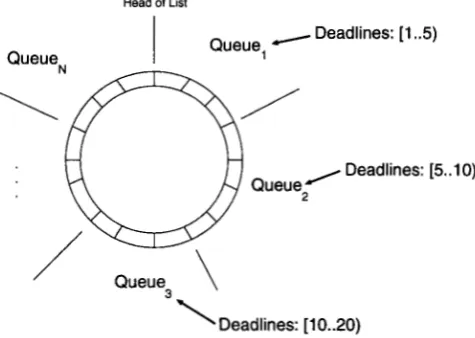
scheduler capable of handling priorities (labeled PRIO in Fig. 4) uses the functionality provided by the RR scheduler to divide the circular list into N priority queues as depicted in Fig. 5 (smaller numbers repre- sent higher priorities). In doing so, it overrides the methods for placing threads on and removing threads from the list provided by the RR scheduler. In addition to the thread itself, a priority must now be specified via the interface of the PRIO scheduler when placing a
thread on the list.
The PRIO scheduler places the head of the first priority queue at the (logical) head of the circular
51n contrast to Fig. 4, which depicts the base/derived class relationship, it proves useful for the following discussion to imagine the drawing upside down with the box labelled RR at the bottom.
Head of List
Queue, Queue.,
[image:5.616.71.288.68.254.2] [image:5.616.66.304.449.618.2]/ Queue3
\
i
Figure 5: Mapping of PRIO onto R R
list managed by the R R scheduler. This ensures that threads with higher priorities are scheduled in favour of those with lower priorities.
Having laid these foundations, the remaining ele- ments of the scheduler framework can now be dis- cussed. A scheduler realizing Rate Monotonic schedul- ing (RM) is implemented easily using PRIO as a basis: each thread is assigned a static priority depending on its period [18] and then placed on the appropriate pri- ority queue.
Head ol List
Queue3 /
Figure 6: Mapping of EDF Scheduling onto PRIO
A scheduler handling the EDF policy is realized in the following way (see Fig. 6): possible deadlines are
grouped into intervals and each interval is assigned a suitable priority according t o its timeliness7. Threads on these priority queues are then ordered according t o their deadlines, so that the thread with the earliest deadline in this interval is placed of its priority queue. Since Least Slack Time First (LSTF) is a refinement of the EDF algorithm [8], it is done is a similar way: each slack time interval is assigned a priority and threads are placed on the corresponding priority queue.
Since each of the classes makes strong use of its base classes, one can think of this structure as a stack: functionality is added by placing a scheduler realizing
a different policy on top of an existing one. The sched- uler implementing RR knows nothing about deadlines or priorities, and PRIO cannot handle slack time or
deadlines, only the combination of classes achieves the functionality desired. Since complex scheduling algo- rithms are structured this way in Roo, the overhead added by each layer of this stack is comparably small. The basic interface of the scheduler classes is de- picted in Tab. l. All scheduler classes derived from the baseclass RR must support this interface in order t o be stackable. An exception is the method move, which assigns a new priority to a thread thereby moving it from one priority queue t o different one and is defined in the PRIO class and below. Supporting this method in the baseclasses of PRIO does not make sense, since these scheduler classes do not know about priorities.
3.4
Synchronization Aspects
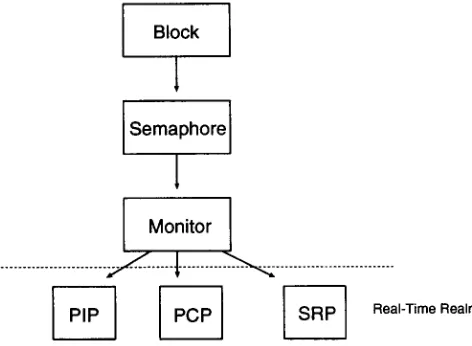
As depicted in Fig. 3, synchronization mechanisms re- present the third major building bock of Roo which is also implemented as a class hierarchy. Similar t o the scheduling class hierarchy described above, this hier- archy consists of a set of classes, implementing only basic functionality, from which higher-level abstrac- tions with richer functionality can easily be built.
Take the realization of a monitor structure as an example of a general mutual exclusion (mutex) mech- anism. According to [3], a monitor is a resource which can only be used exclusively. Before entering a mon- itor, a thread issues a waitOS call indicating that it is about to enter the monitor. If another thread is already using the monitor, the requesting thread will block until the other thread issues a s i g n a l ( ) call in- dicating that it has left the monitor. This awakens
7An alternative would be to assign each deadline a different priority, but this would result in a possibly large number of sparsely populated priority queues, which makes the handling
of these queues inefficient.
Method N a m e
add(Thread)
I remove(Thread1 I Remove a thread from the scheduler realm I
Meaning
Add a thread to the scheduler realm
I
move(Thread, neuPrio)
I
Move a thread to new priority queue (nevPrio)Table 1: Basic Interface of the Scheduler Classes
the first thread which enters the monitor in turn.
Block
I
MonitorI
1 [image:6.614.147.475.60.114.2]F
l
Fl
/SRPI
Real-Time RealmFigure 7: Inheritance Graph for Synchronization Mechanisms
The class structure involved in achieving this func- tionality is depicted in Fig. 7. The base class named BLOCK implements a basic blocking algorithm and of- fers only limited functionality: namely methods to block and release threadsg. Using this restricted in- terface a SEMAPHORE class implements the usual func- tionality associated with semaphores [3]: managing a
counter it blocks the calling thread when the counter reaches a negative value and releases the thread when the value is positive. The MONITOR class uses a bi- nary semaphore to guard access to the monitor, di- rectly using the interface and the code provided by the SEMAPHORE class.
As [20] points out, using this mutex mechanism on its own (i.e. without proper scheduling) can lead to the problem of priority inversion: a high-priority thread is blocked when trying t o access a mutex which is currently held by a thread having a lower priority. A
gSince this base class is not intended to be used by other than sub-classes, its whole interface is p r o t e c t e d in C++ terms meaning that no other classes than the ones inheritingfrom this base class can use its interface.
variety of protocols have been proposed to circumvent this problem [20,2]. Since each of them has its advan- tages and disadvantages] Roo initially offers not only one but three protocols dealing with real-time con- straints imposed on mutexes. These three protocols- namely the basic priority inheritance (PIP), priority ceiling (PCP) and stack reservation (SRP)-are imple- mented using the MONITOR class. Since the additional functionality compared t o the original M U T E X class is restricted t o scheduling issues, the overhead in terms of run-time performance imposed by using these de- rived classes is again comparably low.
3.5
Discussion
The benefits of our approach are two-fold: the pro- grammer using Roo" is offered maximum flexibility while the system programmer concerned with extend- ing the functionality of Roo does so by extending ex- isting class hierarchies.
3.5.1 Flexibility
As the above description of the features of Roo shows that it does not tie the programmer to a specific model but rather offers a variety of mechanisms] from which the programmer is free to select the most appropri- ate one. This approach offers maximum flexibility: whichever synchronization protocol or scheduling pol- icy suits best can be selected. Therefore, Roo resem- bles a toolbox from which a programmer or even an object is free to choose the policy of its choice.
This approach is even more important when the de- sired real-time characteristics are not precisely known. An example from the area of distributed multimedia systems clarifies this point: consider an object display- ing an MPEG video data stream [lo]. Typically this object retrieves the data from a network connection
or storage device, decompresses it and displays it in a
window controlled by the windowing system. Various parameters like the frame rate in frames per second
[image:6.614.66.302.194.367.2]or the resolution of the decompressed MPEG image directly influence the scheduling period, deadline and policy. Unfortunately, these parameters are normally not known in advance i.e. during the development. Using the toolbox provided by Roo, the MPEG ob- ject can influence its scheduling parameters and pol- icy at run-time. For example, when decompressing a large picture, this object may choose t o employ mul- tiple threads concurrently t o fulfill its task in order t o speed up the decompression process by a finer granu- larity of parallelism.
3.5.2 Extensibility
From the viewpoint of the system programmer con- cerned with adding further functionality to Roo, this approach offers an easy way t o extend the system. Since the basic mechanisms are already in place, they can be used without modification.
Take the scheduler stacking mechanism as an ex- ample. If the programmer wants t o add another real- time scheduling algorithm, which we have not catered for in our original framework, he or she identifies the position in the scheduler stack at which to put the new scheduler class and inserts the new policy into the stack reusing code and functionality from the im- mediate baseclasses.
As an example, imagine the new scheduler uses pri- orities in order t o implement a more advanced schedul- ing scheme where threads are moved between dif- ferent priority queues depending on their run-time behaviour". Since the basic PRIO class offers the method m o v e taking a thread and its new priority as
parameters and moving the thread from the priority queue it is currently on t o the priority queue denoted by the new priority, all the programmer has to do is design the new class to decide, based on the given policy, when t o call the move method of its baseclass
PRIO.
3.5.3 Metalevel Issues
The flexibility is, from a conceptual point of view, achieved by the use of a metalevel architecture [15], where the characteristics of baselevel objects (the threads) are controlled12 by so-called metaobjects [19],
which in this case are the scheduler objects controlling the threads. When discussing metalevel architectures, the following issues arise [9]:
l 1 A thread could be penalized by assigning it a lower priority
l 2 Or reflected upon, to use the conventional terminology. if it uses up its whole time quantum for example.
e Upon what as reflected? As the discussion above shows, the framework deals with control of the run-time behaviour of real-time threads. There- fore, the objects representing scheduling policies are the metaobjects of this model. Using the in- terface provided by the different scheduling ob- jects (which is in turn the meta-interface for ap- plication objects), a programmer exerts control over the run-time behaviour of application objects indirectly by controlling the threads attached t o the application objects.
e What as the causal connection between the base- and the metalevel? Recalling the description of the scheduler stacking mechanism from above, the foundation of the whole scheduler stack is the circular list managed by the lowest member of the stack: the RR scheduler class. By using the functionality supplied by this scheduler all other schedulers stacked above achieve their goal.
e When does a level-shajl between base- and meta- level happen? Every time a new scheduling deci- sion has t o be made a level-shift takes place, and control is transferred from the baselevel to the metalevel. This is the case both when preemption occurs (during blocking, when a higher prioritized thread enters the scheduler framework) and when
a thread exits.
3.6
Performance
This section gives some preliminary performance fig- ures from our first prototype implementation. Table
2 gives the times for a context-switch and for making the scheduling decision using two different scheduling policies, namely round robin and priority-based. All figures were obtained using standard Intel-based PC hardware, in this case a 486DX2 running at 66 MHz. Note that context switching and the actual time the decision about which thread t o dispatch next are sepa- rated; the former consists of a register-file switch only, whereas the latter includes up-calls t o the various C++
routines which form the scheduler stack.
2, the additional overhead of introducing priority-based scheduling is small com- pared t o the overall-time it takes t o make a scheduling decision13 since the basic functionality is already pro- vided by the round robin scheduler.
The poorer performance of Roo compared t o other commercial real-time kernels such as QNX [12] can be
As shown in Tab.
Action
Context Switch Round Robin
Priority-Based 125
I
Time in psecI
Table 2: Preliminary Performance Figures
accounted for by two factors: First, the current the implementation of Roo is merely a prototype and has not yet undergone the usual optimization process.
The second reason stems from our decision to em- phasize portability as one of our design goals: for example instead of coding interrupt service routines which are responsible for scheduling decisions in as-
sembly language and thereby hampering portability, we decided t o implement the machine-dependent parts in C++, which impacts performance. Since it could be possible t o implement the mechanisms discussed above in pure assembly language14
,
the performance of highly-tuned, hand-crafted machine code could be achieved (sacrificing portability of course).Considering our main target areal5, we think that
a certain amount of performance can be sacrificed be- cause we are not dealing with hard real-time systems where nearly every CPU cycle is crucial and failure to meet deadlines is disastrous.
4
Related work
Traditional object-oriented real-time systems like [16, 241 merely use the object-oriented paradigm as a means of structuring functionality and code, thereby providing the application with a more or less closed system. In contrast t o this, our approach offers the programmer a variety of mechanisms and policies from which he or she is free to choose the most appropriate one.
The idea of using frameworks for operating sys- tem design is not new. Work such as [14, 131 makes heavy use of the object-oriented paradigm to struc- ture, design and implement operating systems. Here, base classes provide architecture-independent control
mechanisms such as virtual memory management,
whereas concrete implementations use derived classes
With much effort only, because inheritance and other mech- anisms offered by an object-oriented implementation language help much during the design and coding process.
l5 Soft real-time (mainly multimedia and interactive simulations).
to take care of the platform-specific aspects like details of a specific memory management unit.
Also the use of metalevel architectures to design and implement operating systems or part thereof has been discussed in approaches like [25, 221. In contrast to our work, these approaches provide only one mech- anism thereby constraining the programmer to one
policy, whereas our approach permits the use of con- figurable mechanisms yielding in application-specific policies.
5
Status and Outlook
A first prototype of Roo on a platform based on stan- dard Intel-based P C hardware has been designed and implemented. Extending the Roo sub-framework with new schedulers and synchronization mechanisms is our next goal. We expect major input from the appli- cation areas where soft real-time is required: dis- tributed multimedia systems and highly interactive, three-dimensional simulations. For example, decom- pressing and displaying a high-resolution MPEG video data stream may require a different scheduling policy compared to transmitting and processing a low-quality audio data stream.
After this, the next step will be the design and im- plementation of the Distribution Manager and the Lo- cal Manager. Since most of the functionality for im- plementing the LM is already provided by Roo, we do not expect major problems here. For the DM, work that has been done in the areas of distributed, object- oriented (hard) real-time systems such as [24, 111 serves as a starting point for future research. Again
our framework approach should prove t o be useful here.
6
Acknowledgements
We would like to thank Paul Taylor whose comments helped us to improve the quality of this paper and the anonymous referees for their suggestions.
References
[l] P. America. POOL-T: A Parallel Object-
Oriented Language. In A. Yonezawa and
M. Tokoro, editors, Object-Oriented Concurrent Programming, pages 199-220. MIT Press, 1987.
[image:8.612.103.259.65.120.2]M. Ben-Ari. Principles of Concurrent Program- ming. Prentice Hall International, 1982.
G . Blair et al., editors. Object-oriented Lan- guages, Systems and Applications. Pitman, 1991.
G . Booch. Object-Oriented Design with Appli- cations. Benjamin/Cummings, second edition, 1993.
V. Cahill, S. Baker, G. Starovic, and C. Horn. Generic Runtime Support for Distributed Per-
sistent Programming. SIGPLAN Notices,
28( 10):144-161,1993. Also technical report TCD- CS-93-37, Dept. of Computer Science, Trinity College Dublin.
V. Cahill, C. Hogan, A. Judge, D. O’Grady, B. Tangney, and P. Taylor. Extensible Systems- The Tigger Approach. In Proceedings of the SIGOPS European Workshop, pages 151-153. ACM SIGOPS, Sept. 1994. Also technical report
TCD-CS-94-45, Dept. of Computer Science, Trin- ity College Dublin.
M. L. Dertouzos and A. K.-L. Mok. Multipro- cessor On-Line Scheduling of Hard Real-Time Tasks. IEEE Transactions on Software Engineer- ing, 15(12):1497-1506, 12 1989.
[14] R. E. Johnson and V. E. Russo. Reusing Object- Oriented Design. Technical Report UIUCDCS 91- 1696, Department of Computer Science, Univer- sity of Illinois, 1991.
[15] G. Kiczales et al. The Art of the Metaobject Pro- tocol. MIT Press, 1991.
[16] S.-T. Levi et al. The Maruti Hard Real-Time Op- erating System. ACM Operating System Review,
23(3):90-105, 1989.
[17] H. Lieberman. Concurrent Object-Oriented Pro-
gramming in Act 1. In A. Yonezawa and
M. Tokoro, editors, Object-Oriented Concurrent Programming, pages 9-36. MIT Press, 1987.
[18] C. L. Liu and J . W. Layland. Scheduling
Algorithms for Multiprogramming in a Hard
Real-Time Environment. Journal of the ACM,
20(1):46-61, 1973.
[19] P. Maes. Concepts and Experiments in Com- putational Reflection. In Proceedings of the
P d Conference on Object-Oriented Programming
Systems, Languages and Applications, pages 147- 155, 1987.
[20] L. Sha et al. Priority Inheritance Protocols: An
Approach to Real-Time Synchronization. IEEE
Transactions on Computers, 39(9):1175-1185, 9 1990.
[9] J . Ferber. Computational Reflection in Class- Based Object-Oriented Languages. In Proceed- ings O f the
dth
Conference On Object-OrientedProgramming Systems, Languages and Applica- tions, pages 147-155, 1989.
[21] M. Staude. Planning Methods: Process Schedul- ing in Solaris 2.x (in German). i X , pages 130-136, 8 1994.
[lo] D. L. Gall. MPEG: A Video Compression Stan- [22] K. Takashio and M. Tokoro. DROL: An Object-
dard for Multimedia Applications. Communica- Oriented Programming Language for Distributed
tions of the ACM, 34(4):46-58, 1991. Real-Time Systems. In Proceedings of the
Y h
Conference on Object-Oriented Programming Systems, Languages and Applications, pages 276- 294, 1992.[ll] A. Gheith and K. Schwan. CHAOSarc: Ker- ne1 Support for Multiweight Objects, Invocations, and Atomicity in Real-Time Multiprocessor Ap-
plications. ACM Trans. Comput. Sist., 11(1):31- [23] H. Tokuda et al. Real-Time Mach: Towards Pre-
71, 2 1993. dictable Real-Time Systems. In Proceedings of
the Usenix Mach Workshop, 1990. [12] D. Hildebrand. An Architectural Overview of
QNX. In Proceedings of the l s t Usenix Work- shop on Micro-Kernels and Other Kernel Archi- lectures, 1992.
[24] H. Tokuda and C. W. Mercer. ARTS: A Dis- tributed Real-Time Kernel. A CM Operating Sys-
tem Review, 23(3):29-52, 1989.
[l3] N. Islam and R. Campbell. Uniform Co- [25] Y . Yokote. Kernel Structuring for Object-
Oriented Operating Systems: The Apertos Ap- proach. In Proceedings of the l s t International Symposium on Object Technologies for Advanced Software, pages 145-162. Springer Verlag, 1993. Scheduling Using Object-Oriented Design Tech-
[26] A. Yonezawa and M. Tokoro, editors. Object- Oriented Concurrent Programming. MIT Press,
1989.
[27] C. Zimmermann and V . Cahill. Raising the Cub. In Proceedings of the Annual German Unix Users