Cats Rule and Dogs Drool!: Classifying Stance in Online Debate
Pranav Anand, Marilyn Walker, Rob Abbott, Jean E. Fox Tree, Robeson Bowmani, and Michael Minor
University of California Santa Cruz
Abstract
A growing body of work has highlighted the challenges of identifying the stance a speaker holds towards a particular topic, a task that in-volves identifying a holistic subjective dispo-sition. We examine stance classification on a corpus of 4873 posts across 14 topics on ConvinceMe.net, ranging from the playful to the ideological. We show that ideological de-bates feature a greater share of rebuttal posts, and that rebuttal posts are significantly harder to classify for stance, for both humans and trained classifiers. We also demonstrate that the number of subjective expressions varies across debates, a fact correlated with the per-formance of systems sensitive to sentiment-bearing terms. We present results for iden-tifing rebuttals with 63% accuracy, and for identifying stance on a per topic basis that range from 54% to 69%, as compared to un-igram baselines that vary between 49% and 60%. Our results suggest that methods that take into account the dialogic context of such posts might be fruitful.
1 Introduction
Recent work has highlighted the challenges of iden-tifying the STANCE that a speaker holds towards a particular political, social or technical topic. Clas-sifying stance involves identifying a holistic subjec-tive disposition, beyond the word or sentence (Lin et al., 2006; Malouf and Mullen, 2008; Greene and Resnik, 2009; Somasundaran and Wiebe, 2009; So-masundaran and Wiebe, 2010). Our work is inspired by the large variety of such conversations now freely available online, and our observation that the contex-tual affordances of different debate and discussion
websites vary a great deal. One important contex-tual variable, discussed at length below, is the per-centage of posts that arerebuttalsto previous posts, which varies in our data from 34% to 80%. The abil-ity to explicitly rebut a previous post gives these de-bates both monologic and dialogic properties (Biber, 1991; Crystal, 2001; Fox Tree, 2010); Compare Fig-ure 1 to FigFig-ure 2. We believe that discussions con-taining many rebuttal links require a different type of analysis than other types of debates or discussions.
Dialogic Capital Punishment
Studies have shown that using the death penalty saves 4 to 13 lives per execution. That alone makes killing murderers worthwhile. What studies? I have never seen ANY evidence that capital pun-ishment acts as a deterrant to crime. I have not seen any evidence that it is “just” either.
When Texas and Florida were executing people one after the other in the late 90’s, the murder rates in both states plunged, like Rosie O’donnel off a diet.. .
That’s your evidence? What happened to those studies? In the late 90s a LOT of things were different than the periods preceding and following the one you mention. We have no way to determine what of those contributed to a lower murder rate, if indeed there was one. You have to prove a cause and effect relationship and you have failed.
Figure 1: Capital Punishment discussions with posts linked via rebuttal links.
This paper utilizes 1113 two-sided debates (4873 posts) from Convinceme.net for 14 different debate topics. See Table 1. On Convinceme, a person starts a debate by posting a topic or a question and provid-ing sides such asforvs.against. Debate participants can then post arguments for one side or the other, es-sentially self-labelling their post for stance. These debates may be heated and emotional, discussing weighty issues such as euthanasia and capital pun-ishment, such as the example in Figure 1. But they also appear to be a form of entertainment via playful
debate. Popular topics on Convinceme.net over the past 4 years include discussions of the merits of Cats vs. Dogs, or Pirates vs. Ninjas (almost 1000 posts). See Figure 3.
Monologic Capital Punishment
I value human life so much that if someone takes one than his should be taken. Also if someone is thinking about taking a life they are less likely to do so knowing that they might lose theirs Death Penalty is only a costlier version of a lifetime prison sen-tence, bearing the exception that it offers euthanasia to criminals longing for an easy escape, as opposed to a real punishment. There is no proof that the death penalty acts as a deterrent, plus due to the finalty of the sentence it would be impossible to amend a mistaken conviction which happens with regualrity especially now due to DNA and improved forensic science.
Actually most hardened criminals are more afraid to live-then die. I’d like to see life sentences without parole in lieu of capital pun-ishment with hard labor and no amenities for hard core repeat offenders, the hell with PC and prisoner’s rights-they lose priv-eledges for their behaviour.
Figure 2: Posts on the topic Capital punishment without explicit link structure. The discussion topic was “Death Penalty”, and the argument was framed as yes we should keep it vs. no we should not.
Our long term goal is to understand the dis-course and dialogic structure of such conversations. This could be useful for: (1) creating automatic summaries of each position on an issue (Sparck-Jones, 1999); (2) gaining a deeper understanding of what makes an argument persuasive (Marwell and Schmitt, 1967); and (3) identifying the lin-guistic reflexes of perlocutionary acts such as per-suasion and disagreement (Walker, 1996; Greene and Resnik, 2009; Somasundaran and Wiebe, 2010; Marcu, 2000). As a first step, in this paper we aim to automatically identify rebuttals, and identify the speaker’s stance towards a particular topic.
Dialogic Cats vs. Dogs
Since we’re talking much of $hit, then Dogs rule! Cat poo is ex-tremely foul to one’s nostrils you’ll regret ever handling a cat. Stick with dogs, they’re better for your security, and poo’s not too bad. Hah!
Dog owners seem infatuated with handling sh*t. Cat owners don’t seem to share this infatuation.
Not if they’re dog owners who live in the country. If your dog sh*ts in a field you aren’t going to walk out and pick it up. Cat owners HAVE to handle sh*t, they MUST clean out a litter box...so suck on that!
Figure 3: Cats vs. Dogs discussions with posts linked by rebuttal links.
The most similar work to our own is that of So-masundaran & Wiebe (2009, 2010) who also focus on automatically determining the stance of a debate
participant with respect to a particular issue. Their data does not provide explicit indicators of dialogue structure such as are provided by the rebuttal links in Convinceme. Thus, this work treats each post as a monologic text to be classified in terms of stance, for a particular topic. They show that discourse re-lations such as concessions and the identification of argumentation triggers improves performance over sentiment features alone (Somasundaran and Wiebe, 2009; Somasundaran and Wiebe, 2010). This work, along with others, indicates that for such tasks it is difficult to beat a unigram baseline (Pang and Lee, 2008).
Other similar related work analyzes Usenet forum quote/response structures (Wang and Ros´e, 2010). We believe quote/response pairs have a similar dis-course structure to the rebuttal post pairs in Con-vinceme, but perhaps with the linguistic reflexes of stance expressed even more locally. However agreement vs. disagreement is not labelled across quote/response pairs and Wang & Rose (2010) do not attempt to distinguish these different discourse relations. Rather they show that they can use a vari-ant of LSA to identify a parent post, given a response post, with approximately 70% accuracy. A recent paper by (Abbott et al., 2011) examines agreement and disagreement in quote/response pairs in idealog-ical and nonidealogidealog-ical online forum discussions, and shows that you can distinguish the agreement relation with 68% accuracy. Their results indicate that contextual features do improve performance for identifying the agreement relation between quotes and responses.
net-work features provides the best performance. We leave the incorporation of social network informa-tion for stance classificainforma-tion to future work.
Section 3 discusses our corpus in more detail, and presents the results of a human debate-side classi-fication task conducted on Mechanical Turk. Sec-tion 3 describes two different machine learning ex-periments: one for identifying rebuttals and the other for automatically determining stance. Section 4 presents our results. We show that we can iden-tify rebuttals with 63% accuracy, and that using sen-timent, subjectivity and dialogic features, we can achieve debate-side classification accuracies, on a per topic basis, that range from 54% to 69%, as com-pared to unigram baselines that vary between 49% and 60%.
2 Corpus Description and Analysis
Table 1 provides an overview of our corpus. Our corpus consists of 1113 two-sided debates (4873 posts) from Convinceme.net for 12 topics ranging from playful debates such as Cats vs. Dogs to more heated political topics such as Capital Punishment. In Table 1, the topics above the line are either tech-nical or playful, while the topics below the line are ideological. In total the corpus consists of 2,722,340 words; the topic labeled debates which we use in our experiments contain 507,827 words.
Convinceme provides three possible sources of dialogic structure: (1) theSIDEthat a post is placed on indicates the poster’s stance with respect to the original debate topic, and thus can be considered as a response to that post; (2)REBUTTAL LINKSbetween posts which are explicitly indicated by the poster us-ing the affordances of the site; and (3) theTEMPO -RAL CONTEXT of the debate, i.e. the state of the debate at a particular point in time, which a debate participant orients to in framing their post.
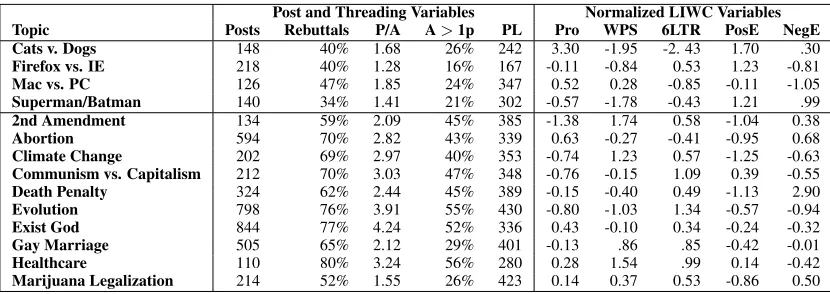
Topics vary a great deal in terms of their dialogic structure and linguistic expression. In Table 1, the columns providing counts for different variables are selected to illustrate ways in which topics differ in the form and style of the argument and in its sub-jective content. One important variable is the per-centage of the topic posts that are linked into a re-buttal dialogic structure (Rere-buttals). Some of these differences can be observed by comparing the dia-logic and monodia-logic posts for the Capital Punish-ment topic in Figures 1 and 2 to those for the Cats vs. Dogs topic in Figures 3 and 4. Ideological
Monologic Cats vs. Dogs
First of all, cats are about a thousand times easier to care for. You don’t have to walk them or bathe them because they’re smart enough to figure out all that stuff on their own. Plus, they have the common courtesy to do their business in the litter box, instead of all over your house and yard. Just one of the many reasons cats rule and dogs, quite literally drool!
Say, you had a bad day at work, or a bad breakup, you just wanna go home and cry. A cat would just look at you like ”oh ok, you’re home” and then walk away. A dog? Let’s see, the dog would most likely wiggle its tail, with tongue sticking out and head tilted - the ”you’re home! i missed you so much, let’s go snuggle in front of the TV and eat ice-cream” look. What more do I need to say?
Figure 4: Posts on the topic Cats vs. Dogs without ex-plicit rebuttal links.
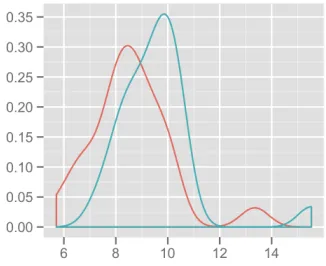
topics display more author investment; people feel more strongly about these issues. This is shown by the fact that there are more rebuttals per topic and more posts per author (P/A) in the topics below the line in Table 1. It follows that these topics have a much higher degree of context-dependence in each post, since posts respond directly to the parent post. Rebuttals exhibit more markers of dialogic interac-tion: greater pronominalization (especially you as well as propositional anaphora such asthatandit), ellipsis, and dialogic cue words; Figure 5 shows the difference in counts of ‘you’ between rebuttals and non-rebuttals (Rebuttalsx¯= 9.6and Non-Rebuttals
¯
[image:3.612.344.507.499.632.2]x = 8.5,t(27) = 24.94, p <.001). Another indi-cation of author investment is the percentage of au-thors with more than one post (A>1P). Post Length (PL), on the other hand, is not significantly corre-lated with degree of investment in the topic.
Figure 5: Kernel density estimates for ‘you’ counts across rebuttals (green) and non-rebuttals (red).
sen-Post and Threading Variables Normalized LIWC Variables Topic Posts Rebuttals P/A A>1p PL Pro WPS 6LTR PosE NegE Cats v. Dogs 148 40% 1.68 26% 242 3.30 -1.95 -2. 43 1.70 .30 Firefox vs. IE 218 40% 1.28 16% 167 -0.11 -0.84 0.53 1.23 -0.81 Mac vs. PC 126 47% 1.85 24% 347 0.52 0.28 -0.85 -0.11 -1.05 Superman/Batman 140 34% 1.41 21% 302 -0.57 -1.78 -0.43 1.21 .99 2nd Amendment 134 59% 2.09 45% 385 -1.38 1.74 0.58 -1.04 0.38 Abortion 594 70% 2.82 43% 339 0.63 -0.27 -0.41 -0.95 0.68 Climate Change 202 69% 2.97 40% 353 -0.74 1.23 0.57 -1.25 -0.63 Communism vs. Capitalism 212 70% 3.03 47% 348 -0.76 -0.15 1.09 0.39 -0.55 Death Penalty 324 62% 2.44 45% 389 -0.15 -0.40 0.49 -1.13 2.90 Evolution 798 76% 3.91 55% 430 -0.80 -1.03 1.34 -0.57 -0.94 Exist God 844 77% 4.24 52% 336 0.43 -0.10 0.34 -0.24 -0.32 Gay Marriage 505 65% 2.12 29% 401 -0.13 .86 .85 -0.42 -0.01 Healthcare 110 80% 3.24 56% 280 0.28 1.54 .99 0.14 -0.42 Marijuana Legalization 214 52% 1.55 26% 423 0.14 0.37 0.53 -0.86 0.50
Table 1: Characteristics of Different Topics. Topics below the line are considered “ideological”. Normalized LIWC variable z-scores are significant when more than 1.94 standard deviations away from the mean (two-tailed).
KEY: Number of posts on the topic (Posts). Percent of Posts linked by Rebuttal links (Rebuttals). Posts per author (P/A). Authors with more than one post (A>1P). Post Length in Characters (PL).Pro=percent of the words as pronominals. WPS=Words per sentence. 6LTR=percent of words that are longer than 6 letters. PosEpositive emotion words.NegEnegative emotion words.
tence (WPS), the length of words used (6LTR) which typically indicates scientific or low frequency words, the use of pronominal forms (Pro), and the use of positive and negative emotion words (PosE,NegE) (Pennebaker et al., 2001). For exam-ple, Table 1 shows that discussions about Cats vs. Dogs consist of short simple words in short sen-tences with relatively high usage of positive emo-tion words and pronouns, whereas 2nd amendment debates use relatively longer sentences, and death penalty debates (unsurprisingly) use a lot of nega-tive emotion words.
Human Topline. The best performance for sid-ing ideological debates in previous work is approx-imately 64% accuracy over all topics, for a collec-tion of 2nd Amendment, Aborcollec-tion, Evolucollec-tion, and Gay Rights debate posts (Somasundaran and Wiebe, 2010). Their best performance is 70% for the 2nd amendment topic. The website that these posts were collected from apparently did not support dialogic threading, and thus there are no explicitly linked re-buttals in this data set. Given the dialogic nature of our data, as indicated by the high percentage of rebuttals in the ideological debates, we first aim to determine how difficult it is for humans to side an individual post from a debate without context. To our knowledge, none of the previous work on de-bate side classification has attempted to establish a human topline.
We set up a Mechanical Turk task by randomly se-lected a subset of our data excluding the first post on
each side of a debate and debates with fewer than 6 posts on either side. Each of our 12 topics consists of more than one debate: each debate was mapped by hand to the topic and topic-siding (as in (Somasun-daran and Wiebe, 2010)). We selected equal num-bers of posts for each topic for each side, and cre-ated 132 tasks (Mechanical Turk HITs). Each HIT consisted of choosing the correct side for 10 posts divided evenly, and selected randomly without re-placement, from two debates. For each debate we presented a title, side labels, and the initial post on each side. For each post we presented the first 155 characters with aSEE MOREbutton which expanded the post to its full length. Each HIT was judged by 9 annotators using Mechanical Turk with each anno-tator restricted to at most 30 HITS (300 judgments). Since many topics were US specific and we wanted annotators with a good grasp of English, we required Turkers to have a US IP address.
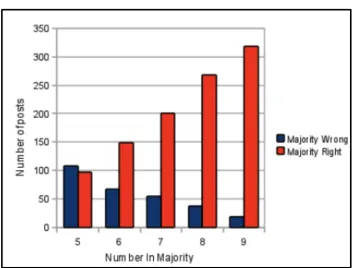
Figure 6 plots the number of annotators over all topics who selected the “true siding” as the side that the post was on. We defined “true siding” for this purpose as the side that the original poster placed their post. Figure 6 illustrates that humans often placed the post on the wrong side. The majority of posters agreed with the true siding 78.26% of the time. The Fleiss’ kappa statistic was 0.2656.
Cli-Figure 6: Accuracies of Human Mechanical Turk judges at selecting the True Siding of a post without context.
mate Change topic. This suggests that posts may be difficult to side without context, which is what one might expect given their dialogic nature. Rebut-tals were clearly harder to side: annotators correctly sided non-rebuttals 87% of the time, but only man-aged 73% accuracy for rebuttals. Since all of the less serious topics consisted of≤50% rebuttals while all of the more serious ideological debates had>50% rebuttals, 76% of ideological posts were sided rectly, while 85% of non-ideological posts were cor-rectly sided. See Table 2.
Class Correct Total Accuracy
Rebuttal 606 827 0.73
[image:5.612.98.275.53.187.2]Non-Rebuttal 427 493 0.87
Table 2: Human Agreement on Rebuttal Classification
Looking at the data by hand revealed that when nearly all annotators agreed with each other but dis-agreed with the self-labeled side, the user posted on the wrong side (either due to user error, or because the user was rebutting an argument the parent post raised, not the actual conclusion).
The difficult-to-classify posts (where only 4-6 an-notators were correct) were more complex. Our analysis suggests that in 28% of these cases, the an-notators were simply wrong, perhaps only skimming a post when the stance indicator was buried deep in-side it. Our decision to show only the first 155 char-acters of each post by default (with aSHOW MORE button) may have contributed to this error. An ad-ditional 39% were short comments or ad hominem responses, that showed disagreement, but no indi-cation of side and 17% were ambiguous out of con-text. A remaining 10% were meta-debate comments,
either about whether there were only two sides, or whether the argument was meaningful. Given the differences in siding difficulty depending on rebut-tal status, in Section 4 we present results for both rebuttal and stance classification.
3 Features and Learning Methods
Our experiments were conducted with the Weka toolkit. All results are from 10 fold cross-validation on a balanced test set. In the hand examination of annotators siding performance, 101 posts were de-termined to have incorrect self-labeling for side. We eliminated these posts and their descendants from the experiments detailed below. This resulted in a dataset of 4772 posts. We used two classifiers with different properties: NaiveBayes and JRip. JRip is a rule based classifier which produces a compact model suitable for human consumption and quick application. Table 3 provides a summary of the fea-tures we extract for each post. We describe and mo-tivate these feature sets below.
Set Description/Examples Post Info IsRebuttal, Poster Unigrams Word frequencies Bigrams Word pair frequencies
Cue Words Initial unigram, bigram, and trigram Repeated
Punctuation
Collapsed into one of the following: ??, !!, ?!
LIWC LIWC measures and frequencies
Dependencies Dependencies derived from the Stanford Parser. Generalized
Dependen-cies
Dependency features generalized with respect to POS of the head word and opinion polarity of both words.
Opinion De-pendencies
Subset of Generalized Dependencies with opin-ion words from MPQA.
Context Fea-tures
Matching Features used for the post from the par-ent post.
Table 3: Feature Sets, Descriptions, and Examples
Counts, Unigrams, Bigrams. Previous work suggests that the unigram baseline can be difficult to beat for certain types of debates (Somasundaran and Wiebe, 2010). Thus we derived both unigrams and bigrams as features. We also include basic counts such as post length.
[image:5.612.315.540.347.498.2] [image:5.612.84.284.403.437.2]Repeated Punctuation. Our informal analyses suggested that repeated sequential use of particular types of punctuation such as!!and?? did not mean the same thing as simple counts or frequencies of punctuation across a whole post. Thus we developed distinct features for a subset of these repetitions.
LIWC. We also derived features using the Lin-guistics Inquiry Word Count tool (LIWC-2001) (Pennebaker et al., 2001). LIWC provides meta-level conceptual categories for words to use in word counts. Some LIWC features that we expect to be important are words per sentence (WPS), pronomi-nal forms (Pro), and positive and negative emotion words (PosE) and (NegE). See Table 1.
Syntactic Dependency. Previous research in this area suggests the utility of dependency struc-ture to determine the TARGET of an opinion word (Joshi and Penstein-Ros´e, 2009; Somasundaran and Wiebe, 2009; Somasundaran and Wiebe, 2010). The dependency parse for a given sentence is a set of triples, composed of a grammatical relation and the pair of words for which the grammatical relation holds (reli, wj, wk), where reli is the dependency
relation among words wj andwk. The word wj is
the HEAD of the dependency relation. We use the Stanford parser to parse the utterances in the posts and extract dependency features (De Marneffe et al., 2006; Klein and Manning, 2003).
Generalized Dependency. To create generalized dependencies, we “back off” the head word in each of the above features to its part-of-speech tag (Joshi and Penstein-Ros´e, 2009). Joshi & Rose’s results suggested that this approach would work better than either fully lexicalized or fully generalized depen-dency features. We call these POS generalized de-pendencies in the results below.
Opinion Dependencies. Somasundaran & Wiebe (2009) introduced features that identify the TAR -GET of opinion words. Inspired by this approach, we used the MPQA dictionary of opinion words to select the subset of dependency and generalized dependency features in which those opinion words appear. For these features we replace the opinion words with their positive or negative polarity equiv-alents (Lin et al., 2006).
[image:6.612.314.481.104.421.2]Context Features. Given the difficulty annota-tors had in reliably siding rebuttals as well as their prevalence in the corpus, we hypothesize that fea-tures representing the parent post could be helpful for classification. Here, we use a naive represen-tation of context, where for all the feature types in
Table 3, we construct bothparentfeatures andpost features. For top-level parentless posts, theparent features were null.
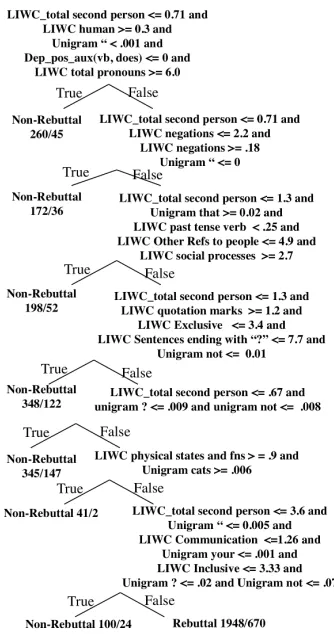
Figure 7: Model for distinguishing rebuttals vs. nonre-buttals across all topics.
4 Results
The primary aim of our experiments was to deter-mine the potential contribution, to debate side clas-sification performance, of contextual dialogue fea-tures, such as linguistic reflexes indicating a poster’s orientation to a previous post or information from a parent post. Because we believed that identification of whether a post is a rebuttal or not might be help-ful in the long term for debate-side classification, we also establish a baseline for rebuttal classification.
4.1 Rebuttal Classification Results
pro-duced 63% accuracy. Figure 7 illustrates a sample model learned for distinguishing rebuttals from non-rebuttals across all topics. The Figure shows that, although we used the full complement of lexical and syntactic features detailed above, the learned rules were almost entirely based on LIWC and unigram lexical features, such as 2nd person pronouns (7/8 rules), quotation marks (4/8 rules), question marks (3/8), and negation (4/8), all of which correlated with rebuttals. Other features that are used at several places in the tree are LIWC Social Processes, LIWC references to people, and LIWC Inclusive and Ex-clusive. One tree node reflects the particular concern with bodily functions that characterizes the Cats vs. Dogs debate as illustrated in Figure 3.
4.2 Automatic Debate-Side Classification Results
We first compared accuracies using Naive Bayes to JRip for all topics for all feature sets. A paired t-test showed that Naive Bayes over all topics and feature sets was consistently better than JRip (p < .0001). Thus the rest of our analysis and the results in Ta-ble 4 focus on the Naive Bayes results.
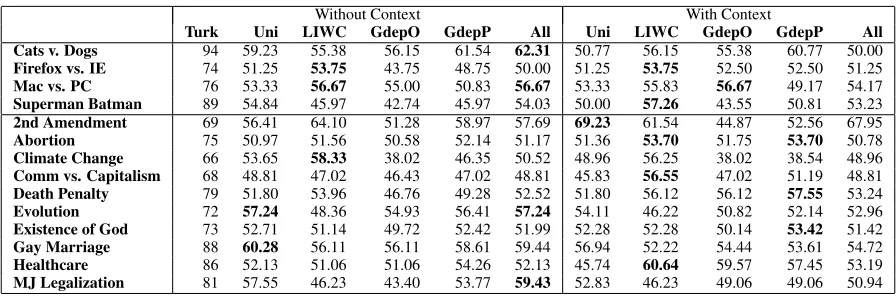
Table 4 presents results for automatic debate side classification using different feature sets and the Naive Bayes learner which performs best over all topics. In addition to classifying using only post-internal features, we ran a parallel set of experiments adding contextual features representing the parent post, as described in Section 3. The results in Table 4 are divided under the headersWithout Contextand
With Context depending on whether features from the parent post were used if it existed (e.g. in the case of rebuttals).
We conducted paired t-tests over all topics simul-taneously to examine the utility of different feature sets. We compared unigrams to LIWC, opinion gen-eralized dependencies, POS gengen-eralized dependen-cies, and all features. We also compared experi-ments using context features to experiexperi-ments using no contextual features. In general, our results in-dicate that if the data are aggregated over all top-ics, that indeed it is very difficult to beat the uni-gram baseline. Across all topics there are generally no significant differences between experiments con-ducted with unigrams and other features. The mean accuracies across all topics for unigrams vs. LIWC features was 54.35% for unigrams vs. 52.83% for LIWC. The mean accuracies for unigram vs POS generalized dependencies was 54.35% vs. 52.64%,
and for unigrams vs. all features was Unigram 54.35% vs 54.62%. The opinion generalized de-pendencies features actually performed significantly worse than unigrams with an accuracy of 49% vs. 54.35% (p < .0001).
It is interesting to note that in general the unigram accuracies are significantly below what Somasun-daran and Wiebe achieve (who report overall uni-gram of 62.5%). This suggests a difference between the debate posts in their corpus and the Convinceme data we used which may be related to the proportion of rebuttals.
The overal lack of impact for either the POS gen-eralized dependency features (GDepP) or the Opin-ion generalized dependency features (GDep0) is surprising given that they improve accuracy for other similar tasks (Joshi and Penstein-Ros´e, 2009; Soma-sundaran and Wiebe, 2010). While our method of extracting theGDepPfeatures is identical to (Joshi and Penstein-Ros´e, 2009), our method for extracting GDepOis an approximation of the method of (So-masundaran and Wiebe, 2010), that does not rely on selecting particular patterns indicating the topics of arguing by using a development set.
The LIWC feature set, which is based on a lexi-cal hierarchy that includes social features, negative and positive emotion, and psychological processes, is the only feature set that appears to have the po-tential to systematically show improvement over a good range of topics. We believe that further analy-sis is needed; we do not want to handpick topics for which particular feature sets perform well.
Without Context With Context
[image:8.612.82.530.52.200.2]Turk Uni LIWC GdepO GdepP All Uni LIWC GdepO GdepP All Cats v. Dogs 94 59.23 55.38 56.15 61.54 62.31 50.77 56.15 55.38 60.77 50.00 Firefox vs. IE 74 51.25 53.75 43.75 48.75 50.00 51.25 53.75 52.50 52.50 51.25 Mac vs. PC 76 53.33 56.67 55.00 50.83 56.67 53.33 55.83 56.67 49.17 54.17 Superman Batman 89 54.84 45.97 42.74 45.97 54.03 50.00 57.26 43.55 50.81 53.23 2nd Amendment 69 56.41 64.10 51.28 58.97 57.69 69.23 61.54 44.87 52.56 67.95 Abortion 75 50.97 51.56 50.58 52.14 51.17 51.36 53.70 51.75 53.70 50.78 Climate Change 66 53.65 58.33 38.02 46.35 50.52 48.96 56.25 38.02 38.54 48.96 Comm vs. Capitalism 68 48.81 47.02 46.43 47.02 48.81 45.83 56.55 47.02 51.19 48.81 Death Penalty 79 51.80 53.96 46.76 49.28 52.52 51.80 56.12 56.12 57.55 53.24 Evolution 72 57.24 48.36 54.93 56.41 57.24 54.11 46.22 50.82 52.14 52.96 Existence of God 73 52.71 51.14 49.72 52.42 51.99 52.28 52.28 50.14 53.42 51.42 Gay Marriage 88 60.28 56.11 56.11 58.61 59.44 56.94 52.22 54.44 53.61 54.72 Healthcare 86 52.13 51.06 51.06 54.26 52.13 45.74 60.64 59.57 57.45 53.19 MJ Legalization 81 57.55 46.23 43.40 53.77 59.43 52.83 46.23 49.06 49.06 50.94
Table 4: Accuracies achieved using different feature sets and 10-fold cross validation as compared to the human topline from MTurk. Best accuracies are shown inbold for each topic in each row. KEY:Human topline results (Turk). Unigram features (Uni). Linguistics Inquiry Word Count features (LIWC). Generalized dependency features containing MPQA terms (GdepO) & POS tags (GdepP). NaiveBayes was used, no attribute selection was applied.
below the majority class baseline for all of the fea-tures without context.
Should we conclude anything from the fact that 6 of the topics are idealogical, out of the 7 topics where contextual features provide the best perfor-mance? We believe that the significantly greater per-centage of rebuttals for these topics should give a greater weight to contextual features, so it would be useful to examine stance classification performance on the subset of the posts that are rebuttals. We be-lieve that context is important; our conclusion is that our current contextual features are naive – they are not capturing the relationship between a post and a parent post. Sequential models or at least better con-textual features are needed.
The fact that we should be able to do much better is indicated clearly by the human topline, shown in the column labelledTurkin Table 4. Even without context, and with the difficulties siding rebuttals, the human annotators achieve accuracies ranging from 66% to 94%.
5 Discussion
This paper examines two problems in online-debates: rebuttal classification and debate-side or stance classification. Our results show that we can identify rebuttals with 63% accuracy, and that using lexical and contextual features such as those from LIWC, we can achieve debate-side classification ac-curacies on a per topic basis that range from 54% to 69%, as compared to a unigram baselines that vary between 49% and 60%. These are the first results that we are aware of that establish a human topline
for debate side classification. These are also the first results that we know of for identifying rebuttals in such debates.
Our results for stance classification are mixed. While we show that for many topics we can beat a unigram baseline given more intelligent features, we do not beat the unigram baseline when we com-bine our data across all topics. In addition, we are not able to show across all topics that our contex-tual features make a difference, though clearly use of context should make a difference in understanding these debates, and for particular topics, classifica-tion results using context are far better than the best feature set without any contextual features. In fu-ture work, we hope to develop more intelligent fea-tures for representing context and improve on these results. We also plan to make our corpus available to other researchers in the hopes that it will stimu-late further work analyzing the dialogic structure of such debates.
Acknowledgments
References
Rob Abbott, Marilyn Walker, Jean E. Fox Tree, Pranav Anand, Robeson Bowmani, and Joseph King. 2011. How can you say such things?!?: Recognizing Dis-agreement in Informal Political Argument. In Pro-ceedings of the ACL Workshop on Language and So-cial Media.
R. Agrawal, S. Rajagopalan, R. Srikant, and Y. Xu. 2003. Mining newsgroups using networks arising from so-cial behavior. InProceedings of the 12th international conference on World Wide Web, pages 529–535. ACM. D. Biber. 1991. Variation across speech and writing.
Cambridge Univ Pr.
David Crystal. 2001. Language and the Internet. Cam-bridge University Press.
M.C. De Marneffe, B. MacCartney, and C.D. Manning. 2006. Generating typed dependency parses from phrase structure parses. InProceedings of LREC, vol-ume 6, pages 449–454. Citeseer.
J.E. Fox Tree and J.C. Schrock. 1999. Discourse Mark-ers in Spontaneous Speech: Oh What a Difference an Oh Makes. Journal of Memory and Language, 40(2):280–295.
J.E. Fox Tree and J.C. Schrock. 2002. Basic mean-ings of you know and I mean. Journal of Pragmatics, 34(6):727–747.
J. E. Fox Tree. 2010. Discourse markers across speak-ers and settings. Language and Linguistics Compass, 3(1):113.
S. Greene and P. Resnik. 2009. More than words: Syn-tactic packaging and implicit sentiment. In Proceed-ings of Human Language Technologies: The 2009 An-nual Conference of the North American Chapter of the Association for Computational Linguistics, pages 503–511. Association for Computational Linguistics. M. Groen, J. Noyes, and F. Verstraten. 2010. The Effect
of Substituting Discourse Markers on Their Role in Dialogue. Discourse Processes: A Multidisciplinary Journal, 47(5):33.
M. Joshi and C. Penstein-Ros´e. 2009. Generalizing de-pendency features for opinion mining. In Proceed-ings of the ACL-IJCNLP 2009 Conference Short Pa-pers, pages 313–316. Association for Computational Linguistics.
D. Klein and C.D. Manning. 2003. Accurate unlexical-ized parsing. InProceedings of the 41st Annual Meet-ing on Association for Computational LMeet-inguistics- Linguistics-Volume 1, pages 423–430. Association for Computa-tional Linguistics.
W.H. Lin, T. Wilson, J. Wiebe, and A. Hauptmann. 2006. Which side are you on?: identifying perspectives at the document and sentence levels. In Proceedings of the Tenth Conference on Computational Natural
Language Learning, pages 109–116. Association for Computational Linguistics.
R. Malouf and T. Mullen. 2008. Taking sides: User clas-sification for informal online political discourse. In-ternet Research, 18(2):177–190.
Daniel Marcu. 2000. Perlocutions: The Achilles’ heel of Speech Act Theory. Journal of Pragmatics, 32(12):1719–1741.
G. Marwell and D. Schmitt. 1967. Dimensions of compliance-gaining behavior: An empirical analysis.
sociomety, 30:350–364.
G. Mishne and N. Glance. 2006. Leave a reply: An anal-ysis of weblog comments. InThird annual workshop on the Weblogging ecosystem. Citeseer.
A. Murakami and R. Raymond. 2010. Support or Oppose? Classifying Positions in Online Debates from Reply Activities and Opinion Expressions. In
Proceedings of the 23rd International Conference on Computational Linguistics: Posters, pages 869–875. Association for Computational Linguistics.
B. Pang and L. Lee. 2008. Opinion mining and senti-ment analysis. Foundations and Trends in Information Retrieval, 2(1-2):1–135.
J. W. Pennebaker, L. E. Francis, and R. J. Booth, 2001.
LIWC: Linguistic Inquiry and Word Count.
S. Somasundaran and J. Wiebe. 2009. Recognizing stances in online debates. InProceedings of the Joint Conference of the 47th Annual Meeting of the ACL and the 4th International Joint Conference on Natural Language Processing of the AFNLP: Volume 1-Volume 1, pages 226–234. Association for Computational Lin-guistics.
S. Somasundaran and J. Wiebe. 2010. Recognizing stances in ideological on-line debates. InProceedings of the NAACL HLT 2010 Workshop on Computational Approaches to Analysis and Generation of Emotion in Text, pages 116–124. Association for Computational Linguistics.
Karen Sparck-Jones. 1999. Automatic summarizing; factors and directions. In Inderjeet Mani and Mark Maybury, editors,Advances in Automatic Text Summa-rization. MIT Press.
Marilyn A. Walker. 1996. Inferring acceptance and re-jection in dialogue by default rules of inference. Lan-guage and Speech, 39-2:265–304.