Multi-Word Unit Dependency Forest-based Translation Rule
Extraction
Hwidong Na Jong-Hyeok Lee
Department of Computer Science and Engineering Pohang University of Science and Technology (POSTECH)
San 31 Hyoja Dong, Pohang, 790-784, Republic of Korea {leona,jhlee}@postech.ac.kr
Abstract
Translation requires non-isomorphic transformation from the source to the target. However, non-isomorphism can be reduced by learning multi-word units (MWUs). We present a novel way of representating sentence structure based on MWUs, which are not necessarily continuous word sequences. Our pro-posed method builds a simpler structure of MWUs than words using words as vertices of a dependency structure. Unlike previous studies, we collect many alternative structures in a packed forest. As an application of our proposed method, we extract translation rules in form of a source MWU-forest to the target string, and verify the rule coverage empirically. As a consequence, we improve the rule coverage compare to a previous work, while retaining the linear asymptotic complexity.
1 Introduction
Syntax is the hierarchical structure of a natu-ral language sentence. It is generally repre-sented with tree structures using phrase struc-ture grammar (PSG) or dependency grammar
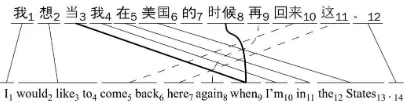
Figure 1: A pair of sentences that require long distance reordering (dashed line) and discontinuous translation (thick line)
[image:1.612.315.517.276.327.2]Table 1: Statistics of the corresponding target words for the continuous word sequences in the source lan-guage, or vice versa. C denotes consistent, O over-lapped, D discontinuous, and N null.
Word Alignment C O D N Manual 25 60 10 5 Automatic 20 55 15 5
the source language. This is because of the two distance-based constraints in PBSMT: the dis-tortion model cost and the disdis-tortion size limit. For the distortion model cost, PBSMT sets zero cost to the monotone translation and penalizes the distorted translations as the distortion grows larger. For the distortion size limit, a phrase can only be moved from its original position within a limit. Therefore, PBSMT fails to handle long distance reordering. Syntax-based SMT man-ages global reordering as structural transforma-tion. Because reordering occurs at the sub-structure level such as constituents or treelets in syntax-based SMT, the transformation of the sub-structure eventually yields the reordering of the whole sentence.
The second advantage of using syntax in TM is that syntax guides us to discontinuous trans-lation patterns. Because PBSMT regards only a continuous sequence of words as a transla-tion pattern, it often fails to utilize many use-ful discontinuous translation patterns. For ex-ample, two discontinuous source words corre-spond to a target word in Figure 1. In our in-spection of the training corpus, a continuous word sequence often corresponds to a set of discontinuous words in the target language, or vice versa (Table 1). Discontinuous translation patterns frequently appear in many languages (Søgaard and Kuhn, 2009). Syntax-based SMT overcomes the limitations of PBSMT because it finds discontinuous patterns along with the
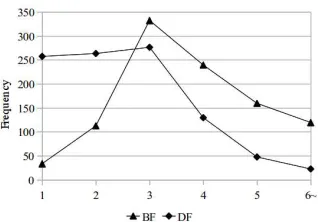
hier-Figure 2: The maximum branching factor (BF) and depth factor (DF) in a dependency tree in our corpus
archical structure. For example, the two discon-tinuous source words have a head-dependent re-lation (Figure 3). Especially with the depen-dency tree, we can easily identify patterns that have non-projectivity (Na et al., 2010). How-ever, syntax-based patterns such as constituents or treelets do not sufficiently cover various use-ful patterns, even if we have the correct syn-tactic analysis (Chiang, 2010). For this reason, many researchers have proposed supplementary patterns such as an intra/inter constituent or se-quence of treelets (Galley et al., 2006; Shen et al., 2008).
flat dependency tree are also likely to be flat. Unfortunately, the flat patterns are less appli-cable at the decoding stage. When one of the modifiers does not match, for instance, we fail to apply the translation pattern. Therefore, we need a more generally applicable representation for syntax-based SMT using DG.
We propose a novel representation of DG that regards a set of words as a unit of the depen-dency relations, similar to (Ding, 2006; Wu et al., 2009; Na et al., 2010). Unlike their work, we consider many alternatives without prede-fined units, and construct a packed forest of the multi-word units (MWUs) from a dependency tree. For brevity, we denote the forest based on MWUs as an MWU-forest. Because all pos-sible alternatives are exponentially many, we give an efficient algorithm that enumerates the k-best alternatives in section 3. As an appli-cation, we extract translation patterns in form of a source MWU-forest to the target string in order to broaden the coverage of the extracted patterns for syntax-based SMT in section 4. We also report empirical results related to the use-fulness of the extracted pattern in section 5. The experimental results show that the MWU-forest representation gives more applicable translation patterns than the original word-based tree.
2 Related Work
Previous studies have proposed merging alter-native analyses to deal with analysis errors for two reasons: 1) the strongest alternative is not necessarily the correct analysis, and 2) most alternatives contain similar elements such as common sub-trees. For segmentation alterna-tives, Dyer et al. (2008) proposed a word lattice that represents exponentially large numbers of segmentations of a source sentence, and inte-grates reordering information into the lattice as
well. For parsing alternatives, Mi et al. (2008) suggested a packed forest that encodes alterna-tive PSG derivations. Futher, Mi et al. (2010) combined the two approaches in order to bene-fit from both.
The translation literature also shows that translation requires non-isomorphic transfor-mation from the source to the target. This yields translation divergences such as head-switching (Dorr, 1994). Ding and Palmer (2005) reported that the percentage of the head-swapping cases is 4.7%, and that of broken dependencies is 59.3% between Chinese and English. The large amount of non-isomorphism, however, will be reduced by learning MWUs such as elementary trees (Eisner, 2003).
Figure 3: A dependency tree of the source sentence in Figure 1
3 MWU-based Dependency Forest
There are two advantages when we use the MWU-forest representaion with DG. First, we express the discontinuous patterns in a vertex, so that we can extract more useful translation patterns beyond continuous ones for syntax-based SMT. Second, an MWU-forest contains many alternative structures which may be sim-pler structures than the original tree in terms of the branching factor and the maximum depth. Wu et al. (2009) utilized an MWU-tree to iden-tify the product features in a sentence easily.
As in previous literature in syntax-based SMT using DG, we only consider the
well-formed MWUs where an MWU is either a
treelet (a connected sub-graph), or a sequence of treelets under a common head. In other words, each vertex in an MWU-forest is either “fixed on head” or “floating with children”. The formal definitions can be found in (Shen et al., 2008).
We propose encoding multiple dependency structures based on MWUs into a hypergraph. A hypergraph is a compact representation of exponetially many variations in a polynomi-nal space. Unlike PSG, DG does not have
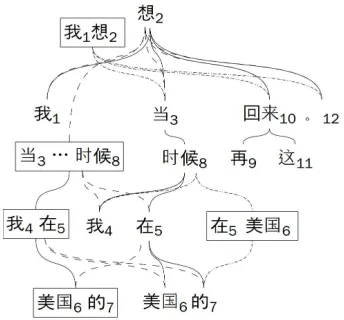
Figure 4: An MWU-forest of Figure 3. The dashed line indicates the alternative hyperedges.
non-terminals that represent the linguistically motivated, intermediate structure such as noun phrases and verb phrases. For this simplicity, Tu et al. (2010) proposed a dependency forest as a hypergraph, regarding a word as a vertex with a span that ranges for all its descendants. The dependency forest offers tolerence of pars-ing errors.
Our representation is different from the de-pendency forest of Tu et al. (2010) since a ver-tex corresponds to multiple words as well as words. Note that our representation is also capable of incorporating multiple parse trees. Therefore, MWU-forests will also be tolerant of the parsing error if we provide multiple parse trees. In this work, we concentrate on the ef-fectiveness of MWUs, and hence utilize the best dependency parse tree. Figure 4 shows an MWU-forest of the dependency tree in Figure 3.
More formally, a hypergraph H = hV, Ei
consists of the vertices V and hyperedges
[image:4.612.330.502.93.253.2]acyclic, and rooted, i.e. hj is the index of the head word of thej-th word, or0if the word is the root. Each vertex v = {j|j∈[1, J]} de-notes a set of the indices of the words that satis-fies the well-formed constraint. Each hyperedge
e=htails(e), head(e)idenotes a set of the de-pendency relations betweenhead(e)and∀v ∈
tails(e). We include a special node v0 ∈ V
that denotes the dummy root of an MWU-forest. Note thatv0does not appear intails(e)for all hyperedges. We denote|e|is the arity of hyper-edgee, i.e. the number of tail nodes, and the arity of a hypergraph is the maximum arity over all hyperedges. Also, letσ(v)be the indices of the words that the head lays out of the vertex, i.e. σ(v) = {j|hj 6∈v∧j∈v}, and τ(v) be the indices of the direct dependent words of the vertex, i.e. τ(v) = {j|hj ∈v∧j6∈v}. Let
OU T(v) and IN(v) be the outgoing and in-coming hyperedges of a vertexv, respectively.
It is challenging to weight the hyperedges based on dependency grammar because a de-pendency relation is a binary relation from a head to a dependent. Tu et al. (2010) assigned a probability for each hyperedge based on the score of the binary relation. We simply prefer the hyperedges that have lower arity by scoring as follows:
c(e) = P
v∈tails(e)|v|
|e|
p(e) = P c(e)
e′∈IN(head(e))c(e′)
We convert a dependency tree into a hyper-graph in two steps using the Inside-Outside al-gorithm. Algorithm 1 shows the pseudo code of our proposed method. At the first step, we find the k-best incoming hyperedges for each vertex (line 3-8), and compute the inside proba-bility (line 9), in bottom-up order. At the sec-ond step, we compute the outside probability
Algorithm 1 Build Forest
1: InitializeV
2: forv∈V in bottom-up order do 3: Create a chartC=|τ(v)|2 4: for chart span[p, q]do
5: InitializeC[p, q]if∃vs.t.[p, q] =vor
σ(v)
6: CombineC[p, i]andC[i+ 1, q]
7: end for
8: SetIN(v)to the k-best inC[T OP]
9: Setβ(v)as in Eq. 1 10: end for
11: forv∈V in top-down order do 12: Setα(v)as in Eq. 2
13: end for
14: Prune outeifp(e)≤δ
15: return v0
(line 12) for each vertex in a top-down manner. Finally we prune out less probable hyperedges (line 14) similar to (Mi et al., 2008). The inside and outside probabilities are defined as follows:
β(v) = X
e∈IN(v)
p(e) Y
d∈tails(e)
β(d) (1)
whereβ(v) = 1.0ifIN(v) =∅, and
α(v) = X
h∈OU T(v) e∈IN(head(h))
α(head(e))p(e)
|OU T(v)|
· Y
d∈tails(e)\{v}
β(d) (2)
whereα(v) = 1.0ifOU T(v) =∅.
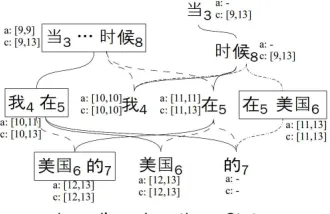
Figure 5: A sub-forest of Figure 4 with annotation ofaspanandcspanfor each vertex. We omit the span if it is not consistent.
• A horizontal vertex is a sequence of modi-fiers for a common head word, and
• A vertical vertex is a path from a word to one of the ancestors, and
• A combination of the horizontal vertices and the vertical vertices, and
• A combination of the vertical vertices and the vertical vertices.
The computational complexity of the initial-izaion directly affects the complexity of the en-tire procedure. For each word, generating the horizontal vertices takesO(b2), and the vertical vertices takeO(bd−1), wherebis the maximum branching factor andd is the maximum depth of a dependency tree. The two combinations takeO(bd+1) andO(b2(d−1))time to initialize the vertices. However, it takes O(mm+1) and
O(m2(m−1))if we restrict the maximum num-ber of the words in a vertex to a constantm.
[image:6.612.112.277.95.202.2]Ding and Palmer (2005) insisted that the Viterbi decoding of an MWU-forest takes lin-ear time. In our case, we enumerate the k-best incoming hyperedeges instead of the best one. Because each enumeration takesO(k2|τ(v)|3),
Table 2: The extracted rules in Figure 5. N denotes the non-lexicalized rules with variablesxi for each v∈tails(e), and L denotes the lexicalized rule.
head(e) tails(e) rhs(γ)
N
{3} {8}:x1 x1
{8} {4}:x1,{5}:x2 whenx1x2
{3,8} {4,5}:x1 whenx1
{3,8} {4}:x1,{5}:x2 whenx1 x2
{4,5} {6,7}:x1 I’m inx1
{5} {6,7}:x1 inx1
L
{6,7}
N/A
the States
{4} I’m
{5} in
{4,5} I’m in
{5,6} in the State
{3,8} When
the total time complexity also becomes linear to the length of the sentencensimilar to Ding and Palmer (2005), i.e.O(|V|k2|τ(v)|3), where
|V|=O(na2(a−1))anda= min(m, b, d).
4 MWU-Forest-to-String Translation Rule Extraction
As an application of our proposed MWU-forest, we extract translation rules for syntax-based SMT. Forest-based translation rule extraction has been suggested by Mi and Huang (2008) although their forest compacts the k-best PSG trees. The extraction procedure is essentially the same as Galley et al. (2004), which iden-tifies the cutting points (frontiers) and extracts the sub-structures from a root to frontiers.
• aspan(v) = [min(av),max(av)], and
• cspan(v) =
aspan(v)Sd∈tails(e) e∈IN(v)
cspan(d)
, whereav = {i|j∈v∧(i, j)∈A}. Figure 5 showsaspans andcspans of a sub-forest of of the MWU-forest in the previous example.
Each span type yields a different rule type:
aspan yields a lexicalized rule without any variables, and cspan yields a non-lexicalized rule with variables for the dependents of the head word. For example, Table 2 shows the ex-tracted rule in Figure 5.
In our MWU-forest, the rule extraction pro-cedure is almost identical to a dependency tree-to-string rule extraction except we regard MWUs as vertices. Letfj and ei be thej-th source andi-th target word, respectively. As an MWU itself has a internal structure, a lexical rule is a tree-to-string translation rule. There-fore, a lexicalized rule is a pair of the source wordssand the target wordstas follows:
s(v) = {fj|j∈v}
t(v) = {ei|i∈aspan(v)} (3)
In addition, we extract the non-lexicalized rules from a hyperedge e to cspan of the
head(e). A non-lexicalized rule is a pair of the source words in the vertices of a hyperedge and thecspanof the target words with substitutions ofcspan(d)for eachd∈tails(e). We abstract
don the source with σ(d) for non-lexicalized rules (row 2 in Table 2). We define the source wordssand the target wordstas follows:
s(e) = {fj|j∈head(e)∨j ∈σ(d)}
t(e) = {ei|i∈cspan(v)∧i6∈cspan(d)}
∪ {xi|d↔xi} (4)
Algorithm 2 Extract Rules(H =hV, Ei) 1: Γ =∅
2: forv∈V do
3: ifaspan(v)is consistent then 4: Γ←Γ∪ hs(v), t(v)ias in Eq. 3 5: end if
6: ifcspan(v)is consistent then 7: fore∈IN(v)do
8: ifcspan(d)∀d∈tails(e)then
9: Γ←Γ∪ hs(e), t(e)ias in Eq. 4
10: end if
11: end for
12: end if
13: end for
14: return Γ
whered∈tails(e).
More formally, we extract a synchronous tree substitution grammar (STSG) which regards the MWUs as non-terminals.
Definition 1 A STSG using MWU
(STSG-MWU) is a 6-tupleG = hΣS,ΣT,∆,Γ, S, φi,
where:
• ΣS and ΣT are finite sets of terminals (words, POSs, etc.) of the source and tar-get languages, respectively.
• ∆is a finite set ofM W Us in the source language, i.e.∆ ={ΣS}+
• Γ is a finite set of production rules where a production rule γ : X → hlhs(γ), rhs(γ), φi, which is a relation-ship from∆to{x∪ΣT} ∗, whereφis the bijective function from the source vertices to the variablesxinrhs(γ). The asterisk represents the Kleenstar operation, and
For each type of span, we only extract the rules if the target span has consistent word alignments, i.e. span 6= ∅ ∧ ∀i ∈ span,
{j|(i, j)∈A∩(i′, j)∈As.t.i′6∈span} =∅.
Algorithm 2 shows the pseudo code of the extraction. Because a vertex has aspan and
csapn, we extract a lexicalized rule (line 3-5) and/or non-lexicalized rules (line 6-12) for each vertex.
5 Experiment
We used the training corpus provided for the DIALOG Task in IWSLT10 between Chinese and English . The corpus is a collection of 30,033 sentence pairs and consists of dialogs in travel situations (10,061) and parts of the BTEC corpus (19,972). Details about the provided corpus are described in (Paul, 2009). We used the Stanford Parser 1 to obtain word-level de-pendency structures of Chinese sentences, and GIZA++ 2 to obtain word alignments of the
biligual corpus.
We extracted the SCFG-MWU from the biligual corpus with word alignment. In or-der to investigate the coverage of the extracted rule, we counted the number of the recovered sentences, i.e. counted if the extracted rule for each sentence pair generates the target sen-tence by combining the extracted rules. As we collected many alternatives in an MWU-forest, we wanted to determine the importance of each source fragment. Mi and Huang (2008) penal-ized a ruleγ by the posterior probability of its tree fragmentlhs(γ). This posterior probability is also computed in the Inside-Outside fashion that we used in Algorithm 1. Therefore, we re-garded the fractional count of a ruleγ as
1
http://nlp.stanford.edu/software/lex-parser.shtml, Version 1.6.4
2
[image:8.612.319.518.92.213.2]http://code.google.com/p/giza-pp/
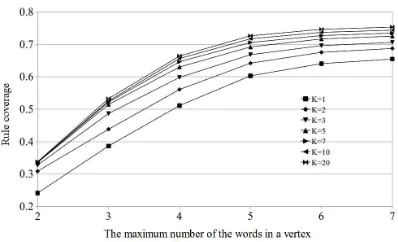
Figure 6: The rule coverage according to the number of the words in a vertex.
c(γ) = αβ(lhs(γ)) αβ(v0)
We prioritized the rule according to the frac-tional count. The priority is used when we com-bine the rules to restore the target sentence us-ing the extracted rule for each sentence. We var-ied the maximum size of a vertex m, and the number of incoming hyperedges k. Figure 6 shows the emprical result.
6 Discussion
Figure 7: The frequency of the recovery according to the length of the sentences in 1,000 sentences
around 65%. This can be viewed as an indirect comparison between Na et al. (2010) and our proposed method in this corpus.
Figure 7 shows that the frequency of suc-cess and failure in the recovery depends on the length of the sentences. As the length of sen-tences increase, the successful recovery occurs less frequently. We investigated the reason of failure in the longer sentences. As a result, the two main sources of the failure are the word alignment error and the dependency parsing er-ror.
Our proposed method does not include all translation rules in PBSMT because of the syn-tactic constraint. Generally speaking, our pro-posed method cannot deal with MWUs that do not satisfy the well-formed constraint. How-ever, ill-formed MWUs seems to be useful as well. For example, our proposed method dose not allow ill-formed vertices in an MWU-forest as shown in Figure 8. This would be problem-atic when we use an erroneuos parsing result. Because dealing with parsing error has been studied in literature, our proposed method has the potential to improve thought future work.
Figure 8: An illustration of ill-formed MWUs
7 Conclusion
We have presented a way of representing sen-tence structure using MWUs on DG. Because of the absence of the intermdiate representation in DG, we built a simpler structure of MWUs than words using words as vertices of a dependency structure. Unlike previous studies, we collected many alternative structures using MWUs in a packed forest, which is novel. We also ex-tracted MWU-forest-to-string translation rules, and verified the rule coverage empirically. As a consequence, we improvemed the rule coverage compared with a previous work, while retaining the linear asymptotic complexity. We will ex-pand our propose method to develop a syntax-based SMT system in the future, and incoporate the parsing error by considering multiple syn-tactic analyses.
Acknowledgments
[image:9.612.347.487.93.204.2]References
David Chiang. 2010. Learning to translate with source and target syntax. In Proceedings of the 48th Annual Meeting of the Association for Com-putational Linguistics, pages 1443–1452, Upp-sala, Sweden, July. Association for Computa-tional Linguistics.
Yuan Ding and Martha Palmer. 2005. Machine translation using probabilistic synchronous de-pendency insertion grammars. In ACL ’05: Pro-ceedings of the 43rd Annual Meeting on Associ-ation for ComputAssoci-ational Linguistics, pages 541– 548, Morristown, NJ, USA. Association for Com-putational Linguistics.
Yuan Ding. 2006. Machine Translation Using Probabilistic Synchronous Dependency Insertion Grammars. Ph.D. thesis, August.
Bonnie J. Dorr. 1994. Machine translation diver-gences: a formal description and proposed solu-tion. Comput. Linguist., 20:597–633, December. Christopher Dyer, Smaranda Muresan, and Philip
Resnik. 2008. Generalizing word lattice trans-lation. In Proceedings of ACL-08: HLT, pages 1012–1020, Columbus, Ohio, June. Association for Computational Linguistics.
Jason Eisner. 2003. Learning non-isomorphic tree mappings for machine translation. In ACL ’03: Proceedings of the 41st Annual Meeting on As-sociation for Computational Linguistics, pages 205–208, Morristown, NJ, USA. Association for Computational Linguistics.
Michel Galley, Mark Hopkins, Kevin Knight, and Daniel Marcu. 2004. What’s in a transla-tion rule? In Daniel Marcu Susan Dumais and Salim Roukos, editors, HLT-NAACL 2004: Main Proceedings, pages 273–280, Boston, Mas-sachusetts, USA, May 2 - May 7. Association for Computational Linguistics.
Michel Galley, Jonathan Graehl, Kevin Knight, Daniel Marcu, Steve DeNeefe, Wei Wang, and Ignacio Thayer. 2006. Scalable inference and training of context-rich syntactic translation mod-els. In Proceedings of the 21st International Con-ference on Computational Linguistics and 44th Annual Meeting of the Association for
Computa-tional Linguistics, pages 961–968, Sydney, Aus-tralia, July. Association for Computational Lin-guistics.
Haitao Mi and Liang Huang. 2008. Forest-based translation rule extraction. In Proceedings of the 2008 Conference on Empirical Methods in Nat-ural Language Processing, pages 206–214, Hon-olulu, Hawaii, October. Association for Compu-tational Linguistics.
Haitao Mi, Liang Huang, and Qun Liu. 2008. Forest-based translation. In Proceedings of ACL-08: HLT, pages 192–199, Columbus, Ohio, June. Association for Computational Linguistics. Haitao Mi, Liang Huang, and Qun Liu. 2010.
Ma-chine translation with lattices and forests. In Coling 2010: Posters, pages 837–845, Beijing, China, August. Coling 2010 Organizing Commit-tee.
Hwidong Na, Jin-Ji Li, Yeha Lee, and Jong-Hyeok Lee. 2010. A synchronous context free grammar using dependency sequence for syntax-base sta-tistical machine translation. In The Ninth Confer-ence of the Association for Machine Translation in the Americas (AMTA 2010), Denver, Colorado, October.
Michael Paul. 2009. Overview of the iwslt 2009 evaluation campaign.
Libin Shen, Jinxi Xu, and Ralph Weischedel. 2008. A new string-to-dependency machine translation algorithm with a target dependency language model. In Proceedings of ACL-08: HLT, pages 577–585, Columbus, Ohio, June. Association for Computational Linguistics.
Anders Søgaard and Jonas Kuhn. 2009. Empirical lower bounds on aligment error rates in syntax-based machine translation. In Proceedings of the Third Workshop on Syntax and Structure in Statis-tical Translation (SSST-3) at NAACL HLT 2009, pages 19–27, Boulder, Colorado, June. Associa-tion for ComputaAssocia-tional Linguistics.
1092–1100, Beijing, China, August. Coling 2010 Organizing Committee.