Regression and Ranking based Optimisation for Sentence Level Machine
Translation Evaluation
Xingyi Song and Trevor Cohn
The Department of Computer Science University of Sheffield
Sheffield, S1 4DP. UK
{xsong2,t.cohn}@shef.ac.uk
Abstract
Automatic evaluation metrics are fundamen-tally important for Machine Translation, al-lowing comparison of systems performance and efficient training. Current evaluation met-rics fall into two classes: heuristic approaches, like BLEU, and those using supervised learn-ing trained on human judgement data. While many trained metrics provide a better match against human judgements, this comes at the cost of including lots of features, leading to unwieldy, non-portable and slow metrics. In this paper, we introduce a new trained met-ric, ROSE, which only uses simple features that are easy portable and quick to compute. In addition, ROSE is sentence-based, as op-posed to document-based, allowing it to be used in a wider range of settings. Results show that ROSE performs well on many tasks, such as ranking system and syntactic constituents, with results competitive to BLEU. Moreover, this still holds when ROSE is trained on hu-man judgements of translations into a different language compared with that use in testing.
1 Introduction
Human judgements of translation quality are very expensive. For this reason automatic MT evalu-ation metrics are used to as an approximevalu-ation by comparing predicted translations to human authored references. An early MT evaluation metric, BLEU (Papineni et al., 2002), is still the most commonly used metric in automatic machine translation evalu-ation. However, several drawbacks have been stated by many researchers (Chiang et al., 2008a; Callison-Burch et al., 2006; Banerjee and Lavie, 2005), most
notably that it omits recall (substituting this with a penalty for overly short output) and not being easily applied at the sentence level. Later heuristic metrics such as METEOR (Banerjee and Lavie, 2005) and TER (Snover et al., 2006) account for both precision and recall, but their relative weights are difficult to determine manually.
In contrast to heuristic metrics, trained met-rics use supervised learning to model directly hu-man judgements. This allows the combination of different features and can better fit specific tasks, such as evaluation focusing more on flu-ency/adequacy/relative ranks or post editing effort. Previous work includes approaches using classifica-tion (Corston-Oliver et al., 2001), regression (Alber-cht and Hwa, 2008; Specia and Gimenez, 2010), and ranking (Duh, 2008). Most of which achieved good results and better correlations with human judg-ments than heuristic baseline methods.
Overall automatic metrics must find a balance be-tween several key issues: a) applicability to differ-ent sized texts (documdiffer-ents vs sdiffer-entences), b) easy of portability to different languages, c) runtime re-quirements and d) correlation with human judge-ment data. Previous work has typically ignored at least one of these issues, e.g., BLEU which applies only to documents (A), trained metrics (Albercht and Hwa, 2008; Specia and Gimenez, 2010) which tend to ignore B and C.
This paper presents ROSE, a trained metric which is loosely based on BLEU, but seeks to further sim-plify its components such that it can be used for sen-tence level evaluation. This contrasts with BLEU which is defined over large documents, and must
be coarsely approximated to allow sentence level application. The increased flexibility of ROSE al-lows the metric to be used in a wider range of situ-ations, including during decoding. ROSE is a linear model with a small number of simple features, and is trained using regression or ranking against human judgement data. A benefit of using only simple fea-tures is that ROSE can be trivially ported between target languages, and that it can be run very quickly. Features include precision and recall over different sized n-grams, and the difference in word counts between the candidate and the reference sentences, which is further divided into content word, func-tion word and punctuafunc-tion. An extended versions also includes features over Part of Speech (POS) se-quences.
The paper is structured as follows: Related work on metrics for statistical machine translation is de-scribed in Section 2. Four variations of ROSE and their features will be introduced in Section 3. In sec-tion 4 we presents the result, showing how ROSE correlates well with human judgments on both sys-tem and sentence levels. Conclusions are given at the end of the paper.
2 Related Work
The defacto standard metric in machine translation is BLEU (Papineni et al., 2002). This measures n-gram precision (n normally equal to 1,2,3,4) be-tween a document of candidate sentences and a set of human authored reference documents. The idea is that high quality translations share many n-grams with the references. In order to reduce re-peatedly generating the same word, BLEU clips the counts of each candidate N-gram to the maximum counts of that n-gram that in references, and with a brevity penalty to down-scale the score for out-put shorter than the reference. In BLEU, each n-gram precision is given equal weight in geometric mean, while NIST (Doddington and George, 2002) extended BLEU by assigning more informative n-grams higher weight.
However, BLEU and NIST have several draw-backs, the first being that BLEU uses a geometric mean over all n-grams which makes BLEU almost unusable for sentence level evaluations1. Secondly,
1Note that various approximations exits (Lin and Och, 2004;
BLEU and NIST both use the brevity penalty to re-place recall, but Banerjee and Lavie (2005) in exper-iments show that the brevity penalty is a poor sub-stitute for recall.
Banerjee and Lavie (2005) proposed a METEOR metric, which that uses recall instead of the BP. Callison-Burch et al. (2007; Callison-Burch et al. (2008) show that METEOR does not perform well in out of English task. This may because that Stemmer or WordNet may not available in some languages, which unable to model synonyms in these cases. In addition, the performance also varies when adjusting weights in precision and recall.
Supervised learning approaches have been pro-posed by many researchers (Corston-Oliver et al., 2001; Duh, 2008; Albercht and Hwa, 2008; Spe-cia and Gimenez, 2010). Corston-Oliver et al. (2001) use a classification method to measure ma-chine translation system quality at the sentence level as being human-like translation (good) or machine translated (bad). Features extracted from references and machine translation include heavy linguistic fea-tures (requires parser).
Quirk (2004) proposed a linear regression model which is trained to match translation quality. Alber-cht and Hwa (2008) introduced pseudo-references when data driven regression does not have enough training data. Most recently, Specia and Gimenez (2010) combined confidence estimation (without reference, just using the source) and reference-based metrics together in a regression framework to mea-sure sentence-level machine translation quality.
Duh (2008) compared the ranking with the re-gression, with the results that with same feature set, ranking and regression have similar performance, while ranking can tolerate more training data noise.
3 Model
ROSE is a trained automatic MT evaluation metric that works on sentence level. It is defined as a linear model, and its weights will be trained by Support Vector Machine. It is formulated as
S=−→w·f(−→c ,−→r) (1)
where−→w is the feature weights vector,f(−→c ,−→r)is the feature function which takes candidate
tion (−→c) and reference (−→c), and returns the feature vector. S is the response variable, measuring the ‘goodness’ of the candidate translation. A higher score means a better translation, although the mag-nitude is not always meaningful.
We present two different method for training: a linear regression approach ROSE-reg, trained to match human evaluation score, and a ranking ap-proach ROSE-rank to match the relative ordering of pairs of translations assigned by human judge. Un-like ROSE-reg, ROSE-rank only gives relative score between sentences, such as A is better than B. The features that used in ROSE will be listed in section 3.1, and the regression and ranking training are de-scribed in section 3.2
3.1 ROSE Features
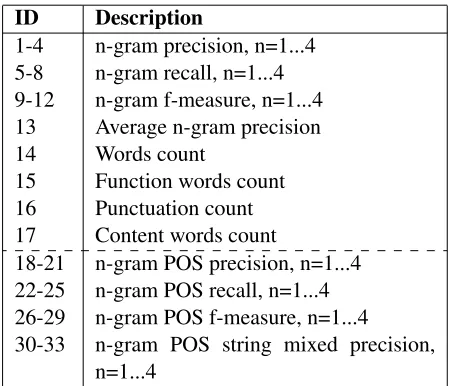
Features used in ROSE listed in Table 1 include string n-gram matching, Word count and Part of Speech (POS). String N-gram matching features, are used for measure how closely of the candidate sen-tence resembles the reference. Both precision and recall are considered. Word count features measure length differences between the candidate and refer-ence, which is further divided into function words, punctuation and content words. POS features are defined over POS n-gram matches between the can-didate and reference.
3.1.1 String Matching Features
The string matching features include n-gram pre-cision, n-gram recall and F1-measure. N-gram precision measures matches between sequence of words in the candidate sentence compared to the ref-erences,
Pn=
P
n-gram∈−→c Count(n-gram)Jn-gram∈ − →r
K
P
n-gram∈−→c Count(ngram)
(2)
whereCountare the occurrence counts of n-grams in the candidate sentence, the numerator measures the number of predicted n-grams that also occur in the reference.
Recall is also used in ROSE, so clipping was deemed unnecessary in precision calculation, where the repeating words will increasing precision but at the expense of recall. F-measure is also included, which is the harmonic mean of precision and recall.
ID Description
1-4 n-gram precision, n=1...4 5-8 n-gram recall, n=1...4 9-12 n-gram f-measure, n=1...4 13 Average n-gram precision 14 Words count
15 Function words count 16 Punctuation count 17 Content words count
18-21 n-gram POS precision, n=1...4 22-25 n-gram POS recall, n=1...4 26-29 n-gram POS f-measure, n=1...4 30-33 n-gram POS string mixed precision,
[image:3.612.314.539.56.249.2]n=1...4
Table 1: ROSE Features. The first column is the feature number. The dashed line separates the core features from the POS extended features.
With there are multiple references, the n-gram preci-sion error uses the same strategy as BLEU: n-grams in candidate can match any of the references. For recall, ROSE will match the n-grams in each refer-ence separately, and then choose the recall for the reference with minimum error.
3.1.2 Word Count Features
The word count features measure the length dif-ference between a candidate sentence and redif-ference sentence. In a sentence, content words are more in-formative than function words (grammatical words) and punctuation. Therefore, the number of content word candidate is a important indicator in evalua-tion. In this case, besides measuring the length at whole sentences, we also measure difference in the number offunction words,punctuationandcontent words. We normalise by the length of the refer-ence which allows comparability between short ver-sus long sentences. In multiple reference cases we choose the ratio that is closest to 1.
3.1.3 Part of Speech Features
fea-tures measure precision, recall and F-measure over POS n-grams (n=1...4). In addition, we also include features that mixed string and POS.
The string/POS mixed feature is used for handling synonyms. One problem in string n-gram match-ing is not bematch-ing able to deal with the synonyms be-tween the candidate translation and the reference. One approach for doing so is to use an external re-source such as WordNet (Banerjee and Lavie, 2005), however this would limit the portability of the met-ric. Instead we use POS as a proxy. In most of the cases, synonyms share the same POS, so this can be rewarded by forming n-grams over a mix-ture of tokens and POS. During the matching pro-cess, both words and its POS shall be considered, if either matches between reference and candidate, the n-gram matches will be counted.
Considering the example in table 2, candidate 1 has better translation than candidate 2 and 3. If only the string N-gram matching is used, that will give the same score to candidate 1, 2 and 3. The n-gram pre-cision scores obtained by all candidate sentences in this example are: 2-gram = 1, 3-gram = 0. However, we can at least distinguish candidate 1 is better than candidate 3 if string POS mixed precision is used , n-gram precision for candidate 1 will be: 2-gram = 2, 3-gram = 1, which ranks candidate 1 better than candidate 3.
Example
reference: A/DT red/ADJ vehicle/NN
candidate 1: A/DT red/ADJ car/NN candidate 2: A/DT red/ADJ rose/NN candidate 3: A/DT red/ADJ red/ADJ
Table 2: Evaluation Example
3.2 Training
The model was trained on human evaluation data in two different ways, regression and ranking.These both used SVM-light (Joachims, 1999). In the rank-ing model, the trainrank-ing data are candidate translation and their relative rankings were ranked by human judge for a given input sentence. The SVM finds the minimum magnitude weights that are able to cor-rectly rank training data which is framed as a series
of constraints reflecting all pairwise comparisons. A soft-margin formulation is used to allow training er-rors with a penalty (Joachims, 2002). For regres-sion, the training data is human annotation of post-edit effort (this will be further described in section 4.1). The Support vector Regression learns weights with minimum magnitude that limit prediction er-ror to within an accepted range, again with a soft-margin formulation (Smola and Schlkopf, 2004).
A linear kernel function will be used, because non-linear kernels are much slower to use and are not decomposable. Our experiments showed that the linear kernel performed at similar accuracy to other kernel functions (see section 4.2).
4 Experimental Setup
Our experiments test ROSE performance on docu-ment level with three different Kernel functions: lin-ear, polynomial and radial basis function. Then we compare four variants of ROSE with BLEU on both sentence and system (document) level.
The BLEU version we used here is NIST Open MT Evaluation tool mteval version 13a, smooth-ing was disabled and except for the sentence level evaluation experiment. The system level evalua-tion procedure follows WMT08 (Callison-Burch et al., 2008), which ranked each system submitted on WMT08 in three types of tasks:
• Rank: Human judges candidate sentence rank in order of quality. On the document level, doc-uments are ranked according to the proportion of candidate sentences in a document that are better than all of the candidates.
• Constituent: The constituent task is the same as for ranking but operates over chosen syntac-tic constituents.
• Yes/No: WMT08 Yes/No task is to let human judge decide whether the particular part of a sentence is acceptable or not. Document level Yes/No ranks a document according to their number of YES sentences
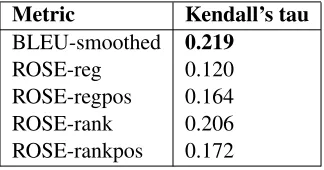
ROSE-reg and ROSE-rank were tested in all target lan-guage sets, but ROSE-regpos was only tested in the into-English set as it requires a POS tagger. On the sentence level, we compare sentences ranking that ranked by metrics against human ranking. The eval-uation quality was examined by Kendall’s tau cor-relation, and tied results from human judges were excluded.
Rank es-en fr-en de-en avg Linear 0.57 0.97 0.69 0.74 Polynomial 0.62 0.97 0.71 0.76
RBF 0.60 0.98 0.62 0.73
Constituent
Linear 0.79 0.90 0.39 0.69 Polynomial 0.80 0.89 0.41 0.70
RBF 0.83 0.93 0.34 0.70
Yes/No
Linear 0.92 0.93 0.67 0.84 Polynomial 0.86 0.90 0.66 0.81
[image:5.612.81.290.175.346.2]RBF 0.87 0.93 0.65 0.82
Table 3: ROSE-reg in with SVM kernel functions
Metric Kendall’s tau BLEU-smoothed 0.219
ROSE-reg 0.120
[image:5.612.105.267.394.479.2]ROSE-regpos 0.164 ROSE-rank 0.206 ROSE-rankpos 0.172
Table 4: Sentence Level Evaluation
4.1 Data
Training data used for ROSE is from WMT10 (Callison-Burch et al., 2010) human judged sen-tences. A regression model was trained by sentences with human annotation for post editing effort. The three levels used in WMT10 are ‘OK’, ‘EDIT’ and ‘BAD’, which we treat as response values of 3, 2 and 1. In total 2885 sentences were used in the re-gression training. The ranking model was trained by sentences with human annotating sentence ranking, and tied results are allowed in training. In this exper-iment, 1675 groups of sentences were used for train-ing, and each group contains five sentences, which
are manually ranked from 5 (best) to 1 (worst). In or-der to test the ROSE’s ability to adapt the language without training data, ROSE was only trained with English data.
The testing data on sentence level used in this paper is human ranked sentences from WMT09 (Callison-Burch et al., 2009). Tied rankings were re-moved, leaving 1702 pairs. We only consider trans-lations into English sentences. On system level, the testing data are the submissions for ’test2008’ test set in WMT08 (Callison-Burch et al., 2008). ROSE, and BLEU were compared with human ranked sub-mitted system in ‘RANK’, ‘CONSTITUENT’ and ‘YES/NO’ tasks.
English punctuation and 100 common function words list of four languages in this experiment were generated. English POS was tagged by NLTK (Bird and Loper, 2004).
4.2 Results and Discussion
Table 3 shows the results of ROSE-reg with three different SVM Kernel functions. Performance are similar among three different Kernel functions. However, the linear kernel is the fastest and simplest and there is no overall winner. Therefore, linear Ker-nel function was used in ROSE.
The results of Kendall’s tau on sentence level evaluation are shown in Table 4. According to Ta-ble 4 ROSE-rank has the highest score in all ver-sions of ROSE. The score is close to the smoothed version of BLEU. Results also showed adding POS feature helped in improving accuracy in the regres-sion model, but not in ranking, The reason for this is not clear, but it may be due to over fitting.
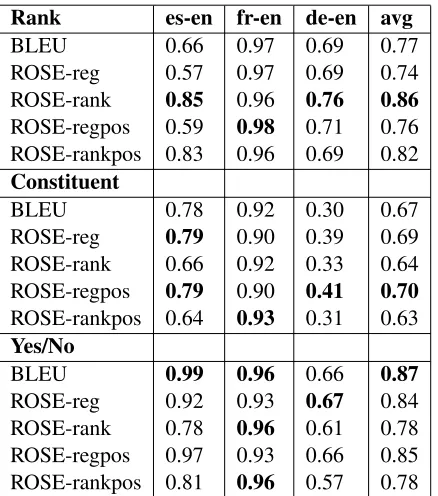
Rank es-en fr-en de-en avg
BLEU 0.66 0.97 0.69 0.77
ROSE-reg 0.57 0.97 0.69 0.74 ROSE-rank 0.85 0.96 0.76 0.86 ROSE-regpos 0.59 0.98 0.71 0.76 ROSE-rankpos 0.83 0.96 0.69 0.82 Constituent
BLEU 0.78 0.92 0.30 0.67
ROSE-reg 0.79 0.90 0.39 0.69 ROSE-rank 0.66 0.92 0.33 0.64 ROSE-regpos 0.79 0.90 0.41 0.70 ROSE-rankpos 0.64 0.93 0.31 0.63 Yes/No
BLEU 0.99 0.96 0.66 0.87
[image:6.612.78.297.56.304.2]ROSE-reg 0.92 0.93 0.67 0.84 ROSE-rank 0.78 0.96 0.61 0.78 ROSE-regpos 0.97 0.93 0.66 0.85 ROSE-rankpos 0.81 0.96 0.57 0.78
Table 5: System Level evaluation that translation into En-glish
5 Conclusion
We presented the ROSE metric to make up for sev-eral drawbacks of BLEU and other trained metrics. Features including string matching, words ratio and POS were combined by the supervised learning ap-proach. ROSE’s overall performance was close to BLEU on system level and sentence level. However, it is better on tasks ROSE was specifically trained, such as ROSE-rank in the system level ranking task and ROSE-regpos in the syntactic constituents task. Results also showed that when training data is not available in the right language ROSE produces rea-sonable results.
Smoothed BLEU slightly outperformed ROSE in sentence evaluation. This might be due to the train-ing data not betrain-ing expert judgments, and conse-quently very noisy. In further work, we shall mod-ify the training method to better tolerate noise. In addition, we will modify ROSE by substitute less informative features with more informative features in order to improve its performance and reduce over fitting.
Rank es-en fr-en de-en avg
BLEU 0.85 0.98 0.88 0.90
ROSE-reg 0.75 0.98 0.93 0.89 ROSE-rank 0.69 0.93 0.94 0.85 Constituent
BLEU 0.83 0.87 0.35 0.68
ROSE-reg 0.73 0.87 0.36 0.65 ROSE-rank 0.72 0.78 0.32 0.61 Yes/No
BLEU 0.75 0.97 0.89 0.87
[image:6.612.321.529.56.223.2]ROSE-reg 0.72 0.97 0.93 0.87 ROSE-rank 0.82 0.96 0.87 0.88
Table 6: System Level evaluation that translation from English
References
Josha S. Albercht and Rebecca Hwa. 2008. Regres-sion for machine translation evaluation at the sentence level. Machine Translation, 22:1–27.
Satanjeev Banerjee and Alon Lavie. 2005. Meteor: An automatic metric for mt evaluation with improved cor-relation with human judgments. Proceedings of the
ACL-05 Workshop.
Steven Bird and Edward Loper. 2004. Nltk: The natural language toolkit. InProceedings of the ACL demon-stration session, pages 214–217, Barcelona, July. Chris Callison-Burch, Miles Osborne, and Philipp
Koehn. 2006. Re-evaluating the role of bleu in ma-chine translation research. InIn EACL, pages 249– 256.
Chris Callison-Burch, Cameron Fordyce, Philipp Koehn, Christof Monz, and Josh Schroeder. 2007. (meta-) evaluation of machine translation. InProceedings of the Second Workshop on Statistical Machine Transla-tion, pages 136–158, Prague, Czech Republic, June. Association for Computational Linguistics.
Chris Callison-Burch, Cameron Fordyce, Philipp Koehn, Christof Monz, and Josh Schroeder. 2008. Further meta-evaluation of machine translation. In Proceed-ings of the Third Workshop on Statistical Machine
Translation, pages 70–106, Columbus, Ohio, June.
Association for Computational Linguistics.
Chris Callison-Burch, Philipp Koehn, Christof Monz, and Josh Schroeder. 2009. Findings of the 2009 Workshop on Statistical Machine Translation. In
Proceedings of the Fourth Workshop on Statistical
Machine Translation, pages 1–28, Athens, Greece,
March. Association for Computational Linguistics. Chris Callison-Burch, Philipp Koehn, Christof Monz,
2010. Findings of the 2010 joint workshop on sta-tistical machine translation and metrics for machine translation. InProceedings of the Joint Fifth Workshop
on Statistical Machine Translation and MetricsMATR,
pages 17–53, Uppsala, Sweden, July. Association for Computational Linguistics. Revised August 2010. David Chiang, Steve DeNeefe, Yee Seng Chan, and
Hwee Tou Ng. 2008a. Decomposability of trans-lation metrics for improved evaluation and efficient algorithms. In Proceedings of the Conference on
Empirical Methods in Natural Language Processing,
EMNLP ’08, pages 610–619, Stroudsburg, PA, USA. Association for Computational Linguistics.
David Chiang, Yuval Marton, and Philip Resnik. 2008b. Online large-margin training of syntactic and struc-tural translation features. InProceedings of the Con-ference on Empirical Methods in Natural Language
Processing, EMNLP ’08, pages 224–233,
Strouds-burg, PA, USA. Association for Computational Lin-guistics.
Simon Corston-Oliver, Michael Gamon, and Chris Brockett. 2001. A machine learning approach to the automatic evaluation of machine translation. In pro-ceedings of the Association for Computational Lin-guistics.
Doddington and George. 2002. Automatic evalua-tion of machine translaevalua-tion quality using n-gram co-occurrence statistics. In Proceedings of the second international conference on Human Language
Tech-nology Research, HLT ’02, pages 138–145, San
Fran-cisco, CA, USA. Morgan Kaufmann Publishers Inc. Kevin Duh. 2008. Ranking vs. regression in machine
translation evaluation. InIn Proceedings of the Third
Workshop on Statistical Machine Translation, pages
191–194, Columbus,Ohio,, June.
T. Joachims. 1999. Making large-scale svm learning practical. Advances in Kernel Methods - Support Vec-tor Learning,.
T. Joachims. 2002. Optimizing search engines using clickthrough data. In Proceedings of the ACM Con-ference on Knowledge Discovery and Data Mining
(KDD).
Chin-Yew Lin and Franz Josef Och. 2004. Orange: a method for evaluating automatic evaluation metrics for machine translation. In Proceedings of the 20th in-ternational conference on Computational Linguistics, COLING ’04, Stroudsburg, PA, USA. Association for Computational Linguistics.
Kishore Papineni, Salim Roukos, Todd Ward, and Wei-Jing Zhu. 2002. Bleu: a method for automatic eval-uation of machine translation. InProceedings of the 40th Annual Meeting on Association for Computa-tional Linguistics, ACL ’02, pages 311–318,
Strouds-burg, PA, USA. Association for Computational Lin-guistics.
C Quirk. 2004. Training a sentence-level machine trans-lation confidence measure. InIn: Proceedings of the international conference on language resources and evaluation, pages 825–828, Lisbon, Portugal.
Alex J. Smola and Bernhard Schlkopf. 2004. A tuto-rial on support vector regression. STATISTICS AND
COMPUTING, 14:199–222.
Matthew Snover, Bonnie Dorr, Richard Schwartz, Linnea Micciulla, and Ralph Weischedel. 2006. A study of translation error rate with targeted human annotation. L. Specia and J. Gimenez. 2010. Combining confidence