Match without a Referee:
Evaluating MT Adequacy without Reference Translations
Yashar Mehdad Matteo Negri Marcello Federico
Fondazione Bruno Kessler, FBK-irst Trento , Italy
{mehdad|negri|federico}@fbk.eu
Abstract
We address two challenges for automatic ma-chine translation evaluation: a) avoiding the use of reference translations, and b) focusing on adequacy estimation. From an economic perspective, getting rid of costly hand-crafted reference translations (a) permits to alleviate the main bottleneck in MT evaluation. From a system evaluation perspective, pushing se-mantics into MT (b) is a necessity in order to complement the shallow methods currently used overcoming their limitations. Casting the problem as a cross-lingual textual entail-ment application, we experientail-ment with differ-ent benchmarks and evaluation settings. Our method shows high correlation with human judgements and good results on all datasets without relying on reference translations.
1 Introduction
While syntactically informed modelling for statis-tical MT is an active field of research that has re-cently gained major attention from the MT commu-nity, work on integrating semantic models of ade-quacy into MT is still at preliminary stages. This sit-uation holds not only for system development (most current methods disregard semantic information, in favour of statistical models of words distribution), but also for system evaluation. To realize its full po-tential, however, MT is now in the need of semantic-aware techniques, capable of complementing fre-quency counts with meaning representations.
In order to integrate semantics more deeply into MT technology, in this paper we focus on the eval-uation dimension. Restricting our investigation to
some of the more pressing issues emerging from this area of research, we provide two main contributions. 1. An automatic evaluation method that avoids the use of reference translations. Most current metrics are based on comparisons between auto-matic translations and human references, and reward lexical similarity at the n-gram level (e.g. BLEU (Papineni et al., 2002), NIST (Doddington, 2002), METEOR (Banerjee and Lavie, 2005), TER (Snover et al., 2006)). Due to the variability of natural lan-guages in terms of possible ways to express the same meaning, reliable lexical similarity metrics depend on the availability of multiple hand-crafted (costly) realizations of the same source sentence in the tar-get language. Our approach aims to avoid this bot-tleneck by adapting cross-lingual semantic inference capabilities and judging a translation only given the source sentence.
2. A method for evaluating translation adequacy. Most current solutions do not consistently reward translation adequacy (semantic equivalence between source sentence and target translation). The scarce integration of semantic information in MT, specif-ically at the multilingual level, led to MT systems that are “illiterate” in terms of semantics and mean-ing. Moreover, current metrics are often difficult to interpret. In contrast, our method targets the ade-quacy dimension, producing easily interpretable re-sults (e.g.judgements in a 4-point scale).
Our approach builds on recent advances in cross-lingual textual entailment (CLTE) recognition, which provides a natural framework to address MT adequacy evaluation. In particular, we approach the problem as an application of CLTE where
directional entailment between source and target is considered as evidence of translation adequacy. Be-sides avoiding the use of references, the proposed solution differs from most previous methods which typically rely on surface-level features, often ex-tracted from the source or the target sentence taken in isolation. Although some of these features might correlate well with adequacy, they capture seman-tic equivalence only indirectly, and at the level of a probabilistic prediction. Focusing on a combina-tion of surface, syntactic and semantic features, ex-tracted from both source and target (e.g. “source-target length ratio”, “dependency relations in com-mon”), our approach leads to informed adequacy judgements derived from the actual observation of a translation given the source sentence.
2 Background
Some recent works proposed metrics able to approx-imately assess meaning equivalence between can-didate and reference translations. Among these, (Gim´enez and M`arquez, 2007) proposed a hetero-geneous set comprising overlapping and matching metrics, compiled from a rich set of variants at five different linguistic levels: lexical, shallow-syntactic, syntactic, shallow-semantic and semantic. More similar to our approach, (Pad´o et al., 2009) proposed semantic adequacy metrics that exploit feature rep-resentations motivated by Textual Entailment (TE). Both metrics, however, highly depend on the avail-ability of multiple reference translations.
Early attempts to avoid reference translations ad-dressed quality estimation (QE) by means of large numbers of source, target, and system-dependent features to discriminate between “good” and “bad” translations (Blatz et al., 2004; Quirk, 2004). More recently (Specia et al., 2010b; Specia and Farzindar, 2010; Specia, 2011) conducted a series of experi-ments using features designed to estimate translation post-editing effort (in terms of volume and time) as an indicator of MT output quality. Good results in QE have been achieved by adding linguistic infor-mation such as shallow parsing, POS tags (Xiong et al., 2010), or dependency relations (Bach et al., 2011; Avramidis et al., 2011) as features. However, in general these approaches do not distinguish be-tween fluency (i.e. syntactic correctness of the
out-put translation) and adequacy, and mostly rely on fluency-oriented features (e.g. “number of punctu-ation marks”). As a result, a simple surface form variation is given the same importance of a content word variation that changes the meaning of the sen-tence. To the best of our knowledge, only (Specia et al., 2011) proposed an approach to frame MT evalu-ation as an adequacy estimevalu-ation problem. However, their method still includes many features which are not focused on adequacy, and often look either at the source or at the target in isolation (see for instance “source complexity” and “target fluency” features). Moreover, the actual contribution of the adequacy features used is not always evident and, for some testing conditions, marginal.
Our approach to adequacy evaluation builds on and extends the above mentioned works. Similarly to (Pad´o et al., 2009) we rely on the notion of textual entailment, but we cast it as a cross-lingual problem in order to bypass the need of reference translations. Similarly to (Blatz et al., 2004; Quirk, 2004), we try to discriminate between “good” and “bad” transla-tions, but we focus on adequacy. To this aim, like (Xiong et al., 2010; Bach et al., 2011; Avramidis et al., 2011; Specia et al., 2010b; Specia et al., 2011) we rely on a large number of features, but focusing on source-target dependent ones, aiming at informed adequacy evaluation of a translation given the source instead of a more generic quality assessment based on surface features.
3 CLTE for adequacy evaluation
We address adequacy evaluation by adapting cross-lingual textual entailment recognition as a way to measure to what extent a source sentence and its au-tomatic translation are semantically similar. CLTE has been proposed by (Mehdad et al., 2010) as an ex-tension of textual entailment (Dagan and Glickman, 2004) that consists in deciding, given a text T and a hypothesis Hin different languages, if the meaning of H can be inferred from the meaning of T.
Los-ing or alterLos-ing part of the meanLos-ing conveyed by the source sentence (i.e.having more, or different infor-mation in one of the two sides) will change the en-tailment direction and, consequently, the adequacy judgement. Framed in this way, CLTE-based ade-quacy evaluation methods can be designed to dis-tinguish meaning-preserving variations from true di-vergence, regardless of reference translations.
Similarly to many monolingual TE approaches, CLTE solutions proposed so far adopt supervised learning methods, with features that measure to what extent the hypotheses can be mapped into the texts. The underlying assumption is that the probability of entailment is proportional to the number of words in H that can be mapped to words in T (Mehdad et al., 2011). Such mapping can be carried out at differ-ent word represdiffer-entation levels (e.g.tokens, lemmas, stems), possibly with the support of lexical knowl-edge in order to cross the language barrier between T and H (e.g.dictionaries, phrase tables).
Under the same assumption, since in the adequacy evaluation framework the entailment relation should hold in both directions, the mapping is performed both from the source to the target and vice-versa, building on features extracted from both sentences. Moreover, to improve over previous CLTE methods and boost MT adequacy evaluation performance, we explore the joint contribution of a number of lexi-cal, syntactic and semantic features (Mehdad et al., 2012).
Concerning the features used, it’s worth observ-ing that the cost of implementobserv-ing our approach (in terms of required resources and linguistic proces-sors), and the need of reference translations are in-trinsically different bottlenecks for MT. While the limited availability of processing tools for some lan-guage pairs is a “temporary” bottleneck, the acqui-sition of multiple references is a “permanent” one. The former cost is reducing over time due to the progress in NLP research; the latter represents a fixed cost that has to be eliminated. Similar consid-erations hold regarding the need of annotated data to develop our supervised learning approach. Concern-ing this, the cost of labellConcern-ing source-target pairs with adequacy judgments is significantly lower compared to the creation of multiple references.
3.1 Features
In order to learn models for classification and regres-sion we used the Support Vector Machine (SVM) algorithms implemented in the LIBSVM package (Chang and Lin, 2011) with a linear kernel and de-fault parameters setting. Aiming at objective ade-quacy evaluation, our method limits the recourse to MT system-dependent features to reduce the bias of evaluating MT technology with its own core methods. The experiments described in the follow-ing sections are carried out on publicly available English-Spanish datasets, exploring the potential of a combination of surface, syntactic and semantic features. Language-dependent ones are extracted by exploiting processing tools for the two lan-guages (part-of-speech taggers, dependency parsers and named entity recognizers), most of which are available for many languages.
Our feature set can be described as follows:
Surface Form (F) features consider the num-ber of words, punctuation marks and non-word markers (e.g. quotations and brackets) in source and target, as well as their ratios (source/target and target/source), and the number of out of vocabulary terms encountered.
Shallow Syntactic (SSyn) features consider the number and ratios of common part-of-speech (POS) tags in source and target. Since the list of valid POS tags varies for different languages, we mapped English and Spanish tags into a common list using the FreeLing tagger (Carreras et al., 2004).
Syntactic (Syn) features consider the number and ratios of dependency roles common to source and target. To create a unique list of roles, we used the DepPattern (Otero and Lopez, 2011) package, which provides English and Spanish dependency parsers.
tokens, lemmas and stems) that can be mapped into target word sequences, and vice-versa. To build our English-Spanish phrase table, we used the Europarl, News Commentary and United Nations Spanish-English parallel corpora. After tokenization, the Giza++ (Och and Ney, 2000) and the Moses toolkit (Koehn et al., 2007) were respectively used to align the corpora and extract the phrase table. Although the phrase table was generated using MT technology, its use to compute our features is still compatible with a system-independent approach since the extraction is carried out without tuning the process towards any particular task. Moreover, our phrase matching algorithm integrates matches from overlapping n-grams of different size and nature (tokens, lemmas and stems) which current MT decoding algorithms cannot explore for complexity reasons.
Dependency Relation (DR) matching fea-tures target the increase of CLTE precision by adding syntactic constraints to the matching pro-cess. These features capture similarities between dependency relations, combining syntactic and lexical levels. We define a dependency relation as a triple that connects pairs of words through a grammatical relation. In a valid match, while the relation has to be the same, the connected words can be either the same, or semantically equivalent terms in the two languages. For example, “nsubj (loves, John)” can match “nsubj (ama, John)” and “nsubj (quiere, John)” but not “dobj (quiere, John)”. Term matching is carried out by means of a bilingual dictionary extracted from parallel corpora during PT creation. Given the dependency tree representations of source and target produced with DepPattern, for each grammatical relationrwe calculate two DR matching scores as the number of matching occurrences of r in both source and target, respectively normalized by: i)the number of occurrences ofrin the source, andii)the number of occurrences ofrin the target.
Semantic Phrase Table (SPT) matching features represent a novel way to leverage the integration of semantics and MT-derived techniques. Semantically enhanced phrase tables are used as a recall-oriented complement to the lexical PT matching features.
SPTs are extracted from the same parallel corpora used to build lexical PTs, augmented with shallow semantic labels. To this aim, we first annotate the corpora with the FreeLing named-entity tagger, replacing named entities with general semantic labels chosen from a coarse-grained taxonomy (person, location, organization, date and numeric expression). Then, we combine the sequences of unique labels into one single token of the same label. Finally, we extract the semantic phrase table from the augmented corpora in the same way mentioned above. The resulting SPTs are used to map phrases between NE-annotated source-target pairs, similar to PT matching. SPTs offer three main advantages: i) semantic tags allow to match tokens that do not occur in the original parallel corpora used to extract the phrase table, ii) SPT entries are often short generalizations of longer original phrases, so the matching process can benefit from the increased probability of mapping higher order n-grams (i.e. those providing more contextual information), and iii) their smaller size has positive impact on system’s efficiency, due to the considerable search space reduction.
4 Experiments and results
4.1 Datasets
Datasets with manual evaluation of MT output have been made available through a number of shared evaluation tasks. However, most of these datasets are not specifically annotated for adequacy measure-ment purposes, and the available adequacy judge-ments are limited to few hundred sentences for some language pairs. Moreover, most datasets are created by comparing reference translations with MT sys-tems’ output, disregarding the input sentences. Such judgements are hence biased towards the reference. Furthermore, the inter-annotator agreement is often low (Callison-Burch et al., 2007). In light of these limitations, most of the available datasets areper se not fully suitable for adequacy evaluation methods based on supervised learning, nor to provide sta-ble and meaningful results. To partially cope with these problems, our experiments have been carried out over two different datasets:
systems, annotated by professional translators withqualityscores in a 4-point scale (Specia et al., 2010a).
• WMT07: 703English-Spanish pairs derived from MT systems’ output, with explicit ade-quacyjudgements on a 5-point scale.
The two datasets present complementary advan-tages and disadvanadvan-tages. On the one hand, al-though it is not annotated to explicitly capture meaning-related aspects of MT output, the quality oriented dataset has the main advantage of being large enough for supervised approaches. Moreover, it should allow to check the effectiveness of our fea-ture set in estimating adequacy as a latent aspect of the more general notion of MT output quality. On the other hand, the smaller dataset is less suitable for supervised learning, but represents an appropri-ate benchmark for MT adequacy evaluation.
4.2 Adequacy and quality prediction
To experiment with our CLTE-based evaluation method minimizing overfitting, we randomized each dataset 5 times (D1 to D5), and split them into 80% for training and 20% for testing. Using different feature sets, we then trained and tested various re-gression models over each of the five splits, and computed correlation coefficients between the CLTE model predictions and the human gold standard an-notations ([1-4] for quality, and [1-5] for adequacy).
16K quality-based dataset
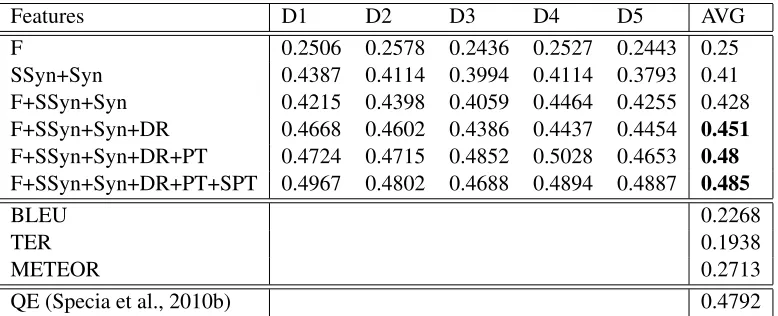
In Table 1 we compare the Pearson’s correlation coefficient of our SVM regression models against the results reported in (Specia et al., 2010b), calcu-lated with the same three common MT evaluation metrics with a single reference: BLEU, TER and Meteor. For the sake of comparison, we also re-port the average quality correlation (QE) obtained by (Specia et al., 2010b) over the same dataset.1
The results show that the integration of syntac-tic and semansyntac-tic information allows our adequacy-oriented model to achieve a correlation with hu-man quality judgements that is always significantly
1We only show the average results reported in (Specia et al., 2010b), since the distributions of the 16K dataset is different from our randomized distribution.
higher2 than the correlation obtained by the MT evaluation metrics used for comparison. As ex-pected a considerable improvement over surface fea-tures is achieved by the integration of syntactic in-formation. A further increase, however, is brought by the complementary contribution of SPT ( recall-oriented, due to the higher coverage of semantics-aware phrase tables with respect to lexical PTs), and DR matching features (precision-oriented, due to the syntactic constraints posed to matching text por-tions). Although they are meant to capture meaning-related aspects of MT output, our features allow to outperform the results obtained by the generic quality-oriented features used by (Specia et al., 2010b), which do not discriminate between ade-quacy and fluency.3 When dependency relations and phrase tables (both lexical and semantics-aware) are used in combination, our scores also outperform the average QE score. Finally, looking at the different random splits of the same dataset (D1 to D5), our correlation scores remain substantially stable, prov-ing the robustness of our approach not only for ade-quacy, but also for quality estimation.
WMT07 adequacy-based dataset
In Table 2 we compare our regression model, obtained in the same way previously described, against three commonly used MT evaluation metrics (Callison-Burch et al., 2007). In this case, the re-ported results do not show the same consistency over the 5 randomized datasets (D1 to D5). However, it is worth pointing out that:i)the small dataset is partic-ularly challenging to train models with higher corre-lation with humans,ii)our aim is checking how far we get using only adequacy-oriented features rather than outperforming BLEU/TER/Meteor at any cost, andiii)our results are not far from those achieved by metrics that rely on reference translations. Com-pared with Meteor, the correlation is even higher proving the effectiveness of the proposed method.
2
p <0.05, calculated using the approximate randomization test implemented in (Pad´o, 2006).
Features D1 D2 D3 D4 D5 AVG
F 0.2506 0.2578 0.2436 0.2527 0.2443 0.25
SSyn+Syn 0.4387 0.4114 0.3994 0.4114 0.3793 0.41 F+SSyn+Syn 0.4215 0.4398 0.4059 0.4464 0.4255 0.428 F+SSyn+Syn+DR 0.4668 0.4602 0.4386 0.4437 0.4454 0.451 F+SSyn+Syn+DR+PT 0.4724 0.4715 0.4852 0.5028 0.4653 0.48 F+SSyn+Syn+DR+PT+SPT 0.4967 0.4802 0.4688 0.4894 0.4887 0.485
BLEU 0.2268
TER 0.1938
METEOR 0.2713
[image:6.612.113.502.54.212.2]QE (Specia et al., 2010b) 0.4792
Table 1: Pearson’s correlation between SVM regression and human quality annotation over 16K dataset.
Features D1 D2 D3 D4 D5 AVG
F 0.10 0.03 0.04 0.10 0.14 0.083
SSyn+Syn 0.299 0.351 0.1834 0.2962 0.2417 0.274
F+SSyn+Syn 0.2648 0.2870 0.4061 0.3601 0.1327 0.29 F+SSyn+Syn+DR 0.3196 0.4568 0.2860 0.5057 0.4066 0.395 F+SSyn+Syn+DR+PT 0.3254 0.4710 0.3921 0.4599 0.3501 0.40 F+SSyn+Syn+DR+PT+SPT 0.3487 0.4032 0.4803 0.4380 0.3929 0.413
BLEU 0.466
TER 0.437
[image:6.612.110.499.255.397.2]METEOR 0.357
Table 2: Pearson’s correlation between SVM regression and human adequacy annotation over WMT07.
4.3 Multi-class classification
To further explore the potential of our CLTE-based MT evaluation method, we trained an SVM multi-class multi-classifier to predict the exact adequacy and quality scores assigned by human judges. The eval-uation was carried out measuring the accuracy of our models with 10-fold cross validation to minimize overfitting. As a baseline, we calculated the per-formance of the Majority Class (MjC) classifier pro-posed in (Specia et al., 2011), which labels all exam-ples with the most frequent class among all classes. The performance improvement over the result ob-tained by the MjC baseline (∆) has been calculated to assess the contribution of different feature sets.
16K quality-based dataset
The accuracy results reported in Table 3a show that also in this testing condition, syntactic and se-mantic features improve over surface form ones.
Be-sides that, we observe a steady improvement over the MjC baseline (from 5% to 12%). This demon-strates the effectiveness of our adequacy-based fea-tures to predict exact quality scores in a 4-point scale, although this is a more challenging and dif-ficult task than regression and binary classification. Such improvement is even more interesting consid-ering that (Specia et al., 2010b) reported discour-aging results with multi-class classification to pre-dict quality scores. Moreover, while they claimed that removing target-independent features (i.e.those only looking at the source text) significantly de-grades their QE performance, we achieved good re-sults without using any of these features.
WMT07 adequacy-based dataset
rang-Features 10-fold acc. ∆
F 42.16% 5.16
Syn+SSyn 46.61% 9.61
F+Syn+SSyn 47.10% 10.10
F+Syn+SSyn+DR 47.26% 10.26
F+Syn+SSyn+DR+PT 48.15% 11.15
F+Syn+SSyn+DR+PT+SPT 48.74% 11.74
MjC 37%
-(a) 16K dataset.
Features 10-fold acc. ∆
F 50.07% 14.07
Syn+SSyn 54.19% 18.19
F+Syn+SSyn 54.34% 18.34
F+Syn+SSyn+DR 56.47% 20.47
F+Syn+SSyn+DR+PT 56.61% 20.61
F+Syn+SSyn+DR+PT+SPT 56.75% 20.75
MjC 36%
[image:7.612.71.555.65.191.2]-(b) WMT07 dataset
Table 3: Multi-class classification accuracy of the quality/adequacy scores.
Features 10-fold acc. ∆
F 65.85% 11.85
Syn+SSyn 69.59% 15.59
F+Syn+SSyn 70.89% 16.89
F+Syn+SSyn+DR 71.39% 17.39
F+Syn+SSyn+DR+PT 71.92% 17.92
F+Syn+SSyn+DR+PT+SPT 72.21% 18.21
MjC 54%
-(a) 16k dataset.
Features 10-fold acc. ∆
F 83.24% 12.84
Syn+SSyn 83.67% 13.27
F+Syn+SSyn 84.31% 13.91
F+Syn+SSyn+DR 84.86% 14.46
F+Syn+SSyn+DR+PT 84.96% 14.56
F+Syn+SSyn+DR+PT+SPT 85.20% 14.80
MjC 70.4%
-(b) WMT07 dataset.
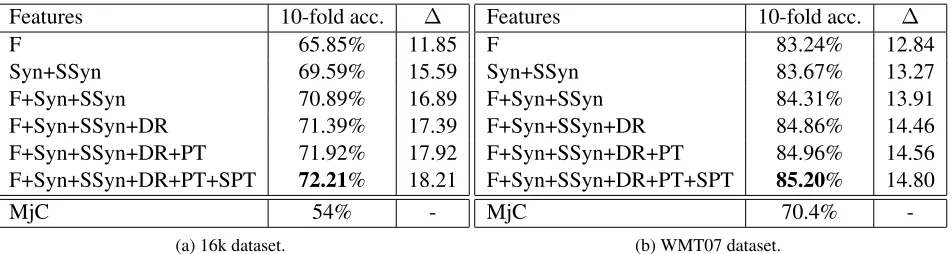
Table 4: Accuracy of the binary classification into “good” or “adequate”, and “bad” or “inadequate”.
ing from 14% to 20%. Interestingly, although the dataset is small and the number of classes is higher (5-point scale), the improvement and overall results are better than those obtained on the 16K dataset. Such result confirms our hypothesis that adequacy-based features extracted from both source and target perform better on a dataset explicitly annotated with adequacy judgements. In addition, the improvement over the MjC baseline (∆) of our best model is much higher (20%) than the one reported in (Specia et al., 2011) on adequacy estimation (6%). We are aware that their results are calculated over a dataset for a different language pair (i.e. English-Arabic) which brings up more challenges. However, our smaller dataset (700 vs 2580 pairs) and the higher number of classes (5 vs 4) compensate to some extent the difficulty of dealing with English-Arabic pairs.
4.4 Recognizing “good” vs “bad” translations
Last but not least, we considered the traditional sce-nario for quality and confidence estimation, which
is a binary classification of translations into “good” and “bad” or, from the meaning point of view, “ade-quate” and “inade“ade-quate”. Adequacy-oriented binary classification has many potential applications in the translation industry, ranging from the design of con-fidence estimation methods that reward meaning-preserving translations, to the optimization of the translation workflow. For instance, an “adequate” translation can be just post-edited in terms of fluency by a target language native speaker, without having any knowledge of the source language. On the other hand, an “inadequate” translation should be sent to a human translator or to another MT system, in order to reach acceptable adequacy. Effective automatic binary classification has an evident positive impact on such workflow.
16K quality-based dataset
[image:7.612.76.552.237.364.2]classification using different sets of features with 10-fold cross validation. We also compared our accu-racy with the MjC baseline, and calculated the im-provement of each model (∆) against it.
The results reported in Table 4a demonstrate that the accuracy of our models is always significantly superior to the MjC baseline. Moreover, also in this case there is a steady improvement using syntactic and semantic features over the results obtained by surface form features. Additionally, it is worth men-tioning that the best model improvement over the baseline (∆) is much higher (about 18%) than the improvement reported in (Specia et al., 2010b) over the same dataset (about 8%), considering the aver-age score obtained with their data distribution. This confirms the effectiveness of our CLTE approach also in classifying “good” and “bad” translations.
WMT07 adequacy-based dataset
We mapped the 5-point scale adequacy scores into two classes, with{1,2,3}judgements assigned to the “inadequate” class, and{4,5} judgements assigned to the “adequate” class. The main motivation for this distribution was to separate the examples in a way that adequate translations are substantially accept-able, while inadequate translations present evident meaning discrepancies with the source.
The results reported in Table 4b show that the accuracy of the binary classifiers to distinguish be-tween “adequate” and “inadequate” classes was sig-nificantly superior (up to about 15%) to the MjC baseline. We also notice that surface form fea-tures have a significant contribution to deal with the adequacy-oriented dataset, while the gain obtained using syntactic and semantic features (2%) is lower than the improvement observed in the 16K dataset. This might be due to the more unbalanced distribu-tion of the classes which:i)leads to a high baseline, andii)together with the small size of the WMT07 dataset, makes supervised learning more challeng-ing. Finally, the improvement of all models (∆) over the MjC baseline is much higher than the gain re-ported in (Specia et al., 2011) over their adequacy-oriented dataset (around 2%).
5 Conclusions
In the effort of integrating semantics into MT tech-nology, we focused on automatic MT evaluation,
in-vestigating the potential of applying cross-lingual textual entailment techniques for adequacy assess-ment. The underlying assumption is that MT output adequacy can be determined by verifying that an en-tailment relation holds from the source to the target, and vice-versa. Within such framework, this paper makes two main contributions.
First, in contrast with most current metrics based on the comparison between automatic translations and multiple references, we avoid the bottleneck represented by the manual creation of such refer-ences.
Second, beyond current approaches biased to-wards fluency or general quality judgements, we tried to isolate the adequacy dimension of the prob-lem, exploring the potential of adequacy-oriented features extracted from the observation of source and target.
To achieve our objectives, we successfully ex-tended previous CLTE methods with a variety of lin-guistically motivated features. Altogether, such fea-tures led to reliable judgements that show high cor-relation with human evaluation. Coherent results on different datasets and classification schemes demon-strate the effectiveness of the approach and its poten-tial for different applications.
Future works will address both the improvement of our adequacy evaluation method and its integra-tion in SMT for optimizaintegra-tion purposes. On one hand, we plan to explore new features capturing other semantic dimensions. A possible direction is to consider topic modelling techniques to measure the relatedness of source and target. Another inter-esting direction is to investigate the use of Wikipedia entity linking tools to support the mapping between source and target terms. On the other hand, we plan to explore the integration of our model as an error criterion in SMT system training.
Acknowledgments
References
E. Avramidis, M. Popovic, V. Vilar Torres, and A. Bur-chardt. 2011. Evaluate with Confidence Estimation: Machine Ranking of Translation Outputs using Gram-matical Features. In Proceedings of the Sixth Work-shop on Statistical Machine Translation (WMT ’11). N. Bach, F. Huang, and Y. Al-Onaizan. 2011.
Good-ness: A Method for Measuring Machine Translation Confidence. InProceedings of the 49th Annual Meet-ing of the Association for Computational LMeet-inguistics (ACL 2011).
S. Banerjee and A. Lavie. 2005. METEOR: An Auto-matic Metric for MT Evaluation with Improved Corre-lation with Human Judgments. InProceedings of the ACL Workshop on Intrinsic and Extrinsic Evaluation Measures for Machine Translation and/or Summariza-tion.
J. Blatz, E. Fitzgerald, G. Foster, S. Gandrabur, C. Goutte, A. Kulesza, A. Sanchis, and N. Ueffing. 2004. Con-fidence Estimation for Machine Translation. In Pro-ceedings of the 20th international conference on Com-putational Linguistics (COLING ’04). Association for Computational Linguistics.
C. Callison-Burch, C. Fordyce, P. Koehn, C. Monz, and J. Schroeder. 2007. (Meta-) Evaluation of Machine Translation. InProceedings of the Second Workshop on Statistical Machine Translation (WMT ’07). X. Carreras, I. Chao, L. Padr´o, and M. Padr´o. 2004.
FreeLing: An Open-Source Suite of Language An-alyzers. In Proceedings of the 4th International Conference on Language Resources and Evaluation (LREC’04).
C.C. Chang and C.J. Lin. 2011. LIBSVM: A Library for Support Vector Machines. ACM Transactions on Intelligent Systems and Technology (TIST), 2(3). I. Dagan and O. Glickman. 2004. Probabilistic Textual
Entailment: Generic Applied Modeling of Language Variability. InProceedings of the PASCAL Workshop of Learning Methods for Text Understanding and Min-ing.
G. Doddington. 2002. Automatic Evaluation of Machine Translation Quality Using N-gram Co-Occurrence Statistics. In Proceedings of the second interna-tional conference on Human Language Technology Research, HLT ’02.
J. Gim´enez and L. M`arquez. 2007. Linguistic Features for Automatic Evaluation of Heterogenous MT Sys-tems. InProceedings of the Second Workshop on Sta-tistical Machine Translation (StatMT ’07).
P. Koehn, H. Hoang, A. Birch, C. Callison-Burch, M. Federico, N. Bertoldi, B. Cowan, W. Shen, C. Moran, R. Zens, C. Dyer, O. Bojar, A. Constantin, and E. Herbst. 2007. Moses: Open Source Toolkit for
Statistical Machine Translation. InProceedings of the 45th Annual Meeting of the ACL on Interactive Poster and Demonstration Sessions (ACL 2007).
Y. Mehdad, M. Negri, and M. Federico. 2010. Towards Cross-Lingual Textual Entailment. InProceedings of the 11th Annual Conference of the North American Chapter of the Association for Computational Linguis-tics (NAACL HLT 2010).
Y. Mehdad, M. Negri, and M. Federico. 2011. Using Bilingual Parallel Corpora for Cross-Lingual Textual Entailment. InProceedings of the 49th Annual Meet-ing of the Association for Computational LMeet-inguistics: Human Language Technologies (ACL HLT 2011). Y. Mehdad, M. Negri, and M. Federico. 2012.
Detect-ing Semantic Equivalence and Information Disparity in Cross-lingual Documents. In Proceedings of the ACL’12.
F.J. Och and H. Ney. 2000. Improved Statistical Align-ment Models. In Proceedings of the 38th Annual Meeting of the Association for Computational Linguis-tics (ACL 2000).
P.G. Otero and I.G. Lopez. 2011. A Grammatical For-malism Based on Patterns of Part-of-Speech Tags. In-ternational journal of corpus linguistics, 16(1). S. Pad´o, M. Galley, D. Jurafsky, and C. D. Manning.
2009. Textual Entailment Features for Machine Trans-lation Evaluation. InProceedings of the Fourth Work-shop on Statistical Machine Translation (StatMT ’09). S. Pad´o, 2006. User’s guide tosigf: Significance
test-ing by approximate randomisation.
K. Papineni, S. Roukos, T. Ward, and W.J. Zhu. 2002. BLEU: a Method for Automatic Evaluation of Ma-chine Translation (ACL 2002. InProceedings of the 40th annual meeting on association for computational linguistics.
C.B. Quirk. 2004. Training a Sentence-Level Machine Translation Confidence Measure. InProceedings of LREC 2004.
M. Snover, B. Dorr, R. Schwartz, L. Micciulla, and J. Makhoul. 2006. A Study of Translation Edit Rate with Targeted Human Annotation. InProceedings of Association for Machine Translation in the Americas (AMTA 2006).
L. Specia and A. Farzindar. 2010. Estimating Machine Translation Post-Editing Effort with HTER. In Pro-ceedings of the AMTA-2010 Workshop, Bringing MT to the User: MT Research and the Translation Indus-try.
L. Specia, D. Raj, and M. Turchi. 2010b. Machine Trans-lation Evaluation Versus Quality Estimation. Machine translation, 24(1).
L. Specia, N. Hajlaoui, C. Hallett, and W. Aziz. 2011. Predicting Machine Translation Adequacy. In Pro-ceedings of the 13th Machine Translation Summit (MT-Summit 2011).
L. Specia. 2011. Exploiting Objective Annotations for Minimising Translation Post-editing Effort. In Pro-ceedings of the 15th Conference of the European As-sociation for Machine Translation (EAMT 2011). D. Xiong, M. Zhang, and H. Li. 2010. Error Detection