Parse Ranking with Semantic Dependencies and WordNet
Xiaocheng Yin♠Jungjae Kim♠Zinaida Pozen♦♣Francis Bond♠ ♠Nanyang Technological University, Singapore
⋄ University of Washington, Seattle
[email protected],[email protected],
[email protected],[email protected]
Abstract
In this paper, we investigate which fea-tures are useful for ranking semantic rep-resentations of text. We show that two methods of generalization improved re-sults: extended grand-parenting and super-types. The models are tested on a subset of SemCor that has been annotated with both Dependency Minimal Recursion Seman-tic representations and WordNet senses. Using both types of features gives a sig-nificant improvement in whole sentence parse selection accuracy over the baseline model.
1 Introduction
In this paper we investigate various features to improve the accuracy of semantic parse ranking. There has been considerable successful work on syntactic parse ranking and reranking (Toutanova et al., 2005; Collins and Koo, 2006; McClosky et al., 2006), but very little that uses pure semantic representations. With recent work on building se-mantic representations (from deep grammars such as LFG (Butt et al., 1999) and HPSG (Sag et al., 1999), directly through lambda calculus, or as in intermediate step in machine translation) the ques-tion of ranking them has become more important.
The closest related work is Fujita et al. (2010) who ranked parses using semantic features from Minimal Recursion Semantics (MRS) and syntac-tic trees, using a Maximum Entropy Ranker. They experimented with Japanese data, using the Hinoki Treebank (Bond et al., 2008), using primarily ele-mentary dependencies: single arcs between
pred-♣
Currently at PointInside, Inc.
S
NP
N
I
VP
V
treat NP
N
N
dogs N
CONJ
and
N
cats
PP
[image:1.595.333.500.242.439.2]with worms
Figure 1: Syntactic view of sentence “I treat dogs
and cats with worms”.
icates and their arguments. These can miss some important connections between predicates.
An example parse tree for I treat dogs and cats
with worms is shown in Figure 1.1, for the interpre-tation “I treat both dogs and cats that have worms” (not “I treat, using worms, dogs and cats” or any of the other possibilities)
The semantic representation we use is De-pendency Minimal Recursion Semantics (DRMS: Copestake, 2009). The Minimal Recursion Se-mantics (MRS: Copestake et al., 2005) is a com-putationally tractable flat semantics that under-specifies quantifier scope. The Dependency MRS is an MRS representation format that keeps all the information from the MRS but is simpler to manipulate. DMRSs differ from syntactic de-pendency graphs in that the relations are defined between slightly abstract predicates, not between
surface forms. Some semantically empty surface tokens (such as infinitive to) are not included, while some predicates are inserted that are not in the original text (such as the null article).
A simplified MRS representation of our exam-ple sentence and its DMRS equivalent are shown in Figure 2.
In the DMRS, the basic links between the nodes are present. However, potentially interesting rela-tions such as that between the verb treat and its conjoined arguments dogs and cats are not linked directly. Similarly, the relation between dogs and
cats and worms is conveyed by the preposition with, which links them through its external
argu-ment (ARG1: and) and internal arguargu-ment (ARG2:
worms). There is no direct link. We investigate
new features that make these links more direct (Section 3.2).
We also explore the significance of the effec-tiveness of links between words that are connected arbitrarily far away in the semantic graph (Sec-tion 3.2.3).
Finally, we experimented with generalizing over semantic classes. We used WordNet semantic files as supertypes to reduce data sparseness (Sec-tion 3.2.4). This will generalize the lexical seman-tics of the predicates, resulting in a reduction of feature size and ambiguity.
2 Previous Work
This paper follows up on the work of Fujita et al. (2010) in ranking MRS semantic representations, which was carried out for Japanese. We are con-ducting a similar investigation for English, and add new features and approaches. Fujita et al. (2010) worked with the Japanese Hinoki Corpus (Bond et al., 2008) data and used hypernym chains from the Goi-Taikei Japanese ontology (Ikehara et al., 1997) for variable-level semantic backoff. This is in contrast to the uniform WordNet seman-tic file backoff performed here. In addition, this work only focuses on MRS ranking, whereas Fu-jita et al. (2010) combined MRS features with syn-tactic features to improve synsyn-tactic parse ranking accuracy.
Our use of WordNet Semantic Files (SF) to re-duce lexical feature sparseness is inspired by sev-eral recent papers. Agirre et al. (2008, 2011) have experimented with replacing open-class words with their SFs. Agirre et al. (2008) have shown an improvement in full parse and PP attachment
scores with statistical constituency parsers using SFs. Agirre et al. (2011) have followed up on those results and re-trained a dependency parser on the data where words were replaced with their SFs. This resulted in a very modest labeled at-tachment score improvement, but with a signifi-cantly reduced feature set. In a recent HPSG work, MacKinlay et al. (2012) attempted to integrate lex-ical semantic features, including SF backoff, into a discriminative parse ranking model. However, this was not shown to help, presumably because the lexical semantic features were built from syn-tactic constituents rather than MRS predicates.
The ancestor features found to be helpful here are inspired by the use of grand-parenting in syn-tactic parse ranking (Toutanova et al., 2005) and chains in dependency parsing ranking (Le Roux et al., 2012).
3 Resources and Methodology
In this section we introduce the corpus we work on, and the features we extract from it.
3.1 Corpus: SemCor
To evaluate our ranking methods, we are using the Redwoods Treebank (Oepen et al., 2004) of manually disambiguated HPSG parses, storing full signs for each analysis and supporting export into a variety of formats, including the Dependency MRS (DMRS) format used in this work.
The HPSG parses in Redwoods are based on the English Resource Grammar (ERG; Flickinger, 2000) – a hand-crafted broad-coverage HPSG grammar of English.
For our experiments, we used a subset of the Redwoods Treebank, consisting of 2,590 sen-tences drawn from SemCor (Landes et al., 1998). In the SemCor corpus each of the sentences is tagged with WordNet senses created at Princeton University by the WordNet Project research team. The average length of the Redwoods SemCor sen-tences is 15.4 words, and the average number of parses is 247.
From the treebank we can export the DMRS. The choice of which words become predicates is slightly different in the SemCor/WordNet and the ERG. The ERG lexicon groups together all senses that have the same syntactic properties, making them underspecified for many sense differences. Thus elementary predicate catn:1 could be any of
usu-I treat dogs and cats with worms.
mrsLTOP h1 h
INDEX e3 e
RELS *
pronh0:1i
LBL h4 h
ARG0 x5 x
,
treatv:1h2:6i
LBL h2 h
ARG0 e3
ARG1 x5
ARG2 x9 x
,
dogn:1h7:11i
LBL h17 h
ARG0 x15
,
andch12:15i
LBL h22 h
ARG0 x9
L-INDEX x15
R-INDEX x19 ,
catn:1h16:20i
LBL h23 h
ARG0 x19
,
withph21:25i
LBL h22
ARG0 e24 e
ARG1 x9
ARG2 x25 x
,
wormn:1h26:31i
LBL h29 h
ARG0 x25
+
pron treatv:1 dogn:1 andc catn:1 withp wormn:1
1
2 L R 2
1 with
2
2 1
1
[image:3.595.143.437.232.532.2]Simplified by omission of quantifiers Dashed lines show Preposition (P) features Dotted lines show Conjunction (LR) features Arc labels show the roles: 1 isARG1, 2 isARG2, . . . .
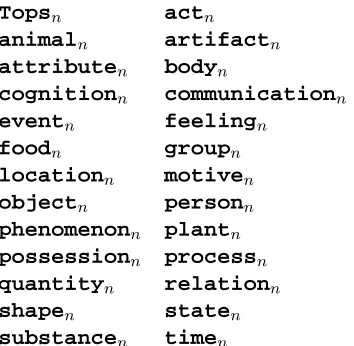
Topsn actn animaln artifactn
attributen bodyn
cognitionn communicationn eventn feelingn
foodn groupn
locationn motiven objectn personn
phenomenonn plantn
possessionn processn quantityn relationn
shapen staten
[image:4.595.326.507.62.173.2]substancen timen
Table 1: WordNet Noun Semantic Files.
ally having thick soft fur and no ability to roar”,
catn:2“an informal term for a youth or man” and
six more.2 In some cases, DMRS decomposes a single predicate into multiple predicates (e.g. here intoinp thisq placen). The ERG and WordNet also often make different decisions about what consti-tutes a multiword expression. For these reasons the mapping between the two annotations is not always straightforward. In this paper we use the mapping between the DRMS and WordNet anno-tations produced by Pozen (2013).
Using the mapping, we exploited the sense tag-ging of the SemCor in several ways. We ex-perimented both with replacing elementary pred-icates with their synsets, their hypernyms at var-ious levels and with their semantic files (Landes et al., 1998), which generalize the meanings of words that belong to the same broad semantic cat-egories.3 These dozens of generalized semantic tags help to address the issue of feature sparse-ness, compared to thousands of synsets. We show the semantic files for nouns and verbs in Tables 1 and 2. In this paper, we only report on the parse selection accuracy using semantic files to reduce ambiguity, as it gave the best results.
3.2 Semantic Dependency Features
In this section we introduce the baseline features for parse ranking.
Table 3 shows example features extracted from the DMRS depicted in Figure 2.Features 1–16 are
2
Elementary predicatesare shown in sans-serif font,
Word-Net senses in bold italic, WordNet semantic files are shown in bold typewriter.
3Semantic Files are also sometimes referred to as Seman-tic Fields, Lexical Fields or Supersenses.
bodyv changev
cognitionv communicationv
competitionv consumptionv
contactv creationv emotionv motionv
perceptionv possessionv
socialv stativev weatherv
Table 2: WordNet Verb Semantic Files.
the semantic dependency features (Baseline). 17– 18 are the conjunctive features (LR). 19–22 are the preposition role features (PR).
# Sample Features
0 h0treatv:1ARG1pronARG2andci 1 h0andc L-INDdogn:1R-INDcatn:1i
2 h0withpARG1andcARG2wormn:1i
3 h1treatv:1ARG1proni 4 h1treatv:1ARG2andci
5 h1andc L-INDdogn:1i
6 h1andc R-INDcatn:1i 7 h1withpARG1andci
8 h1withpARG2wormn:1i
9 h2treatv:1pron andci 10 h2withpandc wormn:1i
11 h3treatv:1proni
12 h3treatv:1andci 13 h3andc dogn:1i
14 h3andc catn:1i
15 h3withpandci 16 h3withpwormn:1i
17 h1treatv:1 ARG2dogn:1i 18 h1treatv:1 ARG2catn:1i
19 h0andc L-INDdogn:1R-INDcatn:1
withpwormn:1i
20 h1andcwithp wormn:1i 21 h2andc wormn:1i
[image:4.595.95.272.63.236.2]22 h3andc wormn:1i
Table 3: Features for the DMRS in Fig 2.
[image:4.595.308.498.277.608.2]theSEM-DEPfeatures of Fujita et al. (2010).
3.2.1 Conjunctive Features
We further create two more features, called Left/Right Handle Features (LR), to link directly the two arguments of conjunctive relations with their parent, independently from the other ar-gument. In Table 1, for example, the feature htreatv:1ARG2andci, although valid, does not con-vey the meaning of the sentence. Instead, we add the two LR features htreatv:1 ARG2dogn:1i (fea-ture 17) and htreatv:1ARG2catn:1i (feature 18), which better model the conjunction relation.
3.2.2 Preposition Role Features
As shown in Figure 2, the node withp has two links: toandc(ARG1) and towormn:1(ARG2). The
two relations together indicate a noun-preposition-noun relationship. Instead of breaking the rela-tionship into the two separate features, we intro-duce it, as a whole, as a new type of feature, where the two arguments of the preposition (e.g. andc,
wormn:1) will have a direct relation via the preposi-tion (e.g. withp). We name these Preposition Role features (PR), as they are similar in spirit to se-mantic roles. Some sample PR features are given in Table 3, features 19–22.
The new features explicitly convey, for exam-ple, noun-preposition-noun relations. Parses con-taining features like something at somewhere can be further distinguished from parses containing at
somewhere and something at separately. When the
features become more representative, active parses are more likely to be selected, though with the cost of a larger feature set size.
As 4 types of features can be developed based on one relationship, a Preposition Role link would have 4 separate features. While the Conjunctive features mentioned in previous section give 2 to 4 additional features, Baseline-PR features normally give 4 more. Thus, the feature size of Baseline-PR model is larger than that of the Baseline-LR model.
3.2.3 Ancestor Features
While the semantic dependency features corre-spond to direct dependencies, we introduce a new type of features that represent indirect dependen-cies between ancestors and their descendants in the DMRS. For each predicate, we collect all its descendants linked through more than one depen-dency and create features to represent the indirect
# Sample Features
0 h0treatv:1ARG1pronARG2andci
1 h0andc L-INDdogn:1R-INDcatn:1i 2 h0treatv:1ARG2dogn:1ARG2catn:1i 3 h1treatv:1ARG1proni
4 h1treatv:1ARG2andci
5 h1treatv:1ARG2dogn:1i 6 h1treatv:1ARG2catn:1i
7 h1andc L-INDdogn:1i
8 h1andc R-INDcatn:1i 9 h2treatv:1pron andci
10 h2treatv:1dogn:1catn:1i 11 h3treatv:1proni
12 h3treatv:1andci
13 h3treatv:1dogn:1i
[image:5.595.310.502.62.284.2]14 h3treatv:1catn:1i
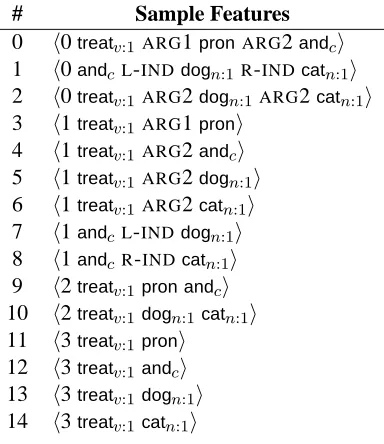
Table 4: Ancestor Features (AF).
dependencies between the predicate and the de-scendants. We name these features Ancestor Fea-tures (AF).
Table 4 has some sample AF features such as that linking fromtreatv:1 todogn:1and catn:1 (i.e. feature 2). This is a one-level ancestor, involving two predicates, while multi-level ancestors deal with more than two predicates linked in a se-quence. Note that these are different from the LR features (features 15, 16 in Table 1), in that AF features include both arguments of a conjunction, for example, connecting the predicatetreatv:1to its grandchildren dogn:1 and catn:1 via the argument
role ofandcin the predicate (feature 2 in Table 4). When a sentence has n dependencies, our
method generates O(n(n−1)
2 ) = O(n2) AF fea-tures. In the corpus we use, the dependency struc-ture of a sentence typically has 4 levels. In prac-tice the number of AF features is roughly triple the number of Baseline features. In the evaluation experiments, we investigated all the eight combi-nations of the three types of LR, PR, and AF fea-tures, where each combination is combined with the baseline features.
3.2.4 Semantic File Features
# Sample Features
0 h0bodyvARG1pronARG2andci
1 h0andc L-INDanimalnR-INDanimalni
2 h0withpARG1andcARG2animalni
3 h1bodyvARG1proni
4 h1bodyvARG2andci
5 h1andc L-INDanimalni
6 h1andc R-INDanimalni 7 h1withcARG1animalni 8 h1withcARG2animalni
9 h2bodyvpron andci
10 h2withpandc animalni 11 h3bodyvproni
12 h3bodyvandci
13 h3andc animalni 14 h3andc animalni
15 h3withcandci
[image:6.595.75.298.61.304.2]16 h3withcanimalni
Table 5: Baseline features with Semantic Files (SF).
the elementary predicate. This SF representation is also applied to the eight combinations of feature types. A sample of the features in the SF represen-tations are given in Table 5.
Sometimes two features, such as 13 and 14 in Table 3, are replaced with the same feature, like 9 in Table 5, because dogn:1 and catn:1 are both replaced withanimaln. There are about half as
many Semantic File features as there are SD fea-tures.
4 Results
We set up the evaluation task as reranking of the top 500 Redwoods analyses, previously selected by the syntactic MaxEnt ranker. The subset of SemCor introduced in Section 3.1 is trained and tested with the features introduced in Section 3.2. We grouped the feature sets into two according to the two word representation of basic Semantic De-pendencies (SD) and generalized Semantic Files (SF). Sometime two or more different parses of a sentence have the same set of features. That is, the features failed to distinguish between two parses: often because of spurious syntactic ambiguity that had no effect on the semantics. In this case we merged duplicate feature sets to reduce the ambi-guity in machine learning. If an inactive parse has the same set of features as that of the active one, the resulting merged parse was treated as active.
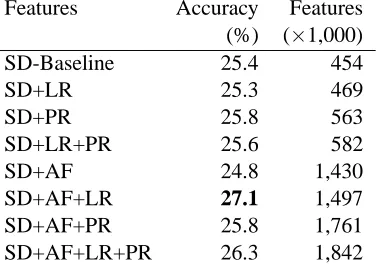
Features Accuracy Features (%) (×1,000)
SD-Baseline 25.4 454
SD+LR 25.3 469
SD+PR 25.8 563
SD+LR+PR 25.6 582
SD+AF 24.8 1,430
SD+AF+LR 27.1 1,497
SD+AF+PR 25.8 1,761
[image:6.595.311.500.65.198.2]SD+AF+LR+PR 26.3 1,842
Table 6: Parse selection results with SD.
Features Accuracy Features (%) (×1,000)
SF-Baseline 25.0 223
SF+LR 25.1 235
SF+PR 26.3 306
SF+LR+PR 26.3 321
SF+AF 28.2 1,051
SF+AF+LR 28.0 1,101
SF+AF+PR 28.1 1,310
SF+AF+LR+PR 27.7 1,375
Table 7: Parse selection results with SF.
We used TADM (Toolkit for Advanced Dis-criminative Modeling; Malouf, 2002) for the train-ing and testtrain-ing of our machine learntrain-ing model, fol-lowing Fujita et al. (2010). We carried out 10-fold cross-validation for evaluation. We measured the parse selection accuracy at the sentence level. A parse was considered correct only when all the de-pendencies of the parse are correct.
The results of parse selection based on SD and SF representations are shown in Tables 6 and 7. The addition of the ancestor features (AF) gives the most increase in the parse selection accuracy. This result indicates that indirect dependencies as well as direct dependencies in a successful parse frequently appear in other active parses. Second, the SF representation shows better results than the SD representation in most cases. The semantic ab-straction of the semantic files reduces the problem of feature sparseness and is enough to effectively rerank parses, whose syntactic properties are al-ready to some extent validated during parsing.
dependen-cies. Fourth, the LR features do not improve the accuracy significantly in most cases, though the SD+AF+LR combination shows the best results among the feature sets of the SD representation. This is understandable since the number of the LR features in our corpus is much smaller than those of the other features of SD, PR and AF. We need to test it with a bigger corpus.
5 Discussion
These results show the validity of our assumption that long distance features and supertypes are both useful for selecting the correct interpretation of a sentence. Currently the SD+AF+LR model is the best for using the elementary predicates. How-ever the best overall results come from the SF+AF model when we generalize to the semantic files. In future work we will investigate on larger-sized and more richly annotated corpora so that we can discover more about the relation between feature size and parse selection accuracy. In addition, we expect that increasing the corpus size will lead di-rectly to higher accuracy. Other avenues we would like to explore is backing off not to the semantic files, but rather to WordNet hypernyms at various levels.
[image:7.595.87.274.604.730.2]These results show that generalizing to seman-tic supertypes allows us to build semanseman-tic ranking models that are not only smaller, but more accu-rate. In general, learning time was roughly pro-portional to the number of features, so a smaller model can be learned faster. We hypothesize that it is the combination of dependencies and supertypes that makes the difference: approaches that used se-mantic features on phrase structure trees (such as Bikel (2000) and MacKinlay et al. (2012)) have in general failed to get much improvement.
Figure 3: Learning curve for SF+AF.
The overall accuracy is still quite low, due prin-cipally to the lack of training data. We show the learning curves for the SF+AF configuration in Figure 3 (the other configurations are similar). The curve is still clearly rising: the accuracy of parse selection on our corpus is far from saturated. This observation gives us confidence that with a larger corpus the accuracy of parse selection will improve considerably. The learning curve in Fujita et al. (2010) showed similar results for the same amount of data, and increased rapidly with more (they had a larger corpus for Japanese).
As there are so far still very few corpora with both structural and lexical semantic annotation, we are currently investigating the use of automatic word sense disambiguation to create the features, in a similar way to Agirre et al. (2008). Finally, we would like to investigate even more features, such as the dependency chains of Le Roux et al. (2012). One exciting possibility is projecting ranking features across languages: wordnet semantic files are the supertypes for all wordnets linked to the Princeton Wordnet, of which there are many (Bond and Foster, 2013). The predicates that are not in the wordnets are generally either named entities or from smallish closed sets of function words such as conjunctions, prepositions and pro-nouns. We are currently investigating mapping these between Japanese and English using trans-fer rules from an existing machine translation sys-tem (Bond et al., 2011). In principal, a small set of mappings for closed class words could allow us to quickly boot-strap a semantic ranking model for any language with a wordnet.
6 Conclusion
In summary, we showed some features that help parse selection. In the SD group, LR features together with AF features achieved a 1.75% im-provement in accuracy over the basic Baseline model (25.36%→27.12%). However, LR feature alone and AF feature alone both decrease the accu-racy (25.36%→25.28% and 25.36%→24.84%). PR features and combination of PR and AF fea-tures both achieved small improvements (0.416% Baseline → Baseline+PR, 0.410% Baseline → Baseline-PR+AF). LR combined with PR features did not improve the accuracy.
be-ing the model with ancestor features (AF) added. This (SF+AF) achieved an improvement of 3.21% absolute over the baseline model (24.97% → 28.18%). Adding more features to AF only de-creases the accuracy. Generalizing to semantic su-pertypes allows us to build dependency ranking models that are not only smaller, but more accu-rate.
Acknowledgments
The authors are grateful to Mathieu Morey and other members of the Deep Linguistic Processing with HPSG Initiative along with other members of their research groups for many extremely helpful discussions.
References
Eneko Agirre, Timothy Baldwin, and David Martinez. 2008. Improving parsing and PP attachment performance with sense information. In Proceedings of the 46th Annual
Meeting of the Association for Computational Linguistics (ACL HLT 2008), pages 317–325. Columbus, USA.
Eneko Agirre, Kepa Bengoetxea, Koldo Gojenola, and Joakim Nivre. 2011. Improving dependency parsing with semantic classes. Proceedings of the 49th Annual Meeting
of the Association for Computational Linguistics, pages
699–703.
Daniel M. Bikel. 2000. A statistical model for parsing and word-sense disambiguation. In Proceedings of the
Joint SIGDAT Conference on Empirical Methods in Natu-ral Language Processing and Very Large Corpora, pages
155–163. Hong Kong.
Francis Bond and Ryan Foster. 2013. Linking and extending an open multilingual wordnet. In 51st Annual Meeting
of the Association for Computational Linguistics: ACL-2013, pages 1352–1362. Sofia. URLhttp://aclweb. org/anthology/P13-1133.
Francis Bond, Sanae Fujita, and Takaaki Tanaka. 2008. The Hinoki syntactic and semantic treebank of Japanese. Language Resources and Evaluation,
42(2):243–251. URL http://dx.doi.org/ 10.1007/s10579-008-9062-z, (Re-issue of DOI 10.1007/s10579-007-9036-6 as Springer lost the Japanese text).
Francis Bond, Stephan Oepen, Eric Nichols, Dan Flickinger, Erik Velldal, and Petter Haugereid. 2011. Deep open source machine translation. Machine Transla-tion, 25(2):87–105. URLhttp://dx.doi.org/10. 1007/s10590-011-9099-4, (Special Issue on Open source Machine Translation).
Miriam Butt, Tracy Holloway King, Mar´ıa-Eugenia Ni˜no, and Fr´ed´erique Segond. 1999. A Grammar Writer’s
Cook-book. CSLI publications.
Michael Collins and Terry Koo. 2006. Discriminative rerank-ing for natural language parsrerank-ing. Computational Lrerank-inguis-
Linguis-tics, 31(1).
Ann Copestake. 2009. Slacker semantics: Why superficiality, dependency and avoidance of commitment can be the right way to go. In Proceedings of the 12th Conference of the
European Chapter of the ACL (EACL 2009), pages 1–9.
Athens.
Ann Copestake, Dan Flickinger, Ivan A. Sag, and Carl Pol-lard. 2005. Minimal Recursion Semantics. An introduc-tion. Research on Language and Computation, 3(4):281– 332.
Dan Flickinger. 2000. On building a more efficient gram-mar by exploiting types. Natural Language Engineering, 6 (1):15–28.
Sanae Fujita, Francis Bond, Takaaki Tanaka, and Stephan Oepen. 2010. Exploiting semantic information for HPSG parse selection. Research on Language and Computation, 8(1):1–22. URL http://dx.doi.org/10.1007/ s11168-010-9069-7.
Satoru Ikehara, Masahiro Miyazaki, Satoshi Shirai, Akio Yokoo, Hiromi Nakaiwa, Kentaro Ogura, Yoshifumi Ooyama, and Yoshihiko Hayashi. 1997. Goi-Taikei — A Japanese Lexicon. Iwanami Shoten, Tokyo. 5 vol-umes/CDROM.
Shari Landes, Claudia Leacock, and Christiane Fellbaum. 1998. Building semantic concordances. In Christine Fell-baum, editor, WordNet: An Electronic Lexical Database, chapter 8, pages 199–216. MIT Press.
Joseph Le Roux, Benoit Favre, Alexis Nasr, and Seyed Abol-ghasem Mirroshandel. 2012. Generative constituent pars-ing and discriminative dependency rerankpars-ing: Experi-ments on english and french. In Proceedings of the ACL
2012 Joint Workshop on Statistical Parsing and Seman-tic Processing of Morphologically Rich Languages, pages
89–99. Association for Computational Linguistics, Jeju, Republic of Korea. URLhttp://www.aclweb.org/ anthology/W12-3412.
Andrew MacKinlay, Rebecca Dridan, Diana McCarthy, and Timothy Baldwin. 2012. The effects of semantic an-notations on precision parse ranking. In SEM 2012:
The First Joint Conference on Lexical and Computational Semantics-, volume 2, pages 228–236. Association for
Computational Linguistics.
Robert Malouf. 2002. A comparison of algorithms for max-imum entropy parameter estimation. In CONLL-2002, pages 49–55. Taipei, Taiwan.
David McClosky, Eugene Charniak, and Mark Johnson. 2006. Reranking and self-training for parser adaptation. In
44th Annual Meeting of the Association for Computational Linguistics and 21st International Conference on Compu-tational Linguistics: COLING/ACL-2006, pages 337–344.
Stephan Oepen, Dan Flickinger, Kristina Toutanova, and Christoper D. Manning. 2004. LinGO Redwoods: A rich and dynamic treebank for HPSG. Research on Language
and Computation, 2(4):575–596.
Zinaida Pozen. 2013. Using Lexical and Composi-tional Semantics to Improve HPSG Parse Selection.
Master’s thesis, University of Washington. URL https://digital.lib.washington.edu/ researchworks/handle/1773/%23469. Ivan A. Sag, Tom Wasow, and Emily Bender. 1999. Syntactic
Theory: A Formal Introduction. CSLI Publications,
Stan-ford, second edition.
Kristina Toutanova, Christopher D. Manning, Dan Flickinger, and Stephan Oepen. 2005. Stochastic HPSG parse disam-biguation using the Redwoods corpus. Research on