Developing and Maintaining a WordNet: Procedures and Tools
Miljana Mladenovi´c Faculty of Mathematics
University of Belgrade [email protected]
Jelena Mitrovi´c Faculty of Philology University of Belgrade [email protected]
Cvetana Krstev Faculty of Philology University of Belgrade [email protected]
Abstract
In this paper we present a set of tools that will help developers of wordnets not only to in-crease the number of synsets but also to en-sure their quality, thus preventing it to become obsolete too soon. We discuss where the dan-gers lay in a WordNet production and how they were faced in the case of the Serbian WordNet. Developed tools fall in two categories: first are tools for upgrade, cleaning and validation that produce a clean, up-to-date WordNet, while second category consists of tools gathered in a Web application that enable search, develop-ment and maintenance of a WordNet. The ba-sic functions of this application are presented: XML support and import/export facilities, cre-ation of new synsets, connection to the Prince-ton WordNet, sophisticated search possibili-ties and navigation, production of a WordNet statistics and safety procedures. Some of pre-sented tools were developed specifically for Serbian, while majority of them is adaptable and can be used for wordnets of other lan-guages.
1 Introduction
Development of a WordNet is always a labor-intensive task for which a work of a number of professionals is needed. If produced from the scratch and mostly manually the development will necessarily take many years if aiming at com-prehensiveness and accuracy. In such a setting a valuable resource, not yet fully developed, can easily become obsolete. The reasons for this are manifold. First, since WordNet is dealing with “words”, its contents can become out-of-date. A straightforward example can be found in the Princeton WordNet 3.0 (PWN): it describes Yu-goslavia as the Union of Serbia and Montenegro (which no longer exists) whileSerbiais described
as a historical region in central and northern Yu-goslavia, and not as a Republic (which it is today). Moreover, new items can be added to a WordNet content, like domain information or similar. Next, the format used to represent a WordNet necessar-ily changes and evolves in time. The early word-nets did not use XML representation which is al-most obligatory today. However, new, more pow-erful representations emerge. Tools used to de-velop and maintain wordnets have to keep pace with content enhancement and format changes. Fi-nally, many wordnets were developed highly rely-ing on the PWN by usrely-ing a so-calledexpand model in which synsets from the PWN are translated into a target language (Fellbaum, 2010). Wordnets de-veloped in this way are all connected through the Interlingual Index (ILI) that links similar concepts between languages, which is highly advantageous for various multilingual applications. However, in order to maintain this network a WordNet has to regularly upgrade when new versions of the Princeton WordNet emerge.
described by meta-data and made public through the META-SHARE1repositories (Ogrodniczuk et al., 2012). The Serbian WordNet is available for download for non-commercial use under the CC-BY-NC license.
In the meantime, many new applications based on natural language processing were being devel-oped for Serbian and for a number of them the Ser-bian WordNet became a valuable resource, e.g. for document classification systems (Pavlovi´c-Lažeti´c and Graovac, 2010), multilingual queries into dig-ital libraries (Stankovi´c et al., 2012), multiword lexica acquisition (Krstev et al., 2010), domain specific knowledge-based ontologies and systems (Mladenovi´c and Mitrovi´c, 2013), etc. However, in order to profit from it as much as possible it be-came a necessity not only to upgrade and improve it but to establish a stable environment for its de-velopment in the future. The most important steps in this process were:
1) A safe and unequivocal mapping onto the current version of the Princeton WordNet (PWN 3.0);
2) A creation of XML Schema that would en-able a thorough validation of the Serbian WordNet and automatic correction of many formal inconsis-tencies;
3) Mapping of Serbian WordNet to SUMO; 4) A conversion from XML format to other rel-evant formats.
In Section 2 we will present the present envi-ronment for the development of SWN and its litations. In order to perform afore mentioned im-provement tasks we have developed a number of preparatory tools that will be described in Subsec-tion 3.1. Our job did not end here: in order to pro-vide for a continuous development of the Serbian WordNet a web application that enables browsing for all and updating and enhancing of its content for a chosen set of specialists is being developed. We will present this tool in Subsection 3.2. In Sec-tion 4 we will give direcSec-tions for future work.
2 Motivation and discussion
Serbian WordNet was structurally built following the pattern of EuroWordNet (Vossen, 1998), as was the case with other wordnets that were built in the scope of BalkaNet - wordnets for Bulgar-ian, Czech, Greek, Romanian and Turkish. XML-like representations of the EuroWordNet data were
1http://www.meta-share.eu
produced with a tool named VisDic (Horák and Smrž, 2004).
For many years VisDic has proved to be a reli-able, user-friendly tool for development and main-tenance of the SWN. It was particularly useful for simultaneous work on multiple WordNet XML documents of identical structure. The connection between those documents was achieved in two ways - through the AutoLookUp function, which connected the synsets of different WordNet files with the same synset identification, where their side-by-side representation was the result, and through the function CopyEntryTo which allowed for copying of the contents of a certain synset from one WordNet file into another. The search func-tionality of this tool leaned on the representation of synsets via a tree-structure in both directions (towards the root and towards the leaves). Two operations were implemented in that regard: Top-mostEntries and FullExpansion. The first one pro-vided all synsets that presented roots of the rela-tional hierarchy. The second operation provided all synsets that represented the parts of a subtree in the given search. VisDic allowed for a certain degree of control over the consistency of data. It could point out to some inconsistencies such as synsets with identical IDs, duplicate Literal/Sense pairs or duplicate synset links.
un-supported as well as some unexpected tag values. The limited system of morphological labeling in VisDic did not serve well to the morphologically rich language such is Serbian. That is why mor-phological tags were manually added later, based on Serbian morphological electronic dictionaries. This information was added manually by the chief editor of the SWN inside the element LNOTE that was not specifically intended for this type of infor-mation. This method was susceptible to errors and slowed down the process of adding entries.
The same problem was present with adding SUMO tags to the synsets that were specifically present only in the Serbian WordNet, that is, they were not transferred from the PWN, like synsets with BILI tags, that is to say, synsets that were added in the course of the BalkaNet project, or those synsets that were specific to the Serbian lan-guage and carried the tag SRP. Also, developers of the SWN often felt that some other useful and often needed checking procedures were missing in VisDic, for instance check for hanging synsets (missing the hypernym relation). Also, it often occurred that some basic statistics had to be pro-duced (number of synsets and literals per Part-of-Speech, number of multi-word literals vs. simple literals, literals with the highest number of senses, synsets with the highest number of literals, etc.). A number of scripts were written as needed to over-come this deficiency of VisDic.
Insufficient connection of VisDic with the SUMO (Pease, 2011) and other upper level ontolo-gies, as well as with domain ontoloontolo-gies, slowed down the development of tools for ontological rea-soning based on the Serbian WordNet. Also, the impossibility of transformation of the XML doc-ument to other formats, especially to RDF and OWL made the development of ontology-based knowledge bases related to WordNet even more difficult. Lastly, the search system of VisDic leaned on elementary queries over the content, without the possibility of setting logical filters or the possibility of smart search, e.g. the use of XPath. Taking into account all advantages and set-backs of the existing software solution, we took on the task of designing and building a set of tools that would improve the development of the Ser-bian WordNet and other semantic resources for the Serbian language.
3 Developing the Tools and the Web application for Semantic Resources for Serbian
The entire project aimed at enhancing the tools for developing, maintaining and using SWN was split into two phases: preparatory phase and oper-ational phase.
3.1 Preparatory Phase
In this phase, we defined procedures and tools that enabled the following 6 tasks:
1. In the first step we created a software tool to upgrade the current version 2.0 of the SWN onto the version 3.0 of the PWN. This tool uses the mapping files produced and made available by The Center for Language and Speech Technolo-gies and Applications at the Technical University of Catalunya 2. to translate SynsetID from one PWN version to SynsetID of the other version of PWN (Daudé et al., 2003). In general, our soft-ware tool was created to transform every version of SWN to any other, as long as the appropriate mapping is available. For the cases of ambiguous or nonexistent mappings, the tool produced two additional files - a file doubled that lists pairs (or triples) of synset IDs in the version 3.0 that corresponded to one synset in version 2.0 (there was a total of 45 such synsets in SWN, version 2.0) and a filemissingthat lists IDs of synsets from version 2.0 that could not be mapped to the new version (a total of 147 synsets with this prob-lem were retrieved in SWN version 2.0). All these cases were resolved manually.
2. In the second step we defined theswn.xsd
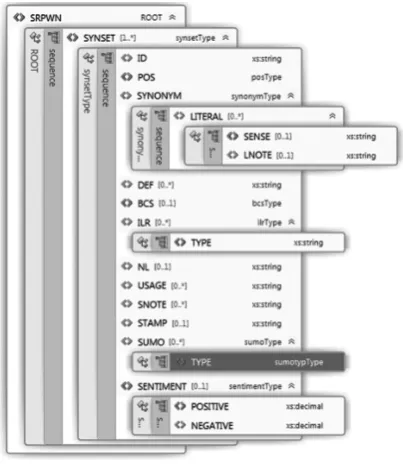
Schema for validation and control of SWN. The first introduced XSD schema used for SWN is pre-sented in (Krstev et al., 2004). A software tool LeXimir (the old name ILReMat) that used it, was created to work as a connection between VisDic and morphological dictionaries for Serbian. Still, functions for validation of the SWN as an XML re-source were not implemented. Also, when the new tags had to be introduced in SWN (such as SNOTE - a note related to a synset, or SUMO - for SUMO concepts), the corresponding XSD schema did not follow those changes. Furthermore, the problem remained to distribute and install the new schema to all the desktop applications that would use it. Now, the new version of the SWN XSD schema (given in Figure 1) can be easily changed by SWN
administrators, uploaded to the web server, made available to all other SWN users and maintained as a part of a web tool for on-line WordNet search, development and maintenance (presented in Sec-tion 3.2).
Figure 1: XSD schema for SWN XML
3. In the third step, a module was developed to validate and correct the SWN in its original Vis-Dic XML-like representation (with the root ele-ment added) against the newly developed SWN XSD Schema. This module performed automatic correction in all unambiguous cases, such as re-arrangement of elements, which represented the majority of cases. In the case of the last version of the SWN XML file a total of 17,994 POS tags, 6,110 BCS tags, 20,421 ILR tags, 130 BCS tags and 10 NL tags changed their position in the new WordNet XML document. For other types of er-rors, such as inappropriate or empty contents of elements an error report was issued and those er-rors were corrected manually. At the end, a well-formed and valid SWN was obtained.
4. This step is specific to the Serbian language. Namely, it uses two alphabets equally: Cyrillic and Latin. Translation from Cyrillic to Latin is straightforward since to each Cyrillic letter corre-sponds one Latin letter or digraph. The same is not valid for translation from Latin to Cyrillic because digraphs have to be distinguished from consonant groups. For instance, innadživeti“outlive” dž rep-resents a consonant group, while inodžak “chim-ney” dž is a digraph. When these two words are
written in Cyrillic the problems do not exist any-more: nadivetiandoak. When the develop-ment of the first Serbian language resource started back in early 80s it was still difficult to work with Cyrillic, especially if it was mixed with the Latin alphabet which normally happens in Serbian texts. For that reason a special encoding was invented that uses the ASCII character set and enables un-ambiguous mapping to both Serbian Cyrillic and Serbian Latin. Many valuable Serbian resources were developed using this encoding. Today, how-ever, it is obsolete and we decided that it was time to switch to the Unicode UTF-8 for Serbian Cyril-lic. This could not be done fully automatically because there are literals or parts of literals that have to remain in Latin script, e.g. names of bio-logical species such asporodicaBovidae “fam-ily Bovidae”, chemical symbols and formulae, e.g. H2O and some acronyms, like PC for personal computer. In order to facilitate this process we have defined some simple rules that recognize in-stances that have to remain in the Latin alphabet. After automatic translation of SWN from ASCII to Unicode UTF-8 the SWN was checked by Ser-bian electronic dictionary and incorrect transla-tions were corrected manually.
5. Serbian WordNet developed using VisDic did not contain the information about SUMO on-tology. This information was indirectly available from the PWN through the alignment process. However, for one wishing to use the SWN outside the VisDic environment this information would be missing. We developed a separate module that ex-plicitly assigns this information to synsets in the SWN. For synsets that were taken over from the PWN this was easily done. In SWN there are spe-cific concepts: 530 Balkan spespe-cific concepts and 174 Serbian specific concepts. They were also ap-pointed with SUMO tags. The procedure was car-ried out automatically, by inheriting the tag of the parent synset, if one existed and if it had a SUMO tag. After that, the rest of the mappings, that is to say the unresolved ones, were done manually.
con-nected to the POS to which they apply. This list was obtained from existing SUMO tags in PWN (Niles and Pease, 2003). The third list is the list of all codes of inflectional paradigms for simple and multi-word units used in Serbian morphological e-dictionaries (Krstev, 2008). This list gives an ex-ample and short explanation beside each code that can help user to choose one when filling the appro-priate element - LNOTE. For example (Table 1), the synset boat:1 from PWN has a corresponding synset barka:1, ˇcamac:1, ˇcun:1 in the SWN. The inflectional codes for these three literals are N664, N41 and N81, respectively. Entries for these three codes in the prepared list are (if these same literals were given as examples):
N664 barka the dative singularbarci N41 ˇcamac fleeting a;
the vocative singularˇcamˇce N81 ˇcun the nominative pluralˇcunovi
Table 1: Examples of inflectional codes used in SWN.
These three lists are used in a form of dropdown list in the web application for WordNet search, de-velopment and maintenance presented in the next section. The first two lists are of general nature, while the third one is specific to Serbian.
3.2 Operational Phase
In this phase, a web application was developed and its beta version was uploaded to the address:
http://resursi.mmiljana.comThe pur-pose of this application was to encompass all ben-efits of the already existing software tool, new de-mands of the Serbian semantic web users and con-temporary software development techniques to en-able a safe, efficient, multi-user, modular and easy to expand system for development of semantic re-sources in Serbian. In this phase, the following procedures and tasks were carried out.
1. A very important module of the web ap-plication is the XML validator. This module is able to validate any WordNet file against any XSD scheme and to obtain validation errors and sug-gestions for corrections. Also, it enables a seri-alization into TXT, CSV, RDF or XML formats with a chosen XSL transformation of a complete file or parts of search results. RDF representa-tion is especially interesting to us because it can be queried and processed by standard Semantic Web
tools, thus facilitating the integration of the Word-Net data into various Semantic Web applications.
2. The web application was built in order to fa-cilitate changing and adding of new synsets into wordnets. The new synsets can be added one at a time (either by transferring from the PWN - see item 3 - or independently) or as a batch. The latter case is particularly useful for addition of language specific concepts. The prepared synsets have to be in a valid XML form (except for a root element) with IDs of linked synsets already filled in appro-priate elements. This method was used for enhanc-ing the SWN with Serbian specific concepts from the culinary domain (Stankovi´c et al., 2014). For synsets that are added one at a time, a form is pre-pared for filling obligatory and optional elements, while a user can open new fields for repeatable ones. In the case of SWN, the drop down lists that we described in the previous subsection were used to input the ILR, LNOTE and SUMO tags which were filtered automatically according to the POS.
3. Another segment of the application is the op-tion of forming queries over the PWN resource in the version 3.0. For that purpose, we used the WordNetEngine 3 and we enhanced it with the functionality of copying of a chosen synset from the PWN into SWN. Search over the PWN can be carried out in two ways: by entering a word (in the Word field) or by entering an ID of a synset (in the synset ID field), in which case the POS must be chosen from the drop-down list given next to the synset ID field. If we choose the ID of a synset for the POS for which it does not exist, the program will notify us, otherwise it will provide a clickable link in order to display further details about se-mantic relations of that synset with other synsets. The number of shown semantic relations i.e. hi-erarchical representations of semantic relations of a particular synset with synsets semantically con-nected to it, is defined by checking the type of a semantic relation which we want to represent hier-archically using the check-box lists named Noun, Verb, Adjective and Adverb which contain labels of the most common semantic relations pertaining to the given POS.
4. The implemented search functions over the SWN take into consideration all tags from a Word-Net used. If a user chooses a tag SYNSET, then a full-text search over a whole wordnet is
per-3http://ptl.sys.virginia.edu/msg8u/
Figure 2: User-friendly XPATH queries over different SWN tags
formed. Also, they search data according to the authoring information. A search function can be either set to a simple value (Figure 2) or via a logic filter which is implemented to be user-friendly for those who are not familiar with XPath.
For example, the filter could be set to search for all synsets that have the termjabuka “apple” and whose SUMO tag is “PreparedFood” via an ad-vanced logic query:
<SUMO> equals "PreparedFood" AND (<LITERAL> contains "jabuka" OR <DEF> contains "jabuka")
Or we could find all synsets whose part of a literal or a literal itself is also contained in the superior synset as is the case with synsets de-scribed by LITERALS obrazovna ustanova “ed-ucational institution”, verska ustanova “religious institution”, medicinska ustanova “medical insti-tution” and their hypernym given by the LITERAL ustanova“institution”.
Similarly, we could find: all antonym synsets for synsets which have a LITERAL tag that contains a word ružan “ugly”. The result of an advanced logic query is a synset whose sense is lep“handsome”.
(<LITERAL>contains "ružan" AND <ILR><Type>equals "near_antonym")
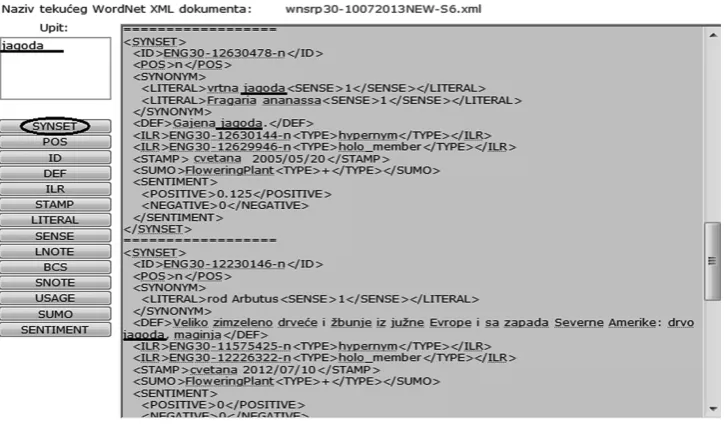
All the query results can be displayed in textual (Figure 3) and graphical tree form. Tree repre-sentation facilitates navigation through the
seman-Figure 3: Semantic relations tree structure of a synsetjagoda“strawberry”
imple-ment all functions needed for navigation through the semantic relations tree structure of SWN.
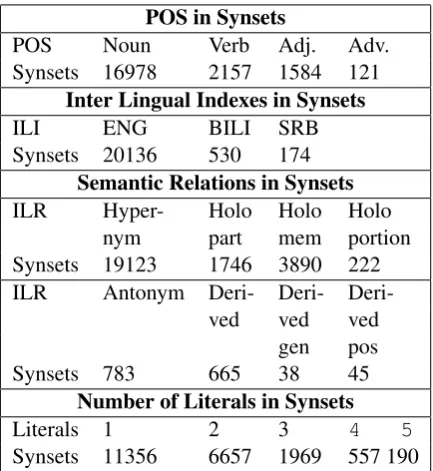
5. Besides search functions over WordNet synsets, a separate module is created for providing statistical information about some valuable param-eters of a WordNet in use that were often needed in the past. Table 2 shows some data provided by this module for the current version of SWN.
POS in Synsets
POS Noun Verb Adj. Adv.
Synsets 16978 2157 1584 121 Inter Lingual Indexes in Synsets
ILI ENG BILI SRB
Synsets 20136 530 174 Semantic Relations in Synsets
ILR Hyper- Holo Holo Holo
nym part mem portion
Synsets 19123 1746 3890 222 ILR Antonym Deri- Deri-
Deri-ved ved ved
gen pos
Synsets 783 665 38 45
Number of Literals in Synsets
Literals 1 2 3 4 5
[image:7.595.73.290.181.417.2]Synsets 11356 6657 1969 557 190
Table 2: Examples of inflectional codes used in SWN.
6. The safety of this application was ensured via roles and levels inside those roles. Roles are granted by WordNet administrators. The follow-ing roles were defined: unauthorized users that have the right of elementary querying over the net-work, using complex logic filters and statistical re-porting about connections and meanings inside of the network itself; WordNet users and administra-tors. Inside of roles, the levels are defined - or-dinary users that can input and change only the synsets which they themselves have defined, and moderators who have control over the entire re-source. Tag NL holds the information about status of a synset. If the moderator has not yet verified all data concerning the newly inserted synset, NL tag is set to “no”, and when the new synset has been approved by the moderator, the value of NL tag switches to “yes”. Also, for the information about the “hanging” semantic relations (e.g. if one of synsets in the relation doesn’t exist) is presented for each synset in the visual form.
The application is developed as ASP.NET
Framework 4.0 C# web site, corresponding to the relational database MS SQL Server 2005 and by using jQuery 1.8.9 library at client’s side. It is available for non-commercial use under the CC-BY-NC license.
4 Conclusion
The Serbian WordNet has a potential to develop with more substantial speed and quality now that valuable new tools for its usage and development are available. In this new tool we wanted to keep all characteristics of the old software VisDic that proved useful in the past and to add the missing ones of which the most important are a full XML support, distributed work, and advanced search. We have achieved this goal, but it should be noted that the interface is still under construction and its development will follow users’ demands in future. Also, for the time being it is given in Serbian, but we plan to enable localization for other languages in the next phase.
We hope to continue the development of SWN in several directions. In the process of further extension of this resource, domain knowledge about agroindustry, medicine, geology etc. will be added, depending on the scientific fields in which it will be used. Sentiment labels for synsets and procedures of parallelization with English re-sources of the same purpose are also planned in the near future. Furthermore, we plan on increas-ing the number of noun-adverb relations in order to enrich the system of semantic relations and se-mantic knowledge that would facilitate tagging of rhetorical figures in Serbian. Finally, mapping to SUMO ontologies and generating of an appro-priate ontology from the existing XML resource will be taken into consideration. We believe that wordnets developed for other languages can bene-fit from some of our tools, namely the tool for up-grading one version of WordNet to another, as well as other tools - with minor adjustments depending on the particular needs of the administrators and users of those wordnets.
Acknowledgments
References
Jordi Daudé, Lluís Padró and German Rigau. 2003.
Validation and Tuning of Wordnet Mapping Tech-niques. In Proc. of the International Conference on Recent Advances in Natural Language Processing (RANLP’03).
Christiane Fellbaum. 2010. WordNet. Springer, Netherlands.
Matthew Steven Gerber. 2013. WordNetEngine.cs, Synset.cs. http://ptl.sys.virginia. edu/msg8u/NLP/Source/ResourceAPIs/
WordNet/WordNet/ (accessed September 2nd
2013).
Aleš Horák and Pavel Smrž. 2004. VisDic - WordNet browsing and editing tool. In Proc. of the 2nd Inter-national Global WordNet Conference, Brno, Czech Republic.
Cvetana Krstev, Duško Vitas, Ranka Stankovi´c, Ivan Obradovi´c and Gordana Pavlovi´c-Lažeti´c. 2004.
Combining Heterogeneous Lexical Resources. In Proc. of the 4th International Conference on Lan-guage Resources and Evaluation, Lisabon, Portugal, vol. 4, pp. 1103-1106.
Cvetana Krstev, Bojana Djordjevi´c, Sanja Antoni´c, Nevena Ivkovi´c-Berˇcek, Zorica Zorica, Vesna Crnogorac and Ljiljana Macura. 2008. Cooperative Work in Further Development of Serbian WordNet. INFOtheca 9(1-2):59a-78a.
Cvetana Krstev. 2008. Processing of Serbian - Au-tomata, Texts and Electronic dictionaries. Faculty of Philology, University of Belgrade, Belgrade.
Cvetana Krstev, Ranka Stankovi´c, Ivan Obradovi´c, Duško Vitas and Miloš Utvi´c. 2010. Auto-matic Construction of a Morphological Dictionary of Multi-Word Units. LNCS 6233, Springer, pp. 226-237.
Miljana Mladenovi´c and Jelena Mitrovi´c. 2013. On-tology of Rhetorical Figures for Serbian. LNAI 8082, Springer pp. 386-393.
Ian Niles and Adam Pease. 2003. Linking Lexicons and Ontologies: Mapping WordNet to the Suggested Upper Merged Ontology. In Proc. of the IEEE Inter-national Conference on Information and Knowledge Engineering, pp. 412-416.
Maciej Ogrodniczuk, Radovan Garabik, Svetla Koeva, Cvetana Krstev, Piotr Pe¸zik, Tibor Pintér, Adam Przepiórkowski, György Szaszák, Marko Tadi´c, Tamás Váradi and Duško Vitas. 2012. Central and South-European language resources in META-SHARE. INFOtheca 13(1): 3-26.
Gordana Pavlovi´c-Lažeti´c and Jelena Graovac. 2010.
Ontology-driven Conceptual Document Classifica-tion. In KDIR, pp. 383-386.
Adam Pease. 2011.Ontology: A Practical Guide. Ar-ticulate Software Press, Angwin, CA.
Sofia Stamou, Kemal Oflazer, Karel Pala, Dimitris Christodoulakis, Dan Christodoulakis, Svetla Ko-eva, George Totkov, Dominique Totkov and Maria Grigoriadou. 2002. BALKANET: A Multilingual Semantic Network for Balkan Languages. In Proc. of the 1st International Global WordNet Conference, Mysore, India.
Ranka Stankovi´c, Ivan Obradovi´c and Aleksandra Tr-tovac. 2012. An Approach to Development of Bilin-gual Lexical Resources. In Proc. of the Workshop on Computational Linguistics and Natural Language Processing of Balkan Languages - CLoBL 2012, the Balkan Conference in Informatics, Novi Sad, Serbia, pp. 101-104.
Staša Vujiˇci´c Stankovi´c, Cvetana Krstev, Duško Vitas. 2014. Enriching Serbian WordNet and Electronic Dictionaries with Terms from the Culinary Domain. In Proc. of the Global Wordnet Conference (in the same volume).
The Center for Language and Speech Technolo-gies and Applications at the Technical University of Catalunya. (accessed September 2nd 2013).
http://bit.ly/18Uf8kX