D S Sharma, R Sangal and E Sherly. Proc. of the 12th Intl. Conference on Natural Language Processing, pages 308–315, Trivandrum, India. December 2015. c2015 NLP Association of India (NLPAI)
Using Multilingual Topic Models for Improved Alignment in
English-Hindi MT
Diptesh Kanojia1 Aditya Joshi1,2,3 Pushpak Bhattacharyya1 Mark James Carman2
1IIT Bombay, India,2Monash University, Australia 3IITB-Monash Research Academy, India
{diptesh,adityaj,pb}@cse.iitb.ac.in [email protected]
Abstract
Parallel corpora are often injected with bilingual dictionaries for improved Indian language machine translation (MT). In ab-sence of such dictionaries, a coarse dictio-nary may be required. This paper demon-strates the use of a multilingual topic model for creating coarse dictionaries for English-Hindi MT. We compare our ap-proaches with: (a) a baseline with no ad-ditional dictionary injection, and (b) a cor-pus with a good quality dictionary. Our re-sults show that the existing Cartesian prod-uct approach which is used to create the pseudo-parallel data results in a degrada-tion on tourism and health datasets, for English-Hindi MT. Our paper points to the fact that existing Cartesian approach using multilingual topics (devised for European languages) may be detrimental for Indian language MT.
On the other hand, we present an alter-nate ‘sentential’ approach that leads to a slight improvement. However, our sen-tential approach (using a parallel corpus injected with a coarse dictionary) outper-forms a system trained using parallel cor-pus and a good quality dictionary.
1 Introduction
Word Alignment is defined as the process of map-ping synonymous words, using a parallel corpora. It is considered to be a valuable resource, and can be used for various applications such as word sense disambiguation, statistical machine transla-tion (SMT), and automatic constructransla-tion of bilin-gual text.
Statistical Machine Translation (SMT) is a tech-nology for the automatic translation of text in one natural language into another. In a country like
India where more than 22 official languages are spoken across 29 states, the task of translation be-comes immensely important. A SMT system typi-cally uses two modules: alignment and reordering. The quality of an SMT system is dependent on the alignments discovered. The initial quality of word alignment is known to impact the quality of SMT (Och and Ney, 2003; Ganchev et al., 2008). Many SMT based systems are evaluated in terms of the information gained from the word alignment re-sults.
IBM models (Brown et al., 1993) are among the most widely used models for statistical word alignment. For these models, having a large paral-lel dataset can result in good alignment, and hence, facilitate a good quality SMT system. However, there is not a lot of parallel data available for English to Indian Languages, or for one Indian Language to another. Without sufficient amount of parallel corpus, it is very difficult to learn the correct correspondences between words that infre-quently occur in the training data. Hence, a need for specialized techniques that improve alignment quality has been felt (Sanchis and Snchez, 2008; Lee et al., 2006; Koehn et al., 2007).
Mimno et al. (2009) present a multilingual topic model called PolyLDA, and apply it for Machine Translation for European and other languages such as Danish, German, Greek, English, Spanish, etc. Since multilingual topic models generate parallel topics: parallel clusters of words that are likely to be about the same theme, these topics provide coarse alignment that a Moses-like translation system can leverage on. The idea is to not rely on any external ontology such as WordNet and to rely purely on a parallel corpus to create such coarse alignments. The focus of our paper is to improve word alignments using multilingual Topic Models approach for English-Hindi MT. The key question that this paper attempts to answer is:
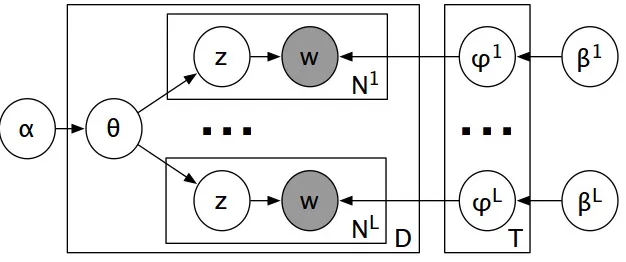
Figure 1: PolyLDA: Plate Diagram
‘Can the information gained from multilin-gual topic models help in improving the quality of SMT for English - Hindi Machine Translation?’
The novelty of the paper lies in the following ways:
• Implementation of a multilingual topic model by Mimno et al. (2009) and applying it to English-Hindi MT using the Cartesian prod-uct approach.
• A novel approach to employ multilingual top-ics extracted by the multilingual topic model above. The approach called the sentential ap-proach that performs better than the Cartesian product approach.
The paper is organized as follows. In section 2, we describe our related work. In section 3, we introduce multilingual Topic Models. In section 4 and 5, we describe the architecture of our work, and the experiment setup. We show the results obtained and our error analysis in section 6, and conclude in section 7.
2 Related Work
Our work covers two broad areas of research: Multilingual topic models and improvement of alignment in MT. We now describe the two in this section.
We implement the algorithm by Mimno et al. (2009) called PolyLDA. This model discovers top-ics for English - Hindi Parallel text, and use it to create pseudo-parallel data. They proposed Carte-sian approach to inject the pseudo parallel data in the training corpora. They evaluate their topics for machine translation. Such multilingual topic mod-els have been applied to a variety of tasks. Ni et
al. (2009) extract topics from wikipedia, and use the top terms for a text classification task. They observe that parallel topics perform better than topic words that are translated into the target lan-guage. Approaches that do not rely on parallel corpus have also been reported. Jagarlamudi and Daum´e III (2010) use a bilingual dictionary, and a comparable corpora to estimate a model called JointLDA. Boyd-Graber and Blei (2009) use un-aligned corpus and extract multilingual topics us-ing a multilus-ingual topic model called MuTo.
tiword alignments with higher accuracy, and can perform word sense disambiguation and select ap-propriate translations while a translation dictio-nary can only list all translations for each word or phrase. Some researchers use Part-of-speeches (POS), which represent morphological classes of words, tagging on bilingual training data (Sanchis and Snchez, 2008; Lee et al., 2006) give valu-able information about words and their neighbors, thus identifying a class to which the word may be-long. This helps in disambiguation and thus se-lecting word correspondences but can also give rise to increased vocabulary thus making the train-ing data more sparse. Joshi et al. (2013) use in domain parallel data to inject additional alignment mappings for the news headline domain. Finally, Koehn et al. (2007) propose a factored translation model that can incorporate any linguistic factors including POS information in phrase-based SMT. It provides a generalized representation of a trans-lation model, because it can map multiple source and target factors. It may help to effectively handle out-of-vocabulary (OOV) by incorporating many linguistic factors, but it still crucially relies on the initial quality of word alignment that will domi-nate the translation probabilities.
In this way, our paper attempts to verify the claim that multilingual topics can be used to ad-dress the problem of improved alignment genera-tion. We use a baseline that contains no bilingual dictionary, and an approach that contains a good quality bilingual dictionary. This is similar to the approach in Och and Ney (2000).
3 Multilingual Topic Models: An Introduction
A topic model takes as input a set of documents, and generates clusters of words called ‘topics’. These topics help to understand themes underly-ing a dataset. A popular topic model by Blei et al. (2003) called Latent Dirichlet Allocation (LDA) is an unsupervised model. This model takes as input the value ofT as the number of
top-ics, and a set of Dirichlet hyperparameters. LDA takes as input a dataset and models two kinds of distributions: (a) a document-topic distribution that determines the distribution of topics within a document, and (b) a word-topic distribution that determines the distribution of words across top-ics. The two distributions can be estimated using an Expectation-Maximization approach, or Gibbs
sampling, among other approaches.
Multilingual LDA (PolyLDA) introduced by Mimno et al. (2009) is based on the idea of LDA, and extends it for extracting equivalent topics across languages. This topic model takes as in-put parallel documents (or sentences) across two or more languages, and discoversT topics in each of the languages. For example, a PolyLDA may discover an English topic ‘book, books’ and the corresponding topic ‘libre, libres’ in French, and ‘libro, libri’ in Italian. Figure 1 shows the plate diagram for our implementation of PolyLDA. We use a simplified version of PolyLDA for two lan-guages: i.e., in our caseL= 2.
Each document is modeled as a set ofNlwords w wherel ranges from 1 to Lfor Lparallel
lan-guages. Each document has a distribution θover
all topics, over a total ofDdocuments. SinceLis
2 for us, There are two word-topic distributionsφ1 andφ2 for English and Hindi, respectively. Thus, based on which language the word belongs to, it is picked from the appropriate distribution. α andβ
are the Dirichlet hyperparameters.
The output of PolyLDA is the estimation forφ
for the two languages. The top nwords for each
topic are considered as candidates for generation of pseudo-parallel data.
4 Architecture
[image:3.612.319.532.529.660.2]Indian languages are morphologically complex, and sometimes very agglutinative. English to Hindi poses a separate challenge of word ordering as well. We take help of multilingual topic mod-els (MLTM) to obtain coarse alignments. In this section, we describe our architecture.
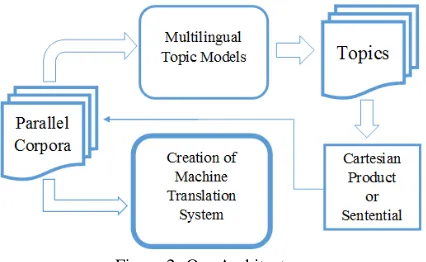
Figure 2: Our Architecture
The basic architecture is shown in Figure 2. We use multilingual topic models with the parame-ter of number of topics Z set. We thus obtain
Z topics: each consisting of top k English and
topk Hindi words. Using these topics, we
gen-erate ‘pseudo-parallel’ data - parallel words or groups of words that may be translations of each other. Finally, this data is appended to the parallel corpus used for training a Moses-based MT sys-tem (Koehn et al., 2007).
The key step in the architecture is the approach used to create pseudo-parallel data. We consider two approaches to do so:
1. Cartesian product Approach: This
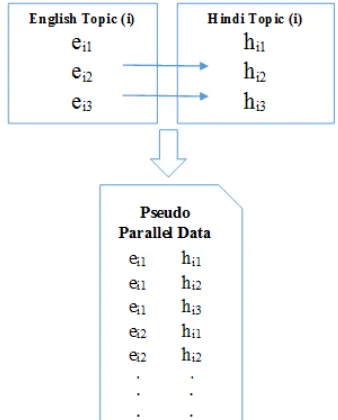
ap-proach was used by Mimno et al. (2009). In their work, they analyzed the character-istics of MLTM in comparison to monolin-gual LDA, and demonstrated that it is pos-sible to discover aligned topics. They also demonstrated that relatively small numbers of topically comparable document tuples are sufficient to align topics between languages in non-comparable corpora. They then use MLTM to create bilingual lexicons for low resource language pairs, and provided can-didate translations for more computation-ally intense alignment processes without the sentence-aligned translations. They conduct experiments for Spanish, English, German, French, and Italian. Figure 3 summarizes the approach. For parallel topic i with top
3 words, we add 9 pseudo-parallel sentences with one-to-one word alignment, as shown. Thus for T topics, and K top words,
Carte-sian product approach results in pseudo-parallel data ofT ∗K sentences of length 1 each. This is appended to the parallel corpus.
2. Sentential Approach: It is a novel approach
which concatenates words belonging to the same topic as a pseudo-sentence. The ap-proach is shown in Figure 4. We use the words aligned in topic models and put them in a sentence to create parallel sentences for the training corpora to be used in creating the MT system. Thus, the pseudo-parallel data generated in this case consists of 1 sen-tence per topic: ei1ei2ei3 in parallel with
[image:4.612.339.508.37.247.2]hi1hi2hi3. We use the sentential approach for the English - Hindi where the sentences constructed may not be word aligned but, un-like so many one to one Cartesian product alignments, our approach keeps them in the same sentence, thus reducing the chances of the system learning non synonymous candi-date translations.
Figure 3: Existing Cartesian Product Approach to generate pseudo-parallel data
Thus forT topics, andKtop words, senten-tial approach results in pseudo-parallel data ofT sentences of lengthK each. This is
ap-pended to the parallel corpus.
[image:4.612.337.508.527.691.2]The Cartesian product approach adds the word sets for every topic to a set of candidate transla-tions. While it provides with a lot more pseudo parallel data to be injected, it also injects one to one aligned non synonymous words to the parallel data. On the other hand, sentential approach only provides fewer pairs. Thus, intuitively, sentential approach performs better in this regard, while in-jecting less noisy data to the parallel corpus.
Figure 4: Our Sentential Approach to create pseudo-parallel data
Figure 5: Parallel English-Hindi topics as generated by the topic model for the health dataset
Figure 6: Parallel English-Hindi topics as generated by the topic model for the tourism dataset
5 Experiment Setup
In this section, we describe the dataset, and setup for the experiments conducted.
5.1 Dataset
For our experiments, we use corpora from health and tourism domain by Khapra et al. (2010). These datasets contain approximately 25000 par-allel sentences for English - Hindi language pair. We use these for both the creation of pseudo par-allel data, and training Machine translation sys-tems. We separate 500 sentences each for testing and tuning purposes. We ensure that they are not present in the training corpus.
5.2 Setup
We implemented the multilingual topic model in Java. Our implementation uses Gibbs sampling as described in the original paper. We used two configurations for our experiment. They vary in the pseudo parallel data which was included along with the training data used for MT system. We use MOSES Toolkit for all our experiments. We per-form experiments and obtained results for 3 differ-ent data sets as indicated in Figure 7. We set K, the number of words in a topic model, to be 11 for our experiments. For the initial experiments, we use number of topics as 50.
1. No dictionary (Baseline): A basic setup for
creating an MT system requires training, test-ing and tuntest-ing corpora which we obtained for HEALTH and TOURISM domains.
2. Cartesian product Approach: In this
ap-proach the pseudo parallel data was created using MLTM approach described earlier, and added to the training data before training the MT systems. We added the pseudo parallel data to training data using the approach indi-cated in Figure 3. Thus, for 50 topics and 11 top words, we add 550 pseudo-parallel sen-tences, each of length 1.
3. Sentential Approach: We added the pseudo
parallel data created using MLTM approach to the training data using the approach indi-cated in Figure 4. Thus, for 50 topics and 11 top words, we add 50 pseudo-parallel sen-tences, each of length 11.
4. Full dictionary: While the
base-line uses no dictionary, this ap-proach considered uses a good qual-ity bilingual dictionary from http: //www.cfilt.iitb.ac.in/˜hdict/ webinterface_user/index.php. The dictionary consists of more than 100,000 mappings between English and Hindi words.
6 Results
[image:5.612.104.513.160.248.2]6.1 Quantitative evaluation of Multilingual topics
Figures 5 and 6 show top 5 words for sample parallel English-Hindi topics for the health and tourism datasets respectively. The total number of topics, as stated before, is 50. Figure 5 shows four topics which correspond to four thematic compo-nents of the health dataset. Topic 1 is about admin-istration of medicines, Topic 2 and 3 are about two kinds of diseases, while Topic 4 is about different types of cancer. We also see that translations of the English words appear in the corresponding Hindi side for each of the topics. They may not appear in the same order, since these are dependent on the frequency of the word in the specific language. Thus, our model is able to discovercoarse topics
underlying the datasets.
Similar trends are observed in case of 6. Con-sider topic 2. The word temples on English side aligns with two words on the Hindi side: one in the root form, and one in the inflected form. Thus, our model is able to discoverinflected forms of words. Consider topic 4. The synonyms ‘road’, ‘route’ and ‘path’ occur on the English side. Three synonyms ‘maarg’, ‘sadak’ and ‘road’ also appear on the Hindi side. Thus, our model is able to discover parallel synonyms across the two lan-guages.
Among 40 English words present in these fig-ures, only 7 do not have a translation in the corre-sponding Hindi topic1. Similarly, for the 40 Hindi words, 6 do not have a translation in the corre-sponding English topic.
6.2 Benefit to MT
We now compare the baseline against the Carte-sian product and sentential approaches that use multilingual topics. The total number of topics, as stated before, is 50. Table 1 shows the BLEU scores before and after injecting the multilingual topic modeling data, for the two datasets. We ob-serve that BLEU score obtained on multilingual topic modeled data set using the Cartesian product approach for HEALTH domain is 25.98.
In the Cartesian product approach, we take par-allel topics and map each topic word to every other parallel language topic word, and add them to training data. This may result in several incor-rect translations being added to the parallel corpus.
1These are ‘nearest, centre, asthma, diabetes, place, kms,
breast’
Health Tourism No dictionary
(Base-line) 26.14 28.68
Cartesian product
Approach (50 topics) 25.98 28.44
Sentential Approach
(50 topics) 26.25 27.52
Full dictionary 26.31 29.30
Table 1: MT Results using no dictionary (baseline), good quality dictionary and coarse dictionary obtained through multilingual topic model (Cartesian product and Sentential approach)
[image:6.612.325.533.308.439.2]This seems to be the likely cause for degradation from 26.14 to 25.98 in case of health dataset, and from 28.68 to 28.44 in case of tourism dataset. In case of health dataset, our sentential approach al-lows us to increase from baseline and move closer to using full dictionary.
Figure 7: Change in BLEU scores for different value for Top-ics (T) for health domain
6.3 Impact of number of topics on MT
The degradation above is a parameter of number of topics; to ascertain that there is indeed degra-dation, we vary the number of topics. Hence, we conduct a separate run of our topic model for num-ber of topics 20, 30, 50, 80 and 100. We then use different approaches as shown above, and show the results for health domain in the graph above (Figure 7). The x - axis represent the number of topics (T) varying from 20 to 100. The results of two topic modeled approaches namely Carte-sian product approach and Sentence formation ap-proach are shown above.
tential approach shown minor improvements for a varied number of topic models. As more top-ics are added, sentential approach improves over the baseline. However, beyond 100, we observe a substantial degradation. This is because data spar-sity along with too many topics introduces non-synonymous words in parallel topics.
For topics 30, 50 and 80, our approach of using a coarse dictionary obtained through multilingual topics surpasses using a full, good quality dictio-nary.
In summary, we see that existing Cartesian product approach using multilingual topics (de-vised for European languages) is detrimental for Indian language MT. A modified sentential ap-proach results in marginal improvement.
7 Conclusion and Future Work
We implemented a multilingual topic model based on a past work to extract parallel English-Hindi topics. These parallel topics can be used by Moses to improve the alignment quality. We discussed two approaches to generate pseudo-parallel data. We used the Cartesian product approach that adds all combinations of top words in a topic. On the other hand, we introduced the sentential approach which adds all words together as a single sentence. We compared against a baseline with no bilingual dictionary, and an approach that uses a good qual-ity dictionary in order to understand how benefi-cial it is to add coarse mappings obtained from the topic models. The strength of our model lies in that our approach using a coarse dictionary per-forms better than using a good quality dictionary.
On experimentation with tourism and health datasets, we observed that the existing Cartesian product approach leads to a degradation in the BLEU score from 26.14 to 25.98. On the other hand, our sentential approach is able to restrict this degradation, butresults in a improvement for a
range of number of topics.
Our paper points to the fact that existing ap-proaches using multilingual topics (devised for European languages) may be detrimental for In-dian language MT. In addition, using additional observed variables for inflections and morpholog-ical characteristics, and latent variables for seman-tic classes, new multilingual topic models can be designed.
References
Lars Ahrenberg, Mikael Andersson, and Magnus Merkel. 1998. A simple hybrid aligner for gener-ating lexical correspondences in parallel texts. In
Proceedings of the 17th International Conference on Computational Linguistics - Volume 1, COLING ’98, pages 29–35, Stroudsburg, PA, USA. Associa-tion for ComputaAssocia-tional Linguistics.
David M Blei, Andrew Y Ng, and Michael I Jordan. 2003. Latent dirichlet allocation. the Journal of ma-chine Learning research, 3:993–1022.
Jordan Boyd-Graber and David M Blei. 2009. Multi-lingual topic models for unaligned text. In Proceed-ings of the Twenty-Fifth Conference on Uncertainty in Artificial Intelligence, pages 75–82. AUAI Press.
Peter F. Brown, Vincent J. Della Pietra, Stephen A. Della Pietra, and Robert L. Mercer. 1993. The mathematics of statistical machine translation:
Pa-rameter estimation. Comput. Linguist., 19(2):263–
311, June.
Colin Cherry and Dekang Lin. 2003. A
probabil-ity model to improve word alignment. In
Proceed-ings of the 41st Annual Meeting on Association for Computational Linguistics - Volume 1, ACL ’03, pages 88–95, Stroudsburg, PA, USA. Association for Computational Linguistics.
Kuzman Ganchev, Joo V. Graa, and Ben Taskar. 2008. Better alignments = better translations. Inin Proc. of the ACL.
Wu Hua and Wang Haifeng. 2004. Improving sta-tistical word alignment with a rule-based machine translation system. InProceedings of the 20th Inter-national Conference on Computational Linguistics, COLING ’04, Stroudsburg, PA, USA. Association for Computational Linguistics.
Jagadeesh Jagarlamudi and Hal Daum´e III. 2010. Ex-tracting multilingual topics from unaligned compa-rable corpora. InAdvances in Information Retrieval, pages 444–456. Springer.
Aditya Joshi, Kashyap Popat, Shubham Gautam, and Pushpak Bhattacharyya. 2013. Making headlines in hindi: Automatic english to hindi news headline translation. Sixth International Joint Conference on Natural Language Processing, page 21.
Mitesh M Khapra, Anup Kulkarni, Saurabh Sohoney, and Pushpak Bhattacharyya. 2010. All words do-main adapted wsd: Finding a middle ground
be-tween supervision and unsupervision. In
Proceed-ings of the 48th Annual Meeting of the Association for Computational Linguistics, pages 1532–1541. Association for Computational Linguistics.
Philipp Koehn, Hieu Hoang, Alexandra Birch, Chris Callison-Burch, Marcello Federico, Nicola Bertoldi, Brooke Cowan, Wade Shen, Christine Moran, Richard Zens, Chris Dyer, Ondˇrej Bojar, Alexandra
Constantin, and Evan Herbst. 2007. Moses: Open source toolkit for statistical machine translation. In
Proceedings of the 45th Annual Meeting of the ACL on Interactive Poster and Demonstration Sessions, ACL ’07, pages 177–180, Stroudsburg, PA, USA. Association for Computational Linguistics.
Jonghoon Lee, Donghyeon Lee, and Gary Geunbae Lee. 2006. Interspeech 2006 improving phrase-based korean-english statistical machine translation.
I. Dan Melamed. 2000. Models of translational
equiv-alence among words. Comput. Linguist., 26(2):221–
249, June.
David Mimno, Hanna M Wallach, Jason Naradowsky, David A Smith, and Andrew McCallum. 2009.
Polylingual topic models. In Proceedings of the
2009 Conference on Empirical Methods in Natural Language Processing: Volume 2-Volume 2, pages 880–889. Association for Computational Linguis-tics.
Xiaochuan Ni, Jian-Tao Sun, Jian Hu, and Zheng Chen. 2009. Mining multilingual topics from wikipedia. InProceedings of the 18th international conference on World wide web, pages 1155–1156. ACM.
Franz Josef Och and Hermann Ney. 2000. Improved
statistical alignment models. In Proceedings of
the 38th Annual Meeting on Association for Com-putational Linguistics, ACL ’00, pages 440–447, Stroudsburg, PA, USA. Association for Computa-tional Linguistics.
Franz Josef Och and Hermann Ney. 2003. A sys-tematic comparison of various statistical alignment
models.Computational Linguistics, 29(1):19–51.
Germn Sanchis and Joan Andreu Snchez. 2008. Vo-cabulary extension via pos information for smt.
Jorg Tiedemann. 1999. Word alignment step by step. InProceedings of the 12th Nordic Conf. on Compu-tational Linguistics, pages 216–227.
Dan Tufi and Anamaria Barbu. 2002. Lexical token alignment: Experiments, results and application. In
In Proc. of LREC-2002, pages 458–465.
Dekai Wu. 1997. Stochastic inversion transduction grammars and bilingual parsing of parallel corpora.
Comput. Linguist., 23(3):377–403, September.