Improving Peer Feedback Prediction: The Sentence Level is Right
Huy V. Nguyen
Department of Computer Science University of Pittsburgh
Pittsburgh, PA 15260
Diane J. Litman
Department of Computer Science & LRDC University of Pittsburgh
Pittsburgh, PA 15260
Abstract
Recent research aims to automatically pre-dict whether peer feedback is of high qual-ity, e.g. suggests solutions to identified problems. While prior studies have fo-cused on peer review of papers, simi-lar issues arise when reviewing diagrams and other artifacts. In addition, previous studies have not carefully examined how the level of prediction granularity impacts both accuracy and educational utility. In this paper we develop models for predict-ing the quality of peer feedback regard-ing argument diagrams. We propose to perform prediction at the sentence level, even though the educational task is to la-bel feedback at a multi-sentential com-ment level. We first introduce a corpus annotated at a sentence level granularity, then build comment prediction models us-ing this corpus. Our results show that ag-gregating sentence prediction outputs to label comments not only outperforms ap-proaches that directly train on comment annotations, but also provides useful infor-mation for enhancing peer review systems with new functionality.
1 Introduction
Peer review systems are increasingly being used to facilitate the teaching and assessment of student writing. Peer feedback can complement and even be as useful as teacher feedback; students can also benefit by producing peer feedback. Past research has shown that feedback implementation is sig-nificantly correlated to the presence of desirable feedback features such as the description of so-lutions to problems (Nelson and Schunn, 2009). Since it would be very time-consuming for in-structors to identify feedback of low quality post-hoc, recent research has used natural language
processing (NLP) to automatically predict whether peer feedback contains useful content for guiding student revision (Cho, 2008; Ramachandran and Gehringer, 2011; Xiong et al., 2012). Such real-time predictions have in turn been used to enhance existing online peer-review systems, e.g. by trig-gering tutoring that is designed to improve feed-back quality (Nguyen et al., June 2014).
While most prior research of peer review qual-ity has focused on feedback regarding papers, sim-ilar issues arise when reviewing other types of ar-tifacts such as program code, graphical diagrams, etc. (Nguyen and Litman, July 2013). In addi-tion, previous studies have not carefully examined how the level of prediction granularity (e.g. multi-sentential review comments versus sentences) im-pacts both the accuracy and the educational utility of the predictive models. For example, while the tutoring intervention of (Nguyen et al., June 2014) highlighted low versus high quality feedback com-ments, such a prediction granularity could not sup-port the highlighting of specific text spans that also might have been instructionally useful.
In this paper, we first address the problem of predictingfeedback type(i.e. problem, solution,
non-criticism) in peer reviews of student argument
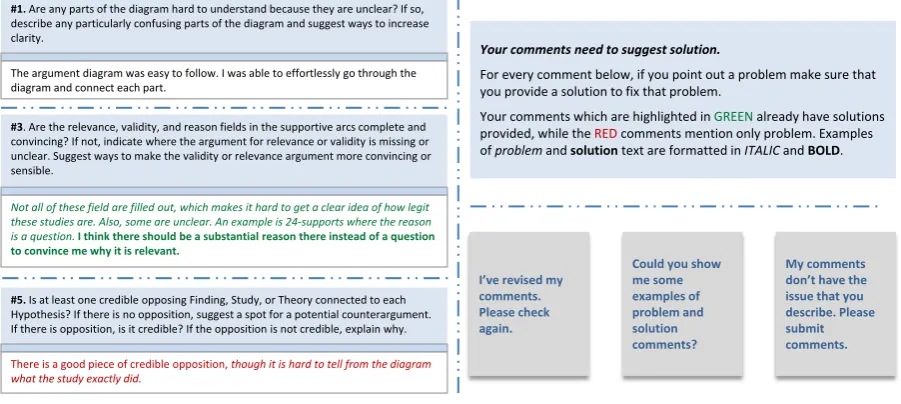
diagrams. In problemfeedback, the reviewer de-scribes what is wrong or needs to be improved in the diagram. In solution feedback, the reviewer provides a way to fix a problem or to improve the diagram quality. Feedback isnon-criticism when it is neither aproblemnor asolution(e.g. when it provides only positive feedback or summarizes). Examples are shown in Figure 1.1
The second goal of our research is to design our prediction framework so that it can support real-time tutoring about feedback quality. We hypoth-1Our peer review corpus comes from a system that uses
an end-comment feedback approach as shown in Figure 1. While it is possible to instead directly annotate a reviewed artifact, this has been shown to encourage feedback on low-level issues, and is not good for more global feedback.
#3. Are the relevance, validity, and reason fields in the supportive arcs complete and convincing? If not, indicate where the argument for relevance or validity is missing or unclear. Suggest ways to make the validity or relevance argument more convincing or sensible.
Not all of these field are filled out, which makes it hard to get a clear idea of how legit these studies are. Also, some are unclear. An example is 24-supports where the reason is a question.I think there should be a substantial reason there instead of a question to convince me why it is relevant.
#5. Is at least one credible opposing Finding, Study, or Theory connected to each Hypothesis? If there is no opposition, suggest a spot for a potential counterargument. If there is opposition, is it credible? If the opposition is not credible, explain why.
There is a good piece of credible opposition, though it is hard to tell from the diagram what the study exactly did.
#1. Are any parts of the diagram hard to understand because they are unclear? If so, describe any particularly confusing parts of the diagram and suggest ways to increase clarity.
The argument diagram was easy to follow. I was able to effortlessly go through the diagram and connect each part.
Your comments need to suggest solution.
For every comment below, if you point out a problem make sure that you provide a solution to fix that problem.
Your comments which are highlighted in GREEN already have solutions provided, while the RED comments mention only problem. Examples of problem and solution text are formatted in ITALIC and BOLD.
I’ve revised my comments. Please check again.
Could you show me some examples of problem and solution comments?
[image:2.595.74.525.67.269.2]My comments don’t have the issue that you describe. Please submit comments.
Figure 1: A mock-up interface of a peer review system where the prediction of feedback type triggers a system tutoring intervention. Left: three sample feedback comments including anon-criticism(top),
a solution (middle), and a problem (bottom). Right-top: a system tutoring intervention to teach the
student reviewer to provide a solution whenever a problem is mentioned. Right-bottom: possible student responses to the system’s tutoring.
esize that using a student’s own high-quality re-views during tutoring, and identifying the explicit text that makes the review high quality, will help students learn how to improve their lower quality reviews. To facilitate this goal, we develop pre-diction models that work at the sentence level of granularity.
Figure 1 presents a mock-up of our envisioned peer review interface. To tutor the student about solutions (figure right), the system uses live ex-amples taken from the student’s current review (figure left). Color is used to display the feed-back type predictions: here anon-criticismis dis-played in black, while the criticisms that are pos-itive and negative examples of solution are dis-played in green and red, respectively. In addition, to help the student focus on the important aspect of the (green) positive example, the sentence that ac-tually specifies the solution is highlighted in bold. This paper presents our first results towards re-alizing this vision. The contributions of our work are two-fold. First, we develop a sentence-level model for predicting feedback type in a diagram review corpus. While our peer review system works at the level offeedback comments(text of each box in Figure 1), we find it is more accu-rate to annotate and predict at finer-grained gran-ularity levels, then use these predictions to infer the comment’s feedback type. By introducing a
small overhead to annotate peer feedback, we cre-ated a phrase level-annotcre-ated corpus of argument diagram reviews. Our experimental results show that our learned prediction models using labeled sentences outperform models trained and tested at comment level. In addition, our models out-perform models previously developed for paper rather than diagram feedback, and also show po-tential generality by avoiding the use of domain-specific features. Second, we demonstrate that our sentence-level prediction can be used to sup-port visualizations useful for tutoring. Particular sentences that are predicted to express the com-ment’s feedback type are highlighted for instruc-tional purposes (e.g. the bold highlighting in Fig-ure 1).
2 Related work
of feedback on diagrams as well.
Building on such findings, researchers have be-gun to develop automated methods to identify helpful feedback. Cho (2008) was the first to take a machine learning approach. Peer feedback, i.e. comments, were manually segmented into idea units2 and human-coded for various features
including problem detection, solution suggestion, praise, criticism, and summary. Feedback was then labeled as helpful or not-helpful based on the presence of such features. The study showed that feedback could be classified regarding helpfulness with up to 67% accuracy using simple NLP tech-niques including ngrams and part-of-speech. Our work is different from (Cho, 2008) in that we focus on predicting particular feedback types (i.e. solu-tion and problem) rather than helpfulness in gen-eral. Also, as the raw feedback to peer-review sys-tems is typically at the comment-level, and being aware that idea-units are difficult to automatically segment, we instead predict at the sentence-level to make model deployment more practical.
Our work is more similar to (Xiong and Litman, 2010; Xiong et al., June 2010; Xiong et al., 2012), in which NLP and machine learning were used to automatically predict whether peer reviews of stu-dent papers contained specific desirable feedback features. Xiong and Litman used NLP-based fea-tures including paper ngrams, predefined keyword lists, and dependency parses to predict feedback type. For feedback of type criticism, they also developed models to further predict problem lo-calization and solution. Following (Cho, 2008), Xiong and Litman evaluated their models on peer review data that had been manually segmented into idea units. As noted above, the difficulty of automatically segmenting raw comments into idea units makes deployment of such models less prac-tical than our sentence-level approach. Also like Cho (2008), while their models predicted a label for each idea unit, the relevant text that led to the prediction was not identified. We will address this limitation by introducing a more fine-grained an-notated corpus.
Regarding peer reviews of student argument diagrams rather than papers, Nguyen and Lit-man (July 2013) developed a rule-based algorithm for predicting feedback that contained localization text (e.g. “Hypothesis 4”). Their approach was to
2Cf. (Cho, 2008) “a self-contained message on a single
piece of strength or weakness found in peer writing.”
first identify common words between a peer com-ment and its diagram, then classify phrases con-taining these words into different localization pat-terns. Although we similarly focus on diagram rather than paper feedback, our work addresses a different prediction task (namely, predicting feed-back type rather than localization). We also use statistical machine learning rather than a rule-based approach, in conjunction with more general linguistic features, to allow us to ultimately use our models for papers as well as diagrams with minimal modification or training.
Outside of peer review, research has been per-formed recently to mine wishes and suggestions in product reviews and political discussion.
Gold-berget al.(2009) analyzed the WISH3corpus and
built wish detectors based on simple word cues and templates. Focusing on product reviews only, Ramanand et al. (2010) created two corpora of suggestion wishes (wishes for a change in an exist-ing product or service) and purchasexist-ing wishes (ex-plicit expressions of a desire to purchase a prod-uct), and developed rules for identifying wish sen-tences from non-wish ones. Both (Goldberg et al., 2009; Ramanand et al., 2010) created rules manu-ally by examining the data. Although we hypoth-esize that wishes are related to solutions in peer review, our educational data makes direct applica-tion of product-motivated rules difficult. We thus currently use statistical machine learning for our initial research, but plan to explore incorporating expression rules to enhance our model.
Sub-sentence annotation has gained much inter-est in sentiment analysis and opinion mining. One notable work is (Wilson et al., 2005) in which the author addressed the problem that the contextual polarity (i.e. positive,negative, orneutral) of the phrase in which a word appears may be different from the word’s prior polarity. We will also use a phrase-level annotation, as described below.
3 Argument diagram review corpus
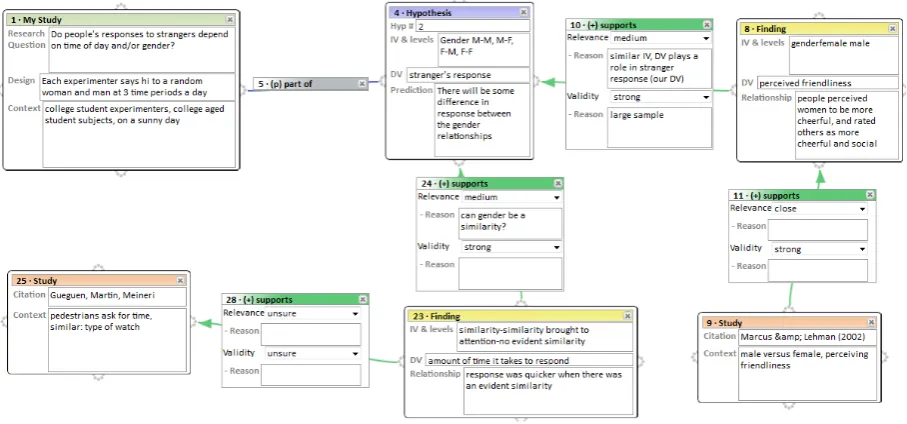
Figure 2: Part of a student argument diagram.
ment schemes before learning how to write argu-mentative essays. To further help students create good argument diagrams, it has recently been sug-gested that receiving and providing feedback on argument diagrams might yield useful pedagogi-cal benefits (Falakmassir et al., July 2013), anal-ogously to improving writing via peer review of papers.
Our corpus consists of a subset of comments from diagram reviews collected from nine separate sections of an undergraduate psychology course. Student argument diagrams were created using an instructor-defined diagram ontology. The diagram ontology defines five different types of nodes:
Current study, Hypothesis, Theory, Finding, and
Study (for reference). The ontology also defines
four different types of arcs that connect nodes:
Supports, Opposes, Part-of, andUndecided.
Fig-ure 2 shows part of a student argument diagram that includes two studies, each of which supports a finding which in turn supports or opposes a hy-pothesis. In the course that generated our corpus, students first created graphical argument diagrams using LASAD to justify given hypotheses. Student argument diagrams were then distributed, using the SWoRD (Cho and Schunn, 2007) web-based peer-review system, to other students in the class for reviewing. Student authors potentially revised their argument diagrams based on peer feedback, then used the diagrams to write the introduction of associated papers. Diagram reviews consist of multiple written feedback comments in response
<IU> <Pr>Not all of these field are filled out, which makes it hard to get a clear idea of how legit these studies are.</Pr> </IU> <IU> <Pr>Also, some are unclear. An example is
24-supports where the reason is a question.</Pr>
<Sl>I think there should be a substantial reason there instead of a question to convince me why it is relevant.</Sl> </IU>
Table 1: Example of an annotated comment. Markers<IU>: idea unit,<Sl>: solution,<Pr>: problem. Problem text is italic and solution text is bold for illustration purpose.
to rubric prompts, i.e. review dimensions. Student reviewers were required to provide at least one but no more than three comments for each of five re-view dimensions. Figure 1 shows three sample peer comments for three review dimensions (i.e. dimensions 1, 3 and 5).
Label Number of comments
Solution 178
Problem 194
Combined 135
Non-criticism 524
[image:5.595.307.526.61.201.2]Total 1031
Table 2: Comment label distribution.
the two labels used in this study. These la-bels are then used to assign a feedback type
(i.e. solution, problem, combined, and
non-criticism) to the comment as a whole. The comment is labeled Solution if at least one of its idea units presents a solution but no problem unit is explicitly present. If no solution idea is found, the comment is labeled Problem
if at least one of its idea units presents a prob-lem. The comment is labeled Combined if it has both solution and problem idea units, or
Non-criticismif it does not have solution or problem. Non-criticismunits can be praise, summary or text that does not express any idea,
e.g. “Yes, it is.” Table 1 shows an example
anno-tated feedback comment that consists of two idea units. The first idea unit is aboutempty fields, and the second is aboutreason is a question. Based on the annotations shown, the comment as a whole has the labelCombined.
We had one undergraduate psychology major annotate the 1031 comments in our corpus, yield-ing the label distribution shown in Table 2. The first author also annotated 244 randomly selected comments, solely to evaluate inter-coder agree-ment. The obtained agreement of comment labels was high, with accuracy 0.81 and kappa 0.74.
In addition to comment labeling, the annotator also highlighted4text spans that explain the labels.
The marked text span must either express solution or problem information but cannot express both. Therefore we require the annotator to highlight at the phrase (i.e. sub-sentence) level, and that each marked text must be completely within an idea unit. Generally speaking this requirement does not increase cognitive workload because annota-tors already have to read the comment and notice any solution or problem mentioned before label-ing.
4Highlighting was made possible using macros in
Mi-crosoft Word. Annotators select the text of interest, then click a button corresponding to the relevant label, e.g. problem.
Label Sentence
Problem Not all of these field are filled out,
which makes it hard to get a clear idea of how legit these studies are.
Problem Also, some are unclear.
Problem An example is 24-supports where
the reason is a question.
Solution I think there should be a substantial
reason there instead of a question to convince me why it is relevant.
Table 3: Examples of labeled sentences extracted from the annotated comment.
Category Number of sentences
Solution 389
Problem 458
Non-criticism 1061
[image:5.595.76.290.63.149.2]Total 1908
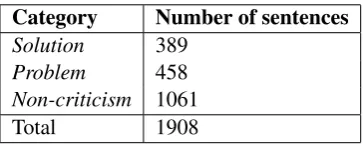
Table 4: Sentence label distribution.
Although we asked the annotator to mark text spans which convey problem or solution informa-tion, we did not ask the annotator to break each text span into sentences. The first reason is that the problem or solution text might only be part of a sentence and highlighting only the informa-tive part will give us more valuable data. Second, sentence segmentation can be performed automat-ically with high accuracy. After the corpus was annotated, we ran a sentence segmentation proce-dure using NLTK5 to create a labeled corpus at
the sentence level as follows. Each comment is broken into three possible parts: solution includ-ing all solution text marked in the comment, prob-lemincluding all problem text, andotherfor non-criticism text. Each part is then segmented into sentences and each sentence is assigned the label of the part to which it belongs. It may happen that the segmented text is a phrase rather than a complete sentence. We consider such phrases as reduced sentential-like text, and we use the term
sentence(s)to cover such sub-sentence forms, as
well. Labeled sentences of the comment in Table 1 are shown in Table 3. After discarding empty sen-tences and those of length 1 (all of those are in the
non-criticismcategory), there are 1908 sentences
remaining, distributed as shown in Table 4.
[image:5.595.326.508.252.325.2]4 Experimental setup
Sections 6 and 7 report the results of two different experiments involving the prediction of feedback types at the comment level. While each experi-ment differs in the exact classes to be predicted, both compare the predictive utility of the same two different model-building approaches:
• Trained using comments (CTRAIN): our
baseline6 approach learns comment
predic-tion models using labeled feedback com-ments for training.
• Trained using sentences(STRAIN): our
pro-posed approach learns sentence prediction models using labeled sentences, then aggre-gates sentence prediction outputs to create comment labels. For example, the aggrega-tion used for the experiment in Secaggrega-tion 6 is as follows: if at least one sentence is predicted
asSolution/Problemthen the comment is
as-signedSolution/Problem.
We hypothesize that the proposed approach will yield better predictive performance than the base-line because the former takes advantage of cleaner and more discriminative training data.
To make the features of the two approaches comparable, we use the same set of generic lin-guistic features:
• Ngrams to capture word cues: word un-igrams, POS/word bun-igrams, POS/word tri-grams, word and POS pairs, punctuation, word count.
• Dependency parse to capture structure cues.
We skip domain and course-specific features (e.g. review dimensions, diagram keywords like
hy-pothesis) in order to make the learned model more
applicable to different diagram review data. In-stead, we search for diagram keywords in com-ments and replace them with the string “KEY-WORD”. The keyword list can be extracted au-tomatically from LASAD’s diagram ontology. Adding metadata features such as comment and sentence ordering did not seem to improve perfor-mance so we do not include such features in the experiments below.
6The use of comment-level annotations for training and
testing is similar to (Nguyen and Litman, July 2013).
Following (Xiong et al., 2012), we learn predic-tion models using logistic regression. However, in our work both feature extraction and model learn-ing are performed uslearn-ing the LightSide7toolkit. As
our data is collected from nine separate sections of the same course, to better evaluate the models, we perform cross-section evaluation in which for each fold we train the model using data from 8 sections and test on the remaining section. Re-ported results are averaged over 9-fold cross vali-dations. Four metrics are used to evaluate predic-tion performance. Accuracy (Acc.) and Kappa (κ) are used as standard performance measurements. Since our annotated corpus has imbalanced data which makes the learned models bias to the ma-jority classes, we also report the Precision (Prec.) and Recall (Recl.) of predicting the minor classes.
5 Sentence prediction performance
We first evaluate models for predicting binary ver-sions of the sentence labels from Table 4 (e.g. so-lution or not), as this output will be aggregated in our proposed STRAIN approach. The results of using sentence training (STr) and sentence testing (STe) are shown in the STR/STE row of Table 5. For comparison, the first row of the table shows the performance of a majority baseline approach (MAJOR), which assigns all sentences the label of the relevant major class in each prediction task. To confirm that a sentence-level annotated corpus is necessary to train sentence prediction models, a third approach that uses labeled comment data for training (CTr) but sentences for testing (STe) is included in the CTR/STE row. As we can see, STR/STEmodels outperform those of CTR/STE and MAJORfor all 4 metrics8. The comment ver-sus sentence training yields significant differences for predictingProblemandCriticismsentences.
6 Three feedback type prediction tasks
In this experiment we evaluate our hypothesis that STRAINoutperforms CTRAINby comparing per-formance on three feedback type prediction tasks at the comment level (derived from Table 2):
• Problem v. Non-problem. TheProblemclass
includes problem and combined comments.
7http://ankara.lti.cs.cmu.edu/side/download.html 8Note thatκin general, and precision and recall of minor
Solution Problem Criticism
Model Acc. κ Prec. Recl. Acc. κ Prec. Recl. Acc. κ Prec. Recl.
MAJOR 0.80 - - - 0.76 - - - 0.56 - -
[image:7.595.70.534.63.139.2]-CTR/STE 0.87 0.57 0.70 0.62 0.75 0.22 0.48 0.29 0.75 0.48 0.76 0.63 STR/STE 0.88 0.61 0.76 0.63 0.81 0.44 0.62 0.51 0.80 0.59 0.79 0.74
Table 5: Prediction performance of three tasks at the sentence level. Comparing STR/STEto CTR/STE:
Italicmeans higher withp <0.05,Boldmeans higher withp <0.01.
• Solution v. Non-solution. TheSolutionclass
includes solution and combined comments.
• Criticism v. Non-criticism. The Criticism
class includes problem, solution and com-bined comments.
The two approaches are also compared to majority baselines (MAJOR) and a hybrid approach (HY -BRD) that trains models using labeled sentence data but tests on labeled comments.
As shown in Table 6, both MAJORand HYBRD perform much worse than CTRAIN and STRAIN. We note that while HYBRDgives comparably high precision, its kappa and recall do not match those of CTRAIN and STRAIN. Comparing CTRAIN and STRAIN, the results confirm our hypothesis that STRAINoutperforms CTRAIN. The major ad-vantage of STRAIN is that it only needs one cor-rectly predicted sentence to yield the correct com-ment label. This is particularly beneficial for pre-dicting problem comments, where the improve-ment is significant for 3 of 4 metrics.
As our evaluation is cross-section, folds do not have identical label distributions. Therefore we look at prediction performance for each of the nine individual sections. We find that the sentence level approach yields higher performance on all four metrics in six sections when predicting both
So-lutionandProblemtask, but only two sections for
Criticism. For theCriticismtask – where it is not
necessary to exclusively differentiate between
So-lutionandProblem, training prediction models
us-ing labeled sentences does not yield higher perfor-mance than the traditional approach.
Roughly comparing predicting at the sentence level (Table 5) versus the comment level (Table 6), we note that the sentence level tasks are more dif-ficult (e.g. lower absolute kappas) despite an in-tuition that the labeled sentence corpus is cleaner and more discriminative compared to the labeled comment corpus. The observed performance dis-parity shows the necessity of developing better
sentence prediction models, which we leave to fu-ture work.
7 A case study experiment
To the best of our knowledge, (Xiong et al., June 2010; Xiong et al., 2012) contain the only published models developed for predicting feed-back types. A comment-level solution prediction model has since been deployed in their peer re-view software to evaluate student rere-viewer com-ments in classroom settings, using the following 3-way classification algorithm9. Each student
com-ment is classified as either a criticism (i.e. presents problem/solution information) or a non-criticism. The non-criticism comment is labeledNULL. The criticism comment is labeledSOLUTIONif it con-tains solution information, and labeledPROBLEM
otherwise.
To evaluate our proposed STRAIN approach in their practically-motivated setting, we follow the description above to relabel peer feedback com-ments in our corpus to new labels:NULL, PROB-LEM, andSOLUTION. We also asked the authors of (Xiong et al., 2012) for access to their current model and we were able to run their model on our feedback comment data. While it is not appro-priate to directly compare model performance as Xiong et al. were working with paper (not dia-gram) review data, we report their model output, named PAPER, to provide a reference baseline. We expect the PAPERmodel to work on our diagram review data to some extent, particularly due to its predefined seed words for solution and problem cues. Our CTRAIN baseline, in contrast, trains models regarding the new label set using relabeled diagram comment data, with the same features and learning algorithm from the prior sections. The majority baseline, MAJOR, assigns all comments the major class label (which is nowNULL).
Regarding our STRAIN sentence level
Solution Problem Criticism
Model Acc. κ Prec. Recl. Acc. κ Prec. Recl. Acc. κ Prec. Recl.
MAJOR 0.70 - - - 0.68 - - - 0.51 - -
-HYBRD 0.82 0.52 0.87 0.48 0.75 0.36 0.68 0.41 0.78 0.56 0.84 0.68 CTRAIN 0.87 0.67 0.84 0.71 0.76 0.43 0.65 0.55 0.83 0.66 0.85 0.80
[image:8.595.71.530.62.151.2]STRAIN 0.88 0.71 0.86 0.74 0.81 0.55 0.71 0.66 0.85 0.70 0.84 0.85
Table 6: Prediction performance of three tasks at comment level. Comparing STRAINto CTRAIN:Italic means higher withp <0.1,Boldmeans higher withp <0.05.
1. For each sentence, label itSOLUTIONif it is predicted asSolutionby theSolutionmodel. 2. For a predictedNon-solutionsentence, label itNULLif it is predicted asNon-criticismby the
Criticismmodel.
3. For a predicted Criticism sentence, label it
PROBLEMif it is predicted asProblemby the
Problemmodel.
4. For a predictedNon-problemsentence, label
itSOLUTION
Table 7: Relabel procedure.
proach, we propose two aggregation procedures to infer comment labels given sentence prediction output. In the first procedure, RELABELFIRST, we infer new sentence labels regardingNULL, PROB-LEM, and SOLUTION using a series of condi-tional statements. The order of statements is cho-sen heuristically given the performance of indi-vidual models (see Table 5) and is described in Table 7. Given the sentences’ inferred labels, the comment is labeled SOLUTION if it has at least oneSOLUTIONsentence. Else, it is labeled
PROBLEMif at least one of its sentences is
PROB-LEM, and labeledNULL otherwise. Our second aggregation procedure, called INFERFIRST, fol-lows an opposite direction in which we infer com-ment labels regardingSolution, Problem, and
Crit-icism before re-labeling the comment regarding
SOLUTION, PROBLEM, andNULLfollowing the
order of conditional statements in the relabel pro-cedure.
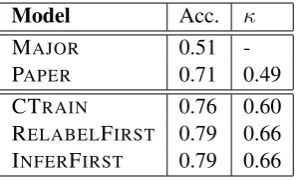
As shown in Table 8, the MAJOR and PAPER models perform much worse than the other three models. While the PAPER model has accuracy close to that of the other models, its kappa is far lower. Regarding the three models trained on di-agram review data, the two sentence level models outperform the CTRAINmodel. Particularly,
kap-Model Acc. κ
MAJOR 0.51
-PAPER 0.71 0.49
[image:8.595.343.493.208.298.2]CTRAIN 0.76 0.60 RELABELFIRST 0.79 0.66 INFERFIRST 0.79 0.66
Table 8: Prediction performance of different ap-proaches in a case study.
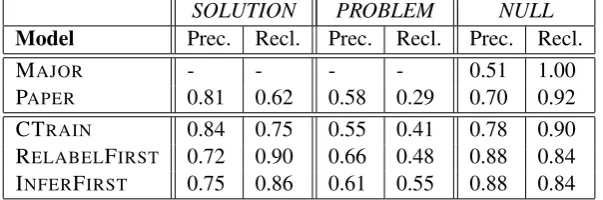
pas of the two sentence level models are either sig-nificantly higher (for INFERFIRST) or marginally higher (for RELABELFIRST) compared to kappa of CTRAIN. To further investigate performance disparity between models, we report in Table 9 precision and recall of different models for each class. The PAPER model achieves high preci-sion but low recall forSOLUTIONandPROBLEM
classes. We reason that the model’s seed words help its precision, but its ngram features, which were trained using paper review data, cannot ad-equately cover positive instances in our corpus. The two sentence level models perform better for
the PROBLEM class than the other two models,
which is consistent with what is reported in Ta-ble 6. Comparing the two sentence level models, INFERFIRST better balances precision and recall than RELABELFIRST.
8 The sentence level is right
discrim-SOLUTION PROBLEM NULL
Model Prec. Recl. Prec. Recl. Prec. Recl.
MAJOR - - - - 0.51 1.00
[image:9.595.149.451.64.164.2]PAPER 0.81 0.62 0.58 0.29 0.70 0.92 CTRAIN 0.84 0.75 0.55 0.41 0.78 0.90 RELABELFIRST 0.72 0.90 0.66 0.48 0.88 0.84 INFERFIRST 0.75 0.86 0.61 0.55 0.88 0.84
Table 9: Precision and recall of different models in a case study.
inative than the labeled comment corpus. This is a nice property that helps reduce feature colloca-tion across exclusive classes,Problem vs. Solution
for example, which is a danger of training on feed-back comments due toCombinedinstances. More-over, our annotated comment corpus has solution and problem text marked at the sub-sentence level, which is a valuable resource for learning solution and problem patterns and linguistic cues.
Improving peer feedback prediction accuracy is not the only reason we advocate for the sentence level. We envision that the sentence level is the necessary lower bound that a peer review system needs to handle new advanced functionalities such as envisioned in Figure 1. Being able to highlight featured text in a peer comment is a useful visu-alization function that should help peer reviewers learn from live examples, and may also help stu-dent authors quickly notice the important point of the comment.
Sentence and phrase level annotation is made easy with the availability of many text annota-tion toolkits; BRAT10 (Stenetorp et al., 2012) is
an example. From our work, marking text spans by selecting and clicking requires a minimal ad-ditional effort from annotators and does not cause more cognitive workload. Moreover, we hypoth-esize that through highlighting the text, an anno-tator has to reason about why she would choose a label, which in turn makes the annotation process more reliable. We plan to test whether annotation performance does indeed improve in future work.
9 Conclusions and future work
In this paper we present a sentence-level anno-tated corpus of argument diagram peer review data, which we use to develop comment-level pre-dictions of peer feedback types. Our work is the first of its kind in building an automated
feed-10http://brat.nlplab.org/
back type assessment component for reviews of argument diagrams rather than papers. We have demonstrated that using sentence prediction out-puts to label the corresponding comments outper-forms the traditional approach that learns mod-els using labeled comments. The improvement of using sentence prediction outputs is more sig-nificant for more difficult tasks, i.e. Problem vs.
Non-problem, in which textual expression varies
greatly from explicit to implicit. In a case study mimicking a real application setting to experiment with the proposed models, we achieved a simi-lar verification of the utility of sentence models. Given our imbalanced training data labels and our avoidance of using domain-specific features, these first results of our two experiments are promising. In these first studies, our models were trained using generic prediction procedures, e.g., using basic linguistic features without feature selection or tuning. Thus our next step is to analyze pre-diction features for their predictiveness. We also plan to incorporate human-engineered rules for so-lution and problem text. We aim to improve per-formance while keeping feature generality. An in-teresting experiment we may conduct is to test our learned models on paper review data to evaluate performance and generality in an extreme setting.
Acknowledgments
This work is supported by NFS Grant No. 1122504. We are grateful to our colleagues for sharing the data. We thank Kevin Ashley, Wencan Luo, Fan Zhang, other members of the Argument-Peer and ITSPOKE groups as well as the anony-mous reviewers for their valuable feedback.
References
Kwangsu Cho and Christian D. Schunn. 2007. Scaf-folded writing and rewriting in the discipline: A
web-based reciprocal peer review system.
Kwangsu Cho. 2008. Machine classification of peer
comments in physics. In Proceedings 1st
inter-national conference on Educational Data Mining (EDM), pages 192–196.
Mohammad Falakmassir, Kevin Ashley, and Christian Schunn. July 2013. Using argument diagramming to improve peer grading of writing assignments. In
Proceedings of the 1st Workshop on Massive Open Online Courses at 16th International Conference on Artificial Intelligence in Education (AIED), Mem-phis, TN, pages 41–48.
Sarah Gielen, Elien Peeters, Filip Dochy, Patrick Onghena, and Katrien Struyven. 2010. Improv-ing the effectiveness of peer feedback for learnImprov-ing.
Learning and Instruction, 20(4):304–315.
Andrew B. Goldberg, Nathanael Fillmore, David An-drzejewski, Zhiting Xu, Bryan Gibson, and Xiao-jin Zhu. 2009. May all your wishes come true: A
study of wishes and how to recognize them. In
Pro-ceedings Human Language Technologies: The 2009 Annual Conference of the North American Chap-ter of the Association for Computational Linguistics, NAACL-HTL, pages 263–271.
Jordan Lippman, Mike Elfenbein, Matthew Diabes, Cori Luchau, Collin Lynch, Kevin Ashley, and Chris Schunn. 2012. To revise or not to revise: What influences undergrad authors to implement peer
cri-tiques of their argument diagrams? InInternational
Society for the Psychology of Science and Technol-ogy 2012 Conference. Poster.
Melissa M. Nelson and Christian D. Schunn. 2009. The nature of feedback: how different types of peer
feedback affect writing performance. Instructional
Science, 37(4):375–401.
Huy V. Nguyen and Diane J. Litman. July 2013. Iden-tifying localization in peer reviews of argument
di-agrams. InProceedings 16th International
Confer-ence on Artificial IntelligConfer-ence in Education (AIED), Memphis, TN, pages 91–100.
Huy Nguyen, Wenting Xiong, and Diane Litman. June 2014. Classroom evaluation of a scaffolding inter-vention for improving peer review localization. In
Proceedings 12th International Conference on Intel-ligent Tutoring Systems (ITS), Honolulu, HI, pages 272–282.
Lakshmi Ramachandran and Edward F. Gehringer. 2011. Automated assessment of review quality
us-ing latent semantic analysis. In Proceedings 11th
IEEE International Conference on Advanced Learn-ing Technologies (ICALT), pages 136–138.
J. Ramanand, Krishna Bhavsar, and Niranjan
Pedanekar. 2010. Wishful thinking: finding
suggestions and ‘buy’ wishes from product reviews. In Proceedings the NAACL-HLT 2010 Workshop on Computational Approaches to Analysis and Generation of Emotion in Text, pages 54–61.
Oliver Scheuer, Frank Loll, Niels Pinkwart, and Bruce M. McLaren. 2010. Computer-supported
ar-gumentation: A review of the state of the art.
In-ternational Journal of Computer-Supported Collab-orative Learning, 5(1):43–102.
Pontus Stenetorp, Sampo Pyysalo, Goran Topic, Tomoko Ohta, Sophia Ananiadou, and Jun’ichi Tsu-jii. 2012. Brat: a web-based tool for nlp-assisted
text annotation. In Proceedings the
Demonstra-tions at the 13th Conference of the European Chap-ter of the Association for Computational Linguistics, pages 102–107.
Theresa Wilson, Janyce Wiebe, and Paul Hoffmann. 2005. Recognizing contextual polarity in
phrase-level sentiment analysis. InJoint Human Language
Technology Conference and the Conference on Em-pirical Methods in Natural Language Processing (HLT-EMNLP), pages 347–354.
Wenting Xiong and Diane Litman. 2010. Identify-ing problem localization in peer-review feedback. In
Proceedings 10th International Conference on Intel-ligent Tutoring System (ITS), Pittsburgh, PA. Poster. Wenting Xiong, Diane Litman, and Christian Schunn. 2012. Natural language processing techniques for
researching and improving peer feedback. Journal
of Writing Research, 4(2):155–176.