Robust SAMs of Ru(II) and Os(II) Polypyridines on
Gold Surfaces: Exploring New Potentials
Frances A. Murphya, Stéphane Suáreza, Egbert Figgemeierb, Emma R. Schofielda, Sylvia M. Drapera,*
a Chemistry Department, Sami Nasr Institute of Advanced Materials (SNIAM), Trinity College Dublin,
College Green, Dublin 2, Ireland; b Department of Chemistry, University of Basel, Spitalstrasse 51, 4056 Basel, Switzerland.
RECEIVED DATE
ABSTRACT:
Metal complexes [M(phtpy)(pztpy)](PF6)2 (phtpy = 4'-phenyl-2,2':6',2"-terpyridine, pztpy =
4'-(N-piperazinyl)-2,2':6',2"-terpyridine, M = Ru, Os) were prepared and examined spectroscopically and electrochemically. The piperazine attachment was found to significantly modify the photophysical and electrochemical properties compared to the parent bis-terpyridine complexes, causing a red-shift of the
1MLCT (23 nm) and a substantial cathodic shift of the redox potential (0.30 V for Ru, 0.23 V for Os).
Self-assembled monolayers (SAMs) of the complexes on polished gold electrodes were generated simply via the in situ formation of a dithiocarbamate (DTC) anchoring group at the terminal piperazinyl nitrogen on the pztpy ligand. Cyclic voltammetry revealed that the monolayers show excellent reversible behaviour and exceptional stability. The high stability of the SAMs is attributed to the strong bidentate attachment to the gold surface of the DTC tether and the favourable low oxidation potentials of the complexes which result from the electron-rich piperazine nitrogen on the pztpy ligand. Such DTC-based SAMs demonstrate a substantial improvement over commonly-employed thiol-based systems, and offer new scope for future development.
Introduction
alkanethiol monolayers on gold include the immobilisation of different photo-, chemical or electroactive groups for sensors1 and biosensors,2,3 optical data storage4 and catalysis.5 Gold electrodes are a particularly attractive platform for SAMs because cyclic voltammetry can be used to examine both monolayer structure and the kinetic parameters of long-range electron transfer of the resulting redox-active SAM.6,7
Of the known redox-active monolayers, those functionalised with ferrocene are ubiquitous.8-10 Studies of electroactive monolayers containing transition metal coordination complexes are less common but include studies on Ru(II),11-13 Os(II)14 and Cu(II)15 complex-functionalised monolayers. Ferrocene is commonly employed as a redox centre because it has a well-behaved redox potential (ca. +0.4 V vs. SCE) which is compatible with thiol SAM stability. There are drawbacks however; ferrocene derivatives can be poorly soluble and their redox processes are in fact relatively slow.16 In contrast, ruthenium polypyridyl complexes can have significantly faster electron transfer processes in analogous alkanethiol monolayers on gold electrode surfaces.17
Although there is no doubt that ruthenium polypyridyl complexes with highly stable and well-understood coordination chemistry and long-lived excited state lifetimes (e.g. Ru(bpy)32+) are desirable
for a multitude of SAM-based applications, only limited studies on monolayers containing Ru(II) complexes have been undertaken. This is because, at the potentials of the Ru(II/III) polypyridyl redox process (ca. +1.1-1.2 V vs. SCE), oxidative desorption occurs so as to render the thiol-gold monolayers unstable.19 SAMs of sulfur-containing adsorbates on gold have been shown to be electrochemically stable only within a limited potential window from -0.8 to +0.4 VMSE (-0.4 to +0.8 VSCE).20
monolayer can be undertaken, e.g. by incorporating a more robust linker to the gold surface which is more stable than conventional thiol adsorbates.
The electrochemical and spectroscopic properties of Ru(II) complexes incorporating 2,2'-bipyridine (bpy) and 2,2':6',2"terpyridine (tpy) ligands can be modified by introducing electronwithdrawing or -donating substituents onto the polypyridyl ligands.21,22 Electron-releasing substituent groups such as pyrrolidine dramatically shift the 1MLCT (metal to ligand charge transfer) absorption in the visible region, leading to more efficient visible light absorption coupled with a shift of the Ru(II/III) redox couple to less positive potentials.22 In our case, we adopt this strategy incorporating a piperazine moiety at the 4' position of a terpyridine ligand which is coordinated to a Ru(II) or Os(II) metal centre.
In addition to improve the complex binding to the gold electrode surface, we present here the replacement of a thiol linker by the more robust dithiocarbamate (DTC) group. Wei et. al. have shown that dithiocarbamates adsorb strongly onto gold nanoparticles and can be prepared by simply combining a secondary amine with CS2 in the presence of a gold surface.23 Subsequent studies have demonstrated
the versatility and robustness of this system.24 Molecules with carbodithioate (-CS2-) groups are
expected to have superior chemisorption properties over thiolates as their interatomic S-S distances are nearly ideal for adsorption onto Au surfaces.25
In this way the incorporaton of a piperazine group onto a tpy ligand serves the dual purpose of tuning the spectroscopic and electrochemical properties of the metal complexes, and provides a secondary amine site by which the complexes can be anchored to the gold surface (via in situ dithiocarbamate formation). Combining a reduced Ru(II/III) redox potential with the strength of the DTC linker allowed us to access stable redox-active monolayers on a gold surface functionalised with Ru(II) polypyridyl complexes for the first time.
Experimental Section
Reagents. Chemicals were purchased from Aldrich Chemical Co. Ltd. and were used without further
prepared according to literature methods. Electrospray mass spectra were recorded on a micromass LCT electrospray mass spectrometer. Accurate mass spectra were referenced against Leucine Enkephalin (555.6 g.mol-1) and reported within 5 ppm. Nuclear magnetic resonance spectra were recorded in deuterated acetonitrile with a Bruker Avance DPX-400 MHz at the following frequencies: 400.1 MHz for 1H and 100.6 MHz for 13C. Coupling constants were recorded in hertz (Hz) to two decimal places.
Electrochemistry. All electrochemical experiments were performed with a CH Instruments potentiostat
model 660B. Cyclic voltammograms were measured on 1 mM solutions of the complexes in acetonitrile with tetra-n-butylammonium hexafluorophosphate (TBAPF6, 0.1 M) as supporting electrolyte with a
glassy carbon working electrode, a Pt wire counter electrode and a SCE as the reference electrode. Potentials are quoted vs. the ferrocene-ferrocenium couple (0.0 V), and all potentials were referenced to internal ferrocene added at the end of each experiment. The self-assembled monolayers were measured with the same setup and under the same conditions.
Monolayer Formation. Before immersing the 2 mm diameter gold electrodes into the solution of the
complex, the surface was treated with piranha solution (70% conc. H2SO4 + 30% H2O2), rinsed with
deionized water and polished with alumina (0.05 μm). After the polishing the electrode was thoroughly rinsed with water and methanol and the electrodes were again immersed into piranha solution. The chemical cleaning of the surface was followed by an electrochemical treatment of the gold electrode in H2SO4 (25 scans between 0 and 1.5 V vs Ag/AgCl-reference electrode at 0.05 Vs-1). The freshly
prepared gold electrode was immersed overnight into a 15 mM solution of the complex in 2:1 DMF:CS2. The electrode was removed from the solution and washed thoroughly with acetone and
acetonitrile to remove non-bound material.
[Ruthenium(II)(4'-phenyl-2,2':6',2"-terpyridine)(4'-chloro-2,2':6',2"-terpyridine)](PF6)2 (3)
Ru(phtpy)Cl3 (1): phtpy (0.97 mmol, 300 mg) and RuCl3.3H2O (1.07 mmol, 277 mg) were heated
removed via filtration and washed well with water, ethanol and diethyl ether. The brown solid, 486 mg (0.942 mmol, 97%), was used without further purification.
Ru(phtpy)Cl3 (0.387 mmol, 200 mg) and Cltpy (0.406 mmol, 109 mg) were combined in 10 mL
ethylene glycol with 5 drops of N-ethylmorpholine and the suspension was heated at 70 °C for 3.5 h under N2. A saturated aqueous solution of KPF6 was added to the cooled reaction mixture to afford a red
precipitate which was filtered over Celite and washed with water and diethyl ether. The crude product was purified via column chromatography (silica, CH3CN:H2O:sat. aq. KNO3 = 20:3:1). The fractions
containing the product were concentrated in vacuo and a saturated aqueous solution of KPF6 was added
to afford 3 as a red solid, 187 mg (0.193 mmol, 50%). 1H NMR (CD3CN): δ 9.00 (s, 2H), 8.86 (s, 2H),
8.64 (d, J = 8.03 Hz, 2H), 8.50 (d, J = 8.03 Hz, 2H), 8.21 (d, J = 7.53 Hz, 2H), 7.96 (m, 2H), 7.78 (dd, J = 7.53 Hz, 7.53 Hz, 2H), 7.70 (t, J = 7.53 Hz, 1H), 7.46 (d, J = 5.52 Hz, 2H), 7.39 (d, J = 5.52 Hz, 2H), 7.21 (m, 4H). ES-MS: Ru-isotopic pattern centered at m/z = 339.0427 (100%) [M – 2PF6]2+, calcd:
339.0436.
[Osmium(II)(4'-phenyl-2,2':6',2"-terpyridine)(4'-chloro-2,2':6',2"-terpyridine)](PF6)2 (4)
Os(phtpy)Cl3 (2): phtpy (0.46 mmol, 141 mg) and (NH4)2[OsCl6] (0.46 mmol, 200 mg) were heated
together at 130 °C in 8 mL ethylene glycol during 3 h. The reaction mixture was cooled and the resulting solid was removed via filtration and washed well with water and diethyl ether. The black solid, 263 mg (0.43 mmol, 95%), was used without further purification.
Os(phtpy)Cl3 (0.248 mmol, 150 mg) and Cltpy (0.248 mmol, 66 mg) were combined in 20 mL
ethylene glycol with 5 drops of N-ethylmorpholine and the suspension was heated at 120 °C overnight under N2. A saturated aqueous solution of KPF6 was added to the cooled reaction mixture to afford a
black precipitate which was filtered over Celite and washed with water and diethyl ether. The crude product was purified via column chromatography on a long column (silica, CH3CN:H2O:saturated
aqueous KNO3 = 20:3:1). The fractions containing the product were concentrated in vacuo and a
saturated aqueous solution of KPF6 was added to afford 4 as a black solid, 135 mg (0.128 mmol, 52%). 1H NMR (CD
8.20 (d, J = 7.60 Hz, 2H), 7.83 (m, 4H), 7.80 (dd, J = 7.60 Hz, 7.60 Hz, 2H), 7.65 (t, J = 7.60 Hz, 1H), 7.36 (d, J = 5.52 Hz, 2H), 7.26 (d, J = 5.52 Hz, 2H), 7.14 (m, 4H). ES-MS: Os-isotopic pattern centered at m/z = 384.0705 (100%) [M – 2PF6]2+, calcd: 384.0722.
[Ruthenium(II)(4'-phenyl-2,2':6',2"-terpyridine)(4'-(N-piperazinyl)-2,2':6',2"-terpyridine)](PF6)2
(5)
[Ru(phtpy)(Cltpy)](PF6)2 (0.103 mmol, 100 mg) and piperazine (1.030 mmol, 89 mg) were dissolved in
40 mL CH3CN and heated at reflux under N2 for 20 h. The solution was reduced in volume and a
saturated aqueous solution of KPF6 was added to afford a dark red precipitate. The solid was removed
via filtration over celite and washed well with water and diethyl ether. The dried solid was removed from the celite by redissolving in acetonitrile then evaporating to dryness in vacuo to afford red solid 5,
104 mg (0.103 mmol, 100%). 1H NMR (CD3CN): δ 9.00 (s, 2 H), 8.66 (d, J = 8.03 Hz, 2 H), 8.49 (d, J
= 8.03 Hz, 2 H), 8.22 (d, J = 7.53 Hz, 2H), 8.15 (s, 2 H), 7.96 (ddd, J = 8.03 Hz, 7.53 Hz, 1.50 Hz, 2 H), 7.89 (ddd, J = 8.03 Hz, 7.53 Hz, 1.50 Hz, 2 H), 7.78 (dd, J = 7.53 Hz, J = 7.53 Hz, 2 H), 7.69 (t, J = 7.53 Hz, 1 H), 7.54 (d, J = 5.52 Hz, 2 H), 7.34 (d, J = 5.52 Hz, 2 H), 7.26 (ddd, J = 7.53 Hz, 5.52 Hz, 1.50 Hz, 2 H), 7.10 (ddd, J = 7.53 Hz, 5.52 Hz, 1.50 Hz, 2 H), 3.82 (t, J = 5.02 Hz, 4 H), 3.13 (t, J = 5.02 Hz, 4 H); 13C NMR (CD
3CN): δ 159.8, 159.5, 157.2, 157.0, 155.3, 153.5, 153.1, 147.9, 138.6,
138.5, 138.0, 131.1, 130.5, 128.6, 128.3, 127.8, 125.1, 124.7, 122.4, 108.9, 49.1, 46.4. ES-MS: Ru-isotopic pattern centered at m/z = 364.0975 (100%) [M – 2PF6]2+, calcd: 364.0975.
[Osmium(II)(4'-phenyl-2,2':6',2"-terpyridine)(4'-(N-piperazinyl)-2,2':6',2"-terpyridine)](PF6)2 (6)
Synthesized using the same procedure as 5, starting from [Os(phtpy)(Cltpy)](PF6)2 (0.095 mmol, 100
mg) and piperazine (0.946 mmol, 81 mg). 6 was isolated as a black solid, 104 mg (0.095 mmol, 100%). 1H NMR (CD
3CN): δ 9.01 (s, 2H), 8.64 (d, J = 8.03 Hz, 2H), 8.48 (d, J = 8.03 Hz, 2H), 8.29 (s, 2H),
8.19 (d, J = 7.53 Hz, 2H), 7.83 (ddd, J = 8.03 Hz, 7.53 Hz, 1.50 Hz, 2H), 7.78 (m, 4H), 7.62 (t, J = 7.53 Hz, 1H), 7.38 (d, J = 5.52 Hz, 2H), 7.23 (d, J = 5.52 Hz, 2H), 7.19 (ddd, J = 7.53 Hz, 5.52 Hz, 1.50 Hz, 2H), 7.05 (ddd, J = 7.53 Hz, 5.53 Hz, 1.50 Hz, 2H), 4.19 (t, J = 5.02 Hz, 4H), 3.57 (t, J = 5.02 Hz, 4H);
13C NMR (CD
130.0, 129.3, 127.9, 127.6, 127.2, 124.1, 124.0, 119.9, 106.5, 48.1, 45.5. ES-MS: Os-isotopic pattern centered at m/z = 409.1344 (100%) [M – 2PF6]2+, calcd: 409.1261.
Results and Discussion
Synthesis. Ruthenium and osmium complexes (5 and 6) functionalized with
4'-(N-piperazinyl)-2,2':6',2"-terpyridine (pztpy) and 4'-phenyl-4'-(N-piperazinyl)-2,2':6',2"-terpyridine (phtpy) were synthesized by reacting a ten-fold excess of piperazine with complexes 3 and 4 which contain both phtpy and
4'-chloro-2,2':6',2"-terpyridine (Cltpy) ligands (Scheme 1). Coordination of Cltpy to the metal centre activates the 4' position on the terpyridine ligand toward nucleophilic substitution,29 thus the piperazinyl moiety
replaces the chloro substituent to generate [M(phtpy)(pztpy)](PF6)2 in quantitative yield, without the
need for the metal-catalyzed coupling typically required for the amination of heteroaryl halides.30 The starting complexes 3 and 4 are prepared by firstly coordinating the phtpy ligand to the metal centre by
reaction with either RuCl3.3H2O or (NH4)2[OsCl6] to form M(phtpy)Cl3 (1 and 2 for Ru(III) and Os(III)
respectively). Cltpy is then coordinated to the metal centres by heating the ligand together with M(phtpy)Cl3 in ethylene glycol under nitrogen and in the presence of a reducing agent
(N-ethylmorpholine) to form [M(phtpy)(Cltpy)](PF6)2 after column chromatography.
N H H N
M=Ru (1) M=Os (2)
M=Ru (3) M=Os (4)
(PF6)2 (PF6)2
CH3CN
N N N M N N N Cl N N N M N N N N N H N N N M Cl Cl Cl N N N Cl HO OH
Sat. aq. KPF6
M=Ru (5) M=Os (6)
The novel osmium and ruthenium complexes 5 and 6 have been characterized by NMR and UV-Vis
spectroscopy, mass spectrometry and cyclic voltammetry. The aromatic 1H NMR signals have been assigned with the aid of 1H-1H correlation spectroscopy experiments. The proton shifts are remarkably similar for both complexes; signals for the terpyridine system with piperazine at the 4' position (pztpy) are shifted upfield relative to the phenyl-substituted terpyridine, due to the electron-donating effect of the attached nitrogen from the piperazine ring (see supporting information).
Solution Spectroscopy. The UV-Vis absorption spectra of 5 and 6 (Figure 1) are dominated by strong
MLCT transitions centered at λmax 498 nm and λmax 497 nm respectively and are quite similar, except
for the presence of the formally spin-forbidden MLCT bands above 600 nm for the osmium complex. The MLCT absorptions are red-shifted by 23 nm from those of the unsubstituted bis-terpyridine complexes ([Ru(terpy)2]2+; λmax = 475nm, [Os(terpy)2]2+; λmax = 474nm).31 This strong shift is a result of
the electron donating effect of the nitrogen from the piperazinyl group bound to the terpyridine ligand. A similar effect has been observed for pyrrole- and pyrrolidine-substituted oligopyridine complexes21,22 and can be attributed to the capacity of an electron-donor substituent to destabilize the HOMO metal orbital (π t2g) more than the LUMO (π*) ligand orbital.32
Error! Not a valid link.
Figure 1: UV-visible absorption spectra of Ru 5 (black line) and Os 6 (red line) complexes recorded in
CH3CN at room temperature.
Solution Electrochemistry. Both Ru 5 and Os 6 are electrochemically active and in both cases cyclic
voltammetry in solution showed a single oxidation peak corresponding to the M(II/III) redox process. The cyclic voltammograms for solutions of 5 and 6 are shown in Figure 2. For 5 the reversible Ru(II/III)
redox process was found to occur at +0.62 V (vs. Fc/Fc+). This is at a significantly less positive potential than the unsubstituted parent complex [Ru(tpy)2]2+ which is oxidized at +0.92 V (vs. Fc/Fc+).31
The phenyl substituent has a minor effect on the position of the redox potential; two phtpy ligands result in the oxidation of [Ru(phtpy)2](PF6)2 occurring at +0.90 V.31-33 The major source of the decrease in the
nitrogen atom which is attached to the tpy can effectively conjugate with the π system of the tpy ligand. This results in increased electron density on the metal centre and as a result the Ru(II)→Ru(III) oxidation becomes a more accessible process. This observation is concurrent with the trend seen for other metal polypyridine complexes which have amine groups such as pyrrole or pyrrolidine attached21,22 and is also in agreement with the red-shift of the MLCT observed in the absorption spectrum. The Ru(II/III) redox peak appears along with a broad shoulder which can only be seen on the oxidation wave of the voltammogram (Figure 2(a)). This feature is assigned to the oxidation of the pendent piperazine ring on the pztpy ligand. Piperazine itself was found to undergo an irreversible oxidation at +0.36 V vs. Fc/Fc+. A similar broad shoulder has been noted in the literature for [Ru(Xtpy)2](PF6)2 where X = pyrrole21 and in a recent publication where X = 4-methylthiophenyl.34
Error! Not a valid link.Error! Not a valid link.
Figure 2: Solution cyclic voltammograms of Ru 5 (a) and Os 6 (b) vs. Fc/Fc+ in CH3CN (1 mM) with
0.1 M TBAPF6 as supporting electrolyte. Recorded at room temperature using a glassy carbon working
electrode, a Pt wire counter electrode and a SCE reference electrode.
6 exhibits a reversible Os(II/III) redox process at +0.35 V (vs. Fc/Fc+) in solution (Figure 2(b)) which
is at a considerably less positive potential than that of the unsubstituted [Os(tpy)2](PF6)2 (+0.58 V).
Unlike the ruthenium equivalent, the CV for 6 is symmetrical and the broad peak due to the irreversible
oxidation of the piperazinyl moiety cannot be seen. Since the Os(II) centre is more easily oxidized than the Ru(II) centre, oxidation of the piperazine group is therefore more difficult on the resulting Os(III) complex and can be observed as a broad oxidation with an onset at ca. 0.8V vs. Fc/Fc+ on the CV (see supporting information).
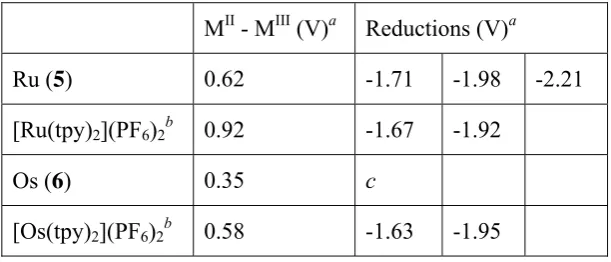
Three reversible reductions which can be considered as ligand centered are observed for 5 (Figure 3)
and like the Ru(II/III) oxidation peak, the positions of the ligand reductions are also shifted from [Ru(tpy)2](PF6)2. The increased electron density on the tpy ligands due to the phenyl and piperazine
substituents results in a cathodic shift as reduction of the pztpy and phtpy ligands is more difficult than that of unsubstituted tpy. We can assume that the first ligand reduction occurs on the phtpy ligand since
it will be the most easily reduced tpy ligand, while the pztpy ligand should be relatively more difficult to reduce as a result of the added electron density resulting from the piperazine substituent. For osmium complex 6 the reduction processes were poorly resolved on the cyclic voltammogram. A summary of
the peak potentials measured for complexes 5 and 6 is presented in Table 1 along with comparative data
for [Ru(tpy)2](PF6)2 and [Os(tpy)2](PF6)2.
-1.E-4 -8.E-5 -6.E-5 -4.E-5 -2.E-5 0.E+0 2.E-5
-2.4 -1.9 -1.4
Potential (V)
C
u
rr
e
n
t (A
[image:10.595.192.399.208.376.2])
Figure 3: Cyclic voltammogram of 5 showing the ligand-based reduction peaks vs. Fc/Fc+ in CH3CN (1
mM) with 0.1 M TBAPF6 as supporting electrolyte. Recorded at room temperature using a glassy
carbon working electrode, a Pt wire counter electrode and a SCE reference electrode.
Table 1: Oxidation and reduction processes for 5 and 6 as compared to the unsubstituted
[M(tpy)2](PF6)2 complexes.
MII - MIII (V)a Reductions (V)a
Ru (5) 0.62 -1.71 -1.98 -2.21
[Ru(tpy)2](PF6)2b 0.92 -1.67 -1.92
Os (6) 0.35 c
[image:10.595.145.451.614.745.2]a In CH
3CN solution (1 mM) with 0.1 M [NBun4][PF6] as supporting electrolyte, measured vs. internal
ferrocene/ferrocenium. b Reference 31. c Reductive processes poorly resolved.
Preparation of Self-Assembled Monolayers. Complexes 5 and 6 were used to form self-assembled
monolayers on gold electrodes via the in situ formation of a DTC anchoring group at the piperazinyl nitrogen on the pztpy ligand (Scheme 2). The gold electrodes used were carefully polished and electrochemically cleaned before SAM formation was attempted by immersing the electrodes overnight into mixtures of the appropriate complex and CS2 in DMF as described in the experimental section. The
resulting SAMs were characterized by cyclic voltammetry in acetonitrile with [NBun4][PF6] as
supporting electrolyte.
(PF6)2
N N N M N N N N N H
CS2, DMF
Au surface + + + N S S N N N N N N N M N S S N N N N N N N M N S S N N N N N N N M
SAMs of 5 or 6
M=Ru (5)
M=Os (6)
Scheme 2: The formation of DTC-anchored SAMs of complexes 5 and 6 on gold surfaces.
Electrochemical Response of Self-Assembled Monolayers. Typical cyclic voltammograms obtained
for SAMs of 5 and 6 are plotted in Figure 4. The CVs show the typical Gaussian shape of redox active
piperazine ring of 5. When the complex is attached to the gold electrode surface the amine group has
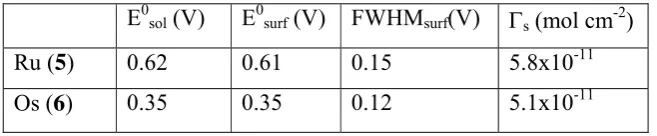
been converted to a dithiocarbamate functionality and hence its oxidation cannot occur. The characteristic values observed for both complexes such as half potentials (E0surf), surface coverage (Γs)
and the full-width-at-half-maximum (FWHM) are listed in Table 2.
[image:12.595.51.380.422.490.2]Error! Not a valid link.
Figure 4: Cyclic voltammograms showing the MII-MIII processes for SAMs of 5 (black line) and 6 (red
line) vs. Fc/Fc+. Recorded at room temperature at a scan rate of 8 Vs-1 in CH3CN with 0.1 M
[NBun4][PF6] as supporting electrolyte, using a Pt wire counter electrode and a SCE reference electrode.
Table 2: Electrochemical properties of SAMs of 5 and 6 adsorbed onto gold electrodes with a DTC
anchoring group, measured in acetonitrile with 0.1 M [NBun
4][PF6] as supporting electrolyte. All
potentials refer to the Fc/Fc+ redox couple.
The peak potentials of the surface-bound complexes (E0surf) remain effectively unshifted from the
solution species (E0sol), indicating that the terminal nitrogen on the pendent piperazinyl ring (now
converted to a DTC group) does not greatly influence the environment at the metal centre. This is expected since the methylene carbon units of the piperazine ring would not induce efficient electron delocalization between the terminal nitrogen and the rest of the molecule. The peak split for Ru 5 and
Os 6 at small scan rates is below 50 mV indicating sufficient electron transfer rates under such
conditions. The FWHM of the redox peaks is around 150 mV indicating relatively strong repulsive interactions as has been discussed extensively for this type of complex on platinum surfaces.35 The saturation surface coverages (Γs) were calculated from the charge under the oxidation and reduction
E0sol (V) E0surf (V) FWHMsurf(V) Γs (mol cm-2)
Ru (5) 0.62 0.61 0.15 5.8x10⁻¹¹
peaks of the cyclic voltammograms (Ru 5: 5.8x10⁻¹¹ mol cm-2 and Os 6: 5.1x10⁻¹¹ mol cm-2). The
surface coverages of the complexes are found to be greater than those observed for related bis-terpyridine compounds, e.g. [M(tpy)(pytpy)](PF6)2 (pytpy = 4'-(4-pyridyl)-2,2':6',2"-terpyridine) which
form SAMs on Pt surfaces via the pendent pyridyl nitrogen, provide surface coverages of 2.5x10⁻¹¹ mol cm-2 for M=Ru and 3.3x10⁻¹¹ mol cm-2 for M=Os.36 The increased surface concentration for SAMs of
5
and 6 on gold electrodes will be heavily influenced by the strong affinity of the DTC group for gold.
Other factors such as different intermolecular interactions (repulsive or attractive) between surface-bound species will also affect the surface coverage.
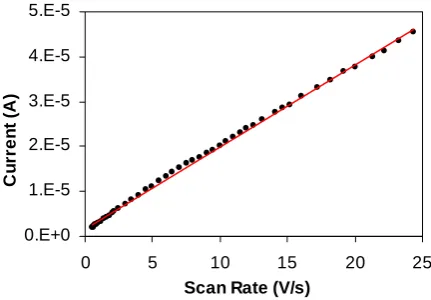
CVs were run at increasing scan rates for SAMs of 5 and 6. Typical surface behavior was reflected in
the linear dependence of the peak current as a function of scan rate, and is illustrated for the peak current of the anodic signal of Ru 5 in Figure 5. It can be concluded that complexes bound to gold
surfaces by the DTC group form ideal self-assembled monolayers comparable to complexes bound to Au electrodes via thiol groups or to platinum by pyridine functionalities.
0.E+0 1.E-5 2.E-5 3.E-5 4.E-5 5.E-5
0 5 10 15 20 25
Scan Rate (V/s)
C
u
rr
e
n
t (A
[image:13.595.75.291.419.569.2])
Figure 5: Peak current as a function of scan rate for SAMs of 5.
Assembling data collected from successive scans at increased scan rates allows for an estimation of the rate constant of the electrochemical reaction (k) and also the charge transfer coefficient (α) using Laviron’s methodology.37 The heterogeneous rate constant measures the intrinsic ability of an oxidized
A species with a large value of k will convert to its redox partner rapidly. The transfer coefficient (0 < α
< 1) is indicative of the symmetry of the energy barrier for a redox half-reaction. In an ideal reversible reaction, the energy required to convert the reduced species into its oxidized equivalent is equal to the energy required to reverse the process such that α = 0.5. Deviation from the ideal value of 0.5 is indicative of an asymmetrical relationship between the oxidized and reduced forms of a compound.
Using Laviron’s method, data were examined where the difference between the anodic and cathodic peak potentials (ΔEp) is greater than 200/n mV (n being the number of electrons transferred in the redox
reaction). Plots of the anodic (Epa) and cathodic (Epc) peak positions against ln v (scan rate) yielded
straight lines with slopes corresponding to –RT/(1-α)nF and –RT/αnF for the anodic and cathodic plots respectively. Appling Laviron’s methodology to data obtained from successive scans of complexes 5
and 6 results in typical Laviron plots as shown in Figure 6. Error! Not a valid link.Error! Not a valid link.
Figure 6: Laviron plots of the anodic and cathodic peak positions for Ru 5 (a) and Os 6 (b) from CVs
recorded in CH3CN vs. SCE. Linear plots are taken from where ΔEp > 200 mV.
For 5 the transfer coefficient α is found to be 0.54 as calculated from the slopes of the linear plots
(ΔEp > 200 mV) in Figure 6 (a). The heterogeneous rate constant for the Ru(II/III) redox reaction in
SAMs of 5 was found to be approximately 351 s-1. For osmium complex 6, α is found to be 0.55 while k
is found to be 248 s-1. The values calculated for the charge transfer coefficients for the Ru(II/III) and Os(II/III) reactions are close to the ideal value of 0.5 and are indicative of a high degree of reversibility in the redox transformation for both complexes. This would suggest that oxidation and reduction of the surface-bound species is a relatively stable process and providing that the link to the surface is sufficiently robust, monolayers of 5 and 6 should endure a large number of cycles without degradation.
The rate constants (k) obtained using the Laviron calculations are not particularly fast, as was expected given the observed scan-rate dependence of the peak positions. There are very few examples of Ru(II) and Os(II) polypyridyl complexes incorporated into SAMs, but one recent publication
(a) (b)
describes a Ru(II) bis-tpy complex with two pendent octanethiolate arms which is used to form SAMs on gold electrodes and nanoparticles.38 The Ru(II/III) electron transfer rate constant was calculated using Laviron’s methodology and assuming that α = 0.5, k was found to be ~3.5 s-1. The rate constant was found to increase significantly to 11.5 s-1 when the distance between the redox centre and the electrode surface was shortened. Electron-transfer rate constants have been obtained for SAMs of other metal polypyridyl complexes but these are too dissimilar from the bis-tpy complexes presented here to draw a direct comparison.17,39 The values of 351 s-1 and 248 s-1 calculated for 5 and 6 suggest that the
electron transfer rates for SAMs of the complexes are faster than those of other bis-tpy thiol-based complexes.
Stability of the SAMs. Having already demonstrated the favourable shift in potential of the new
Ru(II) and Os(II) polypyridine complexes, our aim was to quantify the electrochemical stability of the resulting SAMs. This was achieved experimentally by systematically expanding the potential window of the cyclic voltammetry experiment and examining the charge under the redox peaks to observe the effect of applying greater voltages to the SAM. 100 cycles were run on the electrode between 0 and +0.5 V (vs. Fc/Fc+) and the charge under the Ru(II/III) oxidation peak was measured. Subsequent sets of 100 scans were run with the potential window of the CV being systematically expanded by 0.1 V each time. The area under the oxidation peak was measured after each set of scans and the results of this experiment are plotted in Figure 7.
Error! Not a valid link.
Figure 7: The faradaic charge under the anodic peak as a function of the upper potential applied to SAMs of 5 (100 scans applied at each interval).
adsorbates such as thiols are only known to be stable up to approximately +0.4 V vs. Fc-Fc+.20 The DTC linker offers a significant improvement over the conventional thiol group. This is highly relevant to current research since a large number of ruthenium oligopyridine complexes with interesting electrochemical and photochemical properties have potentials around 1 V; the dithiocarbamate anchoring group could enable surface-bound electrochemical investigation of such complexes.
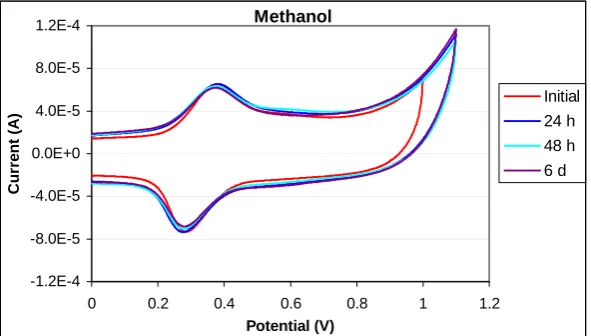
To further test the stability of the monolayers, electrodes modified with the SAMs were immersed into 12 mM solutions of 2-mercaptoethanol (ME) in methanol. A control was set up in which the modified electrode was immersed into methanol so that the effect of ME could be determined. 2-mercaptoethanol is used to rapidly strip thiol monolayers from gold surfaces via an exchange reaction and typically after 24 h the original thiol monolayer is completely removed from the gold surface.23,40 The charge under the M(II/III) redox peak was measured in order to estimate the number of molecules attached to the electrode surface.
For Ru(II) complex 5, after 24 h there was a 31% reduction in the charge under the redox peak for the
SAMs exposed to ME. For SAMs stored in MeOH a reduction of 21% was observed. After 48 h and then 6 days, the CVs showed little change, however the redox peaks for the monolayer exposed to the ME solution broadened. This could to be due to the 2-mercaptoethanol units attaching to the gold surface along with the adsorbed complexes of 5, but since the Ru(II/III) redox peak is still observable it
would seem that the thiol is unable to displace the dithiocarbamate-bound monolayer.
For Os(II) complex 6, after 24 h the SAMs exposed to ME were depleted by just 3% while SAMs
Conclusions
There is much incentive for the design of robust, well-ordered SAMs displaying tethered polyimine complexes, in particular a wide range of Ru(II) complexes would be worthy subjects for the formation of ordered electro-active nanostructures. The light harvesting and fast electron-transfer properties of such complexes could then be exploited in device applications that favour monolayer construction, e.g. solar cells or organic light emitting diodes, in addition to the development of responsive electrochemical sensors. Until now the attachment of such polyimine complexes to gold surfaces in useful devices has been hindered by two separate problems. The first involves the demandingly high redox potentials of the majority of Ru(II) polypyridyl complexes. The second is the poor chemical and electrochemical stability of the universally-employed thiol tethers. This investigation overcomes these problems by incorporating a piperazine group onto a polypyridine ligand attached to a metal complex. This modification makes more efficient the resulting complexes' optical and electronic properties: notably causing a red shift of the 1MLCT and a concomitant cathodic shift of the redox potential. Furthermore the same group provides a site for robust dithiocarbamate attachment of the complex to a gold surface. Synthetically the construction of the pztpy ligand on complexes 5 and 6 was quantitative and no further
purification was required.
A DTC-anchoring group was readily employed to generate SAMs of 5 and 6 from the in situ reaction
of the piperazine (as a secondary amine) with CS2 in the presence of a gold substrate. The strong
bidentate attachment of the DTC linker to gold surface atoms is a result of a near ideal interatomic S-S distance. Electrochemical investigation of SAMs of 5 and 6 revealed their ideal surface behavior. Data
In summary, the SAMs of complexes 5 and 6 present a significant improvement over any related
systems in the literature. The combination of the exceptional DTC anchoring group and the tuned photo- and electrochemical properties of the metal complexes has allowed us to produce what must be considered as the most stable Os(II) and in particular Ru(II) bis-terpyridine complex SAMs to date. This unique and versatile approach to constructing ordered assemblies of metal complexes on gold surfaces offers exciting possibilities for the application of a range of useful Ru(II) complexes in the form of robust functional self-assembled monolayers.
Acknowledgements
SFI-05PICA and E.I.-travel award for funding to F.M. and E.F. Dr. John O’Brien for NMR spectroscopic measurements.
Supporting Information Available
1H NMR spectra of complexes
5 and 6, CV of 6 showing piperazine oxidation.
(1) Hickmann, J. J.; Ofer, D.; Laibinis, P. E.; Whitesides, G. M.; Wrighton, M. S. Science
1991, 252, 688-691.
(2) Chaki, N. K.; Vijayamohanan, K. Biosensors & Bioelectronics 2002, 17, 1-12.
(3) Devillers, C. H.; Boturyn, D.; Bucher, C.; Dumy, P.; Labbé, P.; Moutet, J.-C.; Royal, G.; Saint-Aman, E. Langmuir 2006, 22, 8134 -8143.
(4) Baron, R.; Onopriyenko, A.; Katz, E.; Lioubashevski, O.; Willner, I.; Wang, S.; Tian, H. Chemical Communications 2006 2147-2149.
(5) Péter, M.; Li, X.-M.; Huskens, J.; Reinhoudt, D. N. Journal of the American Chemical Society 2004, 126, 11684-11690.
(6) Ravenscourt, M. S.; Finklea, H. O. Journal of Physical Chemistry 1994, 98, 3843-3850.
(7) Smalley, J. F.; Sachs, S. B.; Chidsey, C. E. D.; Dudek, S. P.; Sikes, H. D.; Creager, S. E.; Yu, C. J.; Feldberg, S. W.; Newton, M. D. Journal of the American Chemical Society 2004, 126,
14620-14630.
(8) Chidsey, C. E. D. Science 1991, 251, 919-922.
(9) Smalley, J. F.; Feldberg, S. W.; Chidsey, C. E. D.; Linford, M. R.; Newton, M. D.; Lid, Y.-P. Journal of Physical Chemistry 1995, 99, 13141-13149.
(10) Weber, K.; Hockett, L.; Creager, S. J. Phys. Chem. B 1997, 101, 8286-8291.
(11) Smalley, J. F.; Finklea, H. O.; Chidsey, C. E. D.; Linford, M. R.; Creager, S. E.; Ferraris, J. P.; Chalfant, K.; Zawodzinsk, T.; Feldberg, S. W.; Newton, M. D. Journal of the American Chemical Society 2003, 125, 2004-2013.
(12) Eberspacher, T. A.; Collman, J. P.; Chidsey, C. E. D.; Donohue, D. L.; Van Ryswyk, H. Langmuir 2003, 19, 3814-3821.
(13) Haga, M. a.; Hong, H. G.; Shiozawa, Y.; Kawata, Y.; Monjushiro, H.; Fukuo, T.; Arakawa, R. Inorganic Chemistry 2000, 39, 4566-4573.
(14) Haddox, R. M.; Finklea, H. O. J. Phys. Chem. B 2004, 108, 1694-1700.
(15) Freire, R. S.; Kubota, L. T. The Analyst 2002, 127, 1502-1506.
(16) Patoux, C.; Coudret, C.; Launay, J.-P.; Joachim, C.; Gourdon, A. Inorganic Chemistry
1997, 36, 5037-5049.
(17) Hortholary, C.; Minc, F.; Coudret, C.; Bonvoisin, J.; Launay, J.-P. Chemical Communications 2002, 1932-1933.
(18) Vos, J. G.; Kelly, J. M. Dalton Transactions 2006, 4869-4883.
(19) Finklea, H. O. Electroanalytical Chemistry; Marcel Dekker: New York, 1996; Vol. 19. (20) Beulen, M. W. J.; Kastenberg, M. I.; Veggel, F. C. J. M. v.; Reinhoudt, D. N. Langmuir
(21) Martineau, D.; Gros, P.; Beley, M.; Fort, Y. Eur. J. Inorg. Chem. 2004, 3984-3986.
(22) Martineau, D.; Beley, m.; Gros, P. C. Journal of Organic Chemistry 2006, 71, 566-571.
(23) Zhao, Y.; Perez-Segarra, W.; Shi, Q.; Wei, A. Journal of the American Chemical Society
2005, 127, 7328-7329.
(24) Vickers, M. S.; Cookson, J.; Beer, P. D.; Bishop, P. T.; Thiebaut, B. J. Mater. Chem.
2006, 16, 209-215.
(25) Colorado, R.; Villazana, R. J.; Lee, T. R. Langmuir 1998, 14, 6337-6340.
(26) Alves, C. A.; Smith, E. L.; Porter, M. D. J. Am. Chem. Soc. 1992, 114, 1222-1227.
(27) Constable, E. C.; Ward, M. D. Journal of the Chemical Society, Dalton Transactions
1990, 1405-1409.
(28) Wang, J.; Hanan, G. S. Synlett 2005, 1252-1254.
(29) Constable, E. C. Chemical Society Reviews 2007, 36, 246-253.
(30) Johansson, O. Synthesis 2006, 15, 2585-2589.
(31) Constable, E. C.; Thompson, A. M. W. C. Journal of the Chemical Society, Dalton Transactions 1994, 1409-1418.
(32) Maestri, M.; Armaroli, N.; Balzani, V.; Constable, E. C.; Thompson, A. M. W. C. Inorganic Chemistry 1995, 34, 2759-2767.
(33) Constable, E. C.; Cargill Thompson, A. M. W.; Tocher, D. A.; Daniels, M. A. M. New Journal of Chemistry 1992, 16, 855-867.
(34) Constable, E. C.; Housecroft, C. E.; Medlycott, E.; Neuburger, M.; Reinders, F.; Reymann, S.; Schaffner, S. Inorganic Chemistry Communications 2008, 11, 518-520.
(35) Figgemeier, E.; Constable, E. C.; Housecroft, C. E.; Zimmermann, Y. C. Langmuir 2004,
20, 9242-9248.
(36) Figgemeier, E.; Merz, L.; Hermann, B. A.; Zimmermann, Y. C.; Housecroft, C. E.; Guntherodt, H. J.; Constable, E. C. J. Phys. Chem. B 2003, 107, 1157-1162.
(37) Laviron, E. Journal of Electroanalytical Chemistry 1979, 101, 19-28.
(38) Dong, T.-Y.; Huang, C.; Chen, C.-P.; Lin, M.-C. Journal of Organometallic Chemistry
2007, 692, 5147-5155.
(39) Ricci, A.; Rolli, C.; Rothacher, S.; Baraldo, L.; Bonazzola, C.; Calvo, E.; Tognalli, N.; Fainstein, A. Journal of Solid State Electrochemistry 2007, 11, 1511-1520.
(40) Demers, L. M.; Mirkin, C. A.; Mucic, R. C.; Reynolds, R. A.; Letsinger, R. L.; Elghanian, R.; Viswanadham, G. Anal. Chem. 2000, 72, 5535-5541.
Supporting Information
Robust SAMs of Ru(II) and Os(II) Polypyridines on Gold Surfaces: Exploring New Potentials
Frances A. Murphya, Stèphane Suareza, Egbert Figgemeierb, Emma R. Schofielda, Sylvia M. Drapera,*
a Chemistry Department, Sami Nasr Institute of Advanced Materials (SNIAM), Trinity College Dublin,
College Green, Dublin 2, Ireland.
NMR Characterisation of 5 and 6:
Figure 2: 1H NMR spectra for Ru 5 (top) and Os 6 (bottom). Recorded in CD3CN at 400.1 MHz.
Chart 1: 1H NMR chemical shifts (ppm) for Ru 5 and Os 6.
Solution Cyclic Voltammetry of 6:
Proton A B C D E F G H A B C D E
5 7.54 7.26 7.96 8.66 9.00 8.22 7.78 7.69 7.34 7.10 7.89 8.49 8.15 6 7.38 7.19 7.83 8.64 9.01 8.19 7.78 7.62 7.23 7.05 7.78 8.48 8.29
7.1 7.2 7.3 7.4 7.5 7.6 7.7 7.8 7.9 8.0 8.1 8.2 8.3 8.4 8.5 8.6 8.7 8.8 8.9 9.0 7.1 7.2 7.3 7.4 7.5 7.6 7.7 7.8 7.9 8.0 8.1 8.2 8.3 8.4 8.5 8.6 8.7 8.8 8.9 9.0 (ppm) p A B C D E A B C D E G H F A B C D E A B C D E G H F N N N N
(PF6)2
-1.0E-5 -5.0E-6 0.0E+0 5.0E-6 1.0E-5 1.5E-5 2.0E-5
0 0.2 0.4 0.6 0.8 1 1.2 1.4
Potential (V)
C
u
rr
en
[image:22.595.57.325.73.264.2]t (A)
Figure 3: Solution cyclic voltammogram of Os 6vs. Fc/Fc+ in CH3CN (1 mM) with 0.1 M TBAPF6 as
supporting electrolyte, showing the irreversible piperazine oxidation at ca. +0.8 V. Recorded at room temperature using a glassy carbon working electrode, a Pt wire counter electrode and a SCE reference electrode.
Stability of SAMs of 5 and 6:
12 mM ME
-8.0E-5 -4.0E-5 0.0E+0 4.0E-5 8.0E-5 1.2E-4
-0.4 0.1 0.6 1.1
Potential (V)
Cu
rr
e
n
t (
A
)
Initial 1 h
24 h
48 h 6 d
Figure 4: Cyclic voltammogram of a SAM of 5 when exposed to 12 mM 2-mercaptoethanol in
[image:22.595.55.351.416.587.2]Methanol -1.2E-4 -8.0E-5 -4.0E-5 0.0E+0 4.0E-5 8.0E-5 1.2E-4
0 0.2 0.4 0.6 0.8 1 1.2
[image:23.595.57.351.73.242.2]Potential (V) Cu rr e n t ( A ) Initial 1 h 24 h 48 h 6 d
Figure 5: Cyclic voltammogram of a SAM of 5 when immersed in methanol.
12 mM ME
-1.2E-4 -8.0E-5 -4.0E-5 0.0E+0 4.0E-5 8.0E-5 1.2E-4
0 0.2 0.4 0.6 0.8 1 1.2
[image:23.595.57.352.296.466.2]Potential (V) Cu rr e n t (A) Initial 24 h 48 h 6 d
Figure 6: Cyclic voltammogram of a SAM of 6 when exposed to 12 mM 2-mercaptoethanol in
methanol. Methanol -1.2E-4 -8.0E-5 -4.0E-5 0.0E+0 4.0E-5 8.0E-5 1.2E-4
0 0.2 0.4 0.6 0.8 1 1.2
Potential (V) Cu rr e n t (A) Initial 24 h 48 h 6 d
[image:23.595.57.353.546.714.2]