Proceedings of the NAACL HLT Workshop on Semi-supervised Learning for Natural Language Processing, pages 10–18,
Surrogate Learning
-From Feature Independence to Semi-Supervised Classification
Sriharsha Veeramachaneni and Ravi Kumar Kondadadi Thomson Reuters Research and Development
Eagan, MN 55123, USA
[harsha.veeramachaneni,ravikumar.kondadadi]@thomsonreuters.com
Abstract
We consider the task of learning a classi-fier from the feature space X to the set of classes Y = {0,1}, when the features can be partitioned into class-conditionally inde-pendent feature sets X1 and X2. We show that the class-conditional independence can be used to represent the original learning task in terms of 1) learning a classifier from X2 to X1 (in the sense of estimating the prob-ability P(x1|x2))and 2) learning the class-conditional distribution of the feature setX1. This fact can be exploited for semi-supervised learning because the former task can be ac-complished purely from unlabeled samples. We present experimental evaluation of the idea in two real world applications.
1 Introduction
Semi-supervised learning is said to occur when the learner exploits (a presumably large quantity of) un-labeled data to supplement a relatively small un-labeled sample, for accurate induction. The high cost of la-beled data and the simultaneous plenitude of unla-beled data in many application domains, has led to considerable interest in semi-supervised learning in recent years (Chapelle et al., 2006).
We show a somewhat surprising consequence of class-conditional feature independence that leads to a principled and easily implementable semi-supervised learning algorithm. When the feature set can be partitioned into two class-conditionally in-dependent sets, we show that the original learning problem can be reformulated in terms of the problem
of learning a first predictor from one of the partitions to the other, plus a second predictor from the latter partition to class label. That is, the latter partition acts as a surrogate for the class variable. Assum-ing that the second predictor can be learned from a relatively small labeled sample this results in an effective semi-supervised algorithm, since the first predictor can be learned from only unlabeled sam-ples.
In the next section we present the simple yet in-teresting result on which our semi-supervised learn-ing algorithm (which we callsurrogate learning) is based. We present examples to clarify the intuition behind the approach and present a special case of our approach that is used in the applications section. We then examine related ideas in previous work and situate our algorithm among previous approaches to semi-supervised learning. We present empirical evaluation on two real world applications where the required assumptions of our algorithm are satisfied.
2 Surrogate Learning
We consider the problem of learning a classifier from the feature spaceX to the set of classes Y = {0,1}. Let the features be partitioned into X =
X1× X2. The random feature vectorx∈ X will be represented correspondingly asx= (x1,x2). Since we restrict our consideration to a two-class problem, the construction of the classifier involves the esti-mation of the probabilityP(y= 0|x1,x2)at every point(x1,x2)∈ X.
We make the following assumptions on the joint probabilities of the classes and features.
1. P(x1,x2|y) = P(x1|y)P(x2|y) for y ∈
{0,1}. That is, the feature sets x1 and x2 are class-conditionally independent for both classes. Note that, when X1 and X2 are one-dimensional, this condition is identical to the
Naive Bayes assumption, although in general our assumption is weaker.
2. P(x1|x2) 6= 0, P(x1|y) 6= 0andP(x1|y =
0) 6= P(x1|y = 1). These assumptions are to avoid divide-by-zero problems in the alge-bra below. Ifx1 is a discrete valued random variable and not irrelevant for the classification task, these conditions are often satisfied.
We can now show that P(y = 0|x1,x2) can be written as a function ofP(x1|x2)andP(x1|y). When we consider the quantity P(y,x1|x2), we may derive the following.
P(y,x1|x2) =P(x1|y,x2)P(y|x2)
⇒ P(y,x1|x2) =P(x1|y)P(y|x2) (from the independence assumption)
⇒ P(y|x1,x2)P(x1|x2) =P(x1|y)P(y|x2)
⇒ P(y|x1,x2)P(x1|x2)
P(x1|y)
=P(y|x2) (1)
Since P(y = 0|x2) +P(y = 1|x2) = 1, Equa-tion 1 implies
P(y= 0|x1,x2)P(x1|x2) P(x1|y= 0) + P(y= 1|x1,x2)P(x1|x2)
P(x1|y= 1)
= 1
⇒ P(y= 0|x1,x2)P(x1|x2)
P(x1|y= 0) +
(1−P(y= 0|x1,x2))P(x1|x2) P(x1|y= 1) = 1(2)
Solving Equation 2 forP(y = 0|x1,x2), we ob-tain
P(y= 0|x1,x2) = P(x1|y= 0)
P(x1|x2) ·
P(x1|y= 1)−P(x1|x2) P(x1|y= 1)−P(x1|y= 0)(3)
We have succeeded in writingP(y= 0|x1,x2)as a function ofP(x1|x2)andP(x1|y). Although this
result was previously observed in a different context by Abney in (Abney, 2002), he does not use it to derive a semi-supervised learning algorithm. This result can lead to a significant simplification of the learning task when a large amount of unlabeled data is available. The semi-supervised learning algorithm involves the following two steps.
1. From unlabeled data learn a predictor from the feature space X2 to the space X1 to predict P(x1|x2). There is no restriction on the learner that can be used as long as it outputs posterior class probability estimates.
2. Estimate the quantityP(x1|y) from a labeled samples. In casex1 is finite valued, this can be done by just counting. IfX1 has low car-dinality the estimation problem requires very few labeled samples. For example, if x1 is binary, then estimatingP(x1|y)involves esti-mating just two Bernoulli probabilities.
Thus, we can decouple the prediction problem into two separate tasks, one of which involves predict-ingx1 from the remaining features. In other words,
x1 serves as a surrogate for the class label. Fur-thermore, for the two steps above there is no neces-sity for complete samples. The labeled examples can have the featurex2missing.
At test time, an input sample(x1,x2)is classified by computingP(x1|y)andP(x1|x2)from the pre-dictors obtained from training, and plugging these values into Equation 3. Note that these two quanti-ties are computed for the actual value ofx1taken by the input sample.
The following example illustrates surrogate learn-ing.
—————————————–
Example 1
Consider the following variation on a problem from (Duda et al., 2000) of classifying fish on a con-veryor belt as either salmon (y = 0) or sea bass
(y = 1). The features describing the fish are x1, a binary feature describing whether the fish islight
and for thesea bass is Laplacian as shown in Fig-ure 1.
−4 −2 0 2 4
0 0.5
x
2
P(x
[image:3.612.335.516.57.203.2]2|y=0) P(x2|y=1)
Figure 1: Class-conditional probability distributions of the featurex2.
Because of the class-conditional feature in-dependence assumption, the joint distribution P(x1,x2,y) = P(x2|y)P(x1,y) can now be completely specified by fixing the joint probabil-ity P(x1,y). Let P(x1 = 0,y = 0) = 0.3, P(x1 = 0,y= 1) = 0.1,P(x1 = 1,y= 0) = 0.2, andP(x1= 1,y= 1) = 0.4. I.e., asalmonis more likely to be lightthan dark and asea bass is more likely to bedarkthanlight.
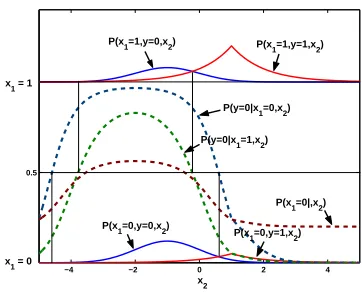
The full joint distribution is depicted in Figure 2. Also shown in Figure 2 are the conditional distribu-tionsP(x1 = 0|x2)andP(y= 0|x1,x2).
Assume that we build a predictor to decide be-tweenx1=lightandx1 =darkfrom thelength us-ing a data set of unlabeled fish. On a randomsalmon, this predictor will most likely decide thatx1 =light (because, for a salmon, x1 = light is more likely than x1 = dark, and similarly for a sea bass the predictor often decides that x1 = dark. Conse-quently the predictor provides information about the true class labely. This can also be seen in the sim-ilarities between the curvesP(y = 0|x1,x2)to the curveP(x1|x2)in Figure 2.
Another way to interpret the example is to note that if a predictor for P(x1|x2)were built on only the salmonsthen P(x1 = light|x2) will be a con-stant value (0.6). Similarly the value of P(x1 =
light|x2)forsea basseswill also be a constant value (0.2). That is, the value of P(x1 = light|x2) for a sample is a good predictor of its class. However,
−4 −2 0 2 4
0.5
x1 = 0 x1 = 1
x2
P(x1=1,y=0,x2) P(x1=1,y=1,x2)
P(x1=0,y=1,x2) P(x1=0,y=0,x2)
P(y=0|x1=1,x2) P(y=0|x1=0,x2)
P(x1=0|,x2)
Figure 2: The joint distributions and the posterior distri-butions of the classyand the surrogate classx1.
surrogate learning builds the predictorP(x1|x2)on unlabeled data from both types of fish and there-fore additionally requires P(x1|y) to estimate the boundary between the classes.
2.1 A Special Case
The independence assumptions made in the setting above may seem too strong to hold in real problems, especially because the feature sets are required to be class-conditionally independent forbothclasses. We now specialize the setting of the classification problem to the one realized in the applications we present later.
We still wish to learn a classifier fromX =X1×
X2 to the set of classes Y = {0,1}. We make the following slightly modified assumptions.
1. x1 is a binary random variable. That is, X1 =
{0,1}.
2. P(x1,x2|y = 0) = P(x1|y = 0)P(x2|y =
0). We require that the feature x1 be class-conditionally independent of the remaining fea-turesonlyfor the classy= 0.
3. P(x1 = 0,y = 1) = 0. This assumption says thatx1is a ‘100% recall’ feature fory= 11.
Assumption 3 simplifies the learning task to the estimation of the probabilityP(y = 0|x1 = 1,x2) for every pointx2 ∈ X2. We can proceed as before
[image:3.612.94.279.95.252.2]to obtain the expression in Equation 3.
P(y= 0|x1= 1,x2)
= P(x1 = 1|y= 0) P(x1 = 1|x2)
. . .
. . . P(x1= 1|y= 1)−P(x1 = 1|x2) P(x1 = 1|y= 1)−P(x1= 1|y= 0)
= P(x1 = 1|y= 0) P(x1 = 1|x2) ·
1−P(x1 = 1|x2)
1−P(x1 = 1|y= 0)
= P(x1 = 1|y= 0) P(x1 = 1|x2) ·
P(x1= 0|x2) P(x1 = 0|y= 0)
= P(x1 = 1|y= 0) P(x1 = 0|y= 0)·
P(x1= 0|x2)
(1−P(x1= 0|x2))(4) Equation 4 shows that P(y = 0|x1 = 1,x2) is a monotonically increasing function ofP(x1 =
0|x2). This means that after we build a predictor fromX2toX1, we only need to establish the thresh-old onP(x1 = 0|x2)to yield the optimum classi-fication betweeny = 0andy = 1. Therefore the learning proceeds as follows.
1. From unlabeled data learn a predictor from the feature spaceX2to the binary spaceX1to pre-dict the quantityP(x1|x2).
2. Use labeled sample to establish the thresh-old on P(x1 = 0|x2) to achieve the desired precision-recall trade-off for the original clas-sification problem.
Because of our assumptions, for a sample from class y = 0 it is impossible to predict whether x1 = 0 or x1 = 1 better than random by looking at the x2 feature, whereas a sample from the posi-tive class always hasx1= 1. Therefore the samples with x1 = 0 serve to delineate the positive exam-ples among the samexam-ples withx1 = 1. We therefore call the samples that havex1 = 1as thetarget sam-ples and those that havex1 = 0 as thebackground samples.
3 Related Work
Although the idea of using unlabeled data to im-prove classifier accuracy has been around for several decades (Nagy and Shelton, 1966), semi-supervised learning has received much attention recently due to impressive results in some domains. The com-pilation of chapters edited by Chappelle et al. is an
excellent introduction to the various approaches to semi-supervised learning, and the related practical and theoretical issues (Chapelle et al., 2006).
Similar to our setup,co-trainingassumes that the features can be split into two class-conditionally independent sets or ‘views’ (Blum and Mitchell, 1998). Also assumed is the sufficiency of either view for accurate classification. The co-training al-gorithm iteratively uses the unlabeled data classified with high confidence by the classifier on one view, to generate labeled data for learning the classifier on the other.
The intuition underlying co-training is that the er-rors caused by the classifier on one view are inde-pendent of the other view, hence can be conceived as uniform2 noise added to the training examples for the other view. Consequently, the number of la-bel errors in a region in the feature space is propor-tional to the number of samples in the region. If the former classifier is reasonably accurate, the propor-tionally distributed errors are ‘washed out’ by the correctly labeled examples for the latter classifier. Seeger showed that co-training can also be viewed as an instance of the Expectation-Maximization al-gorithm (Seeger, 2000).
The main distinction of surrogate learning from co-training is the learning of a predictor from one view to the other, as opposed to learning predictors from both views to the class label. We can there-fore eliminate the requirement that both views be sufficiently informative for reasonably accurate pre-diction. Furthermore, unlike co-training, surrogate learning has no iterative component.
Ando and Zhang propose an algorithm to regu-larize the hypothesis space by simultaneously con-sidering multiple classification tasks on the same feature space (Ando and Zhang, 2005). They then use their so-calledstructural learningalgorithm for semi-supervised learning of oneclassification task, by the artificial construction of ‘related’ problems on unlabeled data. This is done by creating prob-lems of predicting observable features of the data and learning the structural regularization parame-ters from these ‘auxiliary’ problems and unlabeled data. More recently in (Ando and Zhang, 2007) they
showed that, with conditionally independent feature sets predicting from one set to the other allows the construction of a feature representation that leads to an effective semi-supervised learning algorithm. Our approach directly operates on the original fea-ture space and can be viewed another justification for the algorithm in (Ando and Zhang, 2005).
Multiple Instance Learning (MIL) is a learning setting where training data is provided as positive and negative bags of samples (Dietterich et al., 1997). A negative bag contains only negative ex-amples whereas a positive bag contains at least one positive example. Surrogate learning can be viewed as artificially constructing a MIL problem, with the
targets acting as one positive bag and the back-grounds acting as one negative bag (Section 2.1). The class-conditional feature independence assump-tion for class y = 0 translates to the identical and independent distribution of the negative samples in both bags.
4 Two Applications
We applied the surrogate learning algorithm to the problems of record linkage and paraphrase genera-tion. As we shall see, the applications satisfy the assumptions in our second (100% recall) setting.
4.1 Record Linkage/ Entity Resolution
Record linkage is the process of identification and merging of records of the same entity in different databases or the unification of records in a single database, and constitutes an important component of data management. The reader is referred to (Win-kler, 1995) for an overview of the record linkage problem, strategies and systems. In natural language processing record linkage problems arise during res-olution of entities found in natural language text to a gazetteer.
Our problem consisted of merging each of ≈
20000physician records, which we call the update database, to the record of the same physician in a master database of ≈ 106 records. The update
database has fields that are absent in the master database andvice versa. The fields in common in-clude the name (first, last and middle initial), sev-eraladdress fields, phone, specialty, and the year-of-graduation. Although the last name and
year-of-graduationare consistent when present, the ad-dress,specialtyandphonefields have several incon-sistencies owing to different ways of writing the ad-dress, new addresses, different terms for the same specialty, missing fields, etc. However, the name
andyear alone are insufficient for disambiguation. We had access to≈ 500manually matched update
records for training and evaluation (about40of these update records were labeled as unmatchable due to insufficient information).
The general approach to record linkage involves two steps: 1) blocking, where a small set of can-didate records is retrieved from the master record database, which contains the correct match with high probability, and 2)matching, where the fields of the update records are compared to those of the candidates for scoring and selecting the match. We performed blocking by querying the master record database with thelast namefrom the update record. Matching was done by scoring a feature vector of similarities over the various fields. The feature val-ues were either binary (verifying the equality of a particular field in the update and a master record) or continuous (some kind of normalized string edit dis-tance between fields like street address, first name
etc.).
The surrogate learning solution to our matching problem was set up as follows. We designated the binary feature of equality ofyear of graduation3as the ‘100% recall’ featurex1, and the remaining fea-tures are relegated to x2. The required conditions for surrogate learning are satisfied because 1) in our data it is highly unlikely for two records with differ-entyear- of-graduationto belong to the same physi-cian and 2) if it is known that the update record and a master record belong to two different physi-cians, then knowing that they have the same (or dif-ferent)year-of-graduationprovides no information about the other features. Therefore all the feature vectors with the binary feature indicating equality ofyear-of-graduationaretargetsand the remaining arebackgrounds.
First, we used feature vectors obtained from the records in all blocks from all 20000 update records to estimate the probabilityP(x1|x2). We used
Table 1: Precision and Recall for record linkage. Training Precision Recall proportion
Surrogate 0.96 0.95
Supervised 0.5 0.96 0.94
Supervised 0.2 0.96 0.91
gistic regression for this prediction task. For learn-ing the logistic regression parameters, we discarded the feature vectors for which x1 was missing and performed mean imputation for the missing values of other features. Second, the probabilityP(x1 =
1|y = 0) (the probability that two different ran-domly chosen physicians have the same year of graduation) was estimated straightforwardly from the counts of the different years-of-graduation in the master record database.
These estimates were used to assign the score P(y = 1|x1 = 1,x2)to the records in a block (cf. Equation 4). The score of 0is assigned to feature vectors which havex1 = 0. The only caveat is cal-culating the score for feature vectors that had miss-ingx1. For such records we assign the scoreP(y=
1|x2) = P(y = 1|x1 = 1,x2)P(x1 = 1|x2). We have estimates for both quantities on the right hand side. The highest scoring record in each block was flagged as a match if it exceeded some appropriate threshold.
We compared the results of the surrogate learn-ing approach to a supervised logistic regression based matcher which used a portion of the manual matches for training and the remaining for testing. Table 1 shows the match precision and recall for both the surrogate learning and the supervised ap-proaches. For the supervised algorithm, we show the results for the case where half the manually matched records were used for training and half for testing, as well as for the case where a fifth of the records of training and the remaining four-fifths for testing. In the latter case, every record participated in exactly one training fold but in four test folds.
The results indicate that the surrogate learner per-forms better matching by exploiting the unlabeled data than the supervised learner with insufficient training data. The results although not dramatic are still promising, considering that the surrogate
learn-ing approach used none of the manually matched records.
4.2 Paraphrase Generation for Event Extraction
Sentence classification is often a preprocessing step for event or relation extraction from text. One of the challenges posed by sentence classification is the di-versity in the language for expressing the same event or relationship. We present a surrogate learning ap-proach to generating paraphrases for expressing the
merger-acquisition(MA) event between two organi-zations in financial news. Our goal is to find para-phrase sentences for the MA event from an unla-beled corpus of news articles, that might eventually be used to train a sentence classifier that discrimi-nates between MA and non-MA sentences.
We assume that the unlabeled sentence corpus is time-stamped and named entity tagged with orga-nizations. We further assume that a MA sentence must mention at least two organizations. Our ap-proach to generate paraphrases is the following. We first extract all the so-calledsourcesentences from the corpus that match a few high-precision seed pat-terns. An example of a seed pattern used for the MA event is ‘<ORG1>acquired<ORG2>’ (where <ORG1> and <ORG2> are place holders for strings that have been tagged as organizations). An example of asourcesentence that matches the seed is ‘It was announced yesterday that<ORG>Google Inc.<ORG>acquired<ORG>Youtube<ORG>’. The purpose of the seed patterns is to produce pairs of participant organizations in an MA event with high precision.
We then extract every sentence in the corpus that contains at least two organizations, such that at least one of them matches an organization in thesource
sentences, and has a time-stamp within a two month time window of the matching source sentence. Of this set of sentences, all that containtwoor more or-ganizations from thesame sourcesentence are des-ignated as target sentences, and the rest are desig-nated asbackgroundsentences.
We speculate that since an organization is unlikely to have a MA relationship with two different orga-nizations in the same time period the backgrounds
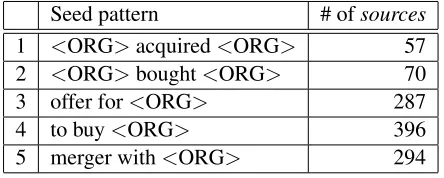
Table 2: Patterns used as seeds and the number ofsource
sentences matching each seed.
Seed pattern # ofsources
1 <ORG>acquired<ORG> 57 2 <ORG>bought<ORG> 70 3 offer for<ORG> 287 4 to buy<ORG> 396 5 merger with<ORG> 294
indistinguishable from that of the background sen-tences. To relate the approach to surrogate learning, we note that the binary “organization-pair equality” feature (both organizations in the current sentence being the same as those in asourcesentence) serves as the ‘100% recall’ featurex1. Word unigram, bi-gram and tribi-gram features were used as x2. This setup satisfies the required conditions for surrogate learning because 1) if a sentence is about MA, the organization pair mentioned in it must be the same as that in asourcesentence, (i.e., ifonlyone of the organizations match those in asourcesentence, the sentence is unlikely to be about MA) and 2) if an un-labeled sentence is non-MA, then knowing whether or not it shares an organization with a sourcedoes not provide any information about the language in the sentence.
If the original unlabeled corpus is sufficiently large, we expect thetargetset to cover most of the paraphrases for the MA event but may contain many non-MA sentences as well. The task of generating paraphrases involves filtering the target sentences that are non-MA and flagging the rest of the tar-getsas paraphrases. This is done by constructing a classifier between thetargetsandbackgrounds. The feature set used for this task was a bag of word un-igrams, bigrams and trun-igrams, generated from the sentences and selected by ranking the n-grams by the divergence of their distributions in the targets
andbackgrounds. A support vector machine (SVM) was used to learn to classify between thetargetsand
backgroundsand the sentences were ranked accord-ing to the score assigned by the SVM (which is a proxy forP(x1 = 1|x2)). We then thresholded the score to obtain the paraphrases.
Our approach is similar in principle to the ‘Snow-ball’ system proposed in (Agichtein and Gravano,
2000) for relation extraction. Similar to us, ‘Snow-ball’ looks for known participants in a relationship in an unlabeled corpus, and uses the newly discovered contexts to extract more participant tuples. How-ever, unlike surrogate learning, which can use a rich set of features for ranking the targets, ‘Snowball’ scores the newly extracted contexts according to a single feature value which is confidence measure based only on the number of known participant tu-ples that are found in the context.
Example 2 below lists some sentences to illustrate the surrogate learning approach. Note that the tar-gets may contain both MA and non-MA sentences but thebackgroundsare unlikely to be MA.
—————————————–
Example 2
Seed Pattern
“offer for<ORG>”
Source Sentences
1. <ORG>US Airways<ORG>said Wednesday it will increase itsoffer for<ORG>Delta<ORG>.
Target Sentences (SVM score)
1.<ORG>US Airways<ORG>were to combine with a standalone<ORG>Delta<ORG>. (1.0008563)
2.<ORG>US Airways<ORG>argued that the nearly $10 billion acquisition of<ORG>Delta<ORG>would result in an efficiently run carrier that could offer low fares to fliers. (0.99958149)
3.<ORG>US Airways<ORG> is asking <ORG>Delta<ORG>’s official creditors commit-tee to support postponing that hearing. (-0.99914371)
Background Sentences (SVM score)
1. The cities have made various overtures to <ORG>US Airways<ORG>, including a promise from <ORG>America West Airlines<ORG> and the former<ORG>US Airways<ORG>. (0.99957752)
2. <ORG>US Airways<ORG>shares rose 8 cents to close at $53.35 on the <ORG>New York Stock Exchange<ORG>. (-0.99906444)
—————————————–
We tested our algorithm on an unlabeled corpus of approximately 700000 financial news articles. We experimented with the five seed patterns shown in Table 2. We extracted a total of 870sourcesentences from the five seeds. The number ofsourcesentences matching each of the seeds is also shown in Table 2. Note that the numbers add to more than 870 because it is possible for a source sentence to match more than one seed.
Table 3: Precision/Recall of surrogate learning on the MA paraphrase problem for various thresholds. The baseline of using all the targetsas paraphrases for MA has a precision of 66% and a recall of 100%.
Threshold Precision Recall 0.0 0.83 0.94 -0.2 0.82 0.95 -0.8 0.79 0.99
corresponded to approximately 12000 target sen-tences and approximately 120000 background sen-tences. For the purpose of evaluation, 500 randomly selected sentences from the targets were manually checked leading to 330 being tagged as MA and the remaining 170 as non-MA. This corresponds to a 66% precision of thetargets.
We then ranked thetargetsaccording to the score assigned by the SVM trained to classify between the
targetsandbackgrounds, and selected all thetargets
above a threshold as paraphrases for MA. Table 3 presents the precision and recall on the 500 manu-ally tagged sentences as the threshold varies. The results indicate that our approach provides an effec-tive way to rank the target sentences according to their likelihood of being about MA.
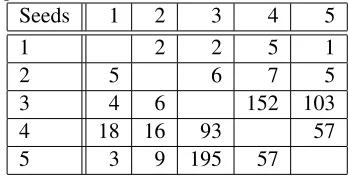
[image:8.612.338.512.151.242.2]To evaluate the capability of the method to find paraphrases, we conducted five separate experi-ments using each pattern in Table 2 individually as a seed and counting the number of obtained sentences containing each of the other patterns (using a thresh-old of 0.0). These numbers are shown in the differ-ent columns of Table 4. Although new patterns are obtained, their distribution only roughly resembles the original distribution in the corpus. We attribute this to the correlation in the language used to de-scribe a MA event based on its type (merger vs. ac-quisition, hostile takeover vs. seeking a buyer, etc.). Finally we used the paraphrases, which were found by surrogate learning, to augment the train-ing data for a MA sentence classifier and evaluated its accuracy. We first built a SVM classifier only on a portion of the labeledtargetsand classified the remaining. This approach yielded an accuracy of 76% on the test set (with two-fold cross validation). We then added all thetargetsscored above a thresh-old by surrogate learning as positive examples (4000
Table 4: Number of sentences found by surrogate learn-ing matchlearn-ing each of the remainlearn-ing seed patterns, when only one of the patterns was used as a seed. Each column is for one experiment with the corresponding pattern used as the seed. For example, when only the first pattern was used as the seed, we obtained 18 sentences that match the fourth pattern.
Seeds 1 2 3 4 5
1 2 2 5 1
2 5 6 7 5
3 4 6 152 103
4 18 16 93 57
5 3 9 195 57
positive sentences in all were added), and all the
backgrounds that scored below a low threshold as negative examples (27000 sentences), to the training data and repeated the two-fold cross validation. The classifier learned on the augmented training data im-proved the accuracy on the test data to 86% .
We believe that better designed features (than word n-grams) will provide paraphrases with higher precision and recall of the MA sentences found by surrogate learning. To apply our approach to a new event extraction problem, the design step also in-volves the selection of thex1 feature such that the
targetsandbackgroundssatisfy our assumptions.
5 Conclusions
We presented surrogate learning – an easily imple-mentable semi-supervised learning algorithm that can be applied when the features satisfy the required independence assumptions. We presented two appli-cations, showed how the assumptions are satisfied, and presented empirical evidence for the efficacy of our algorithm. We have also applied surrogate learn-ing to problems in information retrieval and docu-ment zoning. We expect that surrogate learning is sufficiently general to be applied in many NLP ap-plications, if the features are carefully designed. We briefly note that a surrogate learning method based on regression and requiring onlymean independence
References
S. Abney. 2002. Bootstrapping. InIn Proceedings of the 40th Annual Meeting of the Association for Computa-tional Linguistics, pages 360–367.
E. Agichtein and L. Gravano. 2000. Snowball: Extract-ing Relations from Large Plain-Text Collections. In
Proceedings of the 5th ACM International Conference on Digital Libraries (ACM DL), pages 85–94, June, 2-7.
R. K. Ando and T. Zhang. 2005. A framework for learn-ing predictive structures from multiple tasks and unla-beled data.JMLR, 6:1817–1853.
R. K. Ando and T. Zhang. 2007. Two-view feature gen-eration model for semi-supervised learning. InICML, pages 25–32.
A. Blum and T. Mitchell. 1998. Combining labeled and unlabeled data with co-training. InCOLT, pages 92– 100.
O. Chapelle, B. Sch¨olkopf, and A. Zien, editors. 2006.
Semi-Supervised Learning. MIT Press, Cambridge, MA.
T. G. Dietterich, R. H. Lathrop, and T. Lozano-Perez. 1997. Solving the multiple instance problem with axis-parallel rectangles. Artificial Intelligence, 89(1-2):31–71.
R. O. Duda, P. E. Hart, and D. G. Stork. 2000. Pattern Classification. Wiley-Interscience Publication. G. Nagy and G. L. Shelton. 1966. Self-corrective
charac-ter recognition system. IEEE Trans. Information The-ory, 12(2):215–222.
N. Quadrianto, A. J. Smola, T. S. Caetano, and Q. V. Le. 2008. Estimating labels from label proportions. In
ICML ’08: Proceedings of the 25th international con-ference on Machine learning, pages 776–783. M. Seeger. 2000. Input-dependent regularization
of conditional density models. Technical re-port, Institute for ANC, Edinburgh, UK. See
http://www.dai.ed.ac.uk/˜seeger/papers.html.
W. E. Winkler. 1995. Matching and record linkage. In